This is topic Harkins Southlake in forum Film Handlers' Forum at Film-Tech Forum ARCHIVE.


To visit this topic, use this URL:
https://ft-forum.com/ft/cgi-bin/ubb/ultimatebb.cgi?ubb=get_topic;f=1;t=008032

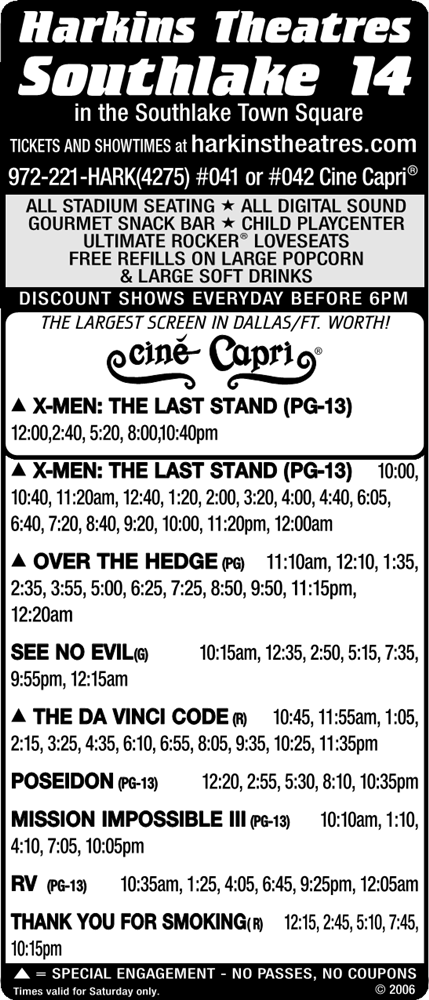
Posted by Brad Miller (Member # 2) on 05-27-2006, 03:28 PM:
 
Very interesting. Looks like Harkins is putting some money and showmanship back into the moviegoing experience. (Assuming of course their projectionists and installing/servicing technicians are truly up to snuff.)

I find it odd though that they are advertising "the largest screen in Dallas/Fort Worth". According to the article here, the big screen is 70 feet wide. Cinemark Webb Chapel has two 75 foot wide screens and UA Galaxy has two 78 foot wide screens, both of which are in Dallas.

 -
Link to article

quote: Dallas Morning News


Multiplex has lots to wow you

THEATERS: Amenities at Southlake 14 include child care, gourmet eats

06:26 PM CDT on Thursday, May 25, 2006

By PHILIP WUNTCH / Movie Critic

At Harkins Southlake Town Square 14, everywhere you look, you'll be wowed.

Unlike some multiplexes, the new complex doesn't evoke the mood of a stately corporate office.

Instead, its marble, neon and granite colorings and textures create a sense of celebration, fun and glamour.

The Southlake multiplex, which opens today at 1450 Plaza Place, is the first that Phoenix-based Harkins Theatres has built in Texas.

It's also one of the chain's first ventures outside Arizona.

"We believe in a word that's missing from some exhibitors' vocabularies," says owner and president Dan Harkins. "The word is 'showmanship.' "

And nowhere is showmanship more evident than in the Southlake's premier auditorium, the 600-seat Cine Capri.

The first glance at the auditorium reminds veteran moviegoers of how theaters used to look in a less streamlined era.

During intermissions, gold waterfall curtains cover the Cine Capri's giant 70-foot screen.

On the draped walls and behind the screen are 150 speakers delivering 26,900 watts of virtually flawless digital sound.

The other 13 auditoriums also are attractive, with handsomely designed soundproof walls. And the seats, designed by Mr. Harkins' chiropractor wife, Karen, are comfortable, with just the right amount of mobility.

The original Cine Capri opened in Phoenix in 1966 as a Cinerama showplace and had the country's best run of Star Wars in 1977. The theater was leased in 1988 to Mr. Harkins, who sought to restore its former glory.

"In 1992, I negotiated with George Lucas to have a special run of the original Star Wars," Mr. Harkins says. "He agreed, as long as all the receipts went to charity. It grossed a fantastic $73,000, all of which went to charity. And its success prompted Fox to rerelease Star Wars IV-VI before they released The Phantom Menace."

Sadly, despite a two-year period of petitions and protests, the theater was torn down to make way for condominiums.

"When you look at the Cine Capri in Southlake, you understand how much the original theater must have meant to Phoenix," Mr. Harkins says.

Another enhancement to the Dallas-Fort Worth movie scene is Southlake's play center, where parents can drop off kids ages 3-8 while they see a movie. Its supervisors have previous child-care experience and have passed the chain's mandatory background checks.

For $6 per child, they can play house and enjoy movie-themed games, beanbags, board games, blocks and toys, including movie-related stuffed animals. Parents and children have matching wristbands, and parents are given a pager in case an emergency occurs.

While the tots are playing, parents can grab dinner at the gourmet concession stand, which features 150 items, including frosted pretzels, cheese sticks, chicken tenders, pizza, spring rolls, brownie bites and popcorn made with canola oil and real butter.

With dinner, a movie and child care available at the theater, it looks as if things just got a little tougher for the neighborhood baby sitter.

And I must ask...what's up with the "150 speakers" bit? I'll bet anything they are counting actual drivers. For example, a 3 way screen speaker with a quad bass cabinet is probably being counted as seven speakers, even though most people would call it one speaker. Can anyone confirm? [Confused]
 
Posted by Frank Angel (Member # 248) on 05-27-2006, 03:47 PM:
 
Geez, this must be a costly operation....I hope they can make it profitable because is sure is the only way theatres are going to reverse the stay-at-home-is-better trend. [thumbsup] I'd love to see pictures.

Brad, we all know that the press guy has to put some hype in their press releases -- it's the movie business after all. I wouldn't hold that against them -- counting drivers, hey, it's a clever trick and it's not exactly a lie.

And unless I missed something in that ad, am I correct in assuming that they didn't feel the need to install a single digital system to get excellent "showmanship"? And if they did, they don't think it is enough of a marketing hook to even mention it in the ad or feed it to the reviewer?
 
Posted by Bobby Henderson (Member # 840) on 05-27-2006, 04:02 PM:
 
This theater sounds very similar to the Harkins Bricktown 16 theater in downtown Oklahoma City (which was the FIRST theater Harkins built outside of Arizona).

150 speakers? Yeah, I'm sure they're counting speaker drivers rather than actual enclosures. The Cine Capris screen in Oklahoma City does have a lot of speaker enclosures though.

As to the "biggest screen" claim, I agree, the UA Galaxy off LBJ Freeway near Garland still has the biggest indoor commercial theater screens in the DFW area. They're bigger than 70' anyway.

The "best run of Star Wars" claim in the article is really pretty odd. I would figure some of the original 70mm showings at premiere class theaters in Westwood and New York (not to mention Northpark #1 in Dallas) would have to be every bit as great, if not potentially even better.

Harkins' Cine Capris concept is a decent one though. It's just too bad they don't have 70mm in these auditoriums. I think a 70' wide screen is just a tad bit too big for any 35mm projector. The image quality just runs a little on the dim side, even with a really good Kinoton projector in the booth. Sound quality is nice and beefy, which is a pleasant break from all those theaters with anemic audio.

Does the lobby at this new Harkins site in Texas feature a full blown film projector setup? The lobby at the Bricktown, Oklahoma City theater has a projector and platter installed over the box office showing trailers on a really big screen above the concession counter. There's even surround speakers all around the lobby -although the volume level is turned down a few notches.

Harkins' Bricktown 16 theater is currently the best movie theater complex in OKC. However construction is now underway on the Warren Theaters Moore 20 just south of OKC. That one will likely outclass Harkins' efforts. Either way, that's the sort of competition we need to see in the movie theater business. It doesn't matter for squat on who has the most screens. Whoever has the best screens is the more important factor to measure.
 
Posted by Monte L Fullmer (Member # 2797) on 05-27-2006, 04:43 PM:
 
quote: Brad Miller
Cinemark Webb Chapel has two 75 foot wide screens and UA Galaxy has two 78 foot wide screens, both of which are in Dallas.

..wonder how the picture looks like on these big of screens. A lot of acreage to cover from a small 35mm frame.. let alone the maximum 7k bulb illumination for 35mm..

..unless these are also screens for 35/70mm/DigCinema ...

thx-monte
 
Posted by Steve Guttag (Member # 268) on 05-27-2006, 04:43 PM:
 
This theatre sounds interesting...too bad he has to run the same crap movies that Hollywood is cranking out nowadays.
 
Posted by Monte L Fullmer (Member # 2797) on 05-27-2006, 04:52 PM:
 
..also, if I may add .. is that in the NATO's "FOCUS" magazine is an topic of how the massive increase of screens are exploding in the USA once again..growth abound almost everywhere with multis and megas..

Harkins, REG, and other circuits seens to be getting on the cinema explosion bandwagon again..

Wonder if it's the demand for digital presentations is what's causing this massive spur of screen growth...

....gonna be interesting to see what happens in the future..

-Monte
 
Posted by Chris Hipp (Member # 1788) on 05-27-2006, 05:20 PM:
 
I would bet it is 150 speakers for the entire complex. I remember some theater a few years back advertised 100' ft screens, I think they meant all of the screens combined.
 
Posted by Floyd Justin Newton (Member # 1316) on 05-27-2006, 05:22 PM:
 
Bobby-- I aggre with all you say above, and Frank above you. I
worked at the original Cine Capri, which opened with two JJ3s,
Ampex 6 channel audio and the whole nine yards. We ran about
every 70MM picture ever made with two operators in the booth at
all times. The Cine Capri was conveived and built by ABC-PARAMOUNT Theaters in 1966 and later on run into the ground by
Plitt Theatres and then taken over by Harkins (who closed it with TITANIC, and then it was torn down to make way for a multi-level office building.

Maybe I'm old-fashioned, but I've never understood the need for
multicolored neon hanging everywhere in a theatre where one goes in to see a MOVIE!
 
Posted by Bobby Henderson (Member # 840) on 05-27-2006, 06:35 PM:
 
The neon all over the lobby, ornate decoration and lavish signs on the outside of the place are all necessary because atmosphere is a big part of the movie-going experience.

Frankly, I'm not going to pay any kind of premium at all to watch a movie in a plain, cinderblock building with all the personality of a government health clinic -especially if the theater is showing digital video with not much more native pixel detail than one can see on a HD-DVD or Blu-Ray disc.

It's that old restaurant analogy. You can cook a really great meal at home. When you go out to eat at a decent restaurant you expect more than just decent food on your plate. Nice surroundings (and good service) are absolutely required.

quote: Monte L Fullmer
..wonder how the picture looks like on these big of screens. A lot of acreage to cover from a small 35mm frame.. let alone the maximum 7k bulb illumination for 35mm..
I watched Waterworld at a pre-opening party for the Cinemark Webb-Chapel+LBJ Frwy theater. Image quality was kind of dim and a bit blurry as well. I saw the same sort of thing when watching The Rock on one of the huge screens at the UA Galaxy when it was newly built.

The same kind of observations can be had at the 70' wide screen at the OKC/Bricktown Cine Capris theater. And I'll bet the quality is the same at the new one in Texas. The folks who put these theaters together are probably trying to do all they can to make 35mm work as best as possible on these huge screens. I just think the giant size of these screens is simply too much for the 4/35 format to handle.

Simply projecting a film (or digital) image as big as possible threatens to ignore two other very critical factors: image brightness and image sharpness. 35mm falls down at certain screen sizes with those last two factors. 5/70 could handle such screen sizes fine. That's why a number of these movie theaters need to be showing 5-perf 70mm blowup prints for any movie they show. Yes. These auditoriums should only show films in 70mm -if they're projecting film prints. But we all know 70mm has little if any chance of being used again with all the hype over all things "digital".

Perhaps Christie and a few other projector manufacturers need to re-think some of their digital projector designs. Not only do they need to support native 4K resolution (or better). They need to jump up from those bulb maximums of 6000 watts and start designing digital projectors with lamps in the 10000 to 15000 watt range. 70' to 80' wide screens need that sort of brightness.
 
Posted by Brad Miller (Member # 2) on 05-27-2006, 07:12 PM:
 
quote: Monte L Fullmer
..wonder how the picture looks like on these big of screens. A lot of acreage to cover from a small 35mm frame.. let alone the maximum 7k bulb illumination for 35mm..
Given the fact that both theaters are using 4500 watt bulbs, the image is quite impressive actually. I measured 12fl in scope at the Galaxy once. Those Christie SLC consoles go a long way, even with matte screens.

Bobby - the Cinemark opened with 7K lamps in CFS consoles. The image was quite horrible. They achieved much more light when they switched to the 4500 watt SLC. Still, I find it inexcusable that these theaters are not burning a 6 or 7K lamp in those rooms.
 
Posted by Bobby Henderson (Member # 840) on 05-27-2006, 11:11 PM:
 
I didn't think Waterworld looked too awful bad at the pre-opening screening I watched. However, I later saw Jumanji in a similar large-screened house a few months later when Cinemark opened a theater in Grapevine. Now that one looked BAD. And the SDDS system they trumpeted in their ads wasn't working either.
[Mad]
 
Posted by David Stambaugh (Member # 1102) on 05-27-2006, 11:27 PM:
 
Cinemark - The Best Seat in Town!®*

*May not apply to theaters we built in the late 80s - early 90s.
 
Posted by Monte L Fullmer (Member # 2797) on 05-28-2006, 01:47 AM:
 
quote: Brad Miller
Those Christie SLC consoles go a long way, even with matte screens.


Brad, (or anybody).. maybe you can help me on this one then: I do absolutely love the Christie SLC and the SLC-45 consoles. What makes them produce more light than the Strong Super Hilite II's that has to burn 7k bulbs with the same size of screen and the light output looks horrible whereas the SLC(45) can shoot a great light using just the 4.5k bulbs?

Just could never figure that one out unless it's the way the mirror is built for each console..and it seems like that the Christie mirror is just a simple mirror, but somehow they really get the light out through the machine...

Thx-Monte
 
Posted by Frank Angel (Member # 248) on 05-28-2006, 05:25 AM:
 
And to take Monte's point further, anyone know what Technilight does to make their lamphouse conversion produce what they claim and what Drive-In operators who have installed them say, increases light output by almost double while using the same lamp size. The guys on the DI file list who went with the Technilight conversion say they get significantly more light from that proprietary system and without increasing bulb wattage. One would think if such technology is do-able, Strong and Christie and the other lamphouse manufacturers would incorporate those advances into their current models, unless there maybe patent issues?
 
Posted by Steve Guttag (Member # 268) on 05-28-2006, 08:23 AM:
 
I, have never had a Christie out-light a Strong of like vintage...in fact, the Christie has normally come up on the short end of the stick. What Christie does do is have their white point MUCH higher...they will put out 6500K whilst the Strong will be closer to 5500K...but in terms of quantity of light, Christie has yet to show me that they have as much light as Strong. What Christie does seem to beat others in is more heat.

Frank, Strong now has 3 different reflectors for the Highlight II console. One is said to be optimized for the Ultra-Star Plus lenses and is supposed to yield even more light.
 
Posted by Brad Miller (Member # 2) on 05-28-2006, 09:21 AM:
 
Monte, compare the two side by side. Your eyes will pick the Christie, and that's the tool your customers will be using to judge your presentation with too. [Wink]

Another variation of the color temperature argument is screen brightness. Many theaters strive to hit precisely 16fl. Well, 18fl looks a whole damned lot better than 16, and even though 14 may be within spec to some people...it sure as hell isn't in my book. Sometimes you just have to do what looks best and throw your meters away.
 
Posted by Brian D. Whitish (Member # 825) on 05-28-2006, 10:36 AM:
 
Brad, Bobby, or anyone, on a 70 foot plus screen what is digital going to look like? Does it need more illumination that 35mm? And I agree with Bobby that anything 70 feet or more should be running 70mm. Sadly the last 70mm print I ran was in 1996, Hamlet. Both my auditoriums are 70mm equiped(Norelco AAIIs). And both auditoriums are in separate buildings with a Pizza place in between.
 
Posted by Brad Miller (Member # 2) on 05-28-2006, 03:21 PM:
 
This was pointed out to me in an email. Oh no!

link

quote:
Our Management Team is responsible for the overall operations of the theatre including [Eek!] operating movie projectors [Eek!] , cash handling, Team supervision and development, guest service, etc.
Come on, there has to be somebody from Harkins on the forums. Speak up...what are you packing behind those port windows? [Wink]
 
Posted by Chris Hipp (Member # 1788) on 05-28-2006, 03:38 PM:
 
Why don't you setup a fake interview for a booth job there and find out?
 
Posted by Michael Coate (Member # 757) on 05-28-2006, 05:56 PM:
 
quote: Bobby Henderson
The "best run of Star Wars" claim in the article is really pretty odd.
I agree the claim is odd...and wrong!

First, there's the vague use of the word "best," which I would interpret to mean either longest-running or highest-grossing, of which the Cine Capri had neither.

The Cine Capri's 60-week run of "Star Wars" grossed about $3 million according to Variety. In its 61-week engagement, the Astor Plaza in New York City brought in closer to $4 million. The longest run was at the Westgate in Portland, Oregon, where the film ran 76 weeks.
 
Posted by Monte L Fullmer (Member # 2797) on 05-28-2006, 10:46 PM:
 
quote: Brad Miller
the Cinemark opened with 7K lamps in CFS consoles.
.and course, those consoles uses that vertical bulb that fires the light straight up and bouncing the light from an angled mirror to head out thorugh the machine..losing brilliance in the process since light doesn't like to be bent.

quote:
Your eyes will pick the Christie,
True, when I saw a presentation on a huge screen with a Highlight (not the Highlite II's) using a 7k bulb and the corners were flickering and dim with hearing of readings of 5 to 8fls .. it was obvious that a better console is out there..
 
Posted by David Stambaugh (Member # 1102) on 05-28-2006, 10:53 PM:
 
I bet the Cinemark Movies 12 in Springfield, built around 1990, has CFS consoles. Most of their screens look half as bright as they should be. There's no way in hell they're getting anywhere close to the necessary light. Even when the place was brand new, the two THX-certified screens were barely acceptable. The rest were awful, and still are. Besides being dim, they're fuzzy and not very steady. Don't get me started on their Peavey sound systems. [thumbsdown] A horrible place to see a movie in my opinion. Their 17-screener on the other side of the mall, built in 1999, is 10 times better (all-Christie).

Well, maybe 7 times better. [beer]
 
Posted by Brad Miller (Member # 2) on 05-28-2006, 11:42 PM:
 
If they have Peavey sound systems, I can guarantee you they are running Simplex projectors on CFS consoles (and SPECO platters). Sound has probably been updated over the years, but initially the THX houses got CP55s and the rest were USL.
 
Posted by Jeffry L. Johnson (Member # 453) on 05-29-2006, 10:14 AM:
 
quote: Brian D. Whitish
on a 70 foot plus screen what is digital going to look like?
70 feet = 840 inches

An image 2048 pixels wide will have pixel width of 0.41 inches.
An image 4096 pixels wide will have pixel width of 0.21 inches.
 
Posted by David Stambaugh (Member # 1102) on 05-29-2006, 11:27 AM:
 
They upgraded the 2 THX screens with DTS after they dropped the THX cert. There's a 3rd screen also with DTS. I'm pretty sure the rest of them are all-original. It's a $1.50 theatre now. Last time I was there (couple years ago) the presentation was abysmally bad.
 
Posted by Michael Coate (Member # 757) on 05-31-2006, 08:41 PM:
 
quote:
The "best run of Star Wars" claim in the article is really pretty odd. I would figure some of the original 70mm showings at premiere class theaters in Westwood and New York (not to mention Northpark #1 in Dallas) would have to be every bit as great, if not potentially even better.
Bobby,
To satisfy your curiosity, the Northpark run of "Star Wars" grossed $1.9 million. Its 54-week run (24 weeks in 70mm) was the ninth most-successful engagement in the country. In comparison, the Cine Capri grossed $2.2 million in 60 weeks; the seventh most-successful run of the movie.

By the way, I finally read the whole Harkins Southlake article from the thread's initial post. What a load of shit! I'm sure the complex is quite nice in many respects, but this Harkins dude is full of himself. He speaks of how great the original Cine Capri was and how much it meant to the residents of Phoenix. Well, if it was really that great, why the %#@* did they tear it down?!?

And does the guy really think that his charity screening of "Star Wars" was singularly responsible for the '97 re-issue? Come on...there were numerous charity screenings held over the years, not to mention the justification for the re-issue was (1) the multi-million dollar restoration and (2) the 20th anniversary.

I'll give Harkins (and any exhibitor) some credit for attempting to instill some showmanship into the moviegoing experience. But my biggest gripe with modern so-called showmanship remains: wall-to-wall screens with vertical masking. To boast about showmanship and then turn around and offer wall-to-wall screens to the moviegoer, to me, is an insult.

Has anyone actually been to this new Harkins complex and observed whether they utilize vertical masking on any of their screens? I'll give Harkins a "free pass" on this one if they went with horizontal masking at their new complex. But nonetheless, every exhibitor is guilty of this horrible practice in many if not most of their modern facilities.
 
Posted by David Stambaugh (Member # 1102) on 05-31-2006, 09:10 PM:
 
Oh come on Mike, just be happy if they get the aspect ratio more-or-less right. [Wink]
 
Posted by Mike Heenan (Member # 392) on 05-31-2006, 11:03 PM:
 
Harkins is usually full of shit. Not many out in these parts like doing business with him.
 
Posted by Jack Ondracek (Member # 1466) on 06-01-2006, 02:14 AM:
 
quote: Frank Angel
And to take Monte's point further, anyone know what Technilight does to make their lamphouse conversion produce what they claim and what Drive-In operators who have installed them say, increases light output by almost double while using the same lamp size.
Frank, you'll find that those comments are usually made right after the installation, when everything is new, and the owner can make a direct (memory) comparison with what he had the night before. Most of those same people are now swearing AT those installs. Reflector failure, lower hours on the bulb and lack of support are among the chief complaints...
 
Posted by Andrew McCrea (Member # 674) on 06-01-2006, 08:37 AM:
 
I thought vertical masking was good. I thought common height was the "proper" way to go?
 
Posted by David Stambaugh (Member # 1102) on 06-01-2006, 09:43 AM:
 
In the context of discussions here, "vertical masking" ususally means "movable vertical masking".
 
Posted by Bobby Henderson (Member # 840) on 06-01-2006, 02:35 PM:
 
quote: Michael Coate
Has anyone actually been to this new Harkins complex and observed whether they utilize vertical masking on any of their screens? I'll give Harkins a "free pass" on this one if they went with horizontal masking at their new complex. But nonetheless, every exhibitor is guilty of this horrible practice in many if not most of their modern facilities.
I have not been to the brand new Southlake complex in Texas, but I suspect it is very similar (if not identical) to the Cine Capris in Oklahoma City. The OKC location does not use vertical masking. I watched the last "Harry Potter" film there and its 'scope image took up all the height and width of the screen.

Aside from the slightly dim projection on a screen honestly too big for 35mm to handle, my only other complaint with the Cine Capris is the colors are a bit drab (goldish yellow curtains, lots of earth tones, etc.). On the upside, it isn't cheap or cartoony looking.
 
Posted by Steve Scott (Member # 630) on 06-01-2006, 03:26 PM:
 
None of their press release really alludes to proper film presentation. To me, it looks like more of an attempt at selling the look of their lobby, and the whole paragraph on the wonders of child care in the theatre doesn't help the showmanship aspect. A good showman ought to be the one that keeps the kids acting civil in the auditorium, not designating a chamber for their short attention spans. A cry room would have been adequate. [Smile]

Amenities are the things that kill me too. The more features you throw into a location just give the managers something to gloat about. It's an easy attraction device, whereas it often seems that decent presentation just requires too much vigilance on the part of staff, or in this case, managers [uhoh]
 
Posted by Michael Coate (Member # 757) on 06-01-2006, 11:55 PM:
 
quote: Andrew McCrea
I thought vertical masking was good.
quote: David Stambaugh
In the context of discussions here, "vertical masking" ususally means "movable vertical masking".
...which means that "scope" movies are shown smaller than "flat." And this, as far as I'm concerned, is just plain WRONG!!!
 
Posted by John Pytlak (Member # 331) on 06-05-2006, 09:26 AM:
 
quote:
...which means that "scope" movies are shown smaller than "flat." And this, as far as I'm concerned, is just plain WRONG!!!

Caring About Composition

quote:
"Scope" Is Meant to be Wider than "Flat"

Filling the full width of the screen for both 2.39:1 scope pictures and 1.85:1 flat pictures is almost as bad as "one size fits all" screens. This poor practice has become a popular trend in modern theatre designs, especially those with stadium seating. The misguided idea is to fill the front wall of the theatre with the biggest image possible, regardless of the intended format. So instead of maintaining the same image height for the scope and flat formats by using adjustable side masking, both formats are projected with the same width. The top and bottom masking are adjusted to letterbox the scope format, and actually project a much smaller image than the flat format.

What's wrong with this picture? Plenty! First, the wider 2.39:1 scope format is usually chosen to give pictures greater impact, than the more intimate 1.85:1 aspect ratio. Letterboxing it to a smaller image often violates the intent of the cinematographer and director in telling a big story.

Image quality of the flat format suffers in comparison to the scope format, especially when common width screens are used. The projectable image area of the 1.85:1 flat format is only 65 percent of the much larger and efficient scope format. It makes no sense to project the much smaller flat film image area on the print to a much larger picture than scope on the screen. It simply magnifies the grain and greatly reduces the light level. For example, a theatre that is getting the SMPTE aim of 16 footlamberts for scope on a 25 x 60 foot screen, will typically get only about 13 footlamberts for the less efficient flat
format on a 25 x 46 foot screen, which is still within the tolerances allowed by the standard. But if they try to magnify the flat image to fill a 32 x 60 foot screen, they will only get a sub-standard 8 footlamberts, since the light must be spread over a much larger screen area. When you project flat and scope
films to the same width on the screen, bigger is definitely not better!


Posted by Lyle Romer (Member # 1266) on 06-05-2006, 10:27 AM:
 
I guess digital cinema throws a little wrench in the discussion with "Flat" having more resolution and equal or better (depending on if an anamorphic lens is used for "scope") light output.

That is the thing that's made the least sense to me about the DCI spec. I know it saves money on anamorphic lenses but they should have specified that "scope" would be anamorphically squeezed and use the entire chip resolution. The projectors could have un-squeezed the image for use without an anamorphic lense for cheapo installations.
 
Posted by Bobby Henderson (Member # 840) on 06-05-2006, 06:42 PM:
 
I'm not sure about the 2K chip designs, but the really crappy low rez 1280 X 1024 pixel DLP projectors did indeed use an anamorphic lens. They had to do so! Crop into an image only 1024 pixels tall? Without aid of an anamorphic lens even all the "digital is nothing but orgasmically great" fanboys would have even had to say, "hey, man, that looks like ass!"
 
Posted by Lyle Romer (Member # 1266) on 06-05-2006, 07:48 PM:
 
The way DCI specifies things, the native resolution of 'scope is 2048x858 (2k), 4096x1714 (4k) and flat is 1998x1080 (2k), 3996x2160 (4k). So neither format uses the entire imager. The projector has the option to fill the whole imager with 'scope and do an anamorphic squeeze. The projector operating in this mode is not allowed to degrade the image.

So the flat format has about 23% more resolution than the 'scope format that was designed for bigger picture.
 
Posted by Bobby Henderson (Member # 840) on 06-11-2006, 06:59 PM:
 
I'm not sure if/when I'll be able to check out a show at the Harkins Southlake Theater. I did look up its location on Google Earth and it is right along the path I usually take into the Dallas area. In fact this new theater is right across the street from a 7-11 where I've stopped many times to get gas or just take a pit stop on road trips back and forth between Lawton and Dallas.

The town of Southlake is just west of Grapevine. Part of this area are pretty affluent. This new theater is less than 4 miles away from Cinemark's Tinseltown 17 in Grapevine.

Harkins is also going to build a new 18-plex in Grand Prairie near the I-20 TX-360 stack interchange. I can't remember what other theaters are in that immediate area.
 
Posted by Paul Konen (Member # 41) on 06-11-2006, 09:56 PM:
 
They used to have a job posting for a GM position for a new building in Plano at George Bush and Coit. They were even on the tax rolls for Plano for a while.

The position is no longer posted.
 
Posted by Michael Coate (Member # 757) on 06-12-2006, 12:52 AM:
 
This thread over at CinemaTour has a grand opening ad touting the wall-to-wall crap. (It's a different ad than the one Brad posted in this thread's initial post.)

John Pytlak wrote:
quote:
"Scope" Is Meant to be Wider than "Flat"
Thanks for posting this, John. I'm surprised there hasn't been much if any outrage over this practice ("flat" movies being shown larger than "scope" due to wall-to-wall screens), particularly from the "Hip To Showmanship" and "Film Done Right" crowd here at film-tech.
 
Posted by Dustin Mitchell (Member # 372) on 06-12-2006, 02:39 AM:
 
What you are advocating, essentially, is a smaller flat image, not a larger scope image. Assuming side masking the scope image for a common height and common width screen should be almost the same-there is no reduction in the quality of the scope image. If the equipment and screen size are adequate to ensure good light on the screen even for flat on a common width screen-where's the beef?

I don't get it, really. I mean, I could see it if you were running your trailers in flat and your image got smaller for the scope feature, but that hardly ever happens in first run plexes anymore. Common width doesn't make scope smaller, it just makes flat bigger and so long as the flat image is still acceptable (which it isn't in John P's example) I can't see what the big deal is.
 
Posted by Bobby Henderson (Member # 840) on 06-12-2006, 07:12 AM:
 
Many theaters touting "wall to wall" screens in their ads are not using side masking. You have a vertical mask that lowers for 'scope movies. That does indeed make a 'scope movie noticeably smaller than a flat one. I've seen this sort of thing done often at AMC locations.

I will say the "wall to wall screens" term is something that gets used on lots of grand opening ads regardless of the kind of masking used on the screen.

What has not been confirmed (at least in the verbiage in this thread) is whether this new Harkins location uses vertical masking on its Cine Capris screen, much less any other screen in this 14 screen complex.

It also sounds like some people are complaining about this Harkins site without having visited the place to actually see how good or bad it is.
 
Posted by Lyle Romer (Member # 1266) on 06-12-2006, 08:52 AM:
 
Another thing about "wall to wall" screens. Some locations I've been to (notably Muvico) have a curved black wall which begins about 10 feet or so in front of the screen and curves inward. The exit hallway is placed along this wall. So I guess technically the screen is "wall to wall" but if the walls were square there would be 6-8 feet on each side of the screen.
 
Posted by Richard Fowler (Member # 893) on 06-12-2006, 09:14 AM:
 
Generally like in the Muvico design the screen is basically wall to wall in reference to the seating area [Wink] ; angle wall constuction helps create space for adequate Exit passage between auditoriums. 70% of the screens that I outfitted in the past decade where wall to wall top masking set-ups. Some of the small auditoriums looked like a poor man's IMAX when projecting 1.66 / 1.85 images [Confused] Client, architect, construction per square foot demands overruled side masking. I was lucky to do two way masking systems in 10% of the locations to get the best average from each format.
 
Posted by Bobby Henderson (Member # 840) on 06-12-2006, 11:29 AM:
 
Although there is a tyranny of top masking in many newer stadium seating builds, I know the Cine Capris screen in Oklahoma City uses side masking. Not top masking. My hunch is the new Southlake theater's Cine Capris screen is built the same way.
 
Posted by Richard P. May (Member # 3598) on 06-12-2006, 12:33 PM:
 
How big is this theater with a 70 ft. screen?
The Goldwyn Theater at the Academy of Motion Picture Arts and Sciences has a width of about 60 ft. for scope, and 1012 seats.
A 70 ft. screen in most of today's multiplexes would overwhelm the audience unless the theater is extremely well-proportioned.
With all the compliments in this thread, it probably is, but more details about the auditorium would be interesting.

RPM
 
Posted by John-Layton Jenkins (Member # 2080) on 06-12-2006, 02:05 PM:
 
I've been through the Cine Capri, and the auditorium isn't that big, maybe 400 something seats. The screen is big, but its not even nearly as big as the two @ Galaxy.

The theatre is extremely nice though. They have their own projector setup playing trailers in the lobby on, estimating, a 40x20 something screen, 60+ plasmas in the concession stand, nice seats, etc etc. They had to pour money into it to make the rich folk in Southlake happy.

I saw Over the Hedge there and was disappointed when the first trailer was framed too low. Hated that particular projectionist from then on, but the picture/sound quality was an A+.
 
Posted by Robert Burtcher (Member # 3227) on 06-12-2006, 04:40 PM:
 
From an outsider's perspective, it seems that Harkins doesn't take as good care of the trailer projector as they do of the other projectors... The one in Oklahoma City projects a picture with a lot of jump.

Granted, that projector isn't mission critical, showing actual movies... but still.
 
Posted by Bobby Henderson (Member # 840) on 06-12-2006, 07:13 PM:
 
Yeah, the trailer projector over the box office is not mission critical. I think it's still a pretty cool thing to place in a lobby though. I've never seen any other movie theaters do that sort of thing.

I haven't noticed the "jump" on my visits to the Bricktown 16. The much larger problem with the lobby trailer projector is sunlight coming in from those big windows into the lobby. That washes out that trailer screen pretty badly during daylight hours -and that's my observation during the colder, darker winter months. It has to be an especially bad problem during these summer months with the sun setting this far north of the equator (I haven't seen the problem during summer for myself yet, but I am planning to check out Superman Returns there pretty soon).

Still, having visited many of the other Oklahoma City area theaters (on a somewhat regular basis), I still must contend Harkin's Cine Capris screen is currently the best place to watch a movie in OKC. It handily beats anything AMC has to offer in the area. It's been awhile since I have taken any chances on Cinemark lately after previous disappointments in OKC and Colorado Springs (still willing to check out an IMAX-3D show however). Dickinson's operation at Penn Square Mall? It's not the same as it was when General Cinemas was running that theater.

Of course the "best theater in OKC" title may change when that huge Warren Theatres 20-plex in Moore gets finished. Don't know when that will be exactly. My understanding is they only finally broke ground on the site early in April. With all the work that has to be done, I'm not expecting anything earlier than a Spring 2007 open.
 
Posted by Ron Curran (Member # 3631) on 06-12-2006, 08:12 PM:
 
Michael Coate said: “I'm surprised there hasn't been much if any outrage over this practice ("flat" movies being shown larger than "scope" due to wall-to-wall screens), particularly from the "Hip To Showmanship" and "Film Done Right" crowd here at film-tech.”

It’s a matter of image area. Should we show 16mm images larger than 35mm images? Or show a movie from a data projector larger than an IMAX film? 1.85 has significantly less image area than Scope and is criminally wasteful of film so we should never blow it up larger than Scope.

When a film maker decides to go Scope, he/she does not intend his image to be smaller than a cropped image. Some even give their excuse for 1.85 is that they wanted the intimacy. So why blow it up?

However, the best arrangement I have seen ws in a 70mm house. 1.85 = top masking up a bit, side masking in a bit. Scope= top masking down a bit, side masking full out. 70mm= top and side masking full out.
 
Posted by Bobby Henderson (Member # 840) on 06-12-2006, 10:43 PM:
 
I don't think top masking makes very much sense at all these days. It seems like more movies these days are being released with 'scope aspect ratio prints.

The whole inspiration on doing top masking, at least to me, seems to be from the assumption there are a lot more 1.85:1 ratio movies than 'scope releases. That was certainly true back in the late 1980s and early 1990s. But not now. These days we're even seeing 'scope aspect ratio being used a lot on video-recorded movies.
 
Posted by Ron Curran (Member # 3631) on 06-12-2006, 10:51 PM:
 
Correct, Bobby.

We are even getting more Scope trailers now, because the producers want to make more impact.
 
Posted by Robert Burtcher (Member # 3227) on 06-13-2006, 03:34 PM:
 
quote: Bobby Henderson
I think it's still a pretty cool thing to place in a lobby though. I've never seen any other movie theaters do that sort of thing.
I agree. It's very cool and I wish more theatres did something along those lines. Even better would be to have the equipment a little lower where more people could see how the system works, but out of their reach.

quote: Bobby Henderson
Dickinson's operation at Penn Square Mall? It's not the same as it was when General Cinemas was running that theater
I wish I didn't, but I have to agree with ya there, man. I do what I can from the booth, but that's only one part of the experience. Two of the managers are still there from the GCC days, but the company itself is different.

I will say this, though. After getting rid of the previous GM last summer for allegedly doing some... unsavory stuff, we've been steadily improving. Still got some work to do, but we're better than we were.

Sometime soon, I'm going to have to go see a movie down at Harkins Bricktown. I like the atmosphere there and I'd like to see what kind of show they put on.
 
Posted by Joe Redifer (Member # 3) on 06-18-2006, 08:25 PM:
 
I have not read every post in this thread, but I am betting the Harkins uses Cinemeccanica projectors. Not sure about what else is used. The speakers are for the whole complex (150 for all auditoriums combined) as is the wattage. We have a Harkins here in Colorado and most are still saying that the Continental looks like it has a bigger screen despite Harkin's advertising of "Biggest screen in the known universe" for their Cine-Capri auditorium.
 
Posted by Bobby Henderson (Member # 840) on 06-19-2006, 08:33 PM:
 
I know the one in OKC uses a Kinoton. I looked at it through the port glass.
 
Posted by Gregory Brannon (Member # 405) on 06-22-2006, 05:00 PM:
 
I've been to the new Harkins Theatre Southlake and saw X-Men 3 in the Cine Capri Auditorium. A couple observations.

It's a really nice theatre. A few things that I look for when going to a theatre are sound, picture quality and showmanship.

Sound - It was excellent in the Cine Capri Auditorium. When I saw the new Superman Returns trailer and the bass was so smooth. I knew that the feature presentation of X-Men would be X-cellent (pun intended). It seems as if theatres now days do not crank up the subs and only have the surrounds on and in most cases they are very low. I'm assuming because they do not want the sound to bleed into the walls of neighboring auditoriums but that isn't the case here.

Picture - As for the picture quality, I'm not an expert but it appeared to be good as far as sharpness, colors and brightness. Some of you had questions about masking. I think it has vertical masking or may not have masking at all because when I entered the auditorium the gold curtains that cover the screen were partically open and at first and they open and close on the sides. The top of the screen has stationary curtains drapped down and do not move. At first I wasn't impressed with the size but then prior to starting of trailers. They close the curtains and do some kinda trumpet music and search light montage and then the re-open the curtains completely to reveal the big screen which is literally wall to wall. Like Brad said it's big but it wasn't as big as Cinemark Webb Chapel and Tinsletown Grapevine and UA Galaxy's screens. I would go on to say that it may not be as big as Cinemark Legacy 24 Auditorium 12 and 13 screens. Speaking of screen size does anyone know the size of Auditorum 8 & 9 at the new AMC Northpark 15 theatres? AMC is advertising them as the largest screens in North Texas on the Northpark Center Mall website. However back to the Cine Capri as I said the sound was excellent and the auditorium reportedly seats 600. So I guess it makes it the larget auditorium in Dallas but not the largest screen.

Showmanship - I like theatres with wide brightly lit lobbies and wide hallways that makes me feel like it's an event to go to the movies. This theatre has those qualities. Other theatres in the metroplex that fit this criteria for me are Cinemark Legacy and the new AMC Firewheel 18 in Garland. On a side note I hate the new Cinemark builds because they are just long retangular boxes with small lobbies and hallways. I'm starting to see them pop these up. I guess their new designs are cost efficient. Example of these are the new Cinemarks in Denton, Allen, Mansfield and Rockwall, Texas. I like the older Cinemark builds of Legacy and Tinsletown in Plano. Anyway I digress, as some one mentioned earlier they have flat LCD screens and projector screens through out the lobby and hallways showing trailers with the sound low. Again a nice touch but I would have to say the most interesting thing is it's the first theatre in the metroplex or of any chain that I'm aware of that has a childrens play area and child care at the site.

Again I've only seen a movie in the Cine Capri auditorium so I need to see a movie in a regular auditorum to see if there's a huge drop in design and quality of presentation.

One last thing the Cinemark Tinsletown in Grapevine which is 5 miles south of the new Harkins have dropped their prices to $4 matinee and $6 evening prices to compete. It should be interesting to see over time how each theatre fares.
 
Posted by Daniel Joseph Fredrickson (Member # 3848) on 06-24-2006, 02:45 AM:
 
I know I'm coming in on this a little late, but nevertheless, here is a bit of information to attempt to address some parts of this thread:

I just happened to come across this thread online and saw that a projectionist from Harkins Theatres had yet to post anything. Working at Harkins Theatres in Mesa, Arizona, I cannot be entirely sure of what equipment is installed at the Southlake 14, but there were a few managers recently training at my theatre for a new Harkins in California and the Northfield 18 in Colorado.
The reason they were training in projection at my theatre is because Harkins has started putting Cinemameccanic Victoria 5 (or some type of updated version of it) in all of its new theatres starting with the Northfield 18. My theatre is one of the only older Harkins that runs Cinemameccanica Vic 5's. In all of the theatres they built between about 2002 and 2004, the used Kinotons.
From talking with one of the projectionists training, the new theatres (likely including Southlake) are running the new Vic 5's on Christie Lamphouses with Christie Platter systems. Also, I have seen the layouts for the "cookie cutter" Cine Capri's (they should have stopped at 1,) and there are indeed 595 seats. One thing to note is that the Scottsdale 101 and Bricktown 16's Cine Capri's both have 40,000 watts of digital sound while the Northfield 18 and Southlake 14's only have 28,000 or so, but the 2 latter are completely digital and have no loss of quality or sound. And yes- there really are 150 speakers alone in the Cine Capri- they are much smaller than found in the other auditoriums. You can find a picture on the Harkins Theatres website.
That is about all I have for now. I'm new to the forums and i'm not the supreme expert on Harkins, but I'm always glad to help out and learn, etc...
 
Posted by Floyd Justin Newton (Member # 1316) on 06-24-2006, 12:43 PM:
 
....and where will you be working next?
 
Posted by Bobby Henderson (Member # 840) on 06-24-2006, 02:31 PM:
 
Hehe, yeah some theater circuits really dislike their employees sounding off on public forums. I guess they see it as either a sort of insubordination or giving away some kind of protected industry secret (as if many of the folks participating here don't already know all the details of operating a movie theater).

I haven't seen any posts from a certain FT member in the Oklahoma City area for quite a long time. He posted once in awhile when he worked at the Cinemark Tinseltown theater at I-44 & MLK. When he got his job at Harkins Bricktown 16 his posts all but stopped.
 
Posted by Daniel Joseph Fredrickson (Member # 3848) on 06-25-2006, 03:34 PM:
 
Harkins Director of Engineering has given out information before publically about it's setups and everything- if I were to post pictures and everything.... maybe I did say too much. Anyway... Most the things I said you could discover by simply looking at the lobby projector in any Harkins Theatres theatre or doing a search for the Cine Capri online.
 
Posted by James Westbrook (Member # 3690) on 06-25-2006, 04:37 PM:
 
If one is careful, posting in these forums should not compromise one's employment. Daniel's post is quite fascinating. The main negative I noted was the downgrading of their choice of projectors (Kineton to Cinemecannica). This is likely due to cost. If the managers are on top of things and treat their staff and customers right, their new theatre should do well.
Their PR person still needs to explain how they arrived at the number of speakers at the Cine Capri...assuming that person knows what they are talking about. (huh huh huh..."assume"). [Smile]
 
Posted by Scott Norwood (Member # 30) on 06-25-2006, 09:24 PM:
 
So, do they actually employ projectionists, or is the Cine Capri manager-operated?

And why the heck would they switch from the machine that offers one of the steadiest pictures (Kinoton) to one which offers one of the least-steady (Cinemeccanica)?

Does anyone have pictures of this place that can be posted in this thread (or as a separate picture tour)?
 
Posted by Michael Schaffer (Member # 1204) on 06-25-2006, 10:00 PM:
 
I heard they had problems with Kinoton projector heads starting to get bouncy because they put them on SLC consoles which are very hotspotty. That is one thing the PK60D doesn't like. It can soften up the delrin framing bushing. That leads to image unsteadiness. The solution of course would have been to just do the right thing and use Kinoton heads on Kinoton consoles. Which also gives you more and more even light. We have run a complex with all Kinoton FP50A consoles for close to 1 1/2 years now with very few and no significant problems.
 
Posted by Brad Miller (Member # 2) on 06-25-2006, 10:04 PM:
 
Aha, well that makes sense. As someone who has put a good number of Kinoton heads on Christie lamphouses, you MUST MUST MUST use water jackets AND heat filters. If you don't, the Kinoton head will develop severe image bouncing problems. If you do, the Kinoton head will perform magnificently, even with a 6k lamp.

Kinoton really needs to explain this to people when they sell a PK60D, because in my opinion it makes them look bad when their projector is installed with another company's lamphouse that produces too much heat for the PK60 to handle.

I have been the most pleased with the Christie heat filters and MiT makes the best circulator (excluding the insanely priced Kinoton unit). There is a picture of one on the Studio Movie Grill Copperfield picture page, which just so happens to have Kinoton heads on Christie lamphouses.
 
Posted by Daniel Joseph Fredrickson (Member # 3848) on 06-26-2006, 01:25 AM:
 
For the Cine Capri, they don't have sperate projectionists. It's typically 1 projectionists running all of the theatres including the Cine Capri.

I'm not really sure of the Kinoton setups used at the other theatres. I assume they have the water jackets and or heat filters. It was one of the steadiest pictures I've ever seen- and the theatre I was at had been running for 5 years. I know at my theatre at least we have the Mit circulators on projectors with higher wattage lamps. But then again we are using all Strong Lamphouses- not Christies.

There are just a couple pictures of the Capri Auditorium available online , however obtaining pictures of the booth or Cine Capri equipment would be near impossible due to the company's policies on photography.
 
Posted by Steve Scott (Member # 630) on 06-26-2006, 12:32 PM:
 
That cooling issue is likely what made some performances at Crown's Block E-15 unsteady, as well. I've watched Minneapolis print of Fight Club run fine through the Riverview's Simplex 35/65, but shake & stutter in (what were then) Crown's new Kinoton heads.

Good to finally know, maybe. [Wink]
 
Posted by Michael Schaffer (Member # 1204) on 06-26-2006, 06:40 PM:
 
quote: Brad Miller
Aha, well that makes sense. As someone who has put a good number of Kinoton heads on Christie lamphouses, you MUST MUST MUST use water jackets AND heat filters. If you don't, the Kinoton head will develop severe image bouncing problems. If you do, the Kinoton head will perform magnificently, even with a 6k lamp.

Kinoton really needs to explain this to people when they sell a PK60D, because in my opinion it makes them look bad when their projector is installed with another company's lamphouse that produces too much heat for the PK60 to handle.

I think they probably tell people that. But it also says very specifically in the manual that you should use water cooling above 3k in all cases. Heat filters are usually in all of their lamphouses. That some other lamphouses are more hotspotty is probably something that should be known. I have a location where the SLC lamphouses burnt huge holes in the (Simplex) dousers. Consider that the dousers are only exposed to that focussed beam of light for a few seconds! A good reason for heat filters - and new dousers, of course.
 
Posted by Bobby Henderson (Member # 840) on 06-26-2006, 07:17 PM:
 
Of course, when "digital projection" takes over the theater circuits may not take any of those liquid considerations into account since they will just assume "digital equals perfect" and that any cheap-ass shitball stunt will fly. Let's have a 250 watt lamp! Afterall, it's digital! You're wrong if you have a problem with it! It's digital! We could light it with a 1 watt lamp and it would still be great since it is digital! You're invited to eat a handgrenade if you have a problem with the quality! It's digital! Digital! Digital! Digital!
[Mad]

It's pretty obvious many of the folks who hold jobs as executives of movie theater circuits don't bother to watch any movies in any of their theaters. If they actually did such a thing we wouldn't be hearing about cost cutting bullshit like the Kinoton to Cinemecannica switch happening at a certain circuit's non-Arizona builds. Yeah, it's all the same. The cheap shit is good enough. Fuck those customers. They just need to pay and shut their damned mouths. Pay my fuckin' Mercedes payments, biotch!!!

Well, I recognize the rock and hard place area in which the theater circuits are stuck. The movie distributors are the real villains in all this mess. The distributors are just using today's level of video projection technology to cut costs, not actually offer something that compares to 35mm projection done right. But the "digital" buzzword pays a lot of dividends so they throw it out there like a trump card.

In the end, the bottom line is the only thing that matters. If quality of presentation is diminished, so be it. If the whole thing is a step backward in the name of "digital," so be it. American businesses are only in the business of making money. We don't actually make a tangible product anymore. We just do whatever to make some shareholders happy.

As an analogy, when asked, "what do you do for a living," a Japanese auto manufacturing executive would respond, "I make cars for a living." The American executives would respond, "I make money for a living." And there you have the symptom on why conditions on average are regressing backwards in quality in the movie theater industry. The people running the show probably couldn't give the first shit about movies. They may not watch them at all. They only want to make money off the enterprise. They need a ball pean hammer strike up side the head. Real justice that would be.

Late Edit: Sorry about the vitriol of this post. I had a couple beers (and it was a typical Monday) when I wrote it. After bicycling around 15 miles to work some stress out of the system things are better.

But still, that big business attitude of "let's just do as little as humanly possible to get by" thing really pisses me off.

[ 06-26-2006, 10:15 PM: Message edited by: Bobby Henderson ]
 
Posted by Will Kutler (Member # 770) on 06-27-2006, 12:50 AM:
 
The Harkins Superstitution Springs is the closest theatre to me and about the only game in town except for an AMC 25 several more miles down the I-60.

Anyhow, this theatre is noted for horrible presentations....Brad and Joe would have "field-days" forever bitchin about them!

I have also noticed that for several years Harkins has been in need of a service-tech...or so their web-site says. Don't bother applying, as you'll probably never hear back!

K
 
Posted by Bobby Henderson (Member # 840) on 07-03-2006, 09:38 AM:
 
I wanted to get back on the oversized screen subject again, in how it relates to screens like Harkins' Cine Capris concept and the push to change things to digital projection.

Has anyone checked out the Christie CP2000-X digital projector? It's a 3-chip 2K DLP unit that boasts a pair of adjustable 6000 watt lamps. The company claims the projector works well for screens up to 75 feet in width.
 
Posted by Frank Angel (Member # 248) on 07-03-2006, 01:58 PM:
 
How about THREE 6Kw xenon bulbs, one for EACH of the 3 chips?!! Lots of light for sure; you could easily reach 16fL spec on a 90ft screen. To bad it would still be 2K rez blown up to 90ft. If you think 35mm would be pushed beyond its optimum optical limits rez-wise past 60ft....imagine what 2K video looks like blown up that big. [puke]
 
Posted by Lyle Romer (Member # 1266) on 07-03-2006, 03:55 PM:
 
quote: Frank Angel
If you think 35mm would be pushed beyond its optimum optical limits rez-wise past 60ft....imagine what 2K video looks like blown up that big
It's not how big you blow it up that matters, it's how far you are from it. If you are 6" from an IMAX screen, it'll look like crap. If you are 60' from an NTSC TV, it'll look great.

If somebody is 2 screen heights from a 60 foot screen projected by a 2k DLP projector it will look the exact same as somebody 2 screen heights from a 20 foot screen projected by the same projector (assuming the projector can meet the illumination spec on both).
 
Posted by Bobby Henderson (Member # 840) on 07-04-2006, 12:49 AM:
 
Of course, to be sure I would never expect 2K digital video to ever compare favorably to 35mm or especially 70mm on a giant screen. But given that giant screens are sort of a new kind of fad or trend or whatever you might want to call it with new movie theater design, it seems extremely necessary for digital cinema equipment manufacturers to make some models that can at least light a giant sized screen properly. The matter of whether those pixels in that 2K image are the size of floor tiles is another matter....
[Big Grin]
 
Posted by Brian Guckian (Member # 1678) on 07-08-2006, 02:43 PM:
 
Here's a thought which could also apply to other mega-screen theatres...if you put a dual-gauge 35mm / 70mm machine into the biggest screen (e.g. the 70ft in the Cine Capri at the Southlake complex)...then you can run classic 70mm prints, taking a cue from the current revival we're seeing (i.e. Fox restorations and so on) - which is making it more doable than it has been in the past (i.e. more and more new, good prints becoming available).

My bet there is that the extra cost might be paid back in time.
I'm going way back to a comment Steve Guttag made way at the start of the thread (sorry for this late posting). He made the pertinent point that it was a shame the Southlake site et al would be burdended with poor-quality contemporary studio movies.

So by running newly-restored prints of classic 70mm titles you are now opening up another stream of programming and really boosting box office...potentially. This is also a way into management thinking which is all about the bottom line...
 
Posted by Bobby Henderson (Member # 840) on 07-08-2006, 05:14 PM:
 
I would be all in favor of theaters with these oversized screens having 70mm capability for revival purposes. Oklahoma City had a film festival in June, and the Bricktown 16 took part in showing off some of the movies. This festival is still in its infancy.

With events like these, it's possible to get some revival stuff shown. Having something like a 70mm DTS print of a movie like Patton, 2001 or Lawrence of Arabia shown on a giant screen with the audio put through a good 40,000 watt sound system would be really nice. I'd certainly drive 100 miles up I-44 to check it out, even with the gas prices being this high.
 
Posted by Scott Jentsch (Member # 1681) on 07-10-2006, 01:22 PM:
 
How much would a 70mm projector cost for a theater to purchase and install?
 
Posted by Brian Guckian (Member # 1678) on 07-10-2006, 05:20 PM:
 
That is the $ 64,000 [Wink] question Scott!

But one is also displacing an existing 35mm machine...so you want to be able to offset the re-sale value of that against a new install. Then you may also have to upgrade the rectifier, etc. and carry out other works, but this should not be an obstacle.

Anyone willing to offer purely ballpark figures without getting into a pickle?
 
Posted by Leo Enticknap (Member # 534) on 07-10-2006, 06:05 PM:
 
OK, here goes for a try. Scenario A: you're removing a 35mm-only mech (which can't be made dual gauge compatible, e.g. an FP20 or a Vic 8) from a single projector installation in which the platter is 70mm capable with only a minor investment in bits and pieces. The auditorium already has a good six-channel B-chain. SVA analogue and digital optical readers etc. can all be stripped from the 35mm mech before removal. You replace it with a good reconditioned 35/70 mech (e.g. a DP70 or a Vic 8), and the only other substantial new item needed is the mag preamp. The projectionists on site are all competent to do the removal, installation and recommissioning themselves, thereby keeping labour costs down. If you're very lucky finding decent used hardware and a good 70mm lens, let's throw a ballpark figure into the air of £10k.

Scenario B: The existing installation is a two-projector setup with no platter or tower. It is proposed to replace them with completely different 35/70 models, meaning that no optical sound equipment can be recycled. The auditorium only has a four-channel Dolby SR sound system when you start the conversion, or even worse. A completely new CP is needed to handle six-channel sound, along with mag preamps etc., and, due to barrel incompatibility, a new set of lenses, for all the 35 ratios plus 70, for both projectors. Then you need to buy all the 70mm accessories like running spools, joiners etc. The whole lot has to be purchased at new, off-the-shelf prices, and an installation company brought into do the work. In that scenario you'd be looking at a bill of £60-80k, I'd guess. If you need to rewire and re-speaker the auditorium to do the six-channel sound justice, you might be pushing six figures.
 
Posted by Bobby Henderson (Member # 840) on 07-10-2006, 06:09 PM:
 
A 35mm projector doesn't have to be displaced. A number of different projector models support both 4/35mm and 5/70mm in the same machine. Brad has two such machines in his own screening room.
 
Posted by Brian Guckian (Member # 1678) on 07-11-2006, 10:14 AM:
 
Interesting figures Leo, there's a good range there from cheapest to dearest (ballpark of course).

To clarify Bobby, I meant a 35mm only machine would be displaced. Of course, it might also be possible to just add in a 70mm-only machine beside the 35mm if there's enough room in the booth, and if there's a suitable position available that's not too far off the screen centreline. That might be even cheaper actually.
 
Posted by System Notices (Member # 2357) on 10-02-2007, 08:22 PM:
 

It has been 448 days since the last post.


Powered by Infopop Corporation
UBB.classicTM 6.3.1.2