This is topic Surround channel for drive-ins? in forum Film Handlers' Forum at Film-Tech Forum ARCHIVE.
To visit this topic, use this URL:
https://ft-forum.com/ft/cgi-bin/ubb/ultimatebb.cgi?ubb=get_topic;f=1;t=008040
Posted by George May (Member # 1060) on 05-30-2006, 05:22 AM:
I'm screening some mobile drive-ins this season, using a Dolby CP-55 and broadcasting in stereo on VHF/FM. I was going to use only the CP-55's L, C and R channels, panning L -> left, C-> mid-position , and R -> right. What to do with the surround channel? Ditch it? Feed it in at low level (what level?) to both left and right. Anyone have any suggestions or experience?
Thanks.
George
Posted by Tim Reed (Member # 137) on 05-30-2006, 07:59 AM:
Use the preamp outputs of the processor, I think you can tap off the signal right after the NR modules (at least, you could on CP-50s). That will give you Lt-Rt signals and it will be perfectly matrixed for FM stereo.
Posted by Louis Bornwasser (Member # 3063) on 05-30-2006, 08:22 AM:
MY suggestion is to remove the 150 card completely. This will give you LT/RT in noise reduced form, with EQ on Left and Right outputs.
Mixing the LCR will cancel some part of the desired signal due to phase rotation in the 150 card. Louis
Posted by George May (Member # 1060) on 06-02-2006, 07:00 AM:
Thanks guys. I compared the LCR scheme I outlined in my original post and the L-R preamp scheme you suggested. The L-R is much better.
George
Posted by Steve Guttag (Member # 268) on 06-02-2006, 09:30 AM:
You CAN do surrounds in a Drive-In...feed the surround output on a separate frequency and inform your patrons which frequency carries the surrounds. Then take a portable radio and place it on the rear deck of the vehicle and tune that to the surround channel.
However for the fronts, as others have suggested...just the Lt to Left and Rt to right will be the best results.
Posted by Jack Ondracek (Member # 1466) on 06-02-2006, 11:44 AM:
quote: Steve Guttag
You CAN do surrounds in a Drive-In
Hmmmm.... then what to set the delay for?... the Yugo down front, or the 40 ft Winnebago in the back row????
![[Razz]](tongue.gif)
Posted by Steve Scott (Member # 630) on 06-02-2006, 06:06 PM:
I, for one, think Steve's idea is golden. ![[thumbsup]](graemlins/thumbsup.gif)
Posted by Frank Angel (Member # 248) on 06-03-2006, 09:07 AM:
Dolby has a virtual surround chip that many consumer products imploy that can produce sounds that trick your ears into hearing sounds that seemingly come from behind you. It can actually produce some quite startling effects and it can easily be employed for car sound systems.
You need to take the LCRS channels and input them into a device that uses the matrix chip like the Sony Virtual Surround Headset unit. It takes the 4 channels and does the virtual surround trick on it and then outputs two VS encoded channels. Playing back the two channels will result in the surround coming from what seems like a position behind your head.
Thing is, this works best if someone is sitting directly between the two speakers in the near field. In a car, they are usually close enough for it to work pretty well, although they might not be dead center. In that case, the audio illusion will shift a bit, locating the surround channel to the left or right, but still behind the listener.
This system seems a perfect application for DIs. If nothing else, the first DI to imploy it could certainly benefit from being able to use it as a marketing tool -- The First Drive-In with Dolby Virtual Surround Sound -- Better Than The Multilpex. (yah, yah, I hear you all moaning, but since when do the marketing departments of corporate America worry about the verasity of their hype?) Anyway, no question, if I owned a DI, I certainly would insert this Dolby VS thing between my processor and the transmitter. And if I were Dolby, I'd but that $10 chip in a 1U box, market it to DIs and charge $800 for it.
Here....I found an earlier post with Sony's Virtual Surround Headset product description: MRD-DS000 Sony's Virtual Digital Surround Processor:
The processor has 6 inputs and sends the processed virtual surround two channel signal to the headsets via infrared. The unit has an output 1/4in TRS jack for a corded headset which is where you can also get the processed VS signal. That is where you would get your Lvs /Rvs signal to feed the transmitter.
Sony sez:
Enjoy the surround sound equivalent to that of 6 speakers (using only two) when you listen with Sonys MDR-DS8000 Infrared Cordless® Digital Surround Headphone System.
....this system is compatible with DTS ES, Dolby Digital EX, DTS, Dolby Digital, Dolby Surround, Dolby Pro Logic II and MPEG2 AAC. ... an Optimum surround field is created anywhere (between two speakers) -- simply select Input, Effect Mode, & Output. For a more realistic surround sound experience, choose the MDR-DS8000
This unit with the infrared headset has a list on the Sony site for $799, but I know I saw it for half that street price. Again, small price to pay to give them surround sound in the car. I know if I owned a DI, you bet I would have this thing installed in the blink of an eye and then go about getting Filmack to make me a snipe proclaiming that we had Dolby Digital Surround.
Posted by Gordon McLeod (Member # 33) on 06-03-2006, 09:32 AM:
Maybe the Smart Mod2b DI could be upgraded to use the SRS enhancement?
Posted by Bobby Henderson (Member # 840) on 06-03-2006, 11:35 AM:
I had some hopes that whenever digital technology took over the radio airwaves that would make it possible to broadcast Dolby Digital 5.1 audio to vehicles in drive-ins.
It's clear lots of people in the SUV crowd have DVD players and such built into their vehicles. But there's a question of external signal inputs and what a car stereo receiver will sense and auto decode.
The new HD Digital Radio format is now taking off and perhaps in a few years most car stereos will support the format and have a good amount of digital capability. However, the bitrates used by both HD Digital Radio and the satellite radio providers (XM and Sirius) are both so horribly low that any decent surround audio is all but impossible to provide. The best data rate for HD Digital Radio is a mere 96kbs, and then it drops down to 64kbs or even as low as 32kbs for additional stations on that frequency. Why call that stuff "HD"?
![[Roll Eyes]](rolleyes.gif)
That very limited bitrate capacity threatens to put a low limit on what drive in theaters could broadcast out to cars. It would seem very simple to send a 384kb/s Dolby Digital signal out to vehicles on some sort of FM or AM frequency. The "infrastructure" just isn't getting built to allow that to happen. We need both a way to broadcast that signal and good enough car stereo systems to receive it.
I'd love for drive-in movie theaters to become more popular. But the audio area needs to be improved. And then with the push to get everyone to go video, new digital projectors must be designed with lamp strengths well above 6K watts. Drive-ins and giant screens for indoor theaters both need models with 10K to 15K lamp strengths.
Posted by Jack Ondracek (Member # 1466) on 06-03-2006, 12:27 PM:
quote: Bobby Henderson
I'd love for drive-in movie theaters to become more popular. But the audio area needs to be improved.
Ahhhh.... one of my favorite subjects! ![[Smile]](smile.gif)
A drive-in is presently capable of providing audio at least as good as any off-air FM station... which may not be much of a compliment... OK... take a decent PBS station... we can do that, too.
To start with, analog FM is a total abomination to a purist at any level. Once you deal with how to cram decent audio into a system with 75ms pre-emphasis, you wind up with a technology that's maybe quieter... but not a whole lot more dynamic than an LP record.
In any case, getting decent sound in a drive-in is all a matter of money... something most owners are notoriously tight with. That alone is the single largest reason for any drive-in not to have excellent sound... or picture, for that matter. Drive-in operators have a curious sense of priority... something that may have a little to do with not getting out there all that often. I once saw a drive-in that had made the major move to FM, by feeding an old Eico bench oscillator from their Motiograph amps... with resultant audio that sounded worse than their speakers. On the other hand, there are a whole lot of indoor houses that are running mono, and they seem to be surviving.
You can buy an FM transmitter that could be used in any commercial station as a high-quality stereo exciter for less than $1,000. Past that, it's what and how you feed it.
You could get SR out to a car, if there was anything out there to decode it, but you'd probably have to pass it directly from the NR cards to the transmitter. That would create its own set of problems, since analog FM doesn't even have the dynamic range of Dolby SR... much less anything digital.
In any case, it could be said that we're pushing things a bit, just being stereo. Given the popularity of SUVs, a huge percentage of our customers BACK into their slots... thereby reversing their stereo image. Nobody's ever mentioned that one to us, which makes me wonder if we shouldn't all be using Kintek comb filters instead.
HD isn't likely to become available anytime soon to anyone but FM broadcasters with lots of $$$$ and a way to earn it back. The process is patented up the gazoo, by a single company (something like DLP?). Chances are, it won't hit the consumer or semi-pro markets anytime soon... and I doubt any drive-in is going to pay the big bucks for THAT technology.
Top notch right now? I'd guess it'd be whatever flavor of digital audio you'd care to put in, though Louis rightly observes that properly tuned SR has better figures than any analog FM system. We have Dolby and DTS at our place, with CP-65s as backups. Then, you have to mash everything down to 2 channels... doable with active mixers. Pick your own switching/routing method to suit, then it's really just a matter of how much you want to put into the FM signal itself. Broadcast Warehouse makes transmitters that would satisfy just about anyone. I recently saw some Drake modulators that appeared to work fine. Depending on how picky your ears are, you can get darn near major market (Omnia/Orban) performance out of your transmitter with a Broadcast Warehouse DSPExtra processor ($6,000), though their transmitters include a simple wideband comp/limiter... if you don't mind that.
The point is that, given a little work and money, any drive-in can put out an FM signal that can compare with any radio station available to you, except for transmitter power. Given the variabilities and limitations, imposed by virtue of the environment (the car) and how it... and its listeners are positioned within it, you could make the argument that multi-channel transmissions could not possibly be received as intended... even if you COULD get the channels out there. Comparing drive-in FM to your car CD player isn't fair, since you're dealing with totally different animals. All of the negative commentary can be applied to every other signal on the FM dial. In the end, my FM channels sound every bit as good (or bad) as the Seattle area stations you'd have available to compare them to. Transmitting from a drive-in really has nothing to do with it.
I do agree with your observations about light levels though. Hopefully, that's a detail that will get more attention by the designers.
Posted by Cameron Glendinning (Member # 3516) on 08-05-2006, 01:27 AM:
I'm only guessing but stereo expanders(use to be found on Radio shack EQs) and other toys that play with the fazing will dramatically increase the illusion of the surround channel in a regular stereo system. I would love to try this in a drive in.
I used the above stereo expander extensively to create a surround channel when recording my own Dolby surround IMAX welcome CD for the Sydney and the opening of Melbourne and Adelaide IMAX theatres here in Australia. This allowed my voice over, mobile phone effects and even the nasa countdown for lift off, to come mostly from the surrounds for dramatic effect ![[Cool]](cool.gif)
Over 1 000 000 people heard it before it was replaced.
I'm not sure if Melbourne or Adelaide actually put it in through the Dolby processsor though like Sydney did.
Posted by Frank Angel (Member # 248) on 08-06-2006, 05:54 AM:
I still say if you can get your FM transmission to sound as good as local FM stations, you are way ahead of the game. Pipe your Lt and Rt channels into this Sony processor --
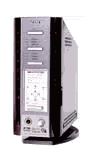 This will get you Dolby Virtual Surround. I've heard it and it is quite passable. Is it what you would hear in a digital system with descrete surround, no; will it sound as good as analog matrixed surround, close -- you certainly do hear stuff coming from what does sound like behind your head and that's quite impressive given there are only two front speakers. Thing is, it's good enough that it will allow the DI to advertise that it has Dolby Virtual Surround. The beauty is that you change nothing in the booth except adding the processor.
You won't have to rely on HD or any other advanced broadcast scheme which not only requires new head-end equipment, but this wouldn't even address the lag in how long before it becomes a ubiquitous in all vehicles. You will have to wait until the majority of vehicles are equipped with compatable receivers. And as we found with Stereo AM, just because they can get a technology to work, doesn't mean it will permeate the marketplace.
If I owned a Drive-In, I sure would give this a shot and milk the marketing advantage of it to the hilt.
Posted by Jack Ondracek (Member # 1466) on 08-06-2006, 06:37 AM:
All that's great. However, our SUV and pickup-loving customers thwart our best efforts to properly directionalize the audio. I'd bet 3/4 of them turn around with their back-ends pointed toward the screen... which reverses what they hear.
It's always been interesting to me that nobody's ever mentioned it... too much pizza and ![[beer]](graemlins/beer.gif) , I guess.
, I guess.
We mix our surrounds in (also the subwoofer), using active mixers to maintain channel separation. I'm just assuming (never checked) that phase rotation isn't an issue with digital?
Posted by Frank Angel (Member # 248) on 08-06-2006, 08:36 AM:
Remixing all channels back into the Left and Right input to the FM transmission shouldn't cause any phase problems....in theory. However, depending how some surround effects are actually created by the sound engineer, sometimes using time delay and phase manipulation to create a more open and spacial spread to the sound and then it's mixed into the descrete surround channels. This kind of manipulation will not necessarily cause any trouble since descrete channels are never electrically mixed. They are only mixed acoustically once they are reproduced in the theatre. However, if the heavily processed rear channels audio is mixed back into the left and right front channels, this could cause a very unpleasant flanging effect.
Do you monitor the audio from an FM receiver? That would pretty much be what they hear in their cars. Or at least to you tap the signals at the input to the transmitter would give you a good idea of what your mix is sounding like? If there is any distortion caused by remixing, you would hear it there.
As for the subwoofer channel, I would wonder if there is any advantage remixing that subbass channel back into your L/R remix since wouldn't this be putting out audio that is below what the FM transmitter can reproduce? Would it unneccessarily muddy up the overall audio? Or a better question would be, do it actually add anything that can be reproduced by the FM transmitter?
I would also wonder if the digital tracks (SRD, DTS or SDDS)don't present more problems that have to be worked around to make the audio acceptable for FM broadcast. Specifically I am thinking about the greater dymanic range of digital signals that is much wider than FM transmitter is capable of modulating. Wouldn't you wind up having to heavily limit the input to the transmitter to prevent overdriving it?
I would think that the SR Lt & Rt analog tracks would more closely match to the limitations of FM transmission in terms of dynamic range and frequency response as well as not needing any remixing -- SR's Lt & Rt channels simply feed into 2 FM transmission channels, whereas all of the advantages of digital -- the 6 channels, the dynamic range, the higher frequency response -- are really not advantages for FM: the higher frequency response will not be reproduced by the FM transmission, the greater dynamic range will have to be severely reigned in so as not to overdrive the transmitter and all those channels will need to be remixed back down to 2.
I guess the ability to be able to run the Dolby or DTS digital trailer may be the biggest advantage of using digital as the playback system for an FM transmission system, although you have heard both on the same system -- I would be curious to hear your take on it.
As for the peeps who turn their vehicles around....hey, you are sending the left and right correctly, you can't be responsible if the patrons do stuff that screws that up, just like if people in my theatre want to sit facing the rear wall, hey....not my fault. ![[Wink]](wink.gif)
Posted by Jack Ondracek (Member # 1466) on 08-06-2006, 02:32 PM:
Good questions, Frank.
I monitor all of my audio right off-the-air. Matter of fact, my booth doesn't have a line monitor, yet. We also screen shows in all 3 fields (occasionally), so I can evaluate how it sounds in something less open (and more quiet) than a booth.
Your FM may not work below 50hZ, but my system will pass most everything above DC. Granted, mixing a little of the sub may not make or break the evening for the majority out here... but for those who have the good stuff, I'm sending 'em what I can.
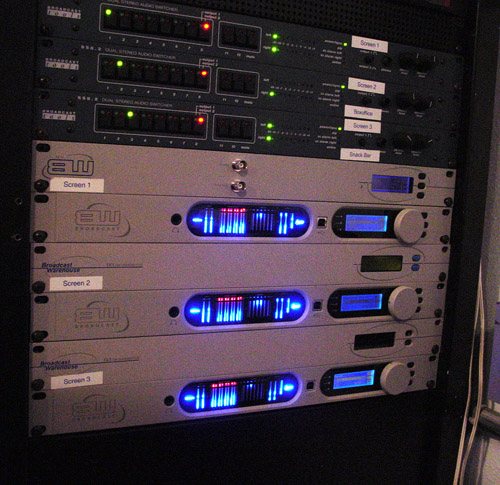
On dynamic range: I've had wideband comp/limiters, Smart Afterburners and Behringer 6-band processors here at one time or another. All have their own set of artifacts that I don't care much for. At this point, I'm pretty much getting what I want out of the Broadcast Warehouse DSPExtra processor. It's pretty spendy, but can (easily) be tuned for pretty much anything. We use separate presets, selected by the computer, to process our pre-show and film audio. The film gets much less aggressive treatment, while keeping the dynamic range reined in, and managing that darned 75ms pre-emphasis curve. When we're running music, we compare favorably with most Seattle stations and their $14k processors, so there's none of that rationalizing that the audio's not so good because "we're at a drive-in".
Hope I'm around long enough to see some after-market HD radio stuff come out... and some real numbers "in the cars". That would be fun to play with.
Posted by Louis Bornwasser (Member # 3063) on 08-06-2006, 03:48 PM:
Actually remixing anything other than discrete digital channels will drive the FM Multiplex system crazy since it is also a phase-related matrix.
If you run phase-related material (Dolby Stereo) it is best to acquire it as LtRt, not off the output of a processor where some phase rotation has already occurred. Azimuth is actually MORE touchy than in indoor theatres.
As for response, FM is quite happy to play at 100% modulation from about 10hz up. There is, however, a filter at 15.5Khz to keep hf transients out of the 19Khz pilot tone. (A practice that I do not agree with since not much high level hf is normally present.) I have removed that filter experimentally in several stations and experienced reduced hf distortion.
Jack, I can tell you are having fun....must visit you just "once before I die." Louis
Posted by Chris Erwin (Member # 176) on 08-10-2006, 10:52 AM:
Jack,
The 9024's are out?
If I had the money...
Omina FM (FM3 would be ok)
or a used 8100 Optimod.
Set of Belar Mod Meters.
Rant on: Damn the Commish and run 19% pilot injection and 130% Modulation like all these other highly processed stations in the land! ![[evil]](graemlins/evil.gif) LOUD!! LOUD!! LOUD!! Who cares if it spatters...we're louder than the next guy!! Rant off.
LOUD!! LOUD!! LOUD!! Who cares if it spatters...we're louder than the next guy!! Rant off.
Nah, I like to keep the D/I on the conservitive side on processing. A cut in the lower bass, mids in the middle of the road and a crisp high for dialogue. An attack to make the KABOOMS and explosions from over modulation and a compressor that doesn't give hiss or acts too slow.
I tailored the sound for film and my non-sync is not as loud and punchy as the local CC cluster but clean and clear was my objective.
Air Chain:ASR-40 to Smart 2 DIT, Smart feeds Autocomm for AM and Field and 9024 feeds BW TX-1.
What would really be fun? RDS at the Drive-In! Scroll Snack Bar ads and Drive-In name!
Posted by Jack Ondracek (Member # 1466) on 08-10-2006, 11:28 AM:
Chris:
Yes, the 9024 has been discontinued , a couple of years ago, I think. It may have been too difficult for most to get sounding right. For a "digital" processor, it had a lot of the pumping effects of an analog compressor that were hard to get out, if you didn't spend the time to get to know it. Still a pretty good box for the money though.
The DSPExtra was built to compete with the Omnia and Orban processors. The other boxes (for the extra $$$$) may be a little better at keeping the clipping artifacts down on really heavily processed stations (yuck)... but if you don't need that kind of "wall of sound", this processor will do just about anything.
I'm with you on keeping the film audio conservatively processed. I like those big booms, too!
RDS is available, if you have an extra $800 or so to spend (and a spare computer laying around). Scrolling snack bar stuff is a cool idea!... maybe even upcoming shows?
Powered by Infopop Corporation
UBB.classicTM
6.3.1.2