This is topic Proper/Improper use of FilmGuard in forum Film Handlers' Forum at Film-Tech Forum ARCHIVE.


To visit this topic, use this URL:
https://ft-forum.com/ft/cgi-bin/ubb/ultimatebb.cgi?ubb=get_topic;f=1;t=008076

Posted by Christopher Meredith (Member # 3767) on 05-28-2006, 03:51 PM:
 
The following is from an email that filtered down to a large number of Regal theaters from a higher-up in REG tech services:

quote:
EDIT: Quote removed
Obviously, you're not supposed to have FG dripping off the pads and running onto the equipment, let alone running down the port glass. But I apply FG quite liberally and that water streaking appearance only happens for the first run (a fact noted in the instructions). When doing this, I always run the print through it once before paying customers see it (also noted in the instructions).

Also, I don't recall the FG instructions recommending doubling up the gate bands. In fact, I have found that using FG will actually improve the presentation in houses that have image stability problems and have not had to adjust the gate tension due to use of FG.

[ 06-05-2006, 05:21 PM: Message edited by: Christopher Meredith ]
 
Posted by Brad Miller (Member # 2) on 05-28-2006, 04:19 PM:
 
Some people are confusing "saturate" with the word "submerge". The author of that note above is correct that there is no reason to literally DUNK the media pads into a container of FilmGuard. The pictures in the instruction sheets show pressing the tip of the sprayer nozzle up against the pads, which is the proper way to apply the product. The pads do need to be "saturated" (not submerged) so that the application is even however. Otherwise there will be lubricated and non-lubricated sections of the print. (This means part of the print will still suffer from static issues as well as will not benefit from the scratch protection, cleaning and image improvement benefits that FilmGuard offers.) However if the product is literally dripping off of the cleaning machine, then there is definitely too much being applied. (Most certainly due to "dunking" the pads immediately prior to running the show.)

As far as the streaking issue goes, that's just a fact of life for the first application run. Placing the film cleaner on the platter, rather than the top of the projector (which is how I am assuming this example was being handled) does help reduce the streaks. However for some reason there are lots of techs who don't like that idea for reasons of which have never been told to me (and that I can't even come up with on my own).

I am assuming the theater example mentioned above was applying FilmGuard to a public show on a new print, rather than pre-screening the film the night before and applying the product then. Putting aside the obvious issue of there potentially being a lab problem with one of the reels that would never get noticed without a pre-screening (but would be presented to the paying customers), there is a trick to drastically reducing the "liquid lines" on that first application performance for theaters that do not prescreen their films the night before for whatever reason. That trick is simply to load up the cleaner the day before and "saturate" (not submerge or dunk) the media, then let it sit until the next day. This will result in streaks that are not as visible on screen, yet the media will still provide an even application. [Wink] I plan on putting this into the next batch of instruction sheets.

On picture jumping, there are two projectors out there that can be overly sensitive to FilmGuard. The #1 offender is some Christie projectors, and is what the instructions were based off of...however it does not affect ALL Christie projectors. For example, I used to work at the UA Galaxy in Dallas, and their gates were extremely sensitive to the product, such that the modification needed to be done. However go across town to the UA MacArthur and nothing needed to be done. These two theaters were only built a few years apart as well.

The second troublesome model is some later model Simplex projectors. I witnessed this problem first hand close to the opening of the AMC Mesquite 30, yet go to another AMC in town built a couple of years before or after and the problem is nonexistant.

I have yet to find another projector that has had any issue with FilmGuard. The reason the tip went into the instructions was because the Christie projector apparently has more people with the issue than those who don't. (The Christie gate tension spring will also tend to break or remain permanently bent if left at 4 or 5 for any length of time, especially with large xenons behind it.) As such, the modification works magnificently on those troublesome models and is a permanent fix. It has been a number of years now, so it is quite possible that Christie has taken care of the pinhole placement problem of their bands by now too. (If your Christie projector cannot run a "dry" print at a setting of 1 steadily, then your machines definitely have that problem.)

Remember a little bit goes a very long way. Only one quart of FilmGuard if used per the instructions will clean an 8 plex for one month. Hope that helps.
 
Posted by Monte L Fullmer (Member # 2797) on 05-28-2006, 07:29 PM:
 
This shows that the REG people need to create an insert in their Booth Operations manual on the correct procedure of using Film-Guard - in booths that have the Kelmar cleaners and media available .. with instructional pictures on proper ways to how to saturate the media rolls.

Then, REG should impliment this procedure in their booth certification policies..in the Level 1 section.

With this, this will ensure that all booth personnel for REG and others will be on the same page of Film-Guard film cleaning procedures..and prevents any discrepency in booth operations..to make things simple.

-Monte
 
Posted by Steve Scott (Member # 630) on 05-28-2006, 08:06 PM:
 
Lightly spraying? What good is that? That seems like it'd be more likely to drip onto wire conduits that way.

I've always held the nozzle against the new media rolls & sprayed until the entire roll became obviously saturated. Century machines seem to have an easier time running & cleaning without noticeable streaking, while I've too confirmed some issues with Christies while I worked for Marcus.
 
Posted by Jack Ondracek (Member # 1466) on 05-28-2006, 08:31 PM:
 
Curious...
I've never had problems with Brad's instruction sheet. Applied as directed, the product has always performed as indicated.

Interesting that the REG guy is sending forth directives on the proper use of the product, even though he's admitted to not reading the instructions himself.
 
Posted by Ron Curran (Member # 3631) on 05-28-2006, 09:11 PM:
 
Yes, the day before saturation works for us. No streaking visable on the first screening.

Brad, the projector mounted cleaner is because some the screenings are off the Eprad MUT while others are off the platter, so the print can go through the cleaner from either. A second machine is contemplated - one mounted on the platter, one on the MUT. While there isn't a problem (Century projector), it is low on the priority list.
 
Posted by Keith Peticolas (Member # 971) on 05-28-2006, 09:42 PM:
 
This is more of a testament to why Regal booths suck. And why I refuse to go to our local Regal craphouses. FG and the platter rings, where usable, should be required equipment in every booth. And proper training for use of both. Dripping down the gear and splashing on the port glass is unexcusable.
 
Posted by Chris Hipp (Member # 1788) on 05-28-2006, 10:08 PM:
 
quote:
Although I have not read the instructions sent with the solution, I understand that the soaking method is the recommended by the supplier, and it is also recommended that gate bands should be doubled up in the event the film jumps excessively, and both of these methods should be ignored and common sense should be applied.
Perhaps common sense should be applied when sending out a chain wide email. If you are going to tell people to ignore the intstructions then you should READ them yourself first. Typical example of a corporate retard.

I can confirm the problems with the simplex projectors. The projectors that we had were technically identical to the strong 1060 model but they were stamped as 'millenium." Of all the AMCs I have been to I have only seen this at one location. The millenium models have a much different film gate. Anyway, they would jump on us like crazy for about the first two, sometimes three shows. Sometimes it was so bad that I would have to pull off the soaked pads and put dry ones on to stop the jumping.
 
Posted by Monte L Fullmer (Member # 2797) on 05-28-2006, 10:28 PM:
 
I've never had any probs with the Mils on using FG - maybe stepping up the tension for the first two shows (course, my FG applications aren't that wet as normal..), then stepped the tension back to "1" ..

...and also heard that wiping the bands and runners with FG during the night cleaning sequences with a cotton swab stick helps out things as well.

In my defense for REG when I used to be employed with this company in 2002: that I did demonstrate proper FG media usage methods to the other booth members - on not how to soak the living crap out of the media rolls, but just spray enough FG to make the media rolls look completely wet since a usual 2hr print would only take up so much media that such a good complete spray was good enough.

Film was treated, no drip, splatters and the Kelmar machines managed to stay clean as well...

thx_monte
 
Posted by Steve Scott (Member # 630) on 05-28-2006, 10:48 PM:
 
Marcus' head booth tech also had some reservations on the streaking issues when we started using FG in 2002. I'm unsure of what became of those reservations as I only worked there for about four months at the start of the test runs at Rosemount.
 
Posted by Brad Miller (Member # 2) on 05-28-2006, 11:45 PM:
 
Monte, that's yet another trick that I do believe is mentioned in the instructions...

If using Film-Tech brand media, the rolls are plenty long to cut into halves for long movies (Harry Potter types) and thirds for shorter movies (100 minute comedy types). Not only does this give the theater more rolls per box, but it uses less FilmGuard because you are only loading up as much media as you need to get through the show. Any excess media on the rolls simply soaks up the FilmGuard and gets wasted (media AND FilmGuard, that is). Kelmar also puts a good amount of media on their rolls, but you don't get the coupling cores, nor are they recyclable for more media stock.

Sure it takes a little bit of effort from a booth guy to cut and roll them up, but seriously, surely these guys can devote a few minutes once a week to the task.

(Chris - I thought AMC got that weirdness fixed with that particular set of Simplexes at Mesquite??? The other AMCs in town, as well as other Simplex houses don't have that problem.)
 
Posted by Monte L Fullmer (Member # 2797) on 05-29-2006, 12:52 AM:
 
Brad, I do agree with you totally since I did read the instructions..AFTER I was told about this Film-Tech site, in 2002.

Yet, Film-Guard was introduced to me the year before, in early 2001 by my good tekkie friend, Mark Gulbrandsen. He told me all about the substance on how well it preserves the film and makes the filmpath run so much smoother. I ordered a bottle from GTS (where he was working with at the time) and tried the substance out with his instruction of soaking the media rolls to the core so that the substance can last throughout a few passes.

It was shortly after the introduction, that I figured out on my own that I could do the limitation of saturation on the media..and cut down the media to fit the feature length to save on the media itself.

When, I was introduced to the Film-Tech site in the summer of 2002 by Mark, is when I noticed the compound being advertised and being sold with the instuctions as you mentioned. This is where I noticed in the instructions of the same tricks of saving the rolls that I was already using and been practicing the year before..

..just a fascinating coinsidence that occured.

thx-Monte
 
Posted by David Ingalsbe (Member # 2433) on 05-29-2006, 03:29 AM:
 
The Regal folks love the film guard that does not meen that we drink it with our eggs. I to work for Regal and we have been useing film guard for 5 year with no problems. On the first run with my millenium heads I have to turn the tension up to 2 or 3 but after the first run it goes right back to 1 or 2. The cut in half trick works well to when i have time because the take up roll does not get so large so the media advances slower.
 
Posted by John Hawkinson (Member # 1135) on 05-29-2006, 08:08 AM:
 
Brad, I think this does show that the word "saturate" is confusing to a lot of people. Certainly it has come up here on F-T before.

It might be worth changing the wording to avoid confusion. After all, even if 90% of the readers understand it right on the first try, shouldn't it be 99%? [thumbsup]

--jhawk
 
Posted by Frank Dubrois (Member # 3042) on 05-29-2006, 03:48 PM:
 
If the word saturate confuses you, then I don't think you should be working with expensive, heavy machinery. The instructions are crystal clear to me and everone I know who actually took the time to READ them.
 
Posted by Mike Blakesley (Member # 26) on 05-29-2006, 04:50 PM:
 
Any item that is soaked is saturated, but an item that is saturated is not necessarily soaked.

I haven't read the FG directions in a while, but maybe there should be a paragraph stating: "It's not necessary to have the pad be dripping wet...just filled (saturated) with Film-Guard. Methods such as dunking or soaking the media pads are NOT recommended because the media will become soaked (that is, overly saturated)."

I have used Brad's suggested method of saturating the pads and then leaving them a couple of days. It works well, although there is still some streaking. ETS prints don't arrive until Friday for us, so we can't ever pre-screen anything except TES prints. Never had a complaint about the streaking though.
 
Posted by Robert Burtcher (Member # 3227) on 06-02-2006, 05:39 AM:
 
Okay, so if I'm understanding this thread right, when saturating the media pads, you want them visibily and uniformly wet, but not to the point where a little drips off as you're applying FilmGuard to them? Or what?

I have been saturating the pads to the point where a drop or two will fall off the pads, then I'll blot a little off so that they will not drip. Is is too much?
 
Posted by Matt Fields (Member # 3211) on 06-02-2006, 08:38 AM:
 
FWIW, I just spray until the film-guard reaches the core all round, but not until its dripping. If I spray till it drips, somtimes I'll get streaks on the second run though (first public show). - Matt
 
Posted by Randy Stankey (Member # 64) on 06-02-2006, 09:03 AM:
 
quote: Brad Miller
...the rolls are plenty long to cut into halves...
I start by using a full roll, uncut for the first movie, rewinding it back to the starting point for each run. Then, when it's time to clean a second print, all I have to do is cut off the used portion and throw it out.

This saves a lot of time and trouble in pulling all that media out and rewinding it again. It also circumvents the problem of getting dirt on the clean media if you drop it or get something on a surface where you are working.

The only drawback is that you have to learn how to judge how much media is left on the roll. If you guess incorrectly it is liable to run out on you before the film ends. (A bad thing, obviously!)

Further, if you have soaked the media rolls prior to using them, they will have set out for a day or more, thus allowing for the "rest period" mentioned above. If the pads are dried out from sitting too long, all that is needed is a quick spritz to freshen them up.

When soaking the rolls, I use enough F.G. to wet them right up to the point where they drip, but not actually dripping. Again, that is a judgement issue. Once you do it a few times, you learn how to tell when enough is enough.
 
Posted by Steve Guttag (Member # 268) on 06-02-2006, 09:33 AM:
 
Randy...how do you get any tape to stick to the unused but now soaked portion of the media?
 
Posted by Randy Stankey (Member # 64) on 06-02-2006, 10:54 AM:
 
I don't.

First, put the fresh roll on the TAKEUP side of the cleaner. Then rewind the media onto the PAYOUT side, onto a plastic core. You can soak the material with FG, little by little as you rewind if you like. (Wind about 10-15 turns then give it a squirt. Wind another 10 turns then squirt again. Repeat until done.)

When you've got it all wound onto the payout, put a plastic core on the takeup. Next, thread the media and pull one corner of it in between the notches of the plastic core. Then, when you rewind it will be trapped between the two interlocked cores. The media won't be able to slip even if it's all slippery with FG. But, once you get a couple-few turns around the core it will usually hold itself in place just by tension.

If you are using the FT media, you can forget about the winding process. (Bonus!) Just put a fresh roll on the payout and an empty core on the takeup. Trap the corner and make a few turns to cinch it and you're ready to go.

I have thought of a couple of possible modifications to the plastic cores that will make this process a bit easier. If I have time to experiment and get it right, I think I can make it so tape can be dispensed with, alltogehter, even if you don't soak the media all the way to the end.
 
Posted by Christopher Meredith (Member # 3767) on 06-05-2006, 05:26 PM:
 
I would like to offer a public apology to the author of the email previously quoted in the original post. I meant no disrespect toward that individual and certainly did not want to give offense. I realize now that posting an internal email, even with no names attached, is imposite, discourteous, and unprofessional. To anyone who may have been affected my my actions, I humbly apologize.

For whatever it's worth, my original intention was not to reflect poorly upon REG or any of its members, but rather to get feedback from the designer and frequent users of a very good product. Again, everyone, please accept my apology.
 
Posted by Dustin Mitchell (Member # 372) on 06-06-2006, 01:19 AM:
 
Yes, many people lurk on this site. Chin up dude, I've been there before. They'll get over it.
 
Posted by Jarrad Salmon (Member # 3818) on 06-06-2006, 07:47 AM:
 
It was touched on before in the previous posts, but I'd like to confirm that allowing the media pads to soak over night prevents the steaking on the first run.

I personally believe that streaking is a direct result of a media pad being over saturated and unevenly applied.
 
Posted by Frank Angel (Member # 248) on 06-06-2006, 10:03 AM:
 
Hey Chris, although you're posting the internal memo probably is a tad impolite (not the litany of horrors you listed), you didn't post the writer's name and your only intent was to get more precise information; it was hardly a personal attack on the moral and ethical verasity of the author (who evidently is pretty thin skinned if he made a big deal about it). Besides, we don't even know who he is nor do we care; he should be more concerned good booth practices and jumping for joy that he's got a worker who is eager to learn how to do things the correct way. Next time, just paraphrase anything that you have a question about rather posting a direct quote and risking the wrath of whoever.

And not for nuthin, as we say in Brooklyn, he'll get over it.
 
Posted by David Stambaugh (Member # 1102) on 06-06-2006, 02:09 PM:
 
FWIW, I didn't read it as disrespectful, but it's probably not a good idea to quote someone's internal email like that. If anything it's good to know there's someone in a technical management position at a large chain who's interested in properly using Film-Guard to improve the company's presentation. And he/she should be patting you on the back for caring. [beer]

We won't mention another large chain of CINEmas whose tradeMARK is "We don't need no stinkin' Film-Guard!" (is that still the case there?)
 
Posted by John Hawkinson (Member # 1135) on 06-06-2006, 04:45 PM:
 
For clarity, RULE #6: Quoting other people's emails in the Film-Tech Rules and Policies says "Do not do this ever!" So regardless of politeness, etc., it would be wise to hold to it.

--jhawk
 
Posted by John Wilson (Member # 269) on 06-06-2006, 06:35 PM:
 
Hey Jarrad

Welcome to Film-Tech. How's the FG working out for you guys there now? Solved the shedding issues?

John
 
Posted by Jarrad Salmon (Member # 3818) on 06-11-2006, 09:06 PM:
 
quote: John Wilson
Hey Jarrad

Welcome to Film-Tech. How's the FG working out for you guys there now? Solved the shedding issues?

John

Thanks John, this site as a great resource!

The shedding isn't normally major problem thanks to film guard, but certain film stocks do seem to need it more than others. That said the hardest thing for us is 16 screens, 20 to 30 prints, one film guard unit! [Eek!] Have to come up with a tight film guard schedule each week.

More units on the way though! [thumbsup]
 
Posted by Monte L Fullmer (Member # 2797) on 06-11-2006, 11:35 PM:
 
That's funny, Dave ... and they could use FG on those Christies real bad....since they have the units that can accept the Kelmars...
 
Posted by John-Layton Jenkins (Member # 2080) on 06-16-2006, 04:35 PM:
 
At the Galaxy, I could never get #6 to focus properly without overloading it with FG. I would spray down the pads before the first screening, and if I didn't put enough, I would usually have to run back upstairs 2-4 times during the show to lubricate them more. The only way to get a good picture on that projector was to use FG. Not sure what its like now there, but when I left, the booth needed some work.
 
Posted by Randy Stankey (Member # 64) on 06-16-2006, 10:18 PM:
 
Okay, so, what kind of projector was "Old #6"?

Did it have a really big lamp, like a 6,000 watter?

Projectors that need refocused more than just a "touch up" every now and then have serious problems. Often it's heat related. Larger lamps make the projector get hotter faster.

FilmGuard may just be treating the symptoms.

This is just a complete, off-the-wall spitball, here:
If the projector has a large lamp and if the heat is causing the film to buckle in the gate, causing "focus flutter", the FilmGuard may be helping because it makes the film just a bit more tolerant to heat before it starts to buckle.

The real solution you (they) need to apply is to check the lamp alignment/focus to see that it's not overheating the film and readjust as necessary until the problem goes away.
 
Posted by Monte L Fullmer (Member # 2797) on 06-17-2006, 02:14 AM:
 
quote: Randy Stankey
what kind of projector was "Old #6"?

..is it a flat trap variety of a projector? focus problems with big bulbs on flat trap machines is what you get.
 
Posted by Brad Miller (Member # 2) on 06-17-2006, 05:20 AM:
 
If he is talking about the UA Galaxy in Dallas, then #6 is a P35GPS with a 4K lamp behind it and no heat filter. I don't ever recall having any sort of focus problems with that particular screen back when I worked there, but I always ran FilmGuard on every show so it's possible it was covering up a problem that entire time.
 
Posted by Randy Stankey (Member # 64) on 06-17-2006, 10:34 AM:
 
I guess until John comes back and talks some more, it's all just conjecture...

...But it would help to know whether the picture drifts out of focus over a period of time or if it "jumps" out of focus. The question of whether it happens on one or both formats (flat/scope) is also in play.

A 4K lamp isn't an exceptionally large lamp but, if it's out of alignment, that's one possible cause. Does the projector have that damned "Auto Focus" feature for the lamp?
(Why did they name it that? Why didn't they name it "Alignment Offset" or something that wouldn't give idiot operators the idea they could "Set it and forget it"?!)

Also, we have yet to eliminate all sorts of misalignment/adjustment problems in the gate and things like that.

Is the projector kept clean?

I know... I know... People think that, when you use FG you don't need to clean the projector. That's complete BS. [bs] You STILL have to clean the projectors. FG just reduces the amount of cleaning you have to do but you STILL have to clean them. Many Christies are notorious for misbehaving when they aren't kept clean... even with FG. Yes, yes, FG dramatically reduces the amount of cleaning necessary. This is a great boon to people who use Christies that have this problem but you still need to wipe them down every so often... once per day... a couple-few times per week. I don't know. That's up to you to decide. But, clean them, you must.

Okay... I'm done ranting... bye, now. [Wink]
 
Posted by Matt Fields (Member # 3211) on 06-17-2006, 11:47 AM:
 
Back on the over-filmguarding topic...

It says in the instructions that 1 oz. of FG is all that is needed for a typical 2 hr movie. About how many squirts is that out of the sprayer bottle?

People could then use that as a rough guess as to how much to put in the pads.
 
Posted by Brad Miller (Member # 2) on 06-17-2006, 03:00 PM:
 
The nozzles aren't accurate enough to judge that number by squirts. It also depends on how long the pads are. If you use the rolls as they come, they are WAY longer than needed, and as such to evenly saturate (not submerge) them it will use up more FilmGuard. This is why we recommend to cut them in halves or thirds.
 
Posted by Jack Ondracek (Member # 1466) on 06-17-2006, 06:22 PM:
 
quote:
If you use the rolls as they come, they are WAY longer than needed,
They're great for double features, though.
 
Posted by Kevin Murphree (Member # 3895) on 08-17-2006, 02:59 AM:
 
Ok, does anyone know where I can find some online instructions on how to set it up to use the film guard and the roller unit for our Millenium projectors? I have the units but have no idea on how to set it up to where the film is going through it or even how to set it up period. I have never used it before but we have a print that is in desperate need and need to figure it out quick. The previous booth manager can't tell me where the instruction manual is so.....yeah....
 
Posted by Brad Miller (Member # 2) on 08-17-2006, 03:09 AM:
 
The FilmGuard kits come with instruction sheets. If you need instructions on how to thread the media cleaner, the manual is here.
 
Posted by Charles Greenlee (Member # 3856) on 08-17-2006, 09:48 AM:
 
I think we use "Standard" pads on our Kelmar cleaner. Just a soft cottony roll, no embossing. Has enough for 3 real short movies, or 2 normal length ones. We only have the 1 unit for all 6 projectors, so I usually do 2 movies/day, or 1/set which I work. After 3 days, I'm done. I just spray the pads untill they look evenly saturated, then I let them sit for 15-30 while I do my other opening procedures to soak it in better. I'll run 2 movies, flip the pads over, run 2, and if they come out clean enopugh, I may flip them back to the first side and do the last 2. We has some other pads that were embossed, may have been Film-tech pads, didn't like them as much, but we only had the 2 rolls, so I didn't get much time to work with them. I'll add more later, and now it's off to work. Yay.
 
Posted by Mike Blakesley (Member # 26) on 08-18-2006, 09:22 PM:
 
Is it really necessary to cut and re-roll the FG pads? What I do is, saturate the whole roll; run that roll (rewinding for each showing, of course). Then when the next movie comes in (or the media is sufficiently dirty), I take a magic marker and put a mark across the media at the end of the "dirty" part, then continue to use the same roll, rewinding back to the mark after each show.
 
Posted by Steve Guttag (Member # 268) on 08-18-2006, 10:05 PM:
 
Mike your way will work but consume more media. Since the speed of the media is dependant on the diameter of the take up spool + media...by not cutting the media down first, the second usage gets a more liberal amount of media/FG than the first usage.
 
Posted by Brad Miller (Member # 2) on 08-18-2006, 11:11 PM:
 
It also uses up more FilmGuard than cutting the pads in half (or thirds) in the first place because you are saturating the latter part of the rolls that end up being resaturated when the time comes you are about to use them.

Of course we tried selling pads in a more suitable length from the get-go, but the feedback was sternly against it. Now we pack more on a roll than any of the competitors.
 
Posted by Barry Floyd (Member # 385) on 08-21-2006, 09:54 AM:
 
quote: Jack Ondracek
They're great for double features, though.
That's just what I plan on doing with mine. I normally build both features and the intermission clock all on the same platter. I just bought a Kelmar Media Cleaner and my first bottle of Film-Guard and box of Film-Tech media pads. One of my many weeknight projects this week is to drill and tap the platter columns to mount my cleaners on.

We manually applied some FG to one of our prints last week to see if we'd notice any results right away. I have already found that my old Brenkert BX-60 in booth #2 doesn't chatter as much and the cleaning is alot easier - less shedding residue in the bottom of the projector.

On the topic of drilling and tapping my platter columns to mount the bracket... does anybody know a "SAFE" place on a Strong AP-3 to drill into the column without drilling thru the internal wiring harness?
 
Posted by Mike Blakesley (Member # 26) on 08-21-2006, 12:28 PM:
 
quote: Steve Guttag
by not cutting the media down first, the second usage gets a more liberal amount of media/FG than the first usage.
Sheeesh, I never thought of that. Of course you are right.

Well what I will do in the future is cut off the "dirty" part after the first week and wind onto the now-empty takeup spool. That'll still enable me to soak each roll of media one time.
 
Posted by Brad Miller (Member # 2) on 08-21-2006, 01:23 PM:
 
Nope, because after a week the FG is mostly evaporated. You will still need to resaturate once a week.
 
Posted by Charles Greenlee (Member # 3856) on 08-21-2006, 06:08 PM:
 
I wish we could run our tapes longer than 1 week. Because we only have 1 cleaner for 6 projectors, by the time it gets back to a projector, the film is dirty enough to constitute not using that portion of the roll again. However, with the currnt short films we have, I can clean 3/roll, then reverse the tape and use the backside to clean 3 more, total of 6. Then the roll is pretty much used up. So each film only can get cleaned once per week since no one else does it.
 
Posted by Jack Ondracek (Member # 1466) on 08-21-2006, 09:09 PM:
 
quote: Brad Miller
Nope, because after a week the FG is mostly evaporated. You will still need to resaturate once a week.

I've noticed that, Brad.

I recall early literature saying something about Filmguard staying on a print for a year before it would evaporate. Is this something different?
 
Posted by Brad Miller (Member # 2) on 08-21-2006, 09:44 PM:
 
You will notice between 6-12 months worth of "life" of FG on a print before it evaporates. In some instances depending on the film stock and how it is stored, it may last a little longer. However the media pads don't have that kind of shelf life, if that makes sense.
 
Posted by Jack Ondracek (Member # 1466) on 08-22-2006, 12:08 AM:
 
Yep, I can see that.
 
Posted by System Notices (Member # 2357) on 01-14-2008, 01:08 PM:
 

It has been 510 days since the last post.


Posted by Carey Barber (Member # 1586) on 01-14-2008, 01:08 PM:
 
I had a question about the routine for applying for Film Guard.

We have 6 cleaners and 23 35mm houses.

__________________________________________________________

Here is our current schedule:

1. On Thursday,all pads are replaced and saturated. EVERY new print gets a run thru the cleaner during the inspection screening with brand new pads.

2. The new films will also be cleaned during the first day of shows to the public.

3. The film cleaners are moved around throughout the week so that every print gets a full-day's worth of cleaning. (Some prints will get 2 full days).

4. On Monday of every week, we re-saturate the pads. We DO NOT replace them, just give them another spray.

__________________________________________________________

Here is my question:

Is it necessary/recommended that we re-saturate the pads on Monday, or is that just a waste of Film Guard?

Also, if you notice any other problems with this procedure please let me know.

Thanks,
Carey
 
Posted by Brad Miller (Member # 2) on 01-14-2008, 11:40 PM:
 
Ideally every time the cleaner moves to another print that it hasn't cleaned before that week you should resaturate the pads. As you have no doubt noticed, it doesn't take a whole lot to get them wet again.
 
Posted by Peter David Bruce (Member # 4447) on 02-03-2008, 08:21 AM:
 
Digesting film guard
Inhaling film guard fumes
Film guard on your skin
Film guard in your eyes.

well, what are the dangers of this stuff? all the bottle says is 'not to be taken internally'

keen to know!

OH and we have been instructed by our technicians (for the company) that we shouldnt put anything at all on the cleaning pads. running a dry film cleaner??? id rather not.
 
Posted by Chris Slycord (Member # 4239) on 02-03-2008, 01:17 PM:
 
The reason they advise you not to use it is that because some people don't read directions correctly and misuse the stuff, thereby creating problems.

Like I've heard of places not wanting to use the stuff because their prints got too oily and would slide then get thrown, which I would bet is because they were applying it liberally.

And if you're worried about the dangers of the stuff... email Brad for the MSDS (Material Safety Data Sheet).
 
Posted by Mike Olpin (Member # 1115) on 02-03-2008, 02:13 PM:
 
Peter, your booth supplier should be able to provide you with MSDS sheets for FilmGuard. If you work at Regal, MSDS sheets for all products can be found via the online web help at Port Regal. If you are still unable to find MSDS sheets, email Brad.

Dry film pads are fine, albeit not as effective, however they cannot be re-used. Also be cautious, as some brands of media pads can scratch the print.

Edit: Oh, I see your from England, never mind about the Regal instructions then.
 
Posted by Peter David Bruce (Member # 4447) on 02-03-2008, 02:37 PM:
 
cheers guys. yeah i think i can get the MSDS sheets from head office. the pads we have here are the actual filmtech ones. guess you cant get better than that!

thanks for letting me know not to reuse dry ones. unfortunately that means we will now get through them alot faster. 6 screens, 13-14 prints every weekend....

peter
 
Posted by Robert W. Jones (Member # 4228) on 02-03-2008, 02:41 PM:
 
At home, I apply it with an old Ecco film cleaner with dual media pads. I've never noticed any streaking using a power rewind at about 1000 ftm with the flow set to two drops per minute. Works fine. Two minutes per reel wind time. Then rewind back through the cleaner with no drip.

With my Kelmar cleaner, I spray the pads then use a cotton cloth to slightly squeeze and distribute the film guard on the pads. No problem with streaking after the initial check run.
 
Posted by Peter David Bruce (Member # 4447) on 02-03-2008, 02:44 PM:
 
Cheers, robert. we use the ecco cleaner. theyve done us proud for about 15 years [Smile]
 
Posted by Mike Olpin (Member # 1115) on 02-03-2008, 02:50 PM:
 
off topic:

Peter, I'm soooo ordering one of those T-shirts.
 
Posted by Carey Barber (Member # 1586) on 02-18-2008, 09:50 AM:
 
I was wondering if anyone else has ever seen this and also whether I should be concerned...

I received 2 bottles of FilmGuard that has some residue floating around in it. It is dark brown gunk that mostly settles at the bottom of the bottle.

The liquid itself does not seem any different.

I have been using FilmGuard for several years and have never seen anything like it. I thought that perhaps the ingredients were not fully mixed.

Anyone have any thoughts?

Thanks,
Carey
 
Posted by Brad Miller (Member # 2) on 02-18-2008, 02:01 PM:
 
Yup, it happens if the bottle sits for too long in a warehouse. Just give it a shake and you're good.
 
Posted by Carey Barber (Member # 1586) on 02-18-2008, 08:57 PM:
 
Thanks Brad.

I kinda figured that was all it was.
 
Posted by System Notices (Member # 2357) on 03-25-2011, 07:30 AM:
 

It has been 1130 days since the last post.


Posted by Carl Martin (Member # 1146) on 03-25-2011, 07:30 AM:
 
re: the streakiness issue. i'm thinking of having new mounting holes tapped into the platter tree so the first run through freshly saturated pads happens on the return to the platter (christe aw3r). any reason this might be a bad idea? while the first ever application happens during the test screening (where the streakiness makes it difficult to tell if there are scratches), subsequent weekly applications happen during public shows. since we don't get new movies every week, there's not always an opportunity to run a movie with no audience.

separate, direr issue: i've received word that the theater that gets our hand-me-down prints is having issues with those we've f-g'd. namely, the film sticks to itself during payout causing the dancer arm to jerk about, and residue is left in the projector. one print was thrown twice its first weekend there. any thoughts on this matter, which i hope to investigate further?

these films have all paid out like a charm at our theater. one print did leave residue on our srd penthouse drum, which i strongly suspect was due to the film being long enough to almost exhaust the pads (f-t pads cut in 2), which i'd secured to the cores using the bits of masking tape that came on the rolls, thinking that must be ok--the residue must be dissolved adhesive. (i since switched to magic tape for all my media taping needs)

this same print also had about 18 extra splices in it from being dropped by a co-worker while being moved. coincidentally (!) this was the print that was thrown at the other theater. i can accept the plausibility of the splices and adhesive causing payout abnormalities with this print (though i observed none at our theater), but don't understand how there could have been an issue with the other several f-g'd prints they got from us. of course none of them were thrown so maybe it's just that a slight difference in behavior was noted and then exaggerated, in the wake of the thrown print, in the third-hand report i heard.

anyways, any and all thoughts on this are welcome.
 
Posted by Randy Stankey (Member # 64) on 03-25-2011, 10:20 AM:
 
Always use the minimum amount needed to do the job and no more.

It isn't until the second and third pass through the cleaner where the real magic happens. There are two reasons for this:

1) The FilmGuard has a chance to dissolve some of the embedded dirt on the film which will come off on subsequent passes through the cleaner.

2) The streaky effect on the screen will go away after the second pass.

It is best if you apply the FilmGuard then let the film sit undisturbed overnight before you play it again. It has a better chance to do its job and the layer of liquid on the film will have a chance to level out, thus reducing the appearance of steaks even more.

If you can move the film cleaner bracket to the platter it would be a good thing. It prevents liquid dripping off the film cleaner getting down onto or into the projector. Many people find it easier and more convenient to operate when it's on the platter. Plus, if you have any digital readers or other types of penthouse units on the projector, it simplifies things. If you have a DTS reader, a SDDS and a Dolby Digital unit all stacked up on top, you don't need a film cleaner taking up valuable room and complicating your film path, not to mention the fact that your digital sound offset (frame delay) might be different based on whether you use the film cleaner or don't use it. Putting it on the platter just makes things easier.

I find that my Dolby Digital reader performs a little bit better if there is some back-tension on the film. The film cleaner mounted on the platter provides just enough. If you have problems with film jumping the track, falling off the rollers or otherwise going haywire as it travels from the platter to the projector, that back-tension might also help alleviate the problem.

I think you will also find that you will clean less gunk off your sound drums and digital readers if you move the cleaner to the platter. I think it gives the liquid a few seconds to dry before going to the projector. I don't know if that's really true. It just seems that way to me.

I rarely have to clean gunk off my sound drums and projector gates. All I have to do is use a red shop rag to wipe out the projector between shows. That's all. In a commercial theater, if you use FilmGuard consistently, I think you will only have to clean projectors once or twice per week. When I worked in the multiplex, we each had to take apart and thoroughly clean one projector per shift. If that was done, every machine got cleaned once per week. Apart from that, all they got was a wipe-down before each show.

If your platter is throwing prints, there is something wrong with the platter. FilmGuard has never caused a thrown print in over ten years that I have been using it. Not once! There has always been another cause.

Christie platters, especially, should never throw prints. If a Christie platter EVER throws a print, you need to have your technician come and investigate the problem right away. There is a small chance that some problem with the print is the cause but, if the platter is properly calibrated, it can deal with a lot of problems and inconsistencies in the film with barely a hiccup.

You might notice that film adheres to itself a little bit more when using FilmGuard but it should never cause a problem if you use it sparingly like I said, first thing, at the top of this post.

Using too much can sometimes be worse than using none at all. Just because you can't see the FilmGuard on the film that doesn't mean the stuff isn't working.
 
Posted by Carl Martin (Member # 1146) on 03-25-2011, 02:34 PM:
 
oh yes, the cleaner is currently mounted in the feed-path on the platter; i only proposed moving it after the projector for the initial application, to avoid on-screen streakiness. the "brass" seems to think the streakiness is a deal-breaker. i find it annoying as well.

i only recently got its use re-approved after 8 years' prohibition, so the more defect-free i can make things, the better. i don't remember streakiness being much of an issue at all back in '03, with (mostly) the same equipment at the same location.

we're not throwing prints. that's the theater that's getting our prints down the line. i should have mentioned that they also have christie aw3r's and a mix of mostly norelco fp20's, 2 turreted centurys (newer sa's?) and one oddball simplex. everything is fine at our place aside from the streakiness issue i want to minimize.
 
Posted by Carl Martin (Member # 1146) on 03-25-2011, 02:36 PM:
 
oh balls, my first double-post.

well, let me add that the streaks are quite pronounced as the film leaves the cleaner on the first application, like the f-g just isn't coating as evenly as it should. is the stuff more viscous than it was 8 years ago?
 
Posted by Chris Slycord (Member # 4239) on 03-25-2011, 03:33 PM:
 
Pronounced streaks on initial pass == expected behavior.
 
Posted by Randy Stankey (Member # 64) on 03-25-2011, 04:43 PM:
 
If *ANY* platter throws prints it is broken and needs to be fixed. It doesn't matter whether you own it or another theater owns it.

Thrown print = Broken platter.

If THEIR platter is throwing prints, THEY should call a technician to fix it.

A competent technician can recalibrate a Christie platter in about 15 minutes. It is not a difficult operation but it needs to be done right.

If anybody blames FilmGuard for thrown prints, they are full of shit.
Tell them Randy said so.

Streaks on the screen are mostly normal. They will go away after a while. Usually within 1 or 2 runs.

As I said, first thing in my previous post, do not use too much FilmGuard.

If your films are not really dirty and your media pads aren't full of dirt and grit you can use the same cleaner on two prints without rewetting them. As long as the "gauze" is just damp with FilmGuard it will work. In fact, "just damp" is the way I would characterize a gauze roll that is correctly saturated. If your rolls are dripping with the liquid, that's too much.

If you are having trouble deciding whether you are using too much FilmGuard, err on the side of using less. It is better to use less than to use too much. That should please the empty suits and the bean counters in your theater's home office because they will save 0.68 cents per year when you use less supplies.

Just because the liquid seems to bead up on the surface of the film and form long streaks does not mean you have a problem. That is the way it is supposed to be. Just rewind the media and run the film again. Keep doing it for at least two or three more runs. The layer of liquid will even out by itself. You'll get even better results if you let your freshly treated print sit overnight before you run it again.

You've got the cleaner mounted on the platter. You seem to be doing it right according to what you report here.
 
Posted by Jake Spell (Member # 5294) on 03-25-2011, 05:21 PM:
 
But I think what he is asking is weather it makes a difference if it is located on the payout side of the platter or on the takeup side?
 
Posted by Randy Stankey (Member # 64) on 03-25-2011, 06:31 PM:
 
When I think "platter mounted cleaner" I just normally think it would be on the payout, not on the takeup. It wouldn't make sense to put the cleaner on the takeup. Would it?
 
Posted by Jake Spell (Member # 5294) on 03-25-2011, 06:56 PM:
 
I wouldn't know as Iv never used a cleaner but am trying to persuade my boss to start using one. It seems like being on the take up wouldn't be such a bad idea. There is always more tension on take up, the film-guard would be applied after the projector so the streaking should be minimized, and it seems like you would get less film-guard on the leader. Of course I'm just gussing at this point so I could be wrong.
 
Posted by Chase Pickett (Member # 5975) on 03-25-2011, 07:01 PM:
 
We use it on the pay out at the top of the tree, and it works exactly as it should. Streaking during the tech screening, but on subsequent runs, the streaking disappears, and no tossed prints. I'd recommend keeping it where it is, and like everyone has said before, investigate the issues with the platters at the other theater with an eye on whether or not the platters are functioning properly. Not your use of Film Guard.
 
Posted by Joe Redifer (Member # 3) on 03-25-2011, 07:05 PM:
 
With Strong platters it might be a bit more beneficial to mount the cleaner on the projector as the Strong platter provides very little backtension. When mounted on the projector, the gravity and tension safe (if installed) adds more tension providing better application and cleaning.
 
Posted by Chase Pickett (Member # 5975) on 03-25-2011, 08:03 PM:
 
Joe, would you happen to know where to get mounting brackets for a kelmar film cleaner to mount it on top of the projector? I would like to try having one mounted there. I do like the added back tension from the film cleaner mounted to the top of the tree, but I am curious to see what mounting on the projector has to offer as well.
 
Posted by Brad Miller (Member # 2) on 03-25-2011, 10:58 PM:
 
Well Chase, Kelmar makes the Kelmar film cleaning brackets. [Razz]

Personally I do not like having the film cleaner mounted on top of the projector. I find it difficult to rewind the media pads. However in Joe's example (assuming the Strong platter has the tension failsafe), it would do a better job cleaning.

Mounting the film cleaner on the takeup side will work, but you really need to start with a new print. If you do that with a dirty print, the dirt and extra tension can scratch it. This is why I always remove the back-tension spring inside Christie's center payout roller. It exerts TOO much tension against the film cleaning media and is completely unnecessary so long as your platter is no more than about 15 feet away from the projector.
 
Posted by Ron Funderburg (Member # 4561) on 03-25-2011, 11:02 PM:
 
I have used film guard since 2000? or 2001? not sure now but it is wonderful stuff! I highly recommend it. So will have some kind of digital guard in the future?
 
Posted by Brad Miller (Member # 2) on 03-26-2011, 12:59 AM:
 
Yes, it is called the Film-Tech DCS and it was designed to eliminate all of the mess and confusion that is currently plaguing the digital cinema industry.
 
Posted by Carl Martin (Member # 1146) on 03-26-2011, 01:10 AM:
 
the takeup mounting would be only for new prints or a fresh application on a previously-f-g'd print. since a fresh application streaks the audience will see that otherwise.

anyways, job one is to find out what's going on at the other theater.
 
Posted by Joe Redifer (Member # 3) on 03-26-2011, 02:23 AM:
 
Chase, I could loan you a bracket or two.
 
Posted by Ron Funderburg (Member # 4561) on 03-26-2011, 11:32 AM:
 
Brad I did suggest to the owners that when we convert we use your automation system. Not with the remote set up but with us doing the set ups. I don't make those decisions but I pumped your system.
 
Posted by Carl Martin (Member # 1146) on 04-10-2011, 05:16 AM:
 
a quick update, with some shitty digi-pix.

i'm fairly certain the payout issues at the next theater were due to dissolved tape residue permeating the pads and getting on the prints (possibly compounded by platter timing issues). one mistake i made was re-using the bits of masking tape on the outside of the f-t media rolls. (any reason these aren't secured with the presumably safe blue tape used to hold the other end of the media to the cores?)

last i heard, the 2 most recent prints received from us were behaving nicely in their new home, though i had only f-g'd them a few days each (using magic tape only) before being told to stop so it's not a great basis for drawing conclusions.

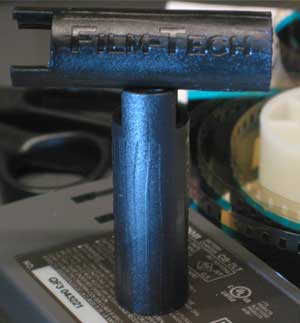
anyways, i've now got a tapeless system for holding media to cores. no, there wasn't, as far as i'm aware, any issue using magic tape. this is just tidier and less hassle, and if the media get rewound too far it's simple to re-secure them. with a razor blade, i scored the cores lengthwise, holding the blade at a bit of an angle to create a grip. it grabs wet or dry media very nicely. time will tell if the grip lessens after many uses.
 -

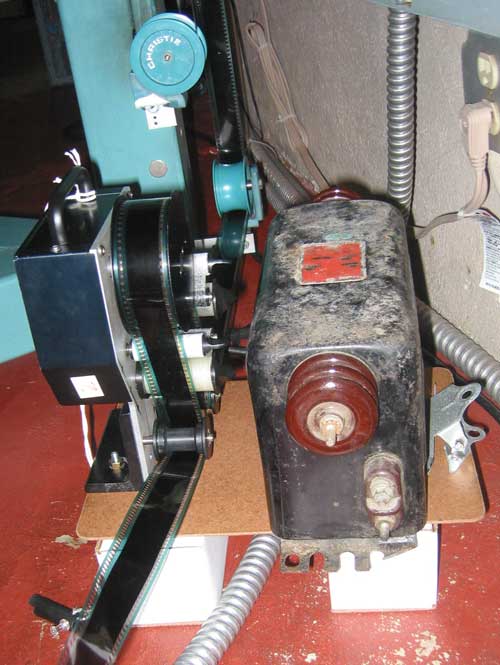
the mounting holes on the aw3 platter seem to be some sort of insert, not just tapped holes. so i'll have to see if these are available somehow for mounting in the return path. but meanwhile, i jury-rigged a cleaner on the floor after the projector. the transformer is just there for ballast.
 -

i ran the week's first f-g application this way, and moved the cleaner to the normal feed-side position for the second show, during which only the slightest streaking was evident, and only when the screen was practically all-white. so i'm pretty satisfied with that.

incidentally, it seems i had been overthinking the saturation procedure all along. i had been carefully going all around the media roll with the spritzer. i wondered how anyone could do this while it was on the cleaner. turns out you can just spritz repeatedly without repositioning the spray nozzle, and the f-g will spread around the roll, with better results, to boot. who knew? oh, yeah, all of you guys.
 
Posted by Randy Stankey (Member # 64) on 04-10-2011, 09:41 AM:
 
First, "Horay for Yankee Ingenuity!"

However, you really need to mount that film cleaner on the platter and clean up the floor around your projector. Rigging things up like that is probably doing more harm than good.

As a test, it's probably fine but, for long-term, you are going to need to do it right.

Second, you don't need tape to hold the saturated media onto the film cleaner shafts.

Cut an empty film core in half, across the diameter so you have a piece of plastic shaped like a letter "C." Use this plastic like a clip to hold the media onto the shaft. You won't need tape. You'll avoid the problem of dissolved stickum and you'll lower your consumption of tape.

Put a full, saturated roll onto the payout shaft, thread it through the cleaner and use the clip to hold it onto the takeup shaft. After each run of film, rewind the cleaner. On an average length movie, you will only use half the roll. The other half will be unused and still saturated on the payout.

When the first half of the roll becomes too dirty to use, simply take a knife or a pair of scissors and cut the media at the end of the dirty part (before you rewind it) and pull it off the cleaner. Then, take the head end of the clean part of the roll and clip it back onto the takeup shaft.

Just be sure you have enough saturated media on the payout roll to cover the print that you are running through the cleaner. You don't want to run out of gauze half way through a movie!

Done this way, you use less FilmGuard, you use less media and you do less work. -- The ergophobe's guide to using FilmGuard!
 
Posted by Carl Martin (Member # 1146) on 04-10-2011, 02:12 PM:
 
randy, i recall reading about your method of securing the media before. never tried it myself but i couldn't figure out how it allowed the takeup core to be locked/unlocked.

the floor isn't filthy there. that's just where paint has flaked off. every time the floor gets vacuumed that bit of conduit gets shifted around, chipping the paint (which is not the best paint, obviously).

anyways, this is just a proof-of-concept. the aim is to get mounting holes on the takeup side of the platter. it already has mounting holes on the feed side.
 
Posted by Randy Stankey (Member # 64) on 04-10-2011, 02:48 PM:
 
You put an empty core on the takeup shaft just like normal. But, since the outside diameter of the core on the shaft is larger than the inside diameter of the core you use as a clip, it's going to be a tight, snap-fit.

Rewinding the media is done in just the same way as you always do. You loosen the screw on the takeup shaft and rewind.

I posted pictures about this, some time ago, but I haven't been able to find them. If I can hunt them up, I'll repost the link.

For testing, your setup is all right.

However, I still prefer to have the cleaner mounted on the feed-out side of the platter. The operator doesn't have to kneel down to rewind and thread the film cleaner. I find it's easier to maintain compliance if everything is near eye level.

UPDATE: I found the pictures:

http://www.film-tech.com/uploads/uploads0503/Clips3.jpg

http://www.film-tech.com/uploads/uploads0503/Clips2.jpg

Original thread where they were posted is here:
http://www.film-tech.com/cgi-bin/ubb/ultimatebb.cgi?ubb=get_topic;f=1;t=010030#000006
 
Posted by Joe Redifer (Member # 3) on 04-10-2011, 06:07 PM:
 
I'm not liking that film twist going into the cleaner. Also, that might be too much tension.
 
Posted by Brad Miller (Member # 2) on 04-11-2011, 01:02 AM:
 
If that is the first pass with fully saturated virgin media pads, then I think it is ok. For subsequent passes though, this is not a good idea. It sounds like that is what his intention is though.
 
Posted by Carl Martin (Member # 1146) on 04-11-2011, 04:35 AM:
 
indeed, that is what my intention is.

incidentally, this print, which we've had well over a month, is far cleaner than the 2 prints we got last week, which have not been film-guarded. too bad it's twice been misthreaded over a roller flange!
 
Posted by Randy Stankey (Member # 64) on 04-11-2011, 08:55 AM:
 
quote:
too bad it's twice been misthreaded over a roller flange!
Sounds like somebody needs to get clobbered! [Wink]


Powered by Infopop Corporation
UBB.classicTM 6.3.1.2