This is topic Wall Fabric vs. Acoustic Panels in forum Film Handlers' Forum at Film-Tech Forum ARCHIVE.
To visit this topic, use this URL:
https://ft-forum.com/ft/cgi-bin/ubb/ultimatebb.cgi?ubb=get_topic;f=1;t=008095
Posted by Lyle Romer (Member # 1266) on 06-23-2006, 10:04 AM:
I'm wondering what the pros and cons of wall fabric vs. acoustic panels are in an auditorium. I'm mostly talking from a technical/sound standpoint. Aesthetically, I prefer panels but some people may like fabric better.
I noticed in the studio movie grill pictures that they used wall fabric. Back in my GCC days, I worked at an older (1985 build?) location. All auditoriums had all walls completely covered in acoustic panels. They later moved to completely covered in THX auditoriums and large acoustic panels with some bare wall showing in non-THX auditoriums.
Posted by Mark Gulbrandsen (Member # 72) on 06-23-2006, 11:40 AM:
Fabric does almost nothing by itself. You still will need to put from 2" to 4" of acoustical material up behind any fabric... depending on your acoustical consultants analysis... before you place the wall coverings over the acoustical panels on the wall. I prefer the look of Acoustical panels fror an astetic viewpoint but it also depoends on the motif of the theater interior. Wall fabrics tends to be a dust magnet.... Hire a consultant!
Mark
Posted by Richard Fowler (Member # 893) on 06-23-2006, 12:07 PM:
Pleated drapery setups like Soundfold will offer some improvement due to the 33% or 50% pleating density. They work much better if behind the drapery there is 1 to 2 inch fiberglas duct liner material, 100% on back wall and at least 50% coverage on the side walls. Wall panels are generally Guilford fabric over rigid 1 inch fiberglas panels ( basically fiberglas rigid duct material ); generally do not do as good a job of sound absorption versus sewn or bracketed drapery. Panels are also a problem if contruction changes at the site are different than the specs supplied to manufacture the panels. There are published sound absorbtion specs for panels and drapes + computer programs to figure problem point of a space based on speakers used and room dimensions.
I recently finished a performing arts center with thick, pleated side curtains for film / video; they are stored in eight variations revealing plaster walls to "liven" the room for stage performances ![[Cool]](cool.gif)
Dirty drapes....must be that cheap burlap that was popular 25 years ago ![[puke]](graemlins/puke.gif)
Posted by Mark Gulbrandsen (Member # 72) on 06-23-2006, 02:32 PM:
quote: Richard Fowler
Dirty drapes....must be that cheap burlap that was popular 25 years ago
I have not seen too many pleasted jobs in a long time but many 10 to 15 year old locations are fairly dusty.... Alot of the western states are just dusty places to begin with and there is not much you can do about it except vaccum off your soundfold. To me Soundfold just plain looks out of style and old school. There are way too many nifty things that can be done with sound panels... at least if its done right. Again... use an acoustical consultant on a big job. I doub't than any of us here could properly do the job of a pro acoustical consultant that has much theater expereince.
Mark
Posted by Adam Martin (Member # 641) on 06-23-2006, 04:33 PM:
quote: Mark Gulbrandsen
many 10 to 15 year old locations are fairly dusty
Maybe if they stopped using that leaf blower in the auditorium and changed the HVAC filters regularly ... oh wait, that would cost money.
Posted by Richard Hamilton (Member # 321) on 06-23-2006, 04:56 PM:
I recently did a service call at a multiplex. When I first arrived, I looked at the presentation of each feature and the sound was pretty bad, except for their 2 big houses. Everything sounded hollow and echoey. Upon inspection of the room, I found that behind the "soundfold like" fabric, it was bare drywall, on every wall. Behind the screen speakers was bare concrete block. I looked at the first room on the analyzer and just told the owner that I would only make sure the sound equipment was operational, I couldn't make it perform beyond what it was capable of. Bad Design, but now he knows for future projects.
Posted by Richard Fowler (Member # 893) on 06-23-2006, 05:12 PM:
The more dead the room, the easier to do something with ![[Wink]](wink.gif) Soundfold with certain fabrics and wide spaced economy pleating does not do much....with surround speakers cross firing, even less...but it is a start from a bare wall. Room geometry plays greatly in sound quality.
Soundfold with certain fabrics and wide spaced economy pleating does not do much....with surround speakers cross firing, even less...but it is a start from a bare wall. Room geometry plays greatly in sound quality.
Posted by Lyle Romer (Member # 1266) on 06-23-2006, 09:23 PM:
quote: Richard Fowler
Room geometry plays greatly in sound quality.
Isn't the idea to use the acoustic panels/fabric to "deaden" the room and take the room geometry out of the equation as much as possible. Obviously you can't completely take it out unless you build the auditorium as an anechoic chamber. It'd probably be hard to maintain the pointy foam cones on the floor though!
Posted by Tommie Evans (Member # 2674) on 06-23-2006, 09:47 PM:
quote:
It'd probably be hard to maintain the pointy foam cones on the floor though!
Unless you cover the floor with seats and people?
Posted by Cameron Glendinning (Member # 3516) on 06-23-2006, 11:10 PM:
You do not need to use either heavy drapes or acoustic panels, you can also use plaster, 3d shapes, non parallel walls. The aim is to break up the sound on its first bounce. In my opinion deadening backstage is the most important factor, early reflections are what makes dialogue hard to understand.
Here is a photo of the first cinema I custom built a complete speaker system/ cinema opened 1995 First art modern cinema built in 40 years in Sydney Australia

Within 3 months of opening, The Audio Guild (sound mixers) forced the Australian Film Institute to hold the NSW Judging for audio category AFI Awards in only this screen.
Backstage is damped by fiberglass, weight is the important factor, 3.5 kilos per sq metre. Components by JBL when they actually made them, before the parts were consigned from asia.
On the walls no curtains, acoustic panels, just deliberate use of plaster work to break up sound.
Ported boxes backstage incorporated large 1/4 wavelength designed wings.
This theatre is long and narrow and holds aprox 350, traditionally a bad shape as the ideal acoustically would be 0.6 x 1 x 1.6 the traditional Egyptian pymamid brick shape that most speaker boxes are based on.
My later systems moved away from the ported design in preference for an extremely large sealed box known as the infinite baffle box with 1/4 length wavelength wings, similar to altecs final approach to cinema systems before they disappeared. This aproach created the most realistic and natural results before going to the expense of a totally active 4 way horn loaded system.
Speaking of which, When the Chauvel re opens here in Sydney, it looks like this will be the type of system installed. www.lenardaudio.com
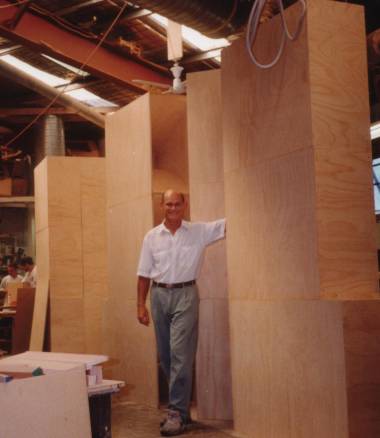
This is the sub and mid bass only, enclosures are aprox 18" deep, 3.5 metres high( 11 ft? ) Sounds incredible!!!
Also 4 way horn loaded systems still sound very good in rooms with poor acoustics, which I confess, I dont understand why.
[ 06-24-2006, 12:50 AM: Message edited by: Cameron Glendinning ]
Posted by Dan Lyons (Member # 1454) on 06-24-2006, 01:44 AM:
![[Eek!]](eek.gif) GORGEOUS!!!!
GORGEOUS!!!!
What's the jumble of white stuff and railings up front on the right?
Posted by Paul Trimboli (Member # 1509) on 06-24-2006, 09:02 AM:
Wow that is a nice looking cinema Cameron, where abouts is that?
I always wondered how some of these old cinemas could have such good accoustics with out the pading type acoustic panels or heavy curtains, but as you explained you can use plaster and 3D shapes. That explains hows this cinema I used to work at picture below can have such good accoustics, although some of the wall is covered in acoustic tiles. They are sort of an airated plaster which I think I was told is packed with hair?

Posted by Mark Gulbrandsen (Member # 72) on 06-24-2006, 09:52 AM:
Nice theater Cameron! I've always had a problem with full horn loaded systems sounding naisley on dialog though... at least thats been my expereince here with the systems made by the big "K".
MArk
Posted by Charles Greenlee (Member # 3856) on 06-24-2006, 11:40 AM:
Very nice look to it. Real ultra modern looking. As far as sound material goes. I like the old school look with the curtains, was well as screen curtains (in addidtion to the masking). It just adds that extra touch. But the theatres that have them need to make sure they back them with accoustical panels, for sound purposes, and for gods sake, take them down and have them cleaned occasionally. I hate smelly, dusty auditoriums, with gum imbeddded in the curtains. And yes, I have the leaf blower thing, it's hard enough to get the cleaning crew to mop our floors. It's like, its dark, alot of kids, 55oz. badder burster coke = sticky floor. Sorry for the anger, but anyhow, curtains look nice. And you never know, maybe a combo of curtains and panels, depends on how it looks.
Posted by Richard Fowler (Member # 893) on 06-24-2006, 04:05 PM:
You do not always need sound deadening in a properly designed performance area but most multiplex construction is basically a dressed up warehouse space ![[Roll Eyes]](rolleyes.gif) . Bellas Artes Performing Arts Center in Caracas, Venezeula has wooden strips with acoustic traps in the angled side walls to great effect. Gusman Theatre in Miami, a classic atmospheric, we found the acoustics and sound projection good enough that after a sound check with Dame Joan Sutherland on her farewell Opera tour, her lead microphone was not used since she was clearly heard all away to the back of the house ( 136 feet / 61.8 meter ). Mark's note on "K" 4 way system being a pain to EQ....they sound better with electronic crossovers than the passive units. JBL is making some parts out of the USA but compared to some of their competition, not as bad. Their Main office and Plant in Northridge, California is something to see since they have 12 - 15 mini-manufacturing stations with most able to be rapidly retooled for different runs
. Bellas Artes Performing Arts Center in Caracas, Venezeula has wooden strips with acoustic traps in the angled side walls to great effect. Gusman Theatre in Miami, a classic atmospheric, we found the acoustics and sound projection good enough that after a sound check with Dame Joan Sutherland on her farewell Opera tour, her lead microphone was not used since she was clearly heard all away to the back of the house ( 136 feet / 61.8 meter ). Mark's note on "K" 4 way system being a pain to EQ....they sound better with electronic crossovers than the passive units. JBL is making some parts out of the USA but compared to some of their competition, not as bad. Their Main office and Plant in Northridge, California is something to see since they have 12 - 15 mini-manufacturing stations with most able to be rapidly retooled for different runs ![[Razz]](tongue.gif) .
.
Posted by Cameron Glendinning (Member # 3516) on 06-26-2006, 09:14 PM:
Paul Trimboli
quote
Wow that is a nice looking cinema Cameron, where abouts is that?
The Hayden Orpheum Picture Palace in Cremorne, Sydney, Australia.
That screen is called the Walsh and is inspired by the original Odeon Lester Square in London. It now has 6 screens. All are based and styled around a dress circle conversion into a stadium of the original 1935 Egytian inspired art deco auditorium in the 80's, quite a mouthful, please note that only 2 cinemas feature my speaker systems.
nice cinema you have there Paul, whats its name? location?
Dan Lyons
quote
What's the jumble of white stuff and railings up front on the right?
Not sure what you mean, do you mean the disabled access in the entrance? or did you notice that the cinema doesn't have any light bulbs to change, as is 100 % consealed neon
Mark Gulbrandsen
quote
I've always had a problem with full horn loaded systems sounding naisley on dialog though..
yes I think I know what you mean, horn loaded loudspeakers have a reputation for beeing hard to do right. The Lenard speakers I have heard simply sound better and more natural than any speaker I have built, I have not heard the Grand by K yet, so my references to 4 way systems are all based on Lenard Audio,
Lenard has been building them in small quantities for 30 years or so, unfortunatly not for cinema. John Bernet who is in the photo in front of his prototype, was one of pioneers of high power amplifer design in the 1970s and whos company was instrumental in the development of the first 3" and 4" voice coiled loudspeakers.
This project is his own personal vision.
Richard Fowler
quote
but compared to some of their competition, not as bad
I agree JBL and EV are very good ![[Smile]](smile.gif) It was the idea of the speaker coming from the same factory, the same hands and same design as the components that the films are actually mixed on, was pretty much the reason I liked using them, the shift in production simply gave me an excuse to use much cheaper but equally impressive sounding components.
It was the idea of the speaker coming from the same factory, the same hands and same design as the components that the films are actually mixed on, was pretty much the reason I liked using them, the shift in production simply gave me an excuse to use much cheaper but equally impressive sounding components.
In the real world of loudspeakers, variations in specifications between different production runs in the same factory are normal. These variations can affect the tuning of bass reflex boxs. Not a big deal if you do small quantities and tune each box by ear like I did.
Posted by Jarrad Salmon (Member # 3818) on 06-28-2006, 06:07 AM:
Some great designs there...
Basicaly evey surface of an enclosure will have a resonance. They can just get rather complicated working out the resonant frequencies they absorb and reflect.
Most of the quick fixes I see are carpeted pannel absorbers to dampen the reflections while absorbing the problem frequencies.
You will need to hire a pro to come and look for the specific issues
Posted by Michael Schaffer (Member # 1204) on 06-28-2006, 04:23 PM:
quote: Paul Trimboli
I always wondered how some of these old cinemas could have such good accoustics with out the pading type acoustic panels or heavy curtains, but as you explained you can use plaster and 3D shapes.
A lot of old movie theaters were simply modelled on actual theaters with the only difference that you had no live actors, therefore no deep stage and no stage house. But the rooms were built to be movie theaters and they could draw on a lot of experience from centuries of building theaters. It never ceases to amaze me how many old theaters and concert halls which were basically built by eye have so much better sound than many new concert halls which are the result of very complex acoustical design studies. Hahaha...
Posted by Richard Fowler (Member # 893) on 06-28-2006, 06:21 PM:
Sabin units are a standard by which acoustical reflection/absorption are figured in a performing space based on studies done by Wallace Sabin at the turn of the last century. Symphony Hall in Boston, which opened in 1900 used his principals in construction. His research help to standardize the "art" of acoustics. "Collected Papers on Acoustics" based on his work was published 1993. There are acoustical computer programs available to measure Sabin units and reactions of wall treatment, room volume, and other factors. Acoustical Engineering based in the Netherlands has computer programs for this type of work. SIA software in New England handle industry favorite Smaartlive and Acoustic programs which where formerly distributed by JBL.
As for acoustics, The old La Scala Opera House in Milan has great acoustics....it has been around for 228 years
Posted by Michael Schaffer (Member # 1204) on 06-28-2006, 07:01 PM:
Design of the Symphony Hall in Boston was actually based on the Gewandhaus in Leipzig and the Concertgebouw in Amsterdam, mostly on the former though. It is actually a scaled down copy of the Gewandhaus. Or was it scaled up? No, I think down. Well, I don't remember. The old Gewandhaus isn't there anymore for comparison. It was bombed during the war. Apart from the scaling, Sabin did change one parameter though, and he used his new insights to arrive at the exact height of the ceiling based on the changes in scale he had made from the model building. Which in itself had been built in the traditional way, without much acoustical engineering.
BTW, do you pronounce the name Saybn or Suhbeen?
An impressive number of modern concert halls are either very problematic or suck completely, despite all the science, like Avery Fisher Hall in NY or the new hall in Philadelphia, or the Barbican Center in London. The new Walt Disney Hall in LA, on the other hand, is very successful. I wonder how much of that was just a good feel for design, and how much actual calculation based design.
But we are wandering a little off topic here. Concert halls are infinitely more complex to design than cinemas, and in cinemas, you have at least a fairly well defined source of sound and fairly set standards.
Posted by Richard Fowler (Member # 893) on 06-28-2006, 07:22 PM:
Say Bin...Yes, he based much of his work on research of successful acoustics in a survey of theatres. Like I said, most cinemas are dressed up warehouses and some benefit from the acoustic dead wall of a stack of stadium chair backs ![[Big Grin]](biggrin.gif) .
.
Miami Performing Arts Center with 2400 + 2200 + 200 seat halls will open this October, two years behind schedule...hope it works well...it has sparked an upgrade of other spaces in the region to improve.
Posted by Michael Schaffer (Member # 1204) on 06-28-2006, 08:03 PM:
A performing arts center with opera house and concert hall.
In Miami.
Why?
Deep overhanging tiers.
That won't work. It never does. When will they learn?
Posted by Richard Fowler (Member # 893) on 06-29-2006, 09:39 AM:
Miami's version of "Fitzcarraldo". I was on the advisory group in the initial planning many years ago...I it will be nice to see what was incorporated...if anything
Powered by Infopop Corporation
UBB.classicTM
6.3.1.2