This is topic Film is nitrate... now what? in forum Film Handlers' Forum at Film-Tech Forum ARCHIVE.
To visit this topic, use this URL:
https://ft-forum.com/ft/cgi-bin/ubb/ultimatebb.cgi?ubb=get_topic;f=1;t=008152
Posted by Philip Borgnes (Member # 2383) on 07-19-2006, 01:58 AM:
I wound up getting a copy of a film called "North Sea" off of eBay. It appears to be a very good original copy printed in 1939 (per the edge code). The edge code also says "Nitrate Film". Now what do I do? I don't have a place to store it or project it because it is Nitrate. Nor do I want to toss it. Serves me right for not checking it out and asking what the stock was...
Any suggestions?
BTW, it was sent via UPS in a crumbly old box with no hazard notice. Unbelievable...
Posted by Dustin Mitchell (Member # 372) on 07-19-2006, 03:43 AM:
It might not be nitrate. The nitrate edge markings ccould just be from the negatives. Leo and/or John P. will be along shortly to let you know how to tell the difference for sure.
Posted by Monte L Fullmer (Member # 2797) on 07-19-2006, 03:59 AM:
Could be full nitrate, since the printing negative was in nitrate, but a very slight possibility of a safety positive..
Look at the edge for both lettering. If you see a black lettered "Nitrate" (meaning the positive) and a faint, white lettered, "nitrate",(the negative) then the stock and negative were both nitrate based.
Also, there would be black hash marks that would run the same direction as does the frameline..on the edge of the film. When safety came out, the hashmarks then would run in the same direction of the filmpath..in a vertical direction.
Nitrate can be still shown, but under extreme careful circumstances..
Big problem is that the nitrate base would shrink after time (if it hasn't started to deteroriate and gone to goo or powder..) - why that 98 release of "Gone with the Wind" was so bad - due to the original three strip nitrate negatives had shrunk some and cause color bleed in the YCM.
I have some Nitrate prob dated in the early 40's and still supple and flexible..and without any shrinkage..but can't run these at work for insurance reasons...
-Monte
Posted by Marin Zorica (Member # 1716) on 07-19-2006, 04:24 AM:
Hm..1939 I also think is probably nitrate, but that isn't problem, You probably can't wait to put in projector, isn't it? ![[Smile]](smile.gif)
Use some projector with 900W bulb or so, or something portable, because heat isn't big like in stronger lamphouses, so is smaller chance to get film burning!!!!
Posted by John Wilson (Member # 269) on 07-19-2006, 04:51 AM:
Whatever you do with it...make sure you let the guy who sent it know what an idiot he is for sending it to you that way. If anything nasty had happened en route...it's possible you could have been implicated too.
These are different times we live in.
Posted by Thomas King (Member # 2745) on 07-19-2006, 05:24 AM:
I'm amazed you treat it so lightly! Nitrate film scares me to a point where I'd just run. Can't it spontaneously combust if not stored right? From everything I've heard, it's really phenominally dangerous.
I think the sure-fire way to test if it's nitrate is to cut off a small piece and then set light to it and drop it in a bucket of water. If it carries on burning; nitrate.
Posted by Cameron Glendinning (Member # 3516) on 07-19-2006, 05:42 AM:
yes burn a frame, thats how we cheaked them at the National Film Theatre in London, Although if it was nitrate we would still run it! Just rebuild the airtight compartments on the cinemacanicas and hook up the co2 canisters to the projectors. The projectors had fire extinguishers built in.
Posted by Stephen Furley (Member # 1277) on 07-19-2006, 06:08 AM:
Calm down, don't panic.
It's quite likely that it's a safety print, but you shouldn't assume anything. look at the edge markings again; are there multiple markings? are there both safety and nitrate markings? Are the nitrate markings black on clear or clear on black?
You could try cutting off a small clip of film and igniting it, but do so well away from the rest of the reel! Remember that if there is a splice then you may be dealing with more than one type of stock; just because the leader is safety doesn't mean that the rest of the print is. If you hold a flame to the top of the clip of film and it shrivels up, blackens and smokes a bit, but any flame goes out when you thake the source of ignition away then it's probably safety. If it continues to burn with the flame travelling down the film, then it's probably nitrate. Watch your fingers, flame travels quickly on nitrate.
Don't take the print into a theatre unless you're certain it is safety; to do so with nitrate would almost certainly be illegal, and you would find yourself in serious trouble if an inspector got to hear about it.
What does the film smell like? Is the print in good condition? If it smells really bad, is sticky and covered in brown goo it's sounds like nitrate in advanced stages of decomposition, which is dangerous. If it's nitrate, but in good condition, it will be fairly stable. If you cannot be certain that it's safety then keep in in a cool, dry place, where it wouldn't do any harm if it should ignite, i.e. don't keep it under your bed as somebody I know did! Having a reel of nitrate film at home to inspect, clean, repair etc, wouldn't be a great problem, but *never* leave any in the house while you are asleep. If you had an ordinary house fire for whatever reason, then having nitrate around will not help matters, and if you are asleep then you might well not get out; fumes from burning nitrate are nasty.
If you are not certain that the film is safety then have it inspected by somebody who can tell the difference; contact your nearest film archive for advice.
Do not project the film until you are sure that it is safety; even with a low-Wattage lamp. The only safe way to project a nitrate print is in a projection room properly built and equipped to do so, and there are very few of those around now. Even then, you need to do a lot of work before projecting the film.
Do you drive a car? Does it run on petrol? The answer is probably yes. Do you panic about the thought of driving around with a tank full of petrol behind you? Probably not. Petrol is a hazardous substance, but if you take sensible precautions then it's pretty safe to handle; it's the same with nitrate film, but to most people it's much less familiar. You wouldn't keep an open dish full of petrol at home, would you? It's the same with nitrate.
Safety prints from nitrate negatives are quite common; other than in film vaults and archives there are far more of those around than there are nitrate prints. I would say the chances are that you have a safety print, but don't assume anything, and *don't panic*.
Is this 'North Sea' the short that was made by the GPO Film Unit at about the same time as 'Night Mail', promoting an early ship-to-shore radio system? If so i've got a very old 16mm print of it.
Posted by John Wilson (Member # 269) on 07-19-2006, 06:21 AM:
quote:
Use some projector with 900W bulb or so, or something portable, because heat isn't big like in stronger lamphouses, so is smaller chance to get film burning!!!!
Not quite...here's a couple of shots at what a dud splice will do with just 300W behind it.
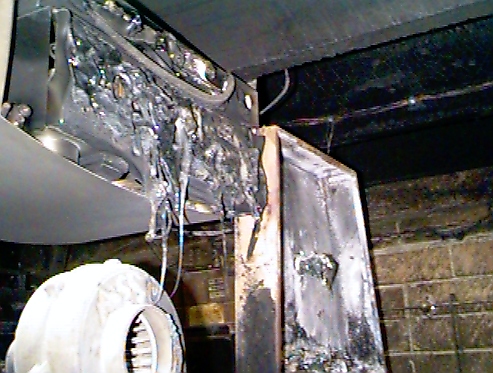
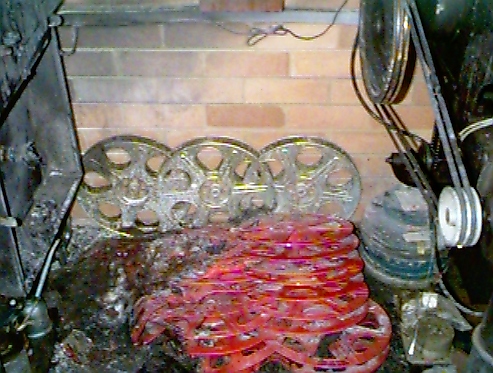
Now...I'm not trying to scare anyone here...but as you can see, you do need to be rather careful. Also, if you're planning on running nitrate in a public cinema...best check on the local ordinances first. Most won't allow it and if it does go up...there goes any chance of an insurance claim.
Posted by Philip Borgnes (Member # 2383) on 07-19-2006, 06:34 AM:
Thanks for the posts. No panic here, just bummed that I won't be able to show the print.
I'll go a take a photo of the edge markings and post it here for folks to see. As i recall the markings are very clear printed black with on clear no white letters to indicate that it was a dupe.
Yes Stephen this is from the GPO Unit. BTW, I just ordered a DVD of the film from England. Should be here next week in a nice shiny new box without the explosive warning.
Speaking of explosive, I remember reading in Ripely's Believe it or Not when I was a kid about a guy in prison who made a pipe bomb out of a deck of cards also made of nitrate cellulose.
Posted by Robert Harris (Member # 1712) on 07-19-2006, 06:44 AM:
Consider donating to an archive. AMPAS in Los Angeles would be appropriate.
Posted by Mitchell Dvoskin (Member # 751) on 07-19-2006, 07:43 AM:
As everyone has said, check the edge code. If there is both Safety and Nitrate markings, the one with black lettering is correct, the white or clear is print thu from the negative.
If the film is on older Eastman/Kodak safety stock, there is a ultraviolet die that will cause the film to glow purple under a black light. Nitrate film will not. PS, thanks John P for that info.
35mm Safety film was introduced in the USA in 1950, and by the end of 1951 everything was Safety. If on Eastman/Kodak stock, you can check the date code on the edge. The date code is a 2 character code consisting of geometric shapes that tell you what year the film was manufactured. Go to Date Codes to see a chart that translates the codes to years.
And of course, you can always cut off a strip of 5 or 6 frames, hold it over a sink with pliers, and light it. If it goes out, it is safety. If it burns to ash, it is nitrate.
Nitrate is not particularly dangerous to store if it is in good condition. The problem is that if it is starting to decompose, it gives off explosive gasses and it's spontainous combustion point starts to approch room temperature.
Do not run Nitrate on any projector that is not set up for nitrate. It is dangerous to do so, and in most states, illegal. Nitrate film produces it's own oxegen and will burn even under water. It is very hard to put out once you ignite it.
Posted by Stephen Furley (Member # 1277) on 07-19-2006, 07:43 AM:
quote: Philip Borgnes
Yes Stephen this is from the GPO Unit.
Here's a frame from the main title on my 16mm print:

I very firmly believe that some basic nitrate training, including actually handling some reels of the stuff, should be mandatory for everybody handling 35mm film today. This doesn't even need to be enough to be able to positivly identify it in every case, but enough to aware of the possibility of a nitrate print turning up one day, and to be able to seek advice if they're in any doubt at all as to what they are handling.
There is much less nitrate film around today, outside of vaults and archives, but there's also much less knowledge of it among today's projectionists, so in some ways the risk may be getting greater.
Imagine something like a member of the public saying to a theatre manager "I've got some film at home of <some local event>, it's the 70th anniversary next month, would you like to show it" Or a theatre books a classic film; very poor print turns up. Somebody says "I know a bloke that's got his own copy of that, and it's in really good condition; I'm sure he'd lend it to us. We can run that instead, and nobody will be any the wiser."
I'm sure that nitrate prints do get run from time to time in these sort of circumstances, and usually everything is ok, but one day something nasty will happen, and the consequences of a platter full of nitrate film going up in a large crouded multiplex theatre, with large projection room windows, audience seeing what's happening and panicing, some of the exits quite possibly passing the door to the projectionion room etc. could be very serious.
Posted by Mark Gulbrandsen (Member # 72) on 07-19-2006, 07:46 AM:
quote: Robert Harris
Consider donating to an archive. AMPAS in Los Angeles would be appropriate.
Humm... I recently helped move back a pick up truck full of Nitrate film from Las Vegas (via the desert no less) to Salt Lake City because NONE of the archives wanted any of it. In talking to the owners of the collection I got the impression that had they just donated it to AMPAS or UCLA, or another archive that it would have probably just been tossed. There was some really neat Technicolor stuff and a near mint B&W original print of "Hurricane". All of it has since been parted out to other collectors so it is good hands. Man it must have reached 150 degrees in the back of that truck! Had it gone up we'd have looked like a meteorite streaking across the desert ![[evil]](graemlins/evil.gif) .
.
Mark
Posted by Steve Guttag (Member # 268) on 07-19-2006, 09:13 AM:
I know for a fact that UCLA archives and still runs Nitrate films as does the Library of Congress....in fact in 2007 we will be installing as many as three rooms for Nitrate projection, including one that will be open to the public. To paraphrase, Nitrate isn't bad, it's just stored that way.
Posted by Stephen Furley (Member # 1277) on 07-19-2006, 09:46 AM:
Surprisingly, Kinoton can still supply new projectors fitted with fireproof spoolboxes; there's a picture on the back of this
datasheet
I'm quite surprised that they still offer these. The ones in the picture are actually fitted to a FP38 E-Q; Leo, that's just what you needed for that 16mm nitrate print that you had turn up once!
They also offer a different type of spoolbox, but these are made of plastic, and are just to keep dust off the film. There's a picture of these fitted to a SP75E
here
Posted by Mitchell Dvoskin (Member # 751) on 07-19-2006, 09:55 AM:
Surprisingly, Kinoton can still supply new projectors fitted with fireproof spoolboxes; there's a picture on the back of this
There is still to much open area for me to feel comfortable running nitrate on that projector.
Many years ago, we ran a nitrate print of Hitchcock's Foreign Corrispondant on a platter. We did not know any better at the time. Knowing what I know now, I shutter to think what would have happened had there been a fire.
Posted by Stephen Furley (Member # 1277) on 07-19-2006, 11:28 AM:
quote: Mitchell Dvoskin
Many years ago, we ran a nitrate print of Hitchcock's Foreign Corrispondant on a platter. We did not know any better at the time.
Do you mean that you didn't know that it was nitrate, or that you knew, but didn't understand the risk of showing it?
This does seem to back up what I said before about training. If Mitchell could do this years ago there must be a much greater chance that a projectionist would do so today. I suspect that the majority of projectionists today, if you were to hand them a nitrate print would run it without knowing what it was, or understanding the danger involved. Most of them have probably never seen a nitrate print, and a fair number have probably never heard of such a thing. Even with the surviving nitrate prints now being rather old and probably brittle, 99 times out of 100 it would run through ok, and nobody would know about it, but I fear that one day there will be a serious accident.
Posted by John Pytlak (Member # 331) on 07-19-2006, 11:30 AM:
Here is the Kodak publication about safe handling, storage, transportation, and disposal of cellulose nitrate film:
http://www.kodak.com/US/en/motion/hse/nitrate/index2.jhtml
http://www.kodak.com/US/plugins/acrobat/en/motion/hse/H-182.pdf
quote:
This publication will help you understand the requirements to safely handle, store, transport, and destroy cellulose nitrate-based films
As mentioned, if the "NITRATE" edgeprint on a print is black letters against a clear background, it is most likely nitrate film. White letters against a dark background indicate the negative was nitrate, and the print may be either nitrate or safety film. A "burn test" of a small sliver of the film (outdoors and with good ventilation) can be used to verify --- hold a clip about the size of a frame in a pair of needle-nose pliers, and carefully light the corner with a flame --- nitrate will burn very quickly, with a bright orange flame. Be sure the film sample you test is representative of the film --- many times safety film was intercut with nitrate (e.g., leaders).
For now, store the film in a COOL DRY place that is NOT inhabited. NEVER try to project the film in a projection room that is not certified for nitrate projection. A film archive MIGHT be interested in preserving the film, depending on its condition and whether other (better) copies are available.
Like it or not, you are now in possession of a material that is legally considered very hazardous, and covered by stringent regulations for storage, shipping and disposal. Follow the guidelines in the Kodak H-182 publication.
Posted by Bill Gabel (Member # 1105) on 07-19-2006, 12:00 PM:
quote: Steve Guttag
I know for a fact that UCLA archives and still runs Nitrate films
Their projection rooms are all certified for nitrate projection. And their projectionists hold the special city license from the fire department to run nitrate. That is the only license left on the books in Los Angeles for projectionists. Here in NYC with their projectionists license, you can not run nitrate.
Posted by Steve Guttag (Member # 268) on 07-19-2006, 12:08 PM:
For projection, follow NFPA 40.
As to the openess of the Kinoton projectors...only in America did everything get buttoned up tighter...really tight in Mass.
However, there is no need for concern about the "openess" of the projector...if you think about it...in the event that the film does ignite...it will quickly burn towards the reels (like a fuse). The amount of time that the flame area is out in the open is very small...having doors on the machine really will do very little if anything at all as far as protection to life or property.
If you are lucky, the fire rollers will snuff out the flame (note, the Kinoton magazines for the FP38EQ have fire rollers too). If the flame does not get extinguished by the fire rollers...it will be a bad day anyway for the after effects of a nitrate fire on a magazine are not pretty.
(magazine = spool box, depending on which side of the pond you reside).
It is nice that someone is indeed offering Nitrate rated machines in any event.
Steve
Posted by Rick Raskin (Member # 1561) on 07-19-2006, 02:28 PM:
Pictures in the archive of the aftermath of a Nitrate Fire
Posted by John Pytlak (Member # 331) on 07-19-2006, 03:03 PM:
quote: Rick Raskin
Pictures in the archive of the aftermath of a Nitrate Fire
Rick: I see you took those photos. Did you work at the AFI Theatre in the JFK Center when the fire occurred? How did it happen?
Posted by Steve Guttag (Member # 268) on 07-19-2006, 04:28 PM:
Note, the projector still ran after that though it was moved to the #1 position and eventually removed. An odd after effect of the fire came when we reworked the sound system in the early '90s and found that the 4-track mag wires had melted in the upper trough that sat just above the upper magazines.
The current AFI theatre, the AFI/Silver is not nitrate rated and that decision was made before construction began. The AFI Theatre at the Kennedy Center is no longer there. It ceased operation about a year ago and has been gutted for use by the Kennedy Center.
Posted by Stephen Furley (Member # 1277) on 07-19-2006, 04:36 PM:
Philip still doesn't know whether this print is nitrate or safety; he really does need to find out for sure. Until positivly identified as safety this print really should be assumed to be nitrate, and handled and stored accordingly. Several of us have give pointers to clues as to the type of stock, but to positivly identify it really does need somebody to actually examine the print. Unlike most feature films, 'North Sea' did not have a release and then disappear; it is still shown from time to time, and is quite likely to have been re-printed at various times in its life. At this point we cannot rule out either the possibility of this being an original nitrate print, or a later safety re-print. If it is original, and is in good condition, it may well be a very good print; it would probably have been made from the original negative, and only a relatively small number of prints would have been made, so the negative should have been in good condition. It's a pity that it's now almost impossible to screen a nitrate print.
I think those who posted the pictures of the aftermaths of the nitrate fires were right to do so. A nitrate fire, even a small one involving just a single reel, is a serious matter, and the suggestion which was made to project it with a 900W lamp, or using a portable projector, was clearly unwise.
The pictures of the fire at the JFK Centre are interesting. Assuming that ignition occurred in the gate, the fire trap in the upper spool box was ineffective, as the fire has spread to the reel in that box. However, the spool box does seem to have done it's job; there's little sign of damage outside the projector and the spool box, the extract ducting and the front wall of the projection room, for example, appear to be largely undamaged. Even though the fire spread to the reel, it was almost certainly conained there, and would not have spread to the other machine, or other reels of film. It is unlikely that the projectionits would have had any great difficulty in safely escaping from the fire, (I certainly hope that was the case) unless the projection room was very badly designed, in which case it should never have been given a nitrate licence. In the first picture it looks like the fire shutter has dropped into position, and so the danger to the audience would have been just about nil. This would clearly not be the case in many modern cinemas, where the effects of a fire would have been much more serious, and clearly shows the importance of not running nitrate in venues not designed, equipped, maintained and licenced to do so. However, I do not believe that there should be a total ban on screening nitrate. I think a few venues, suitably equipped, and with appropriatly trained staff, should still be able to do so.
I think the ccomparison which I made with petrol was a valid one. Both are clearly hazardous substances; I could have posted a picture of a burned-out car, where the fuel tank had caught fire, and the results would have been even more devastating than the small nitrate fires shown here. We do not ban cars, nor the use of petrol to power them, though petrol is probably more dangerous than nitrate, and certainly more volatile. We ae not promoting safer fuels or use in cars, Diesel, for example, nor installing fire supression systems in them. What we do with petrol is to take sensible precautions; we don't smoke while filling vehicle tanks, we don't give it to children to play with, we don't store in in unsuitable containers, or keep it inside houses.
I think in some ways the almost total removal of nitrate film is a bad thing. It's not neen wiped of the face of the Earth, so there's still a chance that a nitrate print could find its way into a cinema, yet it's now become so uncommon that most projectionists have probably never handled it, wouldn't recognise it if it did turn up, and might well screen it in inappropriate venues, with possibly disasterous results.
I know that it is the policy of several major archives here to retain original nitrate elements which have been copied, for as long as they remain printable. This is a good policy, though no doubt not a cheap one. There have certainly been cases where safety dups have proved to be of poor quality, or have deteriorated faster than the nitrate originals.
Posted by Philip Borgnes (Member # 2383) on 07-19-2006, 05:20 PM:
Ok. Here are photos of the reel. I'll let them speak for themselves. Tell me what you see.
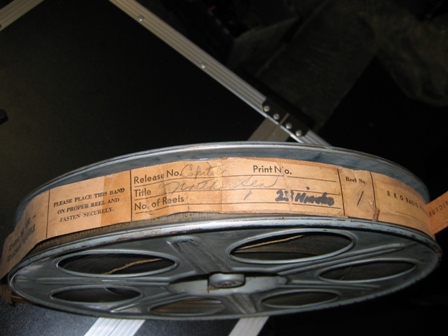
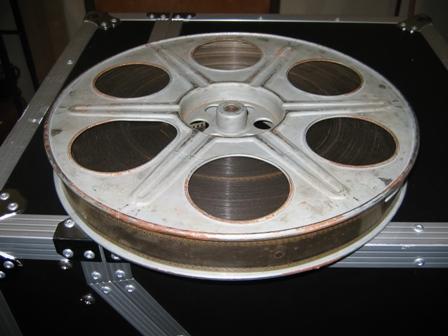
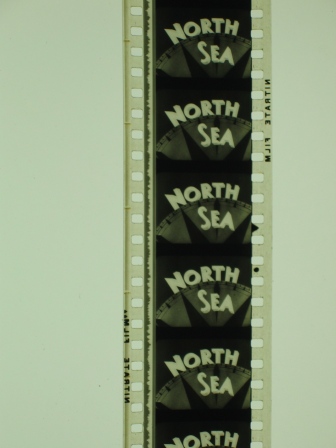
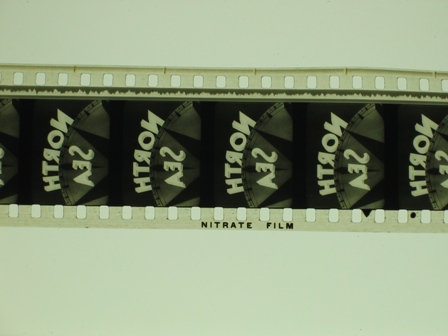
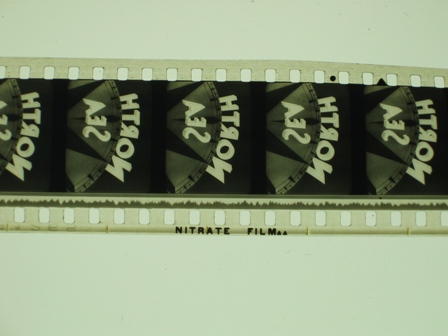
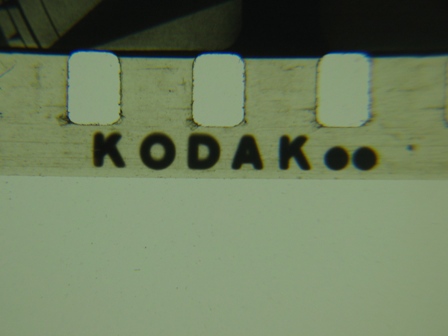
Date code of 1939
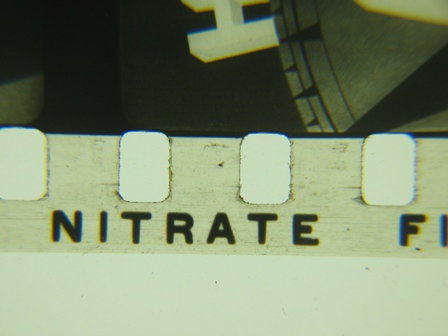
Can it be much clearer?
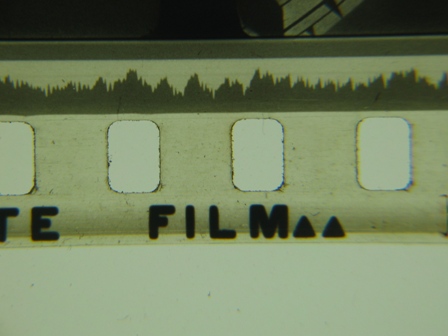
What are these triangles? Some special code?
Posted by Rick Raskin (Member # 1561) on 07-19-2006, 05:30 PM:
quote: John Pytlak
Rick: I see you took those photos. Did you work at the AFI Theatre in the JFK Center when the fire occurred? How did it happen?
Yes John, I was working as second man that night. The film was in poor condition and was patched as best could be. But it broke at the intermittent sprocket midway through reel 3. I was standing right there but before I could close the dowser a fire broke out. Interestingly, the film on the take-up reel remained intact through the fire. The AFI was back on the screen the following night after we moved the #1 head, which was used primarily for interlock, over to the bad #3 position. The burned head was repaired by another of the projectionists and later reinstalled on the #1 position as Steve said earlier. I didn't know about the later mag head wiring problem but we did repair the optical feed when we were cleaning up. We made the newspaper on that one, but thankfully un-named.
Posted by Philip Borgnes (Member # 2383) on 07-19-2006, 05:35 PM:
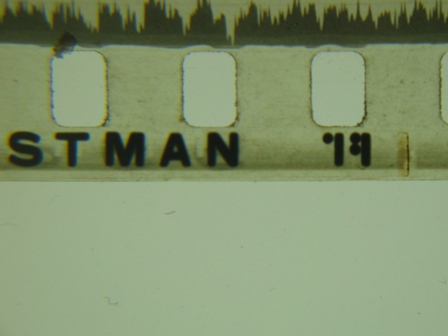
More bizare symbols? Crop circles next?
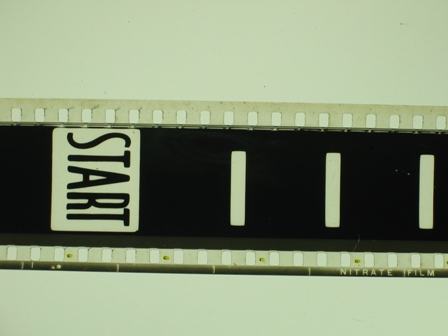
The leader appears to be a copy of Nitrate on Safety
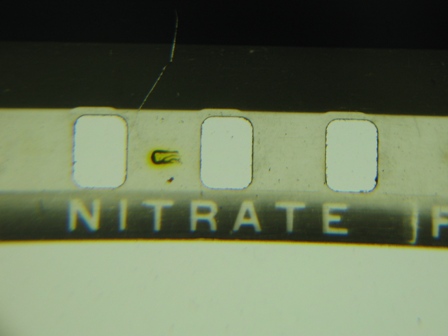
Here is what a copy looks like of the Nitrate symbol.
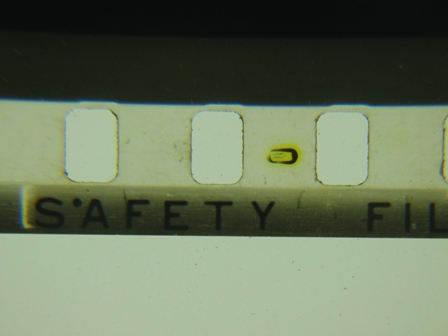
Leader marked Safety.
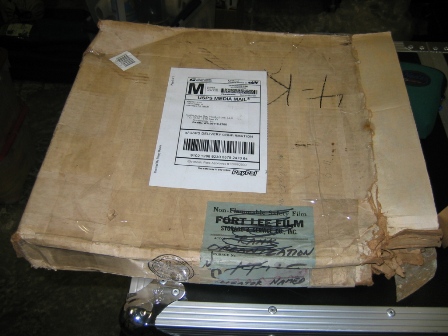
The wonderful fire-safe packaging... NOT!
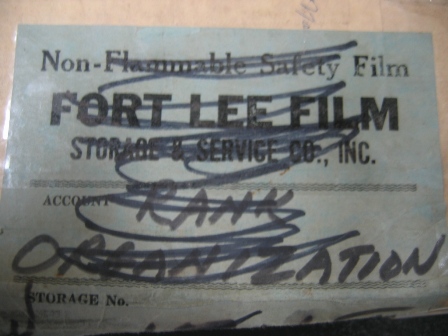
"Let's see, if I cross out non-flamable that will make it a flamable warning..."
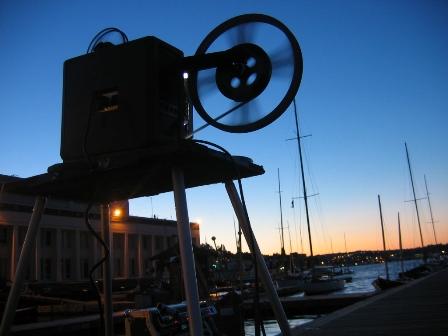
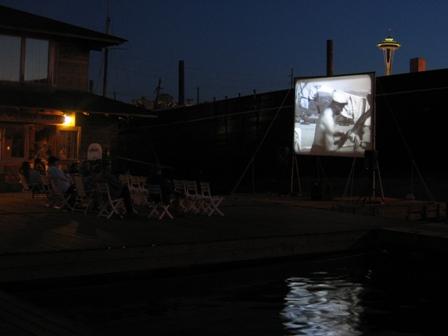
In case you were wondering what I have this film for, it is for a series of maritime films we are showing. Here are some shots from last weekend in Seattle showing 16mm on the water. Some folks even came by boat. How cool is that?
Posted by Leo Enticknap (Member # 534) on 07-19-2006, 05:46 PM:
Philip: the symbols on the edge marking are a code which identifies the year in which the film stock is manufactured. Here is an identification chart. Two triangles indicates the year of manufacture as being 1941 - interesting, given that the film was made in 1938. It must have been reprinted for a subsequent (theatrical, given that the gauge is 35mm) release, I guess.
As for the safety issue, I tend to agree with Stephen that we happily drive around with enough fuel in our cars to blow us into orbit, and so there is a certain amount of paranoia around. However, if it does ignite when you don't want it to, it is very dangerous, as the nitric acid fumes are highly poisonous (they cause inflammation of the lungs, which can lead to suffocation) and the fire cannot be extinguished with water, because the combustion process generates its own oxygen.
There is no common agreement among archivists as to whether spontaneous ignition is possible or not, but this paper strongly suggests that it is, if subjected to constantly high temperatures of 100 degrees F or more for a period of several weeks. Given the weather we're having at the moment, it's something to think about, I guess.
quote: Dustin Mitchell
It might not be nitrate. The nitrate edge markings ccould just be from the negatives.
Agreed, but in that case you should be seeing a 'safety' legend along the edge as well as the 'nitrate' one. This is most likely to happen on prints made during the conversion period, i.e. Summer 1948 to mid-1950s: lots of 'mix and match' printing went on while existing inventories of unexposed nitrate stock were cleared. The two other ways to identify nitrate are thickness - it's significantly thicker than triacetate and a lot thicker than polyester - and the characteristic 'musty' or mothball type smell of nitrate, which is quite different from that of fresh or VS-affected acetate.
Posted by Stephen Furley (Member # 1277) on 07-19-2006, 07:04 PM:
There are a few of odd things about those edge markings. The 'NITRATE FILM' markings appear on both edges of the print, and those on the non track edge appear to be somewhat sharper than those on the track edge, also, these markings are reversed left to right. Could this print have been made from a dup negative made for international release, and we're seeing another set of positive markings from a fine grain positive as well. There don't seem to be any markings from the negative on the print itself.
There also seem to be two different date codes, circles and triangles.
Lastly, there's normally a small symbol next to the words 'NITRATE FILM', looks a bit like a star, I think it's actually a square or rectangle, with lines radiating from it. This doesn't seem to appear on this print.
I can never remember which way the 'tick' marks between the perforotions go, but the negative ones on the leader are horizontal, and we know that this was printed from a nitrate negative, so I assume that it's horizontal for nitrate. There are horizontal tick marks on the print, but they're rather feint; could they also possibly have been printed from a fine grain positive stage?
If I had the print in my hands I could probably say for certain, which I cannot do from just looking at these pictures, but I think it is likely that this is a nitrate print, and you should certainly handle and store it on that basis, unless confirmed otherwise. That means not keeping it at home. Sealing up a print in an airtight container is not normally a good idea, as it does not allow any gasses evolved to escape, but in this case I would put the print in a waterproof container to keep any rain off, if that means sealing it up in a plastic bag, then so be it, it won't hurt for a short period. don't keep the print in the house, put it outside, somewhere that it won't be seen by anybody who might take it, and in a cool place, out of the sun. Contact somebody as soon as possible for positive identification, and advice on what to do with this print; you may be able to find somebody with a proper nitrate vault who could store it for you, but you are unlikely to be able to find anywhere to project it, unless positivly identified to be safety after all.
It does look look like a good print, and, as far as I can see from the pictures, in good condition. I can't see any deterioration of the film base.
Posted by John Pytlak (Member # 331) on 07-20-2006, 07:57 AM:
The dark-letter NITRATE edgeprint shows this print is almost certainly nitrate. The two circles after the word KODAK are the date code, so this stock was made in 1939. The "crop circle" codes are a slitter ID code.
You should contact archives that have nitrate film collections to see if there is any interest in your print. It does seem to be in fairly good condition from the photos:
Here are some archives that may be interested:
http://www.loc.gov/film/
http://www.eastmanhouse.org/
http://www.cinema.ucla.edu/
http://www.moma.org/exhibitions/film_media/2006/vaults_2006.html
http://www.filmpreservation.org/ (list of all US film archives)
You may also find interest from collectors who specialize in collecting nitrate prints, and have the facilities for safe storage and exhibition.
If the nitrate film archive wants the print, they will likely help you with proper and safe shipping. For now, it is most important that you keep the print COOL, DRY, and VENTED, and do not store it in an area that puts people or property at risk.
Posted by Leo Enticknap (Member # 534) on 07-20-2006, 08:12 AM:
I've just checked with a colleague: the camera negative of North Sea is preserved by the BFI along with a complete set of dupes, and so there's no preservation issue with this print.
Sorry I misread the edge code table - banging through messages in a hurry.
Stephen - could the two sets of markings could also be from a pic neg and a track neg rather than multiple generations of combined? Don't know about the sensitometry issues in printing Visatone-Marconi unilateral VA, but they might - I guess - have precluded the use of combined internegs.
Posted by Philip Borgnes (Member # 2383) on 07-20-2006, 09:06 AM:
I really appreciate you help guys. I'll be making some contacts off the list you sent John to see if anyone wants this reel. It is in good condition so I'm sure someone would enjoy having it. Leo, thanks for checking with BFI. I'm not surprised they have a good archive of this print.
Stephen, if you ever get tired of your 16mm copy of "North Sea" I'd be happy to help you out ![[Wink]](wink.gif)
I'll post what happens once I find a home for this puppy.
Cheers!
Posted by Leo Enticknap (Member # 534) on 07-20-2006, 09:56 AM:
OK, now it's my turn to play 'I can be a bigger edge code geek than you' with Stephen. Just had a closer look at Philip's photos, and noticed two interesting things. Firstly, I didn't misread Jeff Joseph's edge code chart; I just saw one set of codes. There are two sets of codes on that element - two circles (1939) and two triangles (1941). Secondly, if you look at the positive 'Eastman' legend (the pic captioned 'Crop circles next?' below), it looks like there's a negative stock mark printed through immediately underneath it (for example, look to the left of the 'N'). Given that and the fact that the 'nitrate film' legends on the earlier pictures are opposite orientation, my guess would be that you're seeing print-through from both internegative and fine grain pos previous generations, possibly from both pic and/or track elements.
The 1941 stock mark is still a puzzle, though, as it suggests that this copy cannot have been printed until a couple of years after the film's initial release.
Given that the shipping box is labelled 'Rank Organisation', I'd also speculate that this print can't have been exported to the US until at least the early '50s. Rank's distribution arm was called General Film Distributors until then (can't remember the exact year, and I'm writing this from a hotel room in the US - will look it up when I get home). Films made during this period (1937 to early '50s) still feature the trademark Rank opening - the bronze, muscular looking chap with the gong who I guess Phil might take a shine to - but with 'GFD presents', or some such wording, rather than 'The J. Arthur Rank Organisation Presents' over it.
Posted by John Walsh (Member # 168) on 07-20-2006, 11:19 AM:
This may have been suggested already but couldn't he just take a small sample from the end of a leader and light it, to see how it burns?
Posted by Stephen Furley (Member # 1277) on 07-20-2006, 11:32 AM:
The leader is printed on safety stock; it's the print itself that seems likely to be nitrate.
Posted by Scott Norwood (Member # 30) on 07-20-2006, 11:49 AM:
What kind of soundtrack is that? It looks like it might not play properly through a stereo solar cell (even if "mono" is selected).
Posted by Leo Enticknap (Member # 534) on 07-20-2006, 12:17 PM:
It's a Visatone-Marconi single unilateral VA track. It's a UK-licensed clone version of either the Tri-Ergon or the Petersen/Poulsen system; can't remember which. They play just about acceptably on a modern system, though the signal to noise ratio isn't pretty. If the CP supports format 02 that helps these tracks a lot, as well as the original unilaterial RCA tracks.
Posted by Mitchell Dvoskin (Member # 751) on 07-20-2006, 12:35 PM:
The Fort Lee Film Storage depot in Fort Lee, NJ, later a branch of Bonded Film Service, had a building full of nitrate at one time. The whole multi-building complex is gone now, or more specifically, not used for film storage.
Check out Fort Lee Film Commission
Posted by Stephen Furley (Member # 1277) on 07-20-2006, 01:26 PM:
Scott,
My 16mm print also has a Visatone track on it; the only one I've seen on that guage. Presumably it's an optical reduction of the 35mm original.
Visatone was a wierd system; here's a sample of it:

It's basically just a unilateral VA track, but the ground noise reduction takes the form of an extra black line printed to fill in some of the clear area of the track during quiet passages. Since the music over the opening titles is quite loud the extra line is not seen in the previous scan that I posted, but it can be seen in this one. During the quietest passages a second black line appears, and this can just be seen at the very bottom of the scan in this post.
Posted by Charles Greenlee (Member # 3856) on 07-20-2006, 08:57 PM:
Nitrate film is usually on a celluiod substrate which is why it deteriorates so, right? I remember reading a few articles about plastics mentionioning that celluoid will break down into a flammable and sometimes explosive substance. Add Nitrate to the mix, in the for of the silver nitrate, can be nasty. Nitrate film has cause many many fires, particularly in storage warehouses. But Nitrate has also been used and stored, during its day, countless times safely. This would indicate that proper care, storage, and usage, would reduce the risks to almost nothing, like having a tank full of gas on your car. I wouldn't mind having it myself, but lacking the proper sotage facilities, and equipment to play it, I'd have to pass.
Oddly to note, back on my inital comment. Being that the pigment is Silver Nitrate, and having a substrate of possibly celluoid, is it possible that it can break down into Nitro-celluose? Which BTW composes gunpowder. Just a random thought, likd of like why do we drive on a parkway, etc etc.
Posted by Leo Enticknap (Member # 534) on 07-20-2006, 09:32 PM:
quote: Charles Greenlee
Nitrate film is usually on a celluiod substrate which is why it deteriorates so, right?
Right. Cellulose nitrate film base is made by dissolving cellulose (wood pulp) in nitric acid and then processing the brew which results into a flexible, transparent solid. As you say, it's chemically very similar to gunpowder.
quote: Charles Greenlee
I remember reading a few articles about plastics mentionioning that celluoid will break down into a flammable and sometimes explosive substance.
Right. There are basically five stages of nitrate decomposition.
- Film shrinks slightly.
- Film becomes noticably brittle.
- Base becomes slightly sticky.
- Film becomes very sticky, with emulsion shrivelling off.
- Film becomes a congealed mass of sludge.
It becomes progressively more volatile (i.e. easier to ignite and burns more intensively once it is alight) as it progresses through those five stages. Up until stage 3 (sticky), the content can be rescued by copying to a polyester dupe (contact print if possible, optical print or scan/digital intermediate if it's too shrunk). Beyond that, the affected footage - not always the whole reel - is too far gone and there's no point in trying to preserve it.
quote: Charles Greenlee
Nitrate film has cause many many fires, particularly in storage warehouses. But Nitrate has also been used and stored, during its day, countless times safely. This would indicate that proper care, storage, and usage, would reduce the risks to almost nothing, like having a tank full of gas on your car. I wouldn't mind having it myself, but lacking the proper sotage facilities, and equipment to play it, I'd have to pass.
Again, right. Until the late 1980s, archives generally took the 'nitrate won't wait' approach (hence Anthony Slide's book of the same name) of believing that decomposition was imminent and inevitable, and that storing nitrate long term was a dangerous and unnecessary liability. Therefore, their policy was to dupe to acetate ASAP and then destroy the nitrate.
In the last 10-20 years, we've come to realise that this isn't wise, and for two reasons. Firstly, research at the Image Permanance Institute, Manchester Metropolitan University and other places has established that, given cool and dry storage conditions, decomposition can be inhibited at least for decades, and possibly for centuries. This paper from 1994 sets out the rationale. Secondly, copying technology is improving all the time. Contact printer heads now exist which can deal with up to 3% shrinkage in an original element, and HD digital scanning is getting cheaper all the time. If you conserve the original, you can always go back to it to make better dupes as the technology becomes available. If you dupe your original and then destroy it, then that dupe is all you have; and in the case of some photochemical preservation work done in the '70s and '80s, the quality wasn't great.
So, long-term temperature and humidity controlled storage for original elements coupled with duplication either for access or, if the element is actively decomposing, for preservation, is the way most archives are going these days. But, needless to say, storing a significant quantity of nitrate in one place has health and safety implications which need managing, e.g. ensuring that air handling plant is well maintained, that disaster management plans are in place etc. etc. All the evidence we have suggests that in a cool and dry environment, nitrate can be stored in comparative safety - but, obviously, providing and maintaining that environment takes resources and money.
Posted by Charles Greenlee (Member # 3856) on 07-20-2006, 11:39 PM:
Yeah, I was recalling all that from various memories, some old. I was really sticking my neck out, suspecting someone would gladly take it, finding some flaw in my post. Glad to see my memory and logic, even if just a curious thought, was sound.
Also, I suspect some sort of cellular storage contairers would benefiet the Nitrate film. Sealed in it's own container, better control over it, and if it does flare up, it's limited to just that container/can. Maybe ones with a smoke sensing unit, real small and cheap, rigged to a small Halon cylinder, like the size of a CO2 cartridge for a small BBgun. Film ignites, the smoke detector, in the small space, almost immediatly ignites, sets off the Halon, and puts out the flame. May even save the film in the can itself. Only problem with it, is I remember something about Halon working by displacing the oxygen, and since a Nitrate fire creates its own, that won't work. But I also remember them using Halon to put out fires with similar type, self-oxygenating, fires.
Posted by Leo Enticknap (Member # 534) on 07-21-2006, 06:47 AM:
As you point out, it's the fact that a nitrate fire produces its own oxygen which makes the stuff so difficult to deal with. So if you have a fire in a sealed, airtight container, the chances are that the offgases are just going to increase the pressure inside the container until it explodes. There was a recent thread on another list I read which speculated that it might be possible to actually put out a nitrate fire once its established, if you could find a way to reduce the temperature in the atmosphere below the point at which combustion is possible; but as far as I know, no-one has ever attempted to design a fire suppression system which does this.
An added complication for us is that the use of Halon is now illegal anywhere in the European Union (though I gather it's still legit in the US), and has been since the end of 2003. The alternative, Ingergen, works: but at £10k for a cylinder of the stuff, many existing archives are having problems raising the money to upgrade their systems.
Posted by John Pytlak (Member # 331) on 07-21-2006, 07:41 AM:
quote: Charles Greenlee
Yeah, I was recalling all that from various memories, some old. I was really sticking my neck out, suspecting someone would gladly take it, finding some flaw in my post. Glad to see my memory and logic, even if just a curious thought, was sound.
As Leo wrote, you got most of the facts correct. The only "flaw" is that although silver nitrate is one of the chemicals used in making emulsion (silver nitrate + halide salts forms the light-sensitive silver halide crystals in film), it is not the "nitrate" in cellulose nitrate film. Processed film emulsion contains mostly silver (B&W film) or dyes (color film) to form the image.
Posted by Charles Greenlee (Member # 3856) on 07-21-2006, 09:04 AM:
Yeah when he responded with a comment that put the nitrate as being part of the celluloid, I think he was talking about the acid bath treatment, it made me wonder if that'd be where the nitrate was. I did remember that in old B/W, that silver nitrate was used to make the pigment, because you can also buy it medically as a cauterizing element. I think we have a stick of it around here somewhere.
As far as the containers they wouldn't need to be airtight, but they would need to be flame suppressive. I don't know much about the regulations in the EU, so didn't know halon was banned. It may still yet work here in the US quote:
Halon differs from all other extinguishing agents in the way it puts out the fire. It offers some of water's cooling effect and some of carbon dioxide's smothering action, but its essential extinguishing technique lies in its capacity to chemically react with the fire's components. It actually interrupts the chain reaction of fire -- a process known as "chain breaking".
I'll have to search for more info when I have a bit of time.
Posted by Brad Miller (Member # 2) on 07-21-2006, 02:02 PM:
I am surprised to see that the Kinoton FP38 with fire magazines does not incorporate two "cutters", similar to the "film chopper" machine that cuts film paying off of a platter in the event of too much tension. In this case, it could easily be set up to work with the Kinoton reel spindle motors so that if tension is lost, it would instantly chop the film just before entering the fire rollers. An extra roller mounted at the front edge of the projector's column to thread nitrate around would buy another foot's worth of time too. Plus the takeup and feed reels would pull that 1/2" of exposed nitrate back past the fire rollers and into the magazine instantly in the event of a nitrate chop. That would make running nitrate on that machine about the safest of any machine ever built, as it would be far more intelligent to let the machine cut the film in the event of a fire or film break rather than for a projectionist to stand next to the projector with a pair of scissors and factor in human reaction time.
Of course that would require getting Kinoton to do it.
Posted by Gordon McLeod (Member # 33) on 07-21-2006, 02:34 PM:
Many of the GK21 machines shipped to canada had a fused film chopper built in
Posted by Louis Bornwasser (Member # 3063) on 07-21-2006, 02:48 PM:
Kelmar once made a "film chopper" to do with brain wraps on platters. Louis
(NO circumcision jokes allowed.)
Posted by Bernard Tonks (Member # 809) on 07-21-2006, 03:23 PM:
quote: Brad Miller
Of course that would require getting Kinoton to do it.
Kinoton could copy the old British B-T-H projectors that had cutters incorporated in the fire traps of both spool boxes. The fuse was a frame of nitrate film above the gate, which also released the contactors for projector motor and arc lamp. You were also unable to open the spool boxes during projection.
The putrid smell of nitrate stock could not be mistaken, and the memory has remained with me, also the reels were heavier in weight than safety film.
During the early part of the 1950’s many re-issue nitrate prints that were clean treated had an extremely strong smell of vinegar. These nearly knocked you out when you opened the can and during projection, some copies also buckled very badly. Another cleaning process was as strong but had a more pleasant smell like acetone, also the base side was turned to a matte surface.
Until at least 1953 when nitrate stock was being used up on newsreels, we used to share the news with another cinema. Travel was on the trolley buses with the unspooled film of fewer than 1,000 feet in the metal can for lightness, when we should have been made to carry the film in the transit case as well for safety.
Posted by Stephen Furley (Member # 1277) on 07-21-2006, 06:15 PM:
quote: John Pytlak
silver nitrate is one of the chemicals used in making emulsion (silver nitrate + halide salts forms the light-sensitive silver halide crystals in film)
There actually are people who make their own photographic emulsion, and coat their own film! After Kodak discontinued dye-transfer matrix film (sheets for still photography, not Technicolor motion picture stuff) there were people who made their own.
There's also been considrable renewed interest in recent years in the so-called 'alternative processes' of photography. Many of these require chemicals which are either exotic, and difficult to obtain, or highly toxic, such as mercury fumes, or cyanide.
However, there is an alternative printing process which is easy to do at home, does not require a photographic darkroom, and is not terribly toxic, though sensible precautions should be taken with silver nitrate, e.g. don't lick you fingers, wash hands afterwards etc.
This is the 'salt print' process. This is a contact printing process, so a larger negative is desirable, though you can do it with 35mm.
You need a good quality white paper, photocopy paper is rather too thin, and it needs to be uncoated, art shops sell suitable paper.
Make up a strong solution of sodium chloride (common salt), this can be made up with tap water.
Soak the paper in this solution, and lay it out to dry. It is not light sensitive at this stage.
Make up a solution of silver nitrate, this does need to be made up with distilled water; the chlorine in tap water would cause problems.
Brush the silver nitrate solution onto the paper; this sensitises it by forming silver chloride. Sodium nitrate is also formed, but plays no part in the process.
Put the paper away in a reasonably dark place to dry.
Place the negative emulsion down on top of the paper, and hold them in contact with a sheet of glass. Various objects, leaves etc. can be used instead of a negative.
Expose to strong light, srong direct sunlight will need about five minutes exposure, other sources rather longer. Putting it inside a carbon arc lamphouse also works, but this isn't really practical with xenon, so sunlight is probably the best illumination to use.
The exposed paper will turn brown, forming a positive image. The problem is that the print would have to be kept in the dark, or the whole sheet would darken, the unexposed silver chloride is still light sensitive. The print can be fixed by washing out the unused silver chloride, together with the sodium nitrate and any remaining sodium chloride, which would attack the image, with luke warm water. The image is rather delicate, so running water should not be used, but rather several changes of water in a dish. When the wash water no longer turns cloudy the washing is complete, and the print can be tried.
Anybody want to try it, and post the results?
Posted by Leo Enticknap (Member # 534) on 07-22-2006, 07:00 AM:
Stephen - any tips on how to make DIY Kodachrome 25, now you can no longer get it in the shops? ![[Big Grin]](biggrin.gif)
Posted by Stephen Furley (Member # 1277) on 07-22-2006, 08:16 AM:
No, but it should be somewhat simpler to make than Ektachrome, or similar, films.
Details of the process have been published, both the current (K14?) and the previous (K12?) versions, so in theory you could make up your own chemistry, and do the processing. I believe that some of the raw cemicals are not commercially manufactured, so you might need to find a way to make those as well. I wouldn't put it beyond somebody to try!
At one of the Momi Wednesday evening lectures many years ago Brian Coe said that he had hand-processed Kodachrome in sheet form, but I wouldn't want to try it. I remember doing C22 and E2/E3, and they were bad enough. The only advantage they had over C41 and E6 was that they were done at lower temperatures. They involved far more baths and a much longer processing cycle though.
I think Kodak are trying to stop me using any of their products; all of the ones which I use are the ones which get dropped. ![[Frown]](frown.gif) Royal Gold 25, Panatomic-X , Technical Pan, Kodachrome 25, Black and white papers etc.
Royal Gold 25, Panatomic-X , Technical Pan, Kodachrome 25, Black and white papers etc.
Dye transfer printing is not easy; to make your own materials as well really is dedication to a processes. People are even making Daguerreotypes again, not to mention the most incredible revival of all, Lippmann photographs are being made by a handful of people. I've only ever seen one of those, and the plate had been badly water damaged at some time; only a small part of the image had survived. Somebody managed to do away with the leather bag filled with mercury, and simply use the optical discontinuity between the emusion and the air as the reflector. I won't describe the process; nobody would believe me that it existed, or that it worked, but it did. There are websites which describe the process, and it occasionally gets discussed on photographic newsgroups. It had certain things in common with Holography, and I believe that some of the people that have revived the process work in that field, and therefore have access to useful materials and experience.
Posted by Jeremy Jorgenson (Member # 2989) on 07-12-2007, 07:34 PM:
quote: Philip Borgnes
I'll post what happens once I find a home for this puppy.
It's been almost a year. Are you still storing this film yourself?
Posted by Philip Borgnes (Member # 2383) on 07-13-2007, 01:44 AM:
Ummm... yes. I am happy to give it to anyone that wants it. However there are two problems. First of all it costs quite a bit to ship. It must go via hazmat service which as I reall was about $70, plus whatever the shipping would be. Next is it appears to be reel 1 of 2. So would anyone like a free partial nitrate film in good condition?
Posted by Mark Gulbrandsen (Member # 72) on 07-13-2007, 11:02 AM:
quote:
There actually are people who make their own photographic emulsion, and coat their own film!
I did this when I was back in high school and had some sucess at coating glass plates... Silver halide, potasium bromide and all that stuff. I also went through a phase when I made my own developers... Gave that up though and went back to off the shelf stuff.\\\
Kodachrome sheet film... that sounds real neato! Today'sclosest thing to that is wthout a doubt Fuji Velvia.
Mark
Posted by Bill Enos (Member # 440) on 07-13-2007, 11:34 AM:
If it's being stored inside, get it out of your house, business, whatever. If your business insurance is like ours, storage of nitrate film is specifically prohibited without a rider covering it. If a fire can be blamed on the nitrate film likely all coverage will be void.
Posted by Frank Angel (Member # 248) on 07-15-2007, 05:01 AM:
Yah, nitrate film might be more dangerous to handle than safety film, but remember it was used on a daily basis for decades, in every theatre in the country for nearly a half a century. And people didn't run screaming in fear from it; they just knew the dangers and were well versed in how to take the necessary precautions. I know is sounds like nitroglyceren but it's not. It's move film and it runs perfectly well in projectors designed to handle it.
The one thing that I would add in nitrate film's defense, is that a nitrate print produced a projected image unlike anything I have ever seen from safety film. I ran quite a number of WB cartoons in the late 60s that evidently were overlooked in the depot which serviced our theatre in Byran-College Station TX. We ran plenty of B&W short subjects that also came in on nitrate. I remember to this day how those images had this quality....difficult to put into words -- I think the best way to describe it is "shimmering" or "effervescent" and three dimentional -- maybe the silver in B&W films gave them that mercurial quality. And it sure was a dazzeling and unmistakable quality. Add with the Technicolor process as in the cartoons... that was downright spectacular. This exceptional quality that the nitrate film was able to produce, very different than acetate or poly, is too often overlooked, IMHO. Rushing off to copy them to other media, even today's best modern stocks, let alone video which can't come close to reproducing those amazing subtilties, is short-sighted. There's something to be said for keeping and storing any nitrate prints that are still in good condition for as long as possible. Copy them, sure; but we shouldn't be so fast to then destroy the nitrate.
I would imagine quite a number of booths could still be easily recertified for nitrate. All I would need in ours would be to get rid of the DTS reader and we'd be in business -- all the fire traps are in place and I've never retired the 6000ft magazine, only because they look so cool compared to those naked looking reel arms. We still have fire shutters on all the port windows with the fusable links are still in tact; any one of them goes off and even the fireproof booth doors will slam shut, turning the operator into a very tasty projectionst flambé.
I'd love to run some nitrate just so an audience and film students could see what that unique process actually looked like.
Posted by Stephen Furley (Member # 1277) on 07-15-2007, 06:20 AM:
quote:
I would imagine quite a number of booths could still be easily recertified for nitrate. All I would need in ours would be to get rid of the DTS reader and we'd be in business -- all the fire traps are in place and I've never retired the 6000ft magazine, only because they look so cool compared to those naked looking reel arms. We still have fire shutters on all the port windows with the fusable links are still in tact; any one of them goes off and even the fireproof booth doors will slam shut, turning the operator into a very tasty projectionst flambé.
Were you allowed 6000 foot magazines with nitrate over there? Here they were not permitted; it wasn't just a question of how much film was actually on the machine; the had to be constructed so that it was impossible for them to contain more than the permitted amount. Large spools came in for 3-D prints, which were made on safety stock. As luck would have it, nitrate finished at just about the time that 3-D started.
AT the NFT in London they use Cinemeccanica Victoria 8 projectors, which were fitted with 70mm 6000 foot spool boxes. When running nitrate they actually had 2000 foot 35mm spoolboxes, which fitted inside these. The doors of the main spoolboxes have been removed sometime in the last ten years or so, but the small boxes which fit inside them are still used. If you can get hold of the BKSTS 'Cinema Technology' magazine for March 2007 there are some pictures of the setup on page 45.
To return to a point that I made in another thread, even if you still have all the precautions in place which were required when you last ran nitrate in the past, I think you would find it very difficult to get a licence to do so today. People today are just to scared of nitrate to risk issuing a licence to project it. They have nothing to lose by not allowing it, and nothing to gain by doing so. If there was a serious accident involving nitrate, then they would almost certainly receive some of the blame, since they permitted its use.
There's an interesting experiment that I've tried a few times; take a small roll of nitrate film, maybe 100-200 feet, and hand it to somebody, without telling them what it is. Let them handle it, unroll a few feet of it, look at it, etc. No problems. Then tell them that it's nitrate, and see how they react. In most cases they are quite alarmed at what they have been handling, then they think about it, and realise that their initial reaction was quite out of proportion to the risk. The same people handle hazardous substances every day, the fill their cars with petrol, one of them previously worked at John Myland, Web page , where he used to handle large drums of volatile, flammable solvents, another was retired, but had worked at the plant that re-processes spent nuclear fuel rods, clearly both hazardous materials, and yet they perceived a greater risk from simply holding a small roll of nitrate film. Most people these days are not familiar with nitrate film; I would guess that even in this group, where almost all of us handle film prints, at least 80% have probably never seen, or handled, a reel of nitrate.
Ultimately whether you can run nitrate depends on whether you can get somebody to sign the bit of paper allowing you to do so, and I think that would be the problem. Even where there are laws totally prohibiting the screening of nitrate prints, this need not, in theory, be a problem; laws can be changed, but getting people to change them, or to issue licences, would be very difficult today I think.
I still think that everybody who handles 35mm film prints in cinemas should be required to have some basic training in nitrate, which should involve actually handling a reel of the stuff, unless they are working under the supervision of somebody who has received such training. At least then they would stand a reasonable chance of recognising what it is in the unlikely event that a nitrate print should ever turn up.
Posted by Leo Enticknap (Member # 534) on 07-15-2007, 07:30 AM:
quote: Stephen Furley
In most cases they are quite alarmed at what they have been handling, then they think about it, and realise that their initial reaction was quite out of proportion to the risk.
It's the old 'familiarity breeds contempt' syndrome. I'd heard the horror stories when I first handled the stuff, too. But as with all things, virtually no activity in this life is risk-free, and so you reduce the level of risk to a sensible level and get on with it. In my last job as an archivist, colleagues whose job did not involve any direct film handling would often ask if I felt uneasy transporting reels of nitrate in the boot of my car (which I did occasionally). My reply would be that the car already contains 65 litres of petrol and 85 of LPG, which is quite enough to turn it into a wicker man on wheels: and so if any of that goes up, a couple of reels of nitrate will be the least of my problems.
Posted by Thomas Pitt (Member # 4322) on 07-15-2007, 12:09 PM:
I found this information in an obscure place of the National Media Museum's (formerly the Museum of Photography, Film and Television) relating to nitrate.
quote:
Nitrate movie film was made mostly in the professional 35mm gauge, though in the 1890s and the early years of the 20th century some amateur film stocks, such as 17.5mm, were cut down from 35mm film.
8mm, Super 8, 9.5mm and 16mm movie film was always manufactured with a safety (non-flammable) base, as were the earlier Edison 22mm and Pathé 28mm films. 35mm safety movie film was made from 1908 onwards but was not widely used by the cinema industry until the mid-1950s.
Nitrate film is often difficult to identify. 35mm movie film is usually found in metal cans, about 1-11?2in (2.5-4cm) deep and varying in diameter from two to fourteen
inches (5-35cm). The film may be wound on a wooden or plastic bobbin but often there is no bobbin at all.
Unroll a few strands of the film to look at the pictures. If the frames stretch from one side of the sprocket holes to the other, it is silent film and almost certainly nitrate. If the picture is yellowish and slightly faded and the film gives off a pungent smell it is nitrate in the first stage of decomposition.
The manufacturer's name is sometimes printed along the film edge together with other identifying marks. A star identifies the film as nitrate. Sound nitrate film (this has smaller-sized frames and a strip of sound track running the length of the film between the frames and one set of sprocket holes) often has 'nitrate film' printed along the edge and/or horizontal dashes between every fourth sprocket hole. Safety film has vertical dashes every fourth sprocket hole or the letter S followed by a
number.
Nitrate negative may be printed on safety film so the film edge may show both 'nitrate' and 'safety' markings. If in doubt, test.
Testing
One way of testing if a film is on nitrate base is to apply a small drop of film cement (Amyl Acetate or Ethyl Acetate) to the base side. If it is nitrate, the base will immediately become quite 'tacky'; safety film will not, though there might be a white deposit left.
The laboratory method is to put the piece of film into a tube of trichloroethylene. Nitrate film sinks, safety floats.
From your photos, it seems that the film is almost certainly nitrate and should really be stored very carefully. It might be worth finding a company that will copy the nitrate film onto safety for you, so it can be projected without worries. Best to do this soon, before the film starts to decompose!
Posted by Leo Enticknap (Member # 534) on 07-15-2007, 12:35 PM:
quote: NMM page
Nitrate movie film was made mostly in the professional 35mm gauge, though in the 1890s and the early years of the 20th century...
A potentially misleading statement, given the scope for interpretation of 'early years'. Far better to state that industrial-scale manufacture of cellulose nitrate film base was discontinued in February 1950 (in the west - production is rumoured to have continued into the '60s in the Soviet Union and China).
quote: NMM page
If the frames stretch from one side of the sprocket holes to the other, it is silent film and almost certainly nitrate.
Not true. It could be - and, given the volume of film in circulation overall, probably will be - an acetate or polyester reprint from material originated on nitrate.
As for testing, I know it's politically incorrect, but about the only definitive and feasible test which someone without access to special equipment or chemicals can do is the obvious one. Chop a frame or two off the spacing at the head or tail (making sure that the spacing isn't of a different stock to the actual picture footage, of course), and, having removed the rest of the reel to a safe distance, put a match to it.
quote: Thomas Pitt
From your photos, it seems that the film is almost certainly nitrate and should really be stored very carefully. It might be worth finding a company that will copy the nitrate film onto safety for you, so it can be projected without worries. Best to do this soon, before the film starts to decompose!
I think the original poster is a private film collector, for whom the £2k (approx.) bill for having a new interneg, track neg and print made might prove a little daunting! In any case, the content of his film (North Sea) is fully preserved from the camera negatives.
Incidentally, research since the early '90s has established that nitrate film stored in the appropriate temperature and humidity conditions and which hasn't got to stage 2 (on the FIAF scale) decomposition will last for centuries. As a result, archives have been shifting their policies somewhat from a 'nitrate won't wait' approach to copying as much as possible as quickly as possible, to a 'passive conservation' strategy of trying to keep originals in good condition until access to the content is needed.
I wrote this 'Could it be nitrate?' paragraph for the website of my last workplace, trying to keep the bullet points as straightforward as possible but without oversimplifying. It was more difficult than I thought.
Posted by Benjamin John Doman (Member # 4365) on 07-15-2007, 01:17 PM:
Hi All, 1st post from a newbie.
Agree about having some knowlage of nitrate film. We do a show once a year at the Sage Gateshead (UK), silent film with a full orchestra. Two years ago we did Chaplin's CITY LIGHTS. The film was safety, but when I opened the can for the short I had that lovely nitrate aroma! One frame and a match confermed this. My first chief once told me about a call from the local fire officer he had alerting him to anyone asking after nitrate stock. Apparently the IRA were using it as fuse wire when they were blowing up the UK & Ierland. Maby takeing recycling a little to far?!
Posted by John Wilson (Member # 269) on 07-15-2007, 02:15 PM:
Hi Benjamin
Welcome to Film-Tech.
May I recommend to you the wonderful spell-check facility on offer before you make your post final. Saves everyone running for cover.
John
Posted by Frank Angel (Member # 248) on 07-15-2007, 05:04 PM:
I am not sure about the regulations against using nitrate film, at least in NYC. In fact, the Bureau of Gas and Electricity licensed the projectionists and wrote much of the regs for booth operation, down to the amount of film that could be carried from the projector to the rewind room (no more than 2000ft) and the reel had to be put into a can -- it couldn't just be carried on the unprotected reel(!); you couldn't pull more than 3ft of film from the top magazine to thread, etc.
The Bureau was removed from regulating, inspecting and licensing projectionists sometime in the early 80s. The question is, without this regulatory agency, were any of these regs actually rewritten (like when many multiplexes builds precluded the regulation that required a licensed projectionist to be in the booth AT ALL TIMES) or were they just ignored? Is there a new regulation that flat outright prohibits running nitrate film in previously nitrate-safe booths? I tend to think not, given how shoddy the safety regulation has been with regard to theatres.
The new department that handles booth licensing is nothing more than a money generating machine for the city -- they have nothing to do with safety regulations. The 3 hour written test and oral test that was required to get a projectionist license, which mainly focused on knowledge of safety procedures has been totally decimated. Plus, up until the late 70s we had an inspection card in the booth and had inspectors come up and look at the booth maybe once every two years. Since the Bureau was closed down, I have never EVER had an inspector come into any of the booths that I work in this city.
But, I digress. My point being, if a nitrate print came in today, I know of no regulation that says my nitrate-safe booth has become uncertified by any active change in existing regulations. My booth is still a fire-proof box with double 1 foot poured concrete walls and steel fireproof doors, sitting inside the bigger theatre box. A fire breaks out in that booth and it stays in that box.
When projectionists needed to be trained in fire and saftey regulations and codes before they could be licensed, the assumption was that there was a licensed projectionist in the booth at all times and he/she was supposed to know when a violation existed in a booth. Has the regulation that a licensed projectionist must be in the booth at all time been recinded? Not to my knowledge, but that reg is routinely ignored. So what? In fact, he's supposed to report violations; that was the whole purpose of licensing projectionists -- they were supposed to be the trained eyes and ears for the city against safety violations -- not reporting a violation to the bureau and still running shows could cost him his license; it was a great incentive to keep booths safe. That's all over now. In fact, the City Council has been pressured by the chains to totally eliminate the license altogether so they can put their pimply minimum wagers in the booth (at show start times). They didn't their way on that -- the license is still issued, but I am told they got around the fact that they couldn't eliminate the license by getting the testing down to a ten question sheet of paper that a grade school kid could pass in ten minutes. Projectionist as knowledgeable safety monitor in the booth? It's a joke.
So is that popcorn machine operator going to even know when he's got a nitrate print in his hands or even what to do about it? The city doesn't seem to care. If I run a nitrate film, who is going to know except me? Even if there WERE a proactive decertification of all booths for nitrate, what's going to prevent me from running it? There are no inspectors; who is going to care?
As for 6000ft reels, Stephen, I am not sure if these were ruled out for nitrate; they do have the same fire traps as their 2000ft baby brothers, so I assume they were allowed. If not, we still have the 2000ft mags and could replace them in a few minutes. In theory I would imagine that just from a safety standpoint, the issue would really be not so much the actual size of the magazine, but the amount of nitrate film that is loaded into it. If you are not running more than 2000ft reels and the 6000ft mags were properly fire-trapped, then they really wouldn't present any more of a safety issue than 2000ft mags, as long as you had enough brains to limit the amount of film you put in them -- again, relying here on a licensed, knowledgeable projectionist.
Posted by Benjamin John Doman (Member # 4365) on 07-17-2007, 01:42 AM:
Hi John,
Now now, calm down! Sorry for any typos - I am dyslexic! Was also dealing with the broadband crashing every time I went to the spell check. Will post some pics of the show when I get time, it's a fantastic venue.
Ben
Posted by Monte L Fullmer (Member # 2797) on 07-17-2007, 03:13 AM:
In 1971 at a Drive-In towards the end of that season, we ran a 10 min clock reel between showings..which was nitrate
..and having 11mm rotator positives in an Ashcraft shooting through Motiograph AA's ...
Just made sure that the magazine doors were closed, the firetrap rollers were spinning..and the extinguisher close by..and never had any problems with that reel. Course, before I ran that reel, I inspected it carefully of any weak section of nicked edges, sprocketholes and a good acetate leader attached.
It was interesting how a wet splice would hold on nitrate compared to a wet splice with acetate. Seems that the nitrate would hold better with stronger adhesion.
The following year, we didn't use that clock roll...owner decided that the risk of a nitrate fire was too risky...don't know whatever happened to that roll, but I'm sure it went in his safekeeping ofsorts ..
Powered by Infopop Corporation
UBB.classicTM
6.3.1.2