This is topic The best 35mm projector in forum Film Handlers' Forum at Film-Tech Forum ARCHIVE.
To visit this topic, use this URL:
https://ft-forum.com/ft/cgi-bin/ubb/ultimatebb.cgi?ubb=get_topic;f=1;t=008203
Posted by Gunnar Asgeirsson (Member # 3882) on 08-16-2006, 04:53 PM:
I was wondering.. Is any type of projector´s better than other. If i would like to upgrade the cinema i work in and bou a new projectors what sute i buy? Now i have Cinemeccanica Vic5, very nice projectors.
Belive it or not, here in Iceland we have nowere Christie prjoectors. All cinema in reykjavik city have Cinemeccanica exept 4 hall´s in one cinema.
Is Christie any better than Cinemeccanica, i love Cinemeccanica and sometimes i would like to go to Milano Italy and visit the company.
Posted by Frank Dubrois (Member # 3042) on 08-16-2006, 05:10 PM:
I like Christies. I think their easy to work on. I don't think you'll get many people here agreeing that they are great projectors, but personally, I like them.
Posted by Ken McFall (Member # 845) on 08-16-2006, 05:29 PM:
'Best' projector really depends on where you are coming from. Are you looking at cost per hour to run. Are you looking at ease of maintenance. Or are you looking at the end result, picture on screen. etc etc.
There are many angles that you can approach such a question.
I would agree with you that currently the vic 5 is possibly the best all round soultion. It has very simple user maintenance and servicing. You can easily change every part of the projector with very little expertise.
The Cinemeccanica approach is very belt and braces with little or no advanced electronics in the projector control system.
Compare it with Kinoton systems, which are very advanced electronically on the newer system. The consumable parts are generally very expensive and do not have the same operating life as Cinemeccanica parts which are all metal.
Then you have the Century projectors, which are hibreds of earlier projectors, nothing really new in the projector world.
I would be more inclined to Cinemeccanica in all their guises. Basic electro mechanical in design and robust. Possibly not the 'very best' in all aspects of performance but very forgiving and robust.
But hey, others will argue equally in favour of their particular projector..... and who's really to say at the end of the day who is right.... or wrong!
Posted by Paer Hoegberg (Member # 3133) on 08-16-2006, 05:30 PM:
My first choice: Kinoton.
Posted by Ken McFall (Member # 845) on 08-16-2006, 05:41 PM:
Ok I'll vote...
1st Cinemeccanica Vic 4, 5, 8 & 9
Joint 2nd BTH with rotary stabalised sound head
Joint 2nd Kalee 18, 19 & 20 with projectomatic model 'O' and Drum versions
Joint 2nd FP20 but NOT the electronic dependant releatives.
3rd Westar (Century)
The Westar/Century loses out for the fact you could not easily change the intermittent sporket on earlier versions and they tended to be vey noisy in my experience.
Posted by Steve Guttag (Member # 268) on 08-16-2006, 10:17 PM:
Oh, the Kinoton FP30D or PK60D (column versus just a head) are simply the cheapest and best machines to own and maintain. They have the best presentation too.
The main wearable in them are the skates/runner strips...whcih means that every year or two you essentially get a new gate for well under $100. Without a doubt, you will spend more on keeping an Cinemeccanica going. One Cinemeccanica shutter box failure and you could have bought decades worth of Kinoton wearables.
BTW...Kinoton does make metal runner strips and they also have a hard skate...but I prefer the delrin.
I have PK60Ds in service that have spent virtually nothing on them in 10,000 hours except one new skate (Film Guard makes them last very long).
Posted by Nick Scott (Member # 2850) on 08-16-2006, 10:30 PM:
Im with Steve here FP 30D or FP 50D are my favorites. I havent used a PK 60D. The FPs are so easy to run and maintain,and its a pleasure working on them.
Posted by Ken McFall (Member # 845) on 08-17-2006, 02:36 AM:
I've had some bad experiences with FP20's and did find them expensive to run. Vic's on the other hand have, without exception, been reliable and cheap to run.
The shutter gearbox problem with the vic 5 has pretty much been sorted in recent years especially if you have slow start motors that don't start at gut wrenching speeds.
It's all down to how people use, or abuse, a projector. I found Cinemeccanica to be more forgiving than Kinoton. None the less both are excellent projectors depending on your individual needs and preferences.
Posted by Marin Zorica (Member # 1716) on 08-17-2006, 08:50 AM:
I also love Kinoton machines, but indeed their electronic is expensive and more complex than other machines!
But if You're Vic 5 running good and if they are in good conmdition (or need repair to be) why you would change it?
Cinemeccanica's are very good machines, I love them also expecialy Vic 8r I worked lot, because is so quiet.....
I don't like Christies due some expensive parts and often You must wait a long for them, I dont say this for US or other country, but in Country where You haven't Christie distributor You may wait a while to get part....
Posted by Scott Norwood (Member # 30) on 08-17-2006, 09:22 AM:
I have operated the following machines:
Simplex (Super, X-L, PR-1014, PR-2000)
Century (C, SA/MSA, JJ)
Cinemeccanica (V5)
Kinoton (FP-30D, PK-60D)
...maybe some others that I can't think of right now...
If you had asked me a year ago, I would have said that Centurys were my favorite. After spending some time with a pair of PK-60s, though, I would say that the current generation of Kinotons would get my vote now. The picture is just so much better than any other projector and everything that I didn't like about the older FP30s seems to have been fixed now (stuff like switching the lamp with the motor, "sticky" picture changeovers, etc.).
I never liked the V5, personally. I'm not a fan of the belt-drive concept and the whole thing just felt flimsy. I didn't like the picture, either.
I still like the simplicity of the Century design, but if I owned a theatre and were buying new equipment, I can't imagine going with anything other than Kinoton heads.
Posted by Marin Zorica (Member # 1716) on 08-17-2006, 10:19 AM:
Anybody use Meopta MEO5? ![[sex]](graemlins/sex.gif)
That gonna give You a big problems! ![[Confused]](confused.gif)
Posted by Christian Appelt (Member # 1067) on 08-17-2006, 11:08 AM:
I consider Meopta 5 the worst projector (excluding some primitively designed 35mm portable machines).
IIRC, it is impossible to change lenses and formats without having to readjust focus. Even slightly warped or shrunken prints were big trouble to keep in focus, image steadiness was below average.
This summer I have seen two open air screenings using Meopta 5, both with terrible registration and endless focus problems. IMHO the only reason to get a Meopta is that you have no money even for a decent 30 year old projector. ![[Mad]](mad.gif)
That said, I would like to praise Meopta for the photo lab equipment they made over the years, very sturdy, well designed and reliable stuff that I still use now and then for medium format enlarging. ![[thumbsup]](graemlins/thumbsup.gif)
Posted by Gunnar Asgeirsson (Member # 3882) on 08-17-2006, 11:16 AM:
"Marin Zorica wrote
But if You're Vic 5 running good and if they are in good conmdition (or need repair to be) why you would change it?"
I dont want to change.. I love these macine so much and the are never whit problems. I was just wondering what people think:D
I think the best machine ever would be Cinemeccanica Vic5 CC7040H.
I would like to change from orginal Vic5 to Vic5 CC7040H:D Then i can control the macine by PC computer and dont need Eprad Ultimation ![[Smile]](smile.gif)
Posted by Ian Woloschin (Member # 3709) on 08-17-2006, 08:01 PM:
quote:
IMHO the only reason to get a Meopta is that you have no money even for a decent 30 year old projector. [Mad]
I happen to use two DP-70s, which as far as I can tell are almost 50 years old. I've never used any other kinds of projectors, but I have to say, for something that's probably more than twice as old as I am, they're pretty amazing machines! Apart from upgrading the sound readers to cyan dye readers last year we barely ever need to do any work on them, though we also barely use them compared to a normal theater.
Of course, I'm sure a nice new projector with automation and everything is nicer, but when I'm only running two movies a week, it's kind of fun to do it the old fashioned way. It's kind of neat to know that I'm one of a small number of projectionists who can run a changeover booth. I'm sure some of the guys at my local theater at home have no idea what a cue mark even is...
Posted by Mark Gulbrandsen (Member # 72) on 08-17-2006, 11:26 PM:
Of course all you know that the DP-70 is my favorite machine but I also have to nominate the the Super Simplex projector. I still service well over 20 locations running these venerable projectors and they put out dam fine images too. With the addition of a set of Positrol Sprockets a Super in good shape could easily compete with any of the "best of the best" projectors out there. Sadly the lack of G-87's will eventually kill them off. Good old friends... some of them have been running since the late 20's!
Mark
Posted by Louis Bornwasser (Member # 3063) on 08-18-2006, 02:53 PM:
Mark: I use the Super as my reference. New projectors are better, worse, about the same as a Super to me. It is amazing how many recent machines are soundly trounced by the old Super.
Naturally, those that are the same as or worse than a super I do not like.
MY Century conversions don't leak oil, are steady and pass more light than most anything else. They don't come that way, however. Louis
Posted by Marin Zorica (Member # 1716) on 08-18-2006, 04:24 PM:
quote: Christian Appelt
This summer I have seen two open air screenings using Meopta 5, both with terrible registration and endless focus problems. IMHO the only reason to get a Meopta is that you have no money even for a decent 30 year old projector.
Yes, also picture problems, and focus...they have curved gates...but mine Iskra NP-21 which is made in 1958 and have normal gates got better picture steadiness and focus than that!
Also is it Meopta that cheap? I know it was half of price than Kinoton or Ernemann?
Posted by Tim Reed (Member # 137) on 08-19-2006, 01:22 AM:
Naturally, everything comes down to a matter of opinion and personal preference, but I feel I can say, without reservation, that the best 35mm projector ever made was the:
DeVry Suitcase.
Posted by Tim Asten (Member # 4051) on 11-10-2006, 07:23 AM:
Hi Everybody,I am new to the forums.I am a projectionist in a 15 screen multiplex in West sussex,England.(Cineworld).There seems to be quite a love affair with Kinoton projectors on this site.Well we have a love/hate relationship with our 15 Kinoton FP40 machines.We have had problems with every single one of them although they may have inproved since we have had them. (They were installed 1998).Its not the mechanics-in this area they are quite good-its the electronics.As everybody that works with them will know,the turrets and aperture changers have mini computers with numerous infra-red sensors.they need constant ajustment for them to work properly.In some cases we've had to disconnect the aperture changers completely and leave them in scope position and mask of the ports with card.As i said though,mechanically they are good.They are easy to lace,gentle on the film,and put out a steady image.however i do take issue with the sound head design which i think is poor.In my opinion the sound drum is way to small which needs a pressure roller with two tiny rubber'o'rings to push the film against the drum.the pressure of this roller is critical because to much and the film rides up the roller,even a dodgy join can make it do this.Not enough pressure causes the sound to wow and flutter badly.Only yesterday we had to cancel a show due to this problem.we stipped down the pressure roller assembly and rebuilt it.It turned out that the spring loaded shaft needed a drop of oil on it.It seems ok now.We are also now having issues with the inverter drive which is making the machine stop in the middle of a film for no reason.Our techs are hopefully coming down soon to try and sort out these problems..So you can see the newer Kinoton machines are not exactly'nearly maintenance free'.When i was training a few years ago I worked on 70 mm VIC 8's which i thought were great.they were simple and reliable,with a good sound head design with a large sound drum where the film sits in channel-rock solid.Anyway sorry to waffle on.I would love to hear your comments.
Posted by Steve Guttag (Member # 268) on 11-10-2006, 07:50 AM:
The Vic 8 as well as all of the other Vics are well noted for their out-of-round drums and shafts...I'm sure playing a 1KHz tone on them is where Dolby got the idea of the Dolby tone warble!
As to the Kinotons....I can't speak to the turrets as I don't generally sell or use them and if we do, they were manual ones and would not exhibit the problems you describe (and I have heard similar reports from others).
You are very much mistaken on their soundheads though...they are probably the best out there right now. The pressure on the pinch roller is not as critical as you make it out...there are other factors at play that probably have not been addressed. First off, there is a stop on the pinch roler arm...this should prevent the pinch roller from compressing the o-ring excessively. A common problem I've found is the bearings need to be cleaned/lubricated...Kinoton uses open bearings for some odd reason. Another but related issue is the collar on the sound drum shaft is applying excessive pressure to the bearings. Prop the pinch roller off the drum, remove the drum flywheel and then spin the drum shaft. It should turn free and not feel like it is binding anywhere. If it does have a hint of binding, loosen the coller and see if that frees it up...if it does then find the point where there is no binding on the shaft but it has no lateral play either...reassemble and all will work phenominally well.
As for the inverters...I have not had any issues but they can certainly fail like all electronics.
While Kinotons are not maintainence free...they are the closest thing to it at the moment (auto turrets aside).
Posted by Richard Fowler (Member # 893) on 11-10-2006, 09:56 AM:
On the Vic's with "fixed channel" design, warble is present if end bells are switched between machines, mating surfaces not clean, screws not seated, faulty "brute force" pressure roller all contribute.....I have installed and serviced more than my share ![[Razz]](tongue.gif)
Posted by Tim Asten (Member # 4051) on 11-10-2006, 11:19 AM:
In the cinema where I first received training,we had three screens with twin 35/70mm Vic 8's in each,except in one screen were we had twin Vic 4's.I believe it was one of the first cinemas in the UK to have platters(philips,now Kinoton of course)but the Vics as far as I can remember ran without fault apart from minor oil leaks here and there.We had CP50 processors in two screens and only mono in the screen with the Vic 4's.I remember the Chief setting dolby levels but i dont remember any warbling or any sound issues at all.I remember one time when the outer bell on the drum got knocked on one machine and was miss-aligned,but we ran the other machine till a tech came and re-aligned it.Mind you this was in the eighties where there were only ever 3 shows a day and they did'nt take the hammering the machines in modern multiplex's do.Also I was only paid as an usher at the time and had to train in my spare time,so I was'nt in the booth all the time and there may have been more problems that I was'nt aware off.The best thing that I remember from that cinema was being shown how to run 70mm on change overs.We used to have friday night late shows where we ran films like Pink Floyd-The Wall,Poltergeist,Brainstorm(remember that?).It's something newer projectionists will probably never experience.The multiplex I now work at is just not the same ![[Frown]](frown.gif) .
.
Posted by Demetris Thoupis (Member # 833) on 11-10-2006, 03:19 PM:
Point of view.
Favourite all time projector Cinemeccanica V5, I grew up with these babies and maybe that is why I am so attached to them. I know every inside out on them. Then comes Kinoton projectors. I have only experienced the FP30E version and it has great results. The most amazing thing on these projectors is the light output they give even in 1600W bulbs. The most common undying projector is the V4 which was one of the most reliable projector of all time and we have several in Cyprus giving great shows in festivals, summer open air cinemas, and even town cinemas. I would love to see a new version of the V4 to match the new A series of the Kinoton range. Kinotons are by far the best, as long as they work! Cinemeccanicas though will never ever let you down unless you are a real idiot and don't keep the minor maintenance schedule you are supposed to. The main "fight" in Europe is between the V5s and the Kinotons FP30E or D projectors. Its a matter of choice really. Both are EXCELLENT choices so it's up to you. I personally wouldn't though go changing the V5 projectors with new V5s or Kinoton. Juct change the main parts to refurbish them (shutter box & intermittent block), perhaps a new sound bell and new sprockets and you don't need anything else. That is my personal opinion.
Best Regards
Demetris
Posted by Bernard Tonks (Member # 809) on 11-11-2006, 02:21 PM:
quote: Ken McFall
Ok I'll vote...
1st Cinemeccanica Vic 4, 5, 8 & 9
Joint 2nd BTH with rotary stabalised sound head...
I did my training on the BTH model KB projector, so it was my favourite for sometime. For an open machine they ran very quietly, film absolutely purred through, as the fibre front gate runners were always left soaked in oil overnight. Super Simplex and Philips (Kinoton) FP20 also DP70, later became my favourite projectors.
Most worked on projector was the ever reliable workhorse Westar 2001 single and double shutter with water cooled gate. Present relief projection: Century with turrets and Christie AW3 platters.
Posted by Jarrad Salmon (Member # 3818) on 11-17-2006, 05:30 PM:
Hi Gunnar,
I have worked on the Cinemeccanica Vic5's and to be honest with you I think they are very reliable. Very easy to maintain and repair if needed.
I have also worked on the Kinoton FP30D and also the electronic intermittent model(I think it is the FP30E), and find these projectors fantastic also.
However in your post you mentioned that most cinemas near you have Cinemeccanica projectors. Maybe it is my being an Australian and therefore geographically distant from supply... but I'd stay with the Cinemeccanica for the extra availability of parts and qualified operators.
There is nothing wrong with a Cinemeccanica.
Posted by Gilles Elbhar (Member # 3719) on 12-19-2006, 01:20 PM:
I have work with V4, V5, V8, V9, DP70, DP75, FP20, FP30, FP30E, FP30D,... Old or new; I never find one projector was better another. Depanding from the maintenance !!!
Posted by Monte L Fullmer (Member # 2797) on 12-19-2006, 06:24 PM:
I can agree totally with above on the Cinemeccanica's since I've worked with V5's and V8r's - esp the V8r's in which I totally enjoy working with. 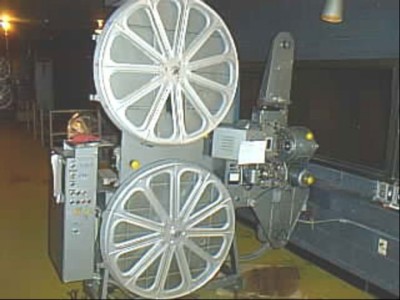
-Monte
Posted by Richard Fowler (Member # 893) on 12-19-2006, 07:31 PM:
Monte, you need a kitty litter box for that oil slick under that machine
Posted by Monte L Fullmer (Member # 2797) on 12-19-2006, 10:14 PM:
Yea, we did that along with sealing up a lot of those oily 'runny noses' from this one machine - this pic was taken over 15yrs ago with I started here. Since then, in 2001, these units were pulled out of this theatre and were sold off when the theatre was closed down. But, sure did enjoy running these V8r (V-18) units.
Posted by Cameron Glendinning (Member # 3516) on 12-20-2006, 01:20 AM:
The cinema I work in has 2 x vic 18's (its a twin) complete with the oil on the floor
Posted by Floyd Justin Newton (Member # 1316) on 12-20-2006, 08:15 AM:
At the orignal Cine Capri in Phoenix I had two JJ2s which
didn't leak oil at all....period.
Posted by Mark Gulbrandsen (Member # 72) on 12-20-2006, 07:44 PM:
quote: Floyd Justin Newton
I had two JJ2s which
didn't leak oil at all....period.
They musta been rebuilt by Louis "no leak" Bornwasser.
Mark
Posted by Floyd Justin Newton (Member # 1316) on 12-20-2006, 08:37 PM:
Nope....they were maintained and operated by professional
projectionists. ![[Wink]](wink.gif)
Posted by Louis Bornwasser (Member # 3063) on 12-21-2006, 09:21 AM:
In the pre_Ultra lens era, I aligned and cut plates for that theatre. (Cine Capri). Flat originally was oval with no corners. Scope was little better. This was about 1976. When I left, you no longer had to move the projector up/down, etc. between formats. The machines were excellent even then. They were the best Centurys I had ever seen at the time, so I KNEW it was possible for them to be really good.
I never worked on the mechanics, though. Nice older gentleman operator was probebly 80 or so in 1976. Louis
Posted by Bobby Henderson (Member # 840) on 12-21-2006, 09:33 AM:
Are there any limitations as to which brands of lens systems can be installed on these various makes of projectors? It would seem the type of lens system being used is just as critical (if not more so) than the make of the projector head.
Posted by Gordon McLeod (Member # 33) on 12-21-2006, 10:02 AM:
Certain machines have issues with lens sliding far enough in to focus or vigneting on the mount
Posted by Louis Bornwasser (Member # 3063) on 12-21-2006, 03:19 PM:
In general anything with a 4" mount is OK (Old Westars, any Century C, and any projector with a recessed lens like Kinotons may well have problems) Problems usually are limited to shorter focal lengths. Louis
Posted by Will Kutler (Member # 770) on 12-22-2006, 04:02 AM:
The early Simplexes (Standards, Supers and E-7s) were all wonderful machines that, when run by a professional projectionist put some of the best pictures on the screen!
Unfortunately the early Simplexes did not use bronze bushings on the sprocket shafts. So you had precision ground shafts running directly against the cast-iron mainframe casting. I have serviced several early Simplexes where those shafts have been madly scored and worn. However, you can use an India stone to clean off any burrs, clean-up the main frame casting, reassemble and they'll still run like champs with minimal slop between the shafts and casting! A real testemant the the quality of manufacture in those bygone days!
Also with the early Simplexes was the ability to fine-tune shutter ghosting while the machine was operating.
The main complaints that I had about those early Simplexes is that they could be difficult to clean and they were "cramped" as compared to a Century. Also with the early Simplexes if one needed to replace a intermittent sprocket then one had to open-up the intermittent and pull the star/sprocket shaft.
But like I said, in the hands of a professional projectionist, what wonderful machines!
Centurys are simple, spacious and built like a tank.
Bevan Wright is very customer orinetated and a first-class gentleman. I spent a substantial amount of time on the telephone with him ironing out and resolving customer problems when I was regularily doing independant tech-work, as well as when I was working as a projectionist for a particular theatre chain. I am not sure of the full extent of Bevan's involvement with the development of the Christie P35 GP projector. But my hats off to Bevan for really going all out to resolve the many problems that pleagued this machine.
Kutler
Posted by Scott Norwood (Member # 30) on 12-22-2006, 06:39 AM:
quote: Will Kutler
Also with the early Simplexes was the ability to fine-tune shutter ghosting while the machine was operating.
Same for current-production Simplexes and most Centurys (except the recent ones).
Posted by Mark Gulbrandsen (Member # 72) on 12-22-2006, 07:57 AM:
quote: Will Kutler
Unfortunately the early Simplexes did not use bronze bushings on the sprocket shafts. So you had precision ground shafts running directly against the cast-iron mainframe casting.
Will,
Why would you say "Unfortunately"? In fact cast iron is one of the very best bearing materials around. Steel shafts in cast iron are capable of many times more service life than bronze is. It is the simple main reason why so many of these projectors are still running today. Worn shaft bores were no problem in the old days where that out of round bore was reamed out and an oversized shaft installed and the projector returned to service for another 20 years of use. Later Simplex's and the later LaVezzi "upgrade kits" for the Super utilized shafts that were secured in the existing rotating shaft bores but the gears that rotated on the new fixed shafts were cast iron.... I'm glad they didn't use bronze or they'd all have dissappeared a long time ago!
Posted by Dave Macaulay (Member # 813) on 12-22-2006, 08:56 AM:
Even the newest Century projectors have shutter adjustment that can be set with the machine projecting. You have to watch your fingers as it's behind the back cover though. From what I've heard the front knob was removed as "booth ushers" were turning it by mistake so it was decided to make the adjustment internal.
Posted by Louis Bornwasser (Member # 3063) on 12-22-2006, 09:46 AM:
Dave: the latest Centurys have a fixed shutter bracket with no adjustment possible. This is OK by me as they are very stable unless broken. Louis
Posted by Tim Reed (Member # 137) on 12-22-2006, 09:57 AM:
That's too bad. I liked having the fine adjustment capability. Especially today, since I've been having difficulty seeing up-close in my old age.
Posted by Monte L Fullmer (Member # 2797) on 12-22-2006, 01:43 PM:
quote: Mark Gulbrandsen
Steel shafts in cast iron are capable of many times more service life than bronze is.
Why automobile engines can actually run forever if you keep the oil changed - steel against iron (like rings, bearings, cams, valves..et.al..).
(..can you imagine an engine with bronze cylinder sleeves, or even bronze bearings?)
Yeppers, Those people at IPC Projector Company who made Simplexes knew what they were doing.
-Monte
Posted by Will Kutler (Member # 770) on 12-22-2006, 05:30 PM:
Mark
Yes, you are correct in your assessment. However, in my opinion pressed-in bronze bearings would be better. Why? When they are worn just press them out and install new ones, as they are dirt cheap. Another advantage would have been the ability to eliminate the manufacture of several different sized shafts (Lean Manufacturing). It would have been interesting to test the service life and performance of oil-lite bearings on these machines.
K
Posted by Mark Gulbrandsen (Member # 72) on 12-22-2006, 06:41 PM:
quote: Will Kutler
It would have been interesting to test the service life and performance of oil-lite bearings on these machines.
They didn't have to worry about lean manufacturing back then, they just did things the right way instead! I've never been at all impressed by the service life of any oilite bushings in anything that I've had to work with over the years. The oil always seems to evaporate out sometimes even before the actual bishing is at the end of its life from a wear standpoint. Most intermittent movements use an outboard oilite bushing and an inner cast iron bushing... the cast iron inner bushings always outlasts the oilite outer bushing. another good example of a no wear cast iron/steel assembly are the sprocket assemblies in the DP-70 which show no wear al all after 50 years of use. I think if given the chance the DP-70 mechanism could easily do 100 years of failtless service with normal film path and electrical replacements. So absolutely, I'd take steel running in cast iron any day over brass, bronze or oilite.
Mark
Posted by Nathan Powers (Member # 3715) on 12-23-2006, 11:25 AM:
Best 35mm Projector I Have Ever Used... Prevost P93 ! Most Stable Picture I've Ever Seen, Very Solid Construction, Easy To Repair And Rebuild....Unless You Have A Cinema Tech That Decides Century Oil Is A Good Idea For It...Then You Have A Problem. ![[uhoh]](graemlins/uhoh.gif) The 35/70mm Combo Is A Nice One As Well...But A Little Big!
The 35/70mm Combo Is A Nice One As Well...But A Little Big!
Posted by Sam D. Chavez (Member # 1841) on 12-23-2006, 12:03 PM:
Which P93 do you have? There are three different versions I know of starting about 25 years ago and they still use the model number on current production but is is a very different machine.
I made a red reader for the earliest ones imported to the US.
Posted by Nathan Powers (Member # 3715) on 12-23-2006, 12:15 PM:
I owned 4 Prevosts that were rescued from a dumpster 3 P93's from the 1960's/70's era...with the 120v motors (converted, they originally had 3 phase)...im not sure which version they were. One of them actually went to someone who was prototyping an LED reader... ![[Roll Eyes]](rolleyes.gif) maybe it was you! two other ones went to a struggling small cinema in columbia, they were in dire need of new equipment, and the other one was a P70...the the 35mm/70mm combo that went to some educational institution. I wish I still had them, very very good projectors id trade in a century any day for one of those. The owner of the Prevost company is actually very helpful and awsome to work with, excelent customer support...even if the parts take 30 years to get here...
maybe it was you! two other ones went to a struggling small cinema in columbia, they were in dire need of new equipment, and the other one was a P70...the the 35mm/70mm combo that went to some educational institution. I wish I still had them, very very good projectors id trade in a century any day for one of those. The owner of the Prevost company is actually very helpful and awsome to work with, excelent customer support...even if the parts take 30 years to get here... ![[Big Grin]](biggrin.gif)
Posted by Mark Gulbrandsen (Member # 72) on 12-23-2006, 03:13 PM:
There are two P-93's that are at least 25 years old running at a twin in Winnemucca, NV that I maintain. They both have Sam's readrs installed on them and unbelievably both have very good scanning drums... no out of round drums. These machines have run faultless except for the crappy turret rotate motor they use. They have gone through at least two per machine. Other than that no problems what so ever.
Mark
Posted by Will Kutler (Member # 770) on 12-23-2006, 08:22 PM:
Hi Mark
I would suggest that you open up your copy of "The Machinery's Handbook". Under the chapter "Machine Elements" is an entire section covering "Plain Bearing Materials".
There are 7 key properties of bearing materials:
1: Fatigue resistance
2: Embeddability: the ability of the bearing material to
absorb or embed within itself large or small dirt
particles present in a lubrication system. Poor
Embeddability means that circulating dirt will score
both the bearing and the journal shaft. Good
embeddability means that the bearing material will
entrap this dirt and force it into the bearing material
out f the way where it will do no harm.
3: Compatibility or anti-scoring tendencies
4: Confrmability: malleability and of the bearing material to
conform to the journal shaft during run-in/break-in.
5: High thermal conductivity
6: Corrosion resistance
7: Load capacity or strength
Cast Iron "is an inexpensive bearing material capable of operation at light loads and low speeds, i.e. up to 130 ft/min and and 150 lb/in squared. These bearings must be well lubricated and have a rather large clearance so as to avoid scoring from particles torn from the cast iron that ride between the bearing and journal. A journal hardness of between 150 and 250 Brinell has been found to be best when using cast-iron bearings." In other words, cast iron has poor embeddability and campatibility properties.
Mark, you are also uneducated about oil-lite bearings:
Porous Metals: "self-lubricating bearings are usually made by sintering metals such as plain or leaded bronze, iron, and stainless steel. The sintering produces a spongelike structure capable of absorbing fairly large quantities of oil, usually 10-35 percent of the total volume. These bearings are used where lubrication supply is difficult, inadequate, or infrequent. This type of bearing should be flodded from time to time to resaturate the material. Another use of these porous materials is to meter a small quantity of oil into the bearings such as in a drip feed system." See table 13 for Application limits
So Mark, the reason that oil-lit bearings have failed you is due to improper useage.
Also Mark, your comment regardin Lean Manufacturing makes no sense??? Lean concepts are critical in todays manufacturing world. It all comes down to waste elimination and the optimum utilization of resourcs. Lean is a culture that includes everyone employeed within the manufacturing enterprise.
Regards
Kutler
Posted by Sam D. Chavez (Member # 1841) on 12-23-2006, 10:53 PM:
Lean or Just-In-Time manufacturing rely on parts getting to the assembly line in the nick of time. If anything is off, the customer gets his stuff late. The idea is to just have minimum inventory, finished and unfinished, on hand and is some bean counter's dream.
It's an admirable goal but it also totally relies on a perfect forecast by marketing. In the normal US business model, the Manufacturing department "owns", and is thus, penalized for excess inventory even though they don't do the forecast. This all leads to turf battles within companies and eventually to building to order instead of having something on the shelf for peak demand times.
In our short sighted cinema world, it sucks.
Posted by Monte L Fullmer (Member # 2797) on 12-24-2006, 02:37 AM:
...prob why you ever noticed that any of the Simplex units have manufacture dates on their products - like Jack-in-the-Box: cook (manufactured) to order..
Yea, inventory sitting on the shelves like like money sitting there: doing nothing and wasting away when it could be used for something else more constructive.
Posted by Mark Gulbrandsen (Member # 72) on 12-24-2006, 07:31 AM:
quote:
They didn't have to worry about lean manufacturing back then, they just did things the right way instead!
What I said makes sense to me... They didn't even consider lean manufacturing back then. They almost always had stuff there before asembley of a product started because you've forgotten that most parts were made in house back then.
quote:
Mark, you are also uneducated about oil-lite bearings:
Will,
You can stick your Machinery Handbook book up your ass as far as how great Oilite is! I am very aware of the characteristics of Oilite and have used them in several projects over the years. The characteristics are such that the oilite bushings in a Simplex X-L sprocket assy. might last perhaps 20 years if you're lucky... they also make a mess out of the shaft as well. Remember the X-L IS an oil bath machine too! While the cast iron bushings and shafts in a DP-70 show zero wear after 50 years. Many oilite Century and Simplex X-L outboard bearings wear out in just several years of use IF NOT KEPT OILED.... oh but this is Oilite material that you don't have to oil. Next time you hear an X-L squeeking away and you have to oil the oilite outboard intermittent bushing you'll remember how great they are.
Happy Holidays!
Mark
Posted by Will Kutler (Member # 770) on 12-24-2006, 11:34 AM:
Hi Mark
It seems that you did not read what I wrote. As I said, oillite bushings DO require periodic relubrication.
Also, both Mark and Sam have proven their lack of understanding regarding Lean Manufacturing Concepts.
JIT is much, much more than "bean-counting". JIT is a philosophy based on the planned elimination of non-value added waste from all aspects of manufacturing and on continuous improvement of productivity. It encompasses all activities required to produce the final product, from design to delivery. Besides having only the required inventory when required, JIT also includes quality improvement to zero defects, lead time and queue length reduction, lot size reduction, and the revisement/improvement of manufacturing operations themselves.
JIT has two fundamental objectives: waste elimination and an attitude of continuous improvement (kaizen) In JIT, 7 wastes have been identified:
1: Waste of overproduction
2: Waste of waiting
3: Waste of transportation
4: Waste of processing, itself
5: Waste of stocks
6: Waste of motion
7: Waste of making defective products
Simply put, Lean Manufacturing is about the aggressive elimination of non-value added waste from all aspects of the manufacturing process. And a key part of lean is the use of flexible manufacturing cells. Lean Manufacturing and 6 Sigma complement each other.
The Japanese Lean System has become known as the Toyota Production System. And it is through Lean Concepts that the Japanese were able to kick our (U.S) asses in manufacturing in the post-WWII era. Ironically, Lean is based in large about what Henry Ford wrote in 1926, and resulted in car prices being cut in half and workers wages to double.
An excellent example of a CIM/Lean enterprise is GEMA (Global Engine Manufacturing Alliance). Just type in GEMA in a search engine and a million internet hits will come up. Anyhow, GEMA is a co-op effort of DaimlerChrysler, Hyundai, and Mitsubishi Motors to produce technology-advanced, fuel efficient but powerful, low cost 4-cylinder engines.
Lean has often failed in the United States because it is a work-place culture and philosophy. When people hear "Lean" they think of loosing their jobs. The subsequent result is the sabatoge of Lean implementation. Lean is not about eliminating jobs, it is about eliminating waste.
The history of manufacturing in the US has always been about management vs workers (and how the two always try to screw each-other). Rarly have the two parties worked as a team for the betterment of enterprise.
Key lean manufacturing principles include:
Pull processing: products are pulled from the consumer end, not pushed from the production end
Perfect first-time quality - quest for zero defects, revealing & solving problems at the source
Waste minimization – eliminating all activities that do not add value & safety nets, maximize use of scarce resources (capital, people and land)
Continuous improvement – reducing costs, improving quality, increasing productivity and information sharing
Flexibility – producing different mixes or greater diversity of products quickly, without sacrificing efficiency at lower volumes of production
Building and maintaining a long term relationship with suppliers through collaborative risk sharing, cost sharing and information sharing arrangements.
Lean is basically all about getting the right things, to the right place, at the right time, in the right quantity while minimizing waste and being flexible and open to change. More importantly, all of these concepts have to be understood, appreciated, and embraced by the actual employees who build the products and therefore own the processes. The cultural aspect of lean is just as important as the actual tools or methodologies.
Lean thinking got its name from a 1990’s best seller called "The Machine That Changed the World : The Story of Lean Production". The book chronicles the transitions of automobile manufacturing from craft production to mass production to lean production.
The seminal book "Lean Thinking" by Womack and Jones, introduced five core concepts:
Specify value in the eyes of the customer
Identify the value stream and eliminate waste
Make value flow at the pull of the customer
Involve and empower employees
Continuously improve in the pursuit of perfection.
Cheers
K
Posted by Sam D. Chavez (Member # 1841) on 12-24-2006, 11:52 AM:
As I said, it is a noble goal (like religion) but it is operated by people (who use its principles for their own agendas) and it often falls far short in practice and in-effect leaves the cupboards bare of goods.
It's sort of like the difference between understanding the Bible and living up to it's ideals. I would however, hesitate to tell you to shove the good book up your bum.
Merry Christmas.
Posted by Mark Gulbrandsen (Member # 72) on 12-24-2006, 02:02 PM:
W,
I completely understand the meaning of it and and feel about the same way Sam does about it. Next time you order a replacement board for your two year old TV or or projector part, in particular a Pro 35 part and it doesn't exist anymore because no one has requested one in over a year you can thank the Lean System of business operation. In the real world it just doesn't work.
Also Will, Please help me to understand why the cast iron bushing shows no wear while the Oilite one has completely worn out as I mentioned above while both are running in an oil bath. Thanks!
Since I'm not religious I'll refrain from even bringing up the Bible.
No.... Happy Holidays for Will!
Mark
Posted by Tim Reed (Member # 137) on 12-24-2006, 02:18 PM:
quote: Sam Chavez
Just-In-Time manufacturing rely on parts getting to the assembly line in the nick of time. If anything is off, the customer gets his stuff late.
quote: Will Kutler
both Mark and Sam have proven their lack of understanding regarding Lean Manufacturing Concepts...
JIT is a philosophy based on the planned elimination of non-value added waste from all aspects of manufacturing
You give a very good and detailed explanation, Will. I got the impression, though, that Sam essentially said the same thing. I mean, you both arrived at the same place, he just got there quicker.
Posted by Mark Gulbrandsen (Member # 72) on 12-24-2006, 03:34 PM:
quote: Tim Reed
You give a very good and detailed explanation
Actually Tim,
He still failed to explain why the cast iron bushings last far longer then his beloved Oilite bushings .
Mark
Posted by Will Kutler (Member # 770) on 12-24-2006, 03:42 PM:
Tim,
In Lean Manufacturing you have both "pull" and "push" philosophies.
Pull processing: products are pulled from the consumer end, not pushed from the production end.
And as I stated, Lean is much more in depth than Sam's explination.
Mark is going to have to explain his statement of Lean not working in the real world! And he needs to explain his statement very well. After all, the Japanese embraced Lean concepts in the post WWII era and ended up kicking America's ass in manufacturing. In order to be successful, Lean has to be accepted as a work-place culture. And American business just does not "get it".
Lean embraces both the manufacturing and service sectors.
In our disfunctional cinema exhibition industry, the lack of Lean concepts are a perfect explaination of everything that we acknowledge as "Film Done Wrong".
And Mark
In all product manufacture the bearing is supposed to take the brunt of the abuse. In the various Simplex models, it is usually the expensive shaft that gets scored and damaged. So now you need to worry about producing and stocking oversized shafts and parts. Would it not be better to replace a $1.50 oil-lite bearing every 20 years instead of that $50-$60 shaft?
Posted by Richard Fowler (Member # 893) on 12-24-2006, 03:59 PM:
Japan was an easy role model after WW2 to implement lean manufacturing due to rising from the ashes and a very homogenious population.
Posted by Monte L Fullmer (Member # 2797) on 12-24-2006, 04:22 PM:
quote: Richard Fowler
Japan was an easy role model after WW2 to implement lean manufacturing due to rising from the ashes and a very homogenious population
Course, the 14 points of management by W.Edward Deming helped this along as well.
Hmm...like microswitches and phase controls for the STRONG brains: having to change out them danged cheap micros every flipping year, while those expensive phase controls can last many years..and then some..
So, who's saving money? .. Looks like a tradeoff to me.
I'd rather stick with cast iron bearings - seen many-a-Simplex - from Standard to XL - not have their intermittents die or needs rebuilt due to the cast iron sleeve in the nose cover and main casting not failing out as does the Century movements ...and I do put a drop of oil the front oilite bearing one every other month.
My big gripe is those DAYTON motors mounted on those end seal cooling fans in the X-90 console (and they use oilite bearings..) where they run all the time -- and the wick inside discentrates where it cant oil both end bearings. I can disassemble these motors and soak up the oilite bearings with light oil to get a few more years out of them.....
Granted, the XL frames are leaky suckers, but are they tolerable to wear and tear..
AND prob why STRONG elected to keep the same movement in their Apogees: to keep a good thing going and cut some costs.
Lean - kinda what the theatre manager does as well since I've been there and done that as well. Run the operation LEAN, yet OPERATIONAL-keep inventory down to a minimum, cut all excessive costs as possible, watch payroll-keep it under a certain percentage of the "house nut", et.al. ...just to keep the profit and expense margin under check.
-Monte
Posted by Will Kutler (Member # 770) on 12-24-2006, 04:51 PM:
Many decades ago products were made to last, and consumers kept their products for many years.
In the automotive industry Detroit would gradually release technology over a period of many years. With any product patent protection and having the competition reverse-engineer your product was an ever-existant problem.
Today we have both a disposable and hi-tech world economy. And in todays manufacturing one stays ahead of the competition by releasing new technology as quickly as possible via new products. Consumer electronics is an excellent example.
Personally, I do believe that the construction of many yesteryear products were vastly superior to what is made today. What has improved today is the vast array/availability of engineering materials. Also, many new people in manufacturing think of all this wonderful new technology, to which I say what is old is new again. For example, Lexus is heavily advertising their headlights that turn with the steering wheel. Gee Whiz, doesn't that sound like a Tucker?
However, I do strongly believe in Lean Manufacturing. It is critical in todays world economy where one needs to produce World-Class products economically. Having a union shop where job-classifications are specifically defined does not cut it any more. Having person #1 bolt in hole, person #2 puts nut on bolt and person #3 tightens and no-one helps each other out or takes responsibility because its not in the defined job description does not cut it! This is where the Japanese have us beat.
With Lean and CIM concepts GEMA is able to produce (in Detroit) technologically advanced engines that are vastly superior and less expensive than what is outsourced overseas. Furthermore, the workforce is required to be more educated and flexible and yet their wages/benefits have not been cut.
How does Lean effect the cinema exhibition industry? How many times have I heard about dark screens because the IATSE projectionist would not go to the box office to get a delivered print, but only waited for the print to be delivered to the booth door? How many times have movie goers experienced all aspects of film-done-wrong due to todays popcorn kid "film-shredders"? etc, etc, etc!!
What Monte describes as Lean implementation by theatre managers is all wrong. Lean is not about cheap! It is about eliminating waste but ensuring quality! When I worked for Century Theatres, oooohhhh the wasted food that was thrown out every night!!!!
Posted by Monte L Fullmer (Member # 2797) on 12-24-2006, 05:56 PM:
Lol, I did that also - eliminate 'waste' by getting rid of excess deadwood called employees standing around when it was close for them to get off of work - thinking that they can 'juice' the timeclock without me knowing about it.
..even when I was a booth manager - shooed the guys out right after they started the 5pm sets and were standing around waiting for their 6pm sets to start..since I could start those myself.
I got pretty high marks from home office on my payroll budgets and eliminating 'waste' as needed.
Posted by Sam D. Chavez (Member # 1841) on 12-25-2006, 01:39 AM:
Someone has obviously drunk the Kool Aid.
You can state it in as much detail as you wish but concept and practice are two different things.
I worked for a company before and after they went to "lean" manufacturing, took the classes, wore the Tee shirt, etc,.
I saw factory execs who don't get out much tell me if we ran the factory 3 shifts a day at full efficiency, how much money we could make, ignoring the fact that you first need products people want to buy and in amounts that warrant running a factory 24/7, not the other way around.
There was even a sign in the factory "Quality Is Not Goodness, It Is a Process". While this is quite literally true, it is also incredibly simplistic, kind of like the Bible Thumper who comes to the door trying to save you asking, Have you let the Lord into your heart?
IHMO, part of the aim at least in the US of Just in Time and Lean system are to "fool proof" the system so fools can run it, and we all know there are always plenty of those around.
Posted by Steve Guttag (Member # 268) on 12-25-2006, 08:49 AM:
The other point that doesn't seemed to be addressed is about the early obsolesence. One of the keys to the relatively low cost of cinema (I know exhibitors probably don't realize just how cheap their products are by other industry comparisons of similar volume per year) is that equipment made half a century ago is still completely servicable and in low volume.
Traditional cinema equipment was built with service in mind. This is something modern manufacturing does not think about...it is all disposable.
On the last two major installations we did...the "JIT" manufacturing really turned into TOO LATE manufacturing. To the point that we often went to plan B or even plan C manufacturer. I'm not talking about unreasonable amounts of lead times expected either. We were getting lead times in excess of 8-weeks from some manufacturers (and not for odd-ball type items and not just for cinema equipment). With Made-to-order, one expects longer lead times...not items that should be more stocked.
Though not a Cinema Product manufacturer, Extron is an example of a company that seems to know how to manufacture and stock their goods. When I took a tour of their plant a couple of years ago, they explained that they constantly adjust their manufacturing to try and keep 3-months of goods on the shelves. Because of strategies like that, I tend to go to them first if they make a product I need since I know I will get it. And in fact, I can't remember the last time, if ever, I had a back ordered item from them!
Even as a dealer, the stocking of items is a tricky business...one has to choose which items and how many. It is worse than as one said about putting money on the shelf. Not only is it that, but we are taxed on the goods on our shelves each and every year too! There is something just not right about that...the government penalizes businesses for being prepaired to service their customers. It isn't like they are not going to get the tax dollars when the goods are sold!
How all of this relates to the best 35mm projector is beyond me other than I guess one that doesn't wear out would be up there. Most of the favorites listed here have multiple decades of service which speaks volumes about this industry's products. Almost no other industry can talk about 50 year old machines that are still regarded as one of the best and still in operation.
If best means best picture and/or best sound...some of you have not done any real critical evaluation (image movment, perceived flicker, wow/flutter...etc) and compared all of that to various models. The "best" is seemingly being judged on familiarity. Others seem to judge the "best" based on service life and or service ease. Certainly these are good qualities but is this best for the projectionist, exhibitor or patron?
Some machines are only expensive in the wrong hands. My whole career I've heard those that talk about the AA2 being "expensive" due to high cost of parts. The only thing I ever changed in them when I ran them as a projectionist were tension bands and the odd sprocket (normally the hold back sprocket but you do get two bites at it). In the hands of an idiot, well the intermittent sprocket will get chewed in seconds as the tenson bands wear the teeth down to nubs. It isn't the machine's fault an idiot was put in charge of running it. It would be like blaming a car for running into a brick wall with an idiot behind the wheel.
There are several good machines out there and there are serveral dogs out there. Just like in most any other industry.
Posted by Mark Gulbrandsen (Member # 72) on 12-25-2006, 09:29 AM:
quote:
Mark is going to have to explain his statement of Lean not working in the real world!
Actually Steve explained it very well by having to sometimes resort to plan B or C. Steve is also correct about the DP-70 operating costs. I'll add to that and go so far as to say its the least expensive machine out there to operate. It just needs someone with an IQ above 83 handling it.
quote: Will Kutler
And Mark
In all product manufacture the bearing is supposed to take the brunt of the abuse. In the various Simplex models, it is usually the expensive shaft that gets scored and damaged. So now you need to worry about producing and stocking oversized shafts and parts. Would it not be better to replace a $1.50 oil-lite bearing every 20 years instead of that $50-$60 shaft?
So Will,
You are obviously stuck in classroom theory not in real world operation and reparing.... Indeed you ALSO almost always HAVE TO REPLACE the 65.00 shaft as well as the oilite bushings... in many cases with intermittents the end of the star shaft becomes too worn to be re-used and that is a several hundred dollar part that was destroyed by your 2.00 oilite bushing! I'd be happy to send you some samples so you would be able to do some researsh as to what ACTUALLY happens in the real world.
As to my question you still have not answered re: the DP-70 cast iron bushings far outlasting the Oilite bushings in the X-L... you are obvuoisly not knowledgable enough to know. And from a metalurgical standpoint I really don't care. Its very obvuois that cast iron is simply a much better material for the job.
Mark
Posted by Sam D. Chavez (Member # 1841) on 12-25-2006, 11:58 AM:
It seems Steve is gaining wisdom all the time.
Posted by Will Kutler (Member # 770) on 12-25-2006, 02:05 PM:
Both Sam and Steve bring up excellent points. One needs to manufacture products that sell in appropriate quantities. It costs a lot of $$ to just crank out parts only to have them warehoused for several years! For example, I called Wolk about some Super and E-7 parts. They quoted me outrageous prices simply because they wanted to recoup their warehousing costs over the decades!
In the old days of manufacturing all similar machines would be grouped together within different parts of the shop (lathes, mills, grinders) with those diffferent departments not being in communication with each other and a lot of wasted transportation, queue, storage and wip in between.
Flexible Manufacturing Cells are sooo much better, if they are correctly run with people working together as a Lean Manufacturing Team.
This past summer I had a paid Manufacturing Engineering Internship at Goodrich TurboMachinery Products...a very large supplier of turbine engine blades for RR, P&R, GE and Uncle Sam. My internship came to an end due to my class schedule that interfered too much with work. Among the vast work I performed was tool designing and engineering folder revision and was directly involved with the operation of flexible manufacturing cells (a key element in Lean Manufacturing).
Each cell was devoted to a specific client, and due to their flexibility several different types of blades could be manufactured with minimal change-over (very quick set-ups). And the cells were small enough where everyone was in communication with each other so that problems could be addressed at their source and be immediatly identified and corrected.
K
Posted by Monte L Fullmer (Member # 2797) on 12-28-2006, 01:26 PM:
..let's get back on topic a bit - I have a question that I was wondering on from the pros: Now, we've talked quite a bit on Simplexes and even with the older ones before the XL:
the Standard and the E-7 (esp the E-7) had the double shutter (front and rear shutters). We all know that with the coming of anamorphic prints that the front shutter was taken off due to the anamorphic attachments that had to be used. Wasn't the double shutter concept allowed more light to pass through, but with the removal of the front shutter, whouldn't this hinder the maximum light output esp if the rear shutter wasnt replaced with a different shutter?
Posted by Louis Bornwasser (Member # 3063) on 12-28-2006, 02:57 PM:
The point of the double shutter (front & rear) was to allow a dissolve. If you used the rear shutter alone, you would either gain light or you would have no change.
Like a Motiograph AA, there are those who can see the flicker and prefer the smooth dissolve, even at the cost of light.
Everything has trade offs; "which problem do you want?" That is why there is more than one brand of projector (er, dog food....with a tip of the hat to Gallegher.) Louis
Posted by John Pytlak (Member # 331) on 12-29-2006, 02:39 PM:
Theoretically, a double shutter that creates a "dissolve" or "scissor action" on the light beam can be a bit more efficient than a single shutter.
Posted by Adam Martin (Member # 641) on 12-29-2006, 05:01 PM:
Does this theoretical efficiency come from the fact that it takes half the time to block the light beam, allowing for a faster pull-down cycle?
Posted by Richard Fowler (Member # 893) on 12-29-2006, 06:02 PM:
Generally double shutters allow more even illuminated image time on the screen in concept versus a single butterfly shutter. More efficient are conical or double speed single blade shutters close to the film plane for faster light cutoff. Most intermittents have the same pull down speed due to the 4 to 1 construction of the star and cam. Hi speed double pin movement, Kodak Quickermittent, electronic and even the old silent era Powers projector intermittents have faster pull down rates.
Posted by Adam Martin (Member # 641) on 12-29-2006, 06:12 PM:
quote: Richard Fowler
double shutters allow more even illuminated image time on the screen
Thanks ... that's pretty much what I miserably failed to convey. By pull-down cycle, I meant the time from fully-dark to fully-open again.
Posted by David Stambaugh (Member # 1102) on 12-29-2006, 06:31 PM:
quote: Louis Bornwasser
"which problem do you want?"
I'll have to remember that one. ![[beer]](graemlins/beer.gif)
Posted by Martin Brooks (Member # 1269) on 12-29-2006, 07:06 PM:
quote: Will Kutler
Many decades ago products were made to last, and consumers kept their products for many years.
In the automotive industry Detroit would gradually release technology over a period of many years. With any product patent protection and having the competition reverse-engineer your product was an ever-existant problem.
If you're trying to imply that Detroit made cars to last, nothing is farther from the truth. After WW II, Detroit purposely built cars with built-in obsolescence and to avoid failure, people who could afford it traded in their cars every two years. It wasn't until consumers started buying superior Japanese cars in the 1970s that there was a perception that it was not normal to have to constantly repair a car.
But one difference between then and now is that it was easier to repair cars yourself.
In the 1950s, my family's very expensive Admiral console TV was in need of constant repair. I saw the TV repairman more often that I saw a doctor.
One area where I think things were superior years ago were items like semi-pro and pro cameras, many of which are still around and operating today (although most of those were German and Japanese.)
Another area where the quality used to be superior was furniture. But that's largely because it used to be made from hardwoods and today much is made from fiberboard.
People toss products today not because they're manufactured in an inferior way but because it's simply more cost effective to purchase a new one than to have it repaired. And repairs on so many products (esp electronics) are near impossible because of integrated circuitry and miniaturization.
Posted by Steve Guttag (Member # 268) on 12-29-2006, 09:40 PM:
Double shutters....
They do NOT offer more even light...just the opposite...they offer a hot-spotty light. They are more efficient and will allow MORE light than the same sized single shutter.
As noted, the double shutter system opens/closes the light beam twice as fast. However, it closes the middle off first and it opens the middle first. As such, the middle will receive more light for the eye to integrate.
If one were to plot the cycle of the double shutter system versus a standard shutter...the period would be the same (48Hz) but the time it is in the open position would be greater than for a standard shutter and the steepness at which it transitions between open and closed would be greater.
In fact, take one of those old solar cells you ripped out for red light readers, put it in the lens barrel. Hook it up to your trusty O'Scope and put a light pointing into the projector (or even the lamphouse but one need not go too crazy on the light source). Now run the projector and let the O'Scope show you what is happening.
The single-wing shutter is generally the best at any given size. It has even illumination and due to its speed being twice as fast as a conventional shutter, it offers all of the benefits of a double shutter but none of its shortcomings.
Steve
Posted by Monte L Fullmer (Member # 2797) on 12-29-2006, 10:15 PM:
quote: Steve Guttag
The single-wing shutter is generally the best at any given size. It has even illumination and due to its speed being twice as fast as a conventional shutter, it offers all of the benefits of a double shutter but none of its shortcomings.
..why, once again, I love those Christie P35GPS units - with that single wing shutter design (just have to keep an eye on those shutter belts...).
In the 16mm world, why the earlier Bell&Howell projectors seems to have the best light with their single wing shutters installed - and with this design, the light is cut off twice per frame being that the third cut is during the pulldown stage.
-thx for the discussions on this shutter topic. Monte
Posted by Steve Guttag (Member # 268) on 12-30-2006, 09:37 AM:
Monte,
Christie HAD to go to the single wing shutter just to bring their crappy light transmssion up to Simplex/Century levels. The speed of the shutter (not the frequency) is determined by its size such that the blade velocity (v) = to its angular velocity (w) x its radius (r) (pretend my double-u is a lowercase greek omega). Christie's r is so small they had to do something to overcome there horrible flicker...all they could do was double the w to increase velocity.
Now take Mark's AA2...the radius of a Century blade (give or take) but single wing so its velocity is pretty darn fast! A standard Kinoton mechanical projector is also a single-wing shutter which accounts for its great light efficientcy and outstanding picture quality.
You like the Christie projector because that is what you know...spend some time with a Kinoton "D" series (or even an "A" series) projector and report back.
Christie's strength is in their precision in machining. As such, they can generally get things to align better than anyone else. I've changed entire heads and swapped turrets...never needing to align anything else...apertures and everything were right on the money. Most heads can't make that claim. I still have a Christie single lens holder that I use for alignments with them...even though it is over 20-years old...it will still pefectly point a laser and alignment projector right down the kazoo of the projector and it fits right on the same registration pins and holes that hold the current turret stop catch.
Steve
Posted by Louis Bornwasser (Member # 3063) on 12-30-2006, 01:06 PM:
Wonder why no one has used a pair of single wing shutters at 2880?
I, myself, do not think double shutters help enough to be worth it. Louis
Posted by Monte L Fullmer (Member # 2797) on 12-30-2006, 01:57 PM:
Yes, I fully agree with you Steve, on your comments of my limited knowledge of the Christie - being that I've only worked with these units only for my 5 years that I worked with EDWS in my area here in this part of the country where the bulk of the theatres over here are using Simplex units...and what I'm working with now.
I do agree with you on the DP70/AA2 units since I've seen projected images coming from these projectors when it comes to light production.
But, I'd definitely will take up your offer on experiencing the Kinoton units and do report back to you on the results when that chance arises.
thx-Monte
Posted by Mark Gulbrandsen (Member # 72) on 12-31-2006, 10:16 AM:
quote: Louis Bornwasser
Wonder why no one has used a pair of single wing shutters at 2880?
Well, with the exception of the Christie which has its shutter safely burried behind 3/4" of solid alumnuim trap no other American made machine is actually built well enough to deal with even one blade turning at that speed let alone two of them, gear trains are just not up to it. I believe that death would lurk in any booth so equipped! You'd also have to convince American projector manufacturers to spend more than 69 cnets for a shutter blade. I certainly agree that double shutters are a mechanical waste and provide no real important gain... Except more breakdowns and service calls $$$.
Mark
Posted by Steve Guttag (Member # 268) on 01-02-2007, 08:24 AM:
Though greatly improved over the original P-35, the Christie gear train isn't exactly their strong area.
The Simplex has a better chance of going with a double speed blade than Century...which is already mis-disigned in their shutter department.
As to double shutter being "worth it"...it is strictly a matter of light...if you need the light, it is worth it...if you don't it is not. It is not a matter of opinion, double shutters are inherently more efficient with the light. You do NOT use the same shutters on a double shutter system as on a single shutter system...I want to say on a Century, you can eek it down by 20-30 degrees. This represents more than 20% more light than a Century with a 90-degree blade. This takes a theatre with only 12fL and puts them up into SMPTE specs without increasing the lamp size...which will likely cost them significantly more (both in lamp cost and shortened life).
In a Drive-In application, where light is always in a shortage, it makes quite a bit of sense.
Even the current FP75E from Kinoton is using a double shutter to get the light and the speed. It is a viable solution though, as I said, neither the best nor only solution for all applications.
Steve
Posted by Mark Gulbrandsen (Member # 72) on 01-02-2007, 08:36 AM:
quote: Steve Guttag
The Simplex has a better chance of going with a double speed blade than Century
I disagree. Not until the movement is redesigned(or the compensator to allow for better shock absorbtion) to allow for larger fibre gears. The slightest oscillation in the shutter would result in an arguement with the "fusable link" G-1836 gear. Had the Century been an oil bath machine and equipped with a conical shutter they'd have really had something there.
Christie has done more homework on their "Gear Train" and has switched to both composite teflon coated pulleys (and composite curved runners) as well as round tooth timming belts that are much larger than the old square tooth stuff.n To me the Christie still represents the most bang for the buck in U.S. made pojectors.
Mark
Posted by Steve Guttag (Member # 268) on 01-02-2007, 08:52 AM:
You can disagree all you want...you'd still be wrong.
Christie HAD to do more homework...look at where they started from...the P35 was a belt drive system gone mad. Most everything they have done has been in response to their original lacking design.
The Century gear train...in an oil bath...would still be a miserable design. It works despite itself but still with significantly higher failures in their gears (shutter, main drive...even intermittent drive) than other designs. An oil bath would help but it wouldn't overcome bad design.
The Simplex has the best chance at a single shutter redesign.
Posted by Mark Gulbrandsen (Member # 72) on 01-02-2007, 03:10 PM:
Humm, I don't remember saying the Christie was the best.... only that it gave the best bang for the buck. Of course they had to redesign again... and they will be redesigning it untill the end of film. Even the older Christies continue to give more reliable service over other American made projectors in todays typical booth that is run by monkeys. The Christie sound head in the later models consistantly gives better W&F specs than either the Century or 5 star are capable of. The P35GP models... well, I won't mention how many percent it actually is.... ![[thumbsdown]](graemlins/thumbsdown.gif) .
.
quote: Steve Guttag
The Simplex has the best chance at a single shutter redesign.
Actually I think you misread my post. We do indeed both agree that the Simplex would need to be re-designed for a single blade shutter to happen... You said it yourself. A century in an oil bath would still be a great idea... anything to make it more reliable and worthy.
Mark
Posted by Scott Norwood (Member # 30) on 01-02-2007, 03:18 PM:
I know that Steve and Mark aren't terribly fond of the Century design, but do the gears really fail that often when they are kept lubricated? I've never seen a stripped gear, nor have I heard of it happening in the recent past at any of the theatres where I have worked. The machines in question date from the 1940s through the 1970s.
I guess what I'm asking is whether the Century is really that much less reliable than an X-L/PR1014, assuming that both are properly maintained. So, is it? Or is the X-L/PR1014 just better under "real world" circumstances where maintenance is poor?
Posted by Mark Gulbrandsen (Member # 72) on 01-02-2007, 03:27 PM:
Actually Scott I am very fond of the Century projector. Used them on close to 40 dailies jobs myself and other portable units I built for customers using Century machines have seen duty on another 200 or so features. Also built the VistaVision projector out of a 4" Century C model and it runs flawlessly.... and doesn't scratch film like most other VV maachines do.
In the future Steve needs to state more than "I am just Wrong" or we can assume that he is merely speculating that I am wrong. I guess I can say that Steve wears pink underwear too but both statements are of course just hearsay. Let him explain why I am wrong via calculations. Of course we could do gear tooth stress calculations on the G-1836 but the teeth are so miniscule and weak that it would be a waste of time. So it is all just speculation about the X-L being able to run a double speed shutter. In relaity the X-L and Century gear trains are similar... both use orthagonal gearing, one with a fine tooth pitch and one with a corse tooth pitch. Both projector designs have gear pairs where the larger gear is turning a smaller gear... thats the bad aspect. What it all really boils down to is the truth that U.S. projector manufacturers just don't produce anything that is really all that good any more. Give me a good ole Super any day!
For me its been about 50/50 in reliability between Simplex and Century assuming both are properly maintained, we service about an equal amount of both. X-L's will suffer broken pad roller latch pins and gate/trap problems with the large asortment of gates and traps they conured up for it. Centurys will go through an occasional main drive gear or seized bearing. Both have their unique problems and good points. Neither will survive well if "let go". On the other hand the latest version of the Christie if let go keeps on running just fine till the shutter belt breaks. How long that takes depends on nnumber hours running time and how good of condition the pulleys are in. The new composition gears and belts for the Christie are supposed to afford a 5 year life span for the belts. We have Cine X-35's with belts that are just at 3 years old now so I think 5 years is believable.
That all said the DP-70 is still the best built most relaible projector ever made and with the lowest maintainance cost.
Mark
Posted by Phil Hill (Member # 371) on 01-02-2007, 04:36 PM:
Ya know Mark, I don't know who's more of a BRUTE... you or Adam! ![[evil]](graemlins/evil.gif)
Posted by Mark Gulbrandsen (Member # 72) on 01-02-2007, 05:06 PM:
Naw Phil.... Actually you are the real BRUTE!
Mark
Posted by Steve Guttag (Member # 268) on 01-02-2007, 05:16 PM:
Scott, The Century failure rate seems about 10:1 given similar operators. Main drives and shutter gear failures are quite common. I'll address Mark's wrongness later.
Steve
Posted by Louis Bornwasser (Member # 3063) on 01-02-2007, 05:24 PM:
Century "troubles" are mostly related to the extremely bad gears made by Wolk, ORC and LaVezzi during a certain period in the late 80's and early 90's. If older they are workhorses and if later can be extremely reliable with only a little care.
As far as wow & flutter, NO ONE beats a properly set up Century MSA (direct drive). It, of course, has a Davis bridge. No one else has ever tried another "closed loop" design. (It works slightly less well in the SA standard drive model due to problems in the projector drive belt.) Louis
Posted by Mark Gulbrandsen (Member # 72) on 01-03-2007, 08:15 AM:
quote: Louis Bornwasser
Century "troubles" are mostly related to the extremely bad gears made by Wolk, ORC and LaVezzi during a certain period in the late 80's and early 90's. If older they are workhorses and if later can be extremely reliable with only a little care.
Absolutely correct... I don't see anywhere near a 10 to 1 failure rate... and this is with Booth Monkeys running the equipment.
quote: Louis Bornwasser
As far as wow & flutter, NO ONE beats a properly set up Century MSA (direct drive).
I always measured all machines running film all the way through the film path....
Century MSA.... .09% at lowest dip on meter.
Kalee model 21... .065% at lowest dip on meter.
.05 is about the residual level on the old SMPTE W&F test Film.
Sorry
Posted by Richard Fowler (Member # 893) on 01-03-2007, 09:31 AM:
The pressure angle on Century gearing was state of the start of the art design for the late 1930's.....the era of small reels and changeovers. Steve Krams of ICECO/Magnatech, with the help of an engineering department of a University, experimented with gears of a different angle which gave much more life. The option never got too far due to people comfortable with "standard" Century issues which have allowed many service people reliable income.
Posted by Gordon McLeod (Member # 33) on 01-03-2007, 11:48 AM:
Westrex in the UK used a different gear angle with much better life
Posted by Mark Gulbrandsen (Member # 72) on 01-03-2007, 03:10 PM:
quote: Richard Fowler
Steve Krams of ICECO/Magnatech, with the help of an engineering department of a University, experimented with gears of a different angle which gave much more life. The option never got too far due to people comfortable with "standard" Century issues which have allowed many service people reliable income.
I tried several sets of those gears a number of years back. No real advantage for me... they lsat about the same length of time as a regular gear pair does... they are finer pitch teeth. They did run seemingly quieter though.
There are a pair of Westrex 35mm machines in Cody, WY that are in excess of 40 years old and are still running with ALL the original parts except for some of the film path parts and one C/O coil.
Then of course the Brits made a soundhead with the lowest W&F spec. I've ever measured in an optical reproducer !!
Mark
Posted by William Del Valle (Member # 3569) on 01-10-2007, 03:07 PM:
which projector is the best is a matter of opinion and who or what you learned on and are most confortable with. Muself i have been a Century man most of my life (i'm 65) about 15 years ago i went to work for AMC and they had Christies. I grew to love those machines, they were easy to thread. Even the do-do kids they hired had no problem in running them. they were easy to maintain. They (Christie) had changed frim a metal drive intermitten gear to a fiber one, after about six months the gear was making so much noise that gear it had to be changed. Until i discovered that reversing the gear gave the fiberr gear new life. otherwise they were great machines.
Posted by Cameron Glendinning (Member # 3516) on 01-10-2007, 09:37 PM:
quote: Mark Gulbrandsen
Kalee model 21... .065% at lowest dip on meter.
Yes but for how long? My memories of working with these machines was that every few months, wow and flutter would become noticable. So off came the back, unscrew a locking device for the bolt on the sound sprocket, flip it over, screw it back on and presto, clear sound.
Mark, I wish that I was financially able to be a serious buyer of your VistaVision gear. I hope it finds a good home.
Posted by Vaughn Hamrick (Member # 4092) on 01-17-2007, 08:50 AM:
I'm fond of Century projectors.Fewer gears to worry about,very low maintenance and easy on film.I've also worked with Simplexes,Cinemacaniccas and Brenkerts.
Posted by Monte L Fullmer (Member # 2797) on 01-17-2007, 02:28 PM:
quote: Vaughn Hamrick
I'm fond of Century projectors
...just keep your eyes peeled to the oil level in the intermittent assembly...and keep that front "Oilite" bearing lubed as well.
Posted by Ben Wales (Member # 92) on 07-15-2007, 05:46 PM:
quote: Bernard Tonks
I did my training on the BTH model KB projector, so it was my favourite for sometime. For an open machine they ran very quietly, film absolutely purred
Interesting there will be two BTH KB's coming on the Market for sale from two private collectors in the UK.
Posted by Mark Gulbrandsen (Member # 72) on 07-15-2007, 06:04 PM:
quote: Steve Guttag
The Century failure rate seems about 10:1 given similar operators.
I've just not seen that kinda failure rate ever on Centurys. Out here The Simplex X-L contines to be the most repaired projector but in all fairness there are more of them and I attribute at least half the repairs I do on them to the poor quality and bad designs from Strong that were supposed to update them. Never the less I just don't see 10 to 1 failure rate in Centurys. If they were that bad they'd have never sold so many of them nor wold they still be making them to this day.
Mark
Posted by Steve Guttag (Member # 268) on 07-15-2007, 06:46 PM:
The Simplex has routinely outsold the Century. Just what sort of failures are you seeing in the Simplex? It is a very rare bird for us to see a Simplex cause a show to be lost. That is not the case for the Century projectors where a main drive gear can give way pretty easily. In fact, we have a Century "field" kit that has most everything a Century can wear out...never needed such a kit for the Simplex.
Steve
Posted by John Walsh (Member # 168) on 07-15-2007, 07:10 PM:
I am a big fan of the Cinemeccanica V9. Seemed to have the right combination of 'toughness" (V8 intermittent) and simple, open frame design. I had good luck with V5's also, but I felt the V5 was just a little too lightweight. The V5-8-9 series seemed to be designed such that, while easy to thread and keep clean, the internal parts are hard to replace (although they don't often need to be.) Whereas, with some American projectors they are harder to thread, (more rollers, etc.) but internal parts can be changed quicker.
Posted by Phil Hill (Member # 371) on 07-15-2007, 07:29 PM:
Oh Boy! A continuation of the pissing contest of what projector is best!
Posted by Gordon McLeod (Member # 33) on 07-15-2007, 08:18 PM:
Phil if one doesn't piss occasionally we die
all things aside there is in my opinion no terrible machine each has its virtues (cheap being in some eyes one of them)
Posted by Louis Bornwasser (Member # 3063) on 07-15-2007, 08:31 PM:
I was once asked after a speech at a theatre owner's convention: "What is the best projector?" I answered: "which problem can you best tolerate?" (price, reliability, ease of obtaining parts.) Your results will vary. Louis
Posted by Tim Reed (Member # 137) on 07-15-2007, 09:33 PM:
This outperforms a lot of them. (Who had one of these, btw? We did - circa 1968!)
Posted by Aaron Stroop (Member # 2874) on 07-15-2007, 09:57 PM:
if you want my view the only projector to buy is
cinemeccanica
i have sent most of my working life on thease projectors along with kinoton and a couple of usa built projectors
if you get the chance go to milano and visit the factory i have been there a couple of times its worth a look
Posted by Ken McFall (Member # 845) on 07-16-2007, 04:26 AM:
Louis what is a Davis Bridge? I've never heard of it/one
quote: Louis Bornwasser
As far as wow & flutter, NO ONE beats a properly set up Century MSA (direct drive). It, of course, has a Davis bridge. No one else has ever tried another "closed loop" design.
Posted by Phil Hill (Member # 371) on 07-16-2007, 04:39 AM:
Timmy, that's funny! I agree wit' ya!
The Davis Bridge refers to the excellent method Century projectors used for sound stabilization on their optical soundheads. Far better than ANY other manufacturer's methods...especially the crappy Simplex and Kinotone ones.
Posted by Ken McFall (Member # 845) on 07-16-2007, 05:40 AM:
Hi Phil, still not sure exactly what makes a Davis Bridge so special. Maybe you could go into some more detail.
One of the best soundheads, for wow and flutter LACK OF, is this one....
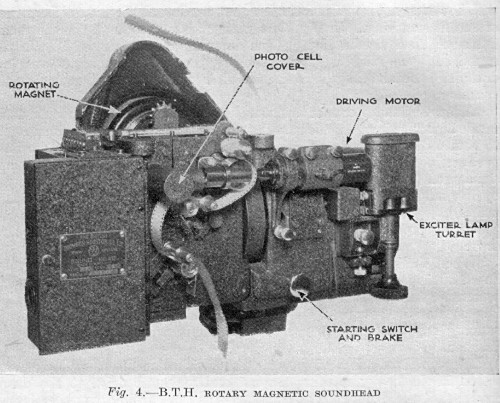
BTH rotary magnetic optical soundhead
The word 'magnetic' applies to the method of driving the sound scanning drum and not to the type of track. The drum is revolved by an electric motor, and magnet, and not by the usual method of using the film.
Never seen another soundhead that used this method. I suspect there may still be some in service in Scotland..... any red led conversions for this one?
Posted by Phil Hill (Member # 371) on 07-16-2007, 06:01 AM:
The Century soundhead is a straight-forward, simple, and efficient design where as the Simplex has a "pinch roller" that tends to imbed dirt on to the print...high maintenance to keep it clean.
The main problem with the Kinoton (IMHO) is the crappy threading path. Way too many rollers and exposures for damaging prints.
Davis example:
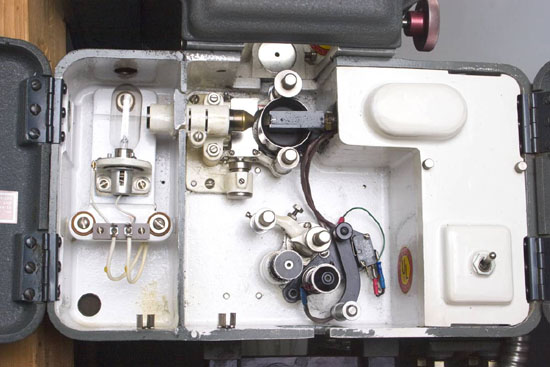
Posted by Ken McFall (Member # 845) on 07-16-2007, 06:22 AM:
Cheers for that Phil....
I have seen this type of soundhead after all, it's used on the later Westar heads, 2003 if memory serves me well.
The BTH head has NO tension on the film in the soundhead at all. As the sound drum is driven thru the magnetic coupling the film follwes a gentle curve thru the lateral guide roller and over the drum to the sprocket.... only the one roller!
I belive this type of drive was used in sound recording and apart from BTH was not used in a projector again.
Can anyone add to this?
Posted by Mark Gulbrandsen (Member # 72) on 07-16-2007, 08:34 AM:
Yous guys are all lost in space. Don't you know that all these projectors are now obsolete...! They have been replaced by this. So go read, have fun... but and don't get lost in its specifications!
quote: Ken McFall
I belive this type of drive was used in sound recording and apart from BTH was not used in a projector again.
The Century R-2 sound head used magnetic coupling in it's stabilization system. This was the sound head that Century won the Technical Oscar for...not the R-3 which Louis has attempted lead you to believe is the best sound head . Some of the Cinemecanicca Vic 10's also used it. A pair that I had very definately used magnatic coupled stabilization on the optical reproducer.
Mark
Posted by Ken McFall (Member # 845) on 07-16-2007, 10:27 AM:
Thanks Mark....
Yeah it may be a sad look back but some of that stuff is still running today. Can you honestly say that this Digital stuff will still be running in 50 years time? With the pace of change currently being seen it's doubtful if some of it will still be 'current' in 2 years let alone 50.
At that time I'm sure even you will be looking back fondly to today.... or maybe not ![[Eek!]](eek.gif)
Posted by Mark Gulbrandsen (Member # 72) on 07-16-2007, 11:14 AM:
quote: Ken McFall
Can you honestly say that this Digital stuff will still be running in 50 years time? With the pace of change currently being seen it's doubtful if some of it will still be 'current' in 2 years let alone 50.
There will be digital stuff running 50 years from now for sure... alot of it. Film will be just a old curiosity in history books by then. As for today's gear running in 50 years probably not because there will be better gear that replaced the old stuff along with perhaps a whole new set of standards by then for D-Cinema. For isntance will we still be using hard drives for storage in 50 years... probably not! Although undoubtedly there may be some surviving examples of the old gear that will still work perfectly just as there are many old survuiving examples of broadcast gear that still function today and some of which is still in use, Old Ampex Quad Video Tape Machines are a good example. There is so much 2" video tape in vaults the world that the old machines have to be kept running to dub the tapes over to todays formats and for preservation.
Mark
ON the magnetic stabilization... I don't know why more companies didn't go that route. Itcworks very well.
Mark
Posted by Louis Bornwasser (Member # 3063) on 07-16-2007, 01:02 PM:
The Davis bridge is used today in all Westrex sound recording cameras; all or nearly all SR analog is recorded on an almost identical bridge. Remember Century/Westrex was once called Western Electric. Louis
Posted by Gordon McLeod (Member # 33) on 07-16-2007, 01:10 PM:
And almost every dubber uses the davis system
Posted by Alan Gouger (Member # 543) on 07-16-2007, 01:17 PM:
Mark
The Christie uses the same layout with the drum and two stabilization rollers top/bottom but they have some play being spring loaded.
Can you elaborate further about magnetic stabilization. Im guessing the Christie does not have this.
Posted by Mark Gulbrandsen (Member # 72) on 07-16-2007, 03:13 PM:
Alan,
Most sound reproducers and dubbers just use a solid flywheel. Normally but not always they are well balanced. Some manufcturers don't seem to care about it being balanced. The magnetic jobs used opposing magnetism to induce an "eddy current" into the motion of the sound drum there by filtering out the sprocket tooth ripple. At least I believe "eddy current" is the correct term. If I'm wrong then some one please correct me.
Mark
Posted by Monte L Fullmer (Member # 2797) on 07-16-2007, 03:25 PM:
..isn't that was those fluid dampened flywheels of the "4-star" soundheads were designed to do in the first place..to dampen the eddy currents caused by the sprocket ripple?
Too bad that STRONG did carry that flywheel over to their "5-star" units...
(Just a shame that dampened flywheels aren't being used today in these newer machines...and even in digital readers..)
Posted by Ken McFall (Member # 845) on 07-16-2007, 04:58 PM:
Going back to the BTH soundhead as an example...
The Sound drum was driven thru a rotating magnet driven by the projector motor. The sound drum was driven by a flywheel that was dragged round by Eddy currents. This ment that even if there was NO film in the projector the sound drum would turn. I suspect that this is unique and not exactly the same as has been suggested before.
The Eddy current imposed onto the sound drum flywheel allowed sufficient slip to eliminate the effect of flutter intorduced by the sporket teeth.
Mark said that some vic 10's had a magnetic coupling.... that is not the same as the system used by BTH. Did the sound drum on the vic 10's rotate with no fim in the projector?
I'm interested in getting this clear so I can appreciate any opinions correctly.
IF the sound drum does not turn without film then it's not the same system. If it does turn without film then it is a similar system to that used by BTH and I'd be interested in some more details.
BTH used a 'V' belt to drive the sound head, which required adjustment of one of the pullies. This was done with a locking pin that you would unscrew and turn one face of the pully inwards or outwards changing the diamaiter of the pulley. Today you would use a timing, toothed, belt to eliminate the need for adjustment. One of the things you noticed immediatly was that when you stopped the projector the sound drum did'nt pull the loop forward as do todays sound drums. The sound drum slowed down with the projector maintaining the loop perfectly.
This sound head was very advanced for it's day and possibly even today.
I may have missed something but I don't think anyone has used a driven sound drum in a projector since?
Of course I'm interested in all comments either way.
Regards.
Posted by Tim Reed (Member # 137) on 07-16-2007, 08:28 PM:
quote: Mark Gulbrandsen
If I'm wrong then some one please correct me.
Okay, you're in timeout!
Posted by Mark Gulbrandsen (Member # 72) on 07-16-2007, 08:56 PM:
K Tim, Timeouts over! I'm back from the pizza place.....
None of the ones I've seen...VIC-10 and Century were driven by the motor. They just used the eddy current generated between the flywheel and fixed magnets motion to create a very smooth drag on the sound drum to effect better filtration. There was also some copper involved in the fluwheel... I've had one apart to re-bearing once. On the Century R-2 it definately worked well and they won the technical oscar for it. that sound reproducer did not use the present lousy Davis tight loop that the R-3 uses. It used a lay on lateral guide roller. Will look for some imfo on it that I have around someplace. There was also a write up in one of old International Projectionist rags about the R-2 sound reproducer. There may be something in Audio Cyclopedia as well and I'll have a look for it.
Mark
Posted by Steve Guttag (Member # 268) on 07-16-2007, 10:43 PM:
Wait a minute...I think you are wrong on that one Mr Hill.
First I think his name was Davies and his method was the closed loop isolation systems to minimize outside influences on wow/flutter.
The Century sound head is NOT a closed loop system. It is a tight loop system and it in fact DOES suffer from outside influences on its sound.
The Davies closed loop system is used in dubbers and in many penthouse readers. The key is that there is but one entry and exit point for the media (for film this is a sprocket but Technics and other used it for magnetic tape machines too). The system also needs to self-balance and have a means for damping, if properly designed. By isolating the media in the closed loop, what happens outside mostly stays outside. As some penthouse and platter users have found out...that is not an entirely true aspect...it isn't perfect. However things can be done to further isolate the loop from the outside. The Cat 699 was better than latter units by having an additional sprung roller to minimize forces on the loop. Reel-to-reel sources perform normally better so long as the clutch pads put even tension on the film.
The Century sound head, neither self balances nor is a closed loop. It is a tight loop system however. For the system to self balance there would need to be a spring used to offset the weight of the rollers being forced down by gravity. Or have the force they exert not be affected by gravity (move left to right). You will note that on most penthouse systems, there is a second spring in addition to the one that ties the two rollers together...its purpose to offset the forces of gravity on the rollers so they will self center when at speed.
In fact, with the Century and slop in the direct drive linkage or with any gear meash or even any bend in a sprocket shaft will affect the flutter in a way that a true Davies loop system will not suffer.
I will give you that the Century design (the whole thing) is a statement in simplicity. It is a very straight film path from top to bottom. The sound head CAN perform very well. Its biggest problem is that no two units are machined the same. The lateral stability of the system is wanting and depends on the bearing quality of the pivots. There is also no provision for the lateral guide roller wearing, other than the drum taper. The damping affect depends on the blend of the Castor Oil...er damping fluid as well as the plugner vs. cup...which seems to be much tighter in the olden days as compared to now.
The bearing receivers in the casting are a bit too sloppy and can be machined non-cocentric. It is not uncommon for the entire Century drum to orbit. This can be mostly negated by changing the loading of the drum shaft by removing the loading spring, pushing the bearing all of the way into the casting so it can't slide anymore (the source of the orbiting drum) and then loading the bearing on its inner race with a wavy washer...this will still allow the drum to be loaded but minimize/eliminate the drum from orbiting.
CE did a good job at improving the film alignment and stabilization with their digital reader version. They changed the the oil pot with an air pot and added a spring to the air pot to deal with gravity. Furthermore, it gets a better wrap on the drum itself with improves with spin up time as well as improving the wrap on the hold back sprocket in the soundhead to reduce perforation stress and dependence on the pad roller.
The Kinoton as well as Simplex (before the dreaded 5-star) are loose loop systems and can perform very well. What Simplex really needs to do is to change their drum and pinch roller so that the edges are all that are pressed on, not the picture area...that was just plain dumb.
Posted by Mark Gulbrandsen (Member # 72) on 07-17-2007, 08:31 AM:
Moe,
I am not talking about that Century sound head...R-3 and later!! I don't think you've ever seen an R-2 before. There are few if any left in service because parts are non-existant. I believe it was introduced at the end of the 1930's when the Model C debuted and made sometime into the 50's. It also has a constant speed and hold back sprocket!! The R-2 was pre davis tight loop! It utilized a lay on lateral guide roller more closely related to the Motiograph's. Also it was completely gear driven and the motor mounted vertically to the bottom of the main casting. The rotary stabilizer was completely enclosed except where the scanning frim was because of the magnetic system stabilization it utilized. This is also very definately the Century that won the oscar.
R-2 Sound Reproducer and Model C Projector head. The box behind the lower magazine contained the drive motor and start resistor. The odd part was the sound head drive to the projector was by chain. I have a brand new drive kit to put an X-L onto one of these sound heads. Note the inching knob stickin out the front of the sound head!!
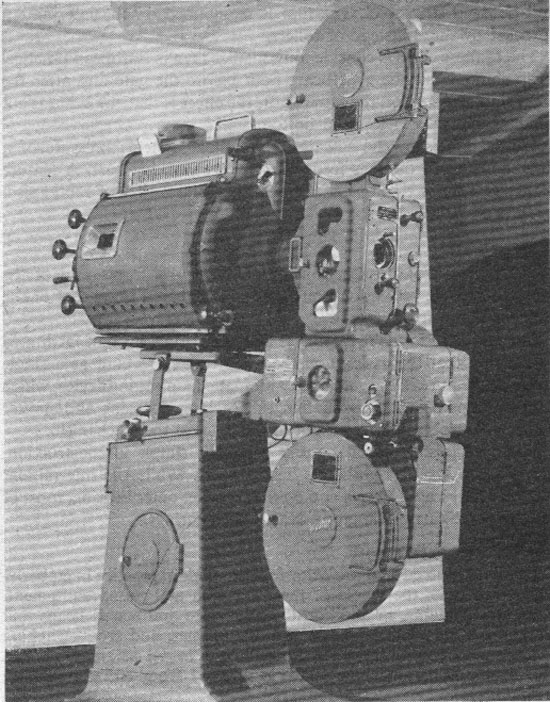
Mark
Posted by Pete Naples (Member # 761) on 07-17-2007, 09:16 AM:
There are a few Westrex 2001/2002 combinations like the one in Marks photo (is that from 'The Complete Projectionist'?) still in service in the UK, not many, because as said, parts are non existant. I just removed one last week, it was replaced with a Century SA/R3.
I have one site on service that runs a pair of 2002 sound heads, they have been fittted with ACL lasers, and the rubber coupling replaced with modern castellated items. They run well, and very smoothly too!
Posted by Richard Fowler (Member # 893) on 07-17-2007, 09:16 AM:
The R2 also had a damping assembly which is similar in concept to the dashpot unit used on Cinemeccanica "delux" projectors ( versus no damper or spring jockey roller unit ). The weak point was the motor set-up where an inferior motor was substituted for the factory specified unit. I used to service many of these out of the USA.
Posted by Mark Gulbrandsen (Member # 72) on 07-17-2007, 09:33 AM:
That photo is from "The Complete Projectionist". You're right Rochard I forgot about the hydro flutter supressor in there.... It works in conjunction with the magnetic stabilizer system somehow. I think much of the design was licensed from Western Electric. The studios also used to have alot of these as far as up into the early 90's. I remember Charlie Wolk calling for any extra parts I had laying around for them. He may have even bought a pair that I once had. As far as I know all the studio's have removed them.
quote:
I have one site on service that runs a pair of 2002 sound heads, they have been fittted with ACL lasers, and the rubber coupling replaced with modern castellated items. They run well, and very smoothly too!
What do you goys do for parts? The lay on roller is apparently the biggest problem.
Mark
Posted by Pete Naples (Member # 761) on 07-17-2007, 11:55 AM:
quote: Mark Gulbrandsen
What do you goys do for parts?
Motors can be rewound, for things like drive couplings and bearings, you can obtain modern equivalents, other than that we've a small stock of parts, and we tend to canibalise out of use heads. Once that stock is gone, it's gone. I can't see us having anything made, there are so few of these in use now. I personally know of 5 in whole of the UK, like I said only 2 of them are on my patch. Fitted with ACL combined optics/lasers they line up beautifully and are very smooth and stable running.
Mark, all the ones I've ever seen like your photo use a springy metal coupling shaft between the rep-set and picture head. It's made of several strands of wire, tightly twisted together and is failure prone on these old machines. The combination of 2001/2003 used a chain drive between the heads. Later variants used a timing belt.
Posted by Louis Bornwasser (Member # 3063) on 07-17-2007, 01:35 PM:
The R2 was invented and manufactured by Western Electric. When the name changed to Century that was the only product they made. At one time there was a theatre in Evansville Indiana that had 2 W.E. and 2 Century R2. Identical. Louis
Posted by Tim Reed (Member # 137) on 07-17-2007, 04:33 PM:
R6's were the same.
Posted by Ken McFall (Member # 845) on 07-17-2007, 05:00 PM:
I've said it before that Pete may well have more Westar equipment than anywhere else in the UK.
As a design standard it's hard to beat and has been improved over the years. But the fundimental mech's remains the same.
The only reason they have survived so long it that Westrex as a service company leased out the equipment and continued service for many years. Of course this eventually ended and so did the service.
For much of the existing equipment still going it's going to be walking a tight rope waiting for a failure that cannot be easily and, more importantly, quickly repaired. I would suspect that such an event may even close some smaller operations.
Omnex can only continue to provide service when it has the parts.... and the cinema operator can afford to pay for the time and expertise required.
I have one site that has this setup and recently had a motor coupling fail. Omnex provided the part and things are back to normal but it is only a matter of time before something else happens that could easily close this site down.
Omnex has always been very generous with its time and I'm sure will continue to help where it is realistic to do so.
But I fear the last bell is about to sound for some of this eqipment.
Posted by Mark Gulbrandsen (Member # 72) on 07-17-2007, 05:13 PM:
Doesn't surprise me that W.E. had a hand in it and that explains the magnetic part. That part of it would have been way way over the heads of anyone at Century to build. Tim, Louis... have you ever had the stabilizer apart on one of those?
Posted by Tim Reed (Member # 137) on 07-17-2007, 06:42 PM:
YES! Little-bitty ball bearing on a needle-point axle holding up the whole works, and horseshoe magnets around the circumference on the inside of the cover!
Posted by Mark Gulbrandsen (Member # 72) on 07-17-2007, 07:17 PM:
quote:
YES! Little-bitty ball bearing on a needle-point axle holding up the whole works, and horseshoe magnets around the circumference on the inside of the cover!
Can you imagine some US company trying to build that stabilizer today... Yikes!
Posted by Monte L Fullmer (Member # 2797) on 07-18-2007, 01:46 AM:
nah, they'd let the Chinese manufacture something like that for us since it's cheaper that way ... let alone they're getting so industrialzed..
Posted by Louis Bornwasser (Member # 3063) on 07-18-2007, 12:25 PM:
Remember the concept of cannibalization; works great. Louis
Posted by Mark Gulbrandsen (Member # 72) on 07-18-2007, 05:16 PM:
Cannibilazation is great when there are abundent pulls to split up but there were not that many of these sound heads to begin with, like the occasional W.E TA-7400 reverse scan sound head you see here and there. Thay musta been expensive suckers....
Mark
Posted by Bastiaan Fleerkate (Member # 3826) on 07-20-2007, 02:31 PM:
I don't know if this is already said... (I am lazy ![[sleep]](graemlins/sleep.gif) , I don't want to read all of the posts )
, I don't want to read all of the posts )
I think the first thing you must take into mind, is the availability of the spare parts in your country or surrounding country's... Iceland is special in this case... Nothing is more frustrating then waiting for a part that isn't available with your supplier.
I personally like the Kinoton FP30E... nice steady picture with German precision and reliability...
Posted by Jeffry L. Johnson (Member # 453) on 07-20-2007, 09:13 PM:
Christie CineX35 quote:
Standard analog visible red LED soundhead with Davis Loop design, which is driven by single sprocket to eliminate possible speed variations and reduce possible film tension
Dolby Cat. No. 702 quote:
To ensure smooth film motion, it uses an easily threaded Davis tight-loop configuration with twin tension arms.
Posted by Mark Gulbrandsen (Member # 72) on 07-21-2007, 08:04 AM:
The Cine-X35 is a really good projector but does seem awkward to thread... And they are still making it Steve! We have basement readers on all of them and the error rates are now as good as a penthouse reader... 0's and 1's! Belts in them also last for years... not just a year as in the P35GP. Six more going in the end of August.
Mark
Posted by Alan Gouger (Member # 543) on 07-21-2007, 11:51 AM:
Why cant someone make a penthouse reader for analog sound. Would the sound drum stabilization to keep wow and flutter at a minimal be the problem. As far as delay there are plenty of outboard delay options on the market. For guys with older projectors I would think there would be a market for this.
Posted by Gordon McLeod (Member # 33) on 07-21-2007, 12:31 PM:
actually the BACP reader has been used on the mega machines like that
but the best is the sondor
http://www.sondor.ch/soundhouse.html
Posted by Tristan Lane (Member # 1169) on 07-21-2007, 01:18 PM:
Christie has discontinued the X-35, unfortunately. All efforts are being focused on improving the P35 instead. Most of the improvements that made the X-35 work so well have been incorporated into the P35GPS. All but the Davis loop soundhead. The addition of the round tooth belts, horizontal changeover assembly, and other small changes have made the P35 a much better projector. I'm told (but have not seen) that SRD basement readers perform really well on the P35 since the addition of round tooth belts.
I'm not sure if Christie intended the X-35 to replace the P35, or just compliment the product line, but it is no more. Christie is offering the round tooth belt and new changeover douser as upgrades to older P35 projectors.
Posted by Alan Gouger (Member # 543) on 07-21-2007, 01:27 PM:
Thanks Gordon. Just what the doctor ordered:)
Posted by Mark Gulbrandsen (Member # 72) on 07-21-2007, 01:27 PM:
Perhaps we're getting the last 6 of them... too bad,it was a better machine.
Also the round tooth beltkits for the P35 are not available as of yet....
On another penthouse note... we will soon have in stock Sony DFP-3000 penthouse sprockets... HArdened steel and VKF teeth, made by LaVezzi! They will cost LESS than the OEM sprocket that Sony still can't supply
Mark
Posted by Louis Bornwasser (Member # 3063) on 07-21-2007, 02:39 PM:
SDDS: why? Louis
Posted by Mark Gulbrandsen (Member # 72) on 07-21-2007, 04:09 PM:
Well, as I always said... it sounds great when it works! At least this IS true of the 20000 systems but the 3000's have been trouble free for the most part. We have replaced a few 3000's with 650's because of lack of rebuilt boards from Sony. I call it the Dolby Syndrome... no one sends the core back! Actually we have quite a few 8 channel systems that we want to keep running as long as there are films with tracks. Others do as well... and there are thousands of other 3000 owners out there that already do or will need the sprocket! Its a real oddball...
Mark
Posted by Steve Guttag (Member # 268) on 07-21-2007, 08:03 PM:
Mark...are you just having the sprocket made or the sprocket assembly? That is...you are having the piece that is held on via a series of screws going around the inboard side of the sprocket?
We too have SDDS units (mostly 2000s but some 3Ks) that we are keeping going. We've been fortunate that we were able to be in the right place at the right time to land several parts units to have a decent supply to keep our customers going. In fact we have both a 2K and a 3K field kit with all the boards.
Steve
Posted by Mark Gulbrandsen (Member # 72) on 07-21-2007, 09:47 PM:
Just having the sprocket made. The holes will be drilled and tapped by LaVezzi for the original metric screws to allow the re-use of the tach generator attachment on the back side. The screw holes will be in the exact same position relative to the teeth. New bearings will be supplied with each sprocket. The specs of the sprocket teeth and such are the same as the 35mm VKF sprockets we had made for the DP-70 in other words hardened stainless steel.
We have close to a dozen 3000 units on 8 channel systems and several more 2000 units on 8 channel as well that we will keep in place and then there are those customers that simply cannot afford to replace those units yet. I think we have close to 35-2000/3000 processors in all still in service...
Mark
Posted by Steve Guttag (Member # 268) on 07-21-2007, 10:01 PM:
Mark...have you tested your sprocket yet? Any chance that the steel sprocket will interfere with the mag-clutch system?
I'm wondering if a hardcoat aluminum sprocket wouldn't be a better choice...the ones we put on the 2000 series readers run super-quiet too (once you properly align the reader).
Steve
Posted by Mark Gulbrandsen (Member # 72) on 07-22-2007, 10:27 AM:
quote: Steve Guttag
Any chance that the steel sprocket will interfere with the mag-clutch system
I appreciate you mentioning that and I will run some more tests this week just to be sure but I doubt any trouble will creep in. If it does we can go to alumnium still with VKF teeth. In the 2000 penthouse I'm not so sure thats really a magnetic clutch system... they may have called it that but in reality its more like an eddy current motor thats driven by an oscillator. Not unlike an eddy current take up motor on a tape deck. It even looks like one and no eddy current motor ever de-maged any tape. The penthouses will actually work with out that motor even connected, or with the motor connected but no flywheel but stability is crap although playbeck is fine. All it serves is to further smooth things out in the tight loop system. Even if there were much of a stray field generated by it there is a pretty good distance between them and the custom sprockets are stainless steel. I had a plain ole steel sprocket(adapted Motiograph 32 tooth) on a 20000 reader once in an emergency and it worked fine. The buzz issue for me was never an issue...drove the customers nuts though, especially once the sprockets became badly hooked. I'm sure that you've heard many different types of dubbers running before and the buzz with them is a constant while film is in motion. Although the hard coated sprockets for the 2000 do run quieter for sure, the alumnium oxide coating is actually a dry form of lubricant.
Mark
Posted by Steve Guttag (Member # 268) on 07-22-2007, 10:48 AM:
Mark, I was actually referring to the 3000 series of reader using a Mag-clutch system...not the 2000 series...for which a decent sprocket does exist off-the-shelf...so to speak. If your sprocket is to be stainless, then there wouldn't be a magnetic issue.
We still have enough factory sprockets to serve our needs but one never knows and the AFI/Silver has 3000 series readers with DFP-D2500 series decoders (relatively rare) that we will try to keep going as long as possible...they have two out of three theatres with 8-channel sound systems (THX approved too).
Steve
Posted by Mark Gulbrandsen (Member # 72) on 07-22-2007, 10:56 AM:
They are no in stock yet.... 8 week lead time. But if you need any just call and let Vince know....
Mark
Posted by Alan Gouger (Member # 543) on 07-23-2007, 03:22 PM:
quote: Gordon McLeod
actually the BACP reader has been used on the mega machines like that
but the best is the sondor
http://www.sondor.ch/soundhouse.html
I just looked into this. They are a UK company ( our dollar really takes a hit, ouch ) with one US distributor. Sadly as much as it would have been a great solution for my Devry I cannot justify its cost. I could buy a used projector, current model with BACP for the same money which I think for myself would be the wiser choice!
Thanks for the link though, its still nice to see there is a solution had I decided to go that route.
Posted by Richard Fowler (Member # 893) on 07-23-2007, 05:16 PM:
Sondor is Swiss...pricy even when our dollar was worth more
Posted by Ken McFall (Member # 845) on 07-23-2007, 07:34 PM:
Silly question..... but here goes anyway.
I've seen an excellent installation of Sondor's in Londons West End, done by Tom Pain beautiful install and very nice machine but why does it look exactly like a Kinoton FP20?
Side by side you could not tell the difference. What's the story here?
Posted by Gordon McLeod (Member # 33) on 07-23-2007, 07:44 PM:
the sondor is an electronic intermitent machine and I beleive they have a rotating prism continous motion version or that may have been perfectone
Posted by Mark Gulbrandsen (Member # 72) on 07-23-2007, 08:09 PM:
I'd bet that Sondor Analog head costs as much as a new Pimp'n Caddy does! Also, I'm still missing why exactly you would want to read the analog sound from above rather than below...
If you go back and look at some of the older Phillips and Bauer 35mm stuff you find that they made stanf along 35mm analog reproducers... No drive in them at all, just the rotary stabilizer and lateral guide roller, optics... all the drive was provided by the projector's lower 32 tooth sprocket.
I use a small Phillips sound reproducer from an FP-56 with my dubber in the shop to feed stereo processors when I work on them...
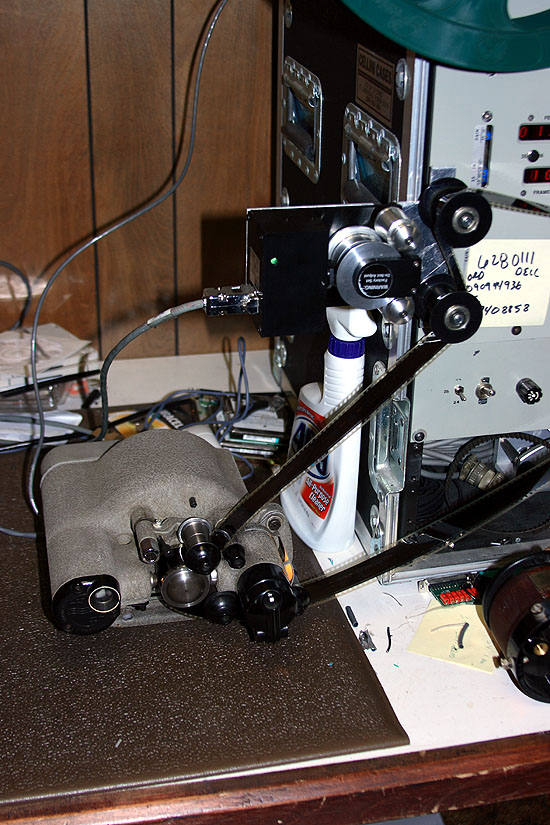
Mark
Posted by Alan Gouger (Member # 543) on 07-23-2007, 10:29 PM:
Not only do you purchase the sound head assembly but you have to buy their interface cables and their special pre amp. I did not get pricing on the preamp which may contain the delay but the price for the sound head alone without DTS or DD scared me enough to not bother asking about the preamp. I was expecting this to cost around 2k at most.
This would have been a simple solution for my Devry. Mark something like that would work great unless I would end up with a lot of flutter.
I could place something in the top of the take up department. I run the film down to a roller at the bottom of the pan and out to a double mutt. There must be a solution to allow me to get stereo out of this puppy without re tooling its own sound pickup..
Posted by Richard Hamilton (Member # 321) on 07-24-2007, 05:52 PM:
Mark, With the Mega, we really had no choice for the 35. They wanted the 35 option available as a kit so existing theaters could buy them. It still meant a trip from Mega to make the initial changes to the machine. When we had to come up with a delay unit, there was a group of us standing around the projector and I asked "how long of a delay? About 2 seconds? That's easy!" I sat for a second looking deep in thought and said "Just run the signal through 980 feet of wire and by the time it gets to the processor, it's delayed!" one tech was thinking about if it would work, the machinist asked me if it would work, and the other tech looked at me and said I was so full of shit, just as me and my boss busted up laughing. Then I heard a couple of "you mother fucker Rick"s as I was leaving the room.
Rick
Posted by Mark Gulbrandsen (Member # 72) on 07-24-2007, 06:56 PM:
Rick,
I can definately understand putting it on the Mega but not on a DeVry! The DeVry is not difficult to convert to stereo/reverse scam. Lets see 980 feet.... about 2 microseconds mabie.... When I worked at the TV station and we built the new facilities we actually timed the fixed station equipment by adding or subtracting coils of wire to the 3.58mhz from the sync generator. We ended up with thousands of feet of wire coiled up under the raised floor but it worked well and was alot cheaper than a proc. amp for each piece of gear. The cameras (TK-45's) didn't need it as they had color phase adjustments on the CCU's.
Mark
Posted by Phillip Grace (Member # 2262) on 07-26-2007, 02:28 AM:
The Sondor Soundhouse can be optioned to read SR-D Analogue (with delay line) and DTS. It is also available with a driven sprocket or a damped sprocket. I thought it would be an ideal one-stop conversion for digital sound. I wanted to use one on an older projector to retain the mono basement reader for old analogue soundtracks. I think the dolby septum may clip some of the older fully modualted dual bi-lateral tracks, and introduce distortion. Unfortunately the currency exchange rate made it too expenive an option.
Maybe it would be possible to re-engineer SDDS readers to read more than just the Sony SDDS track.
Posted by Mark Gulbrandsen (Member # 72) on 07-26-2007, 09:13 AM:
quote: Phillip Grace
I think the dolby septum may clip some of the older fully modualted dual bi-lateral tracks, and introduce distortion.
The septum is actually a bit wider than the track when all is set up and adjusted properly. With some of the older Kelmar scanners it is possible to magnify the track beyond the septum and then you do run into clipping problems. The latest production fomr all the manufacturers pretty much guarantees this doesn't happen. To me older tracks always sound cleaner with a reverse scam unit installed.
Mark
Powered by Infopop Corporation
UBB.classicTM
6.3.1.2