Hi All,
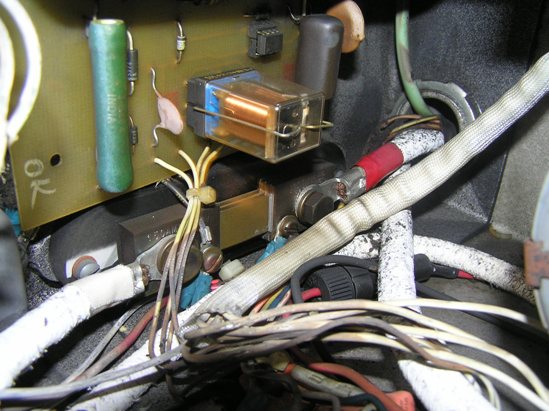
I had been working on taking the advice Louis gave me last week to tighten the bolts in the tranformers. I opened the case, the bolts through the transformers were rusted some what. Put WD-40 on all Bolt heads and nuts... Set for 2 days, I went to turn the Bulb on last night for the movie. Not a single Noise was uttered by this machine.
Unless WD-40 was somewhat of a wonder cure, I would think that maybe with the Very High Humidity that Louis was talking about the last 2 weekends may have been the culprit. He may have the correct answer, Only time will tell and another rise in severe humidity here in Indiana. Knock on Wood!!! Of course, the time to have High Heat and Humidity here in Indiana are quickly passing for the season.
Posted by System Notices (Member # 2357) on 11-16-2007, 01:23 AM:
It has been 446 days since the last post.
Posted by Thomas Dieter (Member # 2507) on 11-16-2007, 01:23 AM:
I thought this would be the best place for this question, beings it deals with the power supply.
I've got a problem with a couple of my lamp houses. I can't seem to get the amperage up to the specified 85A for a 2000W bulb. Even setup on the maximum setting. I'm running Strong Super Lume-X Lamp houses with the Strong Xenon Power Supply. I've taken photos of the settings to show where they are, and so that you can direct me as to what I should do.
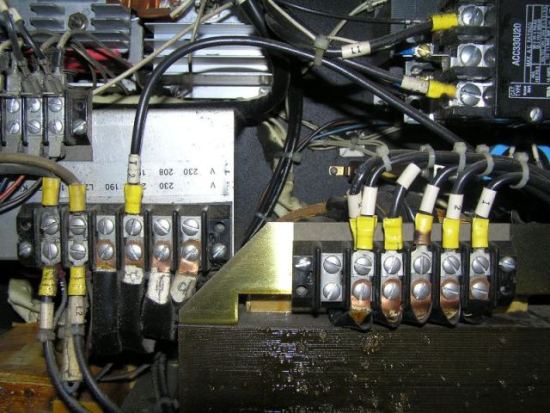
This was the original settings inside the power supply before I tried boosting the amperage.
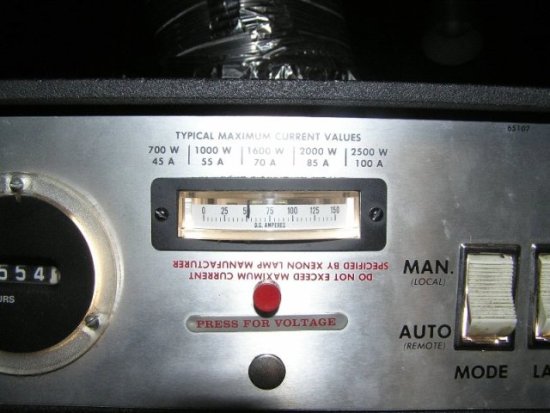
This was the reading from the back of the lamp house while it was running.
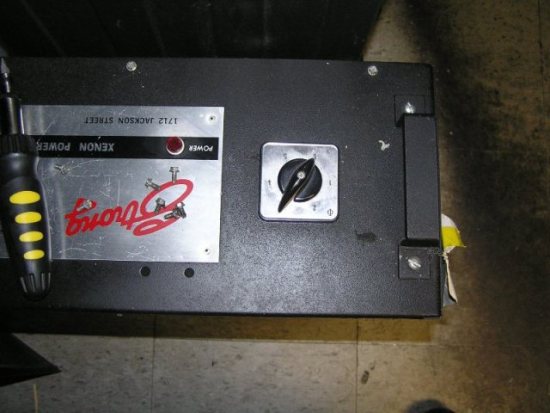
This was the stepper switch setting. 6.
Now I know if the amperage isn't enough for the size bulb that is running, even when set on the highest setting, you can move the wire in the first picture on the left to the left one slot to increase the current. But at the same time you need to turn the stepper switch down so that you don't supply the bulb with to much current. When I did this, the reading on the Lamp House Meter only went up 2 hash marks, bringing the amperage up to 60A, even on the highest setting for the stepper.
What should I do next?
I guess some of this information would be useful.
I've installed an ASL(ORC) XM2000H/VC/G Lamp with is rated at 28V and 70A. I would assume that the amps as the bulb is aged would generally need to be bumped up to 75, 80, and going no higher than 85, is that correct?
Posted by Jeremy Weigel (Member # 4208) on 11-16-2007, 02:22 AM:
Are you sure that the meters are good? I had several meters that were not reading accurately last year. Had one that was reading almost 10amps lower than it actually was. I would try measuring the current across the shunt with a volt meter.
If you know what/where the shunt is quite easy to do. Set the meter to DC and carefully (with full protective clothing and mask if it requires exposing the lamp) measure the voltage across the shunt while the lamp is already lit. It should give you a reading in mV. Next power off the lamp and look at the shunt markings that look something like 150A/50mV. This gives you 3mV per amp. So if you get a reading of say 20mV with your hand held then multiply it by 3 which will give you 60A. I'd post pics, but my camera's not working.
Posted by Monte L Fullmer (Member # 2797) on 11-16-2007, 03:02 AM:
How's the 4 diodes in that diode bank in those old rectifiers?
Those old rectifiers DO get mighty tired after years of service and seen them changed out with switchers.
Actually, you really don't want to go max on that bulb where your suggested rating is 80% of the wattage - like 70 to 75 amps @ 27 VDC. (One can easilly do the math: If you can grab the amperage above mentioned with a VOM, then touch across the DC legs to get VDC, take the two values and times them together to get your wattage ..<the classic PIE formula P=IxE> - which the total should be within the 80 to 90 percent of the maximum wattage of the bulb.
Granted though, the amperage output what is shown on the meter isn't the healthiest...have you tried a different bulb, for I've seen defective bulbs run at low amperage like that.
Also, check for tight connections from rectifier to lamphouse. L
(Tap the meter plastic face with it running., Sometimes the movements inside of them DO love to get a bit on the dry and sticky side.)
Look on the VOLT/AMP plate (where the Model and SS# is embossed on the plate) on the rectifier to see what the MAX VoltsDC/AmpsDC outputs are. You really shouldn't try to exceed those settings.
Good luck, Thomas - Monte
Posted by Thomas Dieter (Member # 2507) on 11-16-2007, 03:47 AM:
![[Roll Eyes]](rolleyes.gif)
![[Wink]](wink.gif)
![[beer]](graemlins/beer.gif)