This is topic Wax For Sealing Oscillator Coils and Electrical Windings in forum Film Handlers' Forum at Film-Tech Forum ARCHIVE.
To visit this topic, use this URL:
https://ft-forum.com/ft/cgi-bin/ubb/ultimatebb.cgi?ubb=get_topic;f=1;t=008230
Posted by Will Kutler (Member # 770) on 08-29-2006, 10:29 AM:
I am putting this topic in the Film-Handlers for reference to anyoneone using antique amps/sound systems in their theatres that might require service. Brad can move thread to Film-Yak if he so chooses.
Phil Hill or Mark G. would probably know the answer to my question.
I am restoring some antique sound-system equipment that does use oscillator coils. The equipment is circa 1938.
Wax was used to seal the windings on the Oscillator Coils as well as the IF Transformers.
Over time the wax became an ooey-gooey dirty mess and requires replacement. .
I thought that Q-Dope would have been a good alternative replacement for the coils, but I may have been wrong in my assessment? Maybe Mark or Phil can give us insight into the proper use and application of Q-Dope?
So, does Phil or Mark know what kind of waxes were originally used for sealing windings and where to purchase?? Was it all just Beeswax, or were there "additives" to it???
Cheers
Kutler
Posted by Phil Hill (Member # 371) on 08-29-2006, 03:49 PM:
Will, I think the original coil wax was a combination of materials commonly referred to as "Mineral Wax".
It had a higher melting temp than that of pure beeswax.
Perhaps Mark, or others, can add more info. Maybe Google would help you find a satisfactory replacement.
(That's all I know about it) ![[Frown]](frown.gif)
Posted by Robert Minichino (Member # 3495) on 08-29-2006, 07:12 PM:
I don't know what was used on the coils of that vintage, but I know some of the newer stuff was sealed with paraffin (which is a mineral wax).
Posted by Ron Yost (Member # 1850) on 08-29-2006, 08:30 PM:
Found via Google:
Zophar Mills Waxes
I didn't investigate the site enough to see if one could order just a little bit, tho. Who knew there were sooooo many potting waxes? Not me, that's for sure!
Hope it helps ya!
Ron Yost
Posted by Jeff Stricker (Member # 224) on 08-30-2006, 06:26 AM:
Will, could be plain old beeswax. We were using beeswax to anchor the windings on auto radio tuning coils through the early 1980's. Worked well and held up in under-dash environment. Good luck with your project. Jeff
Posted by Ron Yost (Member # 1850) on 08-30-2006, 01:13 PM:
I think you're right, Jeff. I remember sticking my fingernail into the wax coating on old electronic parts back in the 50's-60's and my nail always went right in. Obviously beeswax. It was easy to scrape the stuff off, too.
I messed with a lot of old radios and such back then where the wax had melted on some wax caps and such, if they were in a warm area of the chassis .. beneath a warm transformer or hot tube, for example. So I don't think they used anything very exotic for consumer stuff.
Remarkable stuff, beeswax. ![[Smile]](smile.gif)
Ron Yost
Posted by Mark Gulbrandsen (Member # 72) on 08-30-2006, 01:42 PM:
I only use pure beeswax for this purpose. There are alot less contaminents in it that might affect the coil alignment you just got finished doing. Really, unless you're goimng to plan on moving this radio around then no sealent is the best sealent.
Mark
Posted by Will Kutler (Member # 770) on 08-31-2006, 01:36 AM:
On my radio there are three sheetmetal grids that are "stacked" with enough room between them for the coils and various mica caps. Running down the center of this assembly is the band selector switch...actually several wafer switches.
Anyhow, the who assembly was just encased in dirt, dust, etc, etc and the coil wax was a oooey-gooey mess that required cleanup...mostly to access the surronding parts that also required service.
Anyhow, from all I read I though Q-Dope would be an excellent alternative to wax.
Was I wrong on this one! Either I am just applying the Q-Dope wrong or it is just not compatable with a coil that was originally wax sealed.
Due to the Q-Dope I am now concerned that I may have damaged 2 coils.
Cheers
Kutler
Posted by Mark Gulbrandsen (Member # 72) on 08-31-2006, 07:12 AM:
Q-Dope is ok stuff but not consistant with being used on an antique radio if you want to keep it an antique radio. Cleaning old radio and TV's is a difficult matter at best and extremely time consumming to say the least. The liberal use of Q-Tips and the like is mandatory. If the original sealing wax cleans off then pure beeswax should be used to re-seal anything that needs to be. Use of a Caig Labs De-Oxide cleaners to clean the wafer switch contacts works extremely well, just fon't get alot on the wafers. When I overhaul a TV tuner thats filthy I remove it from the set and clean it in my ultrasonic cleaner, then I spray De-Oxide cleaner just on the contacts.
The first photo is showing the oscillator wafer at the front of the tuner. The second is of the same wafer after the whole tuner was disassembled and ultrasonically cleaned. 1 ounce of Dawn Dish detergent was used in the cleaner!
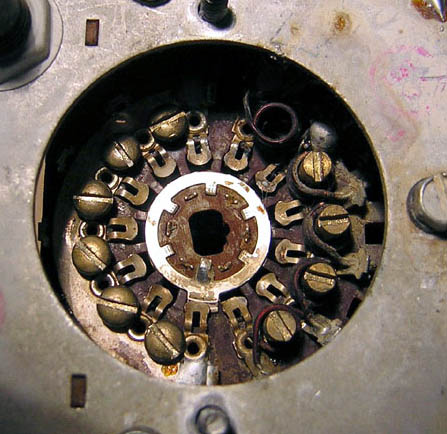
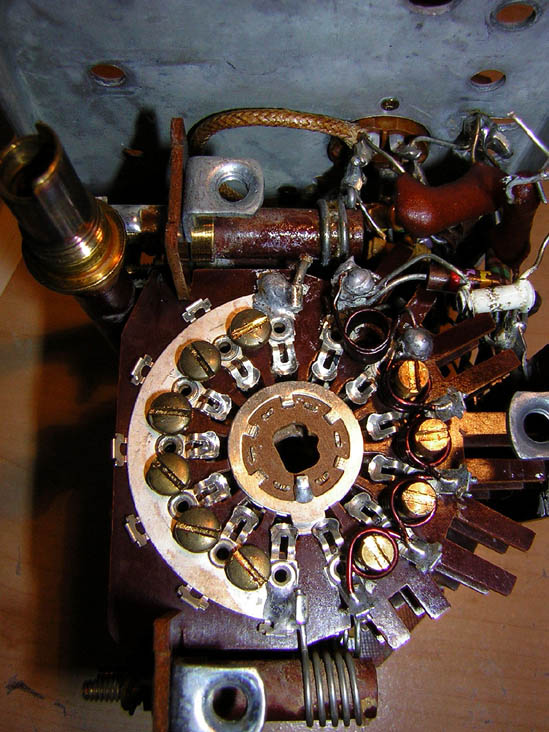
Mark
Posted by Will Kutler (Member # 770) on 08-31-2006, 02:34 PM:
Hi Mark
Could not agree more with your last post.
I gently used a heat gun and LOTS of Q-Tips to clean the coils. Also lots of Caig Labs deoxide cleaners.
Sometimes the chemical cleaners will not dissolve all the oxides that can be built up on wafer switch contacts. In this case the old model railroaders trick can be used: Cleaning the contacts with a soft rubber pencil eraser....this does wonders!
My original purpose for using Q-Dope instead of wax was for long-term preservation. I also thought that Q-Dope would be an easier solution to occasional preventative maintenance cleaning.
My analysis turned out to be incorrect. I am not sure if I incorrectly used the Q-Dope or if it is just not compatable with the old resudial wax that was not removed during prep-cleaning. In any case it was not adhering to the windings or coil forms. As it cured overnight it would shrink and badly craze. It would also turn an opaque-milky white which I believe was the sign of non-adherence. Furthermore, the Q-Dope would crack and flake off quite easily.
My problem is with two of my "A" band coils. These are two of the three with VERY fine windings...like in IF transformers. The microscopic winding wire is actually stranded...and those individual strands are BARELY visable. Looks like the wire was cotton covered and them sealed with the red varnish/lacquer/enamel or whatever it is?? Anyhow, as the Q-Dope peeled off I found that it had dissolved the red coating...revealing the underlaying cotton. Of course only the exterior layers of the windings are visible. While it does not look like the winding wires are broken, I am concerned about the effects of the compromised insulation!
As Mark and others have said, the wax is VERY soft. A few weeks ago I took some of the parts home to Tucson with me for a stop at a local electronics supply store. My Ranchero does not have AC and the summer heat was enough to melt not only the coil wax, but also the IF transformer coil winding wax.
Cheers
Kutler
Posted by Ron Yost (Member # 1850) on 08-31-2006, 09:39 PM:
As Mark says, use pure beeswax. Some of the 'beeswax' sold in hardware stores is adulterated with parafin (so it can be sold at a lower price), so be careful what you buy. Pure beeswax isn't inexpensive these days, but it's worth it.
Maybe you can find (or know) a local beekeeper? They'd most likely make filtered cakes of it, as there's a LOT of it after it and the honey are separated. Grandpa (well, -ma, actually) used to use biscuit tins to mold the small cakes in. They sold the cakes for ten-cents! It's a tad more expensive, now. ![[Eek!]](eek.gif) I helped my grandpa some with his hives .. the separator was the most fun, for a kid.
I helped my grandpa some with his hives .. the separator was the most fun, for a kid.
I do woodworking as one of my hobbies, and it's the bees-knees ![[Big Grin]](biggrin.gif) for lightly lubricating wood-screw threads, too.
for lightly lubricating wood-screw threads, too.
As I said, remarkable stuff.
Ron Yost
Posted by Will Kutler (Member # 770) on 08-31-2006, 10:22 PM:
So, I'll clean up what I can and replace with beeswax. There are some local bee supply stores, so I should be able to get some.
I was unsure if it was originally beeswax that was used, paprafin or a "special blend" So, I'll go with beeswax.
Ron, I am also a woodworker. Good to hear someone elese familiar with the beeswax on screw trick. But a much cheaper solution...a bar or liquid Dial handsoap does the same thing Another old woodworkers trick. If one is using nails, take your hammer and nail and flatten the tip. Do this by putting the nail on concrete or hard surface and moderately hit the nail on the head as if your trying to nail that hard surface. The purpose of this??? It'll prevent your wood from splitting as your nailing it.
And Mark...in the pic you posted it looks as if there is a white "dogbone" resistor. If those go bad what do you replace with? A 1 watt flameproof, wirewound????
Cheers
Kutler
Posted by Jeff Stricker (Member # 224) on 09-01-2006, 06:14 AM:
Will,
That looks like a dogbone capacitor in Mark's picture. Normally these are of low value (few pf) and are of the temperature compensating variety used in oscillator circuits to reduce drift over temperature. They are usually of negative temperature coefficient (meaning as temperature goes up, the cap value goes down). The coil in the circuit will have a PTC characteristic (increasing L with temp). The idea is to keep the C X L product constant over temperaturem which keeps the oscillator drift nearly zero. (easier said than done! I've spent may a day and night at this using temperature chamber -- but, that was in another life. ![[Wink]](wink.gif) )
)
Mark: excellent contact cleaning ![[thumbsup]](graemlins/thumbsup.gif)
73, Jeff
Posted by Will Kutler (Member # 770) on 09-01-2006, 04:15 PM:
Hi Jeff
My RCA 816K has some dogbone style resistors. Not sure wat is special about them...if they were wirewound or what. Interestingly, the RCA parts sheet also specifries "insulated resistors". Not sure what that means and no one whom I have asked seems to know either.
Yes, I am familiar with the temp compensating caps you have mentioned. Temp compensating caps were used on this radio. Unfortunately the specific caps and values are not specified on the parts sheet...just the OEM RCA part number...a ploy to force the consumer to purchase RCA parts. And the caps installed in my radio do not have the dot matrix code used to identify cap values/styles. What is printed on the caps are letter-number codes like M250 that no one seems to be able to decode...nor have I found any on-line info.
Regards
Kutler
Posted by Mark Gulbrandsen (Member # 72) on 09-01-2006, 04:42 PM:
The dogbone resistors are usually wirewound and tighter tolerance. The tuner I posted above fomr my RCA 721TS has no AFC at all but once it warms up for 5 min. it is completely stable.
Mark
Posted by Phil Hill (Member # 371) on 09-01-2006, 09:46 PM:
Actually "dog bone" (radial lead) resistors as used in the old electronic equipment from the 30's-60's (and before/beyond) are carbon composition and not WW. They are usually coated with ceramic, epoxy, or just a painted carbon core. More recent ones are carbon film with spiral grooves laser-cut into them to determine their final resistance and considered "precision".
Forgot who said it, but it's true the "dog bone" caps (condensers) were used for temp compensation in critical circuits and had a negative temp coefficient to offset the positive temp coefficient of resistors and inductors. The net result was (almost) a stable circuit that held it's freq and other characteristics.
In the more expensive and more critical applications, all the freq determining components (including in most cases the vacuum tube or transistor osc) were enclosed in a temp controlled compartment known as an "oven".
As far as the beeswax... I'd look for a better modern replacement...
BTW: Speaking of dog-bone resistors and "condensers", many anal-retentive restorers will go so far as to make their own dog bone, (radial lead) components. They (epoxy?) mold new axial-lead resistors or caps into a "dog-bone" form and paint them to look like an original. I ***cannot*** buy into to those anal-retentive guys that HAVE to have it and MAKE IT LOOK "original"! I mean WTF **REALLY** cares??? Not ME! Fer sure!
Posted by Mark Gulbrandsen (Member # 72) on 09-01-2006, 10:11 PM:
quote: Phil Hill
Actually "dog bone" (radial lead) resistors as used in the old electronic equipment from the 30's-60's (and before/beyond) are carbon composition and not WW.
I do have a piece of H-P test equipment that uses dog bone resistors that are wire wound. You can see the turns through the enamel coating. Will try to look for them and post a photo. Tektronix also used tons of dog bone resistors and caps up through the mid 70's.
Mark
Posted by Randy Stankey (Member # 64) on 09-01-2006, 10:17 PM:
quote:
I ***cannot*** buy into to those anal-retentive guys that HAVE to have it and MAKE IT LOOK "original"!
If the original designers had some of the modern materials, back then, that we have today, they would have used them. (The use of vacuum tubes not withstanding.)
If an old radio is worth keeping it's worth fixing up according to modern standards. The only exception being rare and expensive models. But, those belong in museums in the first place.
Posted by Will Kutler (Member # 770) on 09-02-2006, 01:14 AM:
With my radio I want to be able to safely and reliably use and enjoy it on a daily basis. So, I am restoring with modern components of the correct values per schematic. Another reason for the modern components is that reliable origonals are no longer available.
Among my modern components are the wire, resistors and caps. Using modern UL1015 18AWG throughout. Some of the antique radio supply outfits have colth coverd (UL1015) wire, but they do not have all the color codes I require. All my resistors are NTE 2% Flameproof...what the store had on the shelf.
Yes, there are those restorers anal about keeping a 100% original radio...even if it is not working. There is one outfit reproducing wax/paper caps. And yet there are those restorers that will gut those origonal caps and stuff new ones inside to retain original appearance. There are also methods of opening up micas and restuffing them. Ditto with chassis mounted E-cap cans.
From what I gather the antique radio hobby is very finiky! Radios with roughly 15 tubes or more are the high dollar items. I did ask about donating my 816K to a musuem after I am no longer here...for safe keeping. The consensus response has been "good luck!"
What is really disgusting is seeing people who by upold radios for their cabinets...throwing away original chassis and instaqlling modern low-end audio crap!
I actually had one individual say to me the other day "Why bother restoring an old tube radio...they never held their tuning". So, I asked the person to explain himself which he of course could not do.
Cheers
Kutler
Posted by Mark Gulbrandsen (Member # 72) on 09-02-2006, 07:36 AM:
How a restoration is done is all up to the individual and how much he/she is into it. I also prefer the reliability aspect of making something old working again. Burning one's house down for the sake of making a capacitor or resistor look old is really stupid.
Mark
Posted by Phil Hill (Member # 371) on 09-02-2006, 03:26 PM:
I basically agree Mark & Will. For me, as I said, I want it to be safe as well as perform and look close to the original as "reasonable."
I guess other than replacing worn playfields with NOS playfields in electro-mechanical and early mircoprocessor pinballs, or re-chroming pitted jukebox trim, the most sinful restoring thing I've done is replace burnt video game CRT monitors with modern flat-screen monitors.
Posted by Charles Greenlee (Member # 3856) on 09-06-2006, 02:01 AM:
I preferr honoring the original design as best I can. I'd check everything I could to make sure it was in working order. If there is something I have to replace, I will replace it with the best equivalent. I.e., If I replace a red wire that is worn to the metal, I will replace it with a new, modern, poly coated red wire. It still follows the color scheme and performs the same function, AND adds better safety and performance. External components on things such as an old console radio, I'd try to keep original for cosmetic purposes, but internal, I won't shy away from replaceing an old wax sealed cap with it's updated modern equivalent, if the old one needs it. As long as the schematic is the same. If its a tube, I may try to find it in an exact NOS, but probably I'd be forced to see if there is a modern interchangeable tube still in production, which I would hope would be superior.
Posted by Josh Jones (Member # 447) on 09-07-2006, 11:13 PM:
I have used hot glue on RF coils in the past with no ill effects. Haults microphonic action as well.
JJ
Posted by Will Kutler (Member # 770) on 09-08-2006, 11:42 PM:
I am going to attempt contact with the Materials Engineering dept at ASU Tempe. Maybe they will be able to analyze some original wax for me to see if it is parafin or beeswax...as well as any other noted additives?
Cheers
Kutler
Posted by Jeff Stricker (Member # 224) on 09-09-2006, 05:47 AM:
Will, try these guys. What a collection of finely restored radios at their museum.
Indiana Historical Radio Society
Posted by Mark Gulbrandsen (Member # 72) on 09-09-2006, 12:46 PM:
Josh,
You can't peel off hot glye on a coil wound from #48 enameled wire! Its fine for the plumbing that you work on though.
Mark
Posted by Will Kutler (Member # 770) on 09-10-2006, 06:57 PM:
Hi Mark
Ditto on what you just said! What Josh said is a sure fire way to really screw-up coils wound out of Litz Wire!
My problem was that it looked like the wire on my oscillator coils were all solid strand red-enameled. This belief held true because after melting off the original wax, I lightly cleaned the coils with Q-Tips dipped in MEK (MEK being the carrier agent in Q-Dope). No harm came to the coils with this light cleaning, hence I thought that my enameled wire analysis was correct.
Was I wrong! Two of the critical coils were Litz wire. Three or four strands only visible under magnification covered in cotton and then red lacquered?? over. And the physicall appearance of that red coating also looked as though the wire was single-solid strand!!
While I did not break any wire, the Q-Dope did a great job of dissolving the red coating and damaging the underlying cotton insulation! So, I do not know if these coils are now junk?
But I am lucky! I located a parts chassis which is now on the way! But I will redip my original coils in wax and test them...keeping all body parts crossed in hopes that the coils are still good! Unfortunately I do not think that I can rewind these coils, as they were originally machine wound with obvious special patterns.
Boy am I glad that I did not tackle my IF transformers with Q-Dope...then I would really have been up ![[bs]](graemlins/bs.gif) CREEK!
CREEK!
Powered by Infopop Corporation
UBB.classicTM
6.3.1.2