This is topic Horizontal jitter in picture on a Kinoton FP-23 in forum Film Handlers' Forum at Film-Tech Forum ARCHIVE.
To visit this topic, use this URL:
https://ft-forum.com/ft/cgi-bin/ubb/ultimatebb.cgi?ubb=get_topic;f=1;t=008252
Posted by Mitchell Dvoskin (Member # 751) on 09-18-2006, 01:01 PM:
I have a Kinoton FP-23 that has some slight horizontal jitter in the picture, most noticable when running scope films, although exclusively.
There is nothing obviously loose. The only thing that may be an issue is that the lateral guide rollers at the top and bottom of the film gate are spring loaded on both sides (soundtrack/non-soundtrack), as opposed to being spring loaded on one side to push the film against a fixed surface on the other. I am assuming this is correct as designed, but this is the only FP-23 I have ever seen.
Another thought was that the film was buckling in the gate, but with a curved gate and only a 700 watt xenon, this seems unlikely. Turning up the gate tension did not seem to eliminate the problem.
Any suggestions for eliminating this problem would be appreciated.
Posted by Dave Macaulay (Member # 813) on 09-18-2006, 02:35 PM:
If the discs are clean and working properly you shouldn't have much lateral motion. Check how the intermittent teeth are engaging the sprocket holes, the pins should be centred in the holes. If the sprocket is off centre then you will have lateral movement in the aperture.
I have seen the springs on one side (FP20) replaced with metal spacers. I couldn't see any jitter problem with the springs and the spacers also gave a good steady picture.
Posted by Michael Schaffer (Member # 1204) on 09-18-2006, 02:39 PM:
The lateral guide rollers could be simply worn, or the springs could be worn or there could be dirt stuck inside. But I guess you already checked that. It could also be that the intermittent has some lateral play and that is what you are seeing. When the machine is running, and you press your thumb against the side of the intermittent sprocket - but veeeery carefully, you don't want it to eat your thumb! -, does that influence the horizontal jitter? It has been a long, long while since I last saw an FP-23 in the flesh, so I don't remember how the intermittent movement is mounted in the machine and if the same adjustments as with later models can be done to minimize that. Sometimes the intermittent sprocket is simply loose and then travels horizontally. Maybe you could post a close-up picture of the intermittent and the outboard side of it.
Posted by Mitchell Dvoskin (Member # 751) on 09-18-2006, 06:48 PM:
I had previously check everything Micheal and Dave suggested, nothing obviously wrong. Intermittent tight, guide discs not particulary worn, springs good, no dirt, etc.
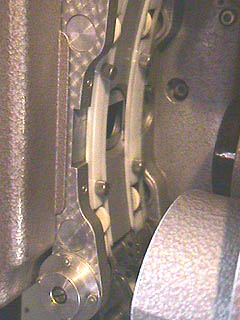
Posted by Gordon McLeod (Member # 33) on 09-18-2006, 06:50 PM:
Is the endplay adjustment too loose
Posted by Mitchell Dvoskin (Member # 751) on 09-18-2006, 07:03 PM:
Is the endplay adjustment too loose
I am not familiar with that terminology. What is the endplay adjustment?
Posted by Gordon McLeod (Member # 33) on 09-18-2006, 07:16 PM:
there is a slot screw in the outboard bearing that sets the amount of endplay it should be just snug
you can see it in the centre of the sprocket outboard bearing support
Posted by Robert John Jeromson (Member # 2559) on 09-18-2006, 07:18 PM:
In your photograph there is a screw adjustment on the end of the sprocket, it is locked in place by a hex bolt. This is the end play adjustment Gordon is referring to. Undo the hex bolt and gently tighten the endplay to see if it fixes the problem.
Is the framing in the machine clunky? Does moving the framing knob or holding it on full lock to one side fix the problem? Worst case scenario you may wish to investigate having the machines framing bush replaced.
Posted by Steve Guttag (Member # 268) on 09-18-2006, 08:53 PM:
Since it is lateral...check with the film running and the skate is closed...see if the film is curling around the skate where the lateral guides contact the film...if the skate is worn where the lateral guide discs contact the film and the film curels (the runners will beveled from the film wear instead of having a sharp 90-degree angle to them , it will do the sideways schimmy. Change the skate and all will be well.
From the photo...the runner strips look well worn too. Just for grins, change both the runners and the skates (the runners look like they had already be transposed).
Posted by Michael Schaffer (Member # 1204) on 09-18-2006, 09:14 PM:
Right, and when even that doesn't help, go on to
quote: Robert John Jeromson
In your photograph there is a screw adjustment on the end of the sprocket, it is locked in place by a hex bolt. This is the end play adjustment Gordon is referring to. Undo the hex bolt and gently tighten the endplay to see if it fixes the problem.
That's where I was heading, too. But I simply couldn't remember if the FP-23 already has the same intermittent casing as later machines. It does.
In that case, loosen that set screw which should be located at approx. 8 o'clock in the side of the circular endplate in which the slotted screw is set. Grab the framing knowb and frame all the way up or down. Insert a flat head screw driver in the slot and loosen the screw. Rattle the framing knob. You should feel the feedback on the screwdriver. Tighten the screw gently until it is just fingertight, and rattling the framing knob does not appear to move the intermittent laterally. Do not overtighten the screw brutally. Then go back on the screw CCW just a tiny little bit, less than "5 minutes". Tighten the set screw properly. That usually takes care of the problem.
Posted by Mitchell Dvoskin (Member # 751) on 09-19-2006, 09:17 AM:
While I am tinkering, what is the proper proceedure for replacing those lateral guide discs? I have spares, just not sure how to get in there and change them.
Posted by Steve Guttag (Member # 268) on 09-19-2006, 11:18 AM:
I would be more than amazed if the ceramic discs need to be changed. I have seen their mechanism rust up though.
To remove them...merely grab on and pull them straight out to you. To put new ones on...merely push them in until the points seat in the middle of the disc...it is that simple.
Anyway...make sure the discs are seated and still have spring action. If they don't you might have a job in front of you. I always lubricate the spring and piston (point) area to keep them from freezing up.
Try the skate and runner strip plan if you have them.
Steve
Posted by Mitchell Dvoskin (Member # 751) on 09-19-2006, 02:54 PM:
Thank everyone, I'll give your suggestions a try this weekend and let you know.
Posted by Michael Schaffer (Member # 1204) on 09-20-2006, 02:14 AM:
Man, what kind of a job/cinema is that where you have the luxury of waiting until next weekend "to try things out"?
Posted by Mitchell Dvoskin (Member # 751) on 09-20-2006, 08:08 AM:
The projector is in a private screening room and will not be used again until next week.
Posted by Mitchell Dvoskin (Member # 751) on 10-06-2006, 09:02 AM:
I changed the runners & skate, and re-adjusted the end play. This seems to have solved the problem.
One more question. In my box of spare parts that came with the projector was a metal skate. I have always used the delrin/plastic skate. Is there any advantage/disadvantage to using the metal skate? Do metal runners also exist?
Posted by Gordon McLeod (Member # 33) on 10-06-2006, 09:25 AM:
I have several locations that use the metal skate
there is also a melamine type of skate as well
In most lab work they use velvet glued to the steel ones
Posted by Richard Fowler (Member # 893) on 10-06-2006, 11:20 AM:
The metal skate is considered a special order due to high cost. Brad seems to prefer them on his PK-60's in service. I have one set on a unit that is in a performing arts center due to the center's on call operators varying in quality and sometimes damaging the delrin type.
Posted by Dave Macaulay (Member # 813) on 10-06-2006, 01:33 PM:
I haven't seen any image quality difference between the emtal and plastic skates, like Gordon says there are folks who swear by velevet strips glued to the skate.
Metal is better where the operators may be unfamiliar with the projector. If you project open gate white light (why?) an open plastic skate melts pretty quickly (depending on lamp power), metal doesn't. If you know the machine you will remove or at least close the skate.
Posted by Michael Schaffer (Member # 1204) on 10-06-2006, 04:16 PM:
I would think that a clumsy operator could do more damage with the metal skate (to the film).
How on earth do you damage the Delrin skate (except for by heat, as Dave mentioned)?
Apart from these aspects, the Delrin parts are much better to the film. The only (technical) reason one might want to use metal parts is when the PK60 is mounted on a hotspotting console such as an SLC. I could imagine they could damage the Delrin parts.
I have seen projectors mounted on SLCs where the hotspotting had caused holes to be burned into the dousers(!).
If you have a good lamphouse with even light distribution, that shouldn't be a problem at all. I have had many projectors with Kinoton lamphouses up to 7k with Delrin parts. No problems at all with heat damage.
Powered by Infopop Corporation
UBB.classicTM
6.3.1.2