This is topic quick guide to 35mm optical (mono vs. Dolby stereo) & Dolby Analog NR formats by year in forum Film Handlers' Forum at Film-Tech Forum ARCHIVE.
To visit this topic, use this URL:
https://ft-forum.com/ft/cgi-bin/ubb/ultimatebb.cgi?ubb=get_topic;f=1;t=008255
Posted by Brian Dooda (Member # 3941) on 09-19-2006, 01:25 PM:
Guide to Optical Sound Formats (Mono vs. Dolby Stereo)
pre 1927 – Probably Silent, very few exceptions
1927-1975 - Mono**
1975-1985 – probably Mono, few Stereo
1985-1987 – 50/50 Mono or Stereo
post 1987 – probably Stereo
* A Stereo or Mono print will both suffer some quality if played
through the wrong format, but if you are uncertain of a
print, it is best to play back in Mono.
** Although not Dolby Stereo, other "stereo" formats did exist on
some major Hollywood films during these years, the most
popular being Perspecta Sound (1954-1957) and Magnetic
stereo (peaking between 1955-1965).
Guide to Dolby Analog NR Formats (A-type vs. SR-type)
1975-1987 – A-type noise reduction
1987-1995 – probably A-type, few SR-type
1995-1997 – 50/50 A-type or SR-type
post 1997 – probably SR-type
* All prints with a Dolby Digital track (introduced in 1992)
use a SR-type optical sound track
* After 1987 a stereo print could be A-type or SR-type.
There is no way to tell just by looking at the track.
It must be labelled. If you are not certain a stereo
print is A or SR, it is best to play it with A-type
noise reduction.
The years and probabilities of formats are based on figures reported to me by the Dolby librarian of types of sound formats produced each year worldwide. I compared that with figures of films produced annually from film almanacs and focused the years around domestic releases.
[ 09-25-2006, 12:48 PM: Message edited by: Brian Dooda ]
Posted by Charles Greenlee (Member # 3856) on 09-20-2006, 12:34 AM:
On a side note, though this is a valuable, and potentially instructional thread, I'd like to add another entry.
1940 - Fantasound (RCA and Disney). Features 3 descreet channels and a control channel on a dedicated film. The control channel allowed the 3 sound channels to be panned between 2 speakers each, emulating 6 channels. The original surround system.
I add this for factual note, not that anyone will use a Fantasound system, or run into a print. BTW, if you do run into a vintage 1940 print of Fantasia, it will have a mono backup on the print. Doubt you'll ever find the soundtrack film for it though.
Posted by Leo Enticknap (Member # 534) on 09-20-2006, 02:49 AM:
quote: Brian Dooda
pre 1927 – Silent
There are De Forest Phonofilm variable density tracks which survive from at least October 1922, though admittedly, the system was not widespread. Derivatives and ripoffs of De Forest technology (e.g. early variants of the Theodore Case system which eventually became Fox Movietone, and Powers Cinephone) also predate 1927.
quote: Brian Dooda
1927-1975 - Mono
Which subdivides into:
1. Variable density tracks mastered using a light source of variable intensity (Aeo-Light and derivatives) - had effectively dropped out of use by the mid-30s;
2. VD tracks mastered using a constant light source and variable aperture (Western Electric) - dropped out of use for mastering and rerecording by the late 30s, but remained in widespread use for release printing well into the 60s;
3. Variable area recording (initially RCA Photophone), which gradually became more sophisticated during the middle of the twentieth century and is still the principal means of analogue optical recording.
Posted by Monte L Fullmer (Member # 2797) on 09-20-2006, 03:04 AM:
quote: Brian Dooda
A Stereo or Mono print will both suffer some quality if played
through the wrong format, but if you are uncertain of a
print, it is best to play back in Mono.
Stereo processors has the ability to determine what soundtrack format is on the film and will automatically switch to that format.
Never heard of a "dolby librarian.."
Posted by Frank Angel (Member # 248) on 09-20-2006, 10:10 AM:
quote: Monte L Fullmer
Stereo processors has the ability to determine what soundtrack format is on the film and will automatically switch to that format.
Monte, you mean between analog and digital, not between SR or A, yes?
Posted by Christopher Seo (Member # 7) on 09-20-2006, 10:28 AM:
Well, Kintek processors could automatically switch to stereo from mono if they detected a difference between Lt and Rt, but I'm sure they couldn't distinguish between A-type and SR.
Posted by Brian Dooda (Member # 3941) on 09-20-2006, 10:51 AM:
The guide is really intended as a quick reference for projectionist working in art house theaters as to the odds of an optical print being stereo or mono and in the case of a stereo print whether it's A or SR type noise reduction. It's certainly not a history of sound formats. There are exceptions to the pre-1927 Silent date but I think that date is generally accepted for major releases. I really should'nt even have included the blurb about magnetic sound but I thought in the case of an optical sound re-release those films would have a stereo master. But the guide mostly applies to original release dates since a re-release can be remastered.
Stereo processors has the ability to determine what soundtrack format is on the film and will automatically switch to that format.
The processors I work with are the CP650 and CP200. I'm not aware that either automatically switches to stereo or mono and in my experience the 200 will stay on whatever format assigned.
Never heard of a "dolby librarian.."
The Dolby Librarians name is Tamara and she is very nice and helpful. She works in the San Francisco office. Librarians are the true defenders of freedom. They Rule.
Posted by Charles Greenlee (Member # 3856) on 09-20-2006, 11:18 AM:
Edison did experiament with sound by rigging up a phonograph to his kinetoscope, but it didn't take off. Interestingly enough, (was it the vitascope?) the first wide relese motion picture system with sound used a phonograph started in synch with the projector. The original sound on disc steup. ![[Big Grin]](biggrin.gif) Though I don't remember the date one that one.
Though I don't remember the date one that one.
Posted by Leo Enticknap (Member # 534) on 09-20-2006, 11:45 AM:
Edison's system was called Kinetophone (based on acoustic recording using cylinders) and the Warners' disc-based system was Vitaphone. It had effectively dropped out of use as a production format by the back end of 1929, although discs continued to be supplied for theatre playback (with an optical sound positive being played into the disc cutter to master the records) for a few years afterwards. Although it used discs as the carrier, though, Vitaphone was based on electric amplification. Disc-based systems go back almost as far as film itself, but most were limited to 3-4 minutes' duration and the recording and playback was acoustic.
Posted by Monte L Fullmer (Member # 2797) on 09-20-2006, 02:15 PM:
..and whats funny is that with DTS .. going back to the sound on disc format..just in a better form.
Posted by Stephen Furley (Member # 1277) on 09-20-2006, 02:59 PM:
quote: Brian Dooda
pre 1927 – Silent
Eugene Lauste was recording, and reproducing, optical sound before the First World War, the system was really only experimental, but he did make combined prints, and demonstrations were given to public audiences.
http://www.amps.net/newsletters/issue22/22_lauste.htm
Both VD and VA systems have been around since the earliest days of optical sound, amd both were in use alongside each other for many years.
Posted by Charles Greenlee (Member # 3856) on 09-20-2006, 05:34 PM:
quote: Monte L Fullmer
..and whats funny is that with DTS .. going back to the sound on disc format..just in a better form.
Exactly my point, Monte. Thanks for picking up on it.
Posted by Monte L Fullmer (Member # 2797) on 09-20-2006, 09:47 PM:
Interesting in all of this, but if one really wants to pick up on a lot of technical zoom, chek out this sound section page of this well-known site to us film tekkies.
-Monte
Posted by Charles Greenlee (Member # 3856) on 09-21-2006, 01:23 AM:
Yes, been there. Although it could be set up to be more astetically appealing, it has alot of information on it. Though I would love to get my grubby hands on a repro of that Fantasia poster. Anyhow, back to the main event.
Posted by Michael Schaffer (Member # 1204) on 09-21-2006, 03:11 AM:
quote: Leo Enticknap
There are De Forest Phonofilm variable density tracks which survive from at least October 1922, though admittedly, the system was not widespread. Derivatives and ripoffs of De Forest technology (e.g. early variants of the Theodore Case system which eventually became Fox Movietone, and Powers Cinephone) also predate 1927.
"Redende Bilder" (talking pictures) were first shown publically in Berlin on September 17, 1922 using a process called Triergon. The patent was then sold to the US where it became the basis for Fox Movietone.
Posted by Bernard Tonks (Member # 809) on 09-21-2006, 05:09 AM:
quote: Michael Schaffer
"Redende Bilder" (talking pictures) were first shown publically in Berlin on September 17, 1922 using a process called Triergon. The patent was then sold to the US where it became the basis for Fox Movietone.
According to the BKSTS wall chart, the 1922 experimental sound-on-film Tri-Ergon system was on 42mm film with the soundtrack in the outside area of the perforations. I seem to remember Stephen Furley mentioning this in another thread.
During the early 1960’s Elstree Studios and ABC Cinemas in the UK, experimented with a single track magnetic mono stripe completely covering over the optical track. This was short lived for first run halls. The idea was that the magnetic track could be washed off the prints for release in cinemas without magnetic sound.
Posted by Steve Guttag (Member # 268) on 09-21-2006, 06:44 AM:
While it does not amaze me, it does sadden me that someone creates a thread aptly named "Quick guide to 35mm optical/Dolby analog sound formats by year" and pretty much accomplishes that and then some people feel the need to not only drift off topic (common and sometimes benefitial, not really in this case) and spout out their knowledge base (or lack there of).
Sorry to sound so pissy here but come on, where does Fantasound fit into the topic offered? It is an obsure format used on how many films? How is that a handy guide for anybody handling film? Fantasound has its place in movie history and is certainly worthy of discussion but not in this thread...it is a waste of space here and clouds the proper discussion.
The same goes for Vitaphone. Certainly has its historical place, certainly worthy of discussion...certainly does not fall into a useful discussion for this thread.
If one were to augment this thread, a more useful addition would have been Perspecta Sound since it is indeed 35mm optical and showed up on a great many non-magnetic films of its era...not just one film that happens to bear the same name...like Fantasound.
I think what Brian started was good and useful and worthy of being expanded upon but most of what came after belongs in another thread or threads. I wish people would take a quick look at the topic before feeling the need to add some tidbit of info that really does not fit. This thread could be endless if all movie sound formats were given their full due...but it really wouldn't be a "Quick Guide" then, would it?
Okay, I'm done venting...sorry to all the feelings I may have hurt. ![[Roll Eyes]](rolleyes.gif)
[ 09-21-2006, 07:53 AM: Message edited by: Steve Guttag ]
Posted by Leo Enticknap (Member # 534) on 09-21-2006, 08:12 AM:
quote: Michael Schaffer
"Redende Bilder" (talking pictures) were first shown publically in Berlin on September 17, 1922 using a process called Triergon. The patent was then sold to the US where it became the basis for Fox Movietone.
It's not quite as simple as that. Lee de Forest spent a year in Berlin (October 1921-September 1922) working on his own variable density system after having been approached by Vogt (one of the 'Tri Ergon') during the summer of 1921. The September '22 demonstration probably involved a hybrid of De Forest's sound camera, the Thallofide photocell and the Tri Ergon mechanism.
The key Tri Ergon patent which was sub-licensed initially by De Forest and subsequently by Case and Fox was for the idling roller on the scanning drum in the projector, i.e. the mechanism for reducing wow and flutter caused by the action of converting intermittent film transport into continuous. To make matters even more complicated De Forest went into partnership with Theodore Case on his return to the US, and the system which De Forest Phonofilms, Inc. began to commercially exploit from April 1923 incorporated De Forest, Case and Tri-Ergon technology.
De Forest and Case fell out with each other towards the end of 1925, at which point Case approached William Fox for R & D funding, to continue to develop optical sound himself. The end result was Fox Movietone. De Forest alleged that Case had taken some of his own patented technology with him: the resulting lawsuits dragged on well into the '30s, by which time it was all over bar the shouting. And Tri-Ergon were suing Fox for patent infringement all the while this was going on! Like so many pioneers whose work served mainly to pave the way for others, Lee de Forest was undercapitalised and just not that good a businessman.
Posted by Stephen Furley (Member # 1277) on 09-21-2006, 12:03 PM:
quote: Leo Enticknap
the system which De Forest Phonofilms, Inc. began to commercially exploit from April 1923 incorporated De Forest, Case and Tri-Ergon technology.
Fairly typical of the way that things tend to happen; It's seldom possible to give a simple answer to a 'who invented something, and when' type of question. There are often several people working along similar lines, and elements of all their experimental systems get incorporated into what eventually becomes a commercial product. It's seldom possible to come up with a single name, date and place, and say that's when it happened. There really is no first sound film, or to put it another way, there are lots of different ones, depending on how you define the term. Do you include experimental or demonstration systems, and, if not, when do you consider that the technology has progressed beyond that stage?
Posted by Mitchell Dvoskin (Member # 751) on 09-21-2006, 12:32 PM:
While Mr. DeForest did make some groundbreaking discoveries, he actually made a living patenting things that he did understand why they worked, and he had no idea of any practical implementation of his "invention". He would then sit back and wait for someone else to actually invent something that overlapped his patent, and then sue them for patent infringement in hopes of getting royalty payments. His buisness plan generally worked up until he went up against David Sarnoff's RCA, which fought him in court for years and eventually invalidated some of his key patents.
Posted by Leo Enticknap (Member # 534) on 09-21-2006, 02:28 PM:
Various other naive inventors attempted to take on Sarnoff, too, and also ended up regretting it (Philo Farnsworth, for example)!
Posted by Richard Fowler (Member # 893) on 09-21-2006, 03:39 PM:
Prior to DeForest / Case and the Europeans you had Eugene Lauste who had an optical variable area sound system on his experimental sound films. His problems where amplification, and a good sound pick up which came available in the early 1920's; just as the underfunded inventor's patents ran out.
RCA, spawn from Edison's General Electric patent trust, used litigation on inventors, such as Howard Armstrong's of FM fame, so as not to disrupt their "market" investments....such as AM radio.
Posted by Charles Greenlee (Member # 3856) on 09-21-2006, 09:03 PM:
I merely mentioned Fantasound and Vitascope as a corrction/addendum to the listed timeline. And since I was there, breifly explained why it was of note. Many spinoff technologies from Fantasound are still in use. Panpots and the Togad, which follow a direct line back to Fantasound are very much in use today, whether integrated and transparent to us, or ovbious. My intent, however, wasn't to cause a cascading deviation, and I'd hoped to maybe gotten a short comment back, and everything goes on.
On topic now, looking at a modern mono print you have to be careful not to mistake it as a stereo print. We had a film come in when I was back at the Carmike 10, that was modern mono. It was unlabeled, and my manager told me it was stereo because it had the dual tracks. I spooled out several feet of film and showed him the difference. Eventually, the stereo tracks will be different, don't just check the first 5 frames in. Check it as you build it periodically. We played it during preview in both stereo, for a period, and mono(Gen) for a period and you can tell the difference.
Posted by Steve Guttag (Member # 268) on 09-22-2006, 07:32 AM:
Without dragging this too much further...you don't get it...Fantasound was neither an omission or a good correction...it simply had not place on the "quick guide"...the guide, as it was written was not a "history of film sound" but a handy guide for someone receiving a film. Listing an obscure though influential sound system does nothing for that but cloud the issue...heck a discussion on Fantasia and its many forms of soundtracks is discussion in its own right.
As I said, Perspecta Sound would a better example of an omission...why? Because it showed up on many films and is quite possible that if one runs a reissue of a Perspecta Film that the control tones will still be on the optical soundtrack if they used the same master. These tones would trigger not only the subwoofer but also play havoc on an NR system if MONO was not selected. Furthermore, it is possible to use semi-modern equipment (any Dolby processor that used the Cat 150) to play these films in Perspecta (and I've done it multiple times) using 3rd Party Perspecta Decoders.
But Fantasound? Historically significant, there has been a semi-recent playing of Fantasia in Fantasound (not using the original separate optical tracks) but it also has no place on a "quick guide" since it does not quickly guide anyone into a proper soundtrack playback.
Posted by Leo Enticknap (Member # 534) on 09-22-2006, 11:27 AM:
If we're focusing on 'What does a projectionist need to know here and now?' issues, then I'd argue that the difference between variable area and variable density is definitely relevant, and recognising the different types of mono VA track (e.g. unilateral, bilaterial, dual bilateral, RCA duplex and shuttered NR) could be. As Charles points out, a dual bilateral mono track can look the same as SVA at first glance. Also, if a CP has the facility to play back format 02, then this can sometimes help thin VD tracks.
Posted by Steve Guttag (Member # 268) on 09-22-2006, 12:23 PM:
Leo...I'd abosolutely agree that the various types of optical tracks one may encounter is of concern and that VD and VA are important ones to cover.
I'm surprised that you find that format 02 helps with VD tracks as I find them the quietest...the problem with them is that they have good exposure and they sound super clean or they are over/under exposed and sound distorted/muffled. Also VD tracks seem to be subject to "thumps" more than normal.
Now I've found 02 to help with VA tracks that have been "previously enjoyed" or with sloppy application and other damage to the track...including red reader on conventional tracks...running with type-A NR on mono can take that edge off.
Posted by Monte L Fullmer (Member # 2797) on 09-22-2006, 07:39 PM:
...we could ALMOST throw "Sensurround" in the pot of boiling oil with Fantasound ... - a came and went format.
Posted by Gordon McLeod (Member # 33) on 09-22-2006, 09:20 PM:
yet there were more sensouround titles than fanta sound
Posted by Monte L Fullmer (Member # 2797) on 09-23-2006, 02:14 AM:
Yea, Gord - they were pretty good titles from Universal..Earthquake, Midway, Rollercoaster..et.al. - in that auditorium shaking format ...
(but, knowing of these very few releases by Universal is what made me choose the word ALMOST in my statement of Sensurround, for it did have an effect on the movie industry during the 70's, but not enough to carry it through for the duration..)
thx-Monte
Posted by Brian Dooda (Member # 3941) on 09-23-2006, 11:34 AM:
Thanks for all the input. Yes, some of the conversation got a little off track but it all helped me edit and better define the objective of the guide. I would like to improve it but its difficult to consider any additions because it could quickly get bogged down in details and there are just so many exceptions. No matter how much information is in a format guide it can't tell you what type of sound track you're holding. It can help, but close physical inspection is the only way to do it and I don't want to go into how to do all that. I originally put the dates together because I was interested in how long it took for Dolby Stereo to catch on and then the same for Dolby SR and that's what the guide tells you.
The different types of optical Mono are important and they can be learned about in the thread but I see them in this Mono vs. Stereo context of the guide as being lumped into the Mono side. They can all be considered 01 format and if we started subdividing the Mono's then we'd have to get into % of Mono films after 1974 that were 01-Academy Mono or 02-Dolby Mono.
What I'm wondering about now is a footnote to the
"1927-1975 - Mono" statement. Its accurate in that there were no Dolby Stereo releases in that era, but I would like to mention something about other stereo formats then. Maybe something like:
*Although not Dolby Stereo, other "stereo" formats did exist on some major Hollywood films during these years, the most popular being Perspecta Sound (1954-1957) and Magnetic stereo (peaking between 1955-1965).
I'd like to add that footnote (just to mention there was stereo before Dolby Stereo)but not go into what it means since it could mean a lot of things. I'm not sure if saying they could be used as a master for a later Dolby stereo print would be accurate. It sounds like a Perspecta Sound print would have to be remastered for it to work as Dolby stereo and some mag sound releases had a mono optical track which might be used in a optical rerelease.
Last week I showed "Lust For Life". 1956 Kirk Douglas as Vincent Van Gogh. Originally a Perspecta Sound release, I found info from the negative on the leader dating the rerelease as 1990 and labelling the soundtrack as stereo so I showed it in dolby A stereo and it sounded fine so it must have been remastered right?
Can someone tell me if 35mm magnetic stereo was ever used on flat releases, cause that could be helpful to know. Then one could say if you have a 35mm non-anamorphic film pre-1975, it would'nt have been stereo in any format except for Perspecta Sound (and aside from the handful of obscure film specific "carnival" stereo formats we're going to ignore), and Perspecta Sound is a kind of fake stereo anyway that would have to be remastered.
Posted by Paul Burt (Member # 3743) on 09-23-2006, 12:00 PM:
35mm mag stereo was indeed used on flat releases, although not often. Prints of the 1.85 film "The Buddy Holly Story" were released in 4-channel mag. As were prints of "Monterey Pop" and "Gimme Shelter." No doubt there were others.
Posted by Robert Throop (Member # 61) on 09-23-2006, 01:17 PM:
"Mary Poppins" and "Thoroughly Modern Millie" were flat mag releases from the sixties. I saw "MacArthur" at Radio City Music Hall in 1977. This was flat and mag and at least for that engagement Dolby encoded.
Bob
Posted by Steve Guttag (Member # 268) on 09-23-2006, 01:27 PM:
There were many non-scope films on 4-track magnetic...in fact, some of the last ones were non-scope...Yentl, for instance...of older titles Fantasia would be one...1.37:1 and released many, many times in 4-track....including the remix of the film in the mid 1980s.
Sensurround really has two personalities...one which used a box to generate the bass and merely triggered by the film, the other had the bass on the film so in that sense it is one to watch out for. 4-track magnetic is actually a good one to know about since many people will often see the thin stripe (surround) and mistake that is where the optical sound should be...when in fact it is next to a fat track, track 2.
I think the list is a good thing and something that should be refined but definately not expanded into the history of movie sound...just what might reasonably walk in the door and one can quickly go in a direction to know what sound format to choose.
Posted by Michael Schaffer (Member # 1204) on 09-23-2006, 03:36 PM:
Has anyone ever encountered a MAGOP track in real life? I haven't, I have only read about it.
Posted by Steve Guttag (Member # 268) on 09-23-2006, 03:53 PM:
Yes, many, many! I've even encountered a 3-track mag/opt...South Pacific.
I would say that most of the 35mm mag prints I've encountered had an optical track too.
Steve
Posted by Michael Schaffer (Member # 1204) on 09-23-2006, 03:57 PM:
When did they start that and how long lasted the format? Wasn't half of the optical track covered by the surround magnetic? Didn't you run into a lot of problems with level and also noise plus occasional tracking of the mag track by the optical pickup?
Posted by Steve Guttag (Member # 268) on 09-23-2006, 05:14 PM:
The Mag optical print started about 3 years, if that into 4-track's life...this continued into the 1980s. This is not to say that all 35 mag prints were mag/opt...far from but they were the majority.
It was the CENTER track that ran over one of the optical stripes and yes, this did reduce the level of the optical track and increase the noise...but hopefully you were running on the mag track. The mag optical print was more of "something is better than nothing."
Posted by Stephen Furley (Member # 1277) on 09-23-2006, 05:55 PM:
There were 16mm mag-opt prints too; both tracks were mono, and they were normally used to add a second language to a print. I've go a couple of shorts, and I've seen one or two features printed this way; I think they were used by the airlines at one time, before they went to 8mm, and then to video.
Posted by Gordon McLeod (Member # 33) on 09-23-2006, 06:18 PM:
Tommy was also flat mag (quintaphonic)
Posted by Monte L Fullmer (Member # 2797) on 09-23-2006, 08:52 PM:
Last time I ran a print of "Fantasia" in the late 70's had a full - 4trk print with no optical backup. (We'll forget the horrible 82 release, recorded in dolby "A" optical that took out the original music track from Stoki leading the Phil Orchestra, Deems Taylor's narrative, and a host of other mistakes done to that release year..). Luckilly, our good ol Simplex System ran that mag print without a hitch.
Of all the MAG that I ran, the one that really was well done, was the 76 DeLaurentiss "King Kong" release - granted, Rick Baker did his best in that monkey suit, but the film was still on the corny side..but the 4channel recording on that film was excellent.
Yet, I had fun with Alice Cooper's "Welcome to My Nightmare" concert movie - which we had a MAGOP of that one. Sound really travelled across the screen and thundered from the surround speakers..
When working at other theatres when I received MAGOP prints, we had to crank up the volume due to half of the optical was covered with the center channel mag track..and a bit of noise started to emit from the screen speaker due to cranking up that fader some.
-Monte
Posted by Michael Coate (Member # 757) on 09-24-2006, 12:01 AM:
quote: Brian Dooda
Can someone tell me if 35mm magnetic stereo was ever used on flat releases
Here's a list of many, if not most, of 'em (from my upcoming article, "The Mag Stereo Story"):
1961
Devil At 4 O'Clock, The (Columbia)
Master Of The World (AIP; "StereoSonic Sound")
1964
Mary Poppins (Disney)
1967
Dirty Dozen, The (MGM)
Guess Who's Coming To Dinner (Columbia)
Happiest Millionaire, The (Disney)
Thoroughly Modern Millie (Universal)
Trip, The (AIP)
1968
Wild In The Streets (AIP)
1969
Angel, Angel, Down We Go (AIP)
De Sade (AIP)
Fantasia (Disney; Re-Issue)
Monterey Pop (Leacock-Pennebaker)
1970
Gimme Shelter (Cinema V)
Zaccariah (Cinerama)
1971
Joe Cocker: Mad Dogs & Englishmen (A&M/MGM)
1972
Concert For Bangladesh, The (Apple/Fox)
Man Of La Mancha (UA)
Pink Floyd: Live At Pompeii / Echoes: Pink Floyd In Concert (ind.)
1973
Ladies And Gentlemen, The Rolling Stones (ind.)
1974
Janis / Janis: A Film (Universal)
Little Prince, The (Paramount; Dolby)
Mahler (Mayfair)
Phantom Of The Paradise (Fox)
1975
Rollerball (UA)
Tommy (Columbia; Quintaphonic)
Train Ride To Hollywood (Taylor-Laughlin)
Yessongs (Ellman; Quadrophonic)
1976
Led Zeppelin: The Song Remains The Same (WB; Dolby)
People Of The Wind (ind.)
Silent Movie (Fox)
Star Is Born, A (WB; Dolby)
1977
Fantasia (Disney; Re-Issue)
Grateful Dead Movie, The (Monarch)
MacArthur (Universal; Dolby)
Renaldo & Clara (Crescent)
Sorcerer (Universal)
Turning Point, The (Fox)
1978
Buddy Holly Story, The (Columbia)
1979
All That Jazz (Fox; + Dolby Re-Issue)
Amityville Horror, The (AIP)
Champ, The (MGM)
Hair (UA; Dolby)
Nightwing (Columbia)
1980
AC/DC: Let There Be Rock (WB; Dolby; "The Wall of Sound")
Blue Lagoon, The (Columbia)
Blues Brothers, The (Universal)
Cloud Dancer (ind.)
Don Giovanni (ind.; Dolby)
Fame (MGM; Dolby)
Idolmaker, The (UA; Dolby)
1981
Zoot Suit (Universal; Sensurround Plus)
1982
Fantasia (Disney; Re-Issue; Dolby)
1983
Yentl (MGM/UA; Dolby)
1984
Against All Odds (Columbia; Dolby)
Natural, The (TriStar; Dolby)
1985
Bring On The Night (Goldwyn; Dolby)
Posted by Cameron Glendinning (Member # 3516) on 09-24-2006, 03:44 AM:
That List is pretty extensive. ![[Smile]](smile.gif)
Im sure I saw Flashdance in 4 track, and Rocky Horror Picture Show ( I could be wrong )
Posted by Leo Enticknap (Member # 534) on 09-24-2006, 04:28 AM:
I once had a magoptical Chitty Chitty Bang Bang (or 'Pretty Shitty Gang Bang', as someone had written on one of the leaders) which I couldn't show, because the standard FP-20 sprockets would have ripped the Fox holes to shreds. It was a Saturday kids' club show and, sadly, the only way we were able to show the film at all was to project a VHS (this was in the mid-90s, before DVDs).
quote: Steve Guttag
I'm surprised that you find that format 02 helps with VD tracks as I find them the quietest...the problem with them is that they have good exposure and they sound super clean or they are over/under exposed and sound distorted/muffled. Also VD tracks seem to be subject to "thumps" more than normal.
With underexposed tracks I found that 02 often gave quite a bit of help; in effect, boosting the s/n ratio and making dialogue easier to hear. It was a bad idea with overexposed ones which overmodulated in loud sections, because the NR would often clip dialogue and make it difficult to hear. The bottom line is that the densitometry and sensitomery with VD tracks is absolutely critical, whereas with VA it effectively doesn't matter (all the density of the track determines is where you set the volume fader, effectively). A minute printing or processing error can totally wreck a VD track, which is why archives tend to rerecord them when money allows. But with many titles - especially the more obscure ones - it doesn't, and they have to strike a viewing print from the final mix track neg they've got.
I think my 'quick advice' over 02 would be: if you've got it, by all means experiment with it on older mono tracks before the show. If it reduces noise without perceptibly affecting the signal, then you can consider using it for the show: but be very careful that it doesn't clip the higher frequency end of dialogue (especially female voices), making it more difficult for the audience to hear what characters are saying.
Posted by Steve Guttag (Member # 268) on 09-24-2006, 06:27 AM:
Believe it or not...this is a place where Kintek (dbx) really did outshine the others. The KT-21 (3bx) could nicely clean up a print if you didn't expand it too far. If you keep the expansion to 10-20% (1.1-1.2) you could really help a poor mono track without adding unnatural artifacts.
Using Dolby-A NR (format 02) is kinda like doing the same thing but without the ability to tailor it to the particular track...02 either works or it doesn't.
Since analog recording and playback has all but gone out of existance...getting a nice dynamic range expander is much harder than it used to be. Even the DSP based processors for pro audio seem to include all sorts of compressor modules but not so on expanders.
Posted by Christian Appelt (Member # 1067) on 09-24-2006, 08:55 AM:
I ran two 35mm 4-trk mag prints last year:
GOLD (1974, dir Peter Hunt, starring Roger Moore, Susannah York, Ray Milland)
TILT (1979, dir Rudy Durand, starring Brooke Shields, Charles Durning)
TILT was an U.S. print, GOLD may have been a British release print.
Posted by Gordon McLeod (Member # 33) on 09-24-2006, 09:55 AM:
The cat 22 can also be set to a cleanup mode in a form of open ended NR
Also with the cat 44? red box one can turn the cat 22 into a impressive cleanup tool
Posted by Frank Angel (Member # 248) on 09-24-2006, 12:05 PM:
quote: Gordon McLeod
The cat 22 can also be set to a cleanup mode in a form of open ended NR
Gordon, you're such a tease; details...details.
Posted by Steve Guttag (Member # 268) on 09-24-2006, 12:27 PM:
Nope...gord is right on that one. I'm almost positive it was the Cat 42 that allowed one to tailor the expansion. In fact Dolby continued that theory with the Cat 280 cards by coming out with the Cat 420.
I have never laid eyes on the Cat 42 but I've sold Cat 420s...they went into cathedral situations.
Perhaps Ken or someone from Dolby will pop up and provide details on the Cat 42 or whatever the number was.
Also to note, the Dolby 364 (single channel NR unit for cinema) did have a "clean up" button.
Posted by Christos Mitsakis (Member # 143) on 09-25-2006, 02:44 PM:
Steve,
Is this the one you're refering to?
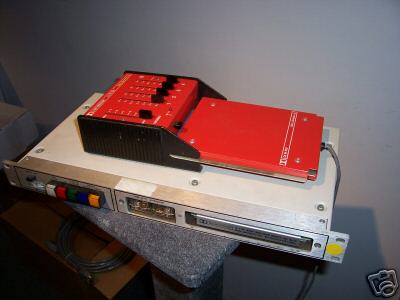
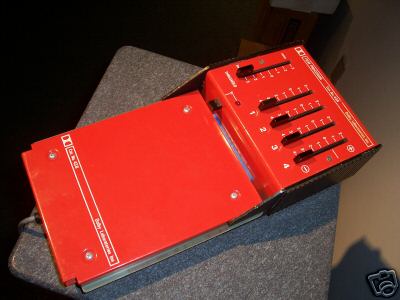
This was on e-bay a while ago and to be honest it is the first time I see one.
The seller said the system has been great for ambient noise reduction from location recordings. The CAT 43A differs from standard Dolby Type A noise reduction, the 4 faders control 30-80 Hz, 80-1 kHZ, 1-3 kHz, and 3kHz and up. The fifth fader is a threshold control.
I would like some more info on this.
Christos.
Posted by Steve Guttag (Member # 268) on 09-25-2006, 05:04 PM:
Yup, that is it...the Cat 43...I was mistaken above...the SR version is the is the 430...I knew that the two systems differed by a 10 multiplier (Dolby is that way on things if the Cat number is available).
The idea behind it is that one can control the expanders in the NR circuit to suit the needs of the signal. Thus one may apply only has much expansion as needed without introducing noticable pumping into the signal.
Since Dolby NR only ever affected signals below Dolby Level, one would have to set the threshold as well as the expansion (5 faders). Anything that is above the threshold is passed through un altered...anything below the threshold is expanded.
Posted by Charles Greenlee (Member # 3856) on 09-25-2006, 07:01 PM:
I had merely pointed out that it wasn't simply beginning-1927 no sound, then sound on film. Something that is important if you are creating a timeline of basic sound formats, though retrospectivly, Fantasound didn't have much place except as a tehcnical note, nothing practical. I have seen and held a Vitascope film and disc, not that you'll ever have to worry about playing them. Most nowadays are dubbed over to mono-optical.
The cat 43, dosn't seem wholy relevant to the topic, it is something I'd like to learn about. Something that has never been fully explained to me is how compression/expansion works. The was Dolby NR works, as been explained to me, seems to be more of an equalization effect. The sound is augmented in the frequencies in which noise typically happens, then recorded to the media. At the processor, the NR decoder basically tunes down those fequencies, bringing the sound back to a normal level, and noise down with it. Is expansion/compression something different?
Posted by Cameron Glendinning (Member # 3516) on 09-26-2006, 02:59 AM:
quote: Charles Greenlee
Is expansion/compression something different?
Charles this is about dynamic range (softest noise to loudest explosion), many sound mixers feel that they compress film soundtracks too much for there own liking. They are trying to play it safe, as the audience complains when its too loud!!
In the mixing suite well they have the best equipment and accoustics, so quite often it sounds great in there at Dolby 7. but real world cinema installs rearly match and cinemas often run at Dolby 5 so not to get complaints ect.
There were so many complaints about the original Jarrasic Park, that some cinemas turned up the center channel (dialogue) and reduced the dynamic range.
Ok when we listen to radio the sound is compressed to almost 1 soundlevel and played at maximum strength and uniformity. with the dolby cards above it would be possible to restore the compressed signal to its original expanded form.
sorry about the crappy explanation
Posted by Monte L Fullmer (Member # 2797) on 09-26-2006, 03:01 AM:
..prob like the good ol' dbx expanders found on higher end VHS HiFi tape machines in as well as home audiophile systems..like this link points to... a few audiophiles know that audio capacity with HiFi units have about the same dB range as CD audio capacity before saturation, which was close to 90dB-thx to dbx processing. '
I would dupe cassettes, or any analog source on VHS tape using the HiFi mode and the reproduction would be astounding - thx again to the dbx process.
- Monte
Posted by Charles Greenlee (Member # 3856) on 09-28-2006, 06:57 PM:
I see. So it'd be handy to have this unit, even for home use, if you knew what you're doing. It almost sounds like a necessity for cinema, it's a wonder why more places don't use it. I wish I had the money for one of my own, at ther very least, it's be fun to experiment with. That would teach me soo much more. You explanation helped alot, but hands on would really max out my understanding. Add this item to my Christmas list.
Posted by Cameron Glendinning (Member # 3516) on 09-29-2006, 03:47 AM:
Charles dbx ect isn't so relevant today, Digital Sound doesn't really need anything more than good acoustics, quality gear and great speakers!!!!!
We really should not touch or play. Just allow the Filmmakers to do their thing. Its our job to realize their dreams, no matter how misguided they may be ![[Razz]](tongue.gif)
By having the gear lined up by a great tech, proper maintance of the equipment. That is what required to do our job professionally
Posted by Charles Greenlee (Member # 3856) on 09-29-2006, 11:13 AM:
True, I was thinking for home partially, where even though I have a Dolby Digital, and DTS ready DVD player, I'm connected through RCA jacks. So I'm not getting digital sound, I'm running pro-logic. I need to get a new receiver.
Posted by Michael Coate (Member # 757) on 10-09-2006, 08:26 PM:
Some of you may find this off-topic, but considering the thread concerns itself in part with Dolby and its many flavors, I thought I'd make this post. I think it's worth pointing out that, in the early years especially, Dolby was something different depending on the title, which explains why the company felt "Dolby Stereo" was essentially an "umbrella" term for its family of audio formats. You'll also notice that many films (especially "A Star Is Born") were released in many versions.
Note that most of the early Dolby releases were also simultaneously offered in Academy mono (i.e. non-Dolby NR-encoded) versions. In fact, the majority of the print runs were of the mono version.
The first and/or significant/recognizable early titles follow.
Introduced 1974: 35mm optical, mono, A-type Noise Reduction
"Callan"
1974: 35mm magnetic, 3-track, A-type NR
"The Little Prince"
1975: 35mm optical, 3-channel, A-type NR
"Lisztomania"
1975: 35mm magnetic, mono, A-type NR
"The Rocky Horror Picture Show"
1975: 35mm magnetic, 4-track, A-type NR
"Nashville," "A Star Is Born"
1976: 70mm magnetic, 6-track (5-screen, 1-surround), A-type NR
"Logan's Run," "A Star Is Born"
1976: 35mm optical, 4-channel, A-type NR
"A Star Is Born," "Star Wars," "Close Encounters Of The Third Kind," "Saturday Night Fever"
1977: 70mm magnetic, 6-track "baby boom" version #1, A-type NR
"Star Wars"
1977: 70mm magnetic, 6-track "baby boom" version #2, A-type NR
"Close Encounters Of The Third Kind," "Days Of Heaven"
1978: 70mm magnetic, 6-track "split surround," A-type NR
"Superman," "Apocalypse Now," "Pink Floyd: The Wall"
1986: 70mm magnetic, 6-track "baby boom," SR-type NR
"Star Trek IV: The Voyage Home"
1987: 35mm optical, 4-channel, SR-type NR
"Innerspace," "RoboCop"
1991: 35mm digital, 6-track (5.1), SR-type NR
"Star Trek VI: The Undiscovered Country," "Newsies," "Batman Returns," "Honey, I Blew Up The Kid"
[Most of the above data first appeared in the article "Widescreen: 50 Years Of Innovation And Showmanship" (co-authored by yours truly) that appeared in Widescreen Review's 2004 Ultimate DVD Movie Guide special edition issue.]
Powered by Infopop Corporation
UBB.classicTM
6.3.1.2