This is topic Hafler Amps, opinions? in forum Film Handlers' Forum at Film-Tech Forum ARCHIVE.
To visit this topic, use this URL:
https://ft-forum.com/ft/cgi-bin/ubb/ultimatebb.cgi?ubb=get_topic;f=1;t=008266
Posted by Bill Enos (Member # 440) on 09-21-2006, 06:48 PM:
What about them, good? great? crap?something in the middle?
Posted by Mark Gulbrandsen (Member # 72) on 09-21-2006, 08:38 PM:
Something in the middle regardless of the model... They can be made better by some simple modifications... Larger power supply caps/transformer, better wiring and replacing the dime store electrolytic caps on the driver boards with higher grade parts as is typically used in todays power amps. Haflers typically sound warm and its because of the very low odd harmonic distortion content they generate.
Mark
Posted by Phil Hill (Member # 371) on 09-21-2006, 08:56 PM:
Mark, if one wanted to make all the changes you mention, I'd say those amps would then be "just" OK... but "As Is" from the factory they are CRAP (in my experience)
The best amps by light years, are (most models of) QSC.
Posted by Fred Georges (Member # 505) on 09-22-2006, 01:06 PM:
The original products of the David Hafler (Mr.Dynaco) co. were Ok for the money. Always built to a low price point many compromises were made (Low quality parts, wimpy power supplies). In the early eighties they brought out the XL-280 (140 wpc) Touted as the "perfect" amplifier. It featured a user adjustable nulling circuit to cancel out all the remaining distortion leaving one with a "Perfect" ![[Roll Eyes]](rolleyes.gif) amplifier. Much as I tried I couldn't get one to match the quality of the 25 watt Levinson Class A amps I was using at the time. The kindest comment I can say about Hafler is that of all the Solid state amplifiers that have passed through My hands in the last 30 years the Hafler was one of them!
amplifier. Much as I tried I couldn't get one to match the quality of the 25 watt Levinson Class A amps I was using at the time. The kindest comment I can say about Hafler is that of all the Solid state amplifiers that have passed through My hands in the last 30 years the Hafler was one of them! ![[Razz]](tongue.gif)
Posted by Bruce McGee (Member # 131) on 09-22-2006, 06:12 PM:
My theatre tech, as he aquires them, is replacing all of the KINTEK amps in my theatre with QSC power amps. We now have 4 of 7 theatres running the QSC's. I am very happy with them.
Posted by Kevin Raisler (Member # 1761) on 09-22-2006, 06:49 PM:
Bill,
Hafflers are great sounding amps I once owned a DH200 years ago
these things were clean, however like mark and others have said based on experience they don't hold up well in professional applications.
cheers
Posted by Gordon McLeod (Member # 33) on 09-22-2006, 09:23 PM:
I have found that Hafler has terrible reliablity issues only slightly better than my experiences with BGW and Crown
Posted by Bruce McGee (Member # 131) on 09-23-2006, 08:34 AM:
I have an XL-280 Hafler amp infront of me. Its not working. I see lots of caps with the plastic cooked off of them. No burned circuitry, other than lots of use. Is it worth my effort to recap it, and get it going?
Posted by Bill Enos (Member # 440) on 09-24-2006, 05:58 PM:
The model number in question is DH500...how old is this model? Any model specific comments?
Posted by Fred Georges (Member # 505) on 09-24-2006, 08:28 PM:
"The model number in question is DH500...how old is this model?"
Early 80's so at least over 20 years old. Caps have changed value for sure. Fan cooled 250 watt per channel. Could have been factory assembled or (ugh) a Kit. If your using it for home on easy to drive speakers you should be ok (For how long is anyones guess). Pro use? Forget it unless rebuilt. ![[Wink]](wink.gif)
Posted by Jon Miller (Member # 163) on 09-25-2006, 12:15 AM:
FWIW, in the four years I was a projectionist for a local museum (1991-94) one xenon lamp leaked and one exploded but not one of the three Hafler DH-500 amps in the sound rack even came close to crapping out. QSCs they aren't, but they did the job.
As they say, your mileage may vary.
Posted by Bill Enos (Member # 440) on 09-25-2006, 10:56 AM:
What are the issues, caps have been mentioned, do output transistors blow? power supplies? control circuits?
Posted by Jim Latendorf (Member # 3425) on 09-25-2006, 03:34 PM:
I remember those things. Worked as the bench tech at a local higher end stereo store that sold them when they came out. The first ones had a bad batch of main filter caps installed in them. Where quickly made good by the factory. Not a bad sounding amp, though. Those power MOSFETS gave the thing a "warm" tube sound and where very forgiving to weird speaker loads. An inherent thing with MOSFETS. Factory wired or kit form didn't make much difference. The main amplifier module on both was built and tested at the factory. The "kit" part was just assembling the chassis and doing all the interconnecting stuff which saved $100 off the purchase price. If yours is still running after all these years, I'd replace all the electrolytic capacitors and then you would be good to go for another ten years. Also, the main power switch on those things where junk. Just bypass it. David Halfler was trying to achieve "more bang for the buck" with his designs just as he did with the Dynaco line. Another note regarding the power MOSFETS. After opening the top cover and looking closely at the transistors you will note a single digit number stamped on the device. This is a test number. All of the output transistors on these things are "matched" sets for each channel so don't mix them up. Not bad for an amplifier that sold for about a buck a watt back then.
Regards,
Jim L.
Posted by Mark Gulbrandsen (Member # 72) on 09-25-2006, 04:30 PM:
Bill,
It is not worth repairing or upgrading. The chassis is however a good chassis for the DIYer to build a real super amp. The Hitachi output devices on these amps have been long obsolete! When it dies just replace it....
Mark
Posted by Louis Bornwasser (Member # 3063) on 09-26-2006, 04:26 PM:
Agreed: just OK in their day. That day passed about 20 years ago when David Hafler left the company. Louis
Posted by Oscar Neundorfer (Member # 458) on 09-27-2006, 11:02 PM:
When I was at SMART, we used the HAFLER modules for MANY years. They were EXTREMELY reliable, sounded very good and could drive just about any load. Now they were not all that powerful at 120 W into 8 Ohms and 180 W into 4 Ohms, but unless you wanted digital at screaming levels, they would do the job. Of course, we were only using the modules. We built our own toroidal power transformer and used much better and larger filter caps than the Hafler amps. So, it is obviously not a direct comparison, but the amplifier modules themselves were quite good.
Later we used the modules in our home theater amplifier which got very good reviews in Stereophile, Absolute Sound, and Widescreen Review magazines as well as several online audiophile sites. You can access these reviews at the bottom of this page: SMART Home Theater Amplifier 2X150VT
Later, I re-designed the circuit board, added another pair of output transistors, and made it modular with gold-plated heavy duty header pins for plug-in use. This design was used in the SMART three channel home theater amplifier, which unfortunately never made it into production.
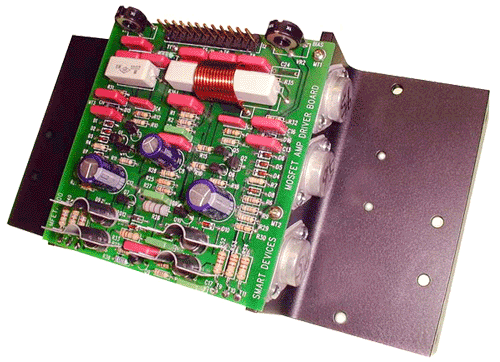
Bottom line is that while the original Hafler amplifiers had their shortcomings, the SMART design using the Hafler modules was a significantly improved product of which we sold many thousands over the years. Many are still in use today.
Posted by Gordon McLeod (Member # 33) on 09-29-2006, 03:37 PM:
we have many of the smart haffler amps in service with excellent results
I smaller rooms the amount of power is not always in the gigawatt range with efficient speakers
Powered by Infopop Corporation
UBB.classicTM
6.3.1.2