This is topic Brenkert in forum Film Handlers' Forum at Film-Tech Forum ARCHIVE.
To visit this topic, use this URL:
https://ft-forum.com/ft/cgi-bin/ubb/ultimatebb.cgi?ubb=get_topic;f=1;t=008295
Posted by Tony L. Hernandez (Member # 3524) on 10-08-2006, 01:08 AM:
Hi There. I have all throughout my 8 years or so in the exhibition business heard projectionists/theater owners bitch, complain and all around hate Brenkert Projectors. Why is this? I myself have never even seen one in person, much less operate one so I truly have no idea. I have operated Motiograph AAA, Simplex E-7 and XL, Strong and Centry equipment (not too sure about the Century...I think we had one at my old six plex but dont really remember) with the Simplex E-7 being my favorite. Those machines are WONDERFUL.
My close friend, Ola (now deceased) who operated movie theaters with her husband and drive ins all around Colorado for over 61 years, used to swear by Motiograph equipment.
But my real question is for thoes who love or hate Brenkerts...why do you??? Also, if anyone knows what ever happened to that company, I'd love to know!
~~Tony H.~~
Posted by Brad Miller (Member # 2) on 10-08-2006, 03:56 AM:
Since this doesn't belong in the Ground Level forum, I am moving it to where it should be.
Posted by Mark Gulbrandsen (Member # 72) on 10-08-2006, 07:55 AM:
Your friend was very wrong about them. Introduced in or about 1939 the BX-80 was the most advanced projector made in the states for many years and the only oil bath type mechanism. They were also the first to introduce a modular type mechanism. Brenkerts are excellent projectors and very long lived.... RCA eventually bought out Brenkert sometime after WW-2 and continued production for many years. When RCA stopped making them all the tooling, parts, etc were bought by Wolk and Wolk continued making parts. When Wolk moved back in the 90's most parts were discontinued or disposed of and the Brenkert came to an end and is just part of history. There are still a number of BX-60's running in the areas that I service. Brenkerts in general have far better build quality than the early pot metal Simplex X-L's and they have a huge star and cam and roller pin in the intermmittent that last just about forever! All models of Brenkerts shared the same movement. Back in the early 80's Wolk made a run of fibre shutter drive gears for the BX-40, BX-80, and BX-100 that were made from the wrong material and they would literally fall apart in a short time. The original Brenkert made gears were of ultra high quality and would typically last 20 or more years, eventually you might have to replace the gear. Without good gears made from the correct material the reliability of three models of the Brenkert was doomed. Brenkerts could put out ultra steady images because of the tight tolerances in the movement and the extra long straight gate. They were a snap to keep clean and didn't have any of the nooks and crannys that were hard to keep clean like a Simplex. The model BX-60 is what you will most likely find running today when you find a Brenkert. The BX-60 has a completely different gear train that doen't use that fibre gear and it was always the most reliable machine of the bunch.
The down side of the Brenkert was that it was a heavy load for the sound reproducer to drive. Bronze gear failures in sound head gearboxes happened more regurlary than actual projector breakdowns did but regular oil changes to the gear box and replacing the pinion when the bronze failed got you the longest life from those parts. Today use of synthetic oils in the gearbox prolongs the life of the bronze gears at least ten fold.
Motiographs and Brenkerts in my opinion were on the same level as far as quality was concerned. The BRenkert was oil bath and the Motio was greased and ball bearing... Brenkerts ran almost silently and Motios were typically very noisy and had at least twice as many gear pairs meshing as a Brenekert. All of these machines were produced by craftsman... not machinists which is why they last so long. Motiograph died out long before Brenkert did but I still have abot 10 Motio's running in various locations too. As they die they have to be replaced because parts just don't exist.... they only place to get parts is from another machine... while Wolk does still carry some Brenkert parts they are few and far between and if you need a major part it too has to be robbed from another head.
The E-7 is a good machine but a pain in the ass to work on... parts are also very scarce. I would take a Super any day over an E-7... much easier to repair and more common. Oiled daily before starting they can last almost indefinately on a platter. Supers when properly maintained put out excellent images... There are still over 24 Supers running in the Mountain States...many of these heads are still original to the theaters they were installed in. I think that overall the Super wins hands down for being the longest lived projector mechanism still used in any quanity today, at least in this area.
Mark
Posted by Luciano Brigite (Member # 1104) on 10-08-2006, 01:34 PM:
I wonder the same thing about why people dislikes these projectors.. While working as projectionist I got to work with BX60/80/100 and never had a problem with any of them,except for hte usual oil leak here and there but nothing like I've heard many other say aboit it.
I now have 4 of htese projectors to keep myself entertained and even in a poor state they're running quite well.
I can't say the same as Mark about hte intermittents.. mine are ugly and worn out, probably because the lack of proper care the slots on the star are getting thin and hte roller is so worn you can see between it and the star's slot when it's engaged :/ .
Parts ,as said, are hard to find and to get some of them have to be taken from projectos out of use.
Regarding it being heavy on hte gearbox.. can't really say much from hte 4 projectors I have only one came with broken gears and it's because the gearbox had the wrong oil in it .On hte ohters the gears looked ok for hte time I was told they were running until they went out of use.
There are 4 theatres I maintain htat runs them, two have BX60 and two BX100, I'm servicing htem for about 4 years now and none of hte projectors had a mechanical failure and hte last time htey went in the shop for repair was over a decade ago.
Recently I received 2 soundheads to rebuild and when I opened the gearbox the gears loked like new and those where in use for several years.
And it does looks like a projector compared to recent machines found in today's theatres...
Posted by Bruce McGee (Member # 131) on 10-08-2006, 03:40 PM:
Doesent the Nugget Theatre at Telluride CO still run Brenkerts?
Posted by Gordon McLeod (Member # 33) on 10-08-2006, 05:35 PM:
The Brenkert is an excellent machine I have a lot in my area still
I think the moitograph AAA is a better machine and in my opinion quieter running
The BX100 is still made in india and japan by Photophone and in Japan there is the 35/70 version of the BX100
Posted by Jack Ondracek (Member # 1466) on 10-08-2006, 06:43 PM:
I would echo everything Mark said about this line. In the late '60s, I first learned how to thread on a Brenkert machine. In the '70s, one of the Seattle chains I worked for had a lot of them. I ran my drive-in for 15 years on Brenkerts. Were it not for the shutter gear problems, I have little doubt the machines would be here today.
Unfortunately, as my business improved, the reliability of my machines did not... especially once a shutter gear went. I obviously needed to depend on the booth, so the Brenkerts were retired.
The RCA version BX100 was the hardest on my sound heads. Mark mentioned that problem. My BX40 and 60 models didn't seem so hard to turn.
Aside from that, whoever told you that Brenkerts were to hate didn't know what they were talking about. They were among the best.
Posted by Mark Gulbrandsen (Member # 72) on 10-08-2006, 07:56 PM:
I agree that the Motiograph might be a little steadier laterally but there were WAY to many gear pairs in the head and many that ran alot of years developed gobs of lost gear motion. The AA and Triple A also suffered from a curious form of flicker that was admitted to even by Motiograph people that I knew that worked at the factory... The double blade Christie P35GP also exhibited a similar flicker and thats why the single blade shutter came to be. This flicker problem was never gotten rid of in the Motiograph and always remained a problem. It was worse with the double barrel shutter arrangment and this is but one reason that was abandoned... the other was that it added even more gear pairs and lost motion to the mechanism. I think if you count them there are 23 gear pairs in a Motiograph head, makes a Century look like a whimp by comparison. Its indeed an impressive gear train to observe running though. The Motiograph soundhead was a piece of junk compared to the others out there. A Triple A on an SH-1000 or RCA is a really nice match!
Yee ha.... 8000th post!
Mark
Posted by Tony L. Hernandez (Member # 3524) on 10-08-2006, 09:39 PM:
Wow, so interesting you should mention that,Mark. I have noticed that Motiograph "flicker" up at The Park Theater especially on very bright scenes in the movie. We still have a Motiograph AAA with xenon lamp and platters up there and I have never seen any Simplex or Strong machines do that. Do you have any idea what causes that flicker?
Posted by Gordon McLeod (Member # 33) on 10-08-2006, 09:40 PM:
With a slow start the SH7500 didn't have many issues
the AA that I have still in service have no ghosting issues either
Posted by Mark Gulbrandsen (Member # 72) on 10-08-2006, 10:37 PM:
I just dislike the 7500 reproducer. Its just too basic even for its day of manufacture, there was the RCA and the SH-1000 which were far better designs and spec'd out better too. The part I dislike the most are the motor coupling... replacement is a pain. Removing and re-installing the motor without some sort of other support or person to assist is a bitch! The inching kob that "gets your knuckles" if you're not careful would never make OSHA today. The lateral guide is lacking too and a bad design for stereo.... too much weave. Noyw did I forget to mention that the ARE very reliable for what they are... A motor coupling now and then is about all that fails. Felt rollers for the lateral guide assy. are long sold out. I have 4 AA's and 7500's still running in Idaho we removed 2 a couple of years ago and replaced with Simplex's. The 4 are all thats left that I deal with.
The AA and triple A don't ghost they flicker, so does the Christie P-35GP with a two wing shutter. If you have a two machine booth with AA's then throw in a Super Head on one side and compare the two.... The AA will have a definate flicker.
Mark
Posted by Monte L Fullmer (Member # 2797) on 10-08-2006, 10:53 PM:
Only thing I didn't like on the 7500 was the absense of the damping flywheel on the motor so the machine can ramp up to speed instead of the sudden jerk starts that any head that was attached to the 7500.
I've seen quite a few Super's mounted on 7500 reproducers and wonder how those Supers can last as they did with that sudden jerk start that they weren't used to..
On the topic of the Brenkert, I unfortunately, didn't have the time to actually experience their operation all that much, just did some relief work in theatres that had the BX-60's and one house had the dbl shutter BX-80's. But I could tell that these were great machines - far better than the Simplex and rated quite along with the Motiograph AA's and AAA's.
(I like Robert Madara's member pict..he's playing with a Brenkert sitting on an RCA reproducer...)
-Monte
Posted by Mark Gulbrandsen (Member # 72) on 10-08-2006, 11:14 PM:
quote: Monte L Fullmer
I've seen quite a few Super's mounted on 7500 reproducers and wonder how those Supers can last as they did with that sudden jerk start that they weren't used to..
Oops, there is a pair of these in Preston, ID. at the Worm Creek Opera House. So that does make 6 still running if the theater is sill open. BTW: The Worm Creek served as the high school auditorium for the filming of Napolean Dynamyte.
Mark
Posted by Jeff Stricker (Member # 224) on 10-09-2006, 06:39 AM:
Ah, Brenkerts are wonderful machines. I've got (2) BX-40's (thanks to Mark G), a BX-60, and a BX-80 (parts machine) in my collection. They'll be working long after I'm gone! ![[thumbsup]](graemlins/thumbsup.gif)
Posted by Barry Floyd (Member # 385) on 10-09-2006, 09:20 AM:
I've got a BX-60 running in one of my booths now, and three spare heads for parts - should I ever need them. My BX-60 has been running at my place for a little over a year and we've had no problems whatsoever with it.
I'd like to replace it with a re-built Simplex XL, but funds are tight and the Brenkert isn't broke!
Posted by Richard Fowler (Member # 893) on 10-09-2006, 10:40 AM:
The current Photophone ( P35 )projector is an upgraded incarnation of the BX100. The gear train is different with a double speed ( 2880 rpm ) shutter. The film trap is now like a Kelmar type and has a lens turret.
The last AAA we serviced was in an art house....I remember the local tech constantly adjusting the lamphouse thinking the flicker was coming from that source. The last Brenkert we serviced was in Latin America; as soon as I walked in the auditorium, I knew the projector brand without going to the booth due to the shutter "hunting" on the screen ![[Roll Eyes]](rolleyes.gif) I had one customer with a BX-60 that ran on a platter for 17 years...12 hours a day with barely a problem. He was afraid of a single machine set-up so we set up a video camera to monitor the projection equipment and kept machine #2 with a carbon arc for emergency...years later he ended up bagging up the spare machine and servicing the unit occaisonally just in case
I had one customer with a BX-60 that ran on a platter for 17 years...12 hours a day with barely a problem. He was afraid of a single machine set-up so we set up a video camera to monitor the projection equipment and kept machine #2 with a carbon arc for emergency...years later he ended up bagging up the spare machine and servicing the unit occaisonally just in case ![[Smile]](smile.gif)
Posted by Martin McCaffery (Member # 37) on 10-09-2006, 11:39 AM:
The Brenkert was certainly one of the coolest looking projectors if you had the full setup. The only ones I ran were in the Staton Art in DC which was a grind porno house in the late 70's. The best I remember about them is they didn't breakdown much despite the abuse.
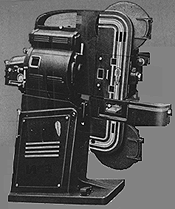
BX-80 from From Showmen's Trade Review January 5, 1946
Posted by Mark Gulbrandsen (Member # 72) on 10-09-2006, 09:38 PM:
quote:
I'd like to replace it with a re-built Simplex XL, but funds are tight and the Brenkert isn't broke!
The Brenkert is a far better machine! The only advantage with the X-L is a tiny bit more light because of the conical shutter and lots of oil leaks....
Mark
Posted by Jack Ondracek (Member # 1466) on 10-09-2006, 11:18 PM:
quote:
I'd like to replace it with a re-built Simplex XL, but funds are tight and the Brenkert isn't broke!
As long as you have parts... and even better... spare heads, you're probably ok, Barry... unless you're mainly looking to make both booths basically the same.
I always had a head that was ready to go. The douser was on a 3-pronged plug, and the framing light was also plugged. A couple of bolts on and off, and moving the reel arm and that was about it. You could change out a head in just a few minutes. Just before we retired our heads, we did... a couple of times... shutter gears in both cases.
Posted by Steve Guttag (Member # 268) on 10-10-2006, 05:54 PM:
The problem I see with the Brenkerts we have to deal with is that the "spare heads" are also worn out so you essentially have a bald spare tire.
As for Simplexes...I'd have no problem replacing Brenkerts with Simplexs and always end up with less leads and less wear on the soundhead bronze gears.
Posted by Barry Floyd (Member # 385) on 10-11-2006, 10:52 AM:
The only problem we've ever had with the BX-60 in our booth was the steel pin that attached the framing mechanism to the shutter compensator linkage backed it's way out of the hole and ended up causing some "ghosting" of the images on the screen. The white credits on a dark background looked "smeared". My tech found it and fixed it so it wouldn't happen again.
I'd just like to have the convenience of 1 set of parts for both projection booths. I've got identical platters and lamphouses in both, only the projector and soundhead are different.
My BX-60 used to always have purple gunk in the bottom of the projector from the film, but since we've started using the Kelmar cleaner and Film Guard - that's no longer is an issue.
Posted by Jack Ondracek (Member # 1466) on 10-11-2006, 01:27 PM:
quote: Steve Guttag
The problem I see with the Brenkerts we have to deal with is that the "spare heads" are also worn out so you essentially have a bald spare tire.
That's true, Steve. However, one of the drive-in owners I used to work for retired and gave me several heads. I was able to get quite a few years out of them before it just became time to move on.
Posted by Louis Bornwasser (Member # 3063) on 10-11-2006, 01:52 PM:
Note that the #1 problem in drive ins is LIGHT (or the lack of it.) Simplexs have the heat-build up problem that even fans and water cooling did not eliminate. One thing about Brenkerts, lack of light precludes them on most drive ins. Water cooling is not required because not enough light gets through to cause heat. Granted they can be quite reliable; what they cannot be is efficient and sharp (no curved gate.) Louis
Posted by Scott Norwood (Member # 30) on 10-11-2006, 03:30 PM:
I'll ask the obvious question: what is the preferred drive-in machine? Century? Something else? Are there any drive-ins with Kinoton heads?
Posted by Jack Ondracek (Member # 1466) on 10-11-2006, 03:52 PM:
Good question, Scott.
In my part of the country, everything seems to be either XL or Century. Offhand, I think I'd say that I see more Century heads.
There are still some Brenkerts out there, and one drive-in that I know of that still uses Motiograph. The local chain that really liked Brenkerts got out of the theatre business a long time ago, and all but one of their drive-ins have been redeveloped.
The only Kinoton machine I've seen in operation is at the Seattle Cinerama. There may be more around here... I just haven't seen 'em, and none that I know of at a drive-in.
I went with XL because of the sealed system, though I've since re-learned that "sealed" only means so much with those machines. I'll probably try the Centurys next year & see how they work here.
Posted by Steve Guttag (Member # 268) on 10-11-2006, 05:49 PM:
Odd...one of our customers that has been traditionally Brenkert has been using an XL we rebuilt and was most concerned...it doesn't leak...he wasn't used to that. I told him it would weep oil eventually but it shouldn't be any real leaking.
The Simplex, all else being equal will beat the Century for light output. A Century can't put out a non-ghosting image without a 90-degree blade...the Simplex can do that with an 84-degree blade. So the Simplex has an immediate edge of 7% or so. You can pick some of that up on the Century if you go to a double shutter system but you will have a bit of a bounce in the light that will vary from small-violent to large-lumbering as the gears wear.
However, since it is a Drive-In most most manufacturers cheat the light a bit and put in a shutter that will have ghosting since it most likely won't be seen by the average drive-in goer. This was particularly true of the Century...I've seen some double shutter Century blades on the order of 60-degrees... A 30% light boost but there WILL be ghosting.
Though I have not seen a Kinoton in a Drive-In...I would say they would do very well there. Kinoton also has a very efficient light path (mechanical versions, like the "D" series).
Steve
Posted by Jack Ondracek (Member # 1466) on 10-11-2006, 05:59 PM:
Hmmmmmm.....
I was recently told, by somebody from Louisville, that the Century would beat a Simplex for light output.
......am soooo confused! ![[Confused]](confused.gif)
![[Big Grin]](biggrin.gif)
Posted by Mark Gulbrandsen (Member # 72) on 10-11-2006, 07:02 PM:
Humm, I seem to have read that someone also fomr Louisville said they won't project sharp pictures... when indeed the Brenkert gate was the only gate that could sharply project a warped print of 2001 that I used to have, and that with a 4kw lamp behind it.
Mark
Posted by Louis Bornwasser (Member # 3063) on 10-11-2006, 09:48 PM:
There is most certainly "breathing" on all straight gates that carry any appreciable brightness (heat). A 4k bulb might not heat a Brenkert as much as another projector.
As regards the Century and its well-known shutter problems, small drive in blades only show the ghosting on factory machines. With the shutter bracket we designed the oscillation is greatly reduced and does not show ghosting with the small drive in blade. In indoor theatres, I keep the 90 degree blade for the sake of quality. In drive ins, brightness is 90% of everything. Louis
Posted by Monte L Fullmer (Member # 2797) on 10-11-2006, 10:25 PM:
quote:
The Simplex, all else being equal will beat the Century for light output....the Simplex can do that with an 84-degree blade.
(not to drift off-topic of the Brenkert)...could also the useage of the high-speed Intermittent assembly aid in this as well for the XL for Drive-In usage?
-Monte
Posted by Barry Floyd (Member # 385) on 10-12-2006, 02:09 PM:
quote: Louis Bornwasser
A 4k bulb might not heat a Brenkert as much as another projector.
I don't know Louis... Changing the aperature plate on a Brenkert with a 4kw bulb running behind it can really burn off your thumb prints if your not quick enough!
Posted by Louis Bornwasser (Member # 3063) on 10-12-2006, 02:57 PM:
A realy good lamp on a Century will almost melt the aperture plate.
I have removed Brenkerts, replaced with Centurys (all drive ins in Eastern KY). While it is true that I also replaced the carbon lamp with xenon; in some cases the projector was in one year and the lamps were next year. The net result was a significant increase in light and focus. I never had to "sell" another projector. The owners told each other. Louis
Posted by David Kilderry (Member # 142) on 10-14-2006, 08:10 AM:
Here in Melbourne, Australia many of the early drive-ins had locally made Super Standard projectors with RCA sound heads. Later in the 1960's many of the drive-ins opened were 70mm with Cinemeccanica Vic 8 and Phillips DP70 (AA11).
The Village drive-in circuit replaced early projectors in the 1970's with Century and Bauer U3 in their drive-ins. Hoyts drive-ins removed the Super Standards and in the non-70mm drive-ins went for Kinoton FP 20's. These worked very well and were reliable with Xebex xenon lamphouses on the back.
Here at the Lunar drive-in we have Philips DP 70's on our two largest fields and a Century DAW on the other. All are running 5k lamps in Strong X-60D and Super 80 lamphouses. We have a spare Philips and a parts stock and we have a spare Century too. I would say all have efficient light paths as we have good on-screen light.........and hot aperture plates!
I don't know of any Brenkerts or Motiographs here, certainly not these days, but then you would not have any Super Standards or C & W's there!
Posted by Mark Gulbrandsen (Member # 72) on 10-14-2006, 08:38 AM:
quote:
I would say all have efficient light paths as we have good on-screen light.........and hot aperture plates!
Or bad water cooling..... A Phillips DP-70 should basically run cold even with a 7kw lamp on it! Its has the best water cooling of any film projector ever made. Century has efficient cooling too, the best of any American Design.
Mark
Posted by David Kilderry (Member # 142) on 10-14-2006, 10:02 AM:
We don't run water cooling. 5k has generally been the limit espcially for meaty heads like the Philips and whilst they run warm, they have never scorched or buckled film or warped a plate.
Posted by Demetris Thoupis (Member # 833) on 10-14-2006, 02:12 PM:
Anything from 3K and above should be watercooled.
D
Posted by Mark Gulbrandsen (Member # 72) on 10-14-2006, 04:20 PM:
quote: David Kilderry
5k has generally been the limit espcially for meaty heads like the Philips and whilst they run warm, they have never scorched or buckled film or warped a plate.
I'd be surprised if your cooling plates were not warped from that much heat! They just soft copper.
Mark
Posted by David Kilderry (Member # 142) on 10-15-2006, 05:19 AM:
No Mark they are OK. I do most alignments myself and obviously it is the critical ingredient in running large lamps on non-water cooled heads. These projectors have run this way for years with no noticable ill effects on either equipment or film.
I should point out that these gates have been modified to permit aperture changes on a dual plate without stopping the projector and dropping the gate back.
Demetris, I would agree that in an ideal world most large lamps (4kw +), particularly in lightly constructed picture heads, should have water cooling. In heads as meaty as the Philips DP70 there is plenty of cold steel to dissipate the heat build-up, especially with cold light reflectors. A metal front coated mirror would cause problems with too much heat pushed forward to the gate.
I formerlly worked at a circuit that consisted of over 1,500 screens. We did water cool some projectors with 4k lamps, but generally only used the 5k and larger rule.
In the never ending quest to light large screens at as close to 16fl as possible, big lamps are the single most important item.
On the largest lamps installed (7kw & 8kw lamphouses) we used refridgerated water cooling systems. Over 5k, the light increases diminish as you increase the lamp size, yet the ambient heat given off by the lamp continues sharply.
Powered by Infopop Corporation
UBB.classicTM
6.3.1.2