This is topic Golden Triangle of Film? in forum Film Handlers' Forum at Film-Tech Forum ARCHIVE.
To visit this topic, use this URL:
https://ft-forum.com/ft/cgi-bin/ubb/ultimatebb.cgi?ubb=get_topic;f=1;t=008302
Posted by Matthew Stevens (Member # 2167) on 10-12-2006, 03:22 PM:
Does anyone know what the golden triangle of film is? I've checked wikipedia and all over the interent?
Thanks.
Posted by Steve Scott (Member # 630) on 10-12-2006, 03:38 PM:
There was the "golden triangle" of Cooper-built Cinerama theatres. Denver-Omaha-Minneapolis (r.i.p)
Posted by Jeffry L. Johnson (Member # 453) on 10-13-2006, 11:51 AM:
Golden Ratio?
A Conversation With Cinematographer M. David Mullen, ASC By Michael Coate
quote:
There are two aspects to scope compositions. One is when you're using the breadth and size of the image to increase the visceral, immersive, three-dimensional quality. It's the wide-angle Cinerama effect where you feel you're more IN the image rather than looking AT the image. The other aspect is the two-dimensional effect where you're using the width of the format to create unusual compositional effects like imbalanced framing, someone offset far to one side. You really feel that imbalance with the 2.35:1 frame; you can deviate farther from the classical balance of picture elements that you would have in the 1.85:1 frame, which is closer to the “golden rectangle” of painting. The 2.35:1 frame is more like modern art… it allows you to use negative space and other elements more graphically. Telephoto lenses can help this effect, but it also has the opposite effect of the immersive 3D quality of wide-angle scope photography. In fact, most films alternate constantly between seeming immersive and looking flat.
"The short and the fat of it" by David Mamet
quote:
Eisenstein's theories, Hitchcock's and De Sica's practice came in the days of the film aspect ratio of 1:1:33. That is, the screen and the projected image were in the golden mean, slightly wider than they were high - the general classical dimensions of a picture frame. Why were the image and the picture frame found in that size?
Rudolph Arnheim, in Film as Art, writes that the human being naturally "imagines" in that format. It perfectly frames the face, the torso of one or two figures, and most objects. It is a good format, as per the Eisenstein theory, for cutting from shot A to shot B. But the aspect ratio changed. Starting in the 1950s, with Cinemascope and VistaVision, the screen got wider and wider.
The "Academy" Ratio - The Shape of Movies Before 1953
quote:
John Belton speculates in his book "Widescreen Cinema" that since Dickson quickly established a film image width of 1 inch (perforations on each side of the 35mm filmstrip that Dickson used left just enough space for a 1 inch wide image), "The use of a three-quarter inch height would appear to maximize the number of frames/images Dickson could create in the short fifty-foot strips of film he initially used, while providing an aspect ratio that still remained close to the Golden Section of 1.618:1 (also known as the Divine Proportion, the Golden Cut, and the Golden Rectangle) of Greek art." Whatever the reason, Dickson's choice of the 4:3 ratio for the Edison film images quickly became the "standard", due principally to, " the monopolistic practices and business acumen of Thomas Edison and George Eastman, who oversaw the innovation and diffusion of this invention." (Widescreen Cinema ) By 1896, once the Lumière Brothers, the largest producer of motion picture films in Europe at that time, adopted the 35mm film format and the 4:3 aspect ratio, this "standard" became international.
Posted by Phil Hill (Member # 371) on 10-13-2006, 07:10 PM:
quote: Matthew Stevens
Does anyone know what the golden triangle of film is?
Like the Golden Section, the Golden Spiral, the Rule of Thirds, etc., the Golden Triangle is a method of frame composition used to manipulate the viewer's eyes to what the cinematographer wants them to see. Basically, the 3 most "important" elements of the picture are placed at the vertices of an imaginary triangle within the frame. The most significant story-element taking up the most real-estate of the frame.
Composition is one of the 5 "C's" of film. Composition, Continuity, Close-ups, Camera angles, and Cutting.
A book I got as a teen and "learned it", and still use the info/method when doing a shoot is "The Five C's of Cinematography" by Mascelli. Still a great book today.
Posted by Tim Reed (Member # 137) on 10-13-2006, 09:23 PM:
Yes, it is, Phil! That book occupies a hallowed spot on my shelf! ![[thumbsup]](graemlins/thumbsup.gif)
quote: Phil Hill
the 3 most "important" elements of the picture are placed at the vertices of an imaginary triangle within the frame. The most significant story-element taking up the most real-estate of the frame.
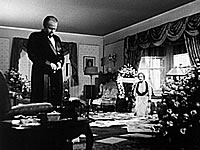
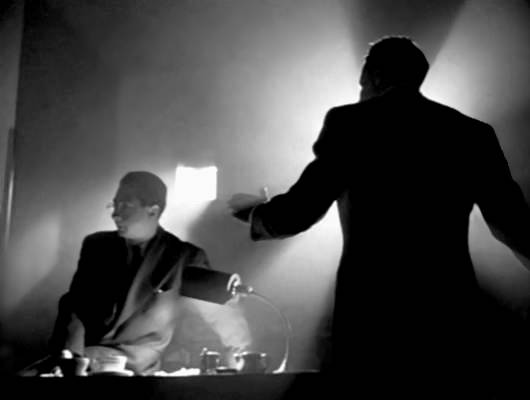
Posted by Cameron Glendinning (Member # 3516) on 10-13-2006, 10:47 PM:
quote: Phil Hill
"The Five C's of Cinematography" by Mascelli. Still a great book today.
It sits next to my ASC Manual in my collection ![[Big Grin]](biggrin.gif)
Posted by Phil Hill (Member # 371) on 10-14-2006, 12:54 AM:
Tim, your 2nd pic is an excellent example of what I was yappin' 'bout.
Note, while the triangle can be a "right" or equilateral triangle, most often they are obtuse...gives the image a more interesting and artistic quality. ![[Smile]](smile.gif)
Posted by Jeffry L. Johnson (Member # 453) on 10-14-2006, 11:45 AM:
All That Glitters: A Review of Psychological Research on the Aesthetics of the Golden Section
The Basics of Composition
'The Magic Of Selective Vision'
Creativity and the Rule of Thirds
The Golden Mean & Photography Part II: Golden Triangles
Posted by Hillary Charles (Member # 769) on 10-14-2006, 12:57 PM:
quote: Phil Hill
A book I got as a teen and "learned it", and still use the info/method when doing a shoot is "The Five C's of Cinematography" by Mascelli. Still a great book today.
I have that one too! Very helpful.
Powered by Infopop Corporation
UBB.classicTM
6.3.1.2