This is topic Film Guard questions - media pads and application in forum Film Handlers' Forum at Film-Tech Forum ARCHIVE.
To visit this topic, use this URL:
https://ft-forum.com/ft/cgi-bin/ubb/ultimatebb.cgi?ubb=get_topic;f=1;t=008436
Posted by Darren Michael Nemeth (Member # 3318) on 12-28-2006, 01:05 PM:
I am looking for a consensous of first hand knowledge on Media Pads and Film Guard.
Going to order a gallon of Film Gaurd and 2 media pads probably by Monday.
Media Pads - are they good for one or two cleanings or can you put them in the washing machine and reuse over and over? If resuable, what is the best method of washing them, in your experience. Hand wash and hang dry or machine?
Film Guard - I want to despense cleaner from a "solvent safe" plastic hand sprayer to media pads or hand cloth. However, I already have Film Renew in one of these and it has deterioirated two of the pumps innards to the point where they won't work. Can't spray any more unless I find another "solvent safe" pump to put on the bottle.
Will Film Guard ruin these, too? If so, what do you used to despense the "right ammount" onto your cloth or Film Tech Media Pads?
The vast majority of film I have is 1920s diacetate, nitrate and there are some triacetate also. None of which has ever been cleaned or treated. (!!!)
Posted by Monte L Fullmer (Member # 2797) on 12-28-2006, 01:19 PM:
quote:
The vast majority of film I have is 1920s diacetate, nitrate and there are some triacetate also. None of which has ever been cleaned or treated. (!!!)
FG works great with all film stock of nitrate, acetate and polyester - and even with 16mm and 8mm films as well..
..does great in slicking down and removing hardened gelatin from gate rails-shoot a bit on a rag and wipe the rails down.
You'll find that FG does quite a lot besides just cleaning and treating film. You'll love the stuff.
-Monte
Posted by Brad Miller (Member # 2) on 12-28-2006, 02:59 PM:
You won't need a gallon. Just a normal quart kit will clean far more film than a gallon of anything else. Remember, it takes only about an ounce to properly clean a 2 hour 35mm feature.
FilmGuard already comes in a suitable spray bottle. You won't need any other container. The ideal method of application is to use a Kelmar web film cleaner, although many people do clean by hand, just remember the rag only needs to be barely damp, not wet or you will end up with a film so slick it will literally jump through the projector since there will be no friction to hold the image steady.
The media pads are designed to be used with the Kelmar film cleaner. Without the cleaner, the pads won't do you much good unless you want to try hand cleaning with them. I've never tried that personally. They cannot be rewashed, but the average theater reuses the pads for about 35 passes before throwing them away. There are 8 sets of pads per box at approximately 16.5 feet in length.
If you desire to clean a film with both of those products, clean with FilmRenew first, then apply FilmGuard last before projection.
Posted by Darren Michael Nemeth (Member # 3318) on 12-28-2006, 04:39 PM:
Thanks for the reply. ![[Smile]](smile.gif)
I have one of those Universal Film Cleaner devises sold by eBayer "kinemaman" from time to time. Looks almost like a Kelmar.
I figure I can at least McGyver the pad rolls to work with it.
Will need more than a quart, too, because nearly all the triacetate has very early stages of VS and all will have to be soaked.
Some of the 1920s stuff has slight water damage in spots. I am afraid emulsion may lift if in contact with liquid. Is Film Guard safe in this application?
What about the emulsion lift in spots with early stages of nitrate decomp?
Nearly all my pre 1930s prints are very dusty and dirty. None will ever be projected, either. ![[Frown]](frown.gif)
WIll order tomorrow. Thanks!
Posted by Scott Norwood (Member # 30) on 12-28-2006, 08:45 PM:
The media pads do work for hand cleaning. Just cut them up into small strips, dampen with FG, and then rewind the film through them. I've done this before and it works fine.
The Kelmar cleaner works better and provides more even application, but isn't absolutely necessary to use the product.
I have used FG on early diacetate 16mm prints and it works well. Maybe someone else has tried it on nitrate.
Posted by Darren Michael Nemeth (Member # 3318) on 12-28-2006, 08:53 PM:
What about spots where the emulsion has lifted from the stock?
Will Film Guard be okay or smear these sections off?
Posted by Monte L Fullmer (Member # 2797) on 12-29-2006, 03:04 AM:
The sad thing about VS is that once the degrading begins, it's irreversable due to the beginning decomposition of the acetate stock when moisture mixes with the acetate ion in the celluose to create acetic acid-hence the "vinegar syndrome".
Only way to slow down VS is to have the prints well ventilated so air can move around. But if the containers are sealed, put those silca gel packets, or those KODAK molecular sieves in the containers to absorb moisture.
quote: Darren Michael Nemeth
Some of the 1920s stuff has slight water damage in spots. I am afraid emulsion may lift if in contact with liquid. Is Film Guard safe in this application?
What about the emulsion lift in spots with early stages of nitrate decomp?
Nearly all my pre 1930s prints are very dusty and dirty.
Film-Guard is just that - to 'guard' the prints for preservation and longetivity purposes (and you don't need to soak the film either-just a nice thin coating will work and will not harm any form of emulsion layers. Also, you'll be amazed on how it will clean those dusty and dirty prints with a couple of passes using FG. - which would make them runnable again.
Here, do your reading assignment for the day on the info on Film-Tech and you'll find some interesting information on this product - and good luck.
-Monte
Posted by Brad Miller (Member # 2) on 12-29-2006, 04:47 AM:
You will find FilmGuard is incredible with water damaged film, provided you apply it liberally to the sides BEFORE you unwind it. Once water damaged film is unwound, it's pretty much over.
Once you get the kit if you have any questions feel free to email me. There is no need to submerge the film in FilmGuard. If you do, the film is probably going to be so slick when you pull the film out you will spend a great deal of time wiping the film with dry cloths. Remember, this is a VERY slow evaporating cleaner and about 1 ounce is enough to properly clean a 2 hour 35mm movie. Although I have heard of people who have done it with success, submerging is something I have never bothered trying because I haven't had a print bad enough to ever bother with it. That would be quite the extreme application...but a quick dip in and out of a container of FG just might be ideal for your very old water damaged film. There wouldn't be any need to leave it in there for any length of time though. Just dip it in and remove it a minute later, then give it say an hour to let it totally soak in and then slowly unwind the reel.
Posted by Charles Greenlee (Member # 3856) on 12-29-2006, 08:57 AM:
quote: Brad Miller
the average theater reuses the pads for about 35 passes before throwing them away.
Hmm, and I've been tossing them after 1 pass, on each side. Total of 6 films cleaned. If this is the case, next year's box should last a good while. Yeah, I'll be changing to a new box of pads on the new year. And a new bottle FG if timing works out right. Good tip on the water damag bit, I have some film that came in to my possession because it's water damaged, but it hasn't been unrolled yet, so maybe I'll try a lil FG on its edges.
Posted by Brad Miller (Member # 2) on 12-29-2006, 02:13 PM:
For water damage you will need to apply FG liberally to the top edge with the film roll laying horizontal, as in sopping wet and let gravity pull it in, then flip the reel and repeat before unrolling.
It is also recommended if the water damage is bad to apply FG between rewinds as you are unrolling it too.
In the instance of a platter print with a roof leak and a rainstorm, clamp the print and flip it upside down. Apply liberally (spray FG onto a folded up paper towel and wipe so the top is very wet), let it sit for several minutes, flip the print back, wet down the top edge, then as it is paying out to the projector make sure you have a freshly saturated online cleaner. I've saved a couple of dozen prints that would've been junk this way due to roof leaks.
Posted by Dave Ritchie (Member # 4030) on 12-29-2006, 02:43 PM:
I was hoping to buy a media cleaner for my screening room but this is just not possible on my budget at this time- if i apply film guard by hand how affective is this and what is the best way to apply it?
[ 12-29-2006, 04:51 PM: Message edited by: Adam Martin ]
Posted by Charles Greenlee (Member # 3856) on 12-29-2006, 07:04 PM:
Dave, get a web style, like a Kelmar, cleaner, not PTC or PTR style cleaners. The media used in the PTR is reusable after a simple washing, but it doesn't outweigh it's shortcomings.
I have used both types, and despite some minor issues with our own cleaner (missing parts), I am much more pleased with our Kelmar than the PTC cleaner. Not to say you can't find a similar cleaner by another brand, that's just what we have. We also use filmguard here, which I have no complaints about. The media we have now is filmtech media, which works great, but the plastic spools that it comes on don't want to fit over the rubber piece on the rewind shafts on the cleaner, though ours may be swollen from age. (BTW, anyone know where I can get the replacement rubber bushings at?) I prefer the cardboard spools that came with the previous brand of media, it fits better.
Posted by Ron Curran (Member # 3631) on 12-29-2006, 09:34 PM:
I started off using Filmtech media pads for a single pass. Then this site told me that I could turn them around. Then others told me that I could run them several times. Then it was revealed that they could be cut in half.
If these tips continue, they may outlast film itself.
Posted by Monte L Fullmer (Member # 2797) on 12-30-2006, 02:07 PM:
..Same as what I would do - cut down media to fit the film being cleaned and would turn the media around to use the other side. Also, if the media wasn't that all dirty, I would use it over for a few times.
Yea,PTR units.. - does exactly what the term stand for: Transfers Particles from one end of the print to the other end.
..may work for IMAX prints, but doesn't cut it for standard prints.
Posted by Bruce McGee (Member # 131) on 12-30-2006, 03:55 PM:
I am the only operator at my theatre that is allowed to handle the film cleaning equipment due to the screw-ups of others!
We have 2 Kelmar cleaners, and use the F-T media rolls with the FilmGuard. I usually clean each print twice. Once in awhile, 3 times.
Our presentation is absolutely dirt and scratch free. A little FG goes a long way. You really dont need a gallon!
Posted by Amanda Mundin (Member # 3386) on 12-30-2006, 04:44 PM:
Can the kelmar film cleaner be used with film running backwards? i.e. when rewinding
Also can it be run at a higher speed than 24 fps, when running film from reel to reel without running through the projector?
Posted by Brad Miller (Member # 2) on 12-31-2006, 02:09 AM:
Yes and yes, but I would recommend you try and limit it to 3X normal projection speed for the best cleaning job.
Posted by Monte L Fullmer (Member # 2797) on 12-31-2006, 02:18 AM:
Wasn't there some Kelmar workbenches have that hole right above the variac assembly on the edge of the tabletop that a bracket could be fitted on the table to mount these Kelmar media cleaners on for cleaning while inspections, or assemblies of prints on the big reels?
Posted by Carl Martin (Member # 1146) on 12-31-2006, 02:31 AM:
i certainly have used a kelmar cleaner between rewinds. it was a used b&w print that was shedding something crazy. i continually sprayed naphtha onto the pads as it whizzed by. (since we're not allowed to use film-guard ( ![[Roll Eyes]](rolleyes.gif) ).)
).)
Posted by Monte L Fullmer (Member # 2797) on 12-31-2006, 03:25 AM:
quote: Carl Martin
I continually sprayed naphtha onto the pads as it whizzed by. (since we're not allowed to use film-guard)
...NOW, that is the worst no-brainer that I have ever heard of: using a highly flammable substance up in the booth that emits a vapor that is somewhat toxic as well...in as well as using it on prints that would dry the crap out of prints since it adsorbs all sorts of oil!
(Ever hear of cigarette lighter fluid-same stuff - all naptha..just a substance that doesn't belong in any booth)
"Ka-BOOM!!" ... "Wooo! ..love the new mullet that you suddenly sporting there!"
Dont get me wrong now. Namptha is great for getting grease, gum and other sticky stuff off of surfaces, in as well as getting road tar off of the fenders of vehicles....but just not for cleaning film in a closed working environment....
Ever see how your fingers get all white and flaky looking from all of the skin oils being purged from the skin by using namptha? Then, think on how the film feels since it's going the same way.
(..hope the owner of this complex has good liability insurance..time to find another complex to work at...)
(geez....!!) - Monte
Posted by Brad Miller (Member # 2) on 12-31-2006, 03:51 AM:
Here is a 70mm cleaner modified to run 16mm or 35mm film mounted on a Kelmar rewind bench in a rigged fashion.
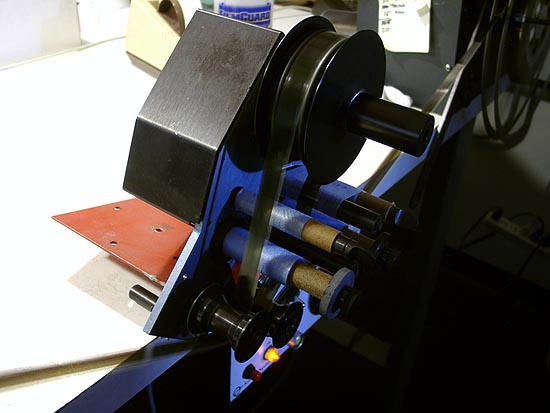
Neumade actually now makes an official film cleaner bracket for their Ultra II table too.
Posted by Monte L Fullmer (Member # 2797) on 12-31-2006, 04:00 AM:
How did you make the flanges of the large drive drum come together so that 16mm can be driven across the edge rubber tires? Is there a spacer that can be switched out to bring the flanges closer together?
thx-Monte
Posted by Charles Greenlee (Member # 3856) on 12-31-2006, 05:11 AM:
Not allowed to use FG? I can see them not wanting to buy it because they're cheap bastards, but outright forbidding its use? Crazy. Strange that they'd let you use charcoal lighter fluid. Naptha truely is wonderful stuff, and I find more uses for it everyday, but I'm also cautious with it. I don't think I'd even consider using it on film. Sounds like your company may have it out for film tech. I mean, at least use C-lube then, though I'm sure Brad will hate me for reccommending it. Well, recommending it only if FG is specifically prohibited, and not all cleaner/lubes, because its gotta be better that naptha.
If you really want to use flammible/toxic solvents on your film, we still have a full can of Renovex sitting on our shelf collecting dust. At least it's designed for film use. I don't plan on using it.
Serously, start sweet talking them into allowing some kind of cleaner/lube for your film.
Posted by Gordon McLeod (Member # 33) on 12-31-2006, 09:55 AM:
Actually hydro naptha is a commonly used film cleaner in many film labs
http://www.sanlabsystems.com/
Posted by Charles Greenlee (Member # 3856) on 12-31-2006, 12:07 PM:
Probably a different formulation, I'm sure. Like the labs using PTR cleaners to clean the film. Their PTRs are huge, and are much different from the ones we get, so I thinking the Naptha is the same, but could be wrong. I'd still shy away from it if I could find something better or safer.
Posted by Gordon McLeod (Member # 33) on 12-31-2006, 01:38 PM:
Actually the labs use the same ptrs that theatres use
Posted by Brad Miller (Member # 2) on 12-31-2006, 02:52 PM:
There is only one company that bans the use of FG, and it is purely a retarded issue.
Anyway, to modify a cleaner you just remove the spacer from in between the two flanges, mount the spacer on the outside of one of the flanges using extra long bolts and then insert an appropriate amount of washers between the flanges (using those same two extra long bolts). Look closely at that picture, you will see the 70mm spacer on the operator side of the two flanges, instead of in between the two flanges.
Posted by Charles Greenlee (Member # 3856) on 12-31-2006, 03:46 PM:
quote: Gordon McLeod
Actually the labs use the same ptrs that theatres use
I thoguht they had a more industrial type. Maybe the same theory and compund, but I think theirs uses larger rollers. Heck if their rollers are 6x as big, they may actually be able to clean a whole movie before the compund becomes saturated.
Posted by John Hawkinson (Member # 1135) on 01-01-2007, 11:18 AM:
As others have said, regular VM&P naptha seems to be the recommended film-cleaning solvent of choice, replacing
1-1-1-tricholoroethane (e.g. Renovex).
It has a different application than FilmGuard, because it evaporates quickly. It is also better than FilmGuard at removing gummed-up tape residue, cheap splicing tape, nasty foil cues, and similar spot-cleaning tasks.
Ideally, every booth should have both. FilmGuard for extensive cleaning, and a solvent like naptha or Renovex for spot-cleaning. Yes, you can use FilmGuard for spot-cleaning, but it doesn't work as well. And you can use naptha or Renovex for entire-print-cleaning, but you'll have to use a lot, and they evaporate quickly, so don't have FilmGuard's benefits.
Kodak's Solvent page is an excellent resource. Do check it out.
As for the flammability, well, it has a higher flash point and higher boiling point than isopropyl alcohol...observe reasonable precautions.
--jhawk
Posted by Henry Titchen (Member # 3141) on 01-01-2007, 07:19 PM:
Hi,
Is Filmguard covered by a patent? If so does anyone know the number? It sounds like a great product.
Thanks from,
Henry.
Posted by Charles Greenlee (Member # 3856) on 01-01-2007, 07:29 PM:
Dude, this is Filmtech, home of Filmguard. I'm sure any of the officials, inc Brad, would be glad to tell you about it. As far as getting the patent number? I'm not sure. You can do a patent search for it though, but I'm not sure what the adress for that is.
Posted by Phil Hill (Member # 371) on 01-01-2007, 07:49 PM:
Yeah, it does seem strange that someone would be looking for the specific patent. In my experience, those asking for a particular patent are basically trying to circumvent it and make a similar product.
If one is concerned about the FilmGuard's specific content hazards, go look up the MSDS sheet.
Posted by Matt Fields (Member # 3211) on 01-02-2007, 09:02 AM:
The patent number is on the bottle. Buy one.
Posted by Henry Titchen (Member # 3141) on 01-02-2007, 05:07 PM:
OK thanks I'll take a look at the bottle.
I am a big fan of patents. If I ever want to understand how something works I look at the patent. The US patent office search engine is excellent. All that is needed is a TIFF plugin and the wisdom of millions of inventors is accessible. All at no cost to the internet user!
A big advantage of looking at patents for any invention is that there is no marketing info. Just the technical aspects of the invention.
Henry.
Posted by Gordon McLeod (Member # 33) on 01-02-2007, 06:52 PM:
The plugin is called altena tiff
Posted by Charles Greenlee (Member # 3856) on 01-02-2007, 07:02 PM:
quote: Phil Hill
Yeah, it does seem strange that someone would be looking for the specific patent. In my experience, those asking for a particular patent are basically trying to circumvent it and make a similar product.
Hence why I was real cautious about what I said. That and it's not my forums or product, so best to refer him to somone who is responsible for it.
Posted by Phil Hill (Member # 371) on 01-02-2007, 09:30 PM:
![[Confused]](confused.gif) I merely made a comment/observation.
I merely made a comment/observation.
I think Brad would have something to say about an imposter/someone stealing his formula and namesake and making/selling a similar product.
(Edit to correct wrong spellings)
[ 01-03-2007, 04:08 PM: Message edited by: Phil Hill ]
Posted by Gordon McLeod (Member # 33) on 01-02-2007, 10:32 PM:
check here
click
Posted by Charles Greenlee (Member # 3856) on 01-03-2007, 08:05 PM:
Oooh, and it features some personal info on Brad. What's the A stand for? Adam? Alex? Anthony?
Posted by Brad Miller (Member # 2) on 01-04-2007, 04:05 AM:
My aren't you oddly interested. I will let Phil analyze that one.
Posted by Charles Greenlee (Member # 3856) on 01-05-2007, 03:22 AM:
Idle curiosty, I assure you. That and a poor sense of humor. ![[Big Grin]](biggrin.gif)
Powered by Infopop Corporation
UBB.classicTM
6.3.1.2