This is topic Zeiss Ikon Favorit 16 - info required in forum Film Handlers' Forum at Film-Tech Forum ARCHIVE.
To visit this topic, use this URL:
https://ft-forum.com/ft/cgi-bin/ubb/ultimatebb.cgi?ubb=get_topic;f=1;t=008507
Posted by Matthew Taylor (Member # 2310) on 02-11-2007, 02:11 PM:
Could anyone point me to some photos of the Zeiss Ikon Favorit 16 projector. If there is a manual available for download somewhere too, that would be helpful. Thanks.
Posted by Kenneth Wuepper (Member # 1174) on 02-11-2007, 08:40 PM:
Matthew,
Check in the photos section for the Temple Theatre, Saginaw photos. There is a Zeis 16B pictured in our booth. I have all three manuals, Xenon lamp, sound amplifier and the projector manual. They are in German language I think but then I might be wrong. It's been a few years since I had to look into them.
Brad, How can we get these manuals on the site? They came to use directly from Zeis in Germany. I don't have a way to scan the larger pages. We would not let them out of our posession either.
KEN
Posted by Gordon McLeod (Member # 33) on 02-12-2007, 08:50 AM:
The favorite line is actual rebadged Prevost equipment
One thing that does vary depending on vintage is the holdback roller is a sprocket on some others it is a rubber roller and the diameter of the sound drum is different
Posted by Scott Norwood (Member # 30) on 02-12-2007, 09:49 AM:
It looks just like the Prevost P16--my least favorite (no pun intended) projector of all time.
Has anyone figured out what that tension adjustment on the sprocket just before the sound drum is supposed to do?
Posted by Gordon McLeod (Member # 33) on 02-12-2007, 10:22 AM:
It sets the amount of damping effect on the sound drum
it is balanced against the fricton of the felt clutch in the pinch roller above the sound drum
Posted by Richard Fowler (Member # 893) on 02-12-2007, 10:37 AM:
The clutch roller before the sound drum is to give some back tension to the film....also found on other projectors such as the 16mm Bauer Selecton.
Posted by Scott Norwood (Member # 30) on 02-12-2007, 10:46 AM:
Hmm...I know of one of these machines that has some sort of "issues" with that tension adjustment and will occasionally go into full-on film-shredding mode, usually right at the beginning of a show (or, sometimes, at the end of a reel). There is some relationship to this tension adjustment being off. Any ideas? What happens is that the loop right after the intermittent is lost and the film breaks right there. It seems to happen about one out of every fifty (?) shows. This place always runs large reels and an additional complication is that the machine has an E-TRAC inverter installed for slow startup and also to allow running at silent speed.
Posted by Gordon McLeod (Member # 33) on 02-12-2007, 11:54 AM:
Ithink it may be a takeup issue
if the film is pulled off the holdback sprocket it will then loose the stabalizer loop
Posted by Steve Guttag (Member # 268) on 02-12-2007, 04:46 PM:
I know Prevost on their P-16 used a real crappy brake-roller design like that...it could easily self-tension itself into full film shredding mode.
Posted by Scott Norwood (Member # 30) on 02-13-2007, 09:47 AM:
Exactly; this happens on a P16.
And the fix for this is what, exactly?
It may be a takeup issue, though I always make a point of using floating-hub reels and giving the reel a bit of a manual push at startup (to avoid bouncing due to the slow start provided by the E-TRAC). Could it just need a takeup tension adjustment? The film isn't being ripped across the holdback sprocket or anything like that and I don't think that the sprocket itself is loose in the shaft (will have to check).
The other issue that I've had with this machine is that the trap seems to be a dirt magnet, and no amount of dust-off seems to be able to help get rid of hairballs mid-show.
Is there even a parts supplier for these machines in the US?
In fairness, I should point out that the picture is pretty steady and there is no "dirt-embedder" roller like on the intermittent-movement Eikis (e.g. EX-6120).
If anyone wants to donate an FP-38E to a nonprofit educational institution, I doubt that they would refuse....
Posted by Steve Guttag (Member # 268) on 02-13-2007, 04:46 PM:
I have no qualms about stating that the Prevost P16 is a complete piece of junk. Any goodness in it is by pure accident. I also have no doubt that someone on here will tout how nice they are but they are just plain wrong! ![[Wink]](wink.gif)
As to the brake roller...there is little to do about it...It has been awhile but one could possibly goop the treads so the tension set nut will tend to stay put when set.
As to the "E-trac"...I don't recall any E-tracks on the ones I operated...however E-tracs are normally fully programmable so any ramp up/down speed should be able to be set for precise starts/stops. I do like TB Woods inverters (E-trac and other drives).
Posted by Mark Gulbrandsen (Member # 72) on 02-13-2007, 04:54 PM:
Gosh, Steve and I actually completely agree on something. For 16mm give me a nice Eastman 25 any day over anything else made!!
Mark
Posted by Steve Guttag (Member # 268) on 02-13-2007, 06:18 PM:
That and phase control Potts/Strong platters are for the birds. For 16mm...I like the Kinoton FP38E best of all Scarecrow. Best sound, best picture. The Eastman was certainly best of its day and it holds up pretty darn well.
Posted by Richard Fowler (Member # 893) on 02-13-2007, 06:51 PM:
I used to service quite a few of the Prevost / Zeiss units. Xetron ( and probably Neumade at present ) have or had the parts. Most service problems where the sound drag roller, someone playing with the sound optics ( a real pain to restore with sound focus film ) or the wimpy take up motor on the Xetron designed units that where designed to "stall" but mostly burned up in short order and were replaced with a decent torque motor.
Posted by Mark Gulbrandsen (Member # 72) on 02-13-2007, 07:38 PM:
quote: Steve Guttag
For 16mm...I like the Kinoton FP38E best of all Scarecrow. Best sound, best picture. The Eastman was certainly best of its day and it holds up pretty darn well.
Well I just so happened to have the chance to compare both of them in the not too distant past and the Eastman VERY DEFINATELY blew the Kinoton out of the water, especially in screen brightness and sound playback, as well as its ability to project acceptably warped, shrunken film. At the latter it excelled over the Kinoton which actually spit some of the film right out... The Eastman was not quite as good in steadiness but was way within SMPTE specs. In fact the Film Department head that looked at and demoed both projectors and ultimately purchased the Eastman said it was hands down in the Eastmans favor. The Kinoton was certainly the runner up and the machine that I orginally wanted to install there. Keep in mind that this was no "stock" Eastman and has a number of mods done to it. This version of the Eastman is now installed in close to 20 locations... in many museums and screening rooms across the states. The end cost is about the same as the Kinoton. Given the fact that new Eastman 25's cost 5k without lamp back in the early 60's that Eastman today would cost close to 60k!!
Mark
Posted by Steve Guttag (Member # 268) on 02-14-2007, 04:57 AM:
I'll tell you Mark...there is no way you could get an Eastman to beat one of my FP38E installs. Neither sound nor picture. As for brightness...I've run the FP38Es up to 5KW when needed. I've gotten the "it looks like 35mm" comments out of them.
Posted by Mark Gulbrandsen (Member # 72) on 02-14-2007, 08:28 AM:
quote: Steve Guttag
I've gotten the "it looks like 35mm" comments out of them.
Funny, but thats exactly what the film department heads said about the Eastman and why they bought it... and they didn't like the clumsiness of threading the Kinoton and I very definately agree on that. The Eastman is super easy to thread and its ruby lined gate will never wear out like the plastic parts in the Kinoton. Again... I don't do the rebuilds or mods to the Eastmans, this is done by a person in the Midwest. Until you've seen these particuluar Eastmans I wouldn't knock them. A hint... it uses a Kinoton lamphouse but not the Kinoton mirror... it uses a custom mirror. You wouldn't need 5kw with this mirror to achieve what you're getting. We were able to achieve an even 28fl on a 36 foot wide screen(in scope!) with this install and a 2kw lamp. We left it set at about 20 and it looks spectaculuar. Remember I've seen both and so did the folks at the U. They choose the better route, I had been pushing the FP38E.
Mark
Posted by Michael Schaffer (Member # 1204) on 02-14-2007, 06:25 PM:
quote: Mark Gulbrandsen
The Eastman is super easy to thread and its ruby lined gate will never wear out like the plastic parts in the Kinoton.
I think I will never understand why people don't understand that simple concept. When you have film racing at high speed through the gate (in addition to abruptly stopping and starting at very high speeds), there is a lot of friction.
Something will wear down. That's just a fact of physics.
It's better to wear the gate and runner strips down than the film and then replace them once a year or so (for what? $20-30?) than to wear the film material down.
As far as the differences between the FP38E and those Eastman machines are concerned, I have no clue. I have never seen one of the latter. At the Berlin Film Festival, we always used FP38E and Bauer Selecton II.
Posted by Gordon McLeod (Member # 33) on 02-14-2007, 06:47 PM:
As wonderfull a peice of engineering art it is the Eastman 25 is an overtly complicted and dated machine
Posted by Mark Gulbrandsen (Member # 72) on 02-14-2007, 06:59 PM:
quote: Gordon McLeod
As wonderfull a peice of engineering art it is the Eastman 25 is an overtly complicted and dated machine
Gord,
I'm trying to imagine what makes it complicated? The fact that it has two drive motors? The fact that the gate is lined with rubies? The fact that all the film path parts... sprockets and pad rollers are made from Stainless Steel? I'm still trying to figure out where the complicated aspect lies in the Eastman... when in reality its actually a very simple mechanism. Like the DP-70 these machines were built to last forever and run properly for ever with very little maintainance.
BTW Michael, The rubies actually produce less friction than do the plastic parts on the FP series.
Mark
Posted by Gordon McLeod (Member # 33) on 02-14-2007, 10:34 PM:
My experience with eastmans either on telecine chains to theatres has never been as good as the FP16
also I have found it far tougher on shrunken and damaged film
Posted by Michael Schaffer (Member # 1204) on 02-15-2007, 02:34 AM:
What exactly is meant by "rubies" here? Ruby colored velvet gate bands?
Posted by Mark Gulbrandsen (Member # 72) on 02-15-2007, 08:17 AM:
quote: Gordon McLeod
My experience with eastmans either on telecine chains to theatres has never been as good as the FP16
also I have found it far tougher on shrunken and damaged film
Gord,
Thats a great explanation of why they are so complicated.... What are we all in for next?
Michael,
If you make it to this neck of the woods sometime I'll be happy to show you the Eastman. You are probably the only one of the few here with an open enough mind to be able to appreciate what it is capable of and how well built it is.
Edit:
Steve is correct in his statement below about 6000' capacity. Many were bult with just 2300' capacity... intended for C/O booth I suppose but there were many later machines that came factory equipped for 6000'. The model 40 Eastman was the last model built was the culmination of all the knowledge gained building the Model 25... unfortunately there are only a handful of Model 40's built before Kodak discontinued production.
Mark
Posted by Steve Guttag (Member # 268) on 02-15-2007, 08:22 AM:
While I'm a big fan of the FP38E...I'm not so gung ho on the FP16 or FP18.
The Eastman 25 was indeed a very well built machine and I have no particular qualms about it (except the lack of easy 6000' reel support...not that many have not come up with their own mods). The light path sound is a bit odd.
As for the FP38E's light efficency...I think it is lacking strictly due to it being part of a combo 35/16 machine and it is the secondary format (it is a 35mm projector that handles 16mm). The skate/runners on the FP38 are fine though much more costly than Mike thinks...16mm is often 2-3 times as costly as 35mm nowadays. Kinoton has always used ceramic discs for the lateral guidance...which is very good for wear but it does make them fragile when they are stored out of the machine (when running 35mm).
Posted by Richard Fowler (Member # 893) on 02-15-2007, 10:24 AM:
Micheal,
the ruby parts are industrial parts machined out of ruby mineral to create a very hard surface which resisted scoring and tend not to trap dirt. Some movie camera had this as a feature....also bearing material in watches.
Posted by Mark Gulbrandsen (Member # 72) on 02-15-2007, 11:27 AM:
quote: Richard Fowler
Some movie camera had this as a feature....also bearing material in watches.
Yea, The Auricon Newsreel cameras had ruby balls in the gate. Those things never wore out. All high grade watches have jewels... not all are ruby but the higher grade watches and clocks are... Reifler Astronomical Clocks are all ruby jeweled and in fact the escapement of the Reifler had razor edges that suspended the pendulum on a set of Ruby slabs. This German Clock was the most accurate time keeping instrument of its day and has yet to be beat by any other electro-mechanical type clock.
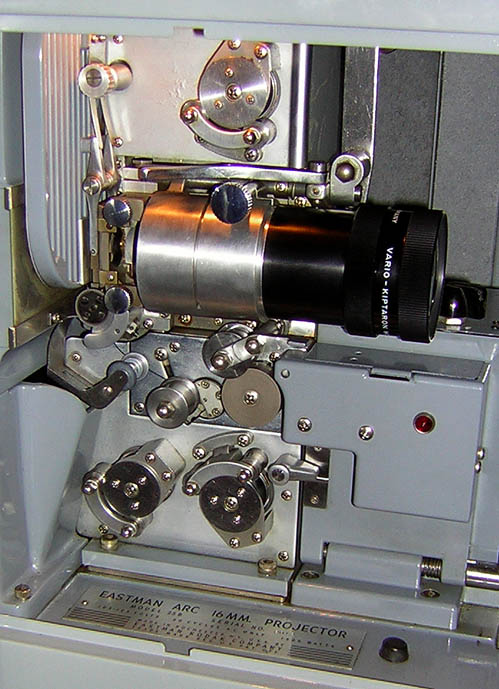
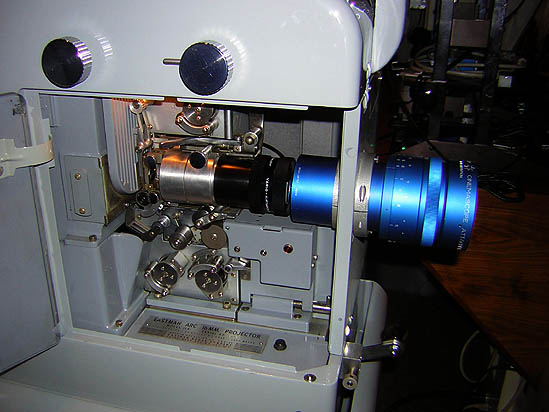
The chastized Eastman looking more like a tiny 35mm machine than anything else. Note its shorter curved gate... shorter path and less friction! Also a much smaller radius than the Kinoton machines have.
Posted by Steve Guttag (Member # 268) on 02-15-2007, 12:08 PM:
Jesus H Tap Dancin' Christ....of course the image looked good on that Eastman...you had God's gift to lenses....the ISCO Vario Kiptaron 20-60 and then for scope used a Blue-Star. One could do no better indeed!
Steve
Posted by Michael Schaffer (Member # 1204) on 02-15-2007, 07:59 PM:
I would like to see pictures of the ruby runner strips. I don't think I have ever seen any of those.
Posted by Richard Fowler (Member # 893) on 02-16-2007, 09:12 AM:
Dorothy needs them to get back from Oz....couldn't resist ![[evil]](graemlins/evil.gif)
Posted by Mark Gulbrandsen (Member # 72) on 02-16-2007, 11:26 AM:
Here they are....... those magic shoes.....

Posted by Scott Norwood (Member # 30) on 02-16-2007, 06:15 PM:
Mark--that's a beautiful machine! What kind of lamphouse are you using with it? (I'm guessing that it's a xenon conversion, not the original arc lamp.)
Posted by Mark Gulbrandsen (Member # 72) on 02-16-2007, 06:26 PM:
Scott,
The lamphouse is a new Kinoton running a 2kw with custom mirror specifically made for this system(that should fry Gords bacon !). It runs from a Strong Compact Switcher since they only had single phase 240 in the booth at this U.
Mark
Posted by Michael Schaffer (Member # 1204) on 02-16-2007, 11:16 PM:
Very nice shoes, Mark. I didn't know you like to cross-dress. But what I meant were the gate bands or runner strips or whatever you want to call it ("Filmlaufbahnen") in that Eastman machine.
Posted by Mark Gulbrandsen (Member # 72) on 02-17-2007, 03:34 PM:
quote: Michael Schaffer
I didn't know you like to cross-dress.
Thats funny... I didn't know that either....
quote: Michael Schaffer
I would like to see pictures of the ruby runner strips.
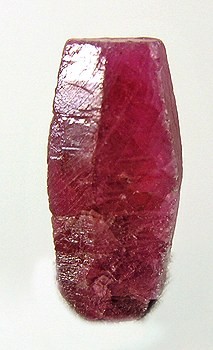
Yes, So would I..... The curved runer is actually made from carbide. The rubys are for guidance. The carbide never wears out in this application neither does the ruby stuff...well, perhaps after 90 or so years it might. Here is a photo of the Raw Ruby Runners before the lapidary experts shape and polish them......
Important Data for those wanting to make their own Ruby Runners.....
Powered by Infopop Corporation
UBB.classicTM
6.3.1.2