This is topic Help identifying Century model in forum Film Handlers' Forum at Film-Tech Forum ARCHIVE.
To visit this topic, use this URL:
https://ft-forum.com/ft/cgi-bin/ubb/ultimatebb.cgi?ubb=get_topic;f=1;t=008513
Posted by Brian Dooda (Member # 3941) on 02-16-2007, 01:51 PM:
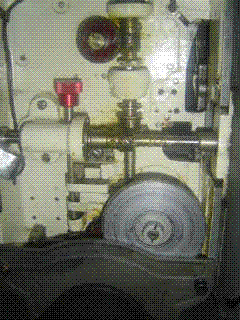
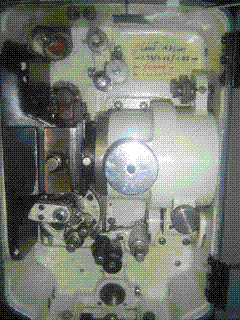
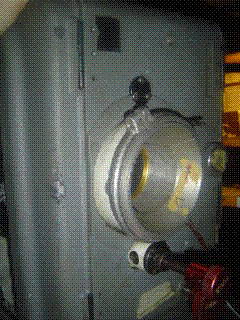
This Century projector is missing its s/n and model tag. I've always thought it was an SA but there are a few things different from all the other SA's I've worked with. The lower pad roller latches from the top and the shutter timing adjustment knob is located inside the drive side. Is this an SA and does anyone know around what year or s/n this would have been manufactured?
Thanks
Posted by Mark Gulbrandsen (Member # 72) on 02-16-2007, 03:05 PM:
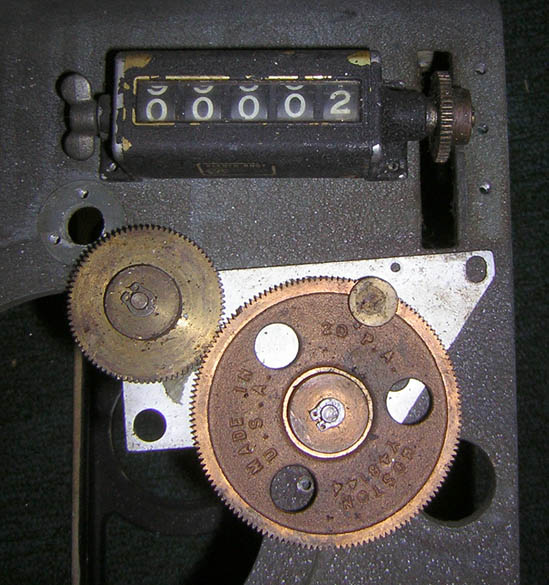
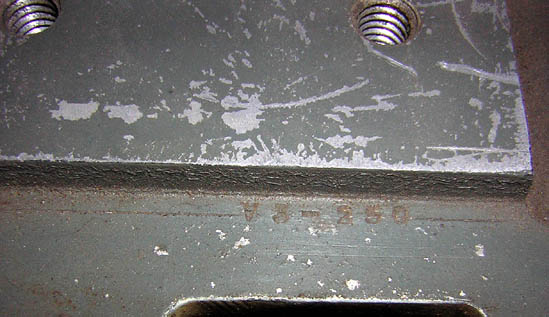
It never had a model tag, just a sticker on the gear side door... the give away on this is that slot on the upper left of the front of the main casting. This was for the gear drive for the veeder root frame counter that used to live on the front of your machine. The other give away is the lower pad roller and if you examine the movement you will find that the arm behind the sprocket is cut back further than a regular SA. This is for sufficient clearance for the larger diameter 24 tooth sprocket that used to be there. What you have is a late model Cinerama 3-strip head thats been converted to run regular 35mm. There should be a V3- ### serial number stamped on the top of the casting between the reel arm mounting pad and the opening for the film to pass through. There are actually quite a few of these around although some are made from C model heads... probably at least 1000 were made since Cinerama had at least several hundred booths at one time..... The one pictured is from a set of three that I have. Out of curiosity whats your serial number?
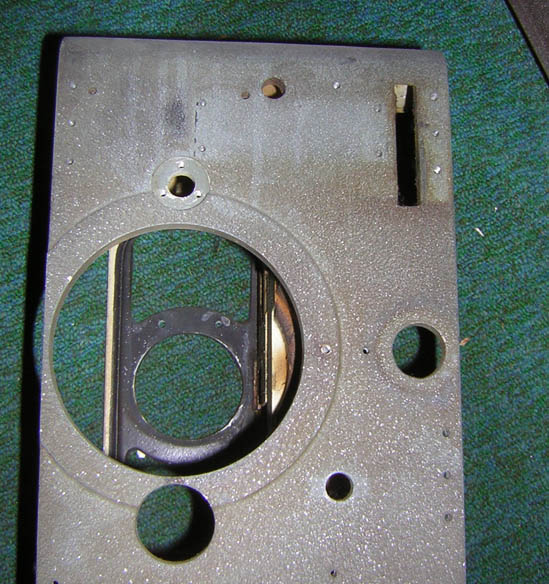
Showing the counter and drove gearing that mounted on the gear side and was driven off the top sprocket shaft.
Serial number location.
The door glass that should be in it.....
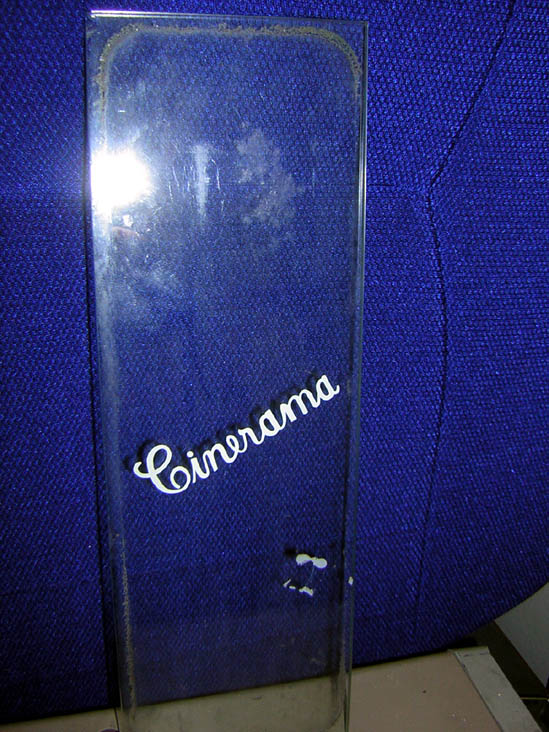
Posted by Brian Dooda (Member # 3941) on 02-16-2007, 06:06 PM:
Wow. Thanks Mark. That's very helpful. The serial # on my machine is V3-123. So what does this all mean? Is it just the frame thats Cinerama and all the parts and gears are the same as a Century SA? How should I look at this machine in terms of manufacturer?
Posted by Mark Gulbrandsen (Member # 72) on 02-16-2007, 06:35 PM:
Well, the only difference I've found is that the Cinerama machines had everything on optical center of the lens. All gearing except the main drive pair was the same. Also todays Strong built Centurys have the shutter adjust inside the gear compartment. Even the hole in the star wheel for seciring the sprocket is in a slightly different location from a normal Century SA star wheel. If you examine closely behind the dovetail that your trap slips into you'll probably also find that a thin steel plate(might be obscured by paint though) has been installed so there was a place to secure the new dovetail. The Cinerama trap had the jiggolos behind it to blend the join lines and the trap mounting was quite different. Many of the 3-strip machines were also converted over to 70mm only Cinerama projectors for Mad Mad World and I've seen a handful of those as well. Look at the Uptown Theater booth photos for shots of the 70mm Cinerama stuff. Originally those projectors had "70mm only" alumnium sprockets on them. Later on when Cinerama began do nose dive most of those were also fitted with 35mm optical reproducers and the necessary conversion parts to run both gauges. Two of the 70mm Cinerama heads I've had in past years were both set up for just 70mm.
Mark
Posted by Cary Loeser (Member # 2923) on 03-06-2007, 08:11 PM:
Is that a Cinerama intermittent movement on your projector? You can tell by the amount of clearance between the intermittent sprocket and the rear arm (that houses the oil cup). If there is a little over 1/4" clearance, then it is a Cinerama movement. I am rebuilding three Cinerama projectors and am currently looking for a Cinerama intermittent movement. Can anybody point me in the direction of someone who might have a Cinerama intermittent movement that they would like to sell?
Posted by David Kilderry (Member # 142) on 03-11-2007, 09:17 AM:
Some of the ex Cinerama Century's used here in Australia were converted and re-used. I understand that at least one was used in one of the theatres in Penrith NSW.
I never knew what to look for, now I do! Hey, I think I'm going to check that Century running on Field 2 behind me right now.........
David
Posted by Mark Gulbrandsen (Member # 72) on 03-11-2007, 05:42 PM:
Carey,
I know of at least two Centurys in use in Theaters that have Cinerama movements in them but I doubt they'd sell them. Actually any SA type movement can be converted to Cinerama if you have or had made the required sprocket and pads. Worrell Grinding in NOrthern CA. will custom make any sprocket for you at reasonable prices. All you need to do is mount the outer case half in a 4 jaw chuck and align it. Then machine the inner area of the outboard arm back on a lathe. I did this for my VistaVision projector... it actually consumed the oil passage but that was easily plugged up. The movement is now filled through the cam end play adjustment hole. Has run millions of feet of 8 perf and never a problem.
Mark
Posted by Brian Dooda (Member # 3941) on 03-13-2007, 11:15 AM:
Hi Cary,
It looks like it is a Cinerama intermittent. I see a 1/4 inch clearance between the sprockets and the arm and the serial number on the intermittent is V3M-258.
-Brian
Posted by Cary Loeser (Member # 2923) on 03-16-2007, 09:04 PM:
Brian,
If you would consider a swap of your Cinerama intermittent for a standard H intermittent plus $$, please let me know. It would help me out greatly.
Mark,
Thanks for letting me know about machining standard intermittents to accomodate a 24-tooth sprocket. I always wanted to know whether I could take off the extra material from the back arm without getting into the oil passage. That saves me from sacrificing a good intermittent housing to find out. Your experience with this sort of thing is amazing!
Posted by Louis Bornwasser (Member # 3063) on 03-17-2007, 04:57 AM:
Actually there were many converted in the 1960's when Cinerama went obsolete and there was still a lot of junk running; Motiogriefs, Simplex regulars, etc.
I converted 4 myself. (Most later reversed on behalf of John Harvey....the Cinerama guy in Dayton, Ohio.Louis
Posted by Brian Dooda (Member # 3941) on 04-02-2007, 02:14 PM:
Cary,
Are there some other ways to identify the intermittent as a Cinerama? I have some other projectors that are Century SA's (Century s/n and id stamped on casing) and thier intermittents also have V3 s/n and 1/4" clearance between sprocket and arm. What clearance would the sprocket have if it was'nt a Cinerama? Does the V3 s/n on the intermittent define it as a Cinerama? I'd like to help you but I want to be sure I have what you're looking for.
-Brian
[ 04-02-2007, 03:48 PM: Message edited by: Brian Dooda ]
Posted by Louis Bornwasser (Member # 3063) on 04-02-2007, 03:27 PM:
V3 means Cinerama unless I am proven wrong. Louis
Posted by Cary Loeser (Member # 2923) on 04-02-2007, 09:37 PM:
Brian,
I think Louis is correct. Cinerama intermittent movements were different from H and SA movements in the following ways:
1. Cinerama used 24-tooth sprockets (approximately 1-1/2" diameter) in lieu of the conventional 16-tooth sprockets (approximately 1" diameter). That's why Cinerama intermittent movements that are have been converted to 16-tooth sprockets will have a little more than 1/4" clearance between the sprocket teeth and the rear bracket; to make room for the extra 1/4" sprocket radius.
2. The original Cinerama intermittent movements had a steel disc that was mounted on the starwheel shaft next to the sprocket. The disc was 1-1/2" OD and approximately .030" thick and looked like a fender washer. Also mounted on the starwheel shaft was a four-legged tension spring made out of .007" thick bronze. This spring was next to the disc and held the disc in contact with the sprocket. I'm not sure what the purpose of this disc and spring were, since the sprocket could not move on the shaft after it was installed. If the intermittent movement has been converted over to a 16-tooth sprocket, then the disc and spring are probably no longer there.
3. Since the diameter of the Cinerama sprocket was larger, the intermittent shoe assembly (sometimes refeered to as the intermittent pad and arm assembly) was longer and designed to run against a larger diameter sprocket. If the intermittent movement has been converted over to a 16-tooth sprocket, then the Cinerama intermittent shoe assembly had to be removed from the intermittent movement and replaced with a conventional shoe assembly. So if you have an 16-tooth intermittent movement with shoes that don't exactly seem to fit the sprocket diameter, it could be a Cinerama intermittent that was converted over to a 16-tooth sprocket and no one bothered to replace the shoe assembly.
There may have been "internal" differences between the Cinerama intermittent movements and the H or SA movements but I do not know what they would be.
If an intermittent movement has a 16-tooth sprocket, there is at least 1/4' clearance between the sprocket teeth and the rear bracket, and the serial number of the intermittent movement starts with a V3, then it is most likely an old Cinerama movement.
Posted by Mark Gulbrandsen (Member # 72) on 04-03-2007, 08:24 AM:
quote: Cary Loeser
I'm not sure what the purpose of this disc and spring were
Most of the Cinerama intermittent sprockets had a flange that was on the outboard side towards the operator. The flange was actually machined into sprocket itself. The disc and spring were there for more lateral guidance to get rid of the last bit of horizontal movement in the image . This makes the join lines less noticable. Today Positrol sprockets do the exact same thing in an even better way. Actually the jiggilo part is what sucked about Cinerama... those fuzzy join lines that no one ever got used to. Cinemiracle got rid of the jiggilos and their method of using mirrors and other slight changes worked ALOT better.
Mark
Posted by Cary Loeser (Member # 2923) on 04-04-2007, 11:23 PM:
quote: Mark Gulbrandsen
The disc and spring were there for more lateral guidance to get rid of the last bit of horizontal movement in the image
Mark,
I still don't understand how the disc and spring would help lateral guidance. The sprocket is "pinned" to the starwheel shaft with the sprocket clamp screw and nut, so the sprocket should not be able to move laterally along the starwheel shaft. The end collar on the starwheel shaft is preventing the shaft from lateral movement (assuming the sprocket is pulled toward the outer bushing when the end collar is installed, to remove shaft play). Can you further expand on your explanation?
Also, how did Cinemiracle eliminate the need for gigolos with the use of the mirrors? Was a line in the mirrors ground down to a diffuse surface where the overlap would be? I never saw a Cinemiracle installation so I am clueless as to how they did this.
Posted by Robert Throop (Member # 61) on 04-05-2007, 08:40 AM:
The early Cinemiracle installations used mirrors on the outboard machines to get a more precise panel alignment. if you look at pictures of some of the later jobs there was no mirror. I think that when Century introduced the lateral lens adjustment it accomplished the same thing.
Bob
Posted by Richard Fowler (Member # 893) on 04-05-2007, 09:57 AM:
I remember seeing "Windjammer" in Cinemiracle and it virually seamless compared to Cinerama.......only occaisional arc light flutter between panels during this presentation I saw in the early 1960's. ![[Cool]](cool.gif)
Posted by Mark Gulbrandsen (Member # 72) on 04-05-2007, 10:02 AM:
Robert is correct on that. The original Cinemiracle mirrors used micrometer adjusters on them to precisely align the edge of the mirror properly, later installations used the movable lens mount. Another interesting feature of Cinemiracle was a fall off on the joining edges of the photographed camera negatives that was caused by falloff of the mirrors in the camera. This fall off or vignetting eliminated the need for the gigilos in the projectors.
As for the Cinerama intermittents... With any multi panel process any film movement in the projector was an annoyance in the projected image so all kinds of devices were used to attempt to control it. The movements I've had over the years all had a flange on the outboard side of the intermittent sprocket that was a machined in part of the sprocket. Opposite that was the disc and spring that you taked about. This system acted just like the lateral guide roller at the top of the gate except it was part of the intermittent. If this still doesn't make sense I can draw a picture.....
Mark
Posted by Richard Hamilton (Member # 321) on 04-05-2007, 10:51 AM:
quote: Mark Gulbrandsen
I can draw a picture
your an arteest also??? ![[Big Grin]](biggrin.gif)
Rick
sorry, I'm in my smartass mood today
Posted by Mark Gulbrandsen (Member # 72) on 04-05-2007, 11:22 AM:
Definately not an arteest.... I can draw stick people pretty good though.... I'd do it on Autocad so it would be legible.
Posted by Cary Loeser (Member # 2923) on 04-07-2007, 06:59 PM:
Mark,
Thanks for the additional explanation. No drawings are required. Just want to verify that the "flange" side of the sprocket was, in fact, on the outboard side and the disc and spring were on the inboard side; is that correct? Also, sometimes Cinerama put shim washers next to the spring. Do you know any specifics about that?
Posted by Mark Gulbrandsen (Member # 72) on 04-08-2007, 09:15 AM:
Yes, thats correct. I too would use a thin hardened washer so that the spring is not turning on the end of the star bushing itself.
Mark
Powered by Infopop Corporation
UBB.classicTM
6.3.1.2