This is topic Equipment Modifications! in forum Film Handlers' Forum at Film-Tech Forum ARCHIVE.
To visit this topic, use this URL:
https://ft-forum.com/ft/cgi-bin/ubb/ultimatebb.cgi?ubb=get_topic;f=1;t=008518
Posted by Christopher Meredith (Member # 3767) on 02-20-2007, 10:10 PM:
I bet with all the handy guys (and girls!) around here, there must be a lot of us who have performed modifications on certain equipment, whether they be minor adjustments or major overhauls. I also thought it would be good to have a thread to demonstrate the little helpful things we've done so that other might be able to benefit from them.
So here goes:
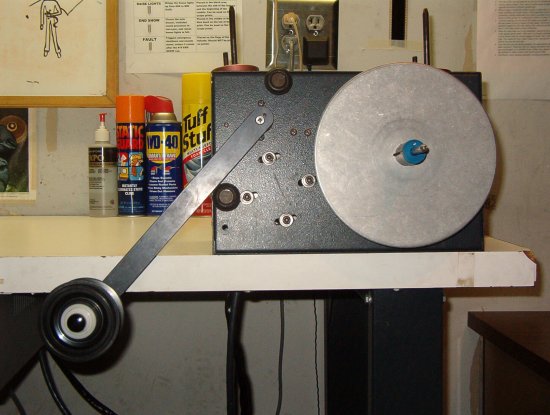
First up, I was having a problem with the auto-stop arm on our Kelmar rewind benches. Seems we have a couple of house reels that were beg enough to drag against the auto-stop roller when it was in the down position. I fixed the problem by moving the bumper up about an inch and a half. The new mount location can be seen above the old one:
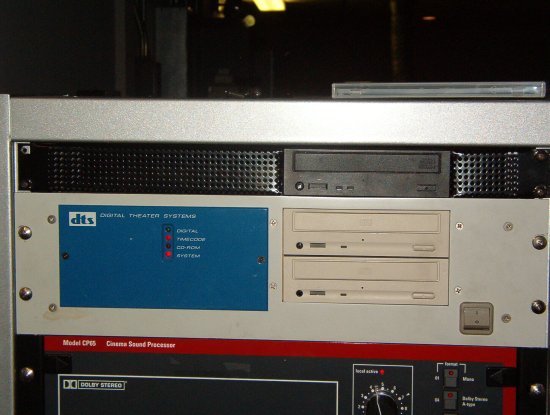
Next is the 3-drive DTS upgrade. This pretty much comes straight from the howto but rather than do the DVD drive upgrade, I just added a third TEAC drive like the ones that were already installed. Simply setting the jumpers and using one of the 3-drive cables provided by DTS in the drive upgrade kit worked like a charm. Rather than cut the blank mounting plate to length, I cut it in one place then bent it to fit. That way, no jagged edges and then the short piece that bends back actually mounts to the third drive. The flash makes it look more angled than it actually is.
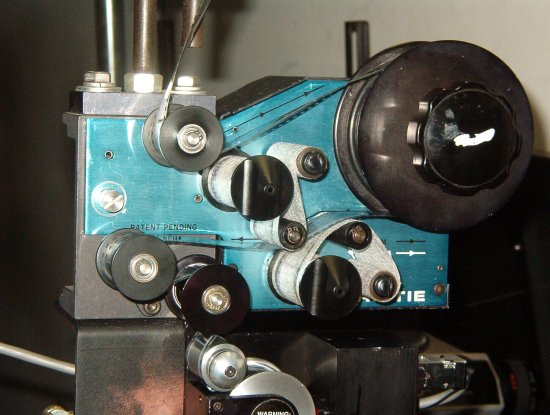
The next exhibit is more of a curiosity. Our tech rescued a pair of Christie FC-1 film cleaners from a theater in Dallas he was helping close. We already had 3 Kelmars and with these addition, that gives us 5 film cleaners for 10 screens. Yay! The only downsides were that the Christies move much slower (a pain, but they still work fine), and they had the old, annoying screw-on caps and no easy way to attach and detach from the mounting brackets. So we retrofitted them with the latest and greatest Kelmar parts. Notice the cool, easy-off caps and mounting bolt.
Posted by Monte L Fullmer (Member # 2797) on 02-20-2007, 11:50 PM:
Nice thing about doing "mods" is that a creative projectionist/engineer is present at the location that he works at and shows great interest in what he does.
Some of us, from time to time in our lifetimes in this crazy business, have done "mods" to keep the show going and make life easier for us in the meantime.
Congrats though on what you've done.
-Monte
Posted by John Walsh (Member # 168) on 02-21-2007, 07:16 AM:
Good idea about moving up the bumper on the rewind table, but be aware that the internal limit switches may need to be adjusted to activate at the new arm location.
Posted by Mark Gulbrandsen (Member # 72) on 02-21-2007, 07:22 AM:
quote: Christopher Meredith
rather than do the DVD drive upgrade, I just added a third TEAC drive like the ones that were already installed.
Fine for now but the Teacs are now dropping like flys. Most of them have ALOT of hours of run time on them!!
Mark
Posted by Scott Norwood (Member # 30) on 02-21-2007, 07:52 AM:
This isn't a modification as such, but I just switched from standard 90-degree shutters to 100-degree shutters (part BD-1466 from Wolk) on my Centurys. In return for a slight loss of light, I've completely eliminated all possibility of shutter ghosting. Now, I can turn the adjustment knob nearly a full revolution before seeing any ghosting at the top or bottom of the screen, even on a small screen with a high light level.
I definitely recommend this to anyone who can afford a bit of light loss, especially if the equipment is being operated by people who can't tell the difference between the "focus" knob and the "shutter" knob.
As for modifications, one that I've seen (but cannot take credit for) involved replacing the roller shafts on the payout side of an AW3 with 70mm shafts and mounting two 35mm rollers on each. This allows simultaneous payout from two decks and, along with a few extra interlock rollers, allows one to easily move prints from one cinema to another in a multiplex, without risk of scratching the platter decks with clamps or cookie sheets.
Posted by Steve Guttag (Member # 268) on 02-21-2007, 08:26 AM:
Scott...you have also ordered the C1-D-50S and got the "fans" already attached.
I'm surprised you had ghosting issues on the 90-Degree blade (C1-D-48) since its job is to eliminate ghosting that the stock 84-degree blade never could do (let alone the ultra short drive in blades)
Steve
Posted by Christopher Meredith (Member # 3767) on 02-21-2007, 08:43 AM:
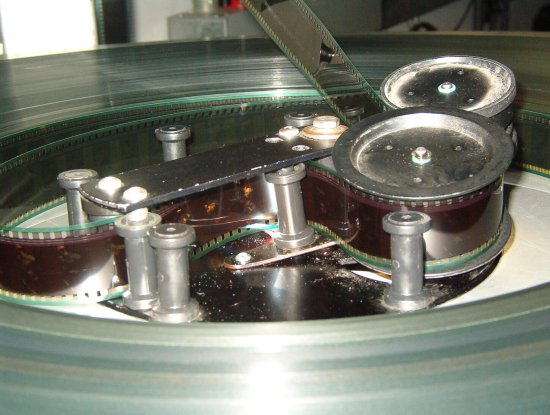
The next one is an idea I got from Brad, who apparently did this a while back. This is the Strong/Christie hybrid brain. My theater has two houses which were designed in such a way that the platters are over 15 feet away from the projectors and since we use all-Strong equipment, that meant that the film would drag on the floor if we didn't use intermediary rollers. I preferred the simpler (relatively) route. This also makes the film cleaner much more effective and prevents DTS dropouts! (BTW, I need to make another one of these if someone wants to send me some old, battle-worn Christie parts brains!)
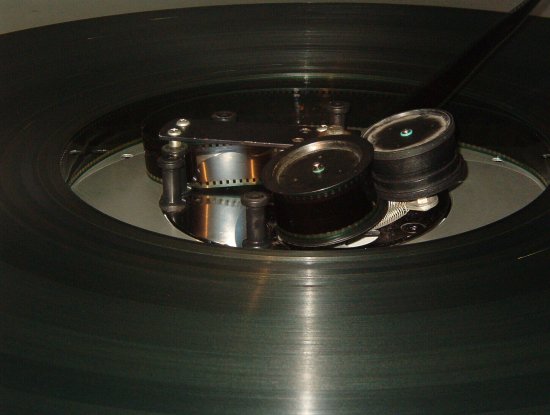
I had to reposition this roller to prevent the film from slipping off the big Christie roller when the film was paying directly into the control arm with no tension on it.
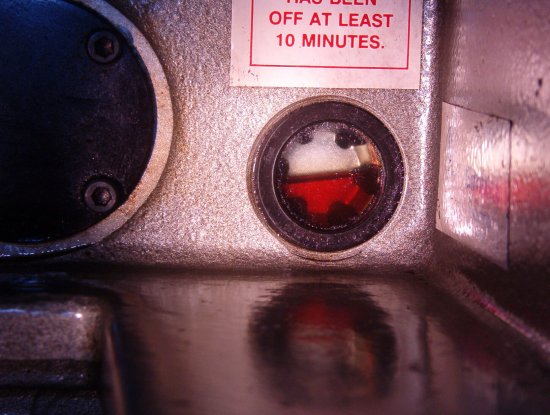
The next two are pretty simple. First, we decided to drain out all the projector oil and replace it with automatic transmission fluid. In addition to the convenience of never needing to be changed, it has the extra added benefit of actually cleaning out the gears and mechanisms. The mystical cleansing power was noticed on one of my projectors which had a leaky intermittent. Where it had been leaking dirty oil into the operator side and leaving a black grimy mess, when it was cranked up with ATF inside it, after the first few runs, the ATF leak had actually cleaned off the built-up residue from the oil leak. (BTW, the leak is fixed now ![[Wink]](wink.gif) )
)
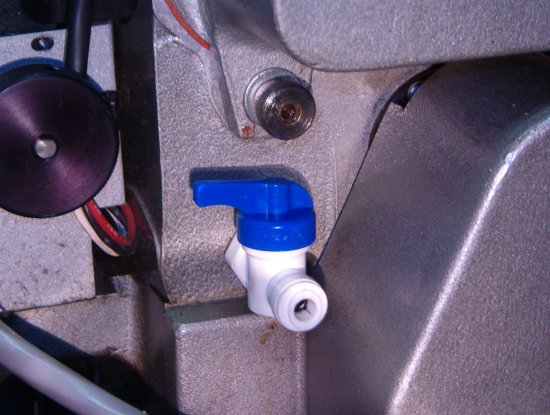
Lastly, I posted this a few months ago, but I decided to replace those PITA oil drain valves with these new ones which have a simple ball valve and a quick-connect for a tube to make draining oil quick and painless. This is kind of ironic considering the fact that, with ATF in there, these should never need to be used until the day the projectors are decomissioned in favor a their digital replacements. ![[Frown]](frown.gif)
So, how about it? What other little things are out there? I for one am interested to see what everyone else has done.
Posted by Scott Norwood (Member # 30) on 02-21-2007, 12:27 PM:
Steve--for some reason, it was much cheaper to order the blades, fins, and screws separately than to order the complete assembly. I don't know why.
The ghosting that I was getting was very slight, but it was really annoying on a small screen. It may have something to do with the Cinemeccanica lamphouses, which have little glass "diffuser" disks that mount on the front (they look a bit like the front of a car headlight). I haven't figured out why these are needed, except that removing them results in a nasty hot spot. I wouldn't be surprised if these cause problems with standard shutters.
Posted by Brad Miller (Member # 2) on 02-21-2007, 05:00 PM:
quote: Scott Norwood
As for modifications, one that I've seen (but cannot take credit for) involved replacing the roller shafts on the payout side of an AW3 with 70mm shafts and mounting two 35mm rollers on each. This allows simultaneous payout from two decks and, along with a few extra interlock rollers, allows one to easily move prints from one cinema to another in a multiplex, without risk of scratching the platter decks with clamps or cookie sheets.
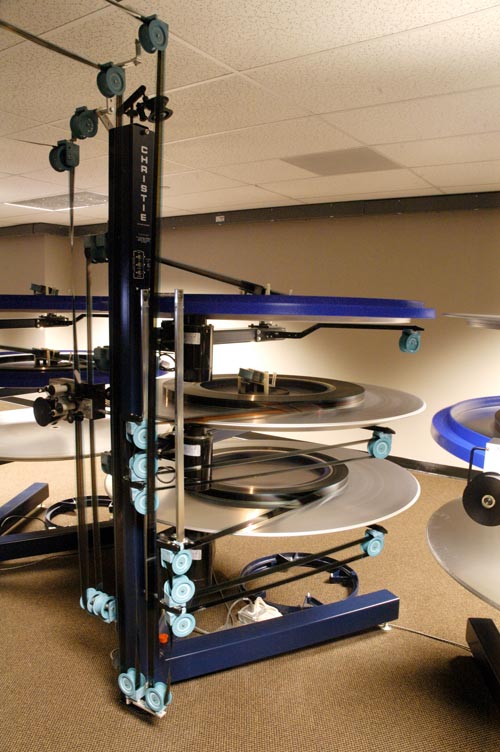
Hmmm, I wonder where I heard that from? I am also doing dual takeup now. The people at Christie probably think these projectionists keep breaking the takeup slidebars at these theaters.
I am surprised nobody has mentioned my dts reader "drag" modification. It is so inredibly simple and knocks out all dropouts and speed variations due to film feed bouncing either from a bad reel arm clutch or wobbly platter roller.
Posted by Monte L Fullmer (Member # 2797) on 02-21-2007, 06:07 PM:
(Don't you just love those AW3r platter units??) That's still pretty slick on that Movie Grill booth setup ... tons of talent there to figure up such an complex operation system.
Could you refresh us with that DTS 'mod' that you did since there has been a new batch of members pop in ... thx
-monte
Posted by Steve Guttag (Member # 268) on 02-21-2007, 06:11 PM:
Scott...did you get the steel blade or aluminium? They look the same but the steel wears way better.
Steve
Posted by Mark Gulbrandsen (Member # 72) on 02-21-2007, 06:22 PM:
Scott... I guess you never have the transmission in your car serviced either. Who on earth told you that you never need to change the lube in your X-L's if you use ATF? Who ever it was is a dork! Over time the lube will still become VERY dirty... full of both metal and phenolic particles generated from the gears running together.... this is quite normal, the intermittent will add more microscopic metal particles to the lube as well. The X-L has one of the worst oil filters... more a strainer than a filter.... and it does very little to keep particulate matter out of the circulating oil, in fact it actually circulates those particles to a great extent! The only decent oil filtration system on a projector is on the DP-70. It has an extremely fine filter aside from having magnets in both the oil pump and intermittent... the X-L doesn't even come close there. Also the star and cam are not designed nor made to be run in ATF and ATF does not necessarily afford the proper rust prevention that normal projector lubricants do... most have anti-rust inhibitors in them that are correct. I wonder how it will attack some of the rubber gaskets over time too...? Thank god they're your projectors and not ones that I have to service. The last X-L's I saw with ATF in them at a drive in had the movements seized up solid.
Keep in mind that some older projectors CAN indeed run just fine with ATF... the Brenkert comes to mind... but the Brenkert had intermittent parts that were not hardened and it had a much better oil filter than the X-L does, including at least a strainer on the movement! But ya still have to cange lube at the correct intervals to get the normal life out of your mechanisms no matter what mechanism you run.
Mark
Posted by Chris Hipp (Member # 1788) on 02-21-2007, 06:32 PM:
quote: Monte L Fullmer
That's still pretty slick on that Movie Grill booth setup ... tons of talent there to figure up such an complex operation system.
I did do a good job on that, didn't I?
Posted by Sam D. Chavez (Member # 1841) on 02-21-2007, 07:06 PM:
I experimented with ATF in Century movements and have always had very good luck. My thought was that the anti foaming quality would be a good thing in the movement.
Did I mention I worked on auto transmissions out of high school back in the 60's?
An automatic is full of rubber seals, metal parts, hardened and non hardened, ball check valves, etc. and are under way more stress than anything in a projector. Most projector technology was perfected before the automatic transmission even came into existence. no?
It's not like we're using brake fluid here.
Posted by Scott Norwood (Member # 30) on 02-21-2007, 08:20 PM:
Steve--no idea. I didn't specify. I got whatever Wolk sent me. They look and feel just like the original blades.
Mark--I'm not the one who isn't changing the oil on X-Ls. I use "Genuine Simplex Oil" and change it about three times per year.
Brad--very nice job! Much better than the homebrew job that someone did years ago at Chestnut Hill. You are officially insane now.
Posted by Mark Gulbrandsen (Member # 72) on 02-21-2007, 09:01 PM:
Intermittents are designed for a certain layer, or "cushion" of oil between the star and cam as the radius of the star comes around and re-engages with the cam and weather or not ATF can provide the correct "cushion" is certainly questionable. No manufacturer of intermittent parts in my lifetime has ever reccomended ATF. ATF is really more of a high temperature lube/hydraulic oil than anything else. Wether or not ATF will attack the rubber parts in a Simplex can only be found by taking a chance.... they deteriorate bad enough as it is with just regular oil over not too many years, hopefully ATF won't accelerate that.
My biggest bitch here is that someone told him he'd never have to change the lube. That is simply plain bad advice unless he's converting to digital in 6 months or less.
Mark
Posted by Brad Miller (Member # 2) on 02-21-2007, 11:59 PM:


Normally if you were to give the main roller a spin, it would spin multiple revolutions. With the same spin, the roller only turns maybe 1/2 revolution. (Again, this should NOT prevent the roller from spinning when film is running through it.) This greatly helps to smooth out the bumpiness from a bouncing platter or feed reel as well as projector vibration. Timecode does track better this way. Just be prepared to change out the paper towel once every year or two.
BTW, the thicker the paper towels the better. The best I've found is something UA used to buy called "Value Choice" heavy duty wipes. That is what is shown here (cut down to size, of course). That was of course in the late 90s. Grainger and Home Depot sells some really plush blue colored heavy duty paper towels that should work equally well. Just stay away from generic type paper towels like Bounty, as they are too thin and not soft enough.
Maybe next week I'll share the secret for setting up an AW3 for achieving different payout vs. takeup speeds. ![[Big Grin]](biggrin.gif)
Posted by Monte L Fullmer (Member # 2797) on 02-22-2007, 02:21 AM:
...interesting - thus, you've created a roller resistance brake like the outside rollers of a AW3's brain does for the payout.
Have to give this a whirl.
Plus, one can use this concept if one is wanting to mount a Kelmar cleaner bracket on top the machine with the DTS unit above (have to reset the delay settings in the processor) and thus having this resistive roller in the reader aid in having the film be a little more snug going through the Kelmar when being used with STRONG platters since they have zero tension from platter to projector.
Thx for sharing this with us .... - Monte
Posted by Bill Enos (Member # 440) on 02-22-2007, 11:29 PM:
Seems to me projector lubrication would be just about the lightest duty for a lubricant....very low speed, no shock loads, no heat to speak of, constant velocity. ATF is a high stress, high speed gear lube, however, it must be formulated not to interfere with the grip of the grip of the multi plate clutch packs and bands so it may not be the slipperiest stuff possible.
Posted by Mark Gulbrandsen (Member # 72) on 02-23-2007, 02:58 AM:
quote: Bill Enos
no shock loads
I guess your projectors don't have any intermittents in them.....
Mark
Posted by Tim Reed (Member # 137) on 02-23-2007, 08:12 AM:
I have seen ATF used in Brenkerts and it worked surprisingly well, as Century or Simplex oil will bog those mechanisms down.
I don't know that I'd use ATF in an XL, though, because it's easy enough to just get the standard-issue stuff.
Posted by Joshua Waaland (Member # 287) on 02-24-2007, 10:18 PM:
Brad,
Do you think one could make the mods to the Christie platters like you did but with one set of 35mm rollers and the other with 70mm rollers? That way the only things that would need changed to switch between formats would be the rollers on the take up arms and the platter brain.
Posted by Will Kutler (Member # 770) on 02-25-2007, 02:44 AM:
Other great uses for ATF: Excellent cutting fluid for machining aluminum!!! ![[thumbsup]](graemlins/thumbsup.gif)
![[beer]](graemlins/beer.gif)
Posted by Brad Miller (Member # 2) on 02-25-2007, 03:57 AM:
Joshua, yes that is easily done. I would put the 70mm on the inside though since it would be used less frequently. Good idea, I just might do that to my screening room platter.
FYI, you can do the dual takeup as well with different gauges. That way the only thing you would have to change out is the roller on the takeup arm. (If you have the older black rollers, you can actually run 35mm on them, you just have to double check it didn't get twisted during threading.)
Posted by Joshua Waaland (Member # 287) on 02-25-2007, 07:42 AM:
I actually do have the older 70mm black rollers. I didn't think of that. Thanks Brad.
Posted by Gordon McLeod (Member # 33) on 02-25-2007, 07:47 AM:
Actually Brad Joe had a training video on this site years ago that showed how to put 70mm on a regular christie with no fuss at all
Posted by Joshua Waaland (Member # 287) on 02-25-2007, 02:18 PM:
I was searching all over Christie's website to try to find the platter in Brad's photo. I wanted to read the specs on it. It took me a minute to realize that he must have come up with the idea.
What did you use for spacers between the take up rails? I imagine you could get some round steel stock and drill and tap it inside.
Posted by Brad Miller (Member # 2) on 02-25-2007, 02:58 PM:
I just used aluminum spacers from this website. Remember you need them not only for the spacing of the slide bars for takeup, but also to space out the film cleaner bracket for the primary payout. Be sure and install a small roller on the uppermost of the two film cleaner bolts so if you are feeding on the secondary payout track from the top platter that you don't scratch the film across that top spacer. If you look at that pictures closely, you can see where this was done.
Posted by Louis Bornwasser (Member # 3063) on 02-25-2007, 03:03 PM:
We used to stack the trailers on top of the film pack. McDonalds soda straws bent into a inverted vee, kept the film on the feed out arm. (perfect fit) Louis
Powered by Infopop Corporation
UBB.classicTM
6.3.1.2