This is topic LED lighting effects during movie.... in forum Film Handlers' Forum at Film-Tech Forum ARCHIVE.
To visit this topic, use this URL:
https://ft-forum.com/ft/cgi-bin/ubb/ultimatebb.cgi?ubb=get_topic;f=1;t=008567
Posted by Bastiaan Fleerkate (Member # 3826) on 03-12-2007, 09:35 AM:
A Dutch company called Philips make LCD and Plasma tv's with Ambilight. I don't know how this system works, but it may be an idea to put in to practice in cinema's across the world.
LED's on the side of the auditorium and sensors behind the perforated screen, was my idea. Or getting a camera and let it record every color change on screen and let a computer 'decode' the data of the camera... just a thought....
If anyone has an idea of putting this idea into practice, please reply...
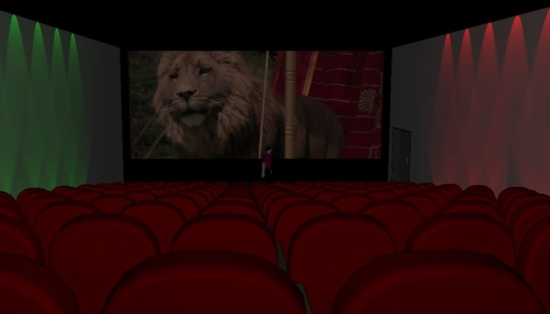
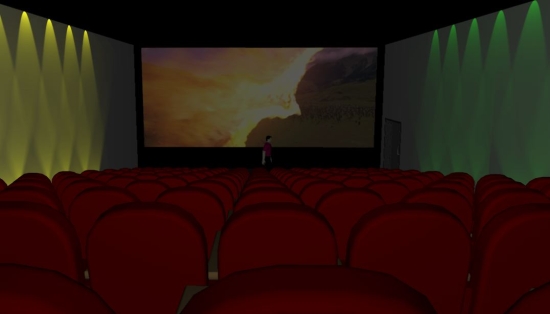
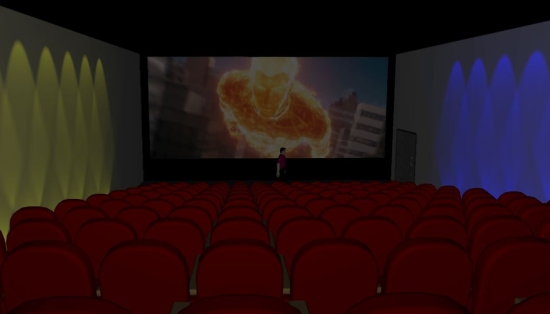
I am working on a pre-visualization so I can show you the effect of this idea.
Bastiaan Fleerkate
Posted by Jack Ondracek (Member # 1466) on 03-12-2007, 09:55 AM:
I'd actually like to hear from anyone who has one of those TV sets. We don't... but we've seen a LOT of their commercials, and my wife and I think the "ambilight" gimmick is lame on a collossal level.
...but then, that's just us! ![[Razz]](tongue.gif)
Posted by Ian Price (Member # 14) on 03-12-2007, 10:23 AM:
There is a difference between how we see a TV that is transmitting light and a movie screen that is reflecting light.
Looking a a TV whether a CRT, DLP box or a Plasma, you are looking at a light source. When you look at a movie screen or a video image from a projector, you are looking at a reflection of a light source. It has been demonstrated that you can reduce eye strain if you add a light source near a TV like a low level lamp, or an up-light reflecting off of the wall behind the TV. This reduces eye strain because it lowers the contrast between the TV and the surrounding environment.
In a movie theatre or home theater where you are using a screen, the intensity of the light is a great deal less and you don't experience the eye strain.
Phillips Ambient light is just another gimmick to sell TVs. They are adding a light source behind the TV that pulsates and changes color with the image on the TV. It's true, I think a TV looks better with the wall behind it lightly washed with light.
Don't ever try this in a movie theatre because any stray light that hits the screen destroys contrast ratio. The blacks become lighter and you are less able to see detail in the dark areas. Since the 1970s and faster film, cinematographers love dark scenes. I love Blade Runner and am unable to watch in on TV. The film is just too dark for video. Perhaps a top video system would make it watchable, but this is a type of picture best watched in a dark movie theatre.
To see "Ambient light" in a movie theatre, just watch the trailers or ads in most commercial movie theatres where they run with the lights at half. Contrast is destroyed. Notice how much better things look when the feature starts and the lights go down. Don't you always figget when the lights don't go down?
Posted by Bastiaan Fleerkate (Member # 3826) on 03-12-2007, 11:04 AM:
quote: Ian Price
Phillips Ambient light is just another gimmick to sell TVs.
Indeed... no doubt about it...
quote: Ian Price
Don't ever try this in a movie theatre because any stray light that hits the screen destroys contrast ratio.
I think with a dim (not white) light you can get away... though the effect is gone if you do so. I will send in some pre-vis pictures soon... (if the time alows me to do so)
Ow, it isn't going to be cheap also.... if I may say so myself... ![[Smile]](smile.gif)
Posted by Christian Appelt (Member # 1067) on 03-12-2007, 11:08 AM:
Bastiaan,
that has been tried for cinemas both in the 1930s and 1950 either by Philips or by Siemens/Klangfilm (I believe they called it Synchro Screen), and it was not adapted for whatever reasons.
Ian Price has given the technical reasons, and there is an additional psychological component. The screen in a theatre is (with good theatre/screen design and decent projection) perceived rather as a window through which we look at filmic reality, while even large Plasma TVs in a darkened room are still a piece of hardware displaying an image. This is why many home cinema people prefer video projection to large self-illuminated displays.
Personally, I would not go to a theatre with ambient lighting because it would destroy part of the immersive experience for me.
The ambient light for TV is not really new, even in the 1950s there were small lamps which you could clamp behind your TV set. Of course they did not adjust to the brightness level of the video signal.
Posted by John Pytlak (Member # 331) on 03-12-2007, 11:32 AM:
I'm old enough to remember the Sylvania "Halo Light" TV sets, that surrounded the CRT with a lighted border:
http://www.tvhistory.tv/1959TVAdvertising.htm
http://www.tvlamps.net/ambient.html
quote:
And so it went, as the 1950s saw the advent of the Sylvania Halo Light television. This nifty bit of ingenuity consisted of a fluorescent bulb that cast a "halo" of light around the screen, surrounding the picture with ambient light. Sounding somehow familiar, this technology was called "Surround Lighting"
Posted by Bastiaan Fleerkate (Member # 3826) on 03-13-2007, 05:25 PM:
Here are the promised images. The screen isn't bright enough and the walls have to be more evenly lit, but I didn't want to sit behind my computer the whole day for this...so... this will give some kind of impression...
Posted by Bobby Henderson (Member # 840) on 03-13-2007, 08:43 PM:
I can perhaps see something like computer controlled full color LED ambient lighting being used to provide an extra layer of atmosphere in a motion simulator ride film or some other amusement park experience. Color Kinetics in Boston is very good at developing such technology. If I were ever to open a bar or nightclub I would buy as much of their stuff as I could afford for lighting effects.
However, when it comes to traditional dramatic movies, I want as little ambient light happening in the auditorium as possible. I don't want anything distracting from the screen. Actively changing LED light effects flanking the screen would be a distraction.
On top of that, Phillips' Ambilight concept is really only designed to make up for the fact TV screens are small. They're only trying to make the TV seem bigger. Movie theater screens are already big -well, at least the good movie theaters have big screens. If the need is present to make a theater screen envelope more of the audience, larger and more curved screens can be installed. Some special venue film formats can extend completely around the audience in a full 360 degree loop.
About the closest active LED lighting effects will get to a commercial movie theater screen is perhaps the lobby. Jordan's Furniture in Natick, Massachusetts has an IMAX 3D theater in the store and a pretty vivid Color Kinetics LED lighting system outside to market the theater.
Posted by Demetris Thoupis (Member # 833) on 03-14-2007, 04:59 AM:
You could do this with DMX lighting. But someone would need to be checking and adjusting the DMX levels on the LED tubes or lights or whatever else you might be using. SGM lighting produces a lot of LED DMX lighting fixtures specially for wall wash. We, as an installation company, have installed some of these Philips plasmas with the Ambilight function. I personally do not like it. It distracts the viewer, especially if you have a dark room and watching a mind blowing DVD. The good thing is that you can turn it off. I would only recommend such an application during intermission, pre-show, maybe trailers but not during the feauture. Even if it is a very light glow around the screen that will be distracting. If someone was to use this kind of application how about masking? Masking will not be implemented and thus you will have a full white screen and projecting only to a certain part of it.
Demetris
Posted by Mark Gulbrandsen (Member # 72) on 03-14-2007, 10:38 AM:
quote: Bastiaan Fleerkate
A Dutch company called Philips make LCD and Plasma tv's with Ambilight. I don't know how this system works, but it may be an idea to put in to practice in cinema's across the world.
My Mitsubishi has a feature that adjust brightness/contrast ratio depending on how much ambient light there is in the room. I don't like the feature and I leav it shut off. We recently remodeled a theater in Provo, UT and put up sound panel/ murals with patterns that are much lighter in color than the surroundings and they are annoying everyone that goes there..... extremely distracting. I prefer to watch movies/TV in a black hole... or no distractions at all. I saw a simulator film by Ex-Pand 3D yesterday at Showorst and the lights and such during the film clip were VERY distracting, actually meaningless... as were the motion seats that didn't seem to move according to what was going on in the clip. The 3D was good though and shoulda been.... 2 barcos rnning LE/RE setup in a tiny room.
Mark
Posted by Richard Hamilton (Member # 321) on 03-14-2007, 02:04 PM:
quote: Mark Gulbrandsen
the motion seats that didn't seem to move according to what was going on in the clip
Mark, I had heard a few years ago that Disney had a malfunction on one of their motion rides causing the sync between the motion and the image/sound to be off. I think everyone on the ride got sick because of this.
At one of the first theaters I worked at, they had light fixtures on the side walls that resembled a porch light. Just a bulb surrounded by 4 pieces of glass. The glass would reflect so much light from the screen, It drove me nuts.... Another bitch is exit lights that are mounted right next to the screen.
Rick
Posted by Cameron Glendinning (Member # 3516) on 03-14-2007, 06:44 PM:
This is one inspired but truely silly idea!
I always liked the idea of the three primary colors mixed on a dark blue wall, creating the amazing colors of sunset, starting with daytime inspired lighting and finishing at dusk at the end of the preshow. Not a new idea by any means ![[Wink]](wink.gif)
Posted by Mike Blakesley (Member # 26) on 03-14-2007, 06:51 PM:
So you're suggesting lights on the sides of the auditorium that change with the colors of the picture?
Technically it would be impressive, but for the audience it would be distracting, annoying and would ruin the atmosphere during the movie, not to mention diluting the picture.
Powered by Infopop Corporation
UBB.classicTM
6.3.1.2