This is topic Lamp Question in forum Film Handlers' Forum at Film-Tech Forum ARCHIVE.
To visit this topic, use this URL:
https://ft-forum.com/ft/cgi-bin/ubb/ultimatebb.cgi?ubb=get_topic;f=1;t=008640
Posted by Jeremy Weigel (Member # 4208) on 04-12-2007, 07:44 PM:
I have a LTI Helios 2k lamp running on a Strong 6280005 model switcher xenon power supply in a Super Highlight(1988) console. The lamp had been operating fine up until last week when I was doing my weekly check on lamp operations (hours count, steady arc, amps, volts, clarity of the envelop)when I noticed that arc on this particular lamp was over shooting anode.
Since the show was running there wasn't much I could do other than try increasing/decreasing the amperage a little bit to see if that would bring the arc down, but no go. So I set the amperage back to where was previously (70amps by meter).
I came back about 30 minutes later to check the arc again, and this time the arc was centered and steady. So now I'm thinking that it corrected itself. I came again a little while later and this time the arc was over shooting again. When the show ended I fired the lamp up again let it heat up checked the arc and again it was over shooting. Shut off the lamp adjusted the stablization magnet upwards to try and pull the arc down, but no good. Reset the magnet let the lamp cool down and then rotated it 180 degrees. Fired it back up and still over shooting the anode.
I then decided to check the amperage/voltage with a hand held meter: 69 amps at the shunt and 26.5 volts off the rectifier leads both within spec. The lamp has about 950 hours on it and is very clear. Before I warranty this bulb is there anything else that I can check? There are still times when I check the arc and it will be centered, but most of the time it is over shooting the anode.
As a side note, I have been using Helios lamps for a little over a year and have had almost zero problems (I had one explode with only about 1 hour use on it; had the warranty honored (got a new lamp and reflector within 2 days), but other than that zilch. I have been getting right around 2100 hours use on them before I get excessive flicker.
Posted by Mark Gulbrandsen (Member # 72) on 04-13-2007, 10:05 AM:
LTI Lamps have been getting better and better slowly... At the AMC locations I service they use LTI exclusively and they have typically been running way past rated hours. The only thing I still see that I don't like is extreme darkening of the envelope. They still have some homework to do... or patent liscencing of others to get and adapt. There are a few Helios's in my area and they seem to be good for the most part. Two things to consider... have you rotated the lamp as recommended... this is a good thing to do on lamps larger than 2kw since the electrodes are quite heavy and can sag just slightly if left in one position for the life of a lamp. Also is the arc stabilization magnet still good. I typically find that Strong Lamphouse magnets become weak over the years.... this is very true in Super-Lum-Ex lamphouses. Also if you see some overshoot or horse shoeing of the arc when running with Strong Switchers try a new stabilization magnet or at least make sure its installed correctly. Strong Switchers seem to exhibit this phenomonon for what ever reason and its not tied to a particuluar brand of lamp. Have seen this with all brands mof lamps on occasion since the appearance of the compact switchers. New magnets seem to help solve it.
Mark
Posted by Jeremy Weigel (Member # 4208) on 04-13-2007, 12:20 PM:
Thanks Mark. I The thought of the magnet being had crossed my mind, but what I don't understand is that sometimes the arc will be centered and steady for a period, although short. I would think that if the magnet was weak the arc would always be over shooting. ![[Confused]](confused.gif)
All my lamps are 2k and I do rotate as recommended. The envelopes on the expired bulbs are usually very clear or with some light darkening.
Posted by Chris Slycord (Member # 4239) on 04-13-2007, 02:34 PM:
In an "ideal" situation (not ideal for you, ideal in the sense that it follows exactly as predicted all the time) if the magnet were the only problem yes it would always overshoot. But if it's a combination of issues, then it won't.
The arc won't always shoot to the exact, exact same spot (with or without a magnet) so there's gonna be some variance in where it goes. The company's QC attempts to minimize the variance but it'll always be there.
Hell, this'll happen to a small extent even on the more expensive bulbs.
And I seriously doubt LTI will go the route of paying for licenses for patented technology from, say, Osram as that would make their bulbs shoot up in price suddenly.
Posted by Mark Gulbrandsen (Member # 72) on 04-13-2007, 02:38 PM:
Its pretty obvious that their "getter" is seriously lacking... they may not have a choice but to use someone elses patent in that department. Most are used to lamps staying clear to the end of theor lives today. At any rate the LTI's are still miles away from offering the customer the most return for the dollar spent.
Mark
Posted by Monte L Fullmer (Member # 2797) on 04-13-2007, 04:11 PM:
quote: Jeremy Weigel
I noticed that arc on this particular lamp was over shooting anode.
Interesting, that I've had the same experience when using LTI bulbs as well when they were in usage after a few months..esp, in using the standard LTi's that I could only get 1200 hrs on an average before they went all bad with horrible flickering - and the warranty hrs for a standard bulb is at 2400hrs ... and we couldn't get warranty afterwards ... (bad bulb supplier..) quote: Jeremy Weigel
I have been getting right around 2100 hours use on them before I get excessive flicker.
I tried a 2k LTi Helios in a STRONG X-90 console (basically a Super Lume-X in a cabinet..) and managed to grab 2300hrs off that bulb before it began to display bad flickering and hard striking-anode plug showed severe cracking and those three ripple 'horns' on the end(I know,I have old rectifiers..)
-but nothing compared to a Christie that I had in there before. which had 5600 hrs on the bulb and hated to pull it out - good exhaust, envelope clear, no hard strikes, just the typical looks of age on both cathode and anode plugs in the envelope ...
(sorry, no more LTI's for me...)
-Monte
Posted by Bernie Anderson Jr (Member # 410) on 04-14-2007, 04:17 PM:
We were told to run LTI bulbs at 90% of their max wattage, don't rotate the bulb at all and remove it at the set max hours.
I'm running 3K which gets removed at 2000 hours regardless if it still is good. And 4.5K that come out at 1500 hours. If you're in an AMC, make sure that they come out by the max hours that they set. Its so that if the bulb has a problem, its under warrenty.
Posted by Scott Norwood (Member # 30) on 04-14-2007, 04:47 PM:
At the Embassy, someone recently pulled a badly flickering LTI 2k (with something like 1500 hours on it) and replaced it with the only spare (an Osram with 4000+ hours and almost no blackening). The picture now looks great, but I hate the idea of using a bulb that old.
Meanwhile, Landmark is now paying about twice as much per hour for LTIs as it was for Osrams (which gave better light anyway). Way to go.
Posted by Bernie Anderson Jr (Member # 410) on 04-14-2007, 05:48 PM:
I heard a rumor that we're chaning back to Osram. Only heard that once, though.
Posted by Monte L Fullmer (Member # 2797) on 04-14-2007, 06:14 PM:
quote: Scott Norwood
The picture now looks great, but I hate the idea of using a bulb that old.
I know what you mean there Scott, but try me with a Christie 2k with 6200plus hrs and I hated to pull it when it still gave me wonderful light, no darkened envelope, and strikes first every time. But, when I pulled it on a change then took it outside to bust it, it didn't pop, just simply shattered
lamphouses I really do like were the ones that used vertical bulbs - could hours be had with bulbs in the vertical position.
Posted by Jeremy Weigel (Member # 4208) on 04-14-2007, 09:57 PM:
I have photos of the past three Helios I've taken out and would like to share them, but simply can not figure out how to upload images. I tried the "image" button and pasted the url from photobucket, but got some angry looking dude with a warning message instead. Tried copy and paste of the image itself, but no go. What am I missing? ![[Frown]](frown.gif)
Posted by Adam Martin (Member # 641) on 04-14-2007, 10:53 PM:
You could do one of two things:
1. Read the FAQ.
2. Click the "Click here to upload an image" link on the page where you type your post.
Posted by Jeremy Weigel (Member # 4208) on 04-15-2007, 08:31 PM:
Sorry didn't see the "Click here to upload an image." link. I was too concentrated on the "image" button below. Just out of curiosity, what the "image" button for if we're not allowed to use a photo storage sevice such as photobucket?
Posted by Monte L Fullmer (Member # 2797) on 04-16-2007, 12:52 AM:
quote: Jeremy Weigel
what the "image" button for if we're not allowed to use a photo storage sevice such as photobucket?
Images stored here on FT has to be a certain pixel range (500 pixels either vertical or horizontal) and those outside services storing images are usually larger than what is required here on FT.
If you want to place an image here on FT, it has to follow the FAQ rules to be properly displayed.
Also, importing images from an outside source like photobucket, those pics could be imbedded with viruses, whereas importing pics from the local host computer has a much lesser chance of being imbedded with a virus.
..it's basically all for security reasons..
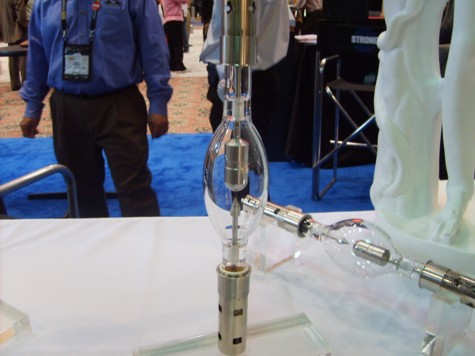
*gasp* those famous "Helios" bulbs
-Monte
Posted by Jeremy Weigel (Member # 4208) on 04-22-2007, 07:34 PM:
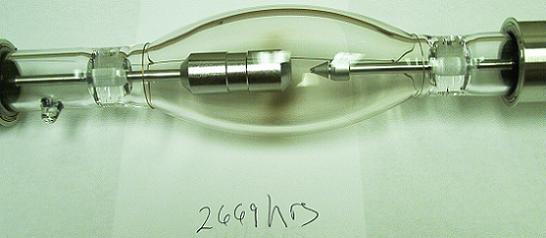
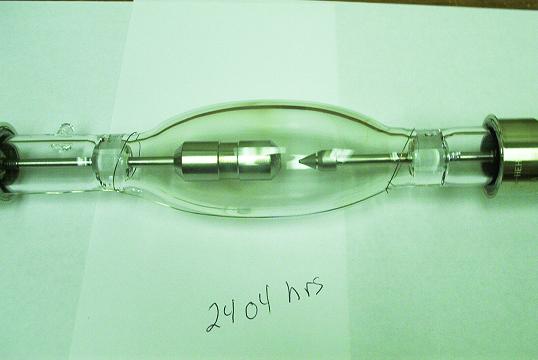
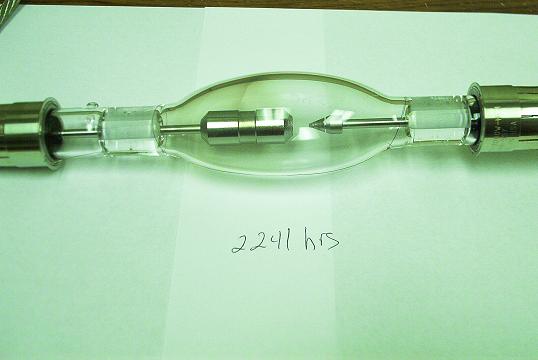
Finally figured out how to reduce pics. Here are pics of the last 3 LTI Helios I pulled with their hours used. As you can see they have relatively clear envelopes very little anode/cathode wear.
[ 04-24-2007, 12:08 AM: Message edited by: Jeremy Weigel ]
Posted by Jeremy Weigel (Member # 4208) on 04-24-2007, 11:50 AM:
Just a follow-up. I received a replacement bulb from LTI and have installed it. The lamp burned for several hours with no problems thus far. Now hopefully I can get at least 2400 hrs out of this one. ![[Razz]](tongue.gif)
Posted by Monte L Fullmer (Member # 2797) on 04-24-2007, 01:16 PM:
quote: Jeremy Weigel
Now hopefully I can get at least 2400 hrs out of this one.
.. not a good sign when you're hoping to get this amount of hours on an LTi esp. when the warranty of these Helios is only set at 1500 hrs.
(Think on getting your company to switch to Christies - warranty is 2000hrs and life expectency well garnishes over 4khrs..saving some money there in the long run...)
Posted by Jeremy Weigel (Member # 4208) on 04-24-2007, 03:31 PM:
Actually they prorate up to 1800 hours with 100% up to 900 at least that is what I was told by my supplier. I switched from Osrams to the Helios just to try them out (1 1/2 years ago) and so far I've been relatively pleased with their overall performance say for this bulb and a previous one that exploded with just a couple of hours on it (which was the first exploded bulb I've ever had). The warranty claim process went very smooth with the first bulb and so far this one has gone smooth. The only major drawback I've seen is that they don't have as long a life, which I'm guessing is due to less gas in the bulb?
As far as switching to Christies, I actually just ordered one last week to try it out after reading several posts on here.
Posted by Monte L Fullmer (Member # 2797) on 04-26-2007, 01:34 AM:
Hmm....Let's do a comparion below and you be the judge:
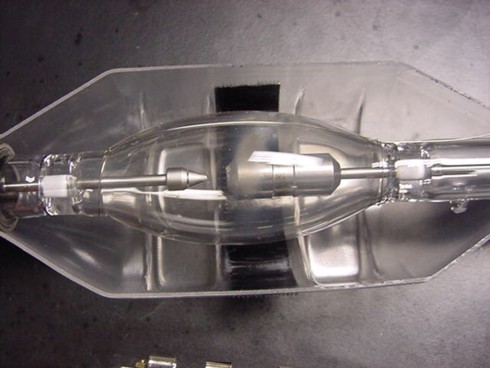
LTI - (LTIX-2000w-HEH) taken out with 2315 hrs. Bulb suffered hard striking, cloudy envelope and hard flickering on removal due to massive cracks in the anode plug. Just managed to get past warranty to consider this a bust and a throwaway. Cost of bulb from dealer $435.00 new
Christie (CXL-20R) taken out with 5400 hrs. (and actually hated to pull this out since I had clean strikes, clear envelope, pleasant light and started to lightly flicker due to the ripple "horns" on the anode plug..). Cost from dealer $495.00 new
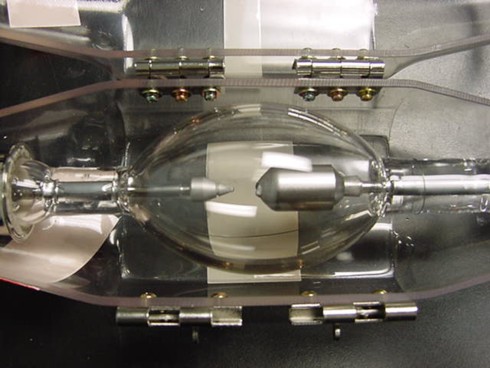
I have this Christie listed as a spare if needed. You ought to see the pile of LTI's (standard LTI's, not the Helios variety) that I have in storage waiting to be busted..and sadly, none of them made warranty, but just had hours on them to not make the pro-rate worthwhile.
As we can see how the math runs then - who is more valuable.
quote: Jeremy Weigel
which I'm guessing is due to less gas in the bulb?
The gas is the same in all makes of bulbs-they have to have a certain pressure for operation.
The big problem with other makes of bulbs outside of Christie and Osram is that they don't use the most purest tungsten for both the anode and cathode pieces in the bulb.
True, they use the purist form of Xenon gas, but the quality of the tungsten has to be on that same plateau. Tungsten quality is dependent on bulb longetivity. If the tungsten isn't pure, it breaks down after a certain amount of age due to decaying factors-like the cracks in the anode plug of an LTI bulb.
..- Monte
Posted by Jeremy Weigel (Member # 4208) on 04-26-2007, 03:08 AM:
Assuming that LTI uses the same quality of tungsten in both their standard bulbs and helios why rate the helios to 1500hrs while their standard bulbs are rated to 2400hrs (which is the same for Osram last I checked the paper work). Just looking at the helios it appears that there is less cubic space which would take less gas to reach the same pressure in the bulb.
Posted by Chris Slycord (Member # 4239) on 04-26-2007, 03:24 AM:
Why would you assume they use the same quality of ANYTHING in their cheap bulb?
If they put the same quality of it into the bulb it would most likely cost about the same to make (they have to make a profit). So the more expensive bulb is expensive because it costs more to make. One area you can save $ when making a bulb is in using a lower grade of tungsten.
Posted by Monte L Fullmer (Member # 2797) on 04-26-2007, 03:34 AM:
quote: Jeremy Weigel
it appears that there is less cubic space which would take less gas to reach the same pressure in the bulb.
Nope. Helios uses the same volume amount per say (sorry, should have said this above - "volume of xenon gas" - which all bulbs have per given wattage instead of comment on pressure.. my bad there). Thus, with the smaller envelope, the gas pressure is higher at cold. Also, the quartz is a bit thicker to handle the increased pressure at hot.
Why the warranty is lower on a Helios than a standard LTI bulb of the same wattage.
Posted by Jeremy Weigel (Member # 4208) on 04-26-2007, 05:55 PM:
Ah, I see. Well, I took the proration on this one since it cheaper to do so since the proration peeriod had just started. I have a Christie on order and if it stays as clear and stable as the one you have for that long (5400 hours would equal roughly 2 1/2 years of use for us) that would be awesome! I usually barely get 3000 hours out of an Osram and they are usually extremely cloudy. In fact, the one Osram I have left in service right now has just over 1500 hours and is clouded up fairly well already, but the arc is stable and has decent light output.
Posted by Monte L Fullmer (Member # 2797) on 04-26-2007, 07:01 PM:
quote:
....5400 hours would equal roughly 2 1/2 years of use for us - that would be awesome!
Gee, wish we could make bulbs last that long, but when you're doing daily matinees 7days/365/yr, this bulb with 5400hrs on it was in the console for 13 months.
I saw one Christie 2k bulb in a Christie SLC consoles with over 8k hours on it. Was installed 6 yrs ago when he bought the console...and still had great light. I did recommend to the owner on a replacement real soon, in which he did the following month.
Course, we need to back one step on how is your exhaust system? Is there enough draw coming out of the lamphouse area where the bulb ends aren't darken due to low airflow? If you had an airmeter, the CFM's drawing out should be almost at 1000CFM's for a good exhaust flow out of the lamphouse. Are the bulb end blowers doing their thing, or is this airflow at an hinderance?
Thus, wonder if you have a weak exhaust system why the cloudiness of the Osrams since they can be extremely sensitive to the cooling factors..
Posted by Louis Bornwasser (Member # 3063) on 04-26-2007, 07:11 PM:
FYI: On Osram, the warranty period is the point in the design where light loss equals 20%.
Most bulbs try to "match" Osram in terms of actual warranty and per cent of pricing. (Your actual mileage may vary, etc.) Louis
Posted by Jeremy Weigel (Member # 4208) on 04-26-2007, 08:10 PM:
quote: Monte L Fullmer
Gee, wish we could make bulbs last that long, but when you're doing daily matinees 7days/365/yr, this bulb with 5400hrs on it was in the console for 13 months.
I saw one Christie 2k bulb in a Christie SLC consoles with over 8k hours on it. Was installed 6 yrs ago when he bought the console...and still had great light. I did recommend to the owner on a replacement real soon, in which he did the following month.
We only run one matinee and one evening show when our local schools are in session during the week, one matinee and 2 evening shows on Fridays and full schedule on Sat and Sun and we don't even start a show unless someone actually buys a ticket during week aswell (that cuts down on wear and tear too).
quote: Monte L Fullmer
Course, we need to back one step on how is your exhaust system? Is there enough draw coming out of the lamphouse area where the bulb ends aren't darken due to low airflow? If you had an airmeter, the CFM's drawing out should be almost at 1000CFM's for a good exhaust flow out of the lamphouse. Are the bulb end blowers doing their thing, or is this airflow at an hinderance?
I have scheduled for our yearly HVAC check-up and have requested them to also check the CFM on the consoles as well. As for the end blowers, I found out that my Super Highlight consoles have a X-60 lamphouse design if that give you any idea on how the end blowers are set up.
Posted by Mark Gulbrandsen (Member # 72) on 04-26-2007, 08:48 PM:
quote: Monte L Fullmer
I saw one Christie 2k bulb in a Christie SLC consoles with over 8k hours on it.
There is a Christie CXL-20 in St George, UT at 19,480 hours and counting (in a Christie SLC Console).
Posted by Gordon McLeod (Member # 33) on 04-26-2007, 09:06 PM:
acording to several sources there is only one source for the tungsten in the electrodes to start with and all but ushio(christie) use the same doping of thorium
so it is an issue of quality build that and cost compared to life expectancy is an issue
yes some lamps last almost for ever, but is the business model that everyone uses or is that the one most want
there is often more in numbers than meet the eye
so buy several cases of 7mx9" neg and 8mmx14 positives and move into the next level ![[Big Grin]](biggrin.gif)
Posted by Jon Miller (Member # 163) on 04-26-2007, 09:59 PM:
quote: Mark Gulbrandsen
There is a Christie CXL-20 in St George, UT at 19,480 hours and counting
I'm sure the lamp is regularly cleaned and rotated and I'm fully aware of the SLC console's lamp longevity reputation, but why would they want to hang onto a lamp some 14,000 hours past the Russian-roulette stage? ![[Eek!]](eek.gif)
Posted by Monte L Fullmer (Member # 2797) on 04-26-2007, 10:12 PM:
quote: Gordon McLeod
so buy several cases of 7mx9" neg and 8mmx14 positives and move into the next level
(..now that's good light to experience - natural arc light from earthen materials within the rods....)
quote: Jon Miller
but why would they want to hang onto a lamp some 14,000 hours past the Russian-roulette stage?
Yes, that is amazing that a bulb can last that long, but just wondering if the owner is just plain cheap to buy a new one, not educated on the dangers of the "Russian Roulette" syndrome upon removal, or just plain logical in seeing as to leave it alone as long as it's functioning normally with no problems...
Posted by Tristan Lane (Member # 1169) on 04-27-2007, 01:20 AM:
Monte's pictures provide a good example of the darkening that occurs on a Helios bulb after full warranty hours.
I used to think this was a quality issue related to the tungsten used in the lamp. I changed my thinking after pulling an Osram 4200 watt helios style lamp @ warranty hours and it had exactly the same type of darkening directly above the gap. The darkening appears on the LTI 4200 helios as well. The Osram lamp was operated well within specifications, with adequate exhaust.
The darkened envelope is probably due to how much closer the quartz is to the arc when compared to a traditional lamp. I'm willing to overlook this due to the increased light these lamps provide.
My experience with Helios lamps has been great. I began using them shortly after they were introduced. I don't recall any major issues, or catastrophic failures. The occasional flicker happened on a few, but only after warranty hours were used. Company policy was to run lamps to a certain percentage over warranty, and then change the lamp. The lamps were changed regardless of whether they were still in good shape.
Some of the houses I installed them in (which Monte is very familiar with) yielded light increases up to 30% on screen, and never dropped below the light level provided by the previously used lamps. This proved to be very economical in 5 houses where CXL-60 lamps were replaced with LTI 4200 lamps, with an increased light output, and more warranty-hours. The LTI lamp also costs considerably less than the CXL-60. In roughly 60 other screens that I serviced, we replaced the CXL-40/45 lamps with 3000 watt helios lamps with similar results.
I suppose the opinion of the lamp depends on the user's expectations and needs. If you are looking for a lamp that will perform well long after warranty is up, stick with Christie. Their track record is hard to dispute. But the Helios lamps have their advantages, and LTI's quality and and track record has improved greatly in the past few years.
Posted by Monte L Fullmer (Member # 2797) on 04-27-2007, 04:19 AM:
Course, I really can't blame LTI completely for their bulbs - be it poor manufacturing or QA situations. I do believe it all depends of what lamphouse/console one is using as well (it take two to tango in a lot of situations..)
The two bulb examples that I presented in my earlier post came out of STRONG X-90 consoles (c) 1989 having the original switcher rectifiers (the big extinct suitcase variety) which by chance, are still plugging away quite nicely outside of the reports that STRONG switchers are lucky to last this long of 19 years.
Yet, I have managed to gather 3800 hours out of an LTI LTIX-2000w standard bulb that was operated in a lot newer X-90 console with the newer compact suitcase switcher. So we see, it's not all LTI's fault
My theory is that the LTI bulbs we did burn were more sensitive to aging switchers than with either OSRAMs or CHRISTIES, which could be more forgiving to high ripple situations that these older switchers could be emitting during operation.
I do believe in Tristian's statement above on his testimony of the LTI's (in which these complexes that he mentions still uses the LTI Helios and have proven very successful in their operations) that they are a good bulb in certain aspects (which the light output is a definite winner with LTI's), but wonder if this make of bulb is more suitable for reactance (diode and transformer) rectifiers instead of switching rectifiers...
It all works out in the wash somehow ...
thx - Monte
Posted by Mark Gulbrandsen (Member # 72) on 04-27-2007, 08:04 AM:
quote: Jon Miller
but why would they want to hang onto a lamp some 14,000 hours past the Russian-roulette stage?
Just to see how long its possible for a lamp to last. Envelope is still clear and the arc is stable. Years ago Marble lamps used to last this long and I can remember theor ads in Box Office mag listing the hours many locations went with them.
quote: Tristan Lane
LTI's quality and and track record has improved greatly in the past few years.
Well, I don't quite agree its improved over the last few years... more like over the last year or so. Three years ago we were selling quite a few LTI lamps and none of them were even making rated hours except the odd one now and then. After they lost many customers they had to do something about the reliability problems... not referring to Helios here just LTI in general. The AMC's we service use them exclusively and thats where I've seen them begin to last longer and longer... now they at least make it past rated warranty hours on a regular basis.
FWIW: We quit selling LTI because of reliability issues and because OSRAM gave us pricing that was consideraby better than LTI's... but we still sell Christie at the rate of about 20 to 1 vs. Osram.
Mark
Posted by Jon Miller (Member # 163) on 04-27-2007, 10:32 AM:
Mark, that reminds me...a long time ago I read something (where I found it, I've long since forgotten) about a theatre getting astounding lamp life from their xenons powered by the pure DC from a motor-generator set from their carbon-arc days. No ripple, no electrode erosion.
Maybe that is where Marble got their lamp longevity figures?
Posted by Dan Reiter (Member # 1386) on 04-30-2007, 12:42 PM:
We at SUPERIOR QUARTZ have been following this thread with a lot of interest, and wanted to interject our thoughts.
First, Bulb Construction – The internal vessel pressures and arc length are the determining factors in the power level of any bulb. When changing the size and volume of the envelope, the pressure ratio of gas:volume must be maintained to meet lamp performance goals. Thickness of the envelope wall is a construction factors to ensure vessel strength. Seal designs, electrode design, seal placement, and so many design issues get mixed in. Tungsten quality was mentioned a few times. Gordon is accurate in the source and quality issues with Tungsten. There are very few reputable sources. We at SQP make sure we only use the highest quality Tungsten and Xenon available, and then use the most stringent processing methods to remove all contamination. In addition, our use of the foil seals, and our individual attention to every bulb makes ours the most labor-intensive bulbs available, yet we keep our prices competitive. This alone is one of the most critical factors in bulb life and performance, and is in reality very hard to replicate thousands of times, as each bulb burns in it’s own unique way. In addition, basic lamp construction techniques can affect the purity during the process. Internal quality control during the manufacturing process, as well as stringent QC methods is another critical factor in manufacturing good bulbs. And then throw in types of seals, electrode design, electrode support, material purity, and a billion other factors, and you can see how hard it is to make a bulb. There is a LOT more going on with construction than just how the bulb appears to the user.
The other HUGE factor in bulb life is the equipment the bulb is in. Probably the most important. All aspects of the lamp section come into play. Cooling, as touched on previously, is critical. Is the blower clogged with dirt? Is there good airflow though the lamphouse, so you do not get a “hot Box”? Where the bulb is in the reflector even comes into play. Bulb mounting fixtures and stresses while in operation can come into play. Does the douser re-focus back on the bulb when it is closed? That’s a major bulb-killer. Then you look at the electrical side of things. Power supplies are a big factor. Magnetic or electronic, how much ripple is present. Is there a shorted or open diode the operator does not know about? Magnetic stabilization – Is there any, and is it still effective? DC cabling connections – is there a bad point? That will change the current and meter readings. Are the lamphouse meters accurate, so the operator is not either over-driving, or under-driving the bulb? Igniter – Is the spark-gap still within spec, so the ignition pulse is not destructive?
Then you toss in the theater operators themselves. Do they rotate and/or maintain the bulbs? Do they allow auto-strike, or do they manually strike the bulb with long ignition periods? How many shows a day?
There are so many factors involved with this, the best way to make ANY bulb last is to have a properly functioning system. Many opinions on this thread have shown that, and there are some very old bulbs still running.
We formally invite all to visit our facility, and see how our bulbs are made.
Thank You.
If we can help in any way at SQP, please contact us.
Posted by Mark Gulbrandsen (Member # 72) on 04-30-2007, 03:56 PM:
Dan,
Do you guys use any radioactive substance(Thorium)mixed in with your electrode tungsten? I've heard that some manufacturers do this in attempt to get longer lamp life. I suppose there may also be other resasons for doing this though.
Thanks,
Mark
Posted by Stephen Furley (Member # 1277) on 04-30-2007, 05:49 PM:
quote: Dan Reiter
We formally invite all to visit our facility, and see how our bulbs are made.
Is there any possibility of you posting some photographs of the production process?
Posted by Dan Reiter (Member # 1386) on 05-01-2007, 07:19 AM:
Mark,
Most manufacturers use Thorium on the electrodes of Xenon, and other lamps, to aid ignition, stabilize the Tungsten, and yes, increase lamp life. Happily, the amount used is extremely small, less than in an average wrist-watch.
I'll find some pics of the lamp process and post them shortly.
Posted by Tim Reed (Member # 137) on 05-01-2007, 08:51 AM:
quote: Monte L Fullmer
the anode plug
Monte, what is this anode plug you keep referring to? You mean the cable? quote: Dan Reiter
We formally invite all to visit our facility, and see how our bulbs are made.
Thanks, Dan! I'll definitely take you up on that. ![[Smile]](smile.gif)
Posted by Dan Reiter (Member # 1386) on 05-01-2007, 11:03 AM:
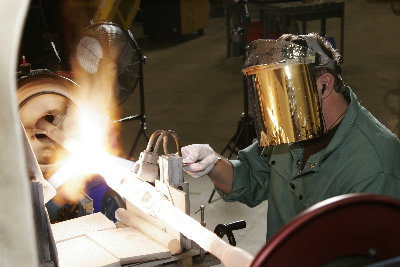
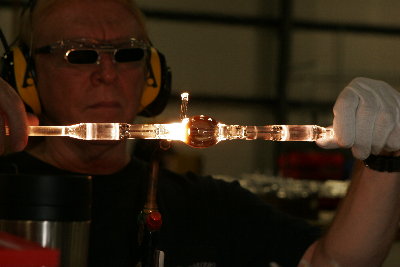
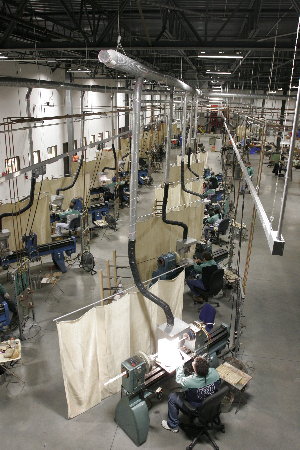
Here are two pics of making a lamp, as well as the Xenon Lathe area...
Posted by Monte L Fullmer (Member # 2797) on 05-01-2007, 12:26 PM:
quote: Tim Reed
what is this anode plug
(lol) the big anode tungsten thingey in the bulb..Don't ask me how I came up with that name, just something I came up with when I began dealing with xenon bulbs back in the late 70's.
Posted by Tim Reed (Member # 137) on 05-01-2007, 09:23 PM:
Monte! Haha! Okay, that IS the anode. ![[Wink]](wink.gif)
Posted by Justin West (Member # 920) on 05-02-2007, 10:54 AM:
quote: Dan Reiter
Do they rotate and/or maintain the bulbs?
Is rotating the bulb necessary, today?
Posted by Jack Ondracek (Member # 1466) on 05-02-2007, 11:01 AM:
quote: Justin West
Is rotating the bulb necessary, today?
That's sure a good question, Justin.
Opinions on this board are all over the place. My experience out here is that these bulbs seem to work best if you just keep them clean, check the connections once in awhile, and leave them alone. These things almost always go unstable on me if I rotate them. After that, it's just a matter of a short time before I get tired of looking at them & just put in new ones.
"Your results may vary", but I seem to get the best life by leaving them in-place until I change them out.
4,000 to 7,000 watt bulbs... Christie, Superior Quartz, Osram... it doesn't seem to matter. In the past 5 years, I've installed new lamphouses, power supplies and blowers, with no change in performance from the bulbs. My screens look a lot better, though! ![[beer]](graemlins/beer.gif)
Posted by Dan Reiter (Member # 1386) on 05-02-2007, 01:02 PM:
Arc stability seems to be much more of an issue of the equipment the bulb is operating in. If the arc is steady and straight throughout the bulbs' lifetime, it will burn straight, and not damage or dis-figure the electrodes, and provide long, trouble-free life. If the magnetic stabilization is incorrect, the equipment is operating at enough of an angle to induce off-centered flame travel, there are excessive heating/cooling issues, or the DC curent is not smooth, the electrodes will suffer. Once an irregularity forms on the Annode & Cathode, then bulb roating is the only method available to try to "force" the arc to re-establish a straight path again, form a uniform pattern on the annode, and then regular maintenance, checking, and rotations become needed for the rest of that particular bulb's service life in order to obtain best and even light.
Jack is also correct in his notes about the electrical connections. As soon as a major DC connection loosens up, it will both burn the DC cable at the point of the problem, and induce a problem with the lamp's performance.
We at SQP have seen the specrum of lamp probems, and they can usually be traced to lamphouse issues.
Posted by Monte L Fullmer (Member # 2797) on 05-04-2007, 11:11 PM:
Is the spent tungsten elements recyclable? ..any recycle value with this material?
Posted by Louis Bornwasser (Member # 3063) on 05-05-2007, 08:28 AM:
Osram has not required bulb rotation for warranty purposes for over ten years. You are free to do so however.
Tungsten probably is not worth collecting...yet. If you routinely break your old bulbs, it probably wouldn't hurt to consolidate your old tungsten for later years....your retirement fund if you are 25 now. Loluis
Posted by Mark Gulbrandsen (Member # 72) on 05-05-2007, 01:09 PM:
Yes! Recycle your tungsten... Its is now being used as part of the armor on Army vehicles destined for Iraq ![[thumbsup]](graemlins/thumbsup.gif) .
.
The price of Tungsten and recyclable metals in general has continually risen.... It may be worth more than you think.
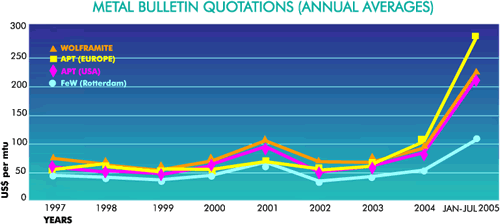
Some interesting stuff on Tungsten....
U.S.G.S. Paper On Recycling Tungsten
International Tungsten Industrial Association
Posted by Monte L Fullmer (Member # 2797) on 05-05-2007, 08:01 PM:
Thx all on this...like the days of the clamor of coffee cans laying around in storage rooms in those old booths full of copper drippings..
...makes me a bit sick though - when I used to work in a complex that ran 4 to 6 k bulbs, I gathered all of that tungsten from my bulb breaks and had a good hunderd plus pounds of tungsten ... then it got thrown away without me knowing about it.. - for I knew somehow that this material could possibly be recyclable...
Posted by Justin West (Member # 920) on 05-06-2007, 04:56 AM:
quote: Dan Reiter
We at SQP have seen the specrum of lamp probems, and they can usually be traced to lamphouse issues.
Jack/Dan: Thanks for the info...I get the picture: Keep your lamphouse happy and you will be happy! That is my goal every week!
Posted by Mark Gulbrandsen (Member # 72) on 05-06-2007, 08:37 AM:
quote:
I get the picture: Keep your lamphouse happy and you will be happy! That is my goal every week!
How... exactly do you do that Justin??? ![[uhoh]](graemlins/uhoh.gif)
Posted by Justin West (Member # 920) on 05-08-2007, 02:11 AM:
quote: Mark Gulbrandsen
How... exactly do you do that Justin???
Rub it right, eh, Mark? ![[puke]](graemlins/puke.gif)
Posted by Dennis J. Losco (Member # 1374) on 05-08-2007, 01:41 PM:
About recycling of the tungsten: keep in mind most lamps utilize thorium mixed in with the tungsten. Not many recycler's will accept this material.
One additional comment: when comparing manufacturers lamps, make sure you are comparing apples to apples. Manufacturers are coming out with shorter arc gap higher pressure lamps...don't compare longevity of these lamps to a standard lamp with lower pressure longer arc gap.
Lamp life will be reduced with shorter arc lamps but you will have better initial brightness. Depending on what you need from the lamp, will determine what type lamp you should be purchasing.
SQP initial standard design utilized slightly higher pressures giving nice light output, but not to the point were we had to reduce warranties.
Powered by Infopop Corporation
UBB.classicTM
6.3.1.2