This is topic Movie Build up. in forum Film Handlers' Forum at Film-Tech Forum ARCHIVE.
To visit this topic, use this URL:
https://ft-forum.com/ft/cgi-bin/ubb/ultimatebb.cgi?ubb=get_topic;f=1;t=008649
Posted by Raymond Christie (Member # 4080) on 04-16-2007, 05:38 PM:
What will happen if a movie is built up too loose? Is there a high risk of a brain wrap?
Posted by Alex Grueneberg (Member # 2652) on 04-16-2007, 05:40 PM:
In my experience, no. Not at all. It may be slightly more difficult to move to a different platter though, if thats even a concern.
Posted by Monte L Fullmer (Member # 2797) on 04-16-2007, 06:54 PM:
...using a pizza board makes easy work in tranferring loosely wound prints from one deck to the other. Clamps, well you are at their mercy.
Posted by Scott Norwood (Member # 30) on 04-16-2007, 07:35 PM:
I was always told that it was risky to make up a print and then move it to a different platter without running it at least once. I believe that the reason had to do with static issues on payout, but I may be mis-remembering this.
Was anyone else ever warned about doing this? If so, why?
In any case, I'm sufficiently paranoid that I don't do it.
Posted by Jon Miller (Member # 163) on 04-16-2007, 07:44 PM:
For the last San Diego Latino Film Festival we had to make up quite a few prints on one platter and move them to other screens for showing. Never had any problems moving those prints using "pizza boards." Also, never heard such a warning about running a print once before moving it.
Maybe the practice of bench-inspecting onto 6000' reels before transferring to the platter helps...
Posted by Mark J. Marshall (Member # 1409) on 04-16-2007, 07:47 PM:
I think the warning had to do with the print getting cinche scratches because it's wound too tight. But we have never had that problem, and we move almost every print to a different platter right after building it.
Posted by Peter Mork (Member # 1336) on 04-16-2007, 07:50 PM:
These days, I often make up a print on one platter and move it to another. Where I work there are three separate booths but I like to use the one with a workbench for this task because I can sit down and leisurely wind film onto big reels, inspecting as I go, then run the big reels to a platter and move the whole thing to where it needs to go. I don't get loose winds doing this but you might. In any case have never noticed a static problem, or at least a worse one than I ever get.
Posted by Chris Slycord (Member # 4239) on 04-16-2007, 09:52 PM:
If you're REALLY worried about the static issue how about building up onto a pizza board? Just stick the ring through the board and into the platter; no different than running a movie onto the board.
Posted by Monte L Fullmer (Member # 2797) on 04-16-2007, 10:41 PM:
quote: Chris Slycord
If you're REALLY worried about the static issue...
...interesting thing is that I do believe that the polyester stock has been dramatically upgraded to prevent such a condition and to where the static conditions are now and long ago..ancient history.
I haven't had static issues for a good 4 years now, but I do remember when poly was first introduced as the new base stock for films..and did we have static problems back then...
quote: Scott Norwood
Was anyone else ever warned about doing this? If so, why?
I've heard it before on rare occasion from other booth operators in other cinemas, but I only took it as an old wive's tale since I figured that it was due to the inexperience and training of handling film is what brought this 'warning' throughout the networks. Plus, due to the inexperiences and 'robotic' training that is now involved in the majority of these cinemas, where if a ruling comes across, there is no questions asked, just do what was told...to make things easy and simple.
John Pytlak can chime in on this one for he'd would know more about this topic.
I do that also - build on one deck, then scoop and move the prints to other decks, in which I've never had any probs with this. Why I do all of this scooping is that one of my platters is right next to the Kelmar bench, so while one reel is winding on the platter, I prep the next reel for building. I get done faster this way, plus have the best light for assembly here.
Posted by Carl Martin (Member # 1146) on 04-17-2007, 01:52 PM:
i'm wary of moving prints any more than i have to. i think it's probably the biggest culprit in getting dirt on our prints. our upstairs platters simply don't take up too tightly and the film will flip flop a bit when it's moved. i do use a pizza board when moving a film from one of these platters, and the added stiffness reduces the problem but doesn't eliminate it. some feel the board makes the print too heavy and don't use it, unfortunately.
i thought the deal with moving a freshly-built print was that the wind tension might have varied around the mid-show splice, making it more likely that the print will lose its integrity there.
Posted by Brad Miller (Member # 2) on 04-17-2007, 02:14 PM:
If there is ANY slippage when a print is being moved, then it is getting scratched. They are called cinch scratches in that they are tiny dot or dash scratches and can occur in any direction on screen depending on how the film slips when moved. Platters with weak center rings such as Strong are major culprits to this sort of damage.
There will be people who will claim that the above statement is bs because they have "never seen any damage", but the fact of the matter is that most theaters are underlit. When a print is projected on a system that puts out minimum brightness spec or excedes it, suddenly all of these marks show up...and it isn't pretty.
Also once a print is moved, it is often no longer properly centered or a true circle. That can be quite the issue towards the end of the film while it is paying out. People who have experienced brain wraps and thrown prints (obviously not using FG or safety rings), will notice it happens most often after a print has been moved.
Posted by Monte L Fullmer (Member # 2797) on 04-17-2007, 05:20 PM:
...another thing to consider, if the worry on static cling is still an issue with some locations, is NOT to drive the AC in the booth too far down.
Granted, it's nice to be in a cool atmosphere, but you drive that AC down to a very cool level, you're drying out the air real bad and dry air promotes any sort of static.
Why IMAX booths are under a very strict control when it comes to humidity situations - don't want that big film stock to experience any cling..let alone with the speed that film travels.
-Monte
Posted by Matt Barth (Member # 3429) on 04-17-2007, 06:39 PM:
The highest risk with a loose print for me was if was REALLY bad a little static could cause a chunk of film to shift to the brain and then the entire print could start shifting around. I did have a bad wrap once because of this but it could have been avoided had we a)not moved the print or b) I'd kept a better eye on it in the later reels. I believe most the problem there was in the booths I was in (one had the platters filed so they had little grip) though.
---Matt
Posted by Raymond Christie (Member # 4080) on 04-21-2007, 02:43 PM:
I had to move a print of Grindhouse. Do they make a pizza board big enough for a print that size. But anyway, I had to fix a splice in it because it was bad and the movie wound really loose. It's all good now because that stupid movie is gone. Thank God! We had too many problems with it. ![[Mad]](mad.gif)
Posted by Chris Slycord (Member # 4239) on 04-21-2007, 03:38 PM:
Of course they make pizza boards that size. You can make a pizza board however big you want. The only limiter on how big you make your board is the size of your platters.
Posted by Monte L Fullmer (Member # 2797) on 04-21-2007, 07:55 PM:
This is my board that I use at my 6plex
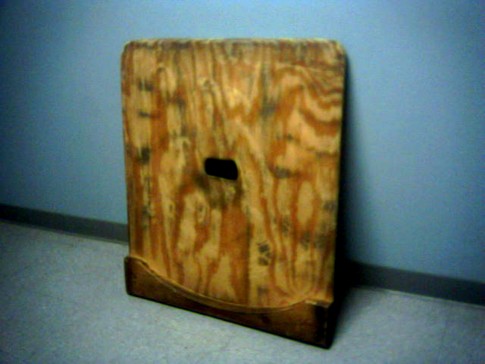
It's a 32x36x3/8 out of plywood with the one side finished (forget the type of plywood code this would be..) with a 2x6x32 that is mounted on the end that was circled cut in the middle to fit the round contour of the print and with the edge routed out to eliminate sharp edges. Plus, the 3x5 grab/carry handle cut in the middle and the end lip cut to a taper to easilly slide the board under the print.
Saves tons of time and no worry on scratching the deck surfaces with the usage of those clamps.
So far, I've made 14 of these for our local theatres..
Posted by Chris Slycord (Member # 4239) on 04-22-2007, 02:51 AM:
That's way different from our boards. Our's are really just like a donut. They're circular with 2 holes punched for where the inner ring can attach to and a cut out circular section in the middle where your brain could fit if it were on the platter.
Powered by Infopop Corporation
UBB.classicTM
6.3.1.2