This is topic Weird Aspect Ratio in forum Film Handlers' Forum at Film-Tech Forum ARCHIVE.
To visit this topic, use this URL:
https://ft-forum.com/ft/cgi-bin/ubb/ultimatebb.cgi?ubb=get_topic;f=1;t=008657
Posted by Bastiaan Fleerkate (Member # 3826) on 04-20-2007, 10:06 AM:
Has anyone seen this aspect ratio before. It is 1:2.44
Looks like they shot the movie in scope and forgot to print it that way...
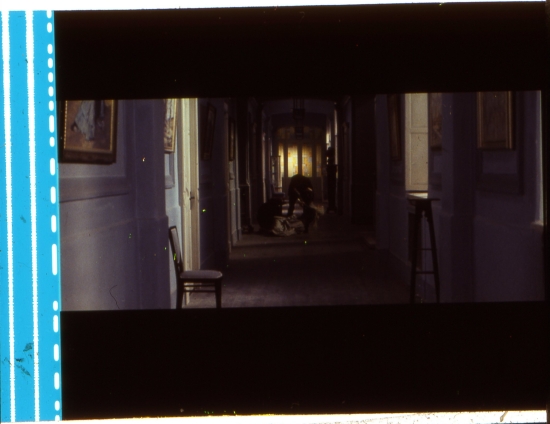
It's a Dutch movie called 'Blind'
Posted by Mike Blakesley (Member # 26) on 04-20-2007, 10:37 AM:
Looks like a letterboxed flat trailer for a scope movie.
Posted by Bernard Tonks (Member # 809) on 04-20-2007, 11:01 AM:
According to Internet Movie Database the release prints are:
Technical specifications for
Blind (2007)
Film negative format (mm/video inches)
35 mm (Kodak)
Cinematographic process
Super 35
Printed film format
35 mm (anamorphic)
Aspect ratio
2.35 : 1
http://www.imdb.com/title/tt0808174/
Posted by Bastiaan Fleerkate (Member # 3826) on 04-20-2007, 01:15 PM:
OK. The whole movie is like this. So if I understand it correctly, they filmed it in scope, but printed it in Widescreen. OK, that makes sense....NOT!
The trailer for this movie was in scope though... nice movie BTW!
Posted by Mitchell Dvoskin (Member # 751) on 04-20-2007, 02:04 PM:
Cinematographic process Super 35
They filmed it FLAT, intending it to be printed SCOPE. Instead, the lab hard matted it ot 2.39. If this is a trailer, it is intended to be run in front of FLAT films. If this is the feature, the lab screwed up.
Posted by Brian Guckian (Member # 1678) on 04-20-2007, 05:07 PM:
It may not be the lab's fault. There are some filmmakers who actually want the "letterbox look". These often come from the advertising or music video end of filmmaking. It's even more likely if the film is non-mainstream.
In this month's American Cinematographer there is an account of a Brazilian feature - Send A Bullet (Manda Bala) - made in an aspect ratio of 2.70:1. They actually shot anamorphic Super-16mm (yes, you read that correctly) and the piece says that the final product was shown at Sundance on 1080i HDCAM. Presumably this was flat.
So it could all be intentional. The labs always do what they're told to do!
Posted by Bastiaan Fleerkate (Member # 3826) on 04-20-2007, 07:13 PM:
This is the feature movie.
The strange thing is...the trailer for this movie was scope. ![[Confused]](confused.gif)
This movie indeed isn't main-stream... maybe it's a fault from the lab or the film maker wanted this...
Posted by John Hawkinson (Member # 1135) on 04-20-2007, 11:35 PM:
There are cases where Super 35 movies are printed to flat
rather than scope for test screenings or non-final prints,
presumably because it is cheaper. This may be such a case.
--jhawk
Posted by Ron Curran (Member # 3631) on 04-21-2007, 01:49 AM:
Don't worry, the whole world will be flat soon. And 16x9.
Posted by Leo Enticknap (Member # 534) on 04-21-2007, 09:37 AM:
quote: John Hawkinson
There are cases where Super 35 movies are printed to flat rather than scope for test screenings or non-final prints, presumably because it is cheaper.
I don't get how that can be cheaper. Continuous contact printing is continuous contact printing, whatever the source and destination format is. It's when you need to optically print format A to format B (e.g. printing an anamorphic original to a letterboxed dupe) that is going to introduce extra cost.
My guess would be that digital intermediate post-production was involved, and that a letterboxed dupe neg was burnt out by the recorder as distinct from an anamorphic one, possibly due to as simple a cock-up as someone clicking the wrong button on a menu screen.
Posted by Mike Blakesley (Member # 26) on 04-21-2007, 10:12 AM:
But, looking at the frame you posted, that's obviously a FLAT print, yet you say the trailer on it was SCOPE. So it's obviously a lab screwup....the thing was supposed to be printed in scope. The trailer was probably attached, rather than printed with the feature...correct?
Posted by Bill Gabel (Member # 1105) on 04-21-2007, 10:33 AM:
I've done screenings of films that have been Super35 with just a SRD track on it. It is cheaper to make a pre-release type print like that then ship a full Track & Picture equipment set-up and you can play it almost any where.
Posted by John Hawkinson (Member # 1135) on 04-21-2007, 11:14 AM:
Leo, huh?
I'm suggesting the negative is in super 35, and it was contact printed to a flat release print with the left edge cut off, rather than step-optical printed to a scope release print, which would be more expensive.
Am I confused?
--jhawk
Posted by Bastiaan Fleerkate (Member # 3826) on 04-21-2007, 11:53 AM:
quote: Mike Blakesley
yet you say the trailer on it was SCOPE.
I didn't say this. The trailer of this movie was in scope. The trailer was shipped separately. Most movies in the Netherlands don't have trailers attached.
I think the movie was shot digitally and printed the wrong way.
Maybe I can blow the picture up with a different lens... I will have to experiment. ![[Mad]](mad.gif)
Posted by Ron Curran (Member # 3631) on 04-21-2007, 10:55 PM:
On the subject of aspect ratios, one of the arguments against full scope is that 2x camera anamorphics are problematic, which is one reason why some prefer Super35 with spherical lenses.
I have also noted that 1.5x anamorphics will not scare the horses. Iscovision proposed something like this.
So what would be wrong with a Super35 width negative with a 1.5 squeeze? This would yield an exposed area about 12% larger than 2x anamorphic (.65” x .98” – I quote Imperial rather than metric to avoid getting a breadstick up my nose) without the 2x distortions. Release prints would be our standard Scope variety or digital files.
Posted by Michael Coate (Member # 757) on 04-22-2007, 12:20 AM:
quote: Ron Curran
So what would be wrong with a Super35 width negative with a 1.5 squeeze?
The problem, assuming I understand your question, would be that using a Super-35 aperture with a 1.5 anamorphic squeeze would yield only a 2.00:1 aspect ratio, not the 2.39:1 I assume you're desiring.
Posted by Ron Curran (Member # 3631) on 04-22-2007, 12:54 AM:
Sorry Michael, my maths was a tad off. The exposed area would have to be .625 x .980 - still more than 2x anamorphic and much more than flat Super 35.
Posted by Leo Enticknap (Member # 534) on 04-22-2007, 03:34 AM:
quote: John Hawkinson
I'm suggesting the negative is in super 35, and it was contact printed to a flat release print with the left edge cut off, rather than step-optical printed to a scope release print, which would be more expensive.
Am I confused?
No - I was; sorry.
Posted by John Hawkinson (Member # 1135) on 04-22-2007, 10:08 AM:
Actually, I was wrong.
Super 35 negatives fill the full 1.33 frame, so those huge black framelines wouldn't exist if it were Super 35. (Of course, it could have been step-printed, but why presumably that's about as pricy as step-optical printing.)
Thanks for keeping me on my toes.
Edit: 1.33 (above) means the full silent width, not the 1.37 Academy ratio...
--jhawk
[ 04-23-2007, 09:59 AM: Message edited by: John Hawkinson ]
Posted by Christian Appelt (Member # 1067) on 04-22-2007, 02:38 PM:
There are (or were) a few cinematographers who insist on shooting hard-matted Super-35 to make sure their original composition cannot be "opened" for TV and home video, just cropped horizontally. I have screened dailies for two S-35 productions with hard matte, just a simple contact print with very, very thick black bars...
Posted by Bastiaan Fleerkate (Member # 3826) on 04-23-2007, 07:06 AM:
I got an answer from the studio. The director shot the film in scope but printed it in Flat. This was an artistic choice. So no screw-ups or other weird things happened. The only question there's left is...........WHY
Some cinema's got complaints about the movie. Remarks like 'is this like TV. There are black bars below and above the picture' and 'the picture is too small' were regularly heard... We haven't had those complaints yet, but I think in time we will have some people knocking on the booth door. ![[Eek!]](eek.gif)
Posted by Gordon McLeod (Member # 33) on 04-23-2007, 09:31 AM:
John said "Super 35 negatives fill the full 1.33 frame"
actually they fill the entrire area between the perfs
Posted by Leo Enticknap (Member # 534) on 04-23-2007, 01:22 PM:
quote: Bastiaan Fleerkate
The only question there's left is...........WHY
Abso - flippin' - lutely !
It's not as if there are many cinemas out there which don't own 'scope lenses...
Posted by Michael Coate (Member # 757) on 04-23-2007, 02:13 PM:
quote: Gordon McLeod
John said "Super 35 negatives fill the full 1.33 frame"
actually they fill the entrire area between the perfs
You're both correct. A fully-exposed 4-perf 35mm camera aperture (AKA Super-35, perf-to-perf left-to-right and frameline-to-frameline top-to-bottom) is, according to Panavision's specs, .980" x .735" = 1.33:1.
Ron seems to be suggesting the use of an all-new format with never-before-used specs...and history has shown that such a process will never fly.
Posted by John Hawkinson (Member # 1135) on 04-23-2007, 04:32 PM:
"I got an answer from the studio. The director shot the film in scope but printed it in Flat. This was an artistic choice. So no screw-ups or other weird things happened. The only question there's left is...........WHY"
Well, that's what they said? But was it really true?
Reading between the lines, I would expect it means the director shot the film Super 35 and then found out how much the optical printing to Scope cost and said, "no way." This doesn't explain the hard matte, but perhaps it was in the camera aperture for some strange reason ("No! You will not produce a pan-and-scan version with more height!").
--jhawk
Posted by Ron Curran (Member # 3631) on 04-23-2007, 07:41 PM:
More accurately Michael, I was wondering why such a method was not not adopted instead of simply naming Superscope Super 35. All of the elements existed - STILL exist. There would be no additional cost to producers or exhibitors but a significant quality benefit.
Posted by Cameron Glendinning (Member # 3516) on 04-24-2007, 03:06 AM:
quote: Leo Enticknap
My guess would be that digital intermediate post-production was involved, and that a letterboxed dupe neg was burnt out by the recorder as distinct from an anamorphic one, possibly due to as simple a cock-up as someone clicking the wrong button on a menu screen.
I lean this way, I have to admit that now days I doubt any optical work would be done with super 35.
Ron, Im confused, I thought Superscope was 2 perf, Super 35 is full frame including soundtrack.
It wouldn't be the first time I was wrong however!
Posted by Ron Curran (Member # 3631) on 04-24-2007, 03:28 AM:
I have been wrong too Cameron. I thought it was in 1974 but I was mistaken.
Check the Widescreenmuseum website for full specs on Supercope/Super 35.
Techniscope was 2 perf. Super 35 can be 4 or 3 perf, using the full width including the sound track area. Some producers prefer 4 perf so that they have latitude in composition when editing, while others choose 3 perf with modified cameras that save stock; though I have heard that some labs won't handle 3 perf.
It is sad that so many people are anxious to tell us why something can't be done.
Posted by Brian Guckian (Member # 1678) on 04-24-2007, 05:28 PM:
It can be done. ![[Razz]](tongue.gif)
Allow me to re-quote your post above Ron, in full (necessary for full understanding):
quote:
On the subject of aspect ratios, one of the arguments against full scope is that 2x camera anamorphics are problematic, which is one reason why some prefer Super35 with spherical lenses.
I have also noted that 1.5x anamorphics will not scare the horses. Iscovision proposed something like this.
So what would be wrong with a Super35 width negative with a 1.5 squeeze? This would yield an exposed area about 12% larger than 2x anamorphic (.65” x .98” – I quote Imperial rather than metric to avoid getting a breadstick up my nose) without the 2x distortions.Release prints would be our standard Scope variety or digital files .
(My bold)
It's much easier to innovate at the taking end of the process than at the exhibition end because of the huge installed base of cinema equipment worldwide. The limiting factors would be the availability of 1.5X anamorphic camera lenses, new scanning accessories and other items.
But it's a good idea in that it restores a larger negative area to conventional 35mm photography. Low-rent spherical Super-35 is one of the reasons for ongoing deterioration in image quality. Unfortunately only James Cameron can do it right!
But 65mm is the real way to go. The latest data shows that the increase on production costs with 65mm, taken in total, is marginal against 35mm origination.
A return to 65mm photography is less fanciful than one might think, given the move to 4K D-Cinema, continuing IMAX DMR blow-ups, HD TV and Blu-Ray / HD DVD formats. These are all a demand for the larger, wider film negative ![[beer]](graemlins/beer.gif)
Posted by Ron Curran (Member # 3631) on 04-24-2007, 07:58 PM:
Agreed Brian but there is a call for 70mm prints for large screens. If they originate from 35mm it would be nice to take them from a bigger piece: .625 x .980 inches.
Wouldn't there be a fair amount of those 1.5 lenses kicking around in bottom drawers from the Ultra/Super 60s?
Posted by Brian Guckian (Member # 1678) on 04-25-2007, 08:16 AM:
...lenses which were used for 65mm photography!
QED ![[Cool]](cool.gif)
Powered by Infopop Corporation
UBB.classicTM
6.3.1.2