This is topic Tips for Booth Operations in forum Film Handlers' Forum at Film-Tech Forum ARCHIVE.
To visit this topic, use this URL:
https://ft-forum.com/ft/cgi-bin/ubb/ultimatebb.cgi?ubb=get_topic;f=1;t=008663
Posted by Bastiaan Fleerkate (Member # 3826) on 04-23-2007, 07:31 AM:
I think it's cool for us to show each other our trade secrets and tips.
I would contribute something to this cause...
On another thread you saw the contraption I made (with help) for changing the trailers and ads every week.
We also use something else...
We run with an cinemeccanica platter and before we used this the film sometimes would come undone and finding it's way to the motor and screwing up the credits... We tried to use magnetic blocks, heavy blocks, etc, etc... nothing worked is good as this...
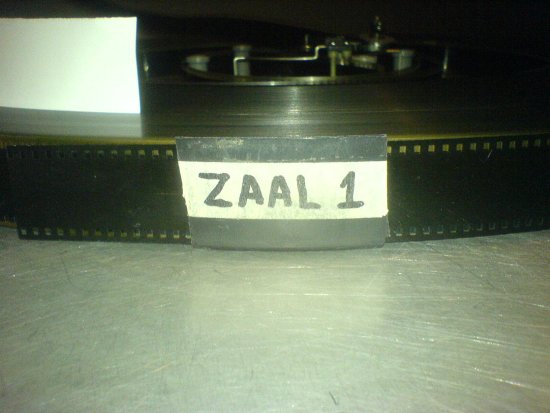
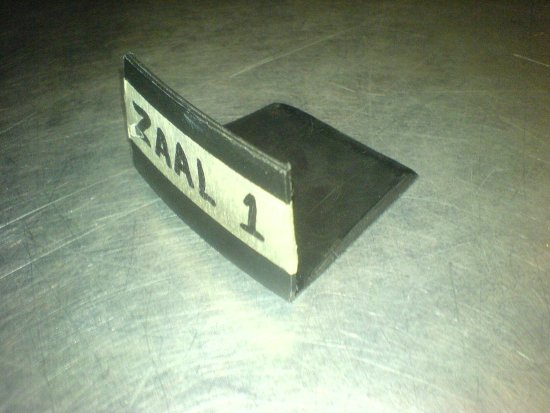
It's made from an old plastic movie can. You can take at least a dozen from these parts out. Since we use these things, I never have to peel the credits out of the platter again. ![[Big Grin]](biggrin.gif)
-> some things in this text could be mildly exaggerated, but all is based on truth <- ![[beer]](graemlins/beer.gif)
Posted by Darryl Spicer (Member # 711) on 04-23-2007, 09:27 AM:
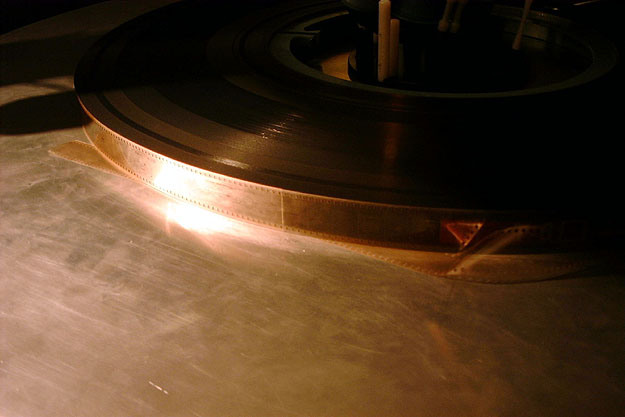
could have tucked the tail under the film.
Posted by Alex Cross (Member # 3520) on 04-23-2007, 06:23 PM:
Tucking the tail under the film on a Cinemaccanica is asking for disaster in my experience. The film quite often pops out, and always manages to drop down and tangle up with the drive wheel. We use excess trailer junk. Get a piece long enough to wrap around the print, with a slight overlap, tape the two ends together. Works for us.
Alex
Posted by Bastiaan Fleerkate (Member # 3826) on 04-23-2007, 07:06 PM:
We had the same problems Alex discribes... I can second his reply...
But do some people have other booth tricks up their sleeves?
Posted by Jeremy Weigel (Member # 4208) on 04-23-2007, 10:06 PM:
Ah...the good old tail tuck. Been doing for almost 15 years and not one tail-wrap. I usually find that when others say they pop out its because not enough of the tail was tucked under.
Posted by Monte L Fullmer (Member # 2797) on 04-24-2007, 01:20 AM:
..as long as the soundtrack is going in first on the tail tuck. For if the soundtrack is away by twisting the film in the opposite direction, the film has more possiblities of looping over the top of the filmroll on the platter.. and a deadly event occurs if such a mishap takes place.
OKEY ,gonna present another 'show and tell' here on how the majority of the cinemas in this part of the state tags their end of the prints ... doesn't cost anything (if you can snitch some clothpins from the laundry area, or spend a few pennies on some clothpins), no platter rings, no tucks, magnet platter stops, no hockey puks, - just a reliable method that holds the end together and never falters.
Pict-1 below showing the clothspin method of a filmroll wrap

Pict-2 Below showing the necessary "equipment" - about 10ft of scrap film and a clothspin. On larger prints, more longer scrap film.

Pict-3 showing how to attach the scrap film to the tail end with the clothspin.
.

Pict-4 Showing on winding the scrap film around the filmroll with the clothspin still attached to the end of the filmroll

Pict-5 Showing on removing the clothspin when the scrapfilm overlaps the area of the filmroll. Plus holding tight the end of the scrapfilm.

Pict-6 Showing after removal of the clothspin, to reinsert the clothspin where the end of the scrapfilm and the wrap of the scrapfilm meets. After clipping the clothspin in this area, give the end of the scrapfilm a tug to secure the scrapfilm around the filmroll.

Pict-7 Showing what's left on the platter when the film has been taken up on the rewind platter - a nice ring of scrapfilm with the clothspin securing it together.

(If Brad wants to move this to the "TIPS" section, be his choice.)
thx-Monte
Posted by Jake Lafree (Member # 3656) on 04-24-2007, 03:57 AM:
I always use magnets to clamp tails of prints, with a good 6"-8" after the 'pinch', have had a very high success rate with this. This way, if the entire print happens to slide a little bit because the platter is flying, you have that extra slack so you won't have to worry about any 'tail issues'. My fellow coworkers use the same method, but usually only leave 1"-2" after the 'pinch', thus resulting in a tailwrap once in a long while. I'll try to upload a pic Wed. nite.
Posted by Mike Blakesley (Member # 26) on 04-24-2007, 10:49 AM:
I used to use the clothespin method except I used a long strip of masking tape to hold the ends of the scrap film together. That method won't save you if you have an unbalanced print due to static or some other reason for uneven platter spinning...it's gonna throw, no matter what.
The F-T platter ring is among the cheapest items in the booth yet it's probably saved me more headaches than any other item up there. The other thing I like about it is, if I have to "distort" the film pack for whatever reason (fix a splice, remove an errant cue, add or remove a trailer, etc.) it doesn't really matter if the film pack is uneven on the platter - the ring will stop any problem from happening.
Posted by Brad Miller (Member # 2) on 05-12-2007, 02:10 AM:
BUILD YOUR OWN START TIMERS! (Attn: all Cinemarkers)
Buy one of these timers (Buy the "good" package. It comes with 3 extra modules you won't need, but could use for other things.)
Buy one of these for every auditorium you want a start timer on.
Set the universal module to "momentary" and either "relay only" or "relay and buzzer". Connect a two conductor wire from the two terminals to the two wires on your START button. (If you don't want to make this a permanent modification, just buy a cheap pack of "alligator clips" from Radio Shack and cut them in half. Use the alligator clip end to clip onto to the START button wires and strip 1/4 inch off of the other end to connect to the module.)
Set up a house code (for example "A") and then dial in each universal module to the number of the auditorium.
Program your timer and kick back! The START button will still work as normal for those pesky manual starts.
Or if you want to be super cool, buy one of these and have a wireless remote control to start the movie with! (You could also set up another module across the STOP button as well to use as a remote controlled stop during screenings for when some dumbass makes a misframe.)
It's also a super fast way to start an interlock at a theater without any interlock circuitry. Just set both projectors to be interlocked on the same number and press the button on the timer/wireless remote! (Or set the timer to fire both projectors at the same time.)
Seriously this does work. I used this exact setup back in the early 90s at a few theaters. ![[Razz]](tongue.gif)
Posted by Monte L Fullmer (Member # 2797) on 05-12-2007, 04:00 AM:
(...you think that Cinemark would allow such devices in their booths..that's extra money that has to be spent let alone something to add into the booth for booth idiots to have to think past their abilities...Looks very interesting though, I do agree..)
Like me, I've got CPA-10's that can do programmed clock starts like with these devices mentioned above, but rather be by the machine due to the curse of Murphy's law. Thus, we do the button pushing... since people can't seem to get it in their heads on how to thread in frame outside of me driving in their heads on how to do the practice when I'm not there...
Posted by Brad Miller (Member # 2) on 05-12-2007, 04:17 AM:
Monte, the "attn all Cinemarkers" was an inside joke between me and the Cinemark head honchos who lurk on the forums.
Still if someone cannot thread in frame, they have absolutely NO business in the booth. I've been using start timers of some form or another for almost 20 years now and I have NEVER had an out of frame start when using them. But yes I do understand what you are saying...when you pay peanuts, you get monkeys.
Posted by Michael Moore (Member # 3867) on 05-12-2007, 08:25 AM:
you know all you need is a neodymium magnet. I took my magnet from my speco lp270 platter and replaced it with an even smaller magnet; (size of a penny) neodymium magnet that has felt on bottom. You can not move it even with pliers. But however you can slide it and with felt on the bottom you never scratch the platter. My speco runs smooth and I never have a problem with tails getting lose or getting caught up.
for the people who are paranoid just use three or four of them.
mike
Posted by Darryl Spicer (Member # 711) on 05-12-2007, 11:06 AM:
Problem with start timers now is the fact that with the pre-show content NCM provides is so random as to when it is complete that it is not possible to keep up with all the start timer settings to prevent early or later than normal starts.
Posted by Chris Slycord (Member # 4239) on 05-12-2007, 12:13 PM:
And if anyone's at an AMC, it's company policy to only do "manned" starts. Using timers is not allowed.
Posted by Ken Lackner (Member # 1002) on 05-12-2007, 07:10 PM:
Many companies maintain this policy, which is a very good idea. Yes, everything should always start in frame, in focus, etc. In a perfect world. But here's the deal. NO ONE is perfect. For that matter, no machine is perfect, either. The most skilled conscientious projectionist could still have a bad day and start one film out of frame. Or the platter may decide not to take up, or the lamp may not strike, or.... You see my point?
Posted by Brad Miller (Member # 2) on 05-12-2007, 11:40 PM:
That's what automation and alarms are for Ken. Should something go wrong, the automation should immediately alert the projectionist. Often times a complex will have 2 or 3 shows starting at the same time and the projectionist cannot be by each projector.
This also assumes that the projectionist knows what he is doing and the tech is worth a flip in maintaining the equipment, so I can certainly see where it may be desired to "force" the projectionist to be there to start the movie...again the whole peanuts thing. However if you have high quality people operating and maintaining the equipment, it really is not a problem.
Posted by Monte L Fullmer (Member # 2797) on 05-13-2007, 12:53 AM:
quote: Ken Lackner
Or the platter may decide not to take up, or the lamp may not strike, or.... You see my point?
..can I add to this: Middle of a show, a small surge hits the building and a "switcher" goes...the dreaded RED LIGHT of doom shows up on top...and obviously no spare - all because the the owner of the building won't put in surge suppressors in the main panel and the town has "dirty power"...
-Monte
Posted by David Graves (Member # 4069) on 05-13-2007, 01:40 AM:
quote: Brad Miller
Often times a complex will have 2 or 3 shows starting at the same time and the projectionist cannot be by each projector.
That's why it's always good to come downstairs and get some face time with whoever writes the schedule at the megas. If you explain how no more than one show can start at a time per projectionist twice a week, it only takes two or three years before management learns. Add one year for AMC.
Posted by Monte L Fullmer (Member # 2797) on 05-13-2007, 03:34 AM:
quote: Brad Miller
a complex will have 2 or 3 shows starting at the same time and the projectionist cannot be by each projector.
..but, there is a system to all of this:
When I was Booth MGR at a 21 plex, we would often have on the avg 3 to 5 shows that would start at the same time. Thus, the operator would start the first one, 4 min early, then run to the other one and start that one 3 min early, next one was 2 min early, one would be on time and to where the last one would be a minute or two late..esp if it was on the other side of the building...but he learned to hustle fast enough to do all of this.
NOW, being in a company where floor staff does booth starts and are needed downstairs with show starts 5 min apart (horrible starting sequences...) they start a pair of shows together-one house would be 2 min late while the other house be 2 min early, this gives them 7 minutes to be downstairs to do whatever til the next pairs are started using the same system above. Hectic in the long run but it works..(until a snafu hits and then the system is all but messed up good..). - Monte
Posted by Chris Slycord (Member # 4239) on 05-13-2007, 04:02 AM:
The argument against using the timer and relying on the alarm is that if you are at the projector you can avoid there being an alarm to begin with.
And with Monte's way of having a couple movies starting early, on time, and late at a lot of multiplexes you can't end up doing that because they have the whole digital advertisements and the advertising company keeps track of when you start things early. In fact, I believe when the digital slides end the thing beeps at you and you have 1 minute of time to start your trailers (what someone told me; we've got slide projectors at mine).
edit: And even if you had a 21-plex why would you want 5 shows starting at the same time? That's crazy. With that many shows at once not only will your booth people be overwhelmed (if they have to do manned starts) but your lobby will be a mess with tons of people all going to the concessions at the same time. And with that many people coming at once, the average person sees your line and says "Screw this" and doesn't buy anything. When there's less people in line, people who would've avoided it before have a higher likelihood of buying. So with shows spread out you increase your concessions.
Posted by Brad Miller (Member # 2) on 05-13-2007, 11:28 AM:
I think you guys are forgetting that booth monkeys are going to be booth monkeys whether a timer starts the movie for them or not. There will still be film damage, the movies will still run out of frame and the movies will still run out of focus. If banning start timers prevented that, then explain to me why I have seen half a dozen movies at a local Cinemark in the last 6 months now and EVERY one of them ran a bit out of frame (a couple were obnoxiously bad) and EVERY one of them was out of focus and EVERY one (except one on opening weekend) was scratched. A few of them were so bad I had to get a manager and beg them to fix it. I am not trying to pick on Cinemark, it's just the only corporate chain theater I have been to in awhile to use as an example for paying a decent wage to get projectonists upstairs who will care.
Yeah, banning start timers really helps. Uh huh. ![[Roll Eyes]](rolleyes.gif)
If these corporate "start timers were evil" guys were serious about putting an end to problems, they would start by locking down the framers to FORCE these monkeys to thread in frame. (Booth monkeys are looking for the easiest possible way to do the minimum amount of work, and having to stop the projector multiple times to reframe would teach them within a day or two to just thread the thing in frame the first time.)
Posted by Frank Angel (Member # 248) on 05-13-2007, 02:51 PM:
I fell in love with X10 devices decades ago and use them all over the place in a number of theatres. Variants of them can be configured to control almost anything you can think of. We use them in our booths so that at the door, by replacing the single wall switch with an X10 module, we can shut off everything in the booth from one location, preventing people from leaving lights on in the storage room or winky lights in the work areas, or the Mr. Coffee machine (ESPECIALLY the Mr. Coffee) in the rewind room, etc.
The units can be controlled by telephone, they can control contacts for switching, they can be controlled by sunrise/sunset, they can be controlled thru walls by a little transmitter on a key fob, and as in Brad's tip, they can controlled by a timer.
The only caveat is, depending on the electrical environment, they can be irratic. In 90% of where we have used them, they have been reliable for years and years, never once being erroniously triggered. In one booth, however, they were not 100% reliable....most importantly, some receivers would go on randomly by noise on the AC lines. We have installed boosters, blockers, and amplifiers (at considerable added expense) and although in this one booth we have been able to reduce random triggers to a minimum, they do still happen.
In one system where a telephone responder is used so that the house manager can call in and turn on a camera & related equipemtn in one of the control rooms so an image can be seen on monitors in the lobby, occassionally the camera would turn on for no reason and left on for days. After trying in vain to filter devices that might be putting noise on the AC line and adding filters, we eventually gave up and just installed a module that let us send OFF signals every hour between 1am and 10am (kind of a curfew safety). I was thinking, using an X10 timer on a projector could theoretically make the system susceptible to a random ON pulse of noise on the AC line -- not a good thing. In fact, I believe someplace in the X10 manuals I recall them saying NOT to use X10 modules on dangerous and unattended devices like motors or heaters, etc.
This might be something to consider. Before I would get the timers and Universal Modules installed on the all the START switches, I would first get a single receiver module and hook it up to a light; leave it in the same circuit as the automation for a few weeks, just as test to see if it is ever erroniously triggered ON. You want to be are sure that your electrical environment is not going to cause X10 receivers to trigger. You don't want to find out after the fact that when you strike any arc, all the projectors turn on!
BTW, switching the transmitters and receivers to different system codes or set to different unit codes (there are 16 available unit codes and 16 system codes) does NOT improve limiting random triggers.
Posted by Brad Miller (Member # 2) on 05-13-2007, 03:01 PM:
While I have yet to find an X10 randomly trigger, I have on rare occasion found a situation where it wouldn't control things. In the booths I have used them in, I simple make sure they are all on the same phase and it has never given me any problems.
BTW Frank, there is now Windows software now to control anything you so desire.
Posted by Frank Angel (Member # 248) on 05-13-2007, 03:14 PM:
Yup -- a great module; total flexiblity. We use one to control a background music system, being able set multiple ON/OFF times (one every minute if you want), different depending on the days of the week, as well as the office lighting in various rooms in the suite and the campus carillon system. Most excellent invention. I have always been surprised that it didn't become more ubiquitous. If I ever built my own house, I would make every light switch and every outlet X10 modules. The cost isn't that much more than regular switches and recepticals.
Posted by David Graves (Member # 4069) on 05-13-2007, 04:19 PM:
With the preshow being delivered digitally, and automatically, most places, the option of starting 3-5 minutes early isn't there anymore- you cut off the ads closest to the show, which are the most expensive ones.
NCM actually delivers a report to theaters (usually home office) detailing ALL early starts over 20 seconds. So late's not an option- now if you've got 4 or 5 starting at once, you either have to use timers or face the possibility of a show starting 5-8 minutes late, which is noticeable.
I'm dead set against timers, because all sorts of things can go wrong. Simply put, you've gotta check everything. Otherwise, inevitable something's out of frame, in the wrong sound format, or worse, getting damaged due to a misthread or bad equipment.
Posted by Brad Miller (Member # 2) on 05-13-2007, 06:00 PM:
Umm David, if it is inevitable, I think you guys need some serious training over there.
I don't have to deal with those retarded 2wenty preshows, but if I did I there is a little box that lights up a pretty little light at start time that can be tied off of. You boys getting your panties in a wad over the idea of a start timer better stop whining or I'll post a "how to" page on interfacing to that box just to annoy you! ![[Moon]](graemlins/moon.gif)
Posted by Chris Slycord (Member # 4239) on 05-13-2007, 11:17 PM:
I really don't understand why people would thread and frame later, in a word of "having it be easy."
I find having to stare at the screen and frame it to be more time consuming than just framing it right the first time. Especially since our leaders start out with with some black film that I'd have to wait through before the first ad starts.
Framing it right I just need to make sure nothing catastrophic happened with my threading. The framing is one less thing I have to worry about since I know I am doing that part right.
Posted by David Graves (Member # 4069) on 05-13-2007, 11:55 PM:
Trust me, I dream of a world where 18 year olds aren't tossed into the booth. We train, and we train well, but in the end they're 18 year olds. They'll make a mistake eventually. A misframe is bad, and will get you yelled at around here- but a misframe that lasts for about four frames is always better than one that lasts about four minutes.
Posted by Brad Miller (Member # 2) on 05-14-2007, 12:15 AM:
BAH! Last year I trained a 16 year old FOOTBALL JOCK who thought we ran DVDs and a week later he was projecting on his own magnificently. (This was in one of those platter array booths, no less!)
It's all in the training...and part of that is kicking anyone out on their ass who doesn't meet the standards within 3 training days. Most people are just too nice "oh he just needs another few months of training that's all".
Posted by Chris Slycord (Member # 4239) on 05-14-2007, 01:03 AM:
It doesn't remotely matter what age someone is being tossed into the booth. Someone who's new/untrained can make mistakes easily. Hell, the people who have film experience could make mistakes too (just those ones tend to be out of the idea that "old habits die hard").
If someone is properly trained and understands the limits of what they've been trained in then things tend to go pretty well.
Posted by Alex Grueneberg (Member # 2652) on 05-14-2007, 01:12 AM:
In my experience what I've run into most is upper management not respecting the operators words on if the trainer should stay in the booth, or better yet hired back a former employee sticking to old habits.
Posted by Monte L Fullmer (Member # 2797) on 05-14-2007, 02:42 AM:
quote: Brad Miller
BAH! Last year I trained a 16 year old FOOTBALL JOCK who thought...
I agree with Brad with this one totally - it's all in the training - no cutting corners at all.
People I train DO remember what I showed them and never forget it,and the way Brad trains is basically mine also: we mean business and take the profession seriously.
That is how you can take a football jock and turn them into one of the best operators around...and age doesn't mean anything at all.
My biggest gall is that when I begin to train someone then someone from mgnt (who was trained from other sources) comes up, when I on my off days, and continues the training "the way THEY think they knows it best! (which includes the sloppy methods of lacing in frame)" Then, I have to "untrain" that poor soul since now that person is all confused on how to do the procedures and HOPEFULLY get that person in the right direction the way I want things done.
(rant..rant....lol) - Monte
Posted by Mark Gulbrandsen (Member # 72) on 05-14-2007, 08:18 AM:
quote: Monte L Fullmer
People I train DO remember what I showed them and never forget it
Yea, And they are over at McDonalds three weeks later thinking about it while assembling burgers for more pay.
Mark
Posted by Louis Bornwasser (Member # 3063) on 05-14-2007, 08:53 AM:
I'm with Brad on this one. Back "in the day" I had a SEVEN year old who was a passable operator (E7/Sword). He was, however, not your average 7 year old. When he was 9, he was loaned out to show the 16 year olds how to operate in frame. Louis
Posted by Mike Blakesley (Member # 26) on 05-14-2007, 09:29 AM:
I just can't understand why "threading in frame" is such a big problem for anyone, even the worst booth monkey. IT'S SO EASY! It takes one second longer, at most. Anytime I've trained anyone how to thread, I just show them how to do it and say, it must be in frame, otherwise YOU'RE DOING IT WRONG. In my experience, most people don't want to do something wrong.
Maybe some projectors are harder to thread properly? I've only ever threaded ours (Simplex, and previously a Brenkert) so maybe I'm missing something.
Posted by Brad Miller (Member # 2) on 05-14-2007, 01:17 PM:
A Christie projector usually messes with a newbie for a few minutes because the aperture plates are on top of each other (rather than side by side or a single plate). Still though, after closing the gate the next part of the training is "now look in there, can you see ONE frameline or TWO framelines? If you can only see ONE, then it is wrong.
Posted by Monte L Fullmer (Member # 2797) on 05-14-2007, 01:53 PM:
LOL ... I all understand with all of you on this framing topic (and with the Christies, I taught people how to frame like you would do with a Super or an E/7 - through the actual aperture opening itself..not with what Brad mentioned since that gate swings out far enough...), BUT, I'll tell you making these booth monkeys how to understand HOW to frame is like pulling teeth at times.
Where I come from all of this is that the other locations in our small circuit that are packed with booth monkeys FLAT OUT don't care on learning stuff like that - I re-train them how to do it with the classic "spin the flywheel and watch the sprocket turn and stop, and when it stops, you're ready to lace the machine" procedure, and I even shown them a procedure in counting - like each roller and gate that is to be opened, you assign that each a number (like 1 for upper pad roller, 2 trap and gate 3, lower pad roller and so forth...) and the last number assigned is the spin the flywheel.
I even tell them that the framebox is a small box and the leader frame is a big box and to but the big box over the small box....
I tell them if they would do this, I promise them that the shows will begin correctly and the FRAME knob doesn't have to be touched.
...AND you think they care about all of this??
The sad thing is the mgr is the one who doesn't care since the mgr has someone else do the training ...
(I just my eyes and wonder how and why this company remains in business the way their presentations look like....)
Yes MARK, I don't expect these monkeys to remember the theatre atmosphere from working with mgr monkeys when they head to McD's to flip burgers for 2 bucks more an hour, yet the ones that do head on to better things, still remember what I burnt in their heads on projection, for I gave them an incentive to be a part of my team and that is to really work together as a whole.
Mike, the one projector that had a goofy framing procedure was the CINE-V8: you didn't have a framebox, but a slit that was lit up from behind and you align the frameline to this, but still, it was no big deal to train on these machines..Otherwise, practically all machines have a set framebox to get it in frame.
Posted by Brad Miller (Member # 2) on 05-14-2007, 02:02 PM:
quote: Monte L Fullmer
I taught people how to frame like you would do with a Super or an E/7 - through the actual aperture opening itself..not with what Brad mentioned since that gate swings out far enough...)
No Monte, I train to thread on the aperture, but then I also train them to look into the gate after it is closed to make damned sure they were framing on the CORRECT aperture.
The V8 is ideally suited to use that generic "breathe on it and it scratches" black mylar with frame line leader. If you can see the light, it is in frame. ![[Wink]](wink.gif)
Posted by Scott Norwood (Member # 30) on 05-14-2007, 02:08 PM:
One situation where I could see newbies having difficulty framing is on a hard-matte 1.85 print where the countdown leader is also hard matted to 1.85. The tendency would be to try to line up one of the framelines with the edge of the framing window/aperture, but that would result in the picture being framed one perf too high or too low. This is obviously not an issue once one understands what a "hard matted" print is and how to frame and splice such prints.
Also, Super Simplexes are painfully difficult to thread in frame when they are missing their framing lamps. I always liked the framing window in the Simplex PR-1014 trap and thought that it was the easiest to use (until the framing lamp burns out).
Posted by Brad Miller (Member # 2) on 05-14-2007, 02:16 PM:
Kinotons with steel runners are the BEST! Just put the frameline even with the top of the runners and it's dead on. No need to even lean over and look at the aperture. Line it up, position it over a couple of pull-downs and voila.
Unfortunately you have to have the steel runners, not the plastic ones for this to be super easy. (Steel runners never wear out either. ![[Smile]](smile.gif) )
)
Posted by Monte L Fullmer (Member # 2797) on 05-14-2007, 02:41 PM:
quote: Scott Norwood
This is obviously not an issue once one understands what a "hard matted" print is and how to frame and splice such prints.
...now teach that one to booth monkeys and see if they'll bite on it ...
Posted by Larry Bowen (Member # 3562) on 05-14-2007, 02:46 PM:
I have to agree with Monte. If the booth candidate has the proper desire and is taught by ONE person who knows the booth and not several (whether all the trainers know the booth operation or not (of course it's worse when they don't)), the candidate will make an excellent operator. I've done some booth training and everyone I've trained have always been able to put a good presentation on the screen and have been able to handle the framing and all operation just fine.
Posted by Chris Slycord (Member # 4239) on 05-14-2007, 03:12 PM:
I must be lucky that no one I've ever worked with does the "thread it then frame later" method. And I've been here long enough that only 1 person is left that was there when I started in the booth.
Posted by Monte L Fullmer (Member # 2797) on 05-15-2007, 01:31 AM:
..and I've seen where as soon as the START is pushed, the booth monkeys would roll the FRAME knob to get the film in frame before the dowswer opens...since they had the light from the lamphouse to really light up the framebox...
...I just *sigh* seeing this.....then they look at me afterwards as if something was wrong...and I tell them....and they give me a "okey, whatever" look and go on ....
Posted by Phil Blake (Member # 2012) on 05-15-2007, 02:07 AM:
I have been fortunate with operators since I have been in this place , one was already trained and in place , another i recruited came from "the old school" and is a terrific operator.
However I am now in the process of training a new spare operator from scratch. I have read up on many tips from the forums and training methods but I seem to be struggling to get him competent.
After four weeks now he is still not able to successfully thread a Vic 5 , just how long should it take a novice to become solo in the booth ? Either my training methods suck or i am dealing with a person who is not able to grasp the job.
Posted by Brad Miller (Member # 2) on 05-15-2007, 02:29 AM:
Phil, some people get it, some don't. If your new guy cannot thread the projector with perfect accuracy by the end of the third day, it's time to kick him out and try someone else.
If it is taking him THIS LONG to learn how to thread the projector, he will be impossible to work with when something goes wrong and he has to fix something even as simple as a brain wrap.
Posted by William T. Parr (Member # 677) on 05-15-2007, 04:13 PM:
Phil You dealing with someone that just not grasp the job at all.
Posted by Chris Slycord (Member # 4239) on 05-15-2007, 10:23 PM:
You know, you could just ask the person in question if they even want to be in the booth. A lot of times someone who does extremely poorly in something either has that feeling because they aren't interested in it or they become uninterested because of it.
It's not a bad thing for them to not be good in the booth. People are good at different things.
Posted by Frank Dubrois (Member # 3042) on 05-15-2007, 10:39 PM:
quote: Chris Slycord
A lot of times someone who does extremely poorly in something either has that feeling because they aren't interested in it or they become uninterested because of it.
Or they could simply be a dumbass who "doesn't get it". Some people can't handle pressure. You can teach them to thread and thread correctly....they will do a fine job, THEN tell them to speed it up because you have 11 more projectors to thread and movies start every 5 minutes. Some people lose their mind and buckle under the pressure. Usually by day 3 I know if they will work out or not.
Posted by Chris Slycord (Member # 4239) on 05-15-2007, 10:57 PM:
quote: Frank Dubrois
Or they could simply be a dumbass who "doesn't get it". Some people can't handle pressure. You can teach them to thread and thread correctly....they will do a fine job, THEN tell them to speed it up because you have 11 more projectors to thread and movies start every 5 minutes. Some people lose their mind and buckle under the pressure. Usually by day 3 I know if they will work out or not.
Well of course they COULD be a dumbass. But if someone is a dumbass, wouldn't you know that well in advance of training them in the booth unless they were hired solely for booth (without any prior experience)?
And my point was that just because doesn't do well doesn't mean they're stupid and it's rude to even make the implicit assumption that they are.
edit: Then again, imo the overall idea behind how to do film is pretty simple.
Posted by Monte L Fullmer (Member # 2797) on 05-16-2007, 03:41 AM:
quote: Frank Dubrois
THEN tell them to speed it up because you have 11 more projectors to thread and movies start every 5 minutes.
A good Booth Manager would look at his performance schedule and instruct his crew to pay more attention to the exit times than the start times. This way that individual will go lace up a house that had just dropped and so forth - and still get those 12 houses started on time with no pressure or hassle.
The wknd that I had to run a 21 screen complex all by myself was actually fun even though it was a very hectic weekend - since I paid more attention to the exit times and immediately laced up that house when it dropped,and still had time to start all 21 houses on their schedules, and after all the sets were in, I had time to run across the courtyard for a chicken dinner to take back for my breaktime.
That was a system that worked and it was in order. Plus the mgr of that complex complimented me on my tremendous efforts in my operations that night, but recommended not to do that again on the pretense of if a snafu happened in a house, the entire building would then be off schedule..
Also, that good Booth Manager would be learning some tactics to were that upstairs operation would run like clockwork and a organized system of checks and balances - and train and work with those to be able to understand these checks and balances to keep the system well tuned - not pressure them in "speeding" up their machine lacing, for that does cause stress for low paying employees who'll begin to hunt for better paying jobs if the stress level has to be that high.
Posted by Brad Miller (Member # 2) on 05-16-2007, 01:04 PM:
What would've happened if you had a projector break that needed your attention for 20 minutes? The start timers would've come in damned handy at that point!
It's really sad how people in this industry cannot differentiate the difference between using start timers as a crutch or an emergency aid. Just because they are there doesn't mean they should be solely relied on. I always felt an ideal situation for a booth with timers was to set the start timers about 2 minutes late. Then when a projector DID break or some other disaster happened, the movies would continue to run until he could finish his emergency and then go double check them.
That is also a great crutch just in case the projectionist happens to lose track of time. It happens.
This has also saved my ass before. I was once managing an 8 screen (manager run booth) and there was only one door to get upstairs into the booth. I had just been upstairs and threaded 6 of the 8 shows before the prime round on a Fri or Sat evening (can't remember which one, but the complex was almost sold out). Right at the time the first movie was supposed to start I went to run upstairs to hit the start button and double check everything...but the punch key door lock had jammed!!! It took almost an hour for us to get the tools needed and to take the door off of the hinges so I could get back upstairs to thread the last couple in the round.
Needless to say those "dreaded evil timers" prevented about 1500 customers from being royally pissed that night, because all of the movies simply started 2 minutes behind schedule...but they still ran!!!
Posted by Alex Cross (Member # 3520) on 05-17-2007, 07:51 AM:
We use our timers all the time, for the very same reason Brad just highlighted. Sod's lore says, when you're off screen through a breakdown, at least you know the other shows are still going to go on. I make a point of leaving the task light on above the projector, to remond me to check it after it has started on the clock. And I make sure I check it within 20 minutes. At least that way, if I have done something stupid, it's only on the trailers and adverts.
Alex
Posted by Dominic Espinosa (Member # 2122) on 05-20-2007, 12:27 PM:
Chiming in a little late here but this is my usage of the stick-a-poo.
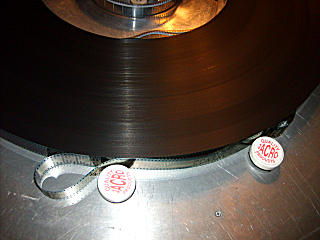
The springiness of the film of course pushes back against the tail keeper and it stays like that even at the high speeds of those blasted stupor platters!
Posted by Michael Moore (Member # 3867) on 05-21-2007, 06:56 AM:
Like I said before platter should not run really fast, erratic, or too slow! If they do then they are not calibrated right. Call the tech and get them fixed.
Posted by Dominic Espinosa (Member # 2122) on 05-22-2007, 12:56 PM:
Due to the fact that the feed deck simply has on/off control while the variac adjusts the overall system speed the feed deck tends to run a bit faster than most as it spins up the system reaches equilibrium.
My platters are as timed as they're ever going to be.
Posted by Monte L Fullmer (Member # 2797) on 05-22-2007, 04:04 PM:
(wooo!...stikeywooos.... platter suddenly takes off and goodbye to the little poobuddies.....)
Posted by Chris Slycord (Member # 4239) on 05-22-2007, 04:34 PM:
Those must be damn fast platters. I've NEVER seen a stickypoo/stickydoo thrown off a platter; even the old ones we've just replaced.
Posted by Michael Moore (Member # 3867) on 05-22-2007, 04:59 PM:
quote: Monte L Fullmer
platter suddenly takes off and goodbye
Monte
why would a platter suddenly take off? I hear many people say this, and why? This tells me something is wrong with the platter system or technician who timed it. I have never had a platter suddenly take off. If your platters take off for no reason I say this:
If it is timed right and still is not working right, then it is a cheap platter system or crappy one or needs to be repaired. Or if it is timed write maybe it really is timed wrong, and you think it is timed write; so fix it. I have used Christie platters, Xetorn platters, and Speco platters; and the only one I ever had problems with was Xetron platters (microswitchs!). not a take off suddenly thing more like a slow wrap around the brain when parked.
check your variacs they may have dead spots or they need to be cleaned.
Mike
Posted by Andy Muirhead (Member # 712) on 05-22-2007, 07:23 PM:
I run CFS super platters. Or whatever you want to call them.
Usually use plastic cores masking taped around the print. It's a really bad thing to do, but can't think of anything better. That's free anyway.
Posted by Jarryd Beard (Member # 2543) on 05-22-2007, 08:09 PM:
As long as you rinse the platter pucks off every week or so, they should stick just fine. We used to use the cores with tape on one of our platters until we received stickapoos (on backorder from everyone's favorite supplier... CPI).
Posted by Brad Miller (Member # 2) on 05-22-2007, 09:25 PM:
Obviously the Film-Tech Platter Safety Rings are *the* ideal way to guarantee that your print will never get tossed, but for those stuck on poos, the MiT poos are the best.
Posted by Scott Norwood (Member # 30) on 05-22-2007, 09:29 PM:
Too bad the F-T rings don't fit on CFS Super Platters. If they did, I'd buy one immediately.
Actually, I've never had any trouble with the usual tail-tuck method on the one Super Platter that I've had to deal with (which, fortunately, is in a single-screen house that rarely runs film). They are too cheap to invest in poos.
Posted by Dominic Espinosa (Member # 2122) on 05-23-2007, 12:11 AM:
By design the CFS platter is a thing of beauty.
It's such a simple, minimal design it's almost elegant. If not for the few el cheapo parts they'd be great systems.
Not to be too much of an ass here, but Michael, you sound a bit more arrogant than I do most days.
Any platter system is prone to erratic behavior for any given reason.
Christies can sudden stop during build/break/run whatever from a shorted card (they just plain fail sometimes, you know).
Other times a motor might short (excessive neglect, bad booth monkey!) or a part may be defective.
Whatever the reason may be it will happen at some point.
All I'm saying really is sometimes a tail will come loose. The loop-back method I employ doesn't seem to be prone to this.
As those decks are sometimes uneven a tuck doesn't always stay and just sticking the tail keepers up against the tail doesn't work well if the keepers are old and in poor repair, whereas the loop will.
Alright, enough of my soap box. Enjoy.
Posted by Monte L Fullmer (Member # 2797) on 05-23-2007, 03:12 AM:
quote:
This tells me something is wrong with the platter system or technician who timed it. I have never had a platter suddenly take off. If your platters take off for no reason I say this:
(...lol...I'm just giving these things a hard time..but, can't stand these things-just something more to keep around when working with platters when that platter ring can stay put on the decks..or our good ol' tuck method does the job fine..) No, why I say that is not the sudden spinoff of the decks and throwing these pukbuddies, it's just that some decks will allow prints to shift some when they start to take off (like the forbidden STRONG and StupidPlatters...) and there using the pukbuddies has lost it's purpose...
Sorry, just never used any fancy devices in securing the tail end down outside of our clothespin wraps or the tuck method...
(I know, I'm a meanie sometimes...)
-Monte
Posted by Mark Gulbrandsen (Member # 72) on 05-23-2007, 08:21 AM:
quote: Brad Miller
the MiT poos are the best.
Awh... Come on Brad... call em by their real name... Bevan Poos
Posted by Michael Moore (Member # 3867) on 05-23-2007, 10:10 PM:
Heres a way I drain oil from my intermittent movement. I came up with this when I was trying to figure out a way to drain the oil and not get it all over the place. I simply took a copper pipe (1/2 inch) cut it and bent it like you see in the photo. I then shaped the end so that it was flat enough to fit snuggly in between the movement body and the casting. works like a charm. I'm sure there is a better way to do this but it works for me.
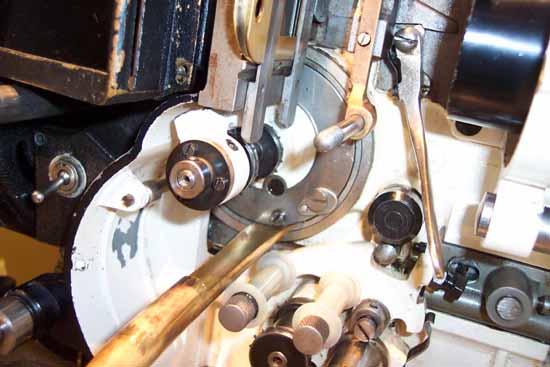
Mike
Posted by Monte L Fullmer (Member # 2797) on 05-23-2007, 11:08 PM:
That's an excellent tip in assembly drainings! Congrats on this and thx for sharing this with us!
Could be an excellent tool to make when draining Century assemblies as well..plus also in doing those XL frame drains.
Should add this to the 'tips' section.
Monte
Posted by Scott D. Neff (Member # 185) on 05-24-2007, 12:03 PM:
I enjoy the old Teco pucks that said "Clean Rubber Pad Weekly" my friend who got hired up in the booth when I was 17 used to say he spent his time lazily cleaning the pucks, had to make sure they were cleaned weakly.
He was also the same guy that used to carry a few of the old worn out ones around so he could hand them off and say "Here's a clean rubber pad, as needed."
I never really did understand why they printed cleaning instructions on them. If yer too stupid to figure it out, you deserved a tail wrap.
Posted by Mike Blakesley (Member # 26) on 05-24-2007, 01:26 PM:
I can't believe this thing has gotten to five pages without somebody screaming that it's a TEASER TOPIC.
This whole site is "booth tips," for cryin' out loud.
Posted by Alex Grueneberg (Member # 2652) on 05-24-2007, 05:25 PM:
THIS IS A TEASER TOPIC!
Posted by Steve Guttag (Member # 268) on 05-24-2007, 05:57 PM:
Back in the day...When I ran Tai films for midnight shows...I got Tipped $20 each night by the guy who rented the theatre for the show.
Posted by Monte L Fullmer (Member # 2797) on 05-25-2007, 03:42 AM:
(oh, I dunno on that, for the topic title does have a definite point title - an adjective and a noun - instead of a "guess what we can do", or "here's an idea for you all.." sort of title that makes us really guess....)
But, if it has to be changed, a "Tips for Booth Operations" title would fit better.....
Posted by Michael Moore (Member # 3867) on 05-25-2007, 05:38 AM:
It doesn’t teas me; however would this be a better title:
"Things that we all can try and test out to increase overall efficiency, cleanliness, comradely, and moral in the projection booth"
I kind of like that; it's strait to the point.
Mike
Posted by John Wilson (Member # 269) on 05-25-2007, 02:53 PM:
You need to increase your 'moral's?
Posted by Monte L Fullmer (Member # 2797) on 05-25-2007, 04:11 PM:
maybe not morals, but definitely increase and improve PRIDE in the booth operations ...
Posted by Michael Moore (Member # 3867) on 05-25-2007, 05:22 PM:
not moral but morale forgot the e. sorry, however some people need to look at their morals in some respects, some people I work with, but who am I to judge?
[ 05-25-2007, 09:39 PM: Message edited by: Michael Moore ]
Posted by Monte L Fullmer (Member # 2797) on 05-25-2007, 06:30 PM:
yea, just stay under the mushroom and do a 'Schultz' - "I know nothing..nothing...."
Posted by Sean McKinnon (Member # 612) on 05-25-2007, 11:36 PM:
This reminded me of when I first learned how to tread a projector. A Century SA. I worked for a manager who didnt give a flip about anything and let me "teach myself" After copying the other running machines and starting the show I was so happy with myself until I realized that there were switches on the alpha platter :)I happened to choose a rewind deck that happened to already be set to rewind, payout on the other hand...
At first I was so confused why I would make sure the leader was framed in the gate but would always start out of frame, My manager told me it didnt matter just to rack the framing knob but even at 15 I was a perfectionist! Finnally when the VP of the chain came for a visit I asked him why I couldnt make the shows start in frame... After he finished freaking out that the manager was allowing a 15 year old in the booth, and after I begged to be allowed to continue working in the booth he showed me how to set the intermittent to the "dwell" position. It makes me laugh until this day, If I had understood how the projector actually worked I could have figured it out but at that point I didnt know much, I did know after my first day working in the theatre that I wanted to be a projectionist and bring entertainment to hundreds of people a night. Now as a tech I feel it is my mission to make sure that people get the best showing possible and that the operators have equipment to work with that is in pristine condition!
As for platters I swear by the R. P. M. gauge that Christie sells. I know a lot of people who feel that they can time these by eye but whenever I use that tool my platters run so smooth its almost elegant! The only problem with it is you have to remember to multiply the reading on the gauge by 2. 20 on the gauge is 40 R.P.M. Also, it is important that you get a bump in speed from 70-100% as LED assemblies wear sometimes you wont get this and cause the film to drag around the feed plate, I always check that you get that increase and change LED assemblies if I don't. I see that often overlooked!
Posted by Brad Miller (Member # 2) on 05-26-2007, 12:57 AM:
The film drags around the brain during operation if the spring that pulls the payout arm to 0% is too tight, not incorrect timing.
Posted by Sean McKinnon (Member # 612) on 05-30-2007, 11:16 PM:
most commonly it is the spring you mentioned brad but if you dont have a change inspeed from 70-100 degrees it will also cause this. I have seen a lot of platters with properly adjusted springs just timed and still have slight film wrap due to a constant speed from 70 degrees to 100. The AW3R's variable density disk is not designed to have the same speed variation from 0 degrees to 70 as it is from 70 degrees to 100. Sometimes a disk thats slipped on the shaft or a work LED assembly will cause this as well as the spring you mentioned.
Posted by Brad Miller (Member # 2) on 05-31-2007, 01:32 AM:
That makes no sense. So what you are saying is that if at 70% the speed is "whatever" and all the way up to 100% the speed is the same "whatever"...that somehow the arm needs to move to 71% or beyond to prevent a slight wrap?
Ummmm, I don't think so.
Posted by Sean McKinnon (Member # 612) on 05-31-2007, 09:19 PM:
The variable density disk is designed so that the increase in speed from 0-70 degrees is smooth and even. From 70-100 degrees the pattern is designed to allow more light through to cause a slight increase in speed to prevent film wrap on start up. I have seen worn photocells that would not register the difference in the light output caused by the change in the pattern on the variable density disk. therefore causing the platter deck to rotate no faster at 100 degrees than at 70.
If you time the system to the manufacturers specification with a known good L.E.D./Photocell Assembly and a properly seated variable density disk and measure the speed with a tachometer you will find a more rapid increase in speed from 70 degrees to 100 degrees than from 0 degrees to 70 degrees.
I am in no way trying to say that you are wrong in anyway about the spring adjustment Brad. I am sure that is the more common case. This is just one thing I have found from time to time in my experience, your experience may differ. I am in no way trying to disagree, argue, or disrespect you in any way, I am just stating my experience that I have had in the field.
Posted by Brad Miller (Member # 2) on 05-31-2007, 11:16 PM:
That has nothing to do with what you said above. If there is enough speed at 70% to keep up with the required payout speed, whether there is more speed available at 71% or more makes no freakin difference in the world because the arm will be sitting at 70%.
Posted by Sean McKinnon (Member # 612) on 05-31-2007, 11:35 PM:
Right! Once the show starts and the payout settles the arm should just stay in that position. All I was trying to say that in my opinion during those few seconds of start-up before things settle down it's just another feature to ensure smooth and scratchless film handling. I am sorry if I wasnt clear at the beginning. And also, as I didnt say it properly before but the spring adjustment is much more crucial and important!
Posted by Mark Gulbrandsen (Member # 72) on 06-01-2007, 07:52 PM:
Also on older AW-3's I find that alot of the time the ball bearing that the shaft goes through is shot and full of crud and requires replacement. This can cause the arm to hang up even though you may have the spring correctly set. You can't use just any bearing here it has to come from Christie. It can't have any type of wet lube in it at all or the lube itself will cause it to hang up!!
I've had so many friggin CDS cells go bad lately that I'm tempted to look for an alternative to use. That CDS cell is from the dinosaur age .
Mark
Posted by Sean McKinnon (Member # 612) on 06-01-2007, 11:42 PM:
Mark remember the infrared version of the aw3? those were awesome! ![[evil]](graemlins/evil.gif)
Posted by Louis Bornwasser (Member # 3063) on 06-02-2007, 05:59 AM:
Mark; agreed. Have they not heard of solar cells? (Photo transistors would live forever, but they need a third wire,) Cds cells are a little hard to come by anymore especially wih Rohs certification. Also, why not slow the time constant response on feed out only while you are working on the AW3. Louis
Posted by Steve Guttag (Member # 268) on 06-02-2007, 06:51 AM:
Actually Mark, you can source the R4 bearing from other than Christie...it is a "light duty" bearing.
I recently came across an odd one in that I guess somehwere in its life on a removable centerfeed system where the two wedge shaped blocks didn't mate up so well in the hub assembly...this bent the shaft in the hub assembly and proceeded to naw out the nylon bearing down by the variable density disc...as this progressed the shaft lost lateral support down by the disc and now will bind up as the shaft is no longer straight and the nylon bearing is enlarged.
I too have been finding the LED/CDS assemblies to be having problems (not making the needed range).
Posted by Mark Gulbrandsen (Member # 72) on 06-02-2007, 06:58 AM:
We stock the standard R-4's but the bearing that Christie sells for this purpose in the AW-3 has no "wet lube" in it at all and its also a high precision bearing. I would guess ABEC 5. They are around 30.00 each from Christie... A standard R-4 bearing puts too much drag on the pay out fingers with Estar film, a standard bearing is fine for acetate film though.
I dono whats up with the CDS cells.... You're right on the range and I'm not sure if its the LED being too bright or the cell just being defective or the wrong one. We sent a bunch of new assemblies back to Christie recently that were defective. I also have had many lately that are intermittent. We stock just the CDS cells and generally rebuild them and do an R/A on bad assemblies. Have had no problems with just the ceclls and we use our own green LED not the one they supply. We also stock the whole assy. as new from the factory. Rebuilding them either in the field or shop takes just 10 min. and Ive had better luck with the rebuilds. The cells are cheap.
It definately is time that Christie start thinking about updating this drive system a bit.
Mark
Posted by Steve Guttag (Member # 268) on 06-02-2007, 09:45 AM:
One of our bearing suppliers has the R4 in three different grades...the light duty grade seems to be a pefect match to the one used by Christie.
Posted by Mark Gulbrandsen (Member # 72) on 06-02-2007, 07:45 PM:
Repairing an AW-3 Slide Bar......
I see alot of abuse of platters in general but this is one of the more common abuses I see on AW-3's. Operators drop the cluster roller down the slide bar to the peg they are going to. Eventually this obliterates the roll pins that are pressed into the bar. The one in the photo was temporarily repaired by someone in the booth but it too fell apart.
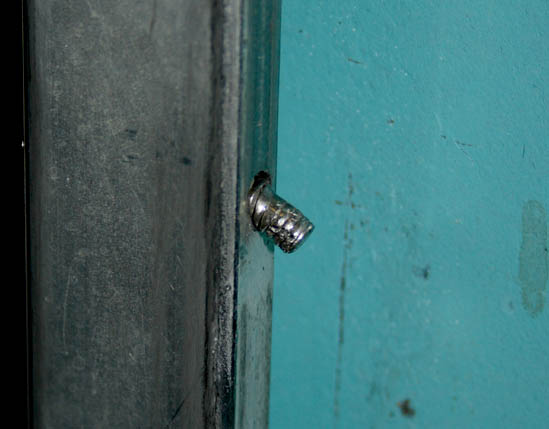
One can repair the bar if the holes for the pins are ovaled out by drilling and pressing in the next larger roll pin. I have a far sturdier way to repair these that follows. Some of you may already be doing this and some may not know about it...
You will need a drill, set of common bits, three roll pins that are either the same diameter as the factory pins assuming the holes are not yet out of round, or three roll pins that are the next size larger in diameter if the holes are ovaled out. Either way the pins need to be at least 1/2" longer than the width of the bar. You will lso need a Dremel tool with a cut off wheel.
If the holes are still round and you are able to stay at the same size pin you will need to simply drill using the same size bit as the existing hole but go straight through the other side of the slider bar. Then press the longer pin all the way thorugh until about 1/8" of the new pin exits the other side of the bar... or be sure that the tapered end of the pin is well past the other side of the bar. Next use the dremel to cut the pin off flush with the other side of the bar. This longer pin that is anchored to both sides of the bar will take alot more abuse over the short stubby pins that come as stock.
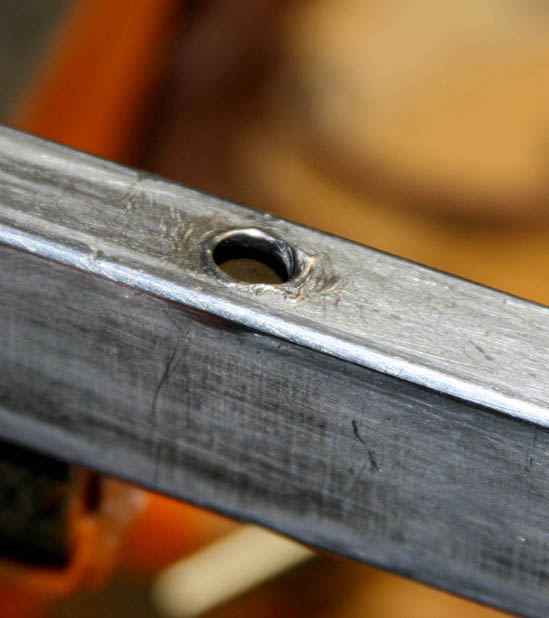
If the hole is out of round as shown above and as I usually find then use at least the next size larger pin and drill the existing hole larger to accomodate the new diameter pin but again go all the way through the other side of the bar and then press the pin in until about 1/8" of the new pin exits the other side of the bar and then cut it off flush with the dremel tool.
A few pics follow.....
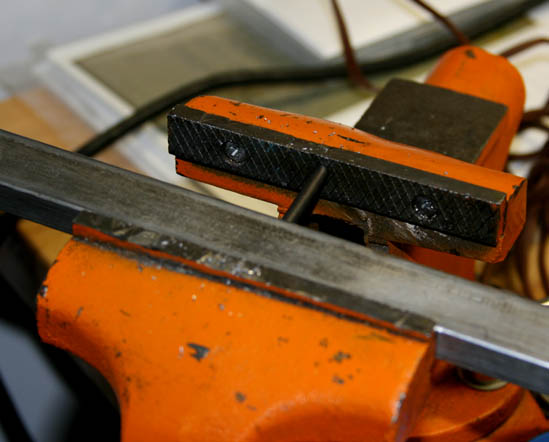
Use a vice to press the pin in. When its flush then tap it farther through with a hammer until the taper end is well through the other side of the bar.
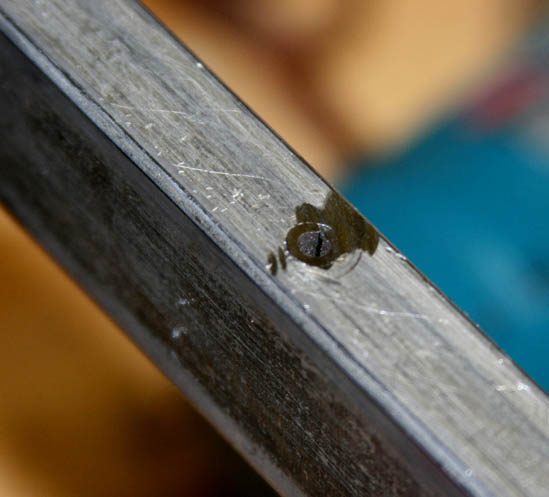
Roll pin cut off with Dremel and cut off wheel on opposite side of slider bar.
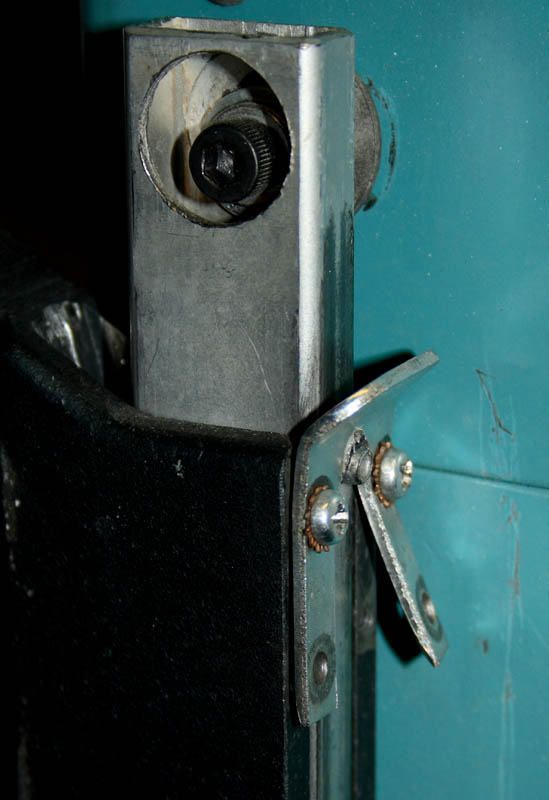
Some of the typical abuse I see during routine service. The longer roll pin survives but the stopper plate is mangled and about to fall off!
Hope this helps someone out there.... I've done about 30+ slider bars this way over the years and never had to go back to repair one twice.
Posted by Brad Miller (Member # 2) on 06-02-2007, 10:18 PM:
If people are going to do this, make sure the bottom deck has LONGER pins, so that the roller cluster cannot accidentally be lowered farther downward than the bottom pin. All new AW3 systems are like this from the factory now.
Posted by Paul Konen (Member # 41) on 06-03-2007, 02:10 PM:
Sure, Christie has done a few mods like that after I figure out a way around it.
Regards to bottom platter. I attached small hose clamps under the cluster assy when in position for the bottom platter. It doesn't prevent from going below the pin, but won't let the assy be positioned straight up / down.
Diode Racks. Initially, they had a standard 1/4 bolts to attach the rack directly to the struts. I changed them to carriage bolts and bolted them to the strut. Then place the diode rack directly on the bolt. This saved time when changing a diode and trying to get the bolt back into place. Now, they are using a much beefier diode for the SLC 30.
Posted by Mark Gulbrandsen (Member # 72) on 06-04-2007, 07:34 AM:
quote: Steve Guttag
the light duty grade seems to be a pefect match to the one used by Christie.
Steve,
All versions of the R-4 bearing ARE light duty bearings from what ever angle you decide look at it. Being ABEC 5 or ABEC 7 only means they are specially selected versions with tighter tolerances and marked high spots. You need to be more specific... IE: No lube, dry lube, grease as they normally come, special lube, or just a plain ole $3.00 R-4 bearing.... the latter doesn't work properly though. Perhaps you should post the bearing number if you are going to be here to actually give any meaningful booth tips.
Mark
Posted by Steve Guttag (Member # 268) on 06-04-2007, 08:34 AM:
Sorry Mark...that is how the supplier presents them...it is an ABEC-5 grade stainless steel bearing going by the trade number SR4ZZ. However, our supplier repacks the bearings for unit sales with their number so I don't have the manufacturer's info...it is in an SKF section though I wouldn't guarantee it is and SKF. I looked at one and could not make out any markings but boy does it spin forever.
Posted by Mark Gulbrandsen (Member # 72) on 06-04-2007, 06:05 PM:
Yea, sounds like there's either no lube in it or some sort of dry lube. Pretty much equivelent to what Christie sells. There are no markings what so ever on the Christie bearings that I have in the van right now.
Mark
Posted by Thomas Pitt (Member # 4322) on 06-05-2007, 02:54 AM:
Here's a tip regarding film cues. Measure the distance between the film gate and the cue reader in your projection setup. That way, you can precisely time when a cue will be triggered in response to a certain point on the film. Since most theaters will use the same projection equipment for each screen, once you know the distance you can add cues to your film prints when building up.
It seems like common sense, but you'd be surprised how many film handlers don't do this! I go to a theater where they use Simplex Millennium projectors; the lens turret is fairly slow and requires 5-8 seconds of 'spacer' film to be spliced in to cover the changeover.
Most film handlers put the cue mark at the beginning of this spacer film, but since the cue doesn't pass through the reader until a short time later, the spacer film (often a VERY scratchy spare piece of leader) is projected on the screen for a couple of seconds!
Posted by James Wheeler (Member # 4070) on 06-05-2007, 02:16 PM:
I'd like to request a tip. I've been building a Super Simplex and I'm only a lamphouse and Exciter Lamp Bracket Assy. away from being functional. My request is a picture of what this projector looks like when the film is threaded properly. I would also like to know why the top reel is backwards.
Thanks
Posted by Monte L Fullmer (Member # 2797) on 06-06-2007, 01:53 AM:
quote: James Wheeler
I would also like to know why the top reel is backwards.
We can give thanks to Mr. Edison that began that "B" (anti-clockwise rotation) wind of the supply reel...
You can take a peek at this manual for the SuperSimplex
Posted by Mark Gulbrandsen (Member # 72) on 06-07-2007, 10:32 PM:
Mainly for JHawk..... but also for anyone else interested.
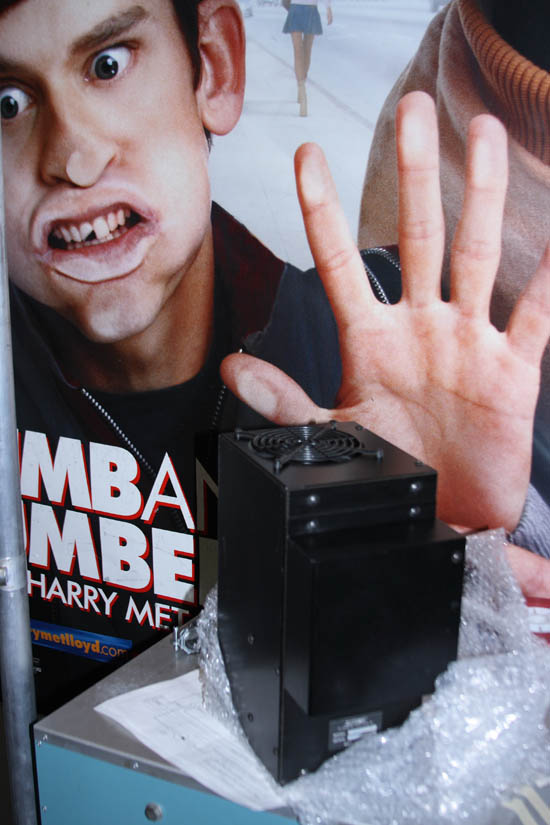
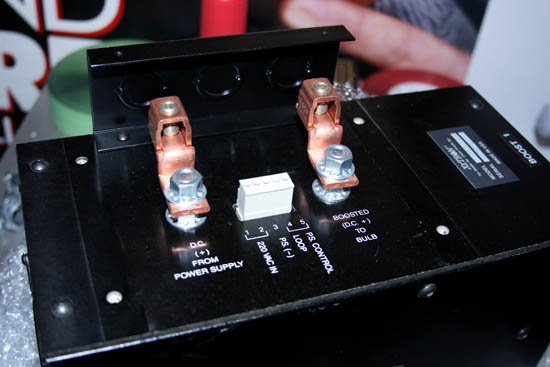
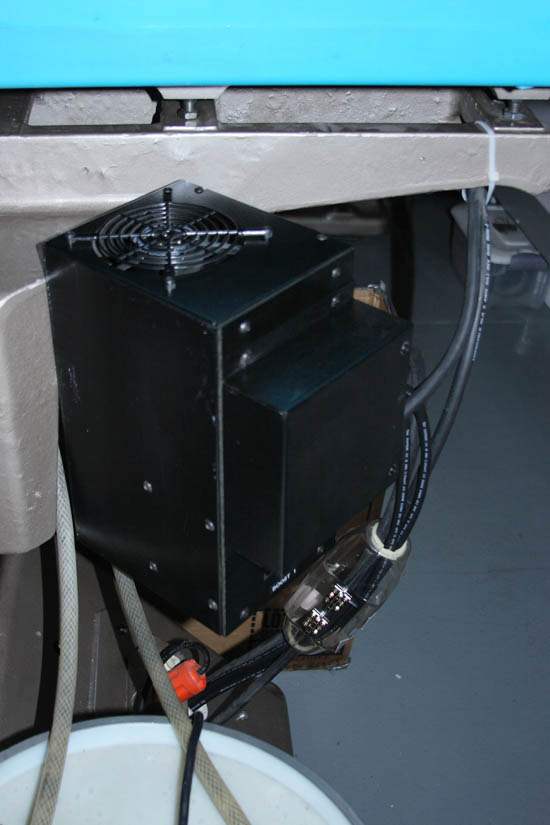
This is the boost-1 that Neumade makes for those older lowly IREM rectifiers that can't put out enough no-load DC to properly start a lamp. Typically you will find these rectifiers running on 208 3 phase and the no-load to be less than 80 volts DC, I had two that were outputting less than 75 volts! Acording to John Walsh at Neumade these older rectifiers are actually intended to operate on 380 volts 3-phase which is the more common AC supply in Europe and at that voltage they do indeed supply 130 volts no-load, later IREM rectifiers are specifically wound for the measly lower AC voltages found here in the U.S.. The Boost-1 is an independent dc supply that raises the no-load to 130 volts and it will work with up to 3kw lamps. It shuts off the instant the lamp ignites. It can be mounted on the rectifier provided you have one of the larger units or at the lamphouse, I don't know how this thing would fit inside a console....? I mounted these on the lamphouse pedestal of the DP-70 and it made it very easy for hookup. It definately works too just as it should, there is light before you hear the clunk of the rectifier's contactor.
Mark
Posted by Monte L Fullmer (Member # 2797) on 06-08-2007, 02:17 AM:
(I love it when yu see booths that keeps their bulb carriers clamped around the rectifier cables....)
Posted by Brad Miller (Member # 2) on 06-08-2007, 05:13 AM:
Really Monte? Why is that? I prefer to find booths where they save not only the bulb carrier but also the BOX that has the serial number and such printed on it for potential warranty return.
Posted by Mark Gulbrandsen (Member # 72) on 06-08-2007, 07:17 AM:
quote: Brad Miller
I prefer to find booths where they save not only the bulb carrier but also the BOX that has the serial number and such printed on it for potential warranty return.
Brad, How unthinkable! Return a Christie lamp thats under warranty.... almost never! We haven't had a Christie lamp to return in warranty in at least several years. This is not our customer that runs them for anywhere from 12,000 to 19,000 hours though... its a different guy and he thinks that guy is crazy. They are so reliable that this customer goes by years of use... not by hours. It equates only to an average of about 2500 hours on a 3kw and 4000 hours on the 2kw's... its a shame to pull em actually but he does. His minimum use time is 1 year and all are grind operations, they stay that length unless they become unstable. Ok, that happens to a 3kw after 2,000 hours sometimes. Notice thats the older style Christie bulb housing that hasn't existed for over two years. ![[Cool]](cool.gif)
Can't say the same for Osram or LTI though.
Posted by Monte L Fullmer (Member # 2797) on 06-08-2007, 12:55 PM:
(lol..way too funny.) Oh, it's obvious why of the carrier clamped to the cables and fully understand, just that it's a bit comical seeing the carrier stored this way instead of putting the carrier in the box and having all of it stored in booth storage areas...but that's just me ...
(But do a rare case in years: I did have a CXL-25SC die on me with 800hrs on it...just waiting for the warranty return confirmation and return procedures..)
Posted by Daryl C. W. O'Shea (Member # 1303) on 06-08-2007, 01:31 PM:
I've never seen someone carry a lamp, without the carrier on it, the length of the booth in booths that clamp the carrier to the DC cables. I have, many times, in booths that don't do this. It's probably not a coincidence.
Posted by Mark Gulbrandsen (Member # 72) on 06-08-2007, 05:25 PM:
I've been placing the lamp covers on the DC leads for going on 27 years. Its right at arms length and if the operator chooses to ignore its purpose thats his own lazy fault. To people on booth tours I tell them its the baby bottle warmer.
Mark
Posted by Monte L Fullmer (Member # 2797) on 06-08-2007, 10:28 PM:
Yet with me practically running console units all my xenon years, yet, in my earlier experiences, I did do a booth with separate lamphouse - and I did clamp the cover on the DC cables. But, then I had to ask myself, "Why have the carrier here where the box is over across the booth or in a storage room, so why not have them together and save a trip?"
Yep, I'm proud to be lazy, but I'm more efficent that way...you find tricks to ease the work some ..
-Monte
Posted by Daryl C. W. O'Shea (Member # 1303) on 06-09-2007, 02:58 AM:
quote: Monte L Fullmer
But, then I had to ask myself, "Why have the carrier here where the box is over across the booth or in a storage room, so why not have them together and save a trip?"
Yep, I'm proud to be lazy, but I'm more efficent that way...you find tricks to ease the work some ..
So now you've got the cardboard box wrapped around the DC leads too. That works, I guess.
Posted by Monte L Fullmer (Member # 2797) on 06-09-2007, 12:51 PM:
(Oh Brother..)
Posted by Mark Gulbrandsen (Member # 72) on 06-09-2007, 09:35 PM:
quote: Daryl C. W. O'Shea
So now you've got the cardboard box wrapped around the DC leads too. That works, I guess.
Reports are that Monte has done just that by using the plastic lamp wrapper supplied with those lamps to affix the box to the cables. Good idea Monte ![[thumbsup]](graemlins/thumbsup.gif)
Mark
Posted by Monte L Fullmer (Member # 2797) on 06-09-2007, 10:47 PM:
(lol... ) Okey, so I threw a curve ball and it got missed by the switch hitters...I meant to say that I put the carrier and the box together back in the cupboard after I do the bulb changeout thingey instead of having the carrier grasping the cables so they don't come apart when they get all heated up during operation and the box across the other side of the booth where the storage cupboard is......
I know, it's time to be picked on after awhile ....
-Monte
Posted by Mark Gulbrandsen (Member # 72) on 06-10-2007, 07:59 AM:
quote: Monte L Fullmer
when they get all heated up during operation
Hopefully not ![[Eek!]](eek.gif)
![[uhoh]](graemlins/uhoh.gif) .
.
Powered by Infopop Corporation
UBB.classicTM
6.3.1.2