This is topic Why makes the edge of a print more prone to have lines? in forum Film Handlers' Forum at Film-Tech Forum ARCHIVE.
To visit this topic, use this URL:
https://ft-forum.com/ft/cgi-bin/ubb/ultimatebb.cgi?ubb=get_topic;f=1;t=008757
Posted by Alan Gouger (Member # 543) on 06-06-2007, 09:39 AM:
I am mostly talking used prints but what is it that almost all scope prints have lines on the extreme edges. The print can be like new in every other sense.
I do not see any projector or transport design reason for these lines. I do not see how miss handling can predictably cause lines on the edges. Whats causing them ?
Posted by Jeremy Weigel (Member # 4208) on 06-06-2007, 10:11 AM:
With "used" prints it would be most likely due to someone breaking down the film at too high of speed. The film guides can't spin fast enough past a certain amount of speed since they rely on friction from the film. Once the film is coming off the platter at a faster rate than the friction can keep a "grip" on the film the film begins to glide over the guide surface.
Posted by Mike Blakesley (Member # 26) on 06-06-2007, 11:00 AM:
I think the cause is more likely platter rollers (or other rollers) not turning properly.
Posted by Brad Miller (Member # 2) on 06-06-2007, 11:48 AM:
It's usually pad rollers not adjusted properly or failsafes (the older 80s type).
Posted by Monte L Fullmer (Member # 2797) on 06-06-2007, 02:44 PM:
...and shouldered rollers...
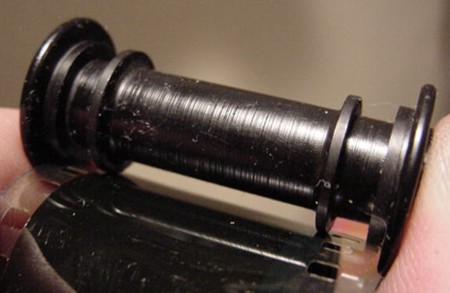
-Monte
Posted by Frank Dubrois (Member # 3042) on 06-06-2007, 04:12 PM:
...another vote for pad rollers.
Posted by Ken Lackner (Member # 1002) on 06-07-2007, 06:38 AM:
Well, since Monte posted a picture of it, I'll ask. What is the point of those rollers? I never understood. Most of the Christie machines I used to service had those as their pad rollers.
Posted by Brad Miller (Member # 2) on 06-07-2007, 10:39 PM:
So did older Simplex/Century projectors too Ken.
Posted by Alan Gouger (Member # 543) on 06-07-2007, 11:39 PM:
Thanks for all the replies. The picture of those rollers looks like the same as what my projector uses. Im not doing anything high speed through it though but I can see where if those were used on a transport at high speed it could be an issue.
Posted by Monte L Fullmer (Member # 2797) on 06-08-2007, 02:12 AM:
I need to add this comment on my pict: this pad roller came from the middle pad roller assembly which this roller is mounted on the front of the pad roller arm and this roller is holding the film as it leaves the intermittent sprocket to the middle constant speed sprocket.
If the lower loops are built too small, the inside of the lower loop is what is making contact with the inner shoulders of this particular roller and doing the base side scratching.
Chek with your local supplier for non-shouldered rollers to replace these shouldered rollers for your make of machine.
-Monte
Posted by Peter Mork (Member # 1336) on 06-08-2007, 03:02 AM:
I agree. I've long since replaced all those double-flanged rollers (or whittled off the inside flanges) wherever I found them, and never had a problem as far as them keeping film in place.
Maybe the idea was to give an extra bit of insurance when running beat-up prints with nicks and split-off edges - something you don't see much in the polyester era.
Posted by Monte L Fullmer (Member # 2797) on 06-09-2007, 11:56 PM:
I do believe that the shouldered roller concept came from the nitrate era - to keep the film securely centered on the sprocket since the constant speed sprockets on those early machines travelled a lot faster in rotation speed (16tooth) and a tighter film wrap making it prone for film hop off the sprocket.
The 24tooth XL sprocket was a blessing in the long run by slowing down the rotation speed and making a larger film wrap around the sprocket, thus less curve stress on the film.
Also, those early machines had brass pad rollers equipped with the same inner shoulders.
Posted by Louis Bornwasser (Member # 3063) on 06-10-2007, 08:48 AM:
Monte; remember the tps (teeth per second) is the same! Louis
Powered by Infopop Corporation
UBB.classicTM
6.3.1.2