This is topic Sidewinder -- double MUT in forum Film Handlers' Forum at Film-Tech Forum ARCHIVE.
To visit this topic, use this URL:
https://ft-forum.com/ft/cgi-bin/ubb/ultimatebb.cgi?ubb=get_topic;f=1;t=008832
Posted by Marin Zorica (Member # 1716) on 07-18-2007, 04:27 AM:
Hello!
I've got some idea to make sidewinder by mine own......but got problem's with drive motors....I try to do something like Meopta with asynchrony motors and resistor in serial with it....but I've get motors over heat too much! ![[Frown]](frown.gif)
Another idea is to put DC motors with regulation, and get regulation from arm lik on ernemann or kinoton.
Any ideas or help with choosing motors....or may bee somebody do this also?
Posted by Robert Minichino (Member # 3495) on 07-18-2007, 08:57 AM:
You need "torque motors." They are designed to have their shaft stationary when power is applied to them without overheating.
Posted by Michael Moore (Member # 3867) on 07-18-2007, 11:38 AM:
I hope I read your post right, so if this is bad advice them I'm sorry.
I built my own single sided MUT from speco parts (LP271). I took their motor, and electronics and built my own box, and then put legs on it and put a a pole assay from Christie. works great. I call is frankenMUT
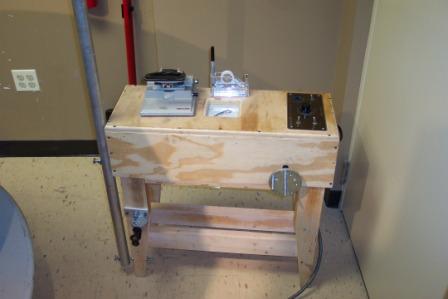

I have started to build my own rewind table with a DC motor from a tread mill. These motors work great and are torque motors, Remember if you use one you need the control board and a pot to increase and decrease the speed. Also they are revisable and you can stop them almost on a dime. You can take them out of old Tread Mills or buy them on eBay or find them in in a Surplus store.
good luck.
Posted by Brad Miller (Member # 2) on 07-18-2007, 12:21 PM:
People may make jokes, but at least the frankenMUT has a place for a splicer, unlike many "professional" MUTs. ![[Razz]](tongue.gif)
Nice work.
Posted by Michael Moore (Member # 3867) on 07-18-2007, 12:42 PM:
thanks Brad, I was going to stain the wood and then paint the name FrankenMUT on the side in gold letters. I was going to call it the Franken-MUT 2000, but I have too many projects now on my plate.
Posted by Catalin Balaceanu (Member # 3712) on 07-18-2007, 02:45 PM:
Hi Marin, I hapen to be working on the same thing, following the same Meopta approach. The type of motor you need is also called (at list around these parts) "Hysteresis Motor". I know somebody that...knows somebody who imports them from Hungary. So this might be a good place to look for them.
Another approach I'm considering, is using a friction assembly from an old projector (which I already have) and a low RPM motor, or even the old projector's motor.
Michael, your FrankenMUT looks sweet. Nice work!
Catalin
www.catalinbalaceanu.com
Posted by Marin Zorica (Member # 1716) on 07-18-2007, 04:20 PM:
I have one MEOPTA motor.....they where (or still they are) produced by MEZ MOHELNICE
The major thing on this so called "Hysteresis Motor" is that they have shorted rotor and big loses in hysterese...so effieny is about 30%....with 120W electrical power, you've get 10W of drive power..and they can be stopped without overheating problems.
Friction assembly from projector isn't good solution because all of this are made up to max 1800 meter....and on 1800 some have problems to drive full rell!
Best solution is to use DC motor with gear or belt drive to film rell and which gonna be regulated with potentiometer which is moving by arm with roller, which is stretched by film moving to rell, and then potentiometer gonna regulate voltage to DC motor true some DC regulator....
Posted by Michael Moore (Member # 3867) on 07-18-2007, 06:10 PM:
What you need is PWM controller for a DC torque motor. The reason why is DC motors will not be able keep up with demand as load increases. So as you increase load, the PWC controller will ramp up the voltage slowly to counter act the load. Treadmill motor controls do this well but they get very hot, so a heat sink is needed attached to the heat sink the board is mounted to. The resistance is changed at the Pot to change the RPM and that is all it does. The PWC controller will do the rest in terms of load and efficiency. These kind of DC motors are well over 90% efficient.
Mike
Posted by Mark Gulbrandsen (Member # 72) on 07-18-2007, 07:22 PM:
quote: Marin Zorica
Best solution is to use DC motor with gear or belt drive to film rell and which gonna be regulated with potentiometer which is moving by arm with roller, which is stretched by film moving to rell, and then potentiometer gonna regulate voltage to DC motor true some DC regulator
Well then you've got an EPRAD Double MUT which is pretty easy to duplicate.
Also....
Can we please see photos of the Frankenreels that go on these???
Thanks!
Mark
Posted by Steve Guttag (Member # 268) on 07-18-2007, 08:18 PM:
I'm a bit curious...With the "FrankenMUT"™...on build up...how did you deal with the tension on the system? SPECO had their LP-271-V which was very similar to the FrankenMUT™. They had to use a variable resistor to "help" the reel turn since the static resistance of the motor was too much and would but too much tension on the film. The problem with SPECO's is that one really needed to adjust the resistor depending on 6K or 2K reels and even during make up with 6K reels. The unit was short lived.
Christie got the back tension thing pretty good without the need of a "helper" circuit.
As to the original question...I believe they are looking for ideas on how to make a reel based transport system in lieu of a platter (i.e. tower like).
DC motors can work with "Dancer Arms" to control the voltage...at the other end of the spectrum...Kinoton's method(s) using every piece of electronics known to man plus special programming...etc to have a relatively easy to use unit on the outside and looks nearly identical to its more primative cousins.
You can even go for brute force things like clutches or even more scary...weighted clutches (anyone that has serviced AAFES or Kinoton FP18s will know these)...as the reel gets heavier, a belt gets pulled tigher which increases the coupling of the clutch, thereby having more torque for a heavy reel than a lighter one.
Steve
Posted by Mark Gulbrandsen (Member # 72) on 07-18-2007, 09:22 PM:
quote: Steve Guttag
As to the original question...I believe they are looking for ideas on how to make a reel based transport system in lieu of a platter (i.e. tower like).
That was my cue above.... the EPRAD Double MUT is pretty easy to make. Isn't the drawing in the manuals section?
Posted by Michael Moore (Member # 3867) on 07-19-2007, 12:08 AM:
good question Steve. When I build I take the pin out that grabs the reel. It just screws out. The reel can spin freely so there is very very low tension on the film, I do not put prints together at break neck speeds, rather i go slow, so I can control the speed of the free moving reel. The film never touches the ground. I know what you mean by the tension, and I had adjusted the resistor, but I just did not like the results. I went with the free spinning idea because it was the best solution at the time, and I have gotten so use to putting movies on the platter with it I have seen no need to change it. Now for break down, everything runs well, however there is more tension on the film then I really like so I take it very slow as well. I did not mean for this to get on the topic of the frankenMUT, but it turned out that way for a bit. As for Frankenreels they are coming next. As soon as I get done with FrankenGoldy
Mike
Posted by Marin Zorica (Member # 1716) on 07-19-2007, 02:27 AM:
quote: Michael Moore
Treadmill motor controls do this well but they get very hot, so a heat sink is needed attached to the heat sink the board is mounted to. The resistance is changed at the Pot to change the RPM and that is all it does.
Heat sink is the last thing on mine mind hear...is easy to put larger heat sink in combination with some fan to get more effiction cooling!
Also I saw Eprad Double MUT....it has regulation true regulating transformer and pole changer on same.....
Is easy to do this...one man from German film forum give me idea...to use audio power amplifier and changing them to a dc-coupled regulator by bridging a wire bridge over the coupling elko in the input and feedback and controlling the speed by using a potentiometer which is connected with the ends of the resistor to 15v and -15v of the internal power supply for the op-amps. And now out voltage can be regulated from VSS to -VSS of supply by turning the potentiometer connected to dancer arm!
Posted by Michael Moore (Member # 3867) on 07-19-2007, 07:20 AM:
You know I can see you doing that, but it will not be a very efficient way and you would lose most of your motor efficiency as heat at the amp side. DC controls (PWM) ramp up the voltage as the load is increased, trust me it is the only way to go. You could use a full wave Bridge rectifier and filter it with some caps, and then get a large (greater then 20 AMP) variac, and then a dancer arm to control the variac. Problem again is if any load is put on the DC motor at a fast rate you will stand a chance of destroying the motor due to over heating.
If I were going to make a transport (if that is what you want to do.) I would get two DC motors, to PWM controllers, and fabricate some dancer arms that will turn some small pots. The electronics from the PWM controller will do everything for you.
Plus if you are going to use it for film transport heat would not be an issue, just make sure the control boards are vented and that is all, you could even use some cheap computer fans to keep them cool if you wanted to.
Then all you would need to do is design your transport assay, Trust me I have experimented with DC motors more then I would like to share. I have designed drive circuits for all of my Machine shop tools, lathe milling machine, Drill press. etc. And the DC motor PWM is the most efficient, reliable and powerful for the money.
The best option for these kinds of tools are VFD drive circuits with 3 phase motors, but they cost too much. But they beat a rotary inverter any day for three phase.
Mike
![[Smile]](smile.gif)
Posted by Marin Zorica (Member # 1716) on 07-19-2007, 08:09 AM:
I understand You Michael, but I've saw some costum and factory made system based on regular Dc controll and works very good!
Also PWM controll is pretty good solution, and more effective I agree with that! What You think about some PWM kit like this ?
Posted by Steve Guttag (Member # 268) on 07-19-2007, 09:03 AM:
VFDs have gotten much less expensive over the years (though some have gone up). If you go with three phase motors...the bulk of the price will be in the motors. You just need to set the parameters to fit your needs.
Steve
Posted by Mark Gulbrandsen (Member # 72) on 07-19-2007, 09:16 AM:
quote: Michael Moore
The best option for these kinds of tools are VFD drive circuits with 3 phase motors
The other problem is that at least with BAldor the smallest they make is 1/4 hp... and that motor is fairly large. You can see the Baldor motor and controler here. Same one we use on the DP-70. Cost for motor is about 200.00 cost for single phase to three phase vfd inverter is about 400.00. There are cheaper bit no less smaller options from reliance... I just hate their cheap line of VFD's though...not user friendly at all!
Mark
Posted by Marin Zorica (Member # 1716) on 07-19-2007, 10:54 AM:
quote:
The other problem is that at least with BAldor the smallest they make is 1/4 hp... and that motor is fairly large. You can see the Baldor motor and controler here. Same one we use on the DP-70. Cost for motor is about 200.00 cost for single phase to three phase vfd inverter is about 400.00. There are cheaper bit no less smaller options from reliance... I just hate their cheap line of VFD's though...not user friendly at all!
I think this is good, but is large and heavy....all fabric made stuff like this have DC motors anf about 300W power at whole unit...
And construction get's heavy with this...this is very important since I prefer to get less heavy so it can be used as portable!
But....somebody mentioned that Eprad Double MUT works fine...and it use some primitive regulation with transformer...so this with DC motor and PWM regulator gonna work as well good and better, since there can be trimmer potentiometer in serial with main dancing arm potentiometer to get good regulation area, and another potentiometer for projectionist to get manual control when film is building up or down!
Posted by Tim Reed (Member # 137) on 07-19-2007, 12:51 PM:
MEZ MOHELNICE, s.p.
Just curious... what does "s.p." mean? I see that a lot with world companies.
Posted by Michael Moore (Member # 3867) on 07-19-2007, 01:27 PM:
Marin
The PWM you have a link for is for small RC like DC motors that will run on 12 to 24 volts. Not enough torque for you application. get motors like this: DC motor
Then get conrollers like this: motor controller
Not too expensive and they work very well.
Mike
Posted by Marin Zorica (Member # 1716) on 07-19-2007, 06:45 PM:
I prefer use 24V motors, and I got feedback from people who did this that this motors work good (even 12V).
But I don't think torque will be problems with this motor and transmission to rell 5:1, motor about 2000rpm..rell max 400rpm.
Posted by Mark Gulbrandsen (Member # 72) on 07-19-2007, 09:19 PM:
Marin,
Sounds like a good choice for motors. You can still build it like the EPRAD including the autofomrers but you just have to have to calculate the correct AC voltage to feed into the variable transfomrers for the 24 volt motors.
Mark
Posted by Michael Moore (Member # 3867) on 07-19-2007, 11:10 PM:
Ah ok I see what you are doing, I can see using 12 or 24 V motors. Do those PWM controllers take a DC line in or an AC line? if they take DC so you could just build a small power variable power supply and you could adjust for voltage in. Also i think it would be a good idea to have a pot that can override the dancer pot for the projectionist to increase take up if there were a problem with take up timing.
Mike
Posted by Marin Zorica (Member # 1716) on 07-20-2007, 04:28 AM:
quote: Michael Moore
Do those PWM controllers take a DC line in or an AC line? if they take DC so you could just build a small power variable power supply and you could adjust for voltage in. Also i think it would be a good idea to have a pot that can override the dancer pot for the projectionist to increase take up if there were a problem with take up timing.
Yes, I also gonna put that potentiometer for manual take up.
I decided to go with PWM because is better for moment and starting torque for motor, and off course is producing less heat than normal regulator. Simple PWM with SG3525 and MOSFET transistor taking DC from external power supply!
I was thinking about PWM like this.
Posted by Michael Moore (Member # 3867) on 07-20-2007, 08:08 AM:
that's a perfect little project to get as a kit and put together. I think that will work great for what you propose.
Good Luck
Mike
Posted by Mark Gulbrandsen (Member # 72) on 07-20-2007, 08:22 AM:
Its going to take a really big Q-1 or multiple in parallel to hold up under driving large reels. Also be sure to match the multiple Q-1's so each shares the currenbt equally!! If you don't you may experience failures of the drvice thats handling the majority of the current. Matching them is VERY easy to do. Also with this setup there is a dangerous prospect of the drvice shorting and the large real all of a sudden going full tilt! That used to happen on the RCA FR-35's.
Mark
Posted by Steve Guttag (Member # 268) on 07-20-2007, 09:28 AM:
Personally, I like Michael's choice in DC Motors. With a 6750 RPM potential...one could turn around Titanic in under 15 minutes ![[Wink]](wink.gif)
For me, at least...I've not had the best of experiences with Minaric controllers on DC motors...a little too unstable for me and too many failures.
Steve
Posted by Mark Gulbrandsen (Member # 72) on 07-20-2007, 09:54 AM:
There is no doubt in my mind that a gear reduction motor is going to work the best for this purpose. Thats been proven in many applications just like this that already exist. Also the PWM chip used in the drawing in the above link is interesting as one can also add an error amplifier to it. In other words you could regulate the pay out/take up speed by counting perfs with an opto pair and comparing them to a refrence frequency. The tourque of the motor would adjust relative to the refrence to keep that payout/take up speed linear regardless of the diameter of film thats wound on the reel. This could also easily be applied to a platter..... might be somewhat along the lines of what Kinoton does..... although I'd bet they complicated it with an mpu. Am only familiar with the old Phillips platters. I am pretty sure that Big Sky is doing something along these lines.
Mark
Posted by Michael Moore (Member # 3867) on 07-20-2007, 12:59 PM:
quote:
I've not had the best of experiences with Minaric controllers on DC motors.
I agree with this, however they work well but not always reliable, however there are other options like:
nice conroller
and
not the best but could work
you could ever put this in too
break
I can see using the smaller PWM and I think it should work I would rather haver a little over kill then under kill.
by the way when I use the quote button how do I give credit for the original poster?
Mike
Posted by Steve Guttag (Member # 268) on 07-20-2007, 01:30 PM:
AC-Tech and Lenze seem to have come up with some really nicely featured, low cost drives
AC-Tech/Lenze
I've used them and they are spot-on for frequency (not as guaranteed as you would think in some VFDs).
Steve
Posted by Mark Gulbrandsen (Member # 72) on 07-20-2007, 04:54 PM:
On a standard drive open loop type VFD system the frequency can be well on spec. but the motor is still going to drift around no matter what you do. Wouldn't matter much on a demand type system though. Then the only alternative is the more expensive closed loop stuff.
Mark
Posted by Steve Guttag (Member # 268) on 07-20-2007, 05:25 PM:
I tried one of those AC-Tech drives with a Bodine inverter rated motor...under load it was on the money...rock stable based on the strobe.
I've found that many cheap VFDs aren't so accurate even with the same motor.
Posted by Mark Gulbrandsen (Member # 72) on 07-20-2007, 07:05 PM:
I agree that some are inherently more stable than others. But in truth I met an engineer at Baldor that was in town that told me that all of the VFD's out there come from less than a half dozen manufacturers... most are custom or rebadged for other companies. I have a similar highly accurate VFD system on my VV projector except even a little higher end and it was quite expensive 15 years ago, I chose it because its very compact. Both Bodine and hall effect drive... it still drifts a bit too. Temperature and load variances will all affect any open loop system and there's no compensation for it available. Just ask the manufacturer... Been there done that myself of just about all of them! Ya can't get around the law of physics ya know is the typical answer. Closed loop drives start at about 2 grand too... makes the general use of them a bit pricy.
Mark
Posted by Marin Zorica (Member # 1716) on 07-20-2007, 07:19 PM:
quote: Michael Moore
that's a perfect little project to get as a kit and put together. I think that will work great for what you propose.
hehe thanks! but gonna meke all electronic by me, and mechanical parts by mine colegue. So I get used to development and if this doesn't work well at first time, or something blowes up the's normal for me ![[Big Grin]](biggrin.gif)
quote:
Its going to take a really big Q-1 or multiple in parallel to hold up under driving large reels. Also be sure to match the multiple Q-1's so each shares the current equally!!
There's no problem with this.....because MOSFET are cheap and one can take about 20A like nothing!
quote: Mark Gulbrandsen
Also with this setup there is a dangerous prospect of the drvice shorting and the large real all of a sudden going full tilt
How did You mean "shorting" Mark?
quote:
lso the PWM chip used in the drawing in the above link is interesting as one can also add an error amplifier to it. In other words you could regulate the pay out/take up speed by counting perfs with an opto pair and comparing them to a refrence frequency. The tourque of the motor would adjust relative to the refrence to keep that payout/take up speed linear regardless of the diameter of film thats wound on the reel.
Good idea indeed Mark....but question is that needed in this system? More components and completive, more potential problems to get in work!
Posted by Jeremy Jorgenson (Member # 2989) on 07-20-2007, 10:27 PM:
quote: Michael Moore
by the way when I use the quote button how do I give credit for the original poster?
It should automatically give credit to the original poster, unless multiple people have written the same thing quoted in that thread. This is assuming you don't change anything that they wrote (even a space).
If it is a quote from some place other than the thread, after the first "QUOTE" in brackets, put = and then the name (or whatever) that you want credited.
Posted by Michael Moore (Member # 3867) on 07-22-2007, 07:33 AM:
quote: Jeremy Jorgenson
"It should automatically give credit to the original poster, unless multiple people have written the same thing quoted in that thread."
ok I had to do this to test it, however I got it work with the = inside the firts guote[]
thank you for the help on thie off topic thread
Mike
Posted by Mark Gulbrandsen (Member # 72) on 07-22-2007, 10:53 AM:
quote:
Good idea indeed Mark....but question is that needed in this system? More components and completive, more potential problems to get in work!
Well, the Double MUT is an extremely reliable piece of equipment... thousands are still in use. In fact the Sundance Film Festival almost completely relies on the Double MUT transports for the majority of the 35mm thats run there every year. I just don't see that re-inventing the "steam engine" is a better idea... Double MUT is a prooven design that works and never fails... at least never fails until the motors wear out. There are few parts that have to be made.
Mark
Posted by Gordon McLeod (Member # 33) on 07-22-2007, 12:26 PM:
mark said "at least never fails until the motors wear out"
or the light bulbs burn out
Posted by Mark Gulbrandsen (Member # 72) on 07-22-2007, 12:40 PM:
quote: Gordon McLeod
mark said "at least never fails until the motors wear out"
or the light bulbs burn out
I replaced the light bulbs in our rental unit with Thermometrics thermisistors of similar characteristics to the bulbs.... sort of like in the degaussing circuit of a color tv except in the Eprad its used a ballast resistor. I asuppose one could also use a resistor but thermisistors have more of a characteristic like light bulbs. This is even a brighter idea than the original 200 watt bulbs... and the lamp lighting up was annoying under some conditions of use. I don't think the thermisistors existed back when it was originally designed for Cinerama so the bulbs went in.
Mark
Posted by Marin Zorica (Member # 1716) on 10-08-2007, 04:35 AM:
I think I want to built double mut with mehanical friction, because this way is simpler and if something gone wrong is easyl so fix, and DC motor are quite expensive.
I want to make whole friction new and connected it to motor via belt drive with cca 200rpm on friction.
Other motor gonna be for rewinding connected directly to other rell.
I want to ask if someone has experiance with friction which can drive film up to 5000 meters??? Or may bee some drowning...also on every rell I want to ad dancing arm so that can compensate bad film or bad rells.
Can someone share opinions with me?
Posted by Marin Zorica (Member # 1716) on 06-20-2008, 09:45 AM:
To get this post to life a bit again
I did over with this project, results you can see on pictures, this one is second prototype made for this Prevost P-86X portable machine, first is normaly for use with standard projector.
Check on rollers, they are from 35mm copier machines :-)
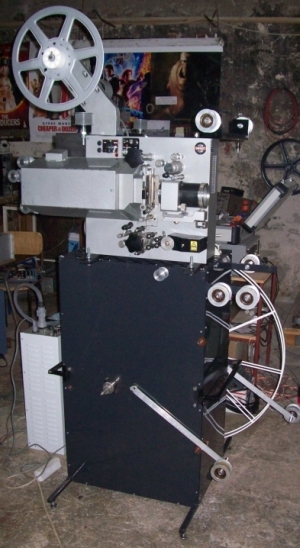
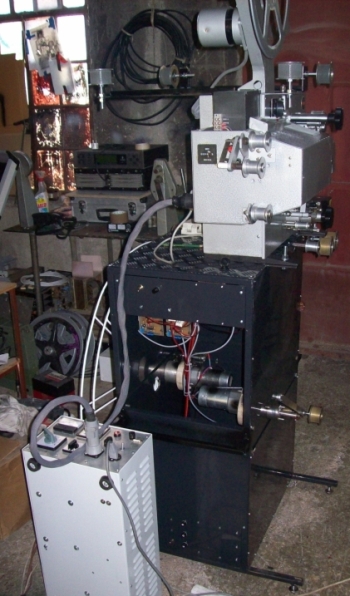
Posted by Tim Reed (Member # 137) on 06-20-2008, 09:17 PM:
Wow. Good work! ![[thumbsup]](graemlins/thumbsup.gif)
Powered by Infopop Corporation
UBB.classicTM
6.3.1.2