This is topic Centralized platters? in forum Film Handlers' Forum at Film-Tech Forum ARCHIVE.
To visit this topic, use this URL:
https://ft-forum.com/ft/cgi-bin/ubb/ultimatebb.cgi?ubb=get_topic;f=1;t=008853
Posted by Bryan M. Montgomery (Member # 4412) on 07-29-2007, 12:38 AM:
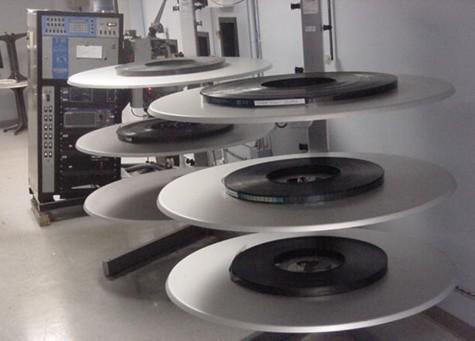
I recently got a Print Pocket for my 16 plex and I love it, so I searched the topics here to see others opinions on it. I found several references to Brad Miller's placement of the platters in a central area of the booth as means to eliminate print shuffling, but I cant quite picture how this is possible in my mind. Got any pictures Brad?
P.S.- Brad, Film-Guard= pure genius. I was the first operator to test your product for Regal back in 2000,wont go a day without it since.
Posted by Brad Miller (Member # 2) on 07-29-2007, 12:58 AM:
Here is one of 5 theaters I have set up like this.
Posted by Monte L Fullmer (Member # 2797) on 07-30-2007, 04:25 AM:
Also very impressive. Tons of film stringing from hither and yon with this setup.
Question for Brad: those larger rings on the decks - to control the rewind tension better and/or for better payout as well?
(Hope the guys that operate this style of booth are being paid rather well since the training and operation isn't for your typical booth clown...prob almost takes a specialist to operate this booth)
-thx Monte
Posted by Brad Miller (Member # 2) on 07-30-2007, 05:05 AM:
Larger rings permit the guys to walk normal speed, or briskly if so needed. Since the inner diameter of the film roll is larger, every spin of the platter is capable of feeding more film per second during threading.
The pictures look intimidating, but as the system design gets more simplified and versatile as time goes on, we are finding that most people get the hang of it after 1-2 shifts.
Posted by John Wilson (Member # 269) on 07-30-2007, 06:45 AM:
Why did you adapt from the platter cluster in the center of the room? Was it just a space issue in this instance or does this way work better for some reason?
Posted by Chris Slycord (Member # 4239) on 07-30-2007, 09:11 AM:
Clearly "moving" a print to it's new auditorium is much simpler this way or if you needed to swap 2 auditoriums if one movie is doing more business to get in the larger house.
Though obviously it requires a ton more head/tail leader.
Posted by John Wilson (Member # 269) on 07-30-2007, 11:50 AM:
No Chris,
I was referring to this previous version (pictured) as opposed to the newer formation.

I´m at work right now and can´t resize but I'll edit this later with a decent sized image.
Posted by Brad Miller (Member # 2) on 07-30-2007, 03:42 PM:
It just depends on the booth layout as to what is easiest and most flexible. The Arlington booth didn't have an open space large enough to facilitate back to back platters, whereas the Houston booth didn't have enough length to line them all up in a row even if we had wanted.
Posted by Monte L Fullmer (Member # 2797) on 07-30-2007, 07:36 PM:
quote: Chris Slycord
Clearly "moving" a print to it's new auditorium is much simpler this way or if you needed to swap 2 auditoriums if one movie is doing more business to get in the larger house.
Basically, what's created here is a simple tradeoff - either scoop/clamp prints (which the latter does horrendous things to aluminum decks) and have potiental print droppage/scratching, or let the system do the moving for you with this conception of the "platter farm" and prevent such accidents.
But the other tradeoff is that the training is more extensive in this case whereas I mentioned before, "definitely a place for booth clowns."
Personally, I'm very impressed with this operation and see it as an ideal way to handle film in such a manner, but unfort, whereas we're surrounded by "booth clowns", I wouldn't even think of it of being an operation to be feasible.
p.s. Brad, thx for the answer - makes perfect sense and can see guys wisk down the booth at a decent pace instead of having to wait for the deck to catch up in payout during lacing.
Posted by Christopher Meredith (Member # 3767) on 07-31-2007, 10:41 AM:
I'll probably get flamed for this, but I've never had a problem with moving prints around without clamps or a print pocket. I've found that it is possible, with small stick-on weights on the back of the "elevator" on a Strong platter system, to get the take-up tension sufficient to prevent the film from slipping against itself, but not so tight that the roll collapses when the ring is removed.
In this way, it's a trivial matter to slide the print off the platter onto my arms and carry it down the booth by myself at a 60-degree angle to the floor. The print is quite secure and has never resulted in damage to the print this way. It's also easy and requires no equipment (though you do work up a sweat moving 10-14 prints this way!)
I've probably done this 500+ times over the past couple of years with no problems. The only time I was ever involved in a dropped print was when I was doing the two-man carry with Harry Potter and the Prizoner of Azkaban. That might have been the worst night of my life...
Posted by Mike Blakesley (Member # 26) on 07-31-2007, 10:49 AM:
quote: Christopher Meredith
The print is quite secure and has never resulted in damage to the print this way.
Unless you are able to keep the film pack completely rigid and the center hole completely round, you ARE sliding film against film, which will make scratches.
Posted by Christopher Meredith (Member # 3767) on 07-31-2007, 10:55 AM:
Yes, the film pack does remain rigid this way. It takes a bit of trial-and-error to get the proper weight, but once you find the "sweet spot," the film pack will remain rigin unless severely jarred in transit (i.e. if the print mover trips or something).
Also, the ring does remain round (if it was round to begin with! ![[Wink]](wink.gif) ). It is a little tricky to slide the ring up enough so that the print will slide off the platter, but it can be done without collapsing the ring or sliding film against film (except the leader, but who cares about scratches on the leader?)
). It is a little tricky to slide the ring up enough so that the print will slide off the platter, but it can be done without collapsing the ring or sliding film against film (except the leader, but who cares about scratches on the leader?)
Posted by Andrew McCrea (Member # 674) on 07-31-2007, 12:44 PM:
Are Christie platters the only ones that can be used, or can you use any kind of platter?
Posted by David Zylstra (Member # 4230) on 07-31-2007, 01:50 PM:
quote: Christopher Meredith
I'll probably get flamed for this, but I've never had a problem with moving prints around without clamps or a print pocket. I've found that it is possible, with small stick-on weights on the back of the "elevator" on a Strong platter system, to get the take-up tension sufficient to prevent the film from slipping against itself, but not so tight that the roll collapses when the ring is removed.
No flame thrower here, when I ran a booth for my previous employer we had ORC platters circa 1989/90 - those natively wrapped tight enough to move the prints without clamps, I think some of the sales literature even touted that films were wrapped tight enough to move without clamps. Those were some tight wraps - you had to really screw up to make the wrap fall apart. (of course my rule was "do as I say, not as I do - everyone must use clamps!)
Posted by Monte L Fullmer (Member # 2797) on 07-31-2007, 01:50 PM:
I can see Christies being the only ones used since it has that great takeup roller arm that has enough return pull tension that even an interlock between two AW3R decks don't need an accumulator between them. Plus, each deck is independently from each other - each with their own control.
STRONG's wouldn't work for the simple case that the decks are not independently controlled were they all depend on that one variac in the base (might say "dumb" platters-no 'brains'). Might be fine for rewind, but the payout platter won't have any variable speed control if the traveller is in the locked position.
(I ran a 4plex that had 4 of the old AW2's that wound prints so tight that I can actually roll the prints on their edge down the booth - as long the ring didn't pop out on me..quite fun this was..)
-Monte
Posted by Thomas Pitt (Member # 4322) on 07-31-2007, 05:27 PM:
While a centralized platter 'farm' may make it easier to move prints from one auditorium projector to another*, there are quite a few disadvantages to this arrangement:
Harder to service the platters (less space)
Lots more head and tail leader needed to reach the projector
Projectionists have to duck and dive to avoid moving film strips
More susceptible to airborne dust and dirt (more film exposed)
* Some platter 'farms' can feed any projector, eliminating the need to move prints between platters.
Also, when I looked into an IMAX booth, the projectionist had a sort of hand-operated fork lift truck, which was used to help load and unload prints on the platters. I can only assume that in this situation, it was easier to keep the IMAX film prints assembled on their platters, and load the platters onto the spindles when necessary. Eliminates the need to keep breaking down and building up again!
Posted by Brad Miller (Member # 2) on 07-31-2007, 07:00 PM:
quote: Thomas Pitt
Harder to service the platters (less space)
Actually no, there is more room and better light.
quote: Thomas Pitt
Lots more head and tail leader needed to reach the projector
So? We just use a junk trailer on the tail end of the prints which would otherwise have been thrown away. As far as head leader is concerned, the more the better, because it is the handling that makes most film presentations cluttered with dirt when the first image hits the screen. The extended head leader also provides tons of time for the xenon to stabilize as well as the entire design by it's nature keeps the threading leader entirely off of the floor.
quote: Thomas Pitt
Projectionists have to duck and dive to avoid moving film strips
The film runs all along one 2 foot wide strip down the center of the booths. If that is such an obstacle for you to dodge, then you've got bigger problems.
quote: Thomas Pitt
More susceptible to airborne dust and dirt (more film exposed)
Total bullshit. This has been raised before and simply does not hold up in real life. AIR does not damage film and if your booth is that dusty the film is going to get exposed to anything airborne anyway. Besides, these theaters run the prints through a film cleaner every single pass and there does not exist a theater with cleaner prints anywhere in this part of the country that I am aware of.
You also fail to take into account the various scheduling advantages of such a system. For example you can have a long movie and a short movie bounce back and forth between auditoriums all day long to SHORTEN the business day and still maintain the same number of showtimes (or the reverse, fit that extra show in). Having to physically move the print takes a bit more time and every time a print is physically moved the film is at a noticeable risk of damage, whether it be cinch scratches from flimsy center rings (like Strong) where the film is permitted to slip against itself, or a flat out drop.
You also forget that such a system forces quality projectionsts in the booth to operate it.
You may be quick to point out the cons, but for this chain's purposes the benefits outweigh any disadvantages.
Posted by Chad M Calpito (Member # 3736) on 07-31-2007, 08:15 PM:
When I looked at the Pics, I was amazed at it's simplicity as Brad pointed out. It certainly makes me wish I had something like that in my booth, but, space restrictions for such a system wouldn't make it possible. A system like that makes perfect sense. Way to go, Brad. You're a genius. ![[Big Grin]](biggrin.gif)
Posted by Mike Blakesley (Member # 26) on 07-31-2007, 09:33 PM:
Are those larger rings a "stock" item from Christie? I wouldn't mind getting one of those...would make print building faster.
Posted by Brad Miller (Member # 2) on 07-31-2007, 10:50 PM:
Yup, that is the oversized ring they offer. Nothing special.
Posted by Tim Reed (Member # 137) on 07-31-2007, 11:07 PM:
quote: Monte L Fullmer
STRONG's wouldn't work for the simple case that the decks are not independently controlled were they all depend on that one variac in the base
SCDCs would work.
Posted by Mark Gulbrandsen (Member # 72) on 08-01-2007, 12:07 AM:
The oversized rings also help when platter calibration has drifted off because the deck does not have to turn as fast at the beginning of the film.
quote: Tim Reed
SCDCs would work.
Yes, they would.
Mark
Posted by Chris Slycord (Member # 4239) on 08-01-2007, 12:14 AM:
quote: Brad Miller
Actually no, there is more room and better light.
Having not used one and am only going based on pictures, I'd have to say I agree with you. Having the projector in a different section would allow you to have any sort of lighting configuration with no possible hurt to the presentation.
quote: Brad Miller
You also fail to take into account the various scheduling advantages of such a system. For example you can have a long movie and a short movie bounce back and forth between auditoriums all day long to SHORTEN the business day and still maintain the same number of showtimes (or the reverse, fit that extra show in).
My theater had something like this happen a while back. Some movie played only twice a day but it was in 2 different theaters. It would essentially be the 1st show of the day in theater A and be the last one in B (I forget which ones it was). And it was pretty annoying to have to move that print twice everyday (would've been simpler if we had known about the print pocket; but our "donut boards" do the job). But print pocket or not: central platter would've been sweet.
The only issue I could see with "booth clowns" is that I've have people thread the wrong movie when the print is right there next to the projector; they could end up threading anything now. On the other hand, if the print can be anywhere it has a possible built-in fix since the person has to look for the print. But idiots always prove that nothing is idiot-proof.
Posted by Monte L Fullmer (Member # 2797) on 08-01-2007, 12:31 AM:
quote: Tim Reed
SCDCs would work.
(Whoops..forgot about those newer STRONG platters - one can tell that I've got A3/AP3's on the mind...)
I guess simpler put that any platter assembly that has decks that are independent of one another would work great in a platter farm as what Brad put together.
Nice thing on the oversized rings is that they do come in handy in trailer pak changeouts - wind the last show on one of these rings, take the ring out and insert the new trailer pak that is wound on a conventional ring and simply insert the entire pak inside this enlarged area..and have no film tipping on the edge of the wind if used conventional rings.
Posted by Bryan M. Montgomery (Member # 4412) on 08-04-2007, 01:52 AM:
Brad, that looks both brilliant and incredibly complicated. Bravo for thinking outside the box and all the inovations.
Christopher: I have increased take-up tension on the Strong platters to allow clamp-free moving in the past, however we did it a bit different.When we knew we would be moving a print, on its last thread-up instead of threading the dancer (speed control)with the normal "W" thread, we would thread the film in a "Z" shape, hence we called it "Z-ing the print." It worked, but concerns over film damage have urged me to eliminate this from my booth. I cant trust the button-pushing monkeys that work at my theater too much ya know?
Posted by Monte L Fullmer (Member # 2797) on 08-04-2007, 03:28 AM:
Yes, that "Z" lace through the "W" is quite interesting..film's really tight around that ring.
When we transfer prints from city to city, I do the "Z" along with the clamps to keep things together..
Posted by Chris Slycord (Member # 4239) on 08-04-2007, 03:48 AM:
quote: Bryan M. Montgomery
Christopher: I have increased take-up tension on the Strong platters to allow clamp-free moving in the past, however we did it a bit different.When we knew we would be moving a print, on its last thread-up instead of threading the dancer (speed control)with the normal "W" thread, we would thread the film in a "Z" shape, hence we called it "Z-ing the print." It worked, but concerns over film damage have urged me to eliminate this from my booth. I cant trust the button-pushing monkeys that work at my theater too much ya know?
Even if we had Strong platters I would never move a print like that. The damage is one thing (that much tension just seems to be a bad thing to me), but if you ever had where your variac or motor started not performing quite as well as they used to you could end up with a print that wasn't on there tight enough to move and then you've got an entire print on the floor.
On the other hand, lots of people here use this method all the time with good results so maybe my ideas are more "theoretical" and in the real world I'm full of shit...
Posted by Brad Miller (Member # 2) on 08-04-2007, 04:38 AM:
Hanging a suitable weight from the takeup elevator is a superior solution than the Z threading. Too much tension and the slightest slippage causes more film damage than moving a print that is wound loose. Bear in mind, if you breathe on those Strong rings they will bend, so I consider it a very bad idea.
Also Monte, the SCDC won't work well in a platter array as there is no way to do dual takeup.
Posted by Monte L Fullmer (Member # 2797) on 08-04-2007, 04:22 PM:
quote: Brad Miller
as there is no way to do dual takeup.
..as why the AW3R platters are still the best platters that I've ever worked with. The options that one can do with those platters
True, since "BigBrother" variac still controls those STRONGS...
Posted by Bryan M. Montgomery (Member # 4412) on 08-05-2007, 01:22 AM:
Yeah, I dont allow anyone to "Z" the prints anymore, never liked the idea in the first place. I'll stick to me and my Print pocket.
The only good thing about the Strong platters is that due to the simple engineering of it,it can be fairly easy to repair.There isnt much a Strong platter can do that I cant fix.
Posted by Andrew McCrea (Member # 674) on 08-05-2007, 01:32 PM:
So, dual take-up or payout... Is that something that can be set-up with a Christie platter very easily, or do you cheat in threading and use different rollers?
Please help me understand these platter farms a little better!
Posted by Brad Miller (Member # 2) on 08-05-2007, 02:34 PM:
Ian coined that dorky phrase "farms".
Just look at the pictures. The mods are nothing super secret and most of them are figured out just by the photos. (The seperate payout vs. takeup speed mod can't be seen in a picture though, nor can the motorized tail spool-up.)
I have actually heard other multiplexes are planning or already have made some of these mods to work as backup for when something does fail. For instance you have #1 and #2 side by side. The #1 platter is on the operator side and the #2 platter is on the non-operator side. As such, if both platters have dual payout and takeup, you don't need to move prints between those two auditoriums, and if one platter fails, you can keep shows running on the other machine just by threading an extra 10 or 20 feet.
Posted by Monte L Fullmer (Member # 2797) on 08-05-2007, 08:38 PM:
Here's my "mini platter farm" with this STRONG setup.
I've set up these two platters to where I can put 5 shows in this one house and film can travel anywhere between the two units.
The platter unit next to the console has the wrap detector so that the feed from either platter unit goes through the wrap detector
Only trick on this one is that I use phase control brains, not those cheezy microswitch brains since the payout deck has to have the "W" unit locked up to pay out. Thus, I've drilled a new hole in the column so that the "W" unit is higher when locked, thus allowing slower motor speed on payout.
Owner was impressed with this setup since he asked me if I can set up a house that can show more than two prints and we had this extra AP3 and accepted the challenge.
Christies and even those DriveIn LP-270 platters are blessed platters since each deck is independently controlled-being that the Christie AW3(r) has more versatility than the LP-270. Being with each deck having it's own control, there is unlimited variations that can be done.
Guess the next challenge is to set up a 10 plex with a 5-deck Christie farm especially if the booth can't merit a full mid-floor, 10 deck farm
-Monte
Posted by Scott Hicks (Member # 376) on 08-09-2007, 08:37 PM:
Do you splice on more "junk" trailer footage on the tails of all the prints, so the credits don't drag across the floor? Is the t-bar ceiling structure beefed up to support the extra weight of the plywood roller trees? Seems like if you had a film wrap that went undetected, you could risk pulling down the ceiling (killing many shows at once). Don't get me wrong, I think it's a cool setup, but I can't help but thinking of new and exciting potential problems.
If one doesn't want to move prints, why not put locking castors on all the platters, mark the floor, set all the guidance to the same aim points, and simply roll the entire platter to where the print needs to go. Of course a hard floor surface would be required.
Another question, does the projectionist run down with the leader, hit the projector, run back to thread the takeup, and then run back to thread? OR, do you thread feed to takeup and pull the loop down to the projector for threading?
I'll be sure to visit one of you installs next time I'm in TX!
Posted by Brad Miller (Member # 2) on 08-09-2007, 10:38 PM:
Each print gets 150 feet of extra tail leader, ideally from trailers for movies such as I Know Who Killed Me, as those deserve to be dragged across the floor.
The clips that hold the rollers onto the slide bars are enough to keep them snug and in place, but if a wrap was to start, they will pop off. A few years back when I set up the first array for that company there was an accident where the projectionist bumped another film path as he was threading and it tripped the failsafe. Since then I added bobble delay to the failsafes just in case that was to happen again, but it hasn't. The theaters just don't have wraps. They run FilmGuard on every show so there isn't any static, and they use the safety rings around the prints, so even if a platter is acting spastic, the print isn't going anywhere.
The projectionist threads brain to takeup ring, then threads it into the projector. Other than the junk tail leader, the film and leader never touches the floor.
Posted by Monte L Fullmer (Member # 2797) on 08-10-2007, 04:51 AM:
quote: Brad Miller
The projectionist threads brain to takeup ring, then threads it into the projector. Other than the junk tail leader, the film and leader never touches the floor.
..like threading the target machine first, then threading the source machine second and then gathering up slack inbetween before hitting the <start> button?
Posted by Mark Gulbrandsen (Member # 72) on 08-10-2007, 08:12 AM:
quote: Brad Miller
theaters just don't have wraps. They run FilmGuard on every show so there isn't any static
Actually Kodak took care of that many moons ago with the conductive coating or layer. I'm sure the FG does keep the prints looking nice though. So what about how the giudance hardware is fastened to the ceiling. Is it attached to the roof joists... or the ceiling grid? If not the joists then I can definately see the ceiling suffering a major blow when there is a wrap. Don't forget BRad... while you may not have any wraps the rest of the world does....
Mark
Posted by Chris Slycord (Member # 4239) on 08-10-2007, 12:44 PM:
quote: Monte L Fullmer
..like threading the target machine first, then threading the source machine second and then gathering up slack inbetween before hitting the <start> button?
I believe he means "Thread from starting platter to ending platter with ring; then pull the film to the projector you want and thread."
Posted by Monte L Fullmer (Member # 2797) on 08-10-2007, 01:59 PM:
quote: Chris Slycord
I believe he means.......
![[Roll Eyes]](rolleyes.gif) ..in a different term...
..in a different term...
Posted by Brad Miller (Member # 2) on 08-10-2007, 03:39 PM:
quote:
Actually Kodak took care of that many moons ago with the conductive coating or layer. Don't forget BRad... while you may not have any wraps the rest of the world does....
Mark, actually no you are wrong, plus you then contradicted your inaccurate comment. Kodak only helped the problem, they certainly did not eliminate it because like you said, the rest of the world still does have wrap problems...and FilmGuard does eliminate them. As far as I am concerned, anyone really wanting to set up a platter array who isn't using FilmGuard is just asking for problems because that sort of setup is only really suitable for projection booth with operators that really know their job and have all the proper tools.
You also failed to read my earlier posts, because I clearly noted that if there was any sort of wrap, the rollers will release themselves from the slide bars. The drop ceiling does not need to be anything special.
Monte, I have no idea what you are talking about with target and source machine. The film path is simply threaded past the front of the projector all the way back to the takeup ring and then it is put into the projector.
Posted by Dustin Mitchell (Member # 372) on 08-10-2007, 04:34 PM:
While I can't see that static no longer exists I can say that it has been literally years since we had a static problem with any of our prints. I can remember when we'd have atrocious static problems for apparantly no reason-now (or rather, before we went all digital) it is not an issue at all. We don't use film gaurd (though I would have like too); no media cleaner.
Posted by Monte L Fullmer (Member # 2797) on 08-10-2007, 07:17 PM:
quote: Brad Miller
The film path is simply threaded past the front of the projector all the way back to the takeup ring and then it is put into the projector
Sorry, got mixed up with interlocking ... Your setup is to have a common area and allowing the film to head to any machine and return back to that common area ... sorry on that... ![[Frown]](frown.gif)
Posted by Brad Miller (Member # 2) on 08-10-2007, 08:43 PM:
Interlocking is even easier. Thread exactly like normal, but when you reach the takeup platter wrap the film backwards around the final roller and then over the side-slung roller on the top of the platter tree...and then back out again to another projector. Repeat for every additional projector you want. This way the takeup arms act as accumulators and when you thread the physical projector heads in reverse order, you can actually thread a 3 screen interlock in less time than threading up 3 separate prints.
Posted by Mark Gulbrandsen (Member # 72) on 08-11-2007, 10:50 AM:
Brad,
Thats funny because none of our customers either using FG or not have any static problems at all since Kodak has been applying the anti-static layer on it's release prints and its alot lower humidity here that down in your area. Iff a release comes in on other stocks then its another story and I've sold countless bottles of FG for that reason.
Mark
Posted by Brad Miller (Member # 2) on 08-11-2007, 01:37 PM:
Ok Mark whatever, as always you are right about everything, whether it be how the CP650 used to sound awful but now after Dolby has done nothing to it suddenly it sounds wonderful. Whatever you say. That doesn't change the fact that I haven't seen any difference on the first pre-FG payout of static action between different filmstock manufacturers. I highly doubt anyone else on this board has noticed such a specific difference between filmstocks.
Anyone NOT using FG care to comment? New Line always prints on Fuji filmstock...anyone have problems specific to New Line prints regarding static and wraps? I'll bet the reports will be "about the same".
It's not quite cut and dry between Kodak and Fuji as you would like to paint the picture Mark. Fact of the matter most theaters can be grouped into one of 3 categories in regards to FG, film condition and static/wraps. There are people who use FG because they care about having their presentation flawless and a side benefit is not to have to worry about wraps. Then there are people who don't use FG who have wraps regularly and continue their operation this way for laziness or because their corporate office won't let them have it. Then there are people who don't use FG that just don't have static problems at all...they just have at minimum dirt problems. (Some of these people claim their presentation is perfect though because they just aren't all that picky. I've never seen a non-FG presentation after a week of playing the print that I would consider perfect. More often than not I wouldn't consider the presentation perfect on their opening day because of shipping and handling dirt buildup.)
Posted by Chad M Calpito (Member # 3736) on 08-11-2007, 04:30 PM:
In answer to your query, with regards to who doesn't use FG & any static problems, etc., Brad, I haven't had any static problems at all at my theatre regardless of the Film Stock. So, I definately agree with you 100%, Brad.
Posted by Dustin Mitchell (Member # 372) on 08-11-2007, 07:47 PM:
Perhaps Fuji also developed an anti-static process? Whatever it is your both right-Brad is right it doesn't appear to have anything to do with filmstock but I think Mark is also right about static not being an issue the past few years j(at least). My theatre used to have horrendous static problems. Nothing changed in our operations but the static problems just disapeared without explanation.
Posted by Mark Gulbrandsen (Member # 72) on 08-11-2007, 08:35 PM:
quote: Brad Miller
whether it be how the CP650 used to sound awful but now after Dolby has done nothing to it suddenly it sounds wonderful.
Brad,
In case you missed it all there have been ALOT of software upgrades to the 650, or perhaps you were not installing them back then. And yes after a point in software maturity the 650 did sound better but its still not as good as the CSP-1200. I still have one 650 runnning with the old software version if you'd care to hear it sometime. FYI... Clint has heard that version of the processor at that theater.
quote: Brad Miller
There are people who use FG because they care about having their presentation flawless and a side benefit is not to have to worry about wraps. Then there are people who don't use FG who have wraps regularly and continue their operation this way for laziness or because their corporate office won't let them have it. Then there are people who don't use FG that just don't have static problems at all...they just have at minimum dirt problems.
You missed two... There are the chains with people at the top who buy FilmGuard that don't pay their employees enough to care to bother to use it.
Or there are theater chains that demand it be used but can't hire enough employees to man the booth properly no matter what the pay.
Mark
Posted by Brad Miller (Member # 2) on 08-11-2007, 09:11 PM:
Mark, I'll give you your last point, but I think the point above it falls within the "too lazy" category. We seem to have an abundance of that in this industry, and it is ultimately what is driving more people to home theaters instead of to the big screen.
I am not even going to get into the 650 argument. Sorry, but I side with Mr. Guttag on that one. If you want to dredge that back up, please take it back into a Dolby thread.
Posted by Mark Gulbrandsen (Member # 72) on 08-11-2007, 09:44 PM:
I agree there are too many lazy people manning booths out there but in many of the places I service you'll find the laziness is because of whats called minimum wage. I work with a 100+ screen chain that is run that way ![[thumbsdown]](graemlins/thumbsdown.gif) . The good side being that we make a ton of money repairing everyones mistakes. In many cases a decent pay scale will get the workers attention resulting in better work standards since they are more likely to WANT to keep their job. I have a 60 screen chain plus many smaller independents that I service that are run on exactly that premise and it works very well. Most of the booth employees at that chain stay at their jobs for many years and become quite profecient.
. The good side being that we make a ton of money repairing everyones mistakes. In many cases a decent pay scale will get the workers attention resulting in better work standards since they are more likely to WANT to keep their job. I have a 60 screen chain plus many smaller independents that I service that are run on exactly that premise and it works very well. Most of the booth employees at that chain stay at their jobs for many years and become quite profecient.
Mark
Posted by Brad Miller (Member # 2) on 08-11-2007, 09:50 PM:
If only other people understood how that works.
Posted by Monte L Fullmer (Member # 2797) on 08-11-2007, 11:34 PM:
...they were never taught the "magic" of the cinema - to have excellent presentations like the ones that are in this forum that knows what this "magic" is.
Posted by Steve Guttag (Member # 268) on 08-12-2007, 06:48 AM:
Unless you are running something before version 1.1.7.x....you are really reaching on the software vs sound on the CP650...which is really around their very first release of the product. About the only other sound improvement came in the version 2 of the software when noise floor optimization came in (2.1 or 2.2, I think). However, I doubt many, except for screening rooms, turn that on since one may potentially clip the system. Also, in most theatres the hiss level is around the HVAC level.
Posted by Mark Gulbrandsen (Member # 72) on 08-12-2007, 11:56 AM:
quote: Monte L Fullmer
...they were never taught the "magic" of the cinema - to have excellent presentations like the ones that are in this forum that knows what this "magic" is.
On the contrary... I teach the magic of Cinema at every training class I do. The problem is that for $4.60 an hour(or what ever measly pay they get) that magic only last so long and goes so far, usually about 6 paychecks in duration after which they go onto higher paying endeavors at places like Wendy's and McDonalds which in some town on my routes pay nearly $15.00 to start. It is these theaters that digital is but a savior!!
Steve,
I don't remember the exact version I left on that one processor... will look next time I go there but those 650's are pretty darn old. I upgraded one when I went thorugh St George a couple of weeks ago that was definately a 1.7x something or other. Our tech down there has since made sure the rest of them have been brought up to date.
I would suggest you ask Clint what he thought but we were all pretty much in agreeance that it wasn't sounding like a $10,000 dollar procecssor. Hence CLACO didn't sell any 650's for a while. It was when I upgraded the rest of them in that complex that I noticed a definate change for the better in SR playback. No complaints since but I still prefer the CSP-1200 quite a bit more.
Mark
Posted by Steve Guttag (Member # 268) on 08-12-2007, 12:44 PM:
I don't think they had a 1.7.x.x version...the settled on 1.2.3 for a while then version 2 came out which nixed the ability for the unit to hang up and dump its settings.
I had early CP650s and there were no problems with the SR decoding whatsoever and the CP650 remains the best SR emulator in the digital domain. Don't bother repeating your belief about the JSD-80's SR decoding...it really mistracks quite a bit and is a bit too noisey for my likings.
There was a high-frequency tone on the outputs of early CP650s (in excess of 100KHz) that would trigger the SPI LEDs on such amps as Crowns that put the SPI circuit on the input pre-fader.
The CP650 has gotten quieter over time due to noise floor optimization for those that use it. But as far as to sonic improvements to the SR decoding and other firmware related changes...you are definately reaching and will have a hard, if not impossible time proving your position with an A/B test where just the firmware is changed unless you go back to 1.1.3 or so. I had some 1.1.7 units sounding pretty damn good...what did you do wrong to have your units sound bad? I have since upgraded those units to 2.x.x.x for the features those firmwares bring (not dumping memory...virtual Dolby Digital voltmeter, noise floor optimization...remote control interfacing...etc)...when the updates were done NOBODY said "WOW, does that sound better!"
Posted by Brad Miller (Member # 2) on 08-12-2007, 12:53 PM:
Hmmmm, I think there are Dolby threads that would fit this discussion a bit better.
Posted by Steve Guttag (Member # 268) on 08-12-2007, 01:03 PM:
I'm sorry....<sulking> ![[uhoh]](graemlins/uhoh.gif)
Posted by Mark Gulbrandsen (Member # 72) on 08-12-2007, 03:56 PM:
quote: Steve Guttag
Don't bother repeating your belief about the JSD-80's SR decoding...it really mistracks quite a bit and is a bit too noisey for my likings.
I don't remember saying that the SR in the JSD was 100% correct... It IS light years ahead of its predecessor though and a great Aux input processor.
Now back to the regularly scheduled Centralized platter thread!!
Mark
Posted by Michael Schaffer (Member # 1204) on 08-12-2007, 05:35 PM:
quote: Steve Guttag
Don't bother repeating your belief about the JSD-80's SR decoding...it really mistracks quite a bit and is a bit too noisey for my likings.
How can you tell how much a system mistracks, unless you have heard a particular soundtrack on an excellent original SR system and know how well it sounds, how much the channels are separated in particular situations etcetc?
Posted by Mark Gulbrandsen (Member # 72) on 08-12-2007, 06:51 PM:
quote: Michael Schaffer
How can you tell how much a system mistracks, unless you have heard a particular soundtrack on an excellent original SR system and know how well it sounds, how much the channels are separated in particular situations etcetc?
Thats exactly what I do, I have a reel that I have been using for the better part of 10 years now, it gives the processor and the entire sound system a real workout in many different aspects. Needless to say I am extremely familiar with how it should sound. Hopefully you also have a certain very high quality reel that you are most familiar with! If you want to continue this discussion thats great but please start another thread elsewhere and let Brad have his thread back as he asks above.
Mark
Powered by Infopop Corporation
UBB.classicTM
6.3.1.2