This is topic Excesssive dynamic range in "Dirty Dancing"? in forum Film Handlers' Forum at Film-Tech Forum ARCHIVE.
To visit this topic, use this URL:
https://ft-forum.com/ft/cgi-bin/ubb/ultimatebb.cgi?ubb=get_topic;f=1;t=008893
Posted by George May (Member # 1060) on 08-26-2007, 06:23 AM:
I screen films out of doors in the summer using a mobile rig including a CP-55 with SR cards. This year "Dirty Dancing" has been my clients' number 1 choice.
I've screened it in SR, in stereo from the pre-amps fed to an FM transmitter for mobile drive-ins, and in stereo fed to a two-channel PA system at music festivals.
At all of these show I've had dynamic range problems. If I set the volume to be right for the dialogue, the musical numbers are overpoweringly loud; if I set it so the songs are good, the dialogue is well-nigh inaudible. The print looks to date from 2004. It's not got a cyan track.
Is it just the print I have been using, or a common problem? Any ideas?
Thanks.
George
Posted by Kenneth Wuepper (Member # 1174) on 08-26-2007, 07:25 AM:
George,
Sounds like you have a really good business going for you. ![[beer]](graemlins/beer.gif)
The center channel caries the dialog. We have a local group that show DVDs outside on a screen attached to a building wall. (Yes! They do pay for the right to show them.) Their sound guy has only used the left and right tracks from the player into two amplifier and speaker channels. They have the same problem you describe, namely the dialog is too low to be heard.
Since you have a processor, you need to add the center channel back into the mix so that it can be heard. The left and right outputs from the processor contain very little dialog.
KEN
Posted by George May (Member # 1060) on 08-26-2007, 07:53 AM:
Kenneth, you've misunderstood me. When I say I use "stereo" that's the amplified L and R outputs from the solar cell, pre any Dolby processing.
George
Posted by Marin Zorica (Member # 1716) on 08-26-2007, 09:00 AM:
I remember that movies...because some of mine client want a mp3 record from film before buying mine preamp for cinema...so accidentally that was movies I recorded him....about 10 min from last rell....and I didn't notice any problems like that.
Posted by Ben Wales (Member # 92) on 08-26-2007, 09:19 AM:
quote: George May
When I say I use "stereo" that's the amplified L and R outputs from the solar cell, pre any Dolby processing.
I would say that's your first problem as it is not Processed Signal and the Centre Channel has not been decoded.
When I have done Outdoor Cinema Screenings, I have set up the L/C/R from the Dolby Processor into a Audio Mixing Desk and Pan the Centre Channel level between L/R, it is also helpful as you can adjust the Levels etc.
Posted by Jack Ondracek (Member # 1466) on 08-26-2007, 10:20 AM:
George:
I ran unprocessed Dolby for years. Back when we were just transitioning from those window speakers, even unprocessed audio sounded better.
You really set your own baseline at a drive-in, because in a sense, each car is it's own "mini auditorium". Each of them has separate, horrible acoustics, so you can't adjust for that like you would a single-room sound system. Some patrons take the speakers out of the cars and set them on the roofs... so what IS normal, and how do you set your system up for it? Added to the challenge, the occupants of those cars have most likely been listening to excessively-processed FM radio stations, so any attempt on your part to expand that dynamic range only makes YOU sound strange.
At lower levels, the companding in SR brings background sounds up close to dialog levels and makes it difficult to separate them. At higher levels, the dynamics force people to constantly twiddle with their volume controls. Without decoding, you can't do anything about the way frequencies are rebalanced in the sound track. Some try to tone the highs down with equalization, but it'll always sound a little strange.
If you watch a scene where two people are on a sidewalk, trying to have a conversation near traffic, you'll immediately recognize this. Even with only a few cars going by, they always seem to sound like they're in downtown New York, and all the cars are 2 feet from the actors, who don't seem to notice.
The best solution I've found is to use properly decoded audio, mix the channels down to the two you need, then use some compression to reduce the dynamic range to suit the environment. That might seem contradictory, but it works.
SR decoding will restore the frequency AND dynamic balance, since the encoding process is based on both. However, at that point you have a process that can generate close to 80dB range at the outputs. FM can't handle much more than about 40, and the audio processing most stations use reduces that even more. Few films actually make use of that much range, but it's still much more than you can handle in a car or outdoor setting. If you set your audio for good dialog levels, quiet passages won't be heard, and loud noises can either clip or at worst, possibly damage a sound system.
The environment you're running your films in is hostile to dynamic range. In both outdoor and in-car environments you have higher ambient noise... traffic, conversation, animals, kids. Reducing the dynamics through compression will keep low passages at a level where they can be heard, while controlling those noisy songs and eliminating most of that knob-twiddling. In an outdoor setting, audio much more than about 20dB below a listenable level will be lucky to be heard past the front row, so the same approach is valid. The highly-processed rock stations many people consider "normal sounding" have a dynamic range of about 2 dB. At higher levels these stations will hurt your ears fast... but you can turn them down to almost nothing and hear everything over all your ambient noise because of the non-existent dynamics. Finding the balance that suits you is a matter of personal choice and opinion. Everybody has one, but you get to decide what's best.
Use a mixer with active inputs to mix your channels down to the two you need. Behringer makes some rack-mount and portable models that are inexpensive and work well for this application. Hook your left audio to a left-panned channel, and your right to a right. Use mono inputs for center, surround and subwoofer channels, if you use them, and pan them to the center. IF you eventually get digital sound (like with a Dolby or DTS processor) and want your surrounds mixed in, those will need to be routed left and right, but not with the single-channel surround of analog SR.
Now you have the ability to balance your audio and bring dialog up a couple of dB, if you need to.
Good compressors are everywhere. Symetrix, DBX and Behringer make good single-band models. I have the Broadcast Warehouse DSPXtra systems here, because I prefer the way multiband units sound.
Some FM transmitters have compressor/limiters in them, including those made by Broadcast Warehouse. They're mainly good for keeping modulation levels within limits, but are also used with some success for the dynamics processing you'll need. While the internal compressor doesn't go far enough for me, they're much better than nothing and quite a few drive-in operators are happy with them as they are.
Hope some of that helps.
Posted by Ben Wales (Member # 92) on 08-26-2007, 10:49 AM:
The A/V supply Company Studio Spares are a good start to buy Mixing Desks etc and are good Prices!.
Studio Spares
Posted by George May (Member # 1060) on 08-26-2007, 12:23 PM:
Thank you for all these good ideas, especially the remix down one.
But we've still not managed to explain why the effects I noted were present in an absolutely conventional SR set-up (L/C/R/SB/S), just like a conventional cinema except that it was out of doors.
I haven't had the problem with any other titles. For example, "Grease", which has a similar 'feel', was fine.
Posted by Steve Guttag (Member # 268) on 08-26-2007, 12:56 PM:
It has been awhile...but was Dirty Dancing issued in SR? It definately predates SR as a standard for the soundtrack. I do recall there was a re-release that may have had the digitals and SR track. Does your print have digital tracks too? If not, have you tried just Dolby-A?
Steve
Posted by Kenneth Wuepper (Member # 1174) on 08-26-2007, 12:58 PM:
Jack,
Your Broadcast experience is showing. ![[Big Grin]](biggrin.gif)
The methods you describe should work very well and the listeners can crank their EQ where they like in each car.
George,
The outdoor sound system you mentioned, can you get a photo of it for us? I think that the speaker system would be pretty elaborate to get theatre SR sound level calibration in that open space. How much head room do you have with the system operating as calibrated?
KEN
Posted by George May (Member # 1060) on 08-26-2007, 03:39 PM:
The print had "SR" edge markings, so I haven't tried Dolby 'A'. There is no digital track.
This is about the best picture I have at present. The LCR speakers are JBL TR125s. For scale purposes the screen is 6m x 3m. 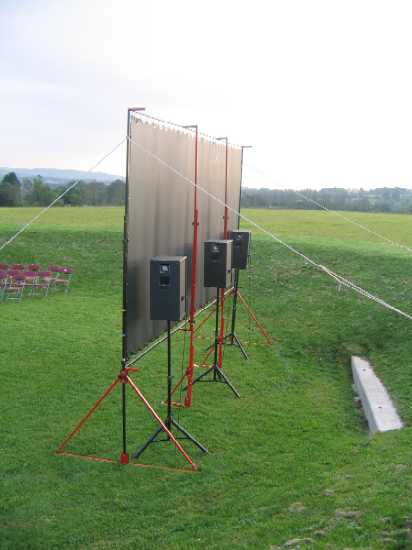
It doesn't show the SB unit (HZ model 600) or the surrounds (HZ Sigma 200s). HZ specifications
I EQ'ed and leveled the sound system in the usual way with the set up as in the picture above, out of doors using pink noise, eg as in the CP55 manual. I don't expect (nor do the audience, I think) to hear something that is quite like an indoor cinema). As for the available headroom, I don't really know; I achieved the 85 db level easily.
Posted by John Wilson (Member # 269) on 08-26-2007, 05:02 PM:
Give Dolby A a go... I'd expect even though the print is dated 2004 it wouldn't have been remixed.
Posted by Mark Gulbrandsen (Member # 72) on 08-26-2007, 07:39 PM:
I agree that its probably in type A... Its that age for sure. If it were re-mixed in SR there would certainly be a D-Digital track along with it. I think some of the problems you are hearing is the NR system mistracking big time.
Mark
Posted by Louis Bornwasser (Member # 3063) on 08-26-2007, 08:23 PM:
The film did have dialog/music level issues. Use of proper decoding, A chain EQ and then a proper compressor will do wonders. Bell Theatre Service has access to the little Ashly CL52, a stereo simple compressor that I have used for many years ahead of FM transmitters. (Use 2 for 4 channel, coupled together) Louis
Posted by Frank Angel (Member # 248) on 08-26-2007, 09:23 PM:
Out of left field here perhaps, George, but it seems like even undecoded audio wouldn't produce the very dramatic loss of the center channel dialogue as you describe. That sounds more like the whole thing is out of phase. That could occur if you are going into a mixer that had balanced inputs, especially transformer inputs, it would be possible for the signals from the cell to be 180% out of phase (high and low reversed going into the mixer on one channel) and that would effectively cancel out any audio that was equal and in phase in both channels as the center dialogue always is. You might just check that possibility, remote as it might be.
Posted by Christopher Seo (Member # 7) on 08-27-2007, 02:30 PM:
Probably off topic, but: George, when you say you set up the outdoor cinemas "in the usual way" according to the Dolby manual, did you EQ to the X-Curve? I'm wondering whether an open-air environment, such as the one in your picture, creates an acoustical situation which is close to that of a free field, and therefore whether the B-chain should be adjusted for a flat response on an RTA, not a rolled-off curve.
Whether this would improve or worsen your specific problem, I don't know.
Posted by Mark Gulbrandsen (Member # 72) on 08-27-2007, 07:21 PM:
quote: Christopher Seo
and therefore whether the B-chain should be adjusted for a flat response on an RTA, not a rolled-off curve.
Thats a good point! When I worked on the Cinema Borealis Event we eq'd for somewhere between flat and the X curve. When it was on the X-Curve things sounded too rolled off outdoors.
Mark
Posted by George May (Member # 1060) on 08-28-2007, 02:10 AM:
Dear All
When I first posted I was simply hoping someone would tell me "Yes, some prints of DD did have a dynamic range problem." Obviously not!
Now we've strayed on to much wider issues. Recent posts suggest I should set up my B chain to have a flat RTA response. The engineer who re-calibrated my EQ set-up very recently is a senior engineer at Dolby here in the UK, and himself does big outdoor shows. I had set my system up with a flat response for the reasons some of you suggested; he said that this was wrong and that it should roll off like a conventional set-up. After he'd set it up said "Your flat response set-up made shows sound like a PA; now it'll sound like hi-fi." I've only done a couple of shows with it since then, but he seems to be right. In particular, the clarity of dialogue seems, subjectively, much improved.
Posted by George May (Member # 1060) on 08-28-2007, 05:19 AM:
The Dolby engineer I spoke of in the last post has read this thread and comments (I've slightly edited you, Michael, I hope that's OK):
“I read all the comments in your forum topic, a lot of valuable info there! As for the X curve versus flat, this is theoretically correct. What I was referring to with my PA/hi-fi comment was the two very powerful peaks in the response that was pulling the response away from flat. I forget what frequency they were but they were quite dominant. This was what I toned down, and were probably natural resonances in the HF and LF drivers or some artifact / comb filtering of the sound going through the perforations in the screen, the very reason for doing the EQ with the speakers behind the screen.
With film mixes out doors I think a totally flat EQ to 20kHz still makes a film sound unnaturally bright/sibilant and thin sounding because the film has been mixed in a room with the ISO 2969 / Dolby X-curve built into the dubbing studio’s system, so there is a measure of HF pre-emphasis into the track . Personally I think it’s better to use the ISO 2969 / Dolby X- curve but to start the roll-off at, say, 4k rather than 2k.
Was your print SR or A? There are SRD prints of Dirty Dancing available but as your print did not have a digital track you would not have had an SR track, as both analogue and digital tracks coexist together on the same sound neg, so you could not have one without the other (unless the digital exposing lamp was dead in the optical printer; this is unlikely and would probably only affect one reel).
If you had the original 1987 version there is no way it could have been SR, as SR did not come out on release prints until 1988 with the release of Robocop. And that was a dual inventory release with A type and SR prints. The next major one was Rain Man, again a dual inventory release. It seems the 2004 and 2007 releases of Dirty Dancing do have Dolby digital and DTS sound but you say you did not see a Dolby digital track so you had an old A type print or a new print made from the original negatives. Playing this A type print with SR would really “suck” on the dynamics of the track, it would sound as though you were listening to it with cotton wool in your ears. All the atmospherics would disappear (wind, rain etc) because the SR would be treating these sounds as unwanted background noise.”
Posted by Louis Bornwasser (Member # 3063) on 08-28-2007, 02:08 PM:
I also agree that the Dolby curve be used. It makes no difference where you are (indoor or out), the quality of sound at the listener's ear is what matters. You EQ accordingly so that the curve is correct IN SPITE OF the location.
BTW: get an SR print! Louis
Posted by Mark Gulbrandsen (Member # 72) on 08-28-2007, 03:18 PM:
quote: Louis Bornwasser
I also agree that the Dolby curve be used. It makes no difference where you are (indoor or out), the quality of sound at the listener's ear is what matters. You EQ accordingly so that the curve is correct IN SPITE OF the location.
I disagree... where we were set up for Cinema Borealis we not only had a 70 foot wide screen to deal with but it was literally blowing in the Chicago breeze... away from and towards the horns themselves. Interestingly the then Dolby Field Engineer stopped by with some new mag preamps for us to test(we were running two 70mm shows) and he pretty much agreed with how we had done the setup. We had no choice but to cut it a little less than normal because we lost too much of the high end with the screen blowing out from the horns... It worked out fine in the end ecept for neighbors comming over and complaining when we had Pink Noise running through all those Inter Sonics subwoofers ![[uhoh]](graemlins/uhoh.gif) . Apparently we were rattling a good number of windows on the High Rise Condos straight north of the screen location. One guy even threatened us with his Pit Bull!
. Apparently we were rattling a good number of windows on the High Rise Condos straight north of the screen location. One guy even threatened us with his Pit Bull!
Please note that it also rained for much of the showing of 2001 so the little extra boost probably saved the showing since the rain then plugged up the perfs.... about 500 folks sat in the rain to watch 2001 in 70mm.
I think on a small screen outdoors the standard curve would be fine under normal circumstances.
Mark
Posted by Louis Bornwasser (Member # 3063) on 08-28-2007, 06:22 PM:
Correct! If you had re-EQed, you would find yourself with less hf and you would have corrected. You must have EQed in still wind!(You probably arrived at the proper EQ by meter and then by experience.) Louis
Posted by Mark Gulbrandsen (Member # 72) on 08-28-2007, 07:10 PM:
Actually the screen was blowing back and forth for a while when we were eq'ing so we could actually see the difference. I more or less split the difference between them.
Mark
Posted by John Hawkinson (Member # 1135) on 08-28-2007, 08:16 PM:
Any experience using software like EAW's SMAART for real-time EQ-ing? You feed it the program audio on one input and a measurement microphone on another and it gives you realtime frequency analysis (and other functions) without pink noise.
Of course, I'm not quite sure how you'd use this well if you had something other than mono in your outdoor theatre, but, well, it's a thought... (I can think of several ways you might...)
--jhawk
Posted by William Phillips (Member # 1162) on 08-29-2007, 12:37 PM:
George
I showed Dirty Dancing back in April for a charity event. On run in the morning to check the print, the sound was ![[bs]](graemlins/bs.gif) playing it in Dolby A was good and for the 1st time in a long while playing at volume 7 was stunning for the entire film
playing it in Dolby A was good and for the 1st time in a long while playing at volume 7 was stunning for the entire film
Posted by David Stambaugh (Member # 1102) on 08-29-2007, 02:06 PM:
quote: William Phillips
the sound was playing it in Dolby A was good
Eh wot? ![[Razz]](tongue.gif)
Posted by Marin Zorica (Member # 1716) on 08-29-2007, 05:52 PM:
For outdoor purposes I prefer only speaker EQ.....I mean to put mic on 2-3 meter from speaker and do eq....on this way you will only do EQ of speaker frequency curve, this is good because is opened and sound waves are much different then in room!
Powered by Infopop Corporation
UBB.classicTM
6.3.1.2