This is topic How Dolby Digital and SDDS Works? in forum Film Handlers' Forum at Film-Tech Forum ARCHIVE.
To visit this topic, use this URL:
https://ft-forum.com/ft/cgi-bin/ubb/ultimatebb.cgi?ubb=get_topic;f=1;t=008914
Posted by Iben Jimenez (Member # 3713) on 09-08-2007, 07:54 PM:
I know that the analog sound works by detecting the modulation of light created by the varying-width soundtrack. But how does the Dolby soundtrack works? Does the small square with the Dolby logo has some information? What about the SDDS with the green bands?
Posted by Mark Strube (Member # 4190) on 09-09-2007, 03:38 AM:
This should be a good start...
http://en.wikipedia.org/wiki/Sdds
http://en.wikipedia.org/wiki/Dolby_Digital#Applications_of_Dolby_Digital
Posted by Monte L Fullmer (Member # 2797) on 09-09-2007, 04:25 AM:
..and the dolby symbol in the middle of the square acts like a center point (target) for the reader.
Posted by Louis Bornwasser (Member # 3063) on 09-09-2007, 10:29 AM:
On Dolby's Digital, the four corners have significance since they serve as markers for the other information; just like a surveyor uses stakes to reference other boundaries. Louis
Posted by Tim Reed (Member # 137) on 09-09-2007, 11:02 AM:
quote: Monte L Fullmer
and the dolby symbol in the middle of the square acts like a center point (target) for the reader.
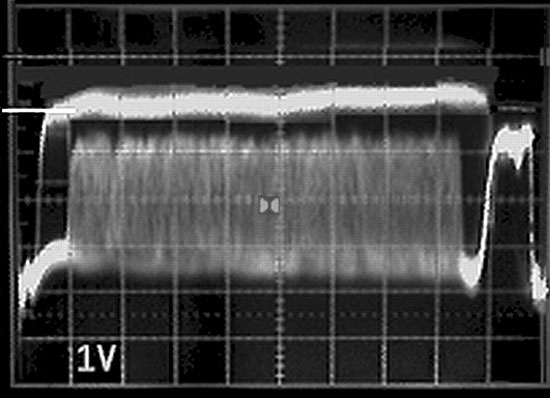
Huh? I've never seen a Dolby logo on my oscilloscope trace... ![[Confused]](confused.gif)
Posted by Louis Bornwasser (Member # 3063) on 09-09-2007, 11:17 AM:
Use a microscope, Tim, on the actual "square." Louis
Posted by Christos Mitsakis (Member # 143) on 09-09-2007, 12:31 PM:

Posted by Tim Reed (Member # 137) on 09-09-2007, 01:26 PM:
I was ribbing Monte. ![[Wink]](wink.gif)
Posted by Mark Gulbrandsen (Member # 72) on 09-09-2007, 06:37 PM:
Tim,
I get the DD insignia on my scopes display... Tektronix 465B.... I don't know what scope you're using but perhaps you need a wider bandwidth scope ![[thumbsup]](graemlins/thumbsup.gif) .
.
Mark
Posted by Phil Hill (Member # 371) on 09-09-2007, 06:49 PM:
I did too Mark on my 465... Dunno what scope Tim is using but it's obviously not capable of aligning modern digital technology...
Posted by Mark Gulbrandsen (Member # 72) on 09-09-2007, 07:56 PM:
Yep Phil! Thats exactly the same waveform that I see.
Mark
Posted by Frank Angel (Member # 248) on 09-09-2007, 10:36 PM:
So what is the state of Sony's support of SDDS -- I seem to recall people here saying that they only have one guy doing tech support now? Are they still actually selling readers and processors? Or they doing a bye-bye like freaking Dolby and the DA20?
Posted by Patrick de Groot (Member # 858) on 09-10-2007, 02:27 AM:
quote: Iben Jimenez
But how does the Dolby soundtrack works? Does the small square with the Dolby logo has some information?
yes
quote: Iben Jimenez
What about the SDDS with the green bands?
yes
Posted by Monte L Fullmer (Member # 2797) on 09-10-2007, 04:19 AM:
...nice fenceline there...
Posted by Mark Gulbrandsen (Member # 72) on 09-10-2007, 09:03 AM:
quote:
So what is the state of Sony's support of SDDS --
We couldn't get any boards for DFP-3000's and have been waiting for sprockets for same since last November. We retired the 3000's with bad boards and are about to take delivery of custom stainless steel VKF sprockets made for us by LaVezzi to keep the remaining systems going. Since we have quite a few 8 channel houses we are aiming to keep those running as long as there are tracks on the film. So back to your question... Sony's present support is nearing zero!
FWIW: Dolby still supports the DA-20 100%.
Mark
Posted by Steve Guttag (Member # 268) on 09-10-2007, 09:35 AM:
Note, the Dolby logo has ZERO functionality on scanning the Dolby digital track. If they made it functional, it would endager their use of the trademark. Louis is correct, there are four unique corner bits that allow the video aquisition to align itself with the data.
Steve
Posted by Lyle Romer (Member # 1266) on 09-10-2007, 09:58 AM:
quote: Monte L Fullmer
..and the dolby symbol in the middle of the square acts like a center point (target) for the reader.
As Steve said, the Dolby symbol serves absolutely no purpose. The four identical patterns in each corner are the reference points. The only reason the Dolby symbol was there is that they ended up with extra space in the data block pattern and decided to put in the logo instead of a black or white block.
Posted by Sam D. Chavez (Member # 1841) on 09-10-2007, 10:30 AM:
Further on the logo in the middle.
Film wear research before going forward with SR.D showed the center of the area between the sprocket holes has a slight scuff or sanding effect in every test. As such, it was deemed the least reliable place to put fine data so someone decided to put a logo there, kind of a show off kind of thing to do with surplus space. That's all there was to it.
Posted by Monte L Fullmer (Member # 2797) on 09-10-2007, 02:40 PM:
That'll work then-(knew I'd get the right answers when I posted that original comment..which I've only heard from others) ... prob why, when running that WinDRAS program, why that one cel goes green when the corner count is at it's highest...and how it's explained in the WinDRAS program manual of the need for high numbers for corner counts.
Posted by Michael Schaffer (Member # 1204) on 09-10-2007, 03:43 PM:
Has anybody heard from Robbie Hidalgo recently?
Posted by Frank Angel (Member # 248) on 09-10-2007, 05:32 PM:
I always wondered how they wound up divvying up what little unused geography existed on the film frame. I mean, I always thought Dolby's approach was quite brilliant -- testing filmstrips for months in real life theatre situations. Did Sony do this, and if they did, how did they wind up choosing the worst area for transport wear? Or were the two of them working without knowledge of each other's digital research and Dolby just beat Sony to the punch and claimed the much better territory?
And can a company "own" a particular area on the film? Suppose the Acme Company invents a holographic sound recording process next year and convinces a few studios to use it, but it needs, let's say, the Dolby area and one of the Sony edges; do either Dolby or Sony get to say, no, those areas belong to us? Someone had to referee the placement of the DTS, SRD and SDDS spaces, no? SMPTE perhaps? And how come Kodak didn't say, sorry boys, that's ours....that's where we put our codes and ID stuff.
Sam, any insight as to how this evolved?
Posted by Louis Bornwasser (Member # 3063) on 09-10-2007, 06:55 PM:
Dolby was 8-10 years ahead in testing and "staked out" the best area. SDDS tried to use the same area as Dolby; then went for a 100% redesign, in effect modernizing the CDS (defunct) system. Louis
Posted by Sam D. Chavez (Member # 1841) on 09-10-2007, 11:20 PM:
I'd have to disagree that Dolby had that much of a head start (more like a year or two) as a number of the engineers in the middle of the SR.D project were quite fearful of what Sony might come up with, and of course, of their abundant resources. There was also the matter of Sony being one of Dolby's biggest licensing customers at that time.
There were casual talks with Sony to co-op with Dolby on a joint venture but Sony wanted the their name on the box.
Anyway, these were not Sony's top people and as I remember it was a new group formed in the LA area for this project.
One of the little clues to the fact that they did not spend much time looking at either Dolby or DTS conventions is that even the optical preamp d-sub pinout was different from that Dolby and DTS used. No big deal but kind of conceited.
Also the idea of insisting on making all the other processors go upstream and thru the SDDS to get to the power amps.
Basically, they got stuck with the worst part of the film as they started last and thought they could overcome the disadvantage through engineering. I guess they never heard of dirt, scratches or static for that matter.
Posted by Blaine Young (Member # 3992) on 09-11-2007, 12:24 AM:
I believe the Dolby Digital patent actually lays claim to the outboard inter-sprocket area. Just as the DTS patent covers the space between the analog soundtrack and the image, and Sony's patent covers both edges outside the sprockets. It would seem that the inboard inter-sprocket area is "free" for future development.
Posted by Steven Gorsky (Member # 603) on 09-11-2007, 01:58 AM:
quote: Mark Gulbrandsen
Sony's present support is nearing zero!
I'm curious now - how has this affected AMC? Having worked for them a few years ago, I remember that they were exclusively using SDDS, but I've been out of the loop for a bit - have they changed their position?
Posted by Frank Angel (Member # 248) on 09-11-2007, 03:03 AM:
I would really be surprised if any of them can patent the area on the film as belonging to them. If anything, Kodak was using that space since the big bang. No doubt the patents indicate where they put their unique digital image, or code in the case of DTS, but the area itself, I doubt it is patentable as it's existed for a century, I wouldn't think.
Like in my example, if some other company came up with a system totally different than any of the three but wants to use those areas and this company convinces a couple of the studios and a few of the chains that this system is so much better than the existing systems -- like it can carry 12 channels like DCinema or whatever, and the studios and the chains agree they go ahead and make these prints, can either Dolby or Sony now say no one else can now do whatever they want on undeveloped film? Seems a stretch. Then that's just me.....I have an instinctual aversion to corporations wanting to own the world. Like "Just do it." How can that BELONG to a company? People have been saying that long before those snotty execs were even a gleam in their daddy's eye.
Posted by Michael Schaffer (Member # 1204) on 09-11-2007, 03:28 AM:
quote:
Note, the Dolby logo has ZERO functionality on scanning the Dolby digital track. If they made it functional, it would endanger their use of the trademark.
Why?
quote: Sam D. Chavez
Also the idea of insisting on making all the other processors go upstream and thru the SDDS to get to the power amps.
That was a necessity simply because of the 8 channels which would have been difficult to feed through conventional 6-channel processors. Plus they wanted to have their own EQing and all that. Which I know a lot of people found "too harsh", but however good or bad that was, it made sense as a concept. Plus it was the first cinema processor which actually had balanced outputs (or was it?).
And, of course, we all loved the idea of bringing 5 front channels back, didn't we?
quote: Sam D. Chavez
Basically, they got stuck with the worst part of the film as they started last and thought they could overcome the disadvantage through engineering. I guess they never heard of dirt, scratches or static for that matter.
I know we have been over this many times here in these pages, and it doesn't really matter anymore since Sony, whatever they say about whatever support is allegedly still existing, effectively dropped the format, so it is really only a historical footnote now.
But I have to say we had a lot of SDDS in theaters I worked for in Germany, and we had very little problems with the format, plus it was the only one that people could reliably pick out as sounding "better" than the other ones (and yes, we had a number of auditoriums in which all 3 were installed, so direct comparisons were possible).
That may have had something to do with that we had mostly Kinoton projectors which are nicer to the film (including and particularly the edges) because of the smooth Delrin runners. Plus the handling and cleanliness standards in these booths were generally higher than most of what I have seen on these shores. So that may all have played into that, I guess.
On the other hand, I have also seen a few prints which were totally trashed but on which the SDDS track still worked stably.
SDDS claimed that superficial dirt and scratches shouldn't matter too much since the track was (actually, is) in the cyan layer and the camera was optimized for just the wavelength produced by the red LED illumination going through the layer, so it should not "see" too much of these scratches.
One could argue that all that doesn't matter since a technology has to be "rugged" enough to "survive" all the abuse and bad handling and being run on badly aligned and maintained projectors the films take these days in 16-plex booths operated by undertrained and undermotivated kids.
But that would mean accepting the "lowest common denominator" and "as long as it still somehow runs, there is no reason to fix or improve it" standards which are all too common today. That wouldn't appear to me to make sense, especially not in this context in which people still argue for the return of 70mm...
Another problem was that a lot of "technicians" simply did not understand how the equipment worked and was supposed to be aligned. I have come across processors more than once which had obviously been set up with the fader set to 6.9dB or 7.2dB... In fact, I remember bumping into "technicians" which complained about the processor not having a "7.0" setting...
![[Roll Eyes]](rolleyes.gif)
Posted by Steve Guttag (Member # 268) on 09-11-2007, 06:49 AM:
Michael...it is merely one of the rules of a registered trademark that it be "non-functional." Functional things are patentable, I guess. I'm getting this from a patent and trademark attorney.
As to patenting an area of the film...no...but the method of encoding the digital audio on a place of the film, yes. That is, you could claim an area of the film for the purpose of encoding bits as square blocks for the purposes of encoding audio or data and the method of recovering that information. For instance, DTS' dashes don't resemble Dolby's square blocks at all so regardless of where they put those dashes, there wouldn't be any enforcable patent infringement by either party. SDDS and Dolby are the most similar in that they have "bits" of data encoded on the film but their method of recoverey is different with SDDS strobing the film while Dolby used the perforations to separate the bits and there are no doubt many other difference in how the digital data is encoded. Note, Kodak went to magenta edge coding to avoid interference with SDDS' track. Kodak would want film the be as accessible to as many people as possible...it sells more film that way.
As to Sony's choice to not conform to the established 0-10 scale on the volume control...that was THEIR stupidity and probably arrogance. There simply was no need to try to force/establish a 0.0dB reference in the cinema exhibition industry. That train had left the station long ago.
Note too, the 2000 series only had a +/-10dB range...as many people set their volume below reference...by continuing to target the magic number "7"...one would effectively have a +3/-17dB range on a 2000 series system which would work...if they don't internally clip the signal. Sony at least made it a +10/-30dB range on the 2500 and 3000 series systems.
Steve
Posted by Bastiaan Fleerkate (Member # 3826) on 09-11-2007, 08:50 AM:
quote: Frank Angel
And can a company "own" a particular area on the film? Suppose the Acme Company invents a holographic sound recording process next year and convinces a few studios to use it, but it needs, let's say, the Dolby area and one of the Sony edges; do either Dolby or Sony get to say, no, those areas belong to us? Someone had to referee the placement of the DTS, SRD and SDDS spaces, no? SMPTE perhaps? And how come Kodak didn't say, sorry boys, that's ours....that's where we put our codes and ID stuff.
If I'm correct, on the other side of the film (were there is no SR-D track between the perforations). Is an empty place for another SR-D-like soundtrack...
Why is this space not used for alternative soundtracks? Is it because of the patents of Dolby, that nobody can have their soundtrack between the sprocket holes?
I also think DTS could upgrade their soundsystem to play 12-track DVD-discs... the timecode is already there. Or another company could make use of the timecode to play multi-track sound with a file you can download from the internet...
The only thing is... if you have 12-track sound. The post-production would have to make 12-track effects. It's more cost-effective to make 6-track sound. It uses less data and is quicker to mix...
Posted by Mark Gulbrandsen (Member # 72) on 09-11-2007, 09:20 AM:
quote: Michael Schaffer
Has anybody heard from Robbie Hidalgo recently?
First I heard from Carl that he was working for Shure Brothers but then I heard from pretty reliable sources he kicked the bucket as a result of his heart attack. Who do you believe? We sent him a 3000 penthouse for repair over two years ago... never saw it again.
Mark
Posted by Louis Bornwasser (Member # 3063) on 09-11-2007, 10:21 AM:
Bastiaan: One of the problems with audio is that the optical recorder/printer favors one side. In other words, the side with the soundtrack. Note that both dts& Dolby are physically close to the analog track and can be easily processed at the same time. The SDDS recorder is a "penthouse-like" arrangement on top of a normal Westrex camera, which does dts/analog/Dolby Digital internally. Louis
Posted by John Walsh (Member # 168) on 09-11-2007, 11:03 AM:
I don't think you could 'patent' an area on the film. If I could talk studios into using CDS again, placing it along the edges, who could legally stop it?
Posted by Blaine Young (Member # 3992) on 09-11-2007, 01:55 PM:
I'm certainly not a patent attorney, but if someone tried to place a new digital audio track in between the sprocket holes on the same space that Dolby is using, I'm fairly confident that Dolby would have something to say about that.
There are other patents which cover digital storage of other information in between the sprockets or between the film edge and the sprockets, which have nothing to do with Digital Audio storage or playback which (I would think) wouldn't infringe on patents by Dolby or Sony.
All of the patents for the various digital audio systems clearly outline where their data is place upon the 35mm film. And the CDS system clearly outlines their data is placed between the image and sprockets on either the left or right of the image (clearly indicating a 70mm application). Having CDS tracks placed elsewhere on the film isn't covered by their patent (which is due to expire before too much longer anyway), and I suspect they'd have to start over.
Posted by Louis Bornwasser (Member # 3063) on 09-11-2007, 02:49 PM:
I'm sure the patent specifies where. I'm also sure that the print company will put any track where the film company says. In Dolby's case, there are just too many cinemas equipped to make a change. Same for analog. Louis
Posted by Stephen Furley (Member # 1277) on 09-11-2007, 03:52 PM:
quote: Blaine Young
I'm certainly not a patent attorney, but if someone tried to place a new digital audio track in between the sprocket holes on the same space that Dolby is using, I'm fairly confident that Dolby would have something to say about that.
Possibly; I believe that the Dolby patent actually covers the use of the space between the perforations on both edges, in case they ever wanted to use it for some future extension of the system. I doubt they could stop you using it for something quite different however. If I was to buy a roll of print stock, surely nobody could stop me from printing a green triangle between each perforation if I wanted to, could they? What if somebody had proposed an alternative use for this space, at the time that Dolby Digital was being developed, encoding the text for fifty different languages worth of subtitles for example, or even nothing to do with the film, like storing interesting photographs of barbed wire that the projectionist could look at in his spare time if he got bored? No doubt Dolby would want to stop this, as it would be incompatible with their sound format, but could they actually stop it, short of buying up the company promoting the alternative use, and killing it off.
As for what would happen to any system which tried to use this area for some other purpose today, now that Dolby Digital has become so widely used, I would suggest exactly the same as happened to CDS when they tried to take over the analogue track area on 35mm prints.
Posted by Benjamin John Doman (Member # 4365) on 09-12-2007, 02:19 PM:
Hi All,
We have a 6 screen theatre in Malta with SDDS throughout (plus SR-D in one). Someone told them that SDDS was the future when the place was built! They are having big issues with the physical quality of the SDDS track. They have had support direct from Sony for there units. Had a client in the UK recently who picked up a 3000 unit on e-bay for a couple of hundred pounds. It packed up after two weeks! Always thought SDDS sounded the best of the lot, but they never made any effort to be compatible with anyone else. There are very few cinemas in the UK with it fitted.
Incidentally, some prints started coming through with a CYAN coloured Dolby Digital track (as well as the cyan analogue track) recently. Had a lot of complaints that the track was wearing off of the print after the first dozen or so shows. Has any one had this problem in the States or is it just a UK thing?
Regards, Ben
Posted by Blaine Young (Member # 3992) on 09-12-2007, 10:44 PM:
I don't recall having seen a cyan SRD track. I have seen sections of SDDS tracks peel off when removing splicing tape.
Posted by John Hawkinson (Member # 1135) on 09-12-2007, 11:00 PM:
Anything Else, the first domestic US cyan release, printed by Technicolor lab in Rome, had a cyan dye SRD track. Apparently this was not the way it was supposed to have been, and every subsequent US release I'm aware of fixed it.
But it seems like something that could happen if a lab were confused. So please make sure they find out and fix it!
--jhawk
Posted by Tim Reed (Member # 137) on 09-12-2007, 11:39 PM:
quote: Bastiaan Fleerkate
Is it because of the patents of Dolby, that nobody can have their soundtrack between the sprocket holes?
We've had this discussion before. No one can actually lay claim to the film "real estate," it's either recommended practice or convention.
Posted by Tim Asten (Member # 4051) on 09-13-2007, 06:35 AM:
Talking of digital soundtracks, I'm sure I heard of a system that used transparent digital information actually recorded on the picture emulsion which was read by an ultra-violet reader and would therefore mean that the soundtrack would be invisible on screen. I don't know whether this system worked or even existed. Tim.
Posted by Richard Fowler (Member # 893) on 09-13-2007, 11:53 AM:
The UltraViolet coating was a Kodak project which was talked about for sound and data information; I remember this being discussed during the late 1980's at some SMPTE meetings. The early 1990's barcode based Kodak KeyCode for data and Dolby and others took care of the sound issues
Posted by Bernie Anderson Jr (Member # 410) on 09-13-2007, 03:24 PM:
From my understanding, the DD logo in the film is there as a source of pride. Correct me if I'm wrong, but the square is made up of a grid, 67 by 67 blocks. When the process was being developed, alot of engineers, said that it would be impossible to scan that small of an area at such a rate of speed with that much accuracy. Dolby not only got the block to scan, but the Dolby Techs threw in the DD logo to thumb their noses at the naysayers. That's the folklore that I heard. Don't know how true it is. But I've heard that story twice now.
Bernie
Posted by Michael Schaffer (Member # 1204) on 09-13-2007, 09:17 PM:
It's 76x76, not 67x67 "fixels" per block. And the story behind the logo has been addressed in this very thread by people who have the actual inside knowledge (e.g. Sam), just a few posts ago. You know, Bernie, it sometimes makes sense to actually read the discussion before "contributing"...
quote: Steve Guttag
Michael...it is merely one of the rules of a registered trademark that it be "non-functional." Functional things are patentable, I guess. I'm getting this from a patent and trademark attorney.
Thanks for clarifying that!
quote: Steve Guttag
Note too, the 2000 series only had a +/-10dB range...as many people set their volume below reference...by continuing to target the magic number "7"...one would effectively have a +3/-17dB range on a 2000 series system which would work...if they don't internally clip the signal.
That's true, I had almost forgotten about the -10dB limit. I have seen the clipping lights on the units come on many, many times, obviously the result of overEQing with a lot of boosting rather than cutting. That, plus installers wanting to match the standard X curve at all costs even in very large auditoriums (and the SDDS systems were, at least initially, perceived as a "high end bonus system" and so typically found in the larger auditoriums) plus the PN deficiency noted by you led to sometimes extremely harsh sound which even -10dB did not take care of in the eyes (ears) of operators and audience...
quote: Louis Bornwasser
The SDDS recorder is a "penthouse-like" arrangement on top of a normal Westrex camera, which does dts/analog/Dolby Digital internally.
And one of the biggest problems I have seen time and time again with SDDS tracks is that they were not correctly printed, meaning, centered on the film. I don't recall what the typical offset was, but I think they were often "pushed over" too far in the direction of the picture side, sometimes so much so that the P side edge marking was unuseable - resulting in total mistracking of the P side and constant DCMs (Digital Concealment Mode), falling back to the backup info on the other side.
The DCM actually worked pretty well in general, but a problem was that even with 6-channel titles, the processor would put the backup mono sum of the dropped out channels from the other side on *all* channels on the affected side, including the LE or RE channels, so that resulted in a weird "pumping" effect as that channel only came on when DCMs occurred. The only solution for that was to switch the system to 6-channel output (provided all 8 were actually installed, which wasn't even the case in all screens in the Sony Center in Berlin...) whenever you had a 6-channel release (in other words, most of the time), or simply switch those amps off.
Posted by Mark Gulbrandsen (Member # 72) on 09-14-2007, 11:12 AM:
FWIW: Sony also had to license many of Dolby's patent's to be able to place and scan the digital track onto and back off the film. Bobby Pinktson once told me that Dolby had patented many aspects of that stuff a number of years before SRD was ever generally made avaialble and that is why Sony first demoed SDDS off a hard drive at Showest. This may also be that part of why Sony wants to see SDDS go bye bye... renew and keep paying those hefty license fees to Dolby. Kinda like RCA paying Farnsworth the patent royalties....
Posted by Louis Bornwasser (Member # 3063) on 09-14-2007, 12:52 PM:
I once had a conversation with a former Dolby employee where we determined that Dolby made more money from SDDS per unit sold than they did on their own processorsz. Louis
Posted by Sam D. Chavez (Member # 1841) on 09-14-2007, 08:38 PM:
This is getting absurd with all sorts of speculation and conjecture (i.e., horse shit) about facts not available.
No one at Dolby Labs now or in the past would know what if any money Sony made on the SDDS processor so therefore would be unable to seriously make a statement contrasting any money Dolby might have made on the SDDS project.
What is this a slow news day?
[ 09-15-2007, 12:49 AM: Message edited by: Sam D. Chavez ]
Posted by Gordon McLeod (Member # 33) on 09-15-2007, 07:25 PM:
The UV system was a development of the National Film Board of Canada and in one of the SMPTE mags there is a article on the laser scanning reader with a 45 degree prism to read the superimpossed digital track over the analogue in a century soundhead
Posted by Michael Schaffer (Member # 1204) on 09-15-2007, 10:36 PM:
Can you scan and reproduce that article for us?
Powered by Infopop Corporation
UBB.classicTM
6.3.1.2