This is topic CNR 3-35N platter globe blowing in forum Film Handlers' Forum at Film-Tech Forum ARCHIVE.
To visit this topic, use this URL:
https://ft-forum.com/ft/cgi-bin/ubb/ultimatebb.cgi?ubb=get_topic;f=1;t=008927
Posted by Phil Blake (Member # 2012) on 09-19-2007, 10:17 PM:
Up until now I have never had a problem with these platter globes. The last 2 months the globes are only lasting about 2 to 3 days and blowing out.
The Cinemeccanica replacement part globes were expensive so I was using the equivalent from the local hardware shop. Thinking these globes may not be of the same quality I switched back to the proper replacement globes as per the book 250v 10w mignon globe.
Even these globes are only lasting 2 to 3 days . I checked voltage at the sockets , (248 to 250V) so I am at a loss. This is happening on all tiers and on all 3 of my platters .
The worst of it is when the globe blows out it usually trips out the main circuit breaker and thus stopping the platter midshow.
![[Confused]](confused.gif)
Posted by Giorgio Volpi (Member # 1182) on 09-20-2007, 01:33 AM:
Phil, you can find bright Led and put it instead normal globe. The modification in very inexpensive and almost forever.
Posted by Mark Gulbrandsen (Member # 72) on 09-21-2007, 03:51 PM:
The most practical thing to do is strap on some of those small under-counter florescent lights that one can get at the hardware store for 5 to 6 dollars. They have very long life, are cheap, and provide much better light so you can see what you're doing in a dark booth!! I have not seen a bright enough LED nor one with very decent coverage to be worthwhile.
Mark
Posted by Phil Blake (Member # 2012) on 09-22-2007, 08:41 AM:
That might be a better solution Mark.
I have looked around and it is near impossible to get 240volt LED lights here.
I was thinking of running new wiring from a transformer and run 12v LEDs which are readily available, but maybe the floro idea would be easier . I could start by raiding the one from my fish tank ![[thumbsup]](graemlins/thumbsup.gif)
Posted by Louis Bornwasser (Member # 3063) on 09-22-2007, 02:31 PM:
Remember the enemy of a tungsten bulb is vibration when hot. A partial solution would be to reduce the voltage 10-15%.
A more likely reason for failure is a change in design: For example did the original;\ bulb have 5-7 supports on the filament and the new one 3 (or less). I can speak from experience on 125-130 volt bulbs. I can only imagine the critical nature of a 240-250 volt bulb.
Can you locate a 250 up to 270 volt bulb? Then, no resistor would be required. (in the U S I can purchase 110-117=120-125-130 volt bulbs for a similar use.)
Century projectors now use a 12 volt framing lamp because of the short, stiff low voltage filament. This helps very much with life extension. Louis
Posted by Stephen Furley (Member # 1277) on 09-22-2007, 03:08 PM:
Phil, what's your Voltage there; I think it's 240, and ,if so, maybe they're supplying 250V ones so they are under-run somewhat to increase the life a bit. I've seen something similar with American Christmas lights, which are much better than anything we get here, they're rated at 130V, rather than 120V.
240V and 10W is a bad combination for a filament lamp, this is one of the few applications where a low Voltage is better. I can get 240V LED lamps of various types quite easily here, but I haven't been very impressed with them so far. What type of cap do these lamps of yours have? If they're a standard screw or bayonet one you could probably replace them with something like this:
web page
I'm not clear from your post exactly what these lamps are used for; it could be that a different shape of lamp would be better, possibly something like this:
web page
Though these are expensive, and it's not clear if they need external control gear, or if it's built in.
If you want to go the LED route then something like this may be suitable, though you may need several of them, depending on how large an area you are trying to illuminate:
web page
If you want to stay with a filament bulb you would probably be better going for a low-Voltage one, maybe 12V, for a Wattage this low.
These are just a few ideas; there is a huge range of lamp types available, and they should be readily available where you are.
Posted by Mark Gulbrandsen (Member # 72) on 09-22-2007, 07:03 PM:
quote: Louis Bornwasser
Century projectors now use a 12 volt framing lamp because of the short, stiff low voltage filament.
I think the switch was more of a UL and or safety issue than any thing else...
Mark
Posted by Phil Blake (Member # 2012) on 09-25-2007, 12:41 AM:
I am not sure of the construction of the original globes as i don't have any left. It could be that they are not making them as good , also the globes position in on it's side , this i guess could cause the filament to sag easily if not supported well.
The current globes supplied are rated at 250v our power is 240v but the actual supply is about 249v
I will consider the replacement idea carefully bearing in mind how rough my other operators can be when moving brains and center rings about, anything strapped to the plate support arm would just get broken.
A flush mount LED would be ideal but I cannot locate any over here for 250v.
Posted by Stephen Furley (Member # 1277) on 09-25-2007, 02:41 AM:
Phil,
I think I know what you are looking for now; do you mean something flat, circular, maybe 35-50mm in diameter, 8-10mm high? I've seen quite a few LED lamps like this, but I don't think you'll find a mains Voltage one; there wouldn't be room for an internal transformer as there is with some other types.
You could use this type of lamp with a suitable external transformer positioned somewhere out of the way. Except for certain 'retrofit' types, LEDs should not be operated from standard halogen transformers, but from special ones designed for LEDs; one transformer can usually operate several lamps. They are usually small, about matchbox size, electronic, devices, not conventional electromagnetic transformers.
Posted by Phil Blake (Member # 2012) on 09-29-2007, 12:20 AM:
Thats about right Steven , even a light similar to a 12v halogen would fit in the platter arm , would be handy to be able to use a 240v light to save messing around with transformers etc.
Posted by Phillip Grace (Member # 2262) on 09-29-2007, 03:03 AM:
Hi Phil.
Maybe replace the lamp socket. They're not the best quality.
We were able to stop the lamp taking out the mains fuse when it blows by rotating the lamp holder so that the bits of melted filament would fall onto the glass envelope when the lamp failed, instead of across the suspension wires causing a dead short, and taking the fuse and the show as well.
We also had good results using a more rugged replacement lamp sourced locally. I think it was an oven pilot, or refrigerator pilot. It fitted direct into the original socket and was more or less the same wattage. I cant remember the exact specs, but at that time our lamp supplier was GMT Agencies in Hawthorn, Victoria. They stock all kinds of odd things.
Voltage at our site when we opened was 248 instead of the correct 240. That percentage increase over voltage will dramatically shorten the life of a lamp.
Beats me why Cinemeccanica thought there was no need for a threading light over the top plate. Nobody I know runs with the room lights on.
Cheers.
Phil.
Posted by Phil Blake (Member # 2012) on 03-13-2008, 07:51 AM:
Well I have finally dealt with this problem,
Unable to find a suitable 240v LED or floro for the job I modified the lamp assembly to 12volt, fitting a transformer rectifier and festoon globe holder fitted with the new 12volt LED festoons
before 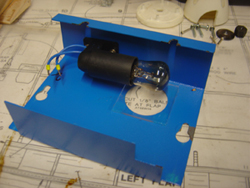
and the modified lamp

If the new LED globe lasts for more than a week then I have solved the problem ![[Wink]](wink.gif)
Posted by Scott Christopher (Member # 834) on 03-13-2008, 08:56 PM:
You could probably mount 1 or more luxeon LED's to the underside of the arm which would also act as a heatsink. Plus, they're reasonably flat (without the reflector).
Powered by Infopop Corporation
UBB.classicTM
6.3.1.2