This is topic Need resolution numbers for publicty copy in forum Film Handlers' Forum at Film-Tech Forum ARCHIVE.
To visit this topic, use this URL:
https://ft-forum.com/ft/cgi-bin/ubb/ultimatebb.cgi?ubb=get_topic;f=1;t=008929
Posted by Frank Angel (Member # 248) on 09-21-2007, 10:29 PM:
We are getting a new EK print of Hitch's STRANGERS ON A TRAIN (supposedly). It is our opening salvo for the new season and since we have a new crop of freshmen in, it becomes more and more a job to educate them as to why they should WANT to see movies in a theatre instead of on a 4 inch iThis or iThat.
I want to say that a 35mm Show Print is n amount higher resolution than a video tape, n amount higher than DVD and is even n amount higher than HD cable. I am not sure what values should be used -- obviously I want it to sound as dramatic as possible. I searched the forums here and although I am almost sure Bobby once posted something similar and probably John Pytlak did too, but I can't find it. Unlike most ad copy writers, I do want it to come at least SOMEWHAT close to the truth.
Posted by Bernie Anderson Jr (Member # 410) on 09-21-2007, 10:53 PM:
From what I was told by a friend that worked for Sony, then Barco that film is about 7K resolution. Video is 480i, high def is 1080i and theatrical video (DLP) is 2K. Don't know the exact number of lines
Posted by John Hawkinson (Member # 1135) on 09-21-2007, 11:18 PM:
The problem, Frank, is that you fundamentally cannot express the nature of film in a resolution number. This is because the grains on film are of nonuniform size, and so instead you use something called the modulation transfer curve to discuss quality and information density.
Of course you can say that film has an "equivalent" resolution, but there are many people with many fights about what this means. And the apparent quality is a function of the generational losses, the grain size and quality of the original camera negative and all the intermediate elements, even the lighting and ASA speed, etc. Even the nature of your projector (how long is the intermittant pulldown cycle? Do you have a "drive-in" intermittant, a "quickermittant," an electronic intermittant, a three-blade shutter, etc., etc.?).
Various people have cogently argued that film is equivalent to 2k resolution, as well as 4k resolution, as well as higher numbers. Note that when we say "2k" we mean "2k pixels per line," i.e. a horizontal resolution of 2048 pixels across, with the appropriate number vertically for the format in question, i.e. 2048x1107 for 1.85:1.
Also, when you are assessing video quality, there is a lot more information to talk about than just resolution. This is not my area so I'll let someone else summarize.
--jhawk
Posted by John Walsh (Member # 168) on 09-22-2007, 04:30 PM:
But can anyone make a suggestion that demonstrates, to the layman, how much better the average print is compared to the average digital projection? Maybe not in terms of grain/pixels, etc. but something a patron can relate to.
Posted by Cameron Glendinning (Member # 3516) on 09-23-2007, 07:45 AM:
I have been told a film grain can be as small as 5 microns, so ball park, best possible would be around 3,300 lines for a 35mm full frame.
Other factors can then degrade the image, the lab, projector steadiness, lens cleanliness and quality ect. Obviously if the film frame is a laser scan, its quality is governed by its 2k or 4k resolution.
On a 4k digital camera with a super 35mm sized gate, the image sensors are i believe aprox 5 microns a piece.
quote: John Walsh
to the layman, how much better the average print is compared to the average digital projection?
Digital is rock solid steady! that's really the only layman difference
Posted by Mark Gulbrandsen (Member # 72) on 09-23-2007, 08:35 AM:
I'd still rather see it projected digitally! This eliminates several steps in the printing process... the places where the modulation transfer curve will typically today get messed up..... And no one can make decent 35mm B&W prints any more because there is so much less silver going into B&W film today. So in your case digital may actually be the better alternative for this sort of content. I can speak of one instance of "Dr. Strangelove" playing in 4K in Seattle(At Orchestra Hall) and those that I know that saw it say the image looked impeccable, better than any print they've seen. You'll find that many of the B&W classics will end up being transfered right from the original camera negative when it is doable and this is a huge advantage.
quote: Cameron Glendinning
Digital is rock solid steady! that's really the only layman difference
Oh boy howdy! The average layman will see alot more than how steady the image is.... in fact thats one of the last things he may notice. If you want to see just how good B&W can look on digital get the HD-DVD copy of "Casablanca" and watch it on a good HDTV or HDTV projection system. Or for color films try Robin Hood or The Searchers, the latter was transfered right from the 8 perf VistaVision B&W seps and Robin Hood hasn't looked this good since its I.B. Tech release. These films look so good "digitally" they'll give you goosebumps! And then there is 2K and 4K digital.... HD-DVD is not even close to those formats capability.
Mark
Posted by Scott Norwood (Member # 30) on 09-23-2007, 11:37 AM:
People keep missing the point. He's not talking about 35mm vs. 2k DLP (or 4k SXRD). He's talking about trying to quantify the difference between 35mm and VHS, DVD, and HD. I think that we would all agree that 35mm film (especially full-frame Academy) is better than even the best 1080p HD picture (assuming that he has decent lenses). Never mind that most of the digital video formats introduce lossy compression and analog video formats all have noise and dropout artifacts.
Even if this film is available for booking in 2k DLP (doubtful), Frank probably doesn't have the equipment needed to show it in that format.
Posted by Mark Gulbrandsen (Member # 72) on 09-23-2007, 11:57 AM:
Scott,
Although I'm sure Frank's facility is top notch the chances of getting a good looking(ie: like the original release) B&W print today is very slim. The high quality B&W release film stocks (Ilford,Agfa) just don't exist any more. And yes... I'd rather watch it in HD-DVD if thats the case because at least its going to be the closet to the original neg and will look better than one of todays sloppy B&W prints... or worse yet B&W on color release stock. So if there are students out there that posess decent HD systems at home then the more power to them as they will get a better representation of what the film looked like. Those systems are also going to be much more representative of what I.B. Technicolor is capable of as compared to an Eastman imitaion of same.
Hence... there is no good way to compare the two since each has its own advantages.
Technology is moving quickly... just think 5 years from now!
Mark
Posted by Frank Angel (Member # 248) on 09-23-2007, 01:18 PM:
Well, it looks like I might leave be better off just dropping that High Def angle and just hype the fact that Farley Granger is going to speak after the first first show. Now THERE'S something they can't get off the DVD (ooops, forgot about those pesky "special features"....dang!). Welp, I guess I'll have to go with the "communal experience" thing....but then again, I am no fan of sitting around with strangers and their cell phones and bad manners. Hmmm.....this is getting to be quite a quandry.
And thanks Mark for the confidence in our operations, but in fact, we don't have Kinotons and we've got 10 yr old ISCOs, so maybe not the lastest of the computer designed in that department. Giant screen. That's it. "See it on the Giant Screen." But on the other hand, if they've got a good sized LCD or Plasma flat in their living room, relatively speaking, their field of vision will be the same as if they were sitting in my cavernous theatre, maybe their's will seem even bigger.
Damn, I am getting depressed.
Posted by Christian Appelt (Member # 1067) on 09-23-2007, 01:33 PM:
quote: Mark Gulbrandsen
The high quality B&W release film stocks (Ilford,Agfa) just don't exist any more.
Well, the Filmotec/Orwo stocks are quite good. With the camera stocks you can get the classic 1950s/1960s look that many people cannot get out of Eastman b&w so they shoot color neg and print it b&w.
Filmotec's dupe and positive stocks are fine too (they only make b&W), but of course it depends on the skill of the lab doing the processing.
Orwo Positive Print Film PF2
With European films, I have noted that some of the best looking vintage b&w prints from the 1950s and 1960s were printed on Ferrania and Dupont positive, but I suppose the fact that many films were contact step-printed back then also has something do do with their exceptional print quality.
Posted by Floyd Justin Newton (Member # 1316) on 09-23-2007, 01:37 PM:
Frank--
Take a Prozac!! ![[Wink]](wink.gif)
Posted by Mark Gulbrandsen (Member # 72) on 09-23-2007, 03:09 PM:
No Prozac Necessary! Actually Frank, Its you and your facility that I would have complete confidence in. Its the actualy quality of today's B&W prints (or labs for that matter) that I have no confidence in. Its purely touch and go with that stuff. One film may look great while the next is absolutely miserable looking. I agree with Christian that both Dupont and Ferriana B&W's were some of the best there were. Even the old Kodak print stock had great capabilities. There are still decent camera stocks available today... Last time I looked Eastman Double-X 5222 was astill being made, its the film that so many good looking classics were shot on. I have used Ilford B&W stock in my VistaVision camera a number of times and it always looked pretty good but this goes back about 12 years... things have probably changed there since Ilford basically disentegrated a couple of years ago.
As for digital... it does have at least some advantages over film. Getting closer to the negative is one, it being able to better replicate I.B. Tech's color spectrum is another. Consistant steadiness, no print wear, constant light level with at least some properly maintained equipment and an evenness in illumination that cannot be obtained with film projection no matter what. As technology advances in both film and digital its necessary for all of us to embrace both technologies or be left in the dust to blow away.
Mark
Posted by Jeffry L. Johnson (Member # 453) on 09-24-2007, 03:25 PM:
Project 35-PA and use the resolution charts to determine how many line pairs per millimeter your system can resolve.
Take that number and multiply by the aperture size of your format.
Aperture width: 0.825 inches = 20.96 mm
1.37 Aperture height: 0.602 inches = 15.29 mm
1.85 Aperture height: 0.446 inches = 11.33 mm
Resolution target of 24 line pairs per millimeter:
Width: 503 line pairs
1.85 height: 272 line pairs
1.37 height: 367 line pairs
Resolution target of 48 line pairs per millimeter:
Width: 1006 line pairs
1.85 height: 544 line pairs
1.37 height: 734 line pairs
Resolution target of 80 line pairs per millimeter:
Width: 1677 line pairs
1.85 height: 906 line pairs
1.37 height: 1223 line pairs
Posted by Cameron Glendinning (Member # 3516) on 09-24-2007, 05:45 PM:
quote: Mark Gulbrandsen
The Searchers, the latter was transfered right from the 8 perf VistaVision B&W seps
Having run a 35mm print of this film (which was in great condition) I look forward to seeing it in HD! I remember running the film on one screen of a twin, and running Terrence Malick's "The Thin Red Line" (1998 anamorphic)on the other and thinking that 35mm film just does not get better!.
Nowdays your average super 35mm based scope release print features 2048 x 850 ish, that's nothing like the 3300 line potential of full frame 35mm.
quote: Mark Gulbrandsen
Oh boy howdy! The average layman will see alot more than how steady the image is.... in fact thats one of the last things he may notice.
I thought Hollywood was afraid of making B&W films because the average layman refused to watch them ![[Razz]](tongue.gif)
I cannot talk for the layman, but for me the most obvious improvement I noticed with 70mm was its rock solid frame.
quote: Frank Angel
their field of vision will be the same as if they were sitting in my cavernous theatre
Frank, the one thing you can not have at home is a cavernous theatre,& lets hope digital does have the potential to allow a new audience to see the classics again!
Posted by Bill Gabel (Member # 1105) on 09-24-2007, 06:28 PM:
Frank you might not have to worry about 35mm prints vs. digital versions from Warner Bros. soon. A friend over at one of the UCLA campus theatres said that Warner will soon not be striking new 35mm prints of their classics and making only digital versions available to theatres.
Posted by Bryan M. Montgomery (Member # 4412) on 09-25-2007, 12:28 AM:
Why is it that only technicians seem to love digital?
Oh yeah, beacause they will still have a job after its implemented.
Posted by Jeffry L. Johnson (Member # 453) on 10-14-2007, 12:50 PM:
quote:
Information Content of Various Display Formats
Format: NTSC
Pixels (Horizontal): 437
Pixels (Vertical): 483
Total Pixels (HxV): 0.2 M
Viewable Pixels (Horizontal): 350
Viewable Pixels (Vertical): 338
Total Viewable Pixels (HxV): 0.1 M
Field/Frame rate/sec: 30
Bandwidth (Mbytes/sec): 11
Percentage of IMAX HD: 0.3%
Format: HDTV
Pixels (Horizontal): 1030
Pixels (Vertical): 1035
Total Pixels (HxV): 1.1 M
Viewable Pixels (Horizontal): 1030
Viewable Pixels (Vertical): 686
Total Viewable Pixels (HxV): 0.7 M
Field/Frame rate/sec: 30
Bandwidth (Mbytes/sec): 64
Percentage of IMAX HD: 2.0%
Format: 35 mm / 4 perf
Film Dimensions, Horizontal (mm): 20.1
Film Dimensions, Vertical (mm): 15.2
Film Dimensions, Area (mm^2): 306
Pixels (Horizontal): 3216
Pixels (Vertical): 2432
Total Pixels (HxV): 7.8 M
Viewable Pixels (Horizontal): 1608
Viewable Pixels (Vertical): 1216
Total Viewable Pixels (HxV): 2.0 M
Field/Frame rate/sec: 24
Bandwidth (Mbytes/sec): 141
Percentage of IMAX HD: 4.5%
Format: 70 mm / 5 perf [Showscan]
Film Dimensions, Horizontal (mm): 48.6
Film Dimensions, Vertical (mm): 22.1
Film Dimensions, Area (mm^2): 1074
Pixels (Horizontal): 7776
Pixels (Vertical): 3536
Total Pixels (HxV): 27.5 M
Viewable Pixels (Horizontal): 3888
Viewable Pixels (Vertical): 1768
Total Viewable Pixels (HxV): 6.9 M
Field/Frame rate/sec: 60
Bandwidth (Mbytes/sec): 1237
Percentage of IMAX HD: 39.8%
Format: 70 mm / 8 perf
Film Dimensions, Horizontal (mm): 48.6
Film Dimensions, Vertical (mm): 36.3
Film Dimensions, Area (mm^2): 1764
Pixels (Horizontal): 7776
Pixels (Vertical): 5808
Total Pixels (HxV): 45.2 M
Viewable Pixels (Horizontal): 3888
Viewable Pixels (Vertical): 2904
Total Viewable Pixels (HxV): 11.3 M
Field/Frame rate/sec: 24
Bandwidth (Mbytes/sec): 813
Percentage of IMAX HD: 26.1%
Format: 70 mm / 8 perf
Film Dimensions, Horizontal (mm): 48.6
Film Dimensions, Vertical (mm): 36.3
Film Dimensions, Area (mm^2): 1764
Pixels (Horizontal): 7776
Pixels (Vertical): 5808
Total Pixels (HxV): 45.2 M
Viewable Pixels (Horizontal): 3888
Viewable Pixels (Vertical): 2904
Total Viewable Pixels (HxV): 11.3 M
Field/Frame rate/sec: 30
Bandwidth (Mbytes/sec): 1016
Percentage of IMAX HD: 32.7%
Format: 70 mm / 15 perf IMAX(R)
Film Dimensions, Horizontal (mm): 69.6
Film Dimensions, Vertical (mm): 48.5
Film Dimensions, Area (mm^2): 3376
Pixels (Horizontal): 11136
Pixels (Vertical): 7760
Total Pixels (HxV): 86.4 M
Viewable Pixels (Horizontal): 5568
Viewable Pixels (Vertical): 3880
Total Viewable Pixels (HxV): 21.6 M
Field/Frame rate/sec: 24
Bandwidth (Mbytes/sec): 1555
Percentage of IMAX HD: 50%
Format: 70 mm / 15 perf IMAX(R) HD
Film Dimensions, Horizontal (mm): 69.6
Film Dimensions, Vertical (mm): 48.5
Film Dimensions, Area (mm^2): 3376
Pixels (Horizontal): 11136
Pixels (Vertical): 7760
Total Pixels (HxV): 86.4 M
Viewable Pixels (Horizontal): 5568
Viewable Pixels (Vertical): 3880
Total Viewable Pixels (HxV): 21.6 M
Field/Frame rate/sec: 48
Bandwidth (Mbytes/sec): 3111
Percentage of IMAX HD: 100%
Notes:
a) assuming 80 lp/mm resolvable information on film negative; video data from: Carlson, SMPTE Journal Dec. 1984
b) assuming 40 lp/mm resolvable information on screen; video data from: Carlson, SMPTE Journal Dec. 1984, HDTV is NHK std.
c) bandwidth = (total viewable pixels x frame rate x 24 colour bits/pixel) / 8 bits/byte
Taken from Appendix 1 of SMPTE Preprint No. 135-22: IMAX HD -- A High Definition Motion Picture System (1993).
Posted by Bernie Anderson Jr (Member # 410) on 10-15-2007, 11:05 AM:
How can you count pixels on film? Its a photograph not an array of pixels.
Posted by Jeffry L. Johnson (Member # 453) on 10-15-2007, 11:43 AM:
quote: Bernie Anderson Jr
How can you count pixels on film?
Read the notes.
Negative pixels assume 80 resolvable line pairs per millimeter. Positive pixels assume 40 resolvable line pairs per millimeter.
Granted the HDTV specification is outdated, and the 35 mm dimensions are undersized for the 1.37:1 frame, but it's a start.
Posted by Paul H. Rayton (Member # 1817) on 10-19-2007, 03:28 PM:
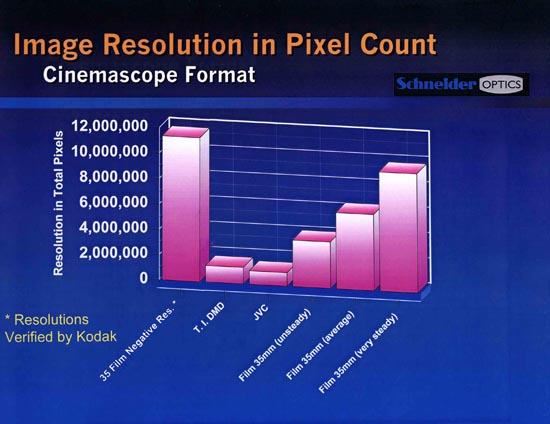
Here's a graphic depiction of resolution, prepared a few years ago by Schneider Co. Some of the numbers may not be exactly up to date, but it gives a good illustration of how things can vary.
[Edit to add re-sized illustration]
[ 10-19-2007, 04:47 PM: Message edited by: Paul H. Rayton ]
Powered by Infopop Corporation
UBB.classicTM
6.3.1.2