This is topic Pictures of the Booth at the Hiway Theater - Chicago (demolished) in forum Film Handlers' Forum at Film-Tech Forum ARCHIVE.
To visit this topic, use this URL:
https://ft-forum.com/ft/cgi-bin/ubb/ultimatebb.cgi?ubb=get_topic;f=1;t=008948
Posted by Edward Jurich (Member # 1787) on 10-10-2007, 03:38 PM:
I was browsing Cinema Treasures and found a lack of pictures for the now demolished HIWAY THEATER. I had taken a couple when I worked there in the 1960's so I put them up and posted a link. I thought some might enjoy seeing these old pictures. The HIWAY was in my old stomping grounds where I grew up in Chicago.
HIWAY THEATER - CHICAGO
Posted by Floyd Justin Newton (Member # 1316) on 10-10-2007, 04:29 PM:
V-E-R-Y interesting! Thanks for sharing!
![[beer]](graemlins/beer.gif)
Posted by John Walsh (Member # 168) on 10-10-2007, 07:11 PM:
I used those same pedestals, only they had RCA badges on them. REALLY heavy! It was better to back the rods apart (to kill the arc) than to use the lever/switch, or the contacts would cook a little.
Posted by Frank Angel (Member # 248) on 10-11-2007, 01:28 AM:
Ed, thanks for the time trip back to the Golden Age of the Single Screen Theatre. The pics are great. I only wish I had taken pictures of the houses and DIs that I worked when I was younger. Who would have thought that it would all just pass away. How everyone loved the movies back then.
What kills me is not so much that the technology changed (it was always changing and each change fascinated and allured me) and not so much that exhibition has evolved -- everything changes -- but that the digevangelists don't just praise the new technology, but they have to piss on everything that went before -- 100 years of film exhibition with all those millions of feet of film and the hundreds of millions of people in those darkend theatres enjoying them, and amazingly, never complaining that there was too much "jitter" for them to enjoy what are now the great classics.
I guess we were priviledged to have worked in what clearly were "classic" booths as well.
Posted by Floyd Justin Newton (Member # 1316) on 10-11-2007, 08:19 AM:
You said it,Frank!
Posted by Sam D. Chavez (Member # 1841) on 10-11-2007, 10:47 AM:
Jitter and weave were not big problems back in the day. The screen sizes were smaller relative to the audience and there were trained professionals in the booths whose job was to keep things optimized.
Lab practices were better as well.
Not nostalgia, just facts.
Not that there were not bad cinemas or bad operators, "your results may vary" as the saying goes, but on balance the experience was better as there was more emphasis on the presentation since all the income came from only one screen.
These booth pictures were a great slice of our past life.
Posted by Steve Guttag (Member # 268) on 10-11-2007, 01:52 PM:
As a general rule, in the past people demanded higher quality and people tended to get the most out of whatever technology they had. Today there is a "good enough" attitude...including from customers.
Steve
Posted by Ben Wales (Member # 92) on 10-11-2007, 05:47 PM:
quote: Steve Guttag
As a general rule, in the past people demanded higher quality and people tended to get the most out of whatever technology they had. Today there is a "good enough" attitude...including from customers
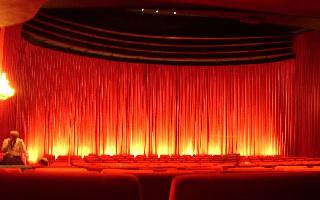
Well said Steve!, There are still the odd Classic Movie Theatre still out there and only last weekend I was at the 3 Todd-AO Film Festival in Germany's last remaining Cinerama Theatre at Karlsruhe.
The main Screen still retains it's now Todd-AO screen and Curtains and presentation to match ![[thumbsup]](graemlins/thumbsup.gif)
"Cinema Done Right"
[ 10-11-2007, 11:53 PM: Message edited by: Adam Martin ]
Posted by Edward Jurich (Member # 1787) on 10-11-2007, 06:15 PM:
The union operators in Chicago for the most part ran an excellent show. The HIWAY and a couple other in this small chain did have RCA tech service so the equipment was maintained. You will notice the projector in the picture looks "clean". That booth was well maintained, the operator did not just sit around between reels. He kept the machines clean. There were also spare sprockets in the booth and the operator would change them when they started getting grooved.
Lots of stories to tell about the HIWAY. The door that led down the hallway to the projection booth was always left open, or there was no door, I don't remember. The ladies room was at the top of the stairway and the booth door was about 10 feet past that. During the Beetles Hard Days Night, there were a few hundred screaming girls in the auditorium. One poor teenage girl came into the booth with a splitting headache. The operator gave her some aspirin. Another time some young woman came in and proceeded to show me and the operator pictures of her having sex with some guys.
Posted by Bill Enos (Member # 440) on 10-12-2007, 03:16 PM:
The Brenograph in the pic. appears to have a hood over the lamps to pick up and exhaust the heat an whatever else came out of the lamps, can't tell whether it's connected to an exhaust duct.
The rewind in another picture is one with a door to contain a nitrate film fire if it started during rewind. Some of this type of machine started when the door was latched shut and stopped automatically when rewind was complete.
Posted by Mark Gulbrandsen (Member # 72) on 10-12-2007, 06:19 PM:
Ed,
Having grown up in Glen Ellyn I do remember the Hiway ads in the Tribune when I was a kid.... but where was it?
quote: Steve Guttag
As a general rule, in the past people demanded higher quality and people tended to get the most out of whatever technology they had. Today there is a "good enough"
attitude...including from customers.
Ok, I give in... What on earth would make you think that people in general back then were more fussy about picture and sound? I say just the opposite.... in fact today there is a whole new generation of more technically oriented population that is in reality far more fussy then ever. Names like Dolby 5.1 surround sound and THX are dinner table names.... Back then all they had was Technicolor and B&W with mono sound... Somehow I can't see folks sitting in theater seats saying to each other "now why on earth didn't they use the RCA sound system instead of the Western Electric sound system?" or... My dear that low intensity lamp at the Rialto sure is dim compared to that new fangled H-I job over at the Bijou.
Now I 100% agree that some people but not all did more with less! That all happened during both World Wars.
Mark
Posted by Sam D. Chavez (Member # 1841) on 10-12-2007, 09:23 PM:
Presentation quality that was the best the equipment and the technology of the day would allow was the rule, not the exception.
First run houses did not as a rule scratch a print or miss a changeover. There were the grind houses in the skid row areas that did look pretty bad but they charged much less and it was more or less known what you were going to get, smoke, stale beer smell...
(I did have one grind house operator in my local who would purposely block the fire valve rollers so they would not make a clicking noise as the crooked reel turned; it disturbed his reading).
The audience awareness of technical names is not the same as real knowledge of quality issues. I and my son once sat behind a couple after completing the installation of some Dolby upgrades in an old downtown SF first run theatre. There were all sorts of challenges, acoustical and otherwise.
The man was expounding about the THX system in this theatre and "super 70mm THX" in the house around the corner. It was all I could do to keep from tapping him on the shoulder and telling how truly full of crap he really was. Sort of like that scene in Annie Hall. Needless to say, there was no THX, and there were some really awful Frazier surrounds etc.
For me like Steve, it comes down to doing the very best you can to give the audience a great show with what you have.
Posted by Mark Gulbrandsen (Member # 72) on 10-12-2007, 11:04 PM:
quote: Sam D. Chavez
For me like Steve, it comes down to doing the very best you can to give the audience a great show with what you have.
For any professional that goes without saying, but that also has more to do with self esteem. There were also people with out any nself esteem back then as well. I just don't agree that people demanded any higher quality in the old days nor did they know what that higher quality might even be as Steve suggests. When in fact they had lesser quality of everything or shall we say old technology. A good example of us having more today technically speaking are DVD's, CD's and high end audio not to mention a myrad of other things technology has provided us in all aspects of our lives. I look at it that advances in technology have made folks in general more aware of technical issues.... if they get it right or wrong is another story. I fear sometimes they read things that are biased or incorrectly explained and they think they understand.
Posted by Tim Reed (Member # 137) on 10-14-2007, 06:56 PM:
Great pix, Edward! Wonderful.
I remember working like hell to get my first paying job as a projectionist. I was one month from my 16th birthday (although, I'd made my first changeover at 12, and had been running shows almost weekly since then, thanks to several projectionists I'd befriended). The standards WERE higher in those days, it was still a craft. Someone off the street could not just waltz in and be the projectionist.
Posted by Edward Jurich (Member # 1787) on 10-14-2007, 07:26 PM:
quote: Mark Gulbrandsen
Ed,
Having grown up in Glen Ellyn I do remember the Hiway ads in the Tribune when I was a kid.... but where was it?
63rd and south Western Avenue, about 200 feet south of the intersection on the east side of Western Avenue.
Posted by Mark Gulbrandsen (Member # 72) on 10-14-2007, 08:49 PM:
quote:
I'd made my first changeover at 12,
quote: Tim Reed
Someone off the street could not just waltz in and be the projectionist.
Tim,
I think you disproved your theory in the second line back near the first line.... Now you leave no doubt with us that someone could just waltz in and be the projectionist ![[Big Grin]](biggrin.gif) !
!
Mark
Posted by Stephen Furley (Member # 1277) on 10-15-2007, 07:09 AM:
Mark, I don't see any contradiction there at all. Firstly, the fact that somebody is 12 says nothing about how much skill, knowledge or experience they have, other than that they obviously cannot have more than 12 years of experience of anything. There is nothing about being a projectionist that a 12 year old could not learn to do, other than lifting large spools of film onto projectors, and moving complete prints on and off platters, due to limitations of size and weight. There are plenty of good projectionists who cannot lift full tower spools on their own, and most cinemas that use them no longer allow one person to do this on their own anyway.
Secondly, why is the ability, or otherwise, to make a changeover seen as any indication of competence, or otherwise, as a projectionist? I keep hearing this; are there people who seriously think that this is all that the job involves? I made my first changeover at the age of six, just a few minutes after setting eyes on a film projector for the first time. It always struck me as being one of the easiest parts of the job: watch screen, press button; watch screen again, press another button; It doesn't get much simpler. It's one of the few things that I've allowed the occasional visitor to a projection room to do, without experience. If you warn them about parts of projectors that can be dangerous, make sure that they don't have any loose clothing, long hair etc. that could get caught, give them about thirty seconds instruction, and a light tap on the shoulder as each cue comes up in case they don't see it, I've never known anybody who couldn't make a reasonable changeover. Since their reaction time is unknown I would wind the incoming reel down just a few extra frames. I've had about half a dozen visitors, of all ages, do this over the years. The usual reaction when they look at the screen and see that it's gone ok is 'Is that all there is to it?' The seem to expect it to be really difficult.
Compare this to starting a show, dealing with houselights, curtains, masking, non-sync, film sound, lamp, douser etc. Or how about making up and breaking down prints, working with platters and setting up automation cues? Even something as simple as checking and setting Dolby levels requires more knowledge and skill than making a changeover.
Posted by Mark Gulbrandsen (Member # 72) on 10-15-2007, 08:06 AM:
quote: Stephen Furley
Compare this to starting a show, dealing with houselights, curtains, masking, non-sync, film sound, lamp, douser etc. Or how about making up and breaking down prints, working with platters and setting up automation cues? Even something as simple as checking and setting Dolby levels requires more knowledge and skill than making a changeover.
In my 30 years of doing work in this field I've only met perhaps eight full time working projectionists that were competant of doing the tasks that you listed above. In the part of the U.S. that I began working in this field the majority of the working projectionists got their jobs as a favor not because they were competant to do the work... indeed most worked other full time jobs and or had other qualifications or degrees. Many would not even clean the machines they ran!
So to me yes... Tim's lines do tell me that anyone can become a projectionist at least in his neck of the woods.
[ 10-15-2007, 09:34 AM: Message edited by: Mark Gulbrandsen ]
Posted by Edward Jurich (Member # 1787) on 10-15-2007, 08:33 AM:
quote: Stephen Furley
Compare this to starting a show, dealing with houselights, curtains, masking, non-sync, film sound, lamp, douser etc. Or how about making up and breaking down prints, working with platters and setting up automation cues? Even something as simple as checking and setting Dolby levels requires more knowledge and skill than making a changeover.
Back in the "good ol days" every so often I would be watching a show at one of the many movie palace's in Chicago and the picture would start to get dim, then turn orange and I would laugh to myself. I knew what was happening was the operator forgot to change carbons and they were at the end. Then when the picture went dark I could picture him changing carbons as fast as possible and then the lamp would strike after a few seconds.
Posted by Mark Gulbrandsen (Member # 72) on 10-15-2007, 09:36 AM:
Ed,
Yea.... and some here say that standards were higher in those days..... Ha! In reality there were proportionately the same percentage of shmaltzes running booths as there is today. Its just that today there are way way more screens out there. I remember hanging out in the Glen Theater booth when I was a kid and the operators name(or nickname) was Red.... he discouraged me from having anything to do with this biz but I think he just hated the U bases they had there. But he taught me alot about how the projectors, lamps and sound system worked... So I did other stuff for many years first before doing tech work in this field. All the jobs I held previously relate very closley to the tech work I do today.
Mark
Posted by Mike Blakesley (Member # 26) on 10-15-2007, 09:50 AM:
I think what Tim was saying is that it was harder to run a booth in the old days because there was more that you HAD to learn in order to do the job properly.
There is no doubt that presentation standards are higher today than back in the old days. We used to dread every new show we started, because there was always the possibility that the used print we got would be scratched, spliced-up, missing footage, etc. Today we probably get a scratched used print maybe once in two years, if that. This is because movies play off so much faster now, mostly.
Plus you had at least five or six chances for a breakdown with every show due to changeovers, not to mention the lamp issues with carbons. Now, if the movie starts properly, chances are good it will play just fine all the way through.
The standards that are lower now are more due to people just not paying attention to adjustments than anything, along with just not caring enough to learn how to operate the equipment (and clean it) properly.
Posted by Scott Norwood (Member # 30) on 10-15-2007, 10:10 AM:
The queston of whether things were better in the past is interesting. I'm only 30, so I wasn't around in the golden days of film exhibition (which I would guess were the mid- to late-1960s), but my research suggests that the very best downtown theatres of that era were far better than the best of today, but that the "average" theatre experience is probably better now.
The average recent (1990 to present) build has adequate light on the screen, a quality sound system, and lenses that are far better than anything that was available before. On the other hand, the best houses in, say, 1965, had 70mm with mag stereo, (generally) larger screens, curtains, no screen advertising, competent operators, and professional managers and floor staffs. They were also (generally) larger buildings with better sightlines (at least compared to most stadium houses) and classier decor.
Having said that, I've seen some "mothballed" small-town theatres and booths (which have sat idle for decades) that would make people here cry. These places were around at the same time as the palaces described above, but would have had poorly maintained equipment, uncomfortable seats, small screens, no curtains, cheesy masking systems, etc. There is no doubt in my mind that an AMC multiplex today provides a better experience for the customer than these trashy houses ever did.
I would be interested in comments from those who were around this business in the 1960s (and earlier) to see if my thoughts are correct.
I disagree that operators' jobs were harder in the past, however. We now have more types of equipment (changeovers, platters, automation, video) and more formats (16mm, 35mm, 70mm, and a slew of video formats) than ever before. Modern sound systems may require less maintenance than older tube systems, but require more knowledge to understand and troubleshoot. Older equipment and installations are still with us, as is the need to know how to operate and troubleshoot it. Add to this the fact that most theatres now have multiple screens and require time-management skills as well as mechanical and electrical knowledge.
Posted by Chris Slycord (Member # 4239) on 10-15-2007, 10:54 AM:
The reason they're saying "the operator's job is easier now" is that, while it's true that we have all those formats, the vast majority of working operators have never touched them. I've never personally played a 70mm show and only remember my old tech showing us a wound-up piece of film of that format when he went through a short training class for us.
And obviously most operators aren't at changeover houses either so in general, that doesn't apply either.
Posted by Edward Jurich (Member # 1787) on 10-15-2007, 11:18 AM:
quote:
I'm only 30, so I wasn't around in the golden days of film exhibition (which I would guess were the mid- to late-1960s),
By the 1960's TV already had an effect on theaters so I would say the golden age would be more like anything prior to 1960. I had an "old timer" operator tell me that in the 1940's the union in Chicago had a union checker that would go from house to house checking to be sure the presentation was good.
The operator from the Hiway went to a new 70mm suburb house and I went to visit him one time. Between shows he let me thread up reel 1 of the next show. Lifting a 2000 foot reel of 70mm film to the upper magazine is not for a weakling
Posted by Jack Ondracek (Member # 1466) on 10-15-2007, 11:31 AM:
Back in the mid-70's, the Seattle local would encourage their operators to critique each other by attending shows at union houses. I don't recall if it was an official practice, but I remember several occasions when a projectionist would be in my audience (I'd hear about it a week or so later).
I think that's one of the real benefits of the profession that we lost early. There's nothing like a critique from someone who shares your perspective on things.
As for the chat about how experienced projectionists were in "the old days", I doubt that was a consideration. We were working with what was then the state of the art. The intricacies of today's technology were traded off for the totally manual requirements of the dual projectors, carbon arcs, tubes, exciter lamps and (in some cases) crude oil boilers that many of us had to contend with.
A changeover at 12? So what? Just because my dad taught me how to shift gears from the passenger side of his Volkswagen doesn't mean I was a qualified driver. It was 3 years in the booth before the (assigned) union projectionist would risk leaving me the place. I also was 12. He would have been nuts not to watch me like a hawk. He was the one responsible for the show, not me.
Apples and oranges here. You can't compare today's gear with what we had in the '70s any more than you can qualify a guy in today's booth just because he happened to be a union projectionist in a large city when Doctor Zhivago first released.
Posted by Floyd Justin Newton (Member # 1316) on 10-15-2007, 11:42 AM:
Ed--
Did you ever try lifting a 'double-stacked' 70MM reel? We double-stacked "OKLAHOMA", a reissue in 19(??). Man those
reels were HEAVY! ![[Eek!]](eek.gif)
Posted by Jeffry L. Johnson (Member # 453) on 10-15-2007, 11:46 AM:
quote:
We double-stacked "OKLAHOMA",
How did you double-stack Oklahoma? Those 30 fps reels were already full.
Posted by Stephen Furley (Member # 1277) on 10-15-2007, 12:37 PM:
quote: Mark Gulbrandsen
In my 30 years of doing work in this field I've only met perhaps eight full time working projectionists that were competant of doing the tasks that you listed above. In the part of the U.S. that I began working in this field the majority of the working projectionists got their jobs as a favor not because they were competant to do the work... indeed most worked other full time jobs and or had other qualifications or degrees. Many would not even clean the machines they ran!
So to me yes... Tim's lines do tell me that anyone can become a projectionist at least in his neck of the woods.
I think most of the projectionists that I have met had been doing the job for years, often decades, before I met them, so I don't know how they got started.
I think that what I said still stands; the fact that somebody was 12 wouldn't stop them from being able to be a good projectionist, other than possibly the heavy lifting, depending on the equipment they were using.
The fact that somebody, of whatever age, can do a changeover doesn't, in itself, make them a good projectionist. If you've learned to do a changeover, and nothing else, then you've learned maybe 2% of what you need to be a good projectionist.
quote: Mike Blakesley
There is no doubt that presentation standards are higher today than back in the old days. We used to dread every new show we started, because there was always the possibility that the used print we got would be scratched, spliced-up, missing footage, etc. Today we probably get a scratched used print maybe once in two years, if that. This is because movies play off so much faster now, mostly.
Are you saying that you only get used prints once in two years, or that you get lots of used prints, but only a few of them are damaged? Where I project at the moment we never get new prints of features; some of the adverts will be new, most of the trailers when they come into the building, tough we may put them into and out of the reel several times over a period of several weeks, or sometimes months, and the short 'A Colour Box' which we ran recently was a new print, but all of the features are used prints. I don't think things are quite as bad as they are over there, judging by the 'Hey you, you suck' thread, but we see plenty of print damage. When I was young North London ran films the week before South London; I lived in the South, so I would almost never have seen a new print, except for newsreels. This would have been in the '60s; the prints that I saw were not full of scratches, splices, dirt, roughly hand-scribed changeover cues, tippex, sticky muck from splicing tape, damaged perforations etc, and of course, these were triacetate prints, so they would have been easier to damage. Now I don't know who is causing all of this print damage, I've visited lots of cinemas, single screens, muliplexes, multi-purpose venues, arts centres etc., and met lots of projectionists, who seem to be doing a good job. There obviously are some bad ones, or the prints wouldn't be in the state that a lot of them are, even ones which can only be a few weeks old when we get them.
quote: Mike Blakesley
The standards that are lower now are more due to people just not paying attention to adjustments than anything, along with just not caring enough to learn how to operate the equipment (and clean it) properly.
That certainly seems to be the case.
quote: Scott Norwood
The queston of whether things were better in the past is interesting. I'm only 30, so I wasn't around in the golden days of film exhibition (which I would guess were the mid- to late-1960s), but my research suggests that the very best downtown theatres of that era were far better than the best of today, but that the "average" theatre experience is probably better now.
I don't know about the"average"; it's very difficult to say. There will always have been a range, but I think there's probably a greater difference between the best and the worst than there was then.
quote: Scott Norwood
The average recent (1990 to present) build has adequate light on the screen, a quality sound system, and lenses that are far better than anything that was available before. On the other hand, the best houses in, say, 1965, had 70mm with mag stereo, (generally) larger screens, curtains, no screen advertising, competent operators, and professional managers and floor staffs. They were also (generally) larger buildings with better sightlines (at least compared to most stadium houses) and classier decor.
In the '60s you could still find cinemas using old cloth, I think they were linen, screens; the modern plastic ones are far better; lenses are generally better, most cinemas in those days were running Academy mono sound; even if they had mag stereo installed most films were not released in those formats. Very steep projection rakes, some that I've seen must have been about 30 degrees, were a problem in some theatres, though others were almost level. This wasn't always within the control of the architect. Consider two of the London Astorias; at Brixton the projection box was located at the rear of the stalls (downstairs), under the circle (upstairs) and the projection was almost level. At Finsbury Park this wasn't allowed by the licencing authority, and so it had to be built high up at the top of the building, with one of the steepest rakes I've seen. This sort of thing became much less of a problem once nitrate was out of the way.
Multi-screen cinemas created by dividing up what had been designed as a single auditorium, were often far from ideal, and some were downright dreadful, though most of these have now closed
quote: Scott Norwood
I disagree that operators' jobs were harder in the past, however. We now have more types of equipment (changeovers, platters, automation, video) and more formats (16mm, 35mm, 70mm, and a slew of video formats) than ever before. Modern sound systems may require less maintenance than older tube systems, but require more knowledge to understand and troubleshoot. Older equipment and installations are still with us, as is the need to know how to operate and troubleshoot it. Add to this the fact that most theatres now have multiple screens and require time-management skills as well as mechanical and electrical knowledge.
What do you mean by 'harder'? They were sometimes physically harder, carrying prints up many flights of stairs for example, there was equipment involved which few modern projectionists will ever use; generators, mercury arc rectifiers, carbon arc lamps, slide lanterns, Brenographs, follow spots, mechanical dimmer systems, organ blowers etc., but they may well have to work with platters, automation systems, video, various front of house display systems, box office equipment, computers, networks, digital projectors live satellite feeds, adsl lines etc. I've only ever run single screens, but many projectionists today have to look after several, or many.
As far as the knowledge required is concerned, I'd say there is more required to run a modern multiplex that a simple traditional cinema, but maybe about the same if you compare it to a large theatre, with organ, live stage events, etc. In terms of being physically hard work, I'd say the multiplex is more so, though I've never actually worked in one; this is my impression from watching people who do.
[ 10-15-2007, 01:57 PM: Message edited by: Stephen Furley ]
Posted by Edward Jurich (Member # 1787) on 10-15-2007, 01:44 PM:
quote: Mark Gulbrandsen
Ha! In reality there were proportionately the same percentage of shmaltzes running booths as there is today.
Well, I would think everyone has a few goofs under their belt. One of the other theaters in the Hiway chain still had the 3-D magazines. With those big magazines you could forget to flip the spindle latch that held the reel and those big doors would still close. So one time I forgot to flip the spindle latch and since the bell did not always work, I opened the magazine door to see how much was left on the reel and the reel dropped out of the magazine as soon as I opened the door. My first reaction was to hurry pick up the reel and put it back in the magazine but forgot that when I looked out and saw a white screen. ![[Frown]](frown.gif)
And my other royal goof would be running a kids show that had 3 cartoons, this was at the Hiway. Talking to the operator while threading the second cartoon I did not even notice there were no numbers on the leader. First cartoon ends and I change over to discover cartoon 2 is tails out. With 1000 screaming kids I quickly threaded up cartoon 3. The operator was laughing his ass off.
Posted by Monte L Fullmer (Member # 2797) on 10-15-2007, 01:57 PM:
quote:
Man those
reels were HEAVY!
...?? 'bout as heavy as hunking up a 13k reel full of film on a CINE V-18 reel transport's upper spindle and you forgot to extend the reel rest pins to aid in slipping that reel on it's respective spindle?
Posted by Mike Blakesley (Member # 26) on 10-15-2007, 02:06 PM:
quote: Stephen Furley
Are you saying that you only get used prints once in two years, or that you get lots of used prints, but only a few of them are damaged?
The latter. We play about 12 to 15 movies a year on the break, and the rest are used prints, but we play as close to break as possible so most of our used prints have only been in one other booth before ours.
Posted by Stephen Furley (Member # 1277) on 10-15-2007, 02:08 PM:
I've seen a tower with dual-gauge spindles, and another where one of the four spindles on a double-sided tower had been replaced by a dual-gauge one, but neither cinema ran 70mm, and I've never seen a 70mm tower spool, or met anybody who claimed to have used them. Did they really exist? I can't imagine that one person could possibly lift one of those safely on their own. I can lift a slightly overfilled 35mm spool onto a tower on my own, but that's about as heavy as I'd want to go. I haven't run a tower for years, and I'd much rather work with smaller spools.
quote: Mike Blakesley
The latter. We play about 12 to 15 movies a year on the break, and the rest are used prints, but we play as close to break as possible so most of our used prints have only been in one other booth before ours.
I'd say maybe one in ten has some sort of significant damage; rather more if you count dirty reel ends. Some are prints that have only been to one or two previous venues, others are decades old.
Posted by Monte L Fullmer (Member # 2797) on 10-15-2007, 02:15 PM:
I've seen a house that had hydraulic hoists for those big 13k, 70mm reels to huck them up on that upper spindle.
..like the hoists to scoop IMAX prints from their respective platters ...esp the huge DMR prints...like 'dang' that's 800 lbs of film to move around..
Posted by Rick Raskin (Member # 1561) on 10-15-2007, 02:44 PM:
I was there in the good old days. Carbons were dirty and film was too often oily. Some booths had to be accessed through a trap door and ladder while others were add-ons to old vaudeville houses that sometimes had fire escape type entrances. Equipment often dated from the silent era but for the most part was well maintained. As stated earlier, changeovers were the easy part. Smoothly starting and stopping a show with curtains, footlights and houselights was the real test of showmanship. Most operators back then also could do spot repairs to keep the show running. However, we did have our fair share of bozos. One of the old old-timers cautioned me not to get trapped in the business.
Posted by Mark Gulbrandsen (Member # 72) on 10-15-2007, 03:01 PM:
Rick,
The reply that I often heard was "cleaning the projector is not part of the contract". Its these pathetic souls that ruin it for those that do a good job.
quote: Stephen Furley
I think that what I said still stands; the fact that somebody was 12 wouldn't stop them from being able to be a good projectionist, other than possibly the heavy lifting, depending on the equipment they were using.
Stephen,
That wasn't my point. I guess you had to have worked with all the schmucks I had to some years ago to understand where I am comming from.
Mark
Posted by Edward Jurich (Member # 1787) on 10-15-2007, 04:19 PM:
quote: Mark Gulbrandsen
I guess you had to have worked with all the schmucks I had to some years ago to understand where I am comming from.
I understand where you are coming from. Although most all the union operators I knew in Chicago did an excellent job, there was one that was a total f#&% up. I mean picture out of focus, missed cues, sleeping during reels and reels running out. But the union protected him regardless how much the theater complained. There was one time he almost got fired. He decided the rollers on the sprockets should ride on the film and spin so he took pliers and forced the adjustment screws for all the sprocket rollers. He completely stripped a brand new print on the first run and the theater had to pay for the print. The union had him take a vacation but he was back a few weeks later. But other that that he was a really nice guy, just a lousy operator.
Posted by Rick Raskin (Member # 1561) on 10-15-2007, 04:33 PM:
quote: Mark Gulbrandsen
"cleaning the projector is not part of the contract"
You can bet I followed behind some of those guys. One in particular would leave dirty machines and carbon stubs long enough to run two reels. But his shows always looked good. One thing for sure, he never ran out of trim.
Posted by Mark Lensenmayer (Member # 134) on 10-15-2007, 08:31 PM:
Some of the 3-strip Cinerama locations used a small elevator to lift the large 35mm reels. You can see it about 1/3 of the way down this page from Roland Lataille's Cinerama Site about the Orpheum Theatre in San Francisco.
In tracking this down, I also came across the Harrisburg, Pennsylvania Cinerama Location . There is a picture about 1/3 down the page of quite a suspicious gentleman! (He's the second guy from the left.)
Posted by Monte L Fullmer (Member # 2797) on 10-15-2007, 08:45 PM:
quote: Rick Raskin
Some booths had to be accessed through a trap door and ladder while others were add-ons to old vaudeville houses that sometimes had fire escape type entrances
...were some of these booths equipped with Carbon TET extingusher bottles held in a device that had a spring loaded hammer that was held in place by a spot of lead, so if there was a fire, the lead melted freeing the hammer that would bust the TET filled bottles to smother out the flames, (or rid the booth of oxygen..lol) if needed?
One booth that I worked in had these, plus the firetrap doors on the portholes . The Carbon TET devices finally came out in late 1972..
-Monte
Posted by Gordon McLeod (Member # 33) on 10-15-2007, 09:10 PM:
Quote Mark "In tracking this down, I also came across the Harrisburg, Pennsylvania Cinerama Location . There is a picture about 1/3 down the page of quite a suspicious gentleman! (He's the second guy from the left."
can't be the same person he isn't holding a martini glass ![[Smile]](smile.gif)
Powered by Infopop Corporation
UBB.classicTM
6.3.1.2