This is topic Film Leader Colors... What do they mean? in forum Film Handlers' Forum at Film-Tech Forum ARCHIVE.
To visit this topic, use this URL:
https://ft-forum.com/ft/cgi-bin/ubb/ultimatebb.cgi?ubb=get_topic;f=1;t=008970
Posted by Ryan Navaroli (Member # 3477) on 11-02-2007, 07:23 PM:
This is something I have been trying to wrap my head around for a week. Is there any rhyme or reason the difference in coloring on leaders? It doesn't seem like it is consistent across prints and I can't figure out any reason to them. I really hate the yellow ones with the clear lettering but love the white ones with black lettering. I sort of feel like they should all be that way.
My most hair-brained hypothesis is they were created for illiterate projectionist to be able to build films. Oh well any responses would be interesting.
Posted by Bill Enos (Member # 440) on 11-02-2007, 08:11 PM:
Seems to me that when I started doing this in the early '80s there were some ancient Disney prints left over from the '50s that had green leaders and red tails, also motor cues and change cues were different, stars for the motor and squares for changeover. I might be completely wrong on the whole thing though.
Posted by Don Furr (Member # 1469) on 11-02-2007, 09:34 PM:
If I remember right, during early school days when we watched 16mm educational movies every head leader was white. Other than that I don't have a clue.
![[Confused]](confused.gif)
Posted by Scott Norwood (Member # 30) on 11-02-2007, 09:47 PM:
I've seen a few different "standards" for this. Most 16mm rental prints (and all that I've seen from Swank, which is the largest supplier of 16mm rental prints in the US) have green head leaders and red tail leaders.
In the case of unmarried prints, yellow or white leaders usually indicate picture and red leaders usually indicate track.
Composite answer prints from Deluxe Labs have white head leaders that say something to the effect of "Deluxe Answer Print" on them in red type. These commonly show up at festivals and usually look fantastic.
Posted by Mark Gulbrandsen (Member # 72) on 11-02-2007, 11:20 PM:
In dailies projection the head is always green and the tail always red. I can't think of a show I worked on that differed from this...
Mark
Posted by Phillip Grace (Member # 2262) on 11-02-2007, 11:50 PM:
One of the U.S. labs or production houses in the 1980's had a colour code for release print leaders. Each spool had its identifiction info in the head and tail printed over a different coloured background. Cant remember which it was, but it was consistent, and there was a printed chart with the colour codes in the projection room. We ran a lot of Paramount product at that time. It might have been from DeLuxe labs though. The colour code made for an extra check of the spool number. Among other things, operators at the time had an absolute horror of confusing Spool 2 with Spool 5. (Easy to read the numerals backwards) I think that is why today that information is covered with tape, so it can only be read from one side of the film.
Archival prints from the Murnau Institute also have a colour coded head and tail. Red, Blue, Green, Orange, Pink, for spools 1,2,3,4,5, and all the subsequent ones are White. Colour is full coat at the head and striped at the tail.
Posted by Paul Mayer (Member # 355) on 11-02-2007, 11:53 PM:
On Casino everything was white, though the hole-punched sync mark stickers for pix and track were black on white and red on white IIRC.
The standard for 16mm in the school district here was blue heads and red tails.
Posted by Frank Angel (Member # 248) on 11-03-2007, 12:26 AM:
I thought the "T" cue marks were only on Technicolor prints.
As far as the color leaders, it's nice and all, but going thru all that trouble to color code the leaders isn't much good in the way of helping insure that reel n leader gets attached to reel n print body. It would be a lot more advantagous if they implimented what we talked about many times over the years, i.e., copy an ID frame from the first frame of the print reel and duplicatd it, say for 14 frames, between Nos. 11 and 10 and then again between 4 and 3. Same principle as the colour chart girl. Now THAT would be something impressive and really helpful.
I know John P. used to say back in the day it would be very labor intensive to do that, but not in this day and age of digital intermediates -- just a simple cut-and-past.
If nothing else, tho, the color leaders add a little color to the booth. I like the way they distinguish the tails by doing that zebra strip thing thru every frame.
Posted by Monte L Fullmer (Member # 2797) on 11-03-2007, 02:00 AM:
..just don't get Reel's 1 and 4 confused since they sometimes both use yellow when pulling the reels out of the cans and in numerical order..
I think it was a DeLuxe thing to color the leaders for simple I.D. when it was introduced in the late 80's
Posted by Aaron Sisemore (Member # 145) on 11-07-2007, 03:39 PM:
DeLuxe introduced the Coloreel® system in 1981 (the first title I had seen with the system was Porky's). With one exception (reel 4), it is the same today as it was back then:
R1 - Yellow
R2 - Red
R3 - Green
R4 - Orange (now clear- most likely to avoid confusion with yellow)
R5 - Blue
R6 - Magenta
R7 - Cyan
R8 - Yellow/Cyan/Magenta stripes
R9 - Clear/Cyan/Black stripes
R10 - Red/Yellow/Clear stripes
-Aaron
Posted by Steve Guttag (Member # 268) on 11-07-2007, 05:25 PM:
Deluxe also started with the easy to read titles on these leaders plus used "/" slash marks on the title if it was the tail. I know many a projectionist that added some tape behind the title so that it shown through the tail so that their prints were effectively labeled (and not at the penmanship quality of the projectionist).
Steve
Posted by Frank Angel (Member # 248) on 11-07-2007, 06:38 PM:
That's all very nice and all, but how helpful is it? And helpful for what exactly? One assumes the projectionist can read numbers -- as long as they print the reel number a few times just in case some footage gets damaged, how does color coding help anything other than looking pretty? If on the other hand, if you want to address the really BIG problem -- that of making sure the body of film reel is accurately identified as to its number, then the leader, colored or not, once it's detatched from the body, is pretty much useless, UNLESS it has some ID Frames printed in it. THAT'S what would REALLY be useful. But then again, given that everyone is looking to digital, there many not be much enthusiasm for tweaking something as minor as a better film leader when everyone on distribution side thinks film is soon to become a footnote.
Posted by Brad Miller (Member # 2) on 11-07-2007, 07:44 PM:
quote: Steve Guttag
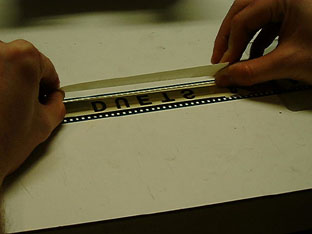
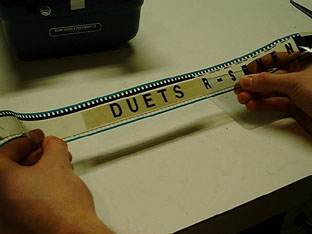
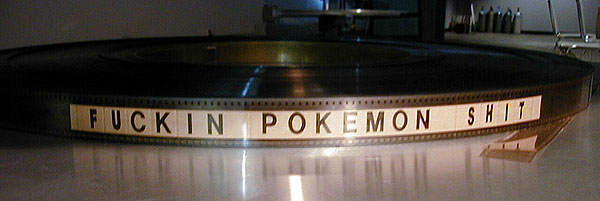
I know many a projectionist that added some tape behind the title so that it shown through the tail so that their prints were effectively labeled (and not at the penmanship quality of the projectionist).
Some examples...

Posted by Phillip Grace (Member # 2262) on 11-07-2007, 10:34 PM:
Yes. Coloreel was the one I saw.
As far as identification of reels is concerned, there is/was a method used for stills which photographically printed an identification "signature" at intervals along the edge of the film. Rigby made a signature machine for the purpose. That approach could be adapted to print the reel number and other information between the perfs opposite the dolby digital track, or better, the picture or track internegs could have this information added at the time of their production. There is also the Aaton code system of l.e.d. exposure to consider. Kodak must use something like that to apply latent information on the edge of the film at the present time. (Would that John P. were still here to comment on that).
A simpler method, cheaper to implement but not 100% foolproof where production is concerned, would be to add a colour filtered exposure lamp to the printer to print the reel colour code in between the perfs for the whole length of the reel. I met something like this at a filmlab which was used to black out the film between the perforations for an "Electronic Pin Registration" system on a telecine machine.
That space being the last unused bit of emulsion available, maybe could be used for some kind of more or less elaborate data record.
Posted by Frank Angel (Member # 248) on 11-08-2007, 04:25 AM:
But don't all films today, at least Hollywood films, have a digital intermediate? I assume the leader is edited onto the reel at that stage so the file for each reel contains everything -- leaders included -- when the entire reel is scanned from the digital back out to the finished negative. So how hard would it be to simply copy and past the first frame image and last frame image to the HEAD and TAIL leaders?
Then again, me thinks trying to get the splice monkies to change their habit of cutting their own ID frame (or two....or freakin THREE) will be a much biggger challenge than getting the labs to edit ID frames into the leaders.
Posted by Phillip Grace (Member # 2262) on 11-08-2007, 06:20 AM:
It probably wouldn't require a digital intermediate to make that possible for all films anyway. There is sure to be some excess trimmed from the head and tail of every shot in the film, so it wouldn't be too difficult to cut in a few frames of a trim into the original final cut neg. Four more joins made in the neg matching department wont involve that much expense. Its the equivalent of 2 more shots in the roll.
While we're at it, couldn't we please have the sound format and intended aspect ratio printed into the leaders? There's space for it, after all. Not every film is matted 1.85, SR-D. And with subtitled shows a mistake in that choice is pretty devastating.
Posted by Chris Slycord (Member # 4239) on 11-08-2007, 11:00 AM:
quote: Phillip Grace
While we're at it, couldn't we please have the sound format and intended aspect ratio printed into the leaders? There's space for it, after all. Not every film is matted 1.85, SR-D. And with subtitled shows a mistake in that choice is pretty devastating.
The sound formats are already printed on every movie I've built up for at least a couple years. They appear on the edge of the head/tail leaders on each reel.
Posted by Richard P. May (Member # 3598) on 11-08-2007, 11:24 AM:
I think one of the primary reasons for the different leader colors was from a lab standpoint. Consider the lab making hundreds of prints of each reel, then needing to assemble those into complete prints. With the color code, it became very easy to see if a stack of reels, on cores, had any duplicates.
Undoubtedly there were still errors, but it prevented the lab packing room people from having to pull down a length of film to know what reel was being put in the box.\
I've also seen head and tail identification being included, with the tail leader having diagonal stripes across the identification section.
RPM
Posted by Paul H. Rayton (Member # 1817) on 11-08-2007, 04:12 PM:
And I've always wondered why DeLuxe didn't use a "logical" color sequence when they launched the project, like "Red, Orange, Yellow, Green, Blue, Violet and ... (whatever) ... after those first 6 reels. It sure seemed (to me) kind of not-thought-through, in a way.
Posted by Phillip Grace (Member # 2262) on 11-08-2007, 10:54 PM:
to quote Chris:
"The sound formats are already printed on every movie I've built up for at least a couple years. They appear on the edge of the head/tail leaders on each reel."
Yes. New prints from some sources are properly finished.
We're in a repertory situation here and handle material from all parts of the world. Virtually nothing I have seen in the last five years has had any kind of reliable information on it. We depend on external references and personal experience. Fortunately we are able to test screen a reel when in serious doubt, but there isn't always the opportunity to do that, particularly in a festival program.
My plea is simply for properly finished screening material.
Posted by Blaine Young (Member # 3992) on 11-09-2007, 12:21 PM:
quote: Frank Angel
As far as the color leaders, it's nice and all, but going thru all that trouble to color code the leaders isn't much good in the way of helping insure that reel n leader gets attached to reel n print body. It would be a lot more advantagous if they implimented what we talked about many times over the years, i.e., copy an ID frame from the first frame of the print reel and duplicatd it, say for 14 frames, between Nos. 11 and 10 and then again between 4 and 3. Same principle as the colour chart girl. Now THAT would be something impressive and really helpful.
I was building "Lions for Lambs" yesterday (a Deluxe print), and noticed something interesting. At the heads and tails of each reel, along the inboard sprockets, there was a series of yellow squares. I've seen them before, but didn't really pay them any notice. But then something struck me. The yellow squares were repeating in a pattern, along the head and tail, and for a few feet on each end of the reel. Then it struck me - they are Reel markers! There were a corresponding number of yellow squares to the reel number. Now, I've only looked at a couple of prints since then - and none were longer than 5 reels.
While that's not as neat as what Frank suggests here, I thought it is a step in the right direction - being able to ID the reels through something other than cutting off a frame.
Posted by John Hawkinson (Member # 1135) on 11-09-2007, 12:22 PM:
Frank asked, "But don't all films today, at least Hollywood films, have a digital intermediate."
No.
I think it is somewhere around half. And growing. But not all by a long shot.
--jhawk
Posted by Frank Angel (Member # 248) on 11-09-2007, 03:13 PM:
Half the problem solved! Then on the other hand, it would be interesting to find out how many theatres play second run. Because, after all, the problem only exists for the next guy; for the 3000 prints that get built where the picture opens -- for them, the leaders are pristine....until it's sent back.
quote: Blaine Young
The yellow squares were repeating in a pattern, along the head and tail, and for a few feet on each end of the reel.
And of course, that's really the simplist answer -- edge print the damn number as a code or human readable numerics.
Bottom line though, is that all the information we would like to see edge printed, however they want to do it, would only be of issue in subruns, not first run, and films make the bulk of their money in the all important first run. And let's face it, other than creating those fanfolds and consequent frame loss problems in a smaller number of booths WAY down the line, how often does NOT having edge information for us actually impacted our being able to put the show on the screen? Rarely if ever will anyone loose a show because there is no reel ID frames in the leader or reel numbers in the body of the print.
So without significant money being an issue, no suits are going to fret that you and I have to spend some extra time on relatively rare occasions in subrun houses trying to figure out reel sequence or that there are a few frames missing at reel joins. It's a problematic issue for us; it's a non-existant problem for them.
Powered by Infopop Corporation
UBB.classicTM
6.3.1.2