This is topic Lamp Flicker or (unstable arc?): noticeable during end credits in forum Film Handlers' Forum at Film-Tech Forum ARCHIVE.
To visit this topic, use this URL:
https://ft-forum.com/ft/cgi-bin/ubb/ultimatebb.cgi?ubb=get_topic;f=1;t=008972
Posted by Michael Moore (Member # 3867) on 11-03-2007, 09:13 AM:
Ok this is a new problem that I have not noticed before and I have never confronted before so I’m a little lost on how to troubleshoot this problem.
I am projecting on a Century SA (Hadden theatre supply version).
I am using a Kneisley Xenex L-1000 lamp house.
My Rectifier is an IREM NS-X75
I have a brand new (29 hours) ASL 2000 watt bulb
Here is the problem. I was projection the movie “Talk to Me” and during the film the picture and color was great. However at the begging credits I noticed the words had a slight light flicker so that they were not solid white, but rather a flickering white light.
Next when the film ended and the final credits were rolling through I noticed the same effect but to a greater extent. The flicker was just at the words and not the whole screen. I’m confident the film is not damaged or faded in spots, leading to a flicker affect. Now when the end logos rolled through I did not notice this affect and the consequence was clear DTS, Dolby, and studio logos crisp and white.
After the show I removed the lens and turned the lamp house on, I observed the image and noted that the bulb was focused quite well, the light image was good, the illumination was good but I did notice a slight flicker around the bulb image.
While I was performing this test I then looked through the site glass at the arc. The Arc was a little elevated (arcing upward). I have always questioned the arc stabilization magnet in this lap house and whether or not it is installed correctly.
I’m thinking that either the film is damaged, or the credits were not printed correctly on this print. I also was considering that the flicker affect was intended by the studio?
Any clues to the problem?
Mike
Posted by Mark Gulbrandsen (Member # 72) on 11-03-2007, 10:37 AM:
Do you have a high leg on your three phase? If so this can and will cause a slight flicker since one phase of the rectifier is operating at perhaps 180 volts while the rest are at 120 volts(each measured to neutral).
quote: Michael Moore
I have always questioned the arc stabilization magnet in this lap house and whether or not it is installed correctly.
I have always questioned those lamphouses no matter what. Adjust the magnet to center the arc between the electrodes.
Mark
Posted by Cameron Glendinning (Member # 3516) on 11-03-2007, 02:24 PM:
How does the white light look on screen? ie without film. If it flickers, its the bulb, if it doesn't, its something to do with the print.
Posted by Aaron Mehocic (Member # 15) on 11-03-2007, 04:48 PM:
Agreed the L-1000 is not a very good lamphouse by any measure.
For two years I've been experimenting with ASL bulbs. The new sleeker design and smaller box are positives, but on the negative side I have noticed a drop in the lamp's longevity and a much hire rate of flickers. Although 29 hours is still, in my opinion, brand-new, it would not surprise me if failure was already setting in. Just last month I replaced a 3000 watt ASL in a L-2730 with a Kneisley M95RTX2X1 rectifier at less than 900 hours due to extraordinary flickering. Not saying ASL is any better or worse than its competitors, just saying their product may be heading down hill.
Posted by Monte L Fullmer (Member # 2797) on 11-03-2007, 07:19 PM:
quote: Aaron Mehocic
The new sleeker design and smaller box are positives, but on the negative side I have noticed a drop in the lamp's longevity and a much hire rate of flickers
..sounds like LTI's - they'd do the same thing...
(Wonder if he switched to Christie bulbs, wonder then if his problems would be drastically reduced...)
Posted by Michael Moore (Member # 3867) on 11-03-2007, 07:57 PM:
thanx for the input.
I have checked the light at the screen with and without the lens in the projector. (Only had it on the screen a few seconds with just the lens in) I did not see flicker at all.
I have also moved that magnet all up and down and still not much of a change. So I question the real function of it.
I was very leery about buying an ASL however the place I got it form (I will not mention their name) said they are one of the best on the market. If I have to change this bulb after just a few hundred hours then I will have to say they are best! The best junk on the market!
I actually have a Christy bulb in the booth. However I have never looked at it to see if it is 2000 watts and I have no clue how old it is. I don’t' want to take the chance and lose my reflector!
When I first arrived at this theater they were projecting with a 500 watt bulb in the Kneisley lamp house and a modified (rigged up) Kneisley rectifier.
I quickly changed things to 1000 watt bulb but still needed more. I then upgraded to a 2000 watt. So this has all been a work in progress.
I'm going to check that 3 phase if I get the 180 or so on one of the legs what should I do?
Is it a primary transformer problem for the three phase? Is the electric companies fought?
Thank you all for you help
Mike
Posted by Aaron Mehocic (Member # 15) on 11-03-2007, 09:31 PM:
quote: Michael Moore
I was very leery about buying an ASL however the place I got it form (I will not mention their name) said they are one of the best on the market.
ASL (Advanced Specialty Lighting) is the newest generation of what used to be known as Perkin Elmer - and before that ORC. Like all lamps, some are better than others without regard to who the manufacturer is. I'd say that we'd all agree that we have our favorite lamp, but at least one story of premature failure too.
Choosing a lamp is like picking your poison. Each lamp has its good points and bad points. In truth, the only lamp I've ran in almost 20 years that I will never purchase again is Yumex. When this site first went up in 1999 many of the "Film Gods" here were big proponents of Osram. When their quality suffered for a while it seemed Christie became the favored son. Buying a bulb is a lot like deciding to drive a Ford, Chevy or Toyota. In the end they'll all get you to the finish line.
My philosophy is that if you aren't getting a full year out of a 2000 watt bulb, you are throwing your money away.
Posted by Monte L Fullmer (Member # 2797) on 11-03-2007, 11:28 PM:
quote:
ASL (Advanced Specialty Lighting) is the newest generation of what used to be known as Perkin Elmer - and before that ORC.
And how many times did I cuss and swear at those cursed ORC bulbs!!
I used to work for a small circuit that was smart and was using Osrams.
Then, they begin to get stupid in going down to Hanovias.
Then, they really "dumbnified" themselves down to a horribly stupid and very cheap level by thinking on saving money with switching to ORC's. By doing this, ORC's failures were occuring like changing your socks on a daily basis.
In a six month period, we went though so many ORC's on returns due to loss of gas, or even explosions that my lamp card was halfway filled up and the owners just couldn't believe the failures and was blaming me for poor installs with poor connections.
I finally proved to them that it was definitely poor manufacturers to where they FINALLY gained some intelligence to go back to OSRAMS - by spending that extra pocket lining that they took earlier for better quality.
Now, a few years later, they decide to go "stupid" again with trying Perkin-Elmers, which right off, I knew those were those confounded ORCS, and sure enough, here comes the problems once again. And once again, in realizing that of their stupidity in saving the buck, that you just don't mess with quality and a good price when it slaps you in the face. They, again, went back to a good bulb, this time with Christies.
Posted by Darryl Spicer (Member # 711) on 11-04-2007, 01:18 AM:
it's the damn credits. I have seen this issue for years. The quality of credits now days sucks. If the picture looks great with no annoying flicker during the movie but then you notice it in the credits. It's the credits.
Posted by Monte L Fullmer (Member # 2797) on 11-04-2007, 01:32 AM:
Darryl ... this is beginning to sound like this topic that was discussed a couple of weeks ago, especially with Steve's comments here that includes what you said about the end credits..
Course, Michael has one of Louis's SA's with that shutter conversion (which I've heard really makes the SA more of a better machine, but it's still a projector with a revolving shutter that cuts the light at 48hz and as that previous topic mentions and what even Steve mentions on different brands of machinery: it could be the projector, not the lamp, mirror or rectifier.
I've just accepted that slight flicker with the end credits due to the black and white - opposite colors fighting against one another.
-Monte
Posted by Louis Bornwasser (Member # 3063) on 11-04-2007, 06:53 AM:
If you are properly aligned, and you see flicker with no lens, I would then look at the magnet situation. You should be able to stabilize a terrible bulb. Sometimes the magnet is in backwards which destabilizes the bulb.
Some brands of equipment "like" certain bulbs. Kneisley tolerates Osram best. I have tried the rest over the years. In your case, the IREM should help you with bulb life, but occasionally you can get a slight flicker from mis-matched diodes.
All in all, I think that the film is at fault unless you see flicker with no film and no lens. Can you run the film at another theatre and see if you have the same problem? Louis
Posted by Richard May (Member # 2627) on 11-04-2007, 07:43 AM:
This may be a stupid reply but check your shutter timing. Could you have been seeing ghosting on the credits?
Posted by Mark Gulbrandsen (Member # 72) on 11-04-2007, 08:31 AM:
Is it a primary transformer problem for the three phase? Is the electric companies fought?
To some extent but it is possible to get a transformer and install it in the booth to the feed for that power panel and end up with 208Y instead.
quote: Louis Bornwasser
Some brands of equipment "like" certain bulbs. Kneisley tolerates Osram best.
Boy howdy, I've found that not to be true. The larger globe of the Osrams tend to allow easier arc over to the mirror and other associated parts.... Sleeker globe type lamps have had less of that problem.
Louis is right though... check the magnet first, then the AC, if thats ok then check the rectifier... mismatched diodes, bad filter capacitor, etc,
Mark
Posted by Michael Moore (Member # 3867) on 11-04-2007, 09:43 AM:
quote: Louis Bornwasser
"Can you run the film at another theatre and see if you have the same problem?"
Carmike is scared of me in Dover Delaware and told me to stay out of their booth. They had a problem with putting Saw 1, 2, and 3 together a week ago (my brother in Law did not know how to put a movie together, he was going to call me to do it and the General Manager told him no! "do it yourself” my bother in law only knows digital, has never touched a film print in his life and they made him both manger and he is only 19!!!)
Let’s put it this way it was a big mess and when the next theatre gets those prints I can only pray for them.
That’s another story for another time. They are the closes theatre to me
quote: Darryl Spicer
"it's the damn credits. I have seen this issue for years. The quality of credits now days suck. If the picture looks great with no annoying flicker during the movie but then you notice it in the credits. It's the credits."
Speaking of this has anyone here projected this movie? Have they had the same issue?
quote: Monte L Fullmer
"Course, Michael has one of Louis's SA's with that shutter conversion (which I've heard really makes the SA more of a better machine, but it's still a projector with a revolving shutter that cuts the light at 48hz and as that previous topic mentions and what even Steve mentions on different brands of machinery: it could be the projector, not the lamp, mirror or rectifier."
Monte
The projector is the last thing I would suspect. Reason for this is I have had no problems with it and I find the nitpicking of shutters to be unfounded. The differences are not that great that you or I can tell the differences. A well maintained machine, Century, Christie, etc.; will give you all comparable results. Put them side by side you might see something different but come on. picky picky picky!
I find my Hadden Century to be quite excellent.
quote: Richard May
"This may be a stupid reply but check your shutter timing. Could you have been seeing ghosting on the credits?"
Not a stupid question, I once thought I had a ghosting issue because when I projecting "The Wind that Shakes the Barley" i noticed during the darkest seems, I thought I could see ghosting but in actuality it was not, It was at this time I started questioning the bulb. That was several months ago, and I kind of forgot about it because everything else I have projected I have not had an issue with until now.
I called Louis about it and he did say it could be the Lamp house alignment and with the Kenisley's it is very critical to get it just right. So i may have to go back to the alignment.
But you know when I look through that sight glass the arc does not look too stable it does dance a little and kind of upward but when I change the position of the magnet it does not do a thing to the arc. I checked the magnet and it is in the correct way and not backwards. I will check tonight after the show, tonight is the last showing so I'm going to make another adjustment to the magnet and see how it looks.
As for the 3 phase, the line comes into the booth and is feed into a 3 phase transformer, and then that line goes to my rectifier.
I am going to check that line voltage tonight...
Thank you all for you help so far.
Posted by Steve Guttag (Member # 268) on 11-04-2007, 04:08 PM:
quote: Michael Moore
nitpicking of shutters to be unfounded. The differences are not that great that you or I can tell the differences.
Actually that is quite easily proven incorrect and you will find that many if not most people that work with the varioius projector designs can tell the differences rather immediately. Now, how important the differences are to a audience that does not have the opportunity to compare the two (i.e. run a changeover booth with one each, Simplex and a Century) are not likely to notice any particuar problem or have a preference. As one that sets up predominately 2-projector systems, I strongly discourage mis-matched machines for this very reason, regardless of brand/model.
Now back to the topic at hand. You say the arc is licking up...that would indicate that there is not enough magnet in there. If the magnet is inserted backwards, it would always lick up since it naturally would lick up and the magnet in reverse would push it that way. So I would verify that it is in correctly and that it is as high as it can go or as close to the arc as it can go and possibly space it up further, if possible to bring the arc in the center. You can also try rotating the lamp...it is possible the electrodes are slightly off center and causing the arc not to be centered.
Now if the picture, sans credits, look flicker free, then odds are it is the credits. Normally solids like the preview "green band" are things that show up flickers more if it is lamp related.
Posted by Michael Moore (Member # 3867) on 11-04-2007, 05:52 PM:
quote: Steve Guttag
Now, how important the differences are to a audience that does not have the opportunity to compare the two
Now this is what I was really getting at; I mean if I were to look at a projectors image and compare it side by side with another brand I may see a difference and I may not, who knows? But will the audience see the difference maybe, I'm not sure, but I would have to say the differences are subtle.
Now as for my problem.
I checked the voltage and it is 121 volts AC at every leg, one leg wanted to go to 122 then back to 121 but it was mostly 121.
I then checked the Magnet and moved it up a little. I then took at look at the image again with out the lens. And I was confounded, I had just checked this thing a few days ago and it was not doing what I was observing. It was horribly out of focus, and instead of seeing uniformed light, all I could see is were heat waves rising from the bulb being reflected to the screen; and the light was dim. I then refocused the bulb and checked it for a few second with the lens in and I got it just right. Now I ran a film loop through with some credits and did not see any flicker what so ever.
I also looked in at the arc and it was not dancing around as much. I then moved the magnet up a little more and I think I got it; the arc was quite still after this.
Now that focus knob is very lose and I'm thinking it cranks it self out under vibration from the machine running.
Is there a way to tighten this down? I'm going to put a mark on it and see if it moves after the show and note the credits again.
Mike
Posted by Steve Guttag (Member # 268) on 11-04-2007, 06:11 PM:
Yes, the Century focus tension can be adjusted. If you look on the focus assy (outside of the projector frame) you will see a small set screw (Can be slotted or allen)...it presses in on a piece of leather or like item to put friction on the focus shaft. A SLIGHT increase in pressure goes a long way. Again, you are looking on the operating side of the machine just about an inch back from the knob or about half-way between the knob and the frame casting.
As to the shutter thing...I encourage you to look at many various types...you really will develop a preference for how some projectors look over others...even on that little aspect. Do customers? Not in the sense that they can technically describe why they liked or disliked the show...the story has a lot to do with that. However, it all adds in somewhere and as such I and others strive to always give the best show possible. Hence, I'm not as dismissive about such things as I DO feel it adds into customer enjoyment, even if a patron can't say "wow, your shutter really....yadda, yadda, yadda. But it all adds up. I have customers that have noticed a signficant improvement in a theatre where the real difference was the projector before and after.
Steve
Posted by Michael Moore (Member # 3867) on 11-04-2007, 07:42 PM:
Steve
I think I did not specify hat I was talking about. the focus knob on the Kneisley not the SA....
I am almost done with the film. stepped into the computer room to check in, the credits are coming up in about 20 min.
I now have a new bigger problem the flicker is actually worse. More towards the top of the screen, Once the bulb got up to temp, I tried to refocus the bulb slightly while projecting but it did not help, but it did not get any worse. I'm thinking I'm totally out of alignment.
but that knob did move about 1/4 of an inch out.
Mike
Posted by Richard May (Member # 2627) on 11-04-2007, 08:53 PM:
Is your lamphouse exhaust working?
Posted by Michael Moore (Member # 3867) on 11-04-2007, 09:16 PM:
Ok
I finally figured this thing out with the input from all of you.
First off my exhaust is working super well. That’s not the problem.
Second
I experimented with the magnet and came to a few conclusions
Many of you will know this but I just figured this out.
If you push the magnet right under the bulb (very close to the bulb) it will not strike and stay lit, Rather it will stick go out, stick go out strike go out, over and over, then finally strike and stay lit and flicker really bad then go out.
If you move the magnet to the middle the bulb will strike and stay on, and you get flicker but not too much flicker.
If you lower the magnet down as low as it will go the bulb strikes stays lit and does not flicker at all.
If I removed the magnet all together the bulb would strike and stay lit but would have very bad flicker.
If I installed it in reverse I got the same problems as having it too close.
If I pivoted it from right while it was in the lowest postion the bulb would strike and the flicker would be at the left of the screen. And if I did it the other way the flicker would be to the right of the screen and if it were dead center the flicker would be just at the very bottom of the screen. If I pulled it up from the lowest position just a little, and placed it just off center to the left of the bulb the arc stabilized, and the picture had no flicker!
Conclusions, I think every one of these lamp houses and bulb combinations would have a different setting and that there is no magic position or placement for the magnet. The user’s manual does not go into great detail about this either. The experiment also showed me that the magnet was not needed to start the bulb but rather to help keep the arc centered. I can't say it really stabilizes anything because if it were to do that the arc would be centered and stable. In my case the arc is slightly licking up and very stable, and production clean flicker free light. I think over time this is going to erode the edge of the anode.
Anyone have some more technical insights as to what is going on here?
Mike
Posted by Monte L Fullmer (Member # 2797) on 11-04-2007, 11:55 PM:
...like the magnet on the old carbon arc lamphouses: Magnet in the same position in the area of the negative rod (cathode). Move the magnet left or right, the flame moves left or right. Move the magnet towards the arc or away from the arc and the flame will either be tall or short - and you didn't want a short flame for the flame would just "ball" around the electrodes and poor light was the result.
As you mentioned: you removed the magnet and by doing this the current was at an even stream across the cathode (-) and anode (+) (as per the same with the carbon arcs..) and your light was not as good plus a lot of flickering.
You put the magnet back to increase the negative current heading towards positive, thus causing the flame to increase and to create the correct burn.
Posted by Steve Guttag (Member # 268) on 11-05-2007, 06:25 AM:
The focus lock for a Kneisley lamphouse is the lock nut...which should be on the outside of the lamphouse. You adjust the focus via the black knob, and then lock it down with the nut.
As to the magnet...its job is really to overcome the arc's tendancy to lick up...just like a flame. You should be able to adjust the magnet to get the arc pretty much centered and stay there for a long period of the lamp's life. The lamp may develop some anode sag, which can be minimized by lamp rotation. I've had better luck with non-rotation but lamps are hand made and some need more attention than others.
Posted by Louis Bornwasser (Member # 3063) on 11-05-2007, 09:19 AM:
If you don't have a locknut, add one to the Kneisley focus (1/4" x 20) Warning: when you tighten this, the rear of the bulb will elevate slightly. You will then have to loosen the bar and lower it just a touch. Louis
Posted by Richard Fowler (Member # 893) on 11-05-2007, 10:59 AM:
The support of the bulb, front and rear, with the reflector pivoting was a Osram recommended design with Kneisley followed for the construction of the Xenex I series. Locking nut is good to prevent focus shift, especially if you are tilting downward. We used to install (2) shaft collars with set screws and spring washers to take the play out of the focus thread. The support box which the lamp post is mounted can have some travel issues + the clamp to post and insulator beneath post are other issues which can effect squareness the "system". The magnet post may need to be bent slightly front/rear in addition to up/down and side to side to tame the arc. I had one of these Xenex I on a 70mm dome show with a 4000 watt bulb tilted at 25% up with the magnet bent forward with great results.
Posted by Michael Moore (Member # 3867) on 11-05-2007, 11:08 AM:
I have to not tried to bend that magnet front to back. I'm not sure why i did not try that before. but good idea, I think that might help.
I suspect maybe the bulb was made a little out of square, and round. I don't think the focus knob has a nut, I am going to add that too.
I'm going to play with the magnet post ion more because I'm not happy with the post ion of the arc it is licking up and I'm sure this will lead to bulb failure sooner then later.
Mike
Posted by Monte L Fullmer (Member # 2797) on 11-05-2007, 02:14 PM:
OH, there is one thing that I did forget .. being that you're using an ASL bulb and which was somewhat common with the ancestory of ORC and Perkin Elmers - which was the "sag" that the anode and cathode would get themselves into.
Bulb sits in the horizontal position for quite the while and you can get "sag" from both electrodes.
Take the bulb out, rotate the bulb by hand and see if the electrodes are in line with one another.
Posted by Jim Cassedy (Member # 4115) on 11-22-2007, 09:38 AM:
I recently had two complaints of 'credit flicker'. In both of my cases it turned out to be the prints. To be 100% sure, I even checked it using another reel of film that I knew had a long white-on-black credit scroll and it ran flicker free. I notice the problem almost always seems to be on credit scrolls with small typefonts. I haven't been involved on the production side of films for some years but I think that many end-credits today are composed on video, and the problem seems to be caused by some interaction between the video rastering/rendering process and the scroll rate, and is most noticable on small type fonts. But as I said, this is sort of a wild guess based on some limited past production experience with video-to-film transfers.
[ 11-23-2007, 02:05 PM: Message edited by: Jim Cassedy ]
Posted by Peter David Bruce (Member # 4447) on 11-22-2007, 06:19 PM:
sorry to be silly... is the magnet the Y-shaped piece of metal the front of the bulb rests on?
Posted by Monte L Fullmer (Member # 2797) on 11-22-2007, 07:56 PM:
..that's the anode support yoke. The rod magnet is that bar in the back below the cathode of the bulb, mounted on the lamphouse base of the mirror platform and is usually perpendicular (90 degrees) to the direction of the bulb.
Posted by Peter David Bruce (Member # 4447) on 11-23-2007, 03:19 AM:
right okay. im still not used to seeing the arc and knowing where everything is in there. i have another 15hr shift today so i will have to take a look and see what i can learn.
i had the problem the other day of it striking, going out over and over again then finally coming on.... i stepped up the amps which has fixed the problem.... but now i wonder whether it might have just needed some adjustment to the magnet etc.....
Posted by Monte L Fullmer (Member # 2797) on 11-23-2007, 01:48 PM:
hard striking could mean tired bulb with high hours, not enough startup voltage coming from the rectifier...etc.. Have you tried a new bulb in that lamphouse to see if the hard striking goes away?
Yea, best to leave the magnet alone.
Good luck-Monte
Posted by John Hawkinson (Member # 1135) on 11-23-2007, 09:58 PM:
Peter, what is your no-load voltage (voltage before striking), and what is the wattage and manufacturer/model of your bulb? This is the autostrike?
--jhawk
Posted by Monte L Fullmer (Member # 2797) on 11-24-2007, 02:53 AM:
Thx John for bringing that autostrike topic out. Yes, the relay on the autostrike board could be going bad as well ... for I've had a couple of them thinking on failing due to pitted contacts in the relays.
-Monte
Posted by Michael Moore (Member # 3867) on 05-10-2008, 08:07 PM:
I want to resurrect this issue because it is still persisting.
First I know in one of my early posts, that I stated the exhaust was work super well.. Well, I guess that is relative because I have nothing to compare it to. But I do know that when I was using 1000W bulbs I never had this flicker problem with this exhaust system.
This is what I changed; I went from 1000W osram bulb, to a 2000W ASL
I went from the old Kniesley rectifier to a IREM rectifier.
I just wonder if there is enough exhaust now that I have double the wattage?
So I have these new possible questions:
Could I have a problem with my exhaust fan. Well this is what the lamp house was installed with when I arrived at the theatre in 2000 and I have not changed it out.
http://www.rewci.com/fahprain4or51.html
I have another one of these fans and wonder if it would hurt if I use my plasma cutter and cut a new exhaust hole just in front of the factory exhaust and install a second fan. Wound this be a problem, maybe too much air flow?
I also wanted to know if maybe there is something wrong with the diodes in the IREM and if I should replace them, or what could be a good way to test to see if I need to replace them. Could a faulty diode cause some flicker?
I have moved the magnet all over the place and there is no net change in the flicker at the screen either way.
Mike
Posted by Jeremy Weigel (Member # 4208) on 05-10-2008, 11:13 PM:
quote: Michael Moore
Could a faulty diode cause some flicker?
Yep. A bad diode will cause a strobing affect on screen if you're lucky enough that the bulb lit. Do you know how to test the diodes?
Posted by Michael Moore (Member # 3867) on 05-11-2008, 06:33 AM:
I don't know how to test the diodes but If someone helps me out I probably have the equipment to do it.
Mike
Posted by Jeremy Weigel (Member # 4208) on 05-11-2008, 01:09 PM:
I'll take some pics for ya when I go in tonight.
Posted by Michael Moore (Member # 3867) on 05-11-2008, 06:22 PM:
I fixed the problem!!!!! Wow that damn MAGNET!!!!
Got thinking about all the things that could go wrong with this lamp house, and nothing added up or sounded right. I then made the discussion to go back to the magnet. This is what I did to it:
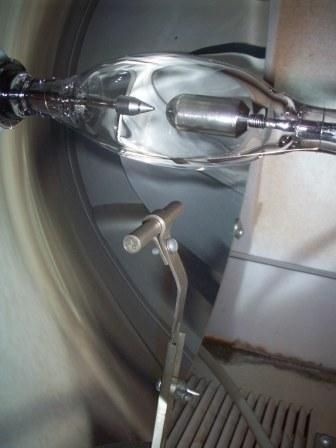
And well as you can see I really bent the hell out of the magnet, and it worked great! Flicker went away, and the light was more stable, without film and with film!
So I guess I solved this and I apologize for all this, I just was a little lost, and all along it was the magnet that I thought was not the problem
But thank you to all of you who have helped me so far.
Mike
Powered by Infopop Corporation
UBB.classicTM
6.3.1.2