This is topic Penthouse digital readers in forum Film Handlers' Forum at Film-Tech Forum ARCHIVE.
To visit this topic, use this URL:
https://ft-forum.com/ft/cgi-bin/ubb/ultimatebb.cgi?ubb=get_topic;f=1;t=008987
Posted by Frank Angel (Member # 248) on 11-15-2007, 05:40 PM:
We are going to add SRD playback to our Simplex XLs which already have DTS. Anyone have a preference for any particular manufacturer's penthouse reader? BACP DSTR-20 say over Dolby's?
Here is another issue. We already have an Ampex mag penthouse (which has to remain) and a DTS code reader on top of that. Will there be any issue if we stack the SDR reader on top of these two in terms of separating the reader that far from the picture aperture? I know that you can adjust the delay to match, but I was told that the more the delay, the more harsh the sound because there is more digital processing needed when you are at the maximum delay rather than the minimum. True?
If this IS true, would it be better to put the SRD reader on top of the mag penthouse and then the DTS on top of that? I am assuming the DTS has enough leeway to deal with the longer offset.
Posted by Monte L Fullmer (Member # 2797) on 11-15-2007, 05:44 PM:
You can stack the SR-D reader on top of the DTS unit with no problems.. Just change the delay timing for the SR-D unit being on top of the reader...and the manuals should have that timing reference.
Plus, the length of delay setting has no effect on sound issues since it's just picking up data from the film-why of the great variances of delay setting to accomodiate almost any extreme of installation..from minute to extreme.
Actually, it helps the film feed through the DTS with that SRD reader above since that reader has the registry pins on the center sprocket, plus the flywheel to smooth the film speed to the DTS reader...
Plus, BACP units are somewhat more economical to have than the Dolby and still is compatible with the Dolby processor units.
Posted by Al Biers (Member # 1961) on 11-15-2007, 06:19 PM:
Both the Dolby and BACP readers are great but I prefer the BACP for one reason, the ease of changing the LED when it goes bad, Dolby you have to solder a new one in, BACP just remove 2 screws and replace with new.
Posted by Ron Curran (Member # 3631) on 11-15-2007, 06:32 PM:
We have no troubles with the Dolby reader stacked on top of the DTS reader. Of course, we have to lace through both when running Dolby Digital to mainain sync.
The only issue you will have is with some used prints where the DD will often fail, though I am sure you have read this in other posts.
Posted by Louis Bornwasser (Member # 3063) on 11-15-2007, 06:45 PM:
Why not use a "basement" reader. They work quite well in SH-1000 soundheads. Then you don't have these problems. Louis
Posted by Sam D. Chavez (Member # 1841) on 11-15-2007, 08:37 PM:
In answer to Louis, I was the main proponent of the basement reader idea and helped all the manufacturers design and build the various versions during my time at Dolby Labs.
All else aside, it's a plug and play world and there are not enough techs and patience to sort out SR.D problems when they arise. It's simply easier to let the factory deal with the problem.
The versions that had the most problems IMHO were Christie and then Century, both in large part for internal vibration problems that resulted in vertical jitter the SR.D process could not handle.
In theory, the basement reader is a better and cheaper way to read the bits, but in practice, only Kinoton pulled it off close to perfectly.
Posted by Tim Reed (Member # 137) on 11-15-2007, 08:52 PM:
Oh, no question... BACP. Sam has a great product and the best value.
(Hi, Al, glad to hear from you!!!! ![[Big Grin]](biggrin.gif) )
)
Posted by Sam D. Chavez (Member # 1841) on 11-15-2007, 10:56 PM:
Thanks for the kind words but I did not write in to draw attention, just to get back to original topic.
Posted by Tim Reed (Member # 137) on 11-15-2007, 11:22 PM:
Oh, I know, Sam. I was just responding to Frank's inquiry.
![[Wink]](wink.gif)
Posted by Mark Gulbrandsen (Member # 72) on 11-16-2007, 08:27 AM:
Sam's readers have been the best as for results for us too. Basically zero problems with them.
quote:
Dolby you have to solder a new one in,
Dolby also offers the entire LED head from the CAT 701/2 penthouses as an assembly with the LED pre-aligned. This way its alot less painful in the field to replace them. The proper alignment of the led is done in a jig as are Sam's when they are built up. For field replacement replacing the entire head on either the BACP or CAT 701/2 units is the best and most accurate way to sucess.
BTW: The new Christie belt kit gets rid of all the verticle jitter on the P-35!! BAsement readers will finally work quite good.
Mark
Posted by Steve Guttag (Member # 268) on 11-16-2007, 08:42 AM:
Just like Sam has to defend his reader...I must defend my basement readers...Simplex, Century and Kinoton...no instrinsic problems there. AND if you fix the problems causing digital failure, you also fix problems degrading the analog sound.
I can't tell you how many times I've come into a penthouse booth where there is zero tension on the tension rollers and the digital is in a failed state. Penthouses are no guarantee to perfect tracking...people can still screw it up. My theory is that they will be threading the analog soundhead anyway; there is no extra stuff.
But back on topic...between Dolby and BACP..performance wise, I see no difference. Cost wise BACP is a clear winner. LED changeout, BACP is a clear winner if you are doing it yourself...since it is plug and play. I've changed LEDs on a great many readers of many different brands so the thought of soldering one in the field doesn't bother me...Ernemann does require an RX LED bracket...since their's is glued in (we can remove the glue and install a new LED but given the solvents and cure time...not really field practical.
So add up the points and I think the BACP reader comes out on top (pun partially intended).
Steve
Posted by Mark J. Marshall (Member # 1409) on 11-16-2007, 11:06 AM:
For what it's worth, our CP650 / CAT 702 setup still warbles. I think we're going on three years now. So do the two down the street. We tried switching the CAT 702 to be under the SDDS reader hoping that the SDDS reader would smooth out the motion in the SRD reader enough to make the warbling go away, but it didn't. It still wows badly when a splice goes through, or cue tape goes through.
The tension is fine in the readers, and our engineers can't do anything more with them. They say that they talked to Dolby and the response was "It's supposed to do that." I'd love to see it work like the 10+ year old CP65 / DA20 / CAT 699 setups down the street which both work perfectly. I've always been a big fan of Dolby, but I've given up on this particular setup. Everything in that house runs in SDDS or SR. A basement reader might help our problem, but I'm not sure.
Posted by Sam D. Chavez (Member # 1841) on 11-16-2007, 11:32 AM:
Apart from refuting Steve's saying I'm defending my reader, I agree mostly with Steve. It's easier that way.
If we had all Steve and Mark clones dogmatically servicing cinemas, we would all be better off but we don't. I'm just stating the obvious when I say we live in a plug and play world.
Basement readers are definitely better when it comes to wow caused by the platter jerking on the film. This was one of the inherent advantages that caused Dolby to go in this direction. The penthouses were mostly intended for the short term. The idea was we would be out of the sprocket business in a few years. Didn't happen.
As to Christie's new belt kit, let's wait and see. This may finally be the magic bullet that make the projector work properly , but time as in a year or more, is the true test here.
Posted by Brad Miller (Member # 2) on 11-16-2007, 11:42 AM:
The only thing I don't like about basement readers which hasn't been brought up is that you are putting all of your eggs in one basket. It is only for this reason I prefer penthouse readers. As far as the tracking ability goes, nothing beats a Kinoton basement reader. However I've not had problems with any other types of projectors running basement readers in them.
As much as I love to defend and support Dolby, I also agree that the BACP reader is a superior machine. The fact that it is cheaper and easier to change the led on just makes it even more attractive.
Don't worry about stacking a bunch of penthouse readers on your projector. It does NOT degrade the audio quality. Whoever told you that has no business anywhere near a booth.
Posted by Lyle Romer (Member # 1266) on 11-16-2007, 01:18 PM:
quote: Frank Angel
I know that you can adjust the delay to match, but I was told that the more the delay, the more harsh the sound because there is more digital processing needed when you are at the maximum delay rather than the minimum. True?
Completely false. The data just gets delayed not processed in any way. Think of it as pausing a live show on a tivo. Hit pause then play and it's the same data just delayed. The only difference is Tivo is on a hard drive and on the digital sound systems it is RAM.
Posted by Monte L Fullmer (Member # 2797) on 11-16-2007, 04:10 PM:
quote: Sam D. Chavez
when it comes to wow caused by the platter jerking on the film
..wouldn't the 'holdback' sprocket in the soundhead prevent the wow caused by the jerking from the platter?
Posted by Brad Miller (Member # 2) on 11-16-2007, 04:36 PM:
Monte, it is the payout side of the platter that affects a penthouse reader, not the takeup side.
I've had this same thing happen when using an upper reel arm with a clutch that wasn't quite perfect or a reel that was out of round.
Posted by Mark J. Marshall (Member # 1409) on 11-16-2007, 07:45 PM:
The worst part for us is when a piece of cue tape goes through to signify the end of the movie. The music "Taa daa..." cue always sounds like "Taa Daaaaaoowaowaowaaa" causing the audience to laugh. That's probably not what the film makers intended. Music throughout the movie itself can sound anywhere from perfect to an analog cassette tape that's been sitting on your car's dashboard for the whole summer. So we just stick with SDDS in that house. Or if there's no SDDS, plain old SR.
Posted by Monte L Fullmer (Member # 2797) on 11-17-2007, 12:08 AM:
Thx Brad for the correction, but an interesting question then, for I know of one cinema that has a BACP penthouse reader and they're complaining on the same "wow" issue ... and they're using STRONG platters.
If the head is just picking up data from the film how does it 'wow' if it's just reading data? You would then think that SDDS would have the same problem then we we don't have to worry on DTS being just timecode..
..guess, I don't fully understand this faulty procedure then and would please ask for a little help on this area .. so that I can tell this cinema on how to curtail their little problem.
thx-Monte
Posted by John Hawkinson (Member # 1135) on 11-17-2007, 07:01 AM:
The problem is pretty simple. Digital sound readers adjust their playback speed based on the speed that film goes through them (because projectors don't run at exactly 24.000Hz and it is important that the sound matches the picture).
So when there is insufficient tension on the sound reader and the film wows as it goes through the reader, that's another way of saying that the speed of the film through the digital sound reader is not constant. You hear the corresponding pitch variation.
This is all a function of tension and film path, etc. Also length of your tail/drag strip.
--jhawk
Posted by Steve Guttag (Member # 268) on 11-17-2007, 07:27 AM:
Brad...all of eggs in one basket? How so? The readers themselves are separate, using separate LEDs and often with separate LED supplies. What is common? The drum? It better be spinning properly or you'll have film damage soon. Better to have digital drop to let you know of a pending failure than to gleefully run in digital and not understand why the film is being damaged or if you have something without digital tell you that your spare tire is flat.
The counter arguement is that with a penthouse you have twice as many failure points.
Mark's problem is a curious one. Just in case...are you running the latest firmware in the CP650? It is 2.3.5.something now (I forget if it is 2 or 4 on that last digit). I always thought it was unfortunate that the penthouse people eliminated the sprung roller that was present in the Cat 699...it was a nice debouncer that took some of the shock off of the closed loop system.
Monte...how the digital decoder deals with speed variations is up to the people that write the code. You need to allow it to deal with speed variations as John noted but how fast is a matter of opinion. My opinion is that it should never be audible. However, that means it can only adjust for speed slowly and that may also mean it will need to use a large enough buffer to deal with catching up to a suddenly faster running machine. But, then again, other than start up or changeover, when is a projector going to suddenly change speed? A clever programmer should have special case algorhythms for those situations as they are known (speeds starting below the minimum are start up...changeovers have motor start signals, changeover signals and such). Once the speed is set for a particular start up...it should be a very slow change if the speed varies to avoid noticable wow/flutter.
DTS went through this problem too a while back (one of those dark firmware versions between 1.29 and 1.46). They had to deal with changeovers between dissimilar machines that have different speeds. Unfortunately, they took a special case and tried to apply it as a general fix. Most changeover houses have identical machines for both and even if there are variances between the two (presumming async motors), it shouldn't be real different to need such a drastic speed change instantly.
John....CUE MARKERS....some machines are indeed right on 24fps to three decimal places...those with good frequency inverters and good motors. I've stobed machines where they they were spot on. We recently conveted some DP75s to inverter drive using some Bodine motors and Lenze controllers and upon verifying the speed with a strobe using the shutter as the target...it was frozen (also indicating little slop in the gear train too). Now, not all motors/controllers are created equally...in fact, the reason I strobed the unit was to see how off they were...I've found several low-cost inverters that put out "about" 60Hz. The Lenze AC-Tech inverters we used on this particular project were not very expensive as inverters go so I was curious.
With sync motors now the norm in most cinemas/screening rooms, odds are, the speeds are quite close to 24.000fps but more importantly to this topic are not varying around by any signficant amount as that would require the line frequency (not voltage) to be varying.
Steve
Posted by Monte L Fullmer (Member # 2797) on 11-17-2007, 06:03 PM:
Thx, John and Steve for this SRD info very much which really clears things up on this one condition that this one cinema has-that I wasn't for sure since I'm justr lightly educated of the full spectrum with SRD playback.
For there is an induction motor on their 5-Star head and I have mentioned on changing that motor out for a sync motor to keep speed more constant since they do have voltage fluctuations in that building from time to time.
thx-Monte
Posted by Brad Miller (Member # 2) on 11-17-2007, 08:59 PM:
Steve, to pick on you I will give you an example. When using a Kinoton basement reader, if the O'ring breaks during a show...the show is lost because the operator can't switch to SR to finish the show. Hence, all your eggs in one basket. Don't tell me it doesn't happen, because it has happened to me before and the projectors were less than a year old at the time.
And that is also why I am a fan of not playing trailers in digital. That alerts you if there is something wrong with your analog backup.
Posted by Steve Guttag (Member # 268) on 11-17-2007, 10:09 PM:
No arguement that there was a bad batch of O-rings on Kinoton. However, I never had one break all of the sudden...just puff up and get oversized...that doesn't just happen but over time...however if it happens in the middle of a show...pull the roller off, switch it around and put it back...you are back in business...the outboard O-ring will not be so afflicted as well. Again, one shouldn't be running the film with O-ring missing...the problem needs to be fixed right then and there.
The O-rings are indeed a wear item. The current green colored ones last a good long time though. This is a case of good trade off on a wearable...that is, yes they add to the cost of operation but the increased friction the O-rings bring offset the added tension that was required for the non-O-ringed pinch rollers of previous soundhead designs by Kinoton.
Steve
Posted by Mark J. Marshall (Member # 1409) on 11-18-2007, 12:30 AM:
Jhawk is right. My problem is a simple one to understand. What I don't understand is everyone's lack of interest in fixing it. I can't even get a Dolby tone loop to play without the pitch wowing all over the place. I believe it was a Dolby tech on these forums that told me that when he runs a test loop, he adds a weight of some sort on the loop to hold it steady in the reader. That's great, but it doesn't in any way simulate how film travels to the reader. When I run the same loop on a CP65 / DA20 / CAT 699 setup, I can push the reader's tension rollers up and down all day long and it won't wow at all. Something changed between then and now. And it sucks.
Changing the speed of the audio to match the speed of the picture is one thing. Changing the pitch is something else entirely. It should be pretty easy for the processor to be able to tell what the pitch SHOULD be, based on sprocket count.
I dunno. I've beaten this horse to death.
Posted by Demetris Thoupis (Member # 833) on 11-18-2007, 04:54 AM:
When using the Dolby Tone loop, you have to thread the whole projector and not just the lower giveaway sprocket and the reader. This applies to all test films!
As regarding the Penthouse Readers, I go for BACPs DSTR-20 Reader. We recently retrofited 5 Christie projectors with these and the projectionists were amazed for they have seen for the first time on the Digital Processors error rates of 2!!!
I have always thought that putting the DTS reader the highest of the readers is a good case. In this way you can always bypass DTS with no problem and go straight to Digital reader using just an auxiliary roller on the DTS reader. It also "looks" better considering first that there is enough film matched to the delay in the DTS decoder/processor.
Demetris
Posted by Mark J. Marshall (Member # 1409) on 11-18-2007, 09:08 AM:
quote:
When using the Dolby Tone loop, you have to thread the whole projector and not just the lower giveaway sprocket and the reader. This applies to all test films!
What does that have to do with the tension of the film coming into the reader?
Posted by John T. Hendrickson, Jr (Member # 849) on 11-18-2007, 11:44 AM:
Thread the whole projector? That's news to me.
Posted by Demetris Thoupis (Member # 833) on 11-18-2007, 12:21 PM:
I've seen someone who used Dolby Tone with threading just the drum and the giveaway sprocket. I am saying that when you use test films, you should thread the whole path (Upper Take In Sprocket, gate, Intermitent, Giveway Sprocket).
Posted by Steve Guttag (Member # 268) on 11-18-2007, 12:21 PM:
FWIW...I've always used 10' loops and threaded the whole film path. I want to simulate the dynamics of the entire film path as much as possible...naturally, the outside forces caused by the reels or film path are much harder to simulate with test film.
Steve
Posted by Brad Miller (Member # 2) on 11-18-2007, 02:05 PM:
Mark do you have a humidity problem in your booth? Has anyone ever checked the bearings on the penthouse sound drum?
Posted by Mark J. Marshall (Member # 1409) on 11-18-2007, 07:05 PM:
Nope, no humidity problems to speak of in any of the three booths (three different theaters). And these units have all done it from pretty much day #1.
I do appreciate the comments. But the problem is not that the film bounces. Of course it does. Anything from a splice going through the brain, to static, to the air conditioner blowing on the film hanging between the platter and the projector will make it bounce. When a splice goes through the reader, it will bounce. I expect all of that. Everyone should. The problem is that the really expensive CP650 can't deal with the film bouncing without making the pitch bounce all over the place. Call me crazy, but I find that rather ridiculous.
Again, I do appreciate all of the comments, but I really think this ball is in Dolby's court. For now the SDDS sounds great... or at least, better than the 650.
Posted by Mark Gulbrandsen (Member # 72) on 11-18-2007, 07:29 PM:
You need to carefully check the dash pot in the penthouse. I have had to replace numerous ones in CAT 700's and 701's. Also the top lateral guide roller which is the top sprung davis roller... check that for wear on the edge closest to the main frame. If that inner guide edge is silvery (anodize gone) then its shot and should be replaced.
Mark
Posted by Brad Miller (Member # 2) on 11-18-2007, 08:08 PM:
Do you have an SDDS reader mounted UNDER the Dolby??? FYI that CREATES such a problem.
Posted by Sam D. Chavez (Member # 1841) on 11-18-2007, 08:10 PM:
The Airpot is the #1 failure mode on the 701. I'm not sure why, but I believe the piston rod breaks off leaving you with zero damping.
Posted by Mark Gulbrandsen (Member # 72) on 11-18-2007, 09:25 PM:
I haven't had them break yet... they seem to develop what is equivelent to slop but it isn't really... and you can't get the proper damping by re-adjusting the screw at the bottom. I think its uneven wearing of the glass tube itself. The west is VERY dusty and I think the dust causes the odd wear...
Mark
Posted by Steve Guttag (Member # 268) on 11-18-2007, 09:40 PM:
We have had the rod become effectively disconnected from the piston...we have also had good luck re-cementing them back.
Posted by John Walsh (Member # 168) on 11-19-2007, 07:20 AM:
Same here; the piston disconnected from the rod on several of our readers. They weren't 'swaged' enough, and slipped through the hole in the piston.
Posted by Tim Reed (Member # 137) on 11-19-2007, 09:25 AM:
quote: Sam D. Chavez
the piston rod breaks off leaving you with zero damping.
Same thing that happens with Christie projectors.
Posted by Mark J. Marshall (Member # 1409) on 11-19-2007, 10:36 AM:
I love all of you guys. Really I do, and I mean that with all sincerity.
The only reason I can think of that would make you want the speed of the data going into the processor to have anything to do with the pitch of the sound waves coming out of the processor would be to have the pitch of the digital track match perfectly with the pitch of the analog track. If the analog track is running through a projector that's operating at 24.004 fps, then the sound track's pitch will be slightly higher than it should be. It makes sense to have the digital track also pitch slightly higher to match that pitch of the analog in order to mask digital drop outs better.
However, wild pitch variations like the ones we're seeing should absolutely not be possible. The 650 should be able to average the speed output of the FIFO buffer a lot better than it is. I assume that there is some sort of a speed averaging algorithm being used on the speed of the FIFO's output. It seems to me that the sample size of the average is way too small, but what do I know? Whether this is a software issue for Dolby to fix, or if it's a problem with all of our processors I don't know.
My biggest gripe: If customers are laughing at your presentation, that's a problem. But I guess for others in my world, it's not. Have you ever felt like you're the only person to care about something? Do you remember how tired that makes you feel? I'm very tired right now. Thanks for waking me up. It's been a pleasure, but I think I'll go back to sleep. Wake me up again when this is fixed, please.
Frank, I'm sorry this thread drifted way off topic. If anyone is interested, here is a thread where this is all pretty well documented, with videos. Thanks again for all of the tips. ![[beer]](graemlins/beer.gif)
Posted by Gordon McLeod (Member # 33) on 11-19-2007, 11:32 AM:
I would fix the problem with the bounce first then look at the processor
one should not use electronics to fix a mechanical issue
Posted by David Stambaugh (Member # 1102) on 11-19-2007, 11:44 AM:
This has nothing to do with anything, but last night the local FOX station was having trouble with their network feed, which is obviously digital. The picture was doing the blocky thing you see when there aren't enough bits to make the entire image. But what was really strange is the Dolby Digital audio was doing a severe "wow" thing just like Mark describes. It was speeding up and slowing down, not just dropping out or "skipping".
Posted by Mark J. Marshall (Member # 1409) on 11-19-2007, 12:01 PM:
Does the film in your penthouse digital readers not bounce when a splice goes through?
Posted by Brad Miller (Member # 2) on 11-19-2007, 12:15 PM:
Mark, two years ago on that other thread you linked to above I pointed out what happens if you permit that top right spring-loaded roller on the SDDS2000 to be in the film path when using an SRD penthouse. In re-watching that video you submitted, I see that you ARE threading around it. Has that threading still not been changed? If that has not been flipped, this bashing of the Dolby product has no merit because I guarantee you that mounting setup WILL cause exactly the complaint you are describing.
Set it up in this manner...
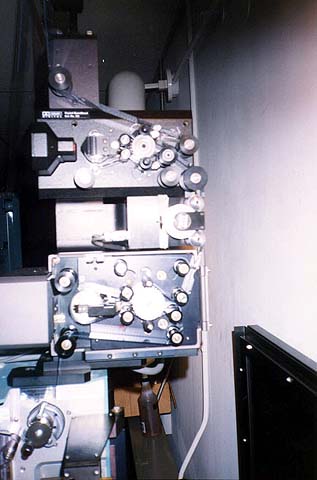
Just make sure you mount the SRD a bit forward so that roller isn't touched at all. Ideally though, put the SRD directly on top of the projector and bypass the SDDS via the two 70/35mm rollers.
As far as your cue tape, as long as you are using that shitty cue reader, you will never get totally rid of that. (And make sure your loops aren't dragging over themselves when you run tests.)
Also in terms of the Dolby guys trying to assist, did you ever swap the readers as was noted on the last page of that other link? They can only give you so much help if you don't give them the troubleshooting assistance.
Finally if none of that helps, swap the projector motor with another machine. Gordon is absolutely correct when he says to go after any possible mechanical problems first.
Posted by Frank Angel (Member # 248) on 11-19-2007, 12:44 PM:
Mark, no need to apologize...no matter how it drifts, it's always chock full of information and a learning experience. I got my answers (thanks everyone) somewhere on page 2.
Posted by Blaine Young (Member # 3992) on 11-19-2007, 01:01 PM:
Brad, I love the setup. Until I had seen your DTS reader upside down, I had no idea it would work in that orientation. But it does raise a question.
Obviously there is no offset issue with the SDDS as it's the last one in the chain. However, the DTS and DD offsets are another question. Do you have them configured to bypass the others, or are they configured to thread through all three readers all the time?
Posted by Brad Miller (Member # 2) on 11-19-2007, 01:05 PM:
That was an older setup, but I always set systems up to thread through everything with automatic digital to digital defaults.
Posted by Blaine Young (Member # 3992) on 11-19-2007, 01:15 PM:
Out of curiosity, what is the order your automation applies on the digital tracks?
Posted by Mark J. Marshall (Member # 1409) on 11-19-2007, 03:11 PM:
Yes, the SDDS is now above the SRD reader, and the problem still persists with and without threading the SDDS reader. And I believe in the second video I demonstrated threading the old configuration (SDDS on the bottom) without touching the SDDS spring roller.
As far as switching the readers between the CP650 and the CP65, I no longer have access to that theater, so I'm unable to do that test. Our engineer was going to bring a spare CAT 699 for me to test with our 650, but something happened to it and for some reason I never saw it.
I'm not sure what changing the projector motor would do. The analog sound doesn't have any pitch variations at all, so that tells me that the projector is running at a constant speed. This is true on three projectors at three separate theaters.
The shitty cue tape (I agree on that!) isn't the only thing that causes the wow. Our Neumade clear splicing tape also does it, and so do ultrasonic lab splices. Anything that makes the film bounce makes the pitch change.
I'm not trying to bash Dolby or their product. I like Dolby. I'm the guy who used to turn ON the CAT 699 and the DA20 and turn OFF the SDDS because I think the SRD sounds better. It seems from the thread I linked to that I wasn't the only one having this problem. I wonder if the others from that thread (including Max from Germany) had their issues resolved. Maybe there were a bad batch of boards or something if it's not a software problem.
If I'm ever proven wrong, I'll admit it. But the best part is that we'll probably either switch to DLP or close the theater before this is fixed, so we may never know the answer. That's what I'm hoping for. I'm pulling for DLP in this house. That'll fix it. I'll even pull for a Dolby server. That would be great.
![[Smile]](smile.gif)
Posted by Max Biela (Member # 1919) on 11-20-2007, 02:18 AM:
Hi Mark,
I don't work for this Theater any longer so I don't know whether the problem still persists or not. Right now I only have access to CP500s with Kinoton Basement readers - no problems at all.
Sorry..
Posted by Mark J. Marshall (Member # 1409) on 11-20-2007, 03:48 AM:
Bummer.
That's ok, Max. I appreciate the reply.
Thanks!
Posted by Sebastian Binz (Member # 4567) on 12-06-2007, 05:51 AM:
Hello,
I have a question regarding the positioning of the digital reader, as discussed in the very beginning of this thread:
Our pair of Bauer B8A projectors is supposed to be upgraded with SRD and DTS.
We are playing in changeover mode, off of 1800 meter reels.
The question now is where to put the two readers?
As you can see on this picture (please take my apologies for the poor quality)
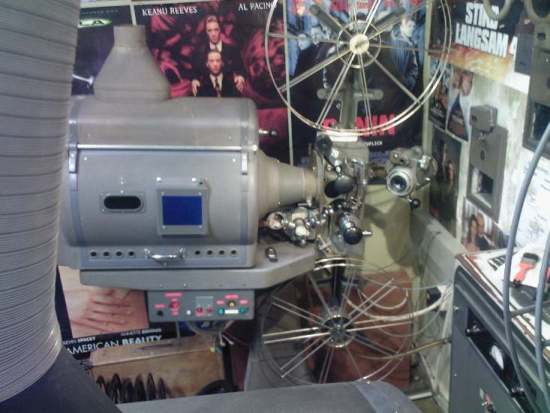
we do not have alot of space between the reel and the projector head. In addition, our reels are usually far off from being round, which may lead to problems as well, when the film is jumping left and right when touching the reel.
My thoughts are either to bolt the two readers on top of each other onto the top of the lamphouse and maybe place an additional roll ontop to smoothen the filmpath a little bit.
The second idea (which would need some kind of framing) would be putting the readers onto the wall, which you can see to the right.
What are your opinions on this? Should we place the SR.D reader above the DTS or vice versa?
Best regards
Sebastian Binz
Posted by Richard Fowler (Member # 893) on 12-06-2007, 09:39 AM:
Better to mount on lamphouse so if projector is accidently moved in relation to the wall, the sound / picture will still be syncronized. Had a similar problem in a film lab screening room with Ernemann E9 with the top mounted drive motor in the way.....so a bracket was built over the lamphouse.
Posted by Mark Gulbrandsen (Member # 72) on 12-06-2007, 07:06 PM:
Why not use the upper reel arm to clamp (or sandwich) a piece of alumnium plate in there to mount the readers onto.... Simple and elegant. Then it moves with the projector and you don't have to mess with the lamphouse.
Mark
Posted by Alban Birch (Member # 4121) on 12-06-2007, 07:30 PM:
I've bolted a cat700 onto a B11 which should have the same boltpattern for the reelarms than a B8. There are actually 2 holes that fit, I don't remember which ones but it should be very easy to find out. Then I installed the standard DTS-Bracket on top of the Dolbyreader which fits like a charm.
With this layout it should be quite easy to reinstall the reelarm with a selfmade adapterplate.
Put the DTS-reader on top of the SRD-reader, it looks nicer and it smoothens the film running through. I'll try to make some pictures at the end of the week, I don't use any reelarms though.
Posted by Sebastian Binz (Member # 4567) on 12-07-2007, 04:04 AM:
quote: Alban Birch
Put the DTS-reader on top of the SRD-reader, it looks nicer and it smoothens the film running through.
Now that is confusing... Someone reccomended to put the SRD-reader ontop of the DTS-reader, since that SR-D reader will smoothen the path for DTS...
Which version now is better? I suppose we will run into some trouble on this issue, because most of our reels are by now far from round and will cause the film to move left and right when fed into the first reader. Which reader is able to deal with this issue better?
Sebastian Binz
Posted by Alban Birch (Member # 4121) on 12-07-2007, 08:07 AM:
DTS usually tracks better than SRD it is less "empfindlich" (sorry can't find the english word). I already had stretched, broken and severly scratched film coming from a broken Tower (feedmotor gave up and dancerarm went the whole way up) running through the DTSreader and tracking justfine.
There is a small trick with the auxilary-roller, fold it the whole way back over the reader, so that the film has to run through an S-shaped loop.
Posted by Louis Bornwasser (Member # 3063) on 12-07-2007, 03:29 PM:
empfindlich: touchy; sensitive. Hope that helps. Louis
Posted by Ron Curran (Member # 3631) on 12-07-2007, 05:40 PM:
The issue with DD below is that, if you want to run trailers in DD with the feature in DTS that’s fine but if you want analog followed by DTS you’ll always have to lace up the DD head to maintain synch.
As lacing the DTS takes 1 second and lacing the DD takes 4 seconds plus the unnecessary wear on a fairly expensive unit, the DD over might be preferable.
99% of trailers have DD and even the trailers with time code rarely match any discs.
Also, as stated elsewhere, DTS is more robust and forgiving, so unless you are running all new prints or all cinemas suddenly adopt FilmGuard you’ll be chasing DTS discs whenever you can.
Posted by Sebastian Binz (Member # 4567) on 12-09-2007, 11:18 AM:
Okay, I understand that so far.
How are we going to put the SR.D reader onto our left-aligned machine? (yes, we have a pair of projectors, one is threaded from the left, one from the right)
I guess there is no such things as a mirrored-Cat702 or DSTR-20, is there?
best rgrds
Sebastian Binz
@Alban: Viele Grüße aus Köln an die Nachbarn nach Luxemburg
Posted by Richard Fowler (Member # 893) on 12-09-2007, 01:08 PM:
No mirror type models Putting a 180 degree twist on the film stock prior to entering the picture head should work ![[Cool]](cool.gif)
Posted by Monte L Fullmer (Member # 2797) on 12-09-2007, 04:41 PM:
quote: Sebastian Binz
Viele Grüße aus Köln an die Nachbarn nach Luxemburg
(...roughly...) Many greetings out of Cologne at the neighbors to Luxembourg
Posted by Brad Miller (Member # 2) on 12-09-2007, 05:32 PM:
quote: Richard Fowler
Putting a 180 degree twist on the film stock prior to entering the picture head should work
That's going to be an interesting setup, as on a changeover house the two readers MUST be the same number of perforations from the gate. Also a 180 degree twist is going to require a certain amount of distance so the film isn't under too much stress. I can only see that maybe working if the two penthouse readers are mounted up relatively high against the auditorium wall, parallel to the wall, with the film comeing out of the bottom of the penthouse and doing a 90 degree twist to a roller that would be in line with the film path of the projector.
I've never seen a mirrored 35mm projector before. Who makes such a beast?
Posted by Louis Bornwasser (Member # 3063) on 12-09-2007, 06:19 PM:
Mount both readers at 90 degrees; to ensure the same distance from gate. Height won't matter as long as it is enough.
(I won't suggest dual left/right basement readers, although that is what I would probably do.) Louis
Posted by Richard Fowler (Member # 893) on 12-09-2007, 06:33 PM:
Bauer and some other European makers used to offer Left - Right machines for small booths; You stand in the middle to thread both projectors......another version that Norelco and others made where double head mechanisms and lamphouses on a common pedestal.....
Posted by Monte L Fullmer (Member # 2797) on 12-10-2007, 12:39 AM:
...and a few 16mm projectors (also European made) had left hand lacing as well for the same center operator,two machine concept.
Posted by Phil Ranucci (Member # 3820) on 12-10-2007, 02:19 AM:
UC Santa Barbara had a pair of Hortsons (sp?)that both threaded on the opposite side, I was told that was so they could share a port with a 35mm machine. Don't know if that's true, but it made sense at the time.
Posted by Stephen Furley (Member # 1277) on 12-10-2007, 03:24 AM:
Left handed 16mm machines were quite common; Hortson, Philips, Kinoton and Carpenter, for example. The reason was to save space. I've never seen a pair of 35mm machines like that, but I did see a photo once. There was also the double sided 35/16mm Philips/Kinoton machine, like the one recently seen in the VW advert in the uk, with the projectionist talking about his interpretation of 'Ghostbusters'. I know of several cinemas in London which had these.
Posted by Sebastian Binz (Member # 4567) on 12-10-2007, 03:46 AM:
quote:
by Brad MillerI've never seen a mirrored 35mm projector before. Who makes such a beast?
Indeed our machines are made by Bauer and date back to 1948. They are running very smoothly and most techs we have had in the booth say they are having a better performance than some of the newest projectors.
The design of these machines is actually a really bad one, because they are built so tough that they basically last forever, which led to the bankrupcy of the company. They just couldnt sell new projectors because their old ones were still so reliable and in a great condition.
I wonder whether the 180 twist of the film path will affect the offset though. My second option is to get a platter or larger reels and only set up one of the projectors with SR.D.
Posted by Jeffry L. Johnson (Member # 453) on 12-10-2007, 01:00 PM:
A projection booth with left and right projectors appears in Wim Wenders' Kings of the Road [Im Lauf der Zeit].
Posted by Benjamin John Doman (Member # 4365) on 12-10-2007, 02:37 PM:
Hi,
The box in the VW advert is the Rio Dalston, London. The other advert with the guy talking outside the 'circle' entrance is the same place. 1 screen circle & stalls. Phillips did make a 'double decker' 35mm based on the FP20 and using the pulsed lamp lamphouse's. Because of the pulser lamphouses were so small, the two mech's could be mounted one above the other. Only ever seen one, it was on display at the Museum of Technology in Prage around 15 years ago.
Regards,
Ben
Posted by Chad Souder (Member # 343) on 08-22-2008, 02:13 PM:
quote: Mark Gulbrandsen
Dolby also offers the entire LED head from the CAT 701/2 penthouses as an assembly with the LED pre-aligned. This way its alot less painful in the field to replace them.
Would I be able to replace an LED assembly for my CAT 701 and have it be good to go or would it still require an oscilloscope?
Posted by Darryl Spicer (Member # 711) on 08-22-2008, 02:35 PM:
I just replaced 4 on Ultra-stereo B.A.C.P units and all I had to do was while it was loose look at the error readings on the Dolby CP unit that you are using while using a loop or using the feature to get the lowest numbers and tighten it up. If you are getting a constant red or orange light on the unit you may have to adjust the voltage. It is really simple to do.
Posted by Ken McFall (Member # 845) on 08-22-2008, 04:23 PM:
Look at the home page of Omnex Pro Film, www.omnexprofilm.co.uk there is a shot of a left handed Westrex 7000. The pics been there for years....
Posted by Tony Bandiera Jr (Member # 2365) on 08-22-2008, 04:43 PM:
I have the dual Kinotons at my University (FP38D) and I'll get some pics to share here soon.
I also put a thought into the Dolby Digital wow thread...
Posted by Chad Souder (Member # 343) on 08-22-2008, 06:48 PM:
Thanks, Darryl
Posted by Demetris Thoupis (Member # 833) on 08-23-2008, 01:26 AM:
For those who might not know, in the CP650 when you use the dip switch to enter the setup menu of the CP650 via the front panel, there is a section where it shows the video level of the Digital reader you are currently using. It is very helpful as you can exactly set the led gain to 4V.
Demetris
Posted by Gerard Bierling (Member # 4900) on 08-23-2008, 10:10 AM:
Here a picture of a Philips double projector FP2
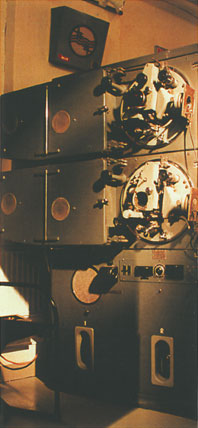
It has constant burning mercury lamps with shutter
I know it was still in use in 1960
Posted by Mark Gulbrandsen (Member # 72) on 08-23-2008, 11:03 AM:
Thats interesting Gerard! What was the point of that dual machine? For 3-D or just made for a really small booth?
Mark
Posted by Joe Redifer (Member # 3) on 08-23-2008, 11:24 AM:
In my experience with the Dolby Cat702 and BACP readers, I have seen solid zeros (not zero dot) hold on multiple occasions on both types. I have seen this on 5 of our 6 readers so far (4 BACP, 2 702). Usually they hover between 2 and 4. I have not heard any wow from any of them and we even have the scourge known as Strong platters. In fact one of my tension-safes in one auditorium is a little out of kilter so the film bounces up and down like mad on its way over to the penthouse reader (702). No problems at all. Kind of amusing, actually. Every once in awhile we'll get a print in that hovers at 6 or 6 dot... even though the print is brand new. We had a used print of Sex at the City that tracked 0's.
I have also used Cat699 and Cat700 readers, but I think those averaged about 4-5 on a good day.
Posted by Robert Throop (Member # 61) on 08-23-2008, 11:35 AM:
quote: Mark Gulbrandsen
For 3-D or just made for a really small booth?
I've seen pictures of this dual Philips machine in IP in the early forties so I'd guess it was intended to save space.
Bob
Posted by Gerard Bierling (Member # 4900) on 08-23-2008, 02:13 PM:
Yes, it was to save space.
Before changeover, the lamp has to be placed in a kind of spin dryer to divide the murcury in the bulb.
If he did not ignite they hit the lampholder with a rubber hammer and then there was light.
Posted by Stephen Furley (Member # 1277) on 08-26-2008, 06:15 AM:
quote: Benjamin John Doman
The box in the VW advert is the Rio Dalston, London.
I know this is a bit late; I must have missed your post, and I've only just seen it.
As far as I remember, the VW advert seems to show two projectors, with part of the second one just visible on the far left of the picture. When I visited the Rio some years ago I'm pretty sure they only had one machine; have they added a second one since? It also looked like they had a digital player in the box, one of the ones as used by Arts Alliance in the original DSN installations, I can't remember the name now.
The periscope arrangement with the moving mirror to divert the light through the 16mm side was clearly visible in the advert, and I do remember seeing this at the Rio. When I was projecting at the clocktower they had a file with various product leaflets in it, including one from Kionton for these double-sided projectors, which also showed this arrangement, but I've also seen them elsewhere, Barbican cinema I think, with separare lamphouses for each side.
Powered by Infopop Corporation
UBB.classicTM
6.3.1.2