This is topic Lamp not striking on Victoria 5 in forum Film Handlers' Forum at Film-Tech Forum ARCHIVE.
To visit this topic, use this URL:
https://ft-forum.com/ft/cgi-bin/ubb/ultimatebb.cgi?ubb=get_topic;f=1;t=009023
Posted by Tim McLendon (Member # 4298) on 12-10-2007, 07:45 AM:
Greetings Everyone!
Long time lurker and first time poster.
I'm a Christie Tech here in the Gulf South and 99% of what I do is digital cinema and OSA. The other 1% is trying to keep 3 Victoria 5's running.
The only issues I've had so far with the V-5's is the motor burning up. These motors date to 1985 and hence the insulation on the internal wires crack, flake off, and then short.
I'm lucky enough to have 3 decommissioned V-5's to rob motors from, but now I'm down to my last one and I'm slightly drifting off topic here.
Friday night I had another motor burn up on me so I replaced it with a decommissioned motor. After replacing the motor and a fuse everything ran fine but now the lamp won't strike and I am at a loss on how to diagnose this further.
Edited to ad: I believe this projector has the Zenith X3000H lamphouse and I am looking through the manual (found here) now.
Any help would be greatly appreciated,
Tim
Posted by German Marin (Member # 918) on 12-10-2007, 03:05 PM:
Probably is the igniter, I'm sure there is an IREM igniter, and the igniter dated in those years has that problem.
Posted by Tim McLendon (Member # 4298) on 12-10-2007, 07:23 PM:
Thanks for the reply!
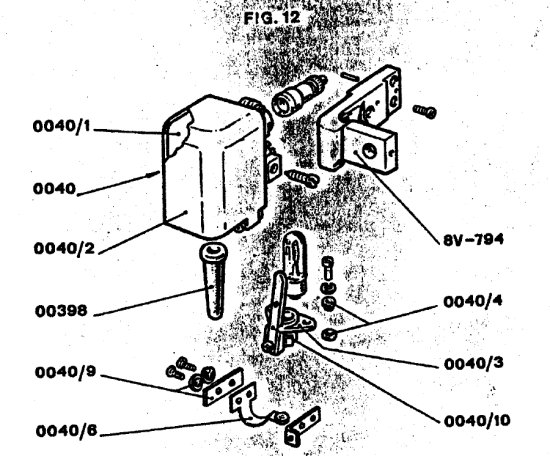
Could the igniter also be referred to as the Exciter Lamp Housing Assembly as shown below?
I'm going to meet an electrician out there tomorrow because the tech that was out there was certain there was not proper power feeding into the projector, i.e. not full 3-phase.
I don't know if I believe it though because the motor appears to be at speed, unscientifically listening to the sound track.
Thanks Again,
Tim
Posted by Monte L Fullmer (Member # 2797) on 12-10-2007, 07:37 PM:
Thing about those Cine V-5 motors is that they rotate at such a low RPM, not the standard 1750 RPM on some setups. See what the RPM range listed on the plate on the motorframe. The low speed motors were prone for failures.
The exciter situation has nothing to do with bulb striking for it has it's own power supply.
Simple question: have you tried a new bulb in that lamphouse, checked failsafe areas (sorry, not familar with Zenith lamphouses, but pretty familar with Cine equipment..and ran V-5's for a good number of years..), turned the rectifier on and see what your no-load DC voltage is?
good luck-Monte
Posted by Gordon McLeod (Member # 33) on 12-10-2007, 07:47 PM:
A missing phase will not cause it to run slow
a missing phase will burn it up fast though
there are several different RPM motor and pulley combinations including a version that had a bodine motor mounted in the top
Posted by Tim McLendon (Member # 4298) on 12-10-2007, 08:10 PM:
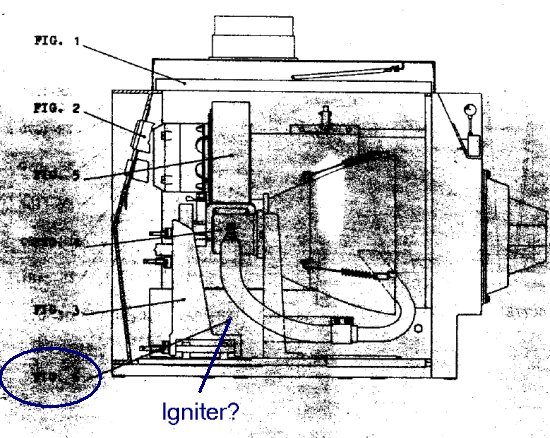
OK, looking at the lamphouse PDF I see a striking unit, would that be my fabled igniter?
It is circled (FIG 6) in the below pic and labeled as a DX/5 Striking Unit:
I appreciate the help here, this theatre is 200 miles away and I need alternate avenues of attack if the electrician gives me a clean bill of health.
The rotational speed of the motor appears to be (GIRI) 1800 as listed on the motor plate.
Posted by Richard Fowler (Member # 893) on 12-10-2007, 08:30 PM:
There are four basic Cinemeccanica motors and one USA( Black Bodine )motor. The information on the motor plate would help to figure which factor or distributor wiring diagram to use. The ignitor in the 3000 series is like the older "classic" ignitor made by Cinemeccanica, similar as found in the CX series lamphouses. This has the transformers, caps, spark gap, auto ignition circuit mounted on a phenolic insulation board. If there is no bulb strike...check the bulb, check the no load voltage on the lamphouse rectifier ( 85 VDC or higher ), see if the bulb will strike with the manual push button...if not check the "spark gap" ( the plastic tube with the center screw for spark adjustment )....if it does strike manually the auto ignition potentiometer may need adjustment. There are other issues like the caps and transformers but they are usually obvious if DOA.
Judging that you can't tell the difference between an audio sound exciter bulb parts versus a Hi-voltage ignitor in a lamphouse.....I suggest you get a electrician or someone more familiar with this hardware than playing with the exposed components on this ignitor board....this is not like modules in newer hardware.
Reading you new post.....if the motor is grey and 1800 RPM, check the Caps to the "slow start" motor control or bad power switch...if black Bodine...they are usually 110VAC single phase and have a short service life compare to the Italian motors.
If you go to the manual site on Film Tech go to X3000H and on PDF page 8 is the mechanical layout of the ignitor and PDF page 12 has the wiring diagram to the ignitor.
Posted by Gordon McLeod (Member # 33) on 12-10-2007, 09:38 PM:
Usually there is caps in the motor circuit only if they are running the 3phase motor on single phase and it is an italian 3 phase motor as it is apparently label with giri 1800 which is a sync motor
They also are not usually very hot running
If run on 3 phase there should be 3 40ohm resistors that are in serries with the three phases that are switched out after a start delay if the motor is run on single phase then there whould be a switch between two different cap values
Posted by Dan Reiter (Member # 1386) on 12-12-2007, 09:04 AM:
Back when I was at Neumade & BIG SKY, motor control was done with a freq drive. This allowed easy motor control, exact motor speed setting, starting & stopping speeds & times, as well as over-current & missing phase protection. This addition to all 3-phase projectors virtually eliminated all motor problems on all European projectors sold.
As far as the lamp not striking, as noted above, check all the safeties and interlock switches, as well as the auto-strike circuits, and the automation. You can always try temporarily feeding AC voltage directly tot he igniter to verify if it is working. If so, then work backwards through the wiring. I think you wil find the problem that way, usually a switch or connection.
Posted by Bryan M. Montgomery (Member # 4412) on 12-16-2007, 01:37 AM:
I cut my teeth on that very equipment many years ago. I'm not sure if anyone has mentioned it, but I had to cut the ignition wire that runs across the lamp's envelope to get mine to strike reliably.
Pizza-mechanicas, got to love 'em!
Powered by Infopop Corporation
UBB.classicTM
6.3.1.2