This is topic nitrate still in circulation (aka Columbia Pictures and ETS/DFS, you suck!) in forum Film Handlers' Forum at Film-Tech Forum ARCHIVE.
To visit this topic, use this URL:
https://ft-forum.com/ft/cgi-bin/ubb/ultimatebb.cgi?ubb=get_topic;f=1;t=009038
Posted by Scott Norwood (Member # 30) on 12-24-2007, 03:39 PM:
Today, I received print #0004 of "Cash and Carry," a one-reel Three Stooges short. This was a nitrate print, but was shipped in a standard ICC can (with no markings or red reel band) out of the Salem, MA. ETS/DFS depot. This is where I point out that storage and exhibition of nitrate film has been illegal for decades in Massachusetts.
Worse, it was shipped with no warning to a platter house that is completely ill equipped for nitrate screenings (even if such were legal).
The manager has notified the booker and hopefully this print will be taken out of general circulation. What is really scary is that a) I almost plattered it without noticing the black-on-clear "NITRATE FILM" edge markings and that b) someone else had done so (original leaders were missing and heads and tails had a good amount of shoe polish on the edges).
To anyone who handles prints of pre-1950 films, _always_ check for the SAFETY FILM edge markings. Better safe than sorry.
To the distributor and depot: WTF is a nitrate print still in general circulation? Are you crazy? There would be one heck of a liability lawsuit if anything happened. This is yet another reason why film should be inspected at the depot level.
Posted by Kenneth Wuepper (Member # 1174) on 12-24-2007, 04:01 PM:
Scott,
Do you still have that print?
Can you expose it to "black Light" and see if it glows? Kodak impregnated that film with a fluorescent dye that glows under black light. (UV Light)
Is it possible that the NITRATE markings are from the negative and that the print is acetate or safety film?
KEN
Posted by Cameron Glendinning (Member # 3516) on 12-24-2007, 04:28 PM:
I would suggest that you burn one frame, well away from the rest of the print, its the easy way to tell. Personally I like the look of nitrate on the big screen! I have however been in a position to legally run it before.
Posted by Scott Norwood (Member # 30) on 12-24-2007, 04:32 PM:
I told the manager that I wanted the print out of the building. I could probably get it back if needed.
I did burn a couple of frames and the result wasn't too impressive, but the print was overall in good condition and might just have been well preserved. Markings were black on clear, indicating that the print was nitrate (white on black would have indicated a nitrate negative) and there was nothing that said "safety" anywhere. Original leaders were missing and I didn't want to cut out any more film to give it the flame test.
I will not take any chances with this sort of thing, and neither should the depots and distributors.
(I agree that nitrate looks great, but there's no excuse for running a public nitrate screening in a venue that isn't equipped for it. It is also no excuse for shipping a print that is very likely nitrate to a random theatre without both sides' being aware of the situation.)
Posted by Cameron Glendinning (Member # 3516) on 12-24-2007, 04:57 PM:
Agree with you 100% Scott. I was horrified many many years ago when we found out that we had run a 6 week season of "Stairway to heaven" that was nitrate! Worse still made up on a 12,000 ft spool ![[puke]](graemlins/puke.gif)
Posted by Scott Norwood (Member # 30) on 12-24-2007, 05:00 PM:
I should add that I'll happily edit my original post if the print turns out to be safety. I mostly intended it to be a warning that some nitrate may still be around and that we all need to be careful to avoid potential disasters.
Posted by Ron Funderburg (Member # 4561) on 12-24-2007, 05:21 PM:
The first booth I worked in was one of the concrete boxes designed to kill the projectionist rather than the public. Of course if you were fast enough you might get out before the big metal door swung shut!
Of course, we never actually tested it in a true lock down situation or even a simulated one as it was 1972 and the prints we were running were safety film! Still the booth was pretty impressive as a fortress or a prison! No handle on to the door on the inside if the safety bar shut came down! Metal shutters would drop in all the port wholes I was 17 or 18 and that was just so cool! Well I was 17 when I started in 72 and 18 when I realized "Hey if this catches fire I'm dead!".
Posted by Mark Gulbrandsen (Member # 72) on 12-24-2007, 08:05 PM:
You can always tell by the smell... NItratem has it's own very unique odor.
Mark
Posted by Tim Reed (Member # 137) on 12-24-2007, 10:54 PM:
Scott, if you got a distinctly orange flame from the burn test, with an accompanying "whoosh" sound, it was nitrate. Flame up and bright, then back down as all the film is consumed.
While a person may be successful getting a small amount of safety film to burn in such a test it's very slow and weak, and the flame soon goes out on its own, leaving most of the frame unburned. quote: Ron Funderburg
I worked in was one of the concrete boxes designed to kill the projectionist rather than the public.
More than anything, those were designed so the public would not know there was a fire. If you could be locked inside, then something had been changed on the door. That wasn't the norm.
Posted by James Westbrook (Member # 3690) on 12-25-2007, 01:11 AM:
Tim's right. Most, if not all theatres would have the booth door closed when the movies were running so as customers won't wander into the booth and disrupt the presentation of the movie. The booth operator would have to be able to open the door to leave. In case of a film fire, the booth operator was EXPECTED to flee and close the door behind him to contain the fire.
Often, the fire would be contained in the magazine or the projector head. These may have been more common for a theatre to have a film fire, be down for a day or two until repairs were made to the magazines/projector heads and then be back on screen.(The upper and lower magazines were supposed to be kept closed when the film was running.) The steel fire door and port window fire shutters, along with the steel and concrete-enforced booth, kept the fire contained.
The fellow who trained me for projection told me all kinds of stories about near-mishaps with nitrate film: He had started working booth in the early 30's. He mentioned one fellow had been building up film from 10 minute reels to 20 minute house reels when the film ignited on the bench: The fellow's corpse was still hunched over the bench.
In the picture warehouse, there are photos of a Simplex 35 at the AFI screening room that sustained damage from a film fire. This occured in 1975.
Posted by Thomas Pitt (Member # 4322) on 12-25-2007, 02:41 AM:
There are non-fire ways to test whether a film is nitrate or safety, but they involve the use of unpleasant chemicals. Besides, I would have thought most (if not all) nitrate prints would have deteriorated to at least stage 2 by now.
The leaders might be 'new' safety film spliced onto the original nitrate print, be careful what you test.
Posted by Stephen Furley (Member # 1277) on 12-25-2007, 04:02 AM:
quote: Thomas Pitt
I would have thought most (if not all) nitrate prints would have deteriorated to at least stage 2 by now.
I've seen Nitrate film over 90 years old that still looked as good as new, and I've seen some from WWII that was totally gone in the '70s. The age of the film really doesn't give any indication as to it's condition.
Posted by Steve Guttag (Member # 268) on 12-25-2007, 08:29 AM:
Stephen is on the money there. Nitrate that is now propely stored has a long life ahead of it.
Steve
Posted by Frank Angel (Member # 248) on 12-25-2007, 11:54 AM:
Scott, is it really illegal for ANYONE to run nitrate up there in Mass...even if your booth retains all the safety items that were in place when nitrate was being run -- safely, for the most part -- up until the 70s?
We still have all the saftey factors in place to make our booth nitrate compliant; all we'd have to do is remove the DTS readers. We have the fire retarding reel magazines, the double thick concrete bunker-type walls, the fire shutters and doors with the heat links, etc. I would hate to think that a municipality would totally ban the running of nitrate if an exhibitor could demonstrated that his booth was nitrate safe. I mean, millions and millions of feet of nitrate film were successfully run for decades without any theatre fires once the safety precautions were put into place. Seems to me that a TOTAL ban like that would be over-kill and bureaucratic stupidity.
Posted by Scott Norwood (Member # 30) on 12-25-2007, 01:52 PM:
Frank--yes, it's completely illegal here to store, transport, or project nitrate film. I agree that this is a bit over-broad and silly, but it is the law. All of this is emphasized on the (otherwise, largely pointless) operator license test.
I haven't handled much nitrate film and that which I have seen has been in generally good condition, with no smell. When I first realized that this reel might be nitrate, I called someone whom I trust who had run quite a bit of nitrate at UCLA in the early 1990s. We went through the usual ways to tell what is what and ended with the conclusion that it "probably" is nitrate. The frame that I burned would not burn underwater (I tried), but that may have been the splicing tape and not the film itself that was burning. In any case, I'm not going to cut out any more film for the sake of burning it. If this is nitrate, which it appears to be, it should be in an archive, not in theatrical distribution.
Posted by Steve Guttag (Member # 268) on 12-25-2007, 04:46 PM:
Sorry Scott...you are going to need to quote chapter and verse on that one...527 CMR 10.27 seems to be governing document in Mass and it appears that many locations will issue a 30-day permit for the storage and projection of Nitrate for a $25.00 fee. I didn't look into this too far but if there was a total ban, then the localities couldn't issue permits for it.
Normally what will put the fear in people is the insurance rider they will need to handle the stuff...particularly to store or project it.
While I certainly share Scott's reaction to having such a reel finding its way into general circulation as in that situation it will be handled by the wrong people. And more to the point, an unsuspecting people (both the workers and the public) as to the potential catastrophy that could result. That said, Nitrate gets WAY too much of a bad wrap as this time-bomb ready to explode at any moment buring all in sight.
There are those that actually claim that running nitrate on a platter has the advantage that they have more time to cut a burning piece of film before it hits the pack. On reels, you really are depending on the fire rollers to try and snuff it and that you only have 20-minutes, at most of fuel to burn.
This reel of film you found should definately be tested for Nitrate and pulled from circulation, regardless since it has the label of Nitrate on it...which at best misinforms and at worse confuses the issue. Hopefully, one could print a safety dupe (if none does not exist yet) that would be absent of the Nitrate designation on the edges.
At the LOC in Culpeper, being a federal installation, we only really need to adhere to NFPA-40 and LOC's own saftey regulations. Oddly enough, NFPA-40 does not carry the weight of law unless a government entity adopts it.
Steve
Posted by Scott Norwood (Member # 30) on 12-25-2007, 05:46 PM:
Steve--interesting. But see MGL 143-89:
quote:
PART I. ADMINISTRATION OF THE GOVERNMENT
TITLE XX. PUBLIC SAFETY AND GOOD ORDER
CHAPTER 143. INSPECTION AND REGULATION OF, AND LICENSES FOR, BUILDINGS, ELEVATORS AND CINEMATOGRAPHS CINEMATOGRAPHS
Chapter 143: Section 89. Thirty-five millimeter nitrate film generally; violation of statute
Section 89. The storage or distribution for purposes of public exhibition and all public exhibition of thirty-five millimeter or larger nitrate motion picture film is hereby prohibited. Violation of this section shall be punished by a fine of not less than fifty dollars nor more than five hundred dollars.
There may be something else in 520 CMR 3.00, but I don't have my copy handy at the moment. Maybe jhawk or someone else familiar with the law can chime in here.
Most of the laws relating to motion-picture exhibition are not well enforced and there are more than a few contradictions.
In any case, the point of this thread was mostly just to warn people who (like me) figured that they would never see a nitrate print without a bunch of warning stickers and bands all over it that there are some out there that are not properly identified and can be dangerous to project without taking proper precautions.
Posted by Martin Brooks (Member # 1269) on 12-25-2007, 06:38 PM:
I can't quote chapter and verse of the law, but I thought I had read some years ago that UCLA is the only place in the nation that was permitted to screen nitrate film. Perhaps that was hype, but that's what I believe I read. (Hard to believe that places like the Museum of Modern Art in NYC couldn't also screen nitrate.)
Posted by Steve Guttag (Member # 268) on 12-25-2007, 08:00 PM:
Scott,
The way I read the law you listed is that it pertains to public exhibition. This would not apply for private use, lab use or other non-public use. Laws being often interwoven and layered, one would need to know all of those layers to render a decision on the matter...gotta keep those judges in business.
As to facilities that can legally show Nitrate...UCLA has never had a lock on it however they are probably the most popular entity that shows such films for the public and with suitable planning and promotion.
The Library of Congress at their Culpeper, VA facility absolutely intend to show Nitrate films for public exhibition in their main auditorium. There is one screening room that will also show Nitrate but for LOC purposes only. The Culpeper factily is open now but the film systems will not be on line until sometime in 2008
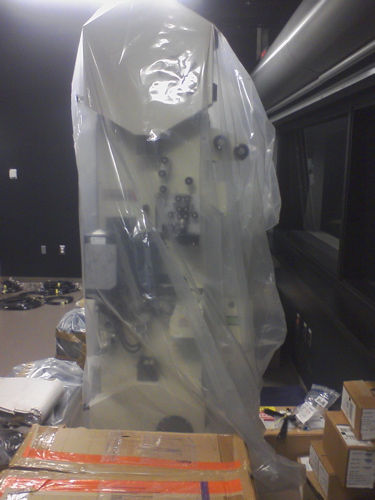
These are the screening room machines upon initial delivery. They are Kinoton FP38EQ projectors.
Posted by Monte L Fullmer (Member # 2797) on 12-26-2007, 12:08 AM:
..course, wouldn't it be much safer and easier to just strike poly reversal (or new negatives, then print positive) prints off these nitrate positives in fear of nitrate shrinkage due to the age of the stock itself-let alone of worrying about the chance of losing that non-replacable nitrate print in the first place??
I've always known that a nitrate stock has the small black hash marks on the edge of the film to be perpendicular to the film direction and safety had these markings running with the direction of the film.
Posted by Jack Theakston (Member # 4484) on 12-26-2007, 12:46 AM:
There are a number of venues set up to run nitrate in the US. In each case, it is set up through a special arrangement with the fire marshal of that district. Usually it entails completely separating the booth from the auditorium and a number of fail-safes.
While I agree that nitrate prints can look pretty damn good, a well timed print off of the camera negative can look equally as rich with the right processing. Unfortunately, this is not always the case.
Posted by Stephen Furley (Member # 1277) on 12-26-2007, 05:08 AM:
quote:
Section 89. The storage or distribution for purposes of public exhibition and all public exhibition of thirty-five millimeter or larger nitrate motion picture film is hereby prohibited. Violation of this section shall be punished by a fine of not less than fifty dollars nor more than five hundred dollars.
That's really badly worded; it seems to apply only to public exhabition of films, and so would presumably allow archives, labs etc. to store, transport, restore, print or otherwise handle nitrate film, which I would expect, given suitable facilities for doing so, as with other hazardous materials used in industry. But what does 'The storage or distribution for purposes of public exhibition' mean? Distribution presumably means sending a nitrate print out to a public cinema, but what about storage? Do the words 'for public exhibition' apply to distribution, or to both storage and distribution? You could read it either way, though one meaning ought to have a comma in it. I think an archive could store nitrate for preservation, but what about a depot storing nitrate prints for the purpose of sending them out for public exhibition in some other locaton where such exhibition was permitted?
Then it only prohibits public exhibition, so screening a nitrate print in a properly equipped cinema, with suitably trained staff is not allowed, but it sounds like a film society could use something like a largely wooden church hall, set up a portable projector at the back of the audience, and screen such a print, as long as it is only for members of the group, since it is not 'for public exhibition'. I am aware of somebody actually screening a few minutes of nitrate film in this way in this country many years ago. Totally inexcusable.
Then it only applies to 'thirty-five millimeter or larger nitrate motion picture film'. Why do they specify a minimum gauge? If whoever wrote the regulation thought that film smaller than 35mm was always on a safety base, then there would be no need for this. Do they mean that they're quite happy for you to screen smaller nitrate film, if you can find any? Leo and I have bot seen 16mm nitrate prints. In the very early days there were a number of small formats, mainly 17.5mm (not to be confused with the later Pathe Rural 17.5mm safety format) sometimes using standard size perforations, so that normal 35mm stock could be slit and used, this would be nitrate. Maybe you could copy the idea of the 34mm print of 'Around the World in 80 Days', take a nitrate print, reduce the width slightly, and then you could show it. I wonder how they would react if you were to claim that your nitrate print was badly shrunken, and was actually 34.85mm, therefore the regulation didn't apply!.
quote: Scott Norwood
In any case, the point of this thread was mostly just to warn people who (like me) figured that they would never see a nitrate print without a bunch of warning stickers and bands all over it that there are some out there that are not properly identified and can be dangerous to project without taking proper precautions.
Agree totally.
quote: Steve Guttag
These are the screening room machines upon initial delivery. They are Kinoton FP38EQ projectors.
Steve, that's interesting. Is this a totally new building, an existing one being newly equipped for flm, or has it previously shown film, and is being refurbished?
The last newly designed and constructed cinema that I'm aware of to be licenced for nitrate was NFT2, which opened sometime around 1970, I think. The projection room is rather odd, in that it sort of extends into the auditorium, the rear part of which is actually underneath the projection room. The whole NFT complex is built on a difficult site, underneath the South end of a bridge over the river Thames, and space is very restricted.
I'd be interested to know what requirements were made in terms of design, construction, equipment and operating practice, for use of nitrate film in this place that you show. Do they have a nitrate vault on site, the NFT does, or would a print just be brought in for a show, and removed immediately, with no need for storage on site? The NFT machines have some sort of gas piped into the gates and spoolboxes; is anything similar required there? There's a raised platform at one side of the NFT2 box and there's a public walkway which crosses from one side of the bridge to the other, onto which a door leads. You can hear the projectors running as you walk past that door, and you used to be able to see the exhuust ducting rising from them, until they filled in a gap; the projectors themselves were too low down to be visible from there. I'm not sure how any members of the public would react to that door being flung open, and a couple or rather worried looking projectionists escaping from a room full of fumes! At one time you could actually see some of the stonework of the previous bridge on the othr side of the projection room, but I think this has ben covered over now.
The only obvious modification on the picture you show is the fitting of spoolboxes. These, as opposed to the plastic ones they make for some of the special venue machines just to keep dust off the film, appeared as an option fairly recently on the Kinoton website, probably within the last year or so; web page I thought it was rather odd that Kinoton should introduce them at this time. Do you know if they are a standard Kinoton product, or were they specially designed and made for this place, and Kinoton put them on the website i case anybody else was interested? There can't be many new machines being installed for nitrate now. I note that the machine shown fitted with them on the website is a FP-38EQ; is this possibly one of the machines built for that venue? I've just looked at the spec; nice machines but I wouldn't even want to think about the price!
Posted by Pete Naples (Member # 761) on 12-26-2007, 05:13 AM:
Stephen, there's some of those not far from you ![[Wink]](wink.gif)
Posted by Stephen Furley (Member # 1277) on 12-26-2007, 06:16 AM:
Some of what, FP-38EQs? Nitrate prints?
Posted by Mitchell Dvoskin (Member # 751) on 12-26-2007, 09:27 AM:
Kodak impregnated that film with a fluorescent dye that glows under black light. (UV Light)
This is backwards. Kodak put an ultaviolet dye in all their Safety Film up until the 1980's. Wind the film on to a core. Under a black light, the side will glow purple. Nitrate will not glow.
I got this information from John Pytlak.
John Pytlak's Answer
Posted by Steve Guttag (Member # 268) on 12-26-2007, 09:37 AM:
Monte
quote: Monte L Fullmer
..course, wouldn't it be much safer and easier to just strike poly reversal (or new negatives, then print positive) prints off these nitrate positives in fear of nitrate shrinkage due to the age of the stock itself-let alone of worrying about the chance of losing that non-replacable nitrate print in the first place??
Actually, safety prints are indeed made. One of the purposes of the screening rooms is to ensure that the dupes are as near to the original in quality as possible. The FP38EQ machines are special quality inspection machines capable of very slow motion or even "stills" (though not with Nitrate). However, there is never a true substitute for an original. I wouldn't expect you will see daily Nitrate shows...they would be special events.
quote: Jack Theakston
While I agree that nitrate prints can look pretty damn good, a well timed print off of the camera negative can look equally as rich with the right processing. Unfortunately, this is not always the case.
This has often been claimed by Kodak and some modern film makers. I have YET to hear ANYBODY that has looked at a Nitrate print ever compare any currently made film as being as good or rich looking. Nitrate just has that look. Kodak has always claimed it was the silver content but there is something else going on there.
That said, the real test would be to take an OCN and strike a Nitrate and Poly print of it and then do a critical comparison of that to minimize the variables...I doubt that has been done so all of this is subjective. I agree that a Vision Premiere EK print can look breath taking...then again, so can Nitrate...not too bad for something that is over 50-years old, at its most recent.
Stephen,
As to Mass law...in this country everything is multi-tiered. You have federal law, state, county, local...etc laws. Normally, it is the most restrictive that will apply on each item. Thus, even if the statute that Scott quoted doesn't specify the booth type, another section might (he was only providing what I asked about where in Mass. law does it prohibit showing Nitrate films since I found in County law within Mass. that one could obtain a permit to handle it. Most states (if not all) have adopted NFPA-40 into their fire codes which will put restrictions on projection rooms as well as storage facilities. So no one piece of law is sufficient to know all of the possible restrictions in this country. Each level of government has their own reasons for making (or removing) laws.
On to your questions...
quote: Stephen Furley
Steve, that's interesting. Is this a totally new building, an existing one being newly equipped for flm, or has it previously shown film, and is being refurbished?
This is a totally new building and projection facility.
quote: Stephen Furley
I'd be interested to know what requirements were made in terms of design, construction, equipment and operating practice, for use of nitrate film in this place that you show.
This is a Federal Installation (US Government)...as such it only must follow federal law. Being that it is also a Congressional installation, it really only has to follow their rules. It was a two-tiered level though...both existing Federal statutes (NFPA-40) as well as LOC's own safety regulations, whichever is more restrictive. There was no indication I could find that they ever tried to tip-toe around any saftey requirements though I was amazed at how little restriction is really in NFPA-40. For instance, the key elements to projection booths regarding Nitrate film being in the booth are that one can not exceed 75lbs. total. The film can also NOT be shielded from the sprinkler system. Thus, if the sprinkler system is activated by fire, the film is to be soaked...this is not to put out the fire (it can't) but to keep the non-blazing film from catching fire. There are also to be spinklers right above the magazines...presumably to keep the OTHER machine from igniting its waiting reel. There is no federal requirement for doors on the projectors but in states like Mass, not only were they required, they even had pieces to seal up around the lens opening (Simplex P-2970).
quote: Stephen Furley
Do they have a nitrate vault on site
Yes. This is the Nitrate storage facility for the Library of Congress (moved from Dayton, OH).
quote: Stephen Furley
The NFT machines have some sort of gas piped into the gates and spoolboxes; is anything similar required there?
Not gas, but sprinkled. The FP38EQ does have compressed air for the gates but not for any form of fire prevention...when in super-slow motion, it is used to increase film stability and focus by overcoming the effects of the heat from the xenon lamp distorting the film...again, not a feature for Nitrate as slow-motion (below 12fps) is prohibited for the Nitrate film...note too, the machines switch to 3-wing shutters below 20fps so unlike a conventional mechanical machine, there isn't this prolonged open shutter time on the film. Remember, DW Grifith was notorious for slow cranking speeds (12 fps and slower) to save on film costs!
quote: Stephen Furley
The only obvious modification on the picture you show is the fitting of spoolboxes.
The spool boxes and the firerollers are about it. They have been available for a few years now (and they are steel with a wire gauze opening for viewing of the film). They were designed to conform to Euro standards. They were most definately NOT made for the LOC project. Oddly enough, there is indeed a small market for Nitrate capable machines. I know of machines sold in the US other than LOC but not to conventional cinemas. One of many nice things about the Kinoton style of machines is that most of their features are a-la-carte. The Nitrate (or "retro version") is but an option to the FP30/38EQ. For some reason they don't want to offer it to the FP30/38ES or even the standard FP30/38E. The only thing I can imagine that would cause this is that the EQ version actively controls the lamphouse current and has a bit more control over projection speeds than the lesser units. Then again, those venues interested in dealing with Nitrate are likely also to want the features of a QC machine as well...I know it worked out that way for LOC.
Steve
Posted by Frank Angel (Member # 248) on 12-26-2007, 09:57 AM:
quote: Jack Theakston
While I agree that nitrate prints can look pretty damn good, a well timed print off of the camera negative can look equally as rich with the right processing. Unfortunately, this is not always the case.
I ran quite a few nitrate prints when I first started out in the late 60s; now I realize how lucky I was to have that experience. WB as well as MGM were still sending out lots of the IBTech cartoons on nitrate stock and quite a number of still on nitrate shorts came our way. All the projectionists that I aprenticed under knew exactly what nitrate meant and pointed out all the precautions that were necessary to handle it safely. And this wasn't in a big city municipality -- it was in Brian-College Station....with dirt roads.
I must tell you that a nitrate print has a look all its own that I have never seen duplicated on any kind of safety stock. It is hard to describe other than it has a shimmering kind of quality that makes the image look "alive." OK, that sounds stupid, but I don't know how else to describe it, but I can tell you there is a papable difference and it is quite jaw-dropping, AND you can tell almost immediately when you are watching it. It is really a shame more people can't experience it. Yes, we all know the dangers nitrate presents, but we also know the dangers of lots of things but we don't forbid their use. As I said, for decades, nitrate films were shown in every theatre in the country day in and out, in booths that were properly outfitted with saftey devices, and people weren't emulated in fires. Of course a key factor was that the people handling nitrate were trained and knew what they were doing. I would wager that probably more people died in plane crashes over the years than died in theatre fires dues to nitrate film. No one ever advocated stopping air flight. Where there are safety issues with modern technology, you provide training and safety procedures to reduce the risk to as low as possible, and you get on with it and avoid acting like Chicken Little.
Banning the use of nitrate film for specific, controlled situations is assinine, IMHO.
[ 12-28-2007, 01:04 AM: Message edited by: Frank Angel ]
Posted by Leo Enticknap (Member # 534) on 12-26-2007, 10:26 AM:
quote: Thomas Pitt
There are non-fire ways to test whether a film is nitrate or safety, but they involve the use of unpleasant chemicals.
Trichloroethylene if you're talking about a float test - not what one would expect to find lying about in your average projection booth!
quote: Thomas Pitt
Besides, I would have thought most (if not all) nitrate prints would have deteriorated to at least stage 2 by now.
Depends on (i) the acidity of the wood pulp used to make the cellulose which goes into the original film base, and (ii) the atmospheric conditions in which the film is stored. Part of the reason the Mitchell and Kenyon collection (various elements from 1895-1913) survived with no more damage than a slight shrinkage and discolouration of the base is that, just by a lucky accident, they spent almost a century in a very cool and very dry cellar. In a warm and/or damp environment, they could have been gone within 20 years.
Personally I'd have thought that, in a 1930s nitrate print that showed up at random, you'd be more likely to have a problem with shrinkage than with the film having become sticky.
quote: Thomas Pitt
The leaders might be 'new' safety film spliced onto the original nitrate print, be careful what you test.
Agreed totally; and during the crossover period (1948 to mid-50s approx.), distributors would cobble together good prints by cutting and joining sections (and/or combining reels) from a number of existing flawed ones. When some of the inventory was nitrate and some acetate, you can imagine what happened. I've come across early '50s prints that are mainly acetate, but with the odd 300 foot section of nitrate spliced into the middle of a reel. The bottom line - if it's an original print from the danger period, check every foot. The characteristic mothball/camphor smell is the biggest nitrate giveaway, in my experience.
quote: Steve Guttag
I know of machines sold in the US other than LOC but not to conventional cinemas.
The Dryden Theater at George Eastman House in Rochester is nitrate-capable. They ran a nitrate screening evening at the AMIA conference in September. I'm afraid to say I skipped it in favour of dinner with some friends (the film was Portrait of Jennie; I've seen that once, and once was enough!) who I knew I wouldn't get a chance to see at any other point during the week, but people who went reported that it looked great.
Posted by Paul Mayer (Member # 355) on 12-26-2007, 10:03 PM:
The American Cinematheque's Egyptian theater in Hollywood is also nitrate capable.
Posted by Stephen Furley (Member # 1277) on 12-27-2007, 04:41 PM:
quote: Steve Guttag
Yes. This is the Nitrate storage facility for the Library of Congress (moved from Dayton, OH).
That's interesting; Do they run more recent films? What films does the LOC take into it's collection? what sound formats are they installing? Will they be able to run 3-D?
Any chance of some photographs when it's completed?
Posted by Steve Guttag (Member # 268) on 12-27-2007, 05:56 PM:
At present they are not on line with motion pictures so they don't run anything at this facility. However, I would think the sky is the limit on what they could show. Anything submitted for copyright is viable for the venue.
The Library of Congress has two fucntional theatres on line in Washington, DC proper. The main theatre is the "Pickford" located in the Madison building. The other theatre is in the Jefferson Building...the Coolidge Auditorium. The Pickford is equipped for 16-70mm presentations while the Coolidge is just set up for 35mm and is rarely used by the film division. I recall screening a silent film there with an orchestra...something the Pickford would be poor at doing. There was another screening room, the Mumford (also in the Madisdon Building) but it was decomissioned in favor of the Coolidge (equipment moved).
In any event...more directly to your questions, they can take everything into their collections...that does not mean everything is in there though.
For sound formats in the theatres we are handling, optical sound 35mm (just the standard stuff, not the obscure ones) from mono up to Dolby-SR, Dolby Digital, DTS-Digital (35 and 70mm), 16mm optical and magnetic (mono). 35mm and 70mm magnetic.
As for 3D, yes and no. The screens are white but that is certainly changable or one can set up a silver screen in front of the main screen for a special event. Due to the nature of being a QC facility and the need for frame-for-frame simultaneous projection two reels, they are inherently 3-D machines as well. In the main auditorium, they will be capable of a 3-D changeover (one pair changing over to the other pair). So think of it as 3-D capable but not on a moment's notice.
As to pictures...maybe...I'm sure that would be subject to whomever controls the public presentation of the facility. If you see me post any in the pictures section then you can presume I had permission to do so. I feel safe on the picture above as it could by ANY facility.
Posted by John Wilson (Member # 269) on 12-28-2007, 08:02 AM:
If your fire test was unimpressive it's most likely safety with nitrate marking still on it form the original. I've seen this a few times.
Real nitrate would've made you go ![[Eek!]](eek.gif)
Posted by Rick Raskin (Member # 1561) on 12-28-2007, 08:14 AM:
Some pictures have been submitted but the theatre was in the early stages of construction (no equipment). The meat locker (nitrate vault) is in the group but sans film. The nitrate move from Dayton still has not happened. Safety films in the copyright collection are there in another area. The only caveat on pictures; I was told that the page must credit the Packard Campus of the LOC.
Posted by John Hawkinson (Member # 1135) on 12-28-2007, 11:13 AM:
Scott wrote, "There may be something else in 520 CMR 3.00, but I don't have my copy handy at the moment. Maybe jhawk or someone else familiar with the law can chime in here.¨
I would agree with Steve that you can probably weasel out of this with the word "public," and that the local authority is probably most relevant. Also, you could think of it as a $500 permitting fee, which is not unreasonable ![[Embarrassed]](redface.gif) .
.
It turns out that 520CMR3 is now on the web, courtesy of the Department of Public Safety. Seems to be a new development.
FWIW, the Lexis/Nexis notes have nothing useful to say about 143 MGL 89, other than to note that ``The 1971 amendment, inserted the words "or larger" after the words "thirty-five millimeter" in the first sentence, and increased the fine from not less than ten nor more than fifty dollars to not less than fifty nor more than five hundred dollars.''
Anyhow, I have to wonder if you were suckered, Scott. I hope, regardless, if you really thought it was nitrate, you included a big note taped securely to the film and its can explaining that you thought it was nitrate, what that meant, and what you cut to burn...
--jhawk
Posted by Stephen Furley (Member # 1277) on 12-28-2007, 11:30 AM:
quote: Steve Guttag
In any event...more directly to your questions, they can take everything into their collections...that does not mean everything is in there though.
Do they only take material of American origin into the collection, or from elsewhere in the World as well?
I found a website with a bit of information about the place; I have a better idea of what it is now. It's really quite similar to the The J Paul Getty Jnr Conservation Centre of the BFI here. web page Though there are some differences. This place has several very large vaults, where safety film, videotape and small quantities of other media are stored, there are also smaller vaults for the storage of colour film, and a very limited storage facility for nitrate, just a handful of small vaults for material actually being worked on at the time; the main nitrate vaults are elsewhere, at a site at Gaydon, in Warwickshire. The new LOC facility will have the lab facilities to handle colour film, whereas the BFI one does not, unless things have changed since I was last there, all colour printing is sent out to commercial labs. There's not much of this though, the vast majority of their film work is black and white. They have comprehensive workshop and lab facilities for the restoration and printing of black and white film. Elsewhere on the site they have storage for paper-based materials, books, scripts, posters, etc., which again seems similar to the LOC facility. There are two small preview theatres there, one of which is equipped for nitrate. None of these facilities is generally open to the public, though it is possible to be shown around on occasional open days. I don't hink the public are ever admitted to the nitrate vaults at Gaydon; I've never even seen a picture of them.
The main facility which the BFI has for screening films to the public is at the NFT in London. The original auditorium is NFT1, which I think seats about 400, though it was reduced somewhat some years ago. The much smaller NFT2 was added in about 1970. What used to be the Museum of the Moving Image Cinema is still there, and is now known as NFT3. The NFT3 name was previously used for a very small screening room upstairs, but the equipment was removed from this some years ago, and I think it is now an office. They've recently opened a new small screening room called the 'Studio', but I haven't seen inside this yet. The three main theatres are all equipped for 16 and 35mm film, plus digital and various video formats. NFT 1 and 3 are also equipped for 70mm. NFT 2 and 3 were both equipped for 3-D but NFT3 has been re-equipped, and I'm not sure if it still is. NFT1 and 2 were equipped for nitrate, but it is unclear whether either or both still are. The BFI also have a building at Stephen Street, in central London, which houses the library, and private viewing facilities. A small part of the library collection is shelved in the reading room, more is elswhere in the building, and will be brought to the reading room on request, which usually takes less than half an hour when I've been there, but if you need access to material stored at the main conservation centre, at Berkhampstead this can take a few days.
The LOC seem to be aiming to bring everything onto one site, whereas the BFI have things spread around more. I'm not quite clear as to the purpose of the theatre there; it is said to seat 200, which seems rather large for their own use, but rather too small or some public shows. How large are the auditoria of the theatres in DC?
They seem to have similar problems with ever-changing videotape formats to those at the LOC; they started transferring 2" Quad material to 1" 'C' format, but before they completed this that format had itself become obsolete, so they started using D3. Since the material was in composite form to start with I suppose a composite digital format made some sense. I don't know what format they're using now.
quote: Steve Guttag
For sound formats in the theatres we are handling, optical sound 35mm (just the standard stuff, not the obscure ones) from mono up to Dolby-SR, Dolby Digital, DTS-Digital (35 and 70mm), 16mm optical and magnetic (mono). 35mm and 70mm magnetic.
You say theatres (plural), but the only one I've seen mentioned on that site is the 200 seater; are there others? You also mention 70mm, But the picture you showed was of a FP-38EQ, which doesn't handle 70mm. Are the 70mm machines elsewhere, or are there other machines in this theatre, 2x 16/35 and 2x 35/70 maybe?
quote: Steve Guttag
As for 3D, yes and no. The screens are white but that is certainly changable or one can set up a silver screen in front of the main screen for a special event. Due to the nature of being a QC facility and the need for frame-for-frame simultaneous projection two reels, they are inherently 3-D machines as well. In the main auditorium, they will be capable of a 3-D changeover (one pair changing over to the other pair). So think of it as 3-D capable but not on a moment's notice.
As to pictures...maybe...I'm sure that would be subject to whomever controls the public presentation of the facility. If you see me post any in the pictures section then you can presume I had permission to do so. I feel safe on the picture above as it could by ANY facility.
Posted by Steve Guttag (Member # 268) on 12-28-2007, 12:17 PM:
The auditorium is beautiful. I guess it is 200-seats but very roomy seats. This facility is a ways south of Washington, DC so I wouldn't expect it to fill up very much unless something is particularly rare and of interest.
There are three film presentations rooms and forth room that will have A 35mm projector.
If you will note in my previous post, I stated that the projectors I showed were for one of the screening rooms.
The main auditorium will have four film projectors, two 35/70s and two 35/16s. Only the 35/16s will run Nitrate. Each pair of machines can run in frame-sync with each other so say a 70mm and 35-scope version of a film may be projected one above the other. Since each pair is capable of this, 3-D is capable too as is a 3-D changeover.
I am not privy to the exact storage capability of the facility beyond what is published (I think I saw something about 55,000 sq.ft for Nitrate but that is from memory of some article somewhere.
Anyway, only the 200 seat theatre is to be open to the public, as I understand it. The other film facilities are for LOC personnel only.
Steve
Posted by Stephen Furley (Member # 1277) on 12-28-2007, 03:27 PM:
Well, it's certainly a nice set-up.
For anybody who's interested, there are some pictures of the place here
Posted by Jack Theakston (Member # 4484) on 12-28-2007, 03:32 PM:
The projectors may be in sync for 3-D, but would they be in phase?
quote: Steve Guttag
This has often been claimed by Kodak and some modern film makers. I have YET to hear ANYBODY that has looked at a Nitrate print ever compare any currently made film as being as good or rich looking. Nitrate just has that look. Kodak has always claimed it was the silver content but there is something else going on there.
That's because stocks ARE different then they were 50 years ago. Look at any vintage safety print from the '50s... same thing. Possibly a thicker emulsion, giving a denser grayscale, and that's based on having run an original nitrate print of a couple of titles side-by-side with safety prints off of the original negs.
Posted by Steve Guttag (Member # 268) on 12-28-2007, 04:15 PM:
quote: Jack Theakston
The projectors may be in sync for 3-D, but would they be in phase?
Please elaborate...do you mean that they are running at the same speed but the shutters may not be opening at the same time?
Not to worry...yes, the shutters are also synced and the machines are electronically tied to each other...turn the master and the slave will follow frame for frame...by hand or by motor. In fact, my previous installations with similar machines (AFI) had an indicator to denote when the machines were in actual lock.
Steve
Posted by Jack Theakston (Member # 4484) on 12-28-2007, 06:31 PM:
Very interesting, Steve. I would love to see that set-up sometime.
Posted by Steve Guttag (Member # 268) on 12-28-2007, 07:57 PM:
Which one? The AFI or the LOC...the AFI has been operational since 2003. The LOC facility should be on-line by spring of this year. I don't know what LOC's plans are for public tours of the facility. The AFI is definately a fun place for "film techno-geeks" The control system there and the flexibility is just plain cool.
I'm sure the LOC will be up there too...high-Euro equipment with extremely flammable material Nitrate film just has fun written all over it! Though the LOC projectors are more sophisticated (EQ versus ES) than the AFI's, the theatre's system design is nowhere near the AFI's. The LOC, being a typical government job, went for a "turn-key" design. I've yet to meet the A/V house that could design a good cinema system...they just don't get it. The AFI had the benefit of the projection/sound being heavily designed by Boston Light and Sound and separate disciplines were kept separate but equal. Thus, each can have the specialists that they need to get optimal performance...there were three separate systems (film projecton/sound, Control-A/V-PA, and Broadcast/Video), none are dependant on the other but all work seamlessly with each other and augment each other.
The venus are also different in purpose...the LOC really is being optimized for the critical review (QC and archival) of historical films versus the AFI which showcases past and present movies. The link that Stephen has above shows just how georgous the LOC Packard Theatre is (and it looks as good or better in person).
But I see I have rambled on again and way off topic...sorry.
Steve
Posted by Jack Theakston (Member # 4484) on 12-29-2007, 11:44 AM:
Yes, LoC's. Haven't been to the AFI's theater, either, so it sounds like a road trip to be planned for.
Powered by Infopop Corporation
UBB.classicTM
6.3.1.2