This is topic Light meters for screen levels in forum Film Handlers' Forum at Film-Tech Forum ARCHIVE.
To visit this topic, use this URL:
https://ft-forum.com/ft/cgi-bin/ubb/ultimatebb.cgi?ubb=get_topic;f=1;t=009060
Posted by Phil Ranucci (Member # 3820) on 01-09-2008, 11:42 PM:
I have been looking for a meter to check screen levels. The Spectra is now $2500, and I've looked at the Sekonic L-758 Cine which reads in Foot-Lamberts. Sekonic doesn't know if the meter can take into account the shutter of a 35mm projector.
I recall others asking this question, but no answers from people that have actually used the Sekonic, or any other meter for that matter.
The Spectra is stupidly expensive and there has to be another way, preferably without having to do any sort of conversions/calculations.
Anybody got an answer?
Thanks,
Phil
Posted by Marco Giustini (Member # 4544) on 01-10-2008, 06:01 AM:
Hi Phil
Took a Sekonic last month, I had to return it because the fps setting you can see on the specifications are referred to CAMERA shutter and not projector shutter. Sekonic is not able to compensate for shutter compensation.
Actually, I read a note on an old Pytlak's article saying that a Sekonic 558 can be used to mesure screen luminance, but with calibration.
I asked on this forum when I was using the Sekonic, before selling it back, but no replies.
Sekonic post
I was forced to buy a Screenchecker, not as precise as Sekonic, but at least I have a reading.
The only way to have a reading was to use the flash measurement. The Sekonic read the projector light as sequential flashes.
But the unit of measure was not useful.
Let me know!
Marco
Posted by Steve Guttag (Member # 268) on 01-10-2008, 07:16 AM:
The problem arises that if one uses a poor quality meter that all they are provided with is a relative number for that meter rather than any sort of accurate measurement. This is equivalent to some saying..."hmmm that looks like 14fL" and carries with it no more weight.
Now, if you do have access to a calibrated meter (just for a loan) and you have a lesser meter, you can reference the lesser meter against the good one and see if it will provide reliable readings of an accuracy needed for the application. Be sure to check the lesser meter over a significant range of values likely to be encountered...say 6fL up to 30fL.
Light meters may seem stupidly expensive but in truth, they are not. There is no economy of scale in that technology. Furthermore, their value is in the quality of readings they provide. Just how many meters do you think they sell each year? The number is likely in the 100s or even 10s. For that, they had to design the thing...go through revisions to get it working, and ensure its accuracy. Then they had to go to manufacturing on a small-volume device which means all of the metal fab or molded plastic...etc also enjoys no economy of scale...finally market and package the unit. I guarantee you that NOBODY is getting rich on light meters (for cinemas at least).
Now I do agree it is expensive. In fact, it is probably the worst bang for the buck equipment in a tech's tool kit. You typically point-shoot take a reading...maybe make an adjustment and 1-2 minutes later you are done. How many billable minutes does a business have to generate before their light meter has "paid for itself?" The answer is forever...because for them to be worth using, their accuracy has to be checked annually.
Now the Ultra Stereo PSA is a bit better in many regards since it is a very useful alignment tool in addition to being 45 light meters in one box. It is more expensive than the Spectra but it is also MUCH more useful. You can get absolutely EVEN and properly lit images with it. As someone that sets up a lot of multi-projector systems, I find it to be THE best way...it sits down in the auditorium while I can adjust the systems in the booth. When done, the difference between projectors is minimized.
Now if you want to complain about the cost of meters...start pricing out chromaticity meters. They are essential for setting up DCinema and really useful for film too (particularly for multi-projectors for color balance). The average price on them is well over $10K. I'm happy to say, that USL's PSC has done well for us (even before DCinema use) but has actually done well in setting up DCinema projectors (and I've A/Bed it to much more expensive units). In one instance, I found it to be more accurate...but that was likely that ours had been freshly calibrated and the other unit had not.
Steve
Posted by Mark Gulbrandsen (Member # 72) on 01-10-2008, 07:29 AM:
I agree on the USL meters... They are dead accurate and easy to operate. It goes to show that the more expensive meters are not necessarily any more accurate... they more expensive meters may be more flexible though. For a screen brightness meter I wouldn't go anywhere except USL... We happen to own PSA Serial number #1. I haven't had a chance to compare it's readings with te PCA meters Footlambert section but I will later today.
Mark
Posted by Louis Bornwasser (Member # 3063) on 01-10-2008, 09:56 AM:
"You get what you pay for." Louis (Spectra dealer)
Posted by Steve Guttag (Member # 268) on 01-10-2008, 08:24 PM:
Mark, if they were calibrated within a year of each other, you should find that they agree VERY closely...ours sure do. We tend to get our meters (and THX mics) calibrated once-per-year to ensure accuracy. We also have a Photo-Reasearch Cine-Spot meter I like for point-n-shoot work...It too agrees with the USL stuff...it is very handy for checking screen gain too (and also is accurate enough to do contrast readings).
I wish the PSA went down to 1/100th of a fL as that is essential for any meaningful contrast measurements. The PCA will do it (it reads down to .001 but I think its accuracy is not down to .001, if I recall correctly.
Steve
Posted by Marco Giustini (Member # 4544) on 01-10-2008, 10:20 PM:
I'm sure that USL is a very good piece of equipment, the colorimeter is a must in D-Cinema.
Actually I'm just starting the job and I do not have many customers. I know that I cannot have more customers if I do not have the right equipment, but for my needs a Sekonic was enough. I realize that the Screenchecker is very roughtly but I cannot afford a Spectra or an USL at the moment...
Ciao
Marco
Posted by Phil Hill (Member # 371) on 01-10-2008, 10:23 PM:
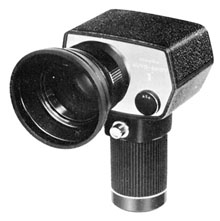
What about the Minolta spot meter...any good?
It has a 1 degree spot and a cine range of 8 to 128 fps.
I've used mine for many years to measure screen brightness and falloff at the edges.
Posted by Mark Gulbrandsen (Member # 72) on 01-10-2008, 11:13 PM:
I will know tommrrow if they match or not...didn't get to it today. Both were calibrated with in the last month fortunately...
I would never consider a Spectra Meter... they let them go obsolete way too fast...been there done that, another dislike Ihave of them is that they are no more than adaptionsof existing "Off The Street Meters" for me its USL first and then Minolta. The Photo Research meters that Dolby had when I attended their class (Louis was there too) were not even close to each other... all three they had read very differently.
Of all the meters out there I prefer the Minolta CS 200 for measuring color space... its also the more flexible of the bunch and the most rock solid of all the color meters out there... priced about the same as the Photo Research. The thing is that the USL is every bit as accurate and built in a solid block of alumnium so why spend all the extra money.
Mark
Posted by Louis Bornwasser (Member # 3063) on 01-11-2008, 09:33 AM:
In fairness, the Spectra does use the CASE of an off the shelf meter; insides (including electronics and optics) are quite different. 1 degree optics are unknown outside of our specialty. Louis
Powered by Infopop Corporation
UBB.classicTM
6.3.1.2