This is topic Technical Film Systems 35mm FIlm Cleaning Machine in forum Film Handlers' Forum at Film-Tech Forum ARCHIVE.
To visit this topic, use this URL:
https://ft-forum.com/ft/cgi-bin/ubb/ultimatebb.cgi?ubb=get_topic;f=1;t=009109
Posted by Steve Beverly (Member # 4540) on 02-09-2008, 11:20 PM:
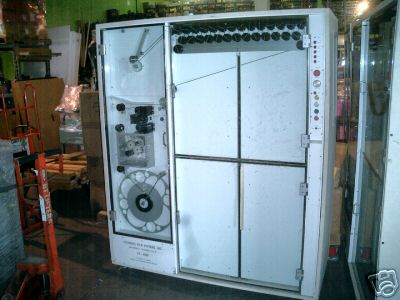
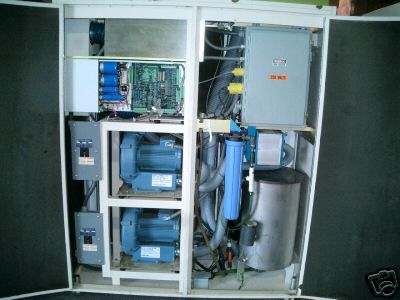
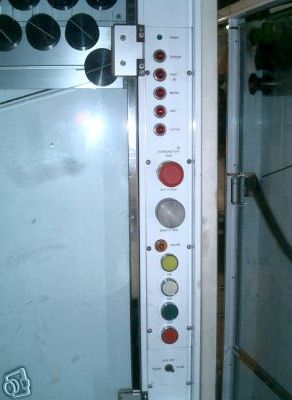
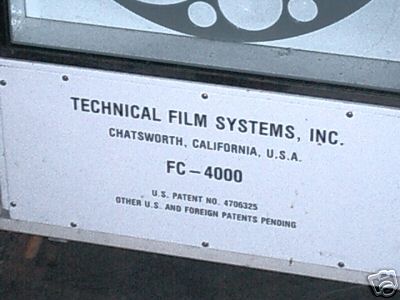
I just bought a Technical Film Systems 35mm Model FC-4000 Film Cleaning Machine last month. I wanted to get some information on this beast. I know from the description, it uses distilled water to clean the film is from the 1990s and originally cost over 50K. I also know Technical Film Systems doesn't make them anymore (or any other film cleaning machine of any kind) and hasn't supported them for the last 7 years. I bought this because we have a REAL problem with dust here in El Paso, which is the desert winds blow dust EVERYWHERE so I needed a machine that would thoroughly clean film. Has anyone ever used one of these things before any any chance in Hell there's a manual available for one somewhere out there? Thanks-Steve ![[Cool]](cool.gif)

Posted by Ken Lackner (Member # 1002) on 02-09-2008, 11:48 PM:
Forgive the ignorance, but I truly do not understand. Wouldn't distilled water dissolve the emulsion? And why would anyone pay $50,000 for a film cleaner when they can buy a Kelmar cleaner for around $500?
A Kelmar cleaner paired with Film-Guard will solve your dust problem.
Posted by Steve Beverly (Member # 4540) on 02-10-2008, 12:20 AM:
quote: Ken Lackner
why would anyone pay $50,000 for a film cleaner when they can buy a Kelmar cleaner for around $500?
I don't know, maybe that's why they quit making them. I didn't pay 50 grand, but I seriously doubt that a 50 grand film cleaning machine would dissolve film emulsion, I think the R&D department of Technical Film Systems woulda caught THAT ONE before they started selling them for 50 grand, HOWEVER if it did, I would expect there'd be some sort of price discount on 'em. ![[Big Grin]](biggrin.gif)
I was planning to use a Kelmar, or something equivalent, in addition to this as well. You REALLY don't understand the dust problem we have here. ![[Eek!]](eek.gif)
Posted by Chris Slycord (Member # 4239) on 02-10-2008, 01:54 AM:
Why would you buy the thing BEFORE asking about it? Heck, I seem to remember you doing this with your projector setup... having people give you pointers causing you to back pedal and change it after you'd already done the order. Not trying to be mean but just asking.
Posted by Tim Reed (Member # 137) on 02-10-2008, 02:59 AM:
Surprise! Film has changed. Positive prints, intermediates, and soundtrack negative are now on polyester stock, which doesn't like water.
Posted by Max Biela (Member # 1919) on 02-10-2008, 03:56 AM:
Actually, it is the emulsion that doesn't like water, not the base
Posted by Stephen Furley (Member # 1277) on 02-10-2008, 05:32 AM:
Water doesn't harm film, as long as it's carefully handled while wet, and fully dried before being wound up. There's plenty of water used in processing the stuff.
Posted by Max Biela (Member # 1919) on 02-10-2008, 05:50 AM:
Yes, my point was that water doesn't do anything to the base (acetat, polyester or whatever, it just plastic) while the emulsion is getting soft.
Posted by Stephen Furley (Member # 1277) on 02-10-2008, 07:30 AM:
Yes, I find Tim's response rather puzzling; if anything, polyester should have even less of a problem with water than other bases; water, in the form of high humidity over a long period, can affect bases made of nitrate and the acetates, but as far as I'm aware, not polyester. The only possible problem that I can think of which could be worse with polyester is that the emulsion is less securely bound to the base, and therefore more likely to be removed while wet and soft. However, polyester film survives processing. I'm not that familiar with the motion picture processes, but other than sound track re-development and backing removal, where these are used, I think that they're quite similar to the processes used for still film. Since C41 replaced C22, sometime in the '70s, colour film has been processed at high temperatures, around 38C (100F), and even water at these temperatures does not harm the film. I don't know how this cleaner works; does it use physical treatment of the film, wiping, brushing etc. while it is wet, or is it ultrasonic?
Posted by Kenneth Wuepper (Member # 1174) on 02-10-2008, 08:26 AM:
Hello Steve,
Well, I think you have a real piece of history there. As I recall, our school system had one of these machines for cleaning their 16mm collection. The machine was very reliable but you had to be sure not to let it become unlaced or it took almost as long to reload as it did to clean the film.
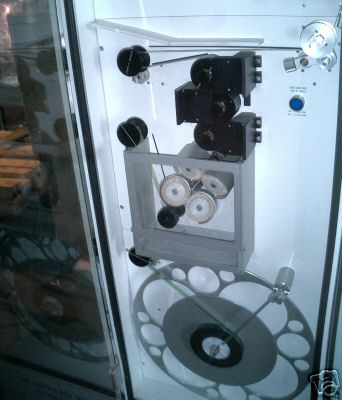
The solvent is in contact with the film for only a matter of seconds in the lower chamber of the cleaner cabinet. After applying the solvent, there is another area with compressed air "knives" that remove the liquid and particles loosened from the film. This is much like the way the car wash removes most of the water from you car. The film is then run into the second chamber where there is a giant accumulator. The film is payed out between the two rows of rollers and the lower set of rollers can move to accommodate the length of film needed to fill the cabinet. Once the accumulator is full, the take-up begins and warm dry and filtered air is used to remove all of the remaining moisture from the film.
Sorry but the media center disposed of their machine many years ago so I don't have any more to offer in the way of specifics.
KEN
Posted by Sean McKinnon (Member # 612) on 02-10-2008, 10:01 AM:
I wonder if you could use Film-Guard in this machine instead of distilled water... It kind of seems like way way way too much overkill for a cinema but to each thier own
Posted by Mark Gulbrandsen (Member # 72) on 02-10-2008, 10:08 AM:
The cleaner was originally meant for cleaning negatives before printing. It should:
Clean the film with water jets, dry the film, and wind it back onto the core ready to go onto the printer. Since it uses Air KNives similar to what is used in a processing machine it shouldn't be any more dangerous to clean film in this than it is to run exposed stock through a processsing machine. Its hard to believe though that it would use water and not some sort of solvent. The RTI cleaners at the School District I worked at used some solvent that made you higher than a kite... Weeeeeeeeeeeeeeeeeeeeeeeeeeeeeeeeee......
Mark
Posted by Stephen Furley (Member # 1277) on 02-10-2008, 10:18 AM:
When I visited the National Film and Television Archive, sometime in the '90s, they had recently had to replace their film cleaning equipment, due to the solvent which the older machines being either banned or no longer available. The new machines still used an organic solvent, but a different one. It is quite likely that a water based cleaning system may have been introduced in the '90s for environmental reasons.
Posted by Tim Reed (Member # 137) on 02-10-2008, 12:13 PM:
I was echoing Ken's comment. Water or oil on polyester stock will cause the emulsion to stick like glue, while acetate shrugged these things off fairly well. Whether or not it's the emulsion that doesn't adhere as well to polyester as it did to acetate, the difference still is in the fact that it is polyester stock.
I don't know that labs apply water to the stock for (ultrasonic) cleaning, but rather a chemical.
Posted by Kenneth Wuepper (Member # 1174) on 02-10-2008, 09:53 PM:
I think that Mark remembers the old 16mm formula of 50% PERC and 50% Xecoat. That could give you a massive headache in no time at all. That is why the solvent chambers were sealed while operating.
Cleaning projection films has the extra need to remove oil as well as dust and other particles. Water doesn't do that too well.
Posted by Gordon McLeod (Member # 33) on 02-10-2008, 10:08 PM:
Lipsner Smith (aka Bell and Howell printers) San Lab systems one of the early developers of PTRs all built distiled water cleaning machines
They were and are still used by many film abs for cleaning negatives and elements
They were expensive to build and did an excellent job for what they were intended to do
Posted by Steve Beverly (Member # 4540) on 02-11-2008, 03:17 AM:
quote: Chris Slycord
Why would you buy the thing BEFORE asking about it? Heck, I seem to remember you doing this with your projector setup... having people give you pointers causing you to back pedal and change it after you'd already done the order. Not trying to be mean but just asking.
Because it was a PRISTINE 50K machine made 10 to 15 years ago that I picked up for $163 bucks. How badly could I possibly get burnt? Besides from what I'm reading both here and at Cinematography.com, it is exactly what I need. I'll be processing dailies from my film shoots and this thing is great for cleaning my negatives before I print them.
I found out these machines were pulled off the market after one of them ruined 50K ft or more of archival OCN at a big facility. The problem stemmed from mold growing in the water for the system which then contaminated the emulsion and as Dominic Case stated at Cinema... "It wouldn't be the first cleaner that people managed to wreck original camera neg on - but 50,000ft of archival neg is a bit like losing a Boeing 747, you'd be grounding the fleet, at least until you knew what happened." TFS is the Roll Royce of film lab equipment so rather than taking a chance with another failure which would lead to catastrophic damage to the immaculate reputation in such a small market, they just shut it down. Their reputation was too important to risk losing customer confidence on such a small element of the product line. They recommended getting a good fungicide to use with it one suggestion was Nolvasan AKA Chlorhexadine. The machine was very well engineered and environmentally friendly BUT we will run some tests before cleaning anything irreplaceable. I have a sneaking suspicion it'll work just fine but better to be safe than sorry.
Posted by Robert W. Jones (Member # 4228) on 02-11-2008, 01:06 PM:
I still have a bottle of the old Kodak movie film cleaner (with lubricant) from the 1970's. Contains methyl chloroform. Remember getting a buzz from that stuff.
Posted by Bill Gabel (Member # 1105) on 02-11-2008, 02:04 PM:
quote: Steve Beverly
Because it was a PRISTINE 50K machine made 10 to 15 years ago that I picked up for $163 bucks.
So you got it off of eBay, that seller has been trying to sell that unit for a few months. He had it at a few thousand, no takers.
Posted by Jeff Taylor (Member # 443) on 02-11-2008, 02:39 PM:
Yea, I would have thought ICECO might have had some docs on it.
Posted by Steve Beverly (Member # 4540) on 02-11-2008, 10:47 PM:
quote: Bill Gabel
So you got it off of eBay, that seller has been trying to sell that unit for a few months. He had it at a few thousand, no takers.
Yes, he's sold a few of them prior to this, this one was the last one they had. As for it not selling right away, this is not a unit everyone would be interested in, it's a film cleaner the size of a double wide refrigerator that weighs about 450 lbs. You gotta have the room for it and the need. It was designed for high volume film labs. Then there WAS the archival print incident, and the fact that most people know water will saturate the emulation if left on the film, and find this disconcerting. I'm not surprised it didn't sell but am VERY pleasantly surprised it didn't until I had the cash to buy it.I would have paid more for it if I had to, fortunately I didn't.
It will fit nicely in my lab's workflow. We plan on shooting and processing somewhere between 50 to 80 thousand feet of 35mm motion picture film that will then be printed for editing ans screening. A negative film cleaner will be a very useful tool in a dusty environment like a wind blown desert which is just the kind of environment we have in El Paso and the lab is at the northeast edge of town so there's very little to block blowing sand and dust, We WILL have dust in the emulation problems we will have to overcome. Also, because we will be running 2 film processing machines, we want to avoid creating any additional pollutants if at all possible if for nothing else than to be environmentally conscientious. The way the machine works is the film is in contact with the water for a very short time the dried immediately with specially designed air jets, so it not like sticking you film into a dishwasher. TFS is a VERY respected company and I would tend to trust their design is sound and that the mold problem was more of a freak accident than a chronic design flaw, Hell if it hadn't been archival prints that were ruined and just standard prints, no one would have taken any notice except the guys who were having the prints done.
Powered by Infopop Corporation
UBB.classicTM
6.3.1.2