This is topic Westrex 5035 tower tension? in forum Film Handlers' Forum at Film-Tech Forum ARCHIVE.
To visit this topic, use this URL:
https://ft-forum.com/ft/cgi-bin/ubb/ultimatebb.cgi?ubb=get_topic;f=1;t=009125
Posted by Amanda Mundin (Member # 3386) on 02-18-2008, 01:12 PM:
What does anyone who uses the Westrex 5035 tower set their Pay Off & Take-Up tensions at?
We tend to start up with 120 Pay Off and 140 Take-Up, and once running back off the Pay Off to 100 and Take-Up to 130 and don't then change tensions for the rest of the show, at least when we run polyester, when we run acetate we back off the Pay Off more when its getting close to the end, dropping progressively to 90, 80 then maybe down to 70 for the very end. We have had old acetate films break under possibly too much tension on the top side of the gate if we don't back the tension off. Also when starting up the Take-Up does bounce slightly, only a small amount, which is perfectly fine on 95%+ of films, but when we run classic films on acetate, some are fine but others are brittle to the point where they snap on starting. Any suggestions on how to stop the bounce? Not sure whether its the tower or projector causing the bounce as it reaches running speed.
Posted by Pete Naples (Member # 761) on 02-18-2008, 03:26 PM:
The Westrex 5035, my chosen specialised subject, well one of them ![[Smile]](smile.gif)
Is your tower directly behind the machine? Or to one side?
According to the Westrex manual for these beasts, you should not adjust during the show. There is however much derision about this. My 15 years experience with them in many different cinemas tells me that once you've got everything setup just right, you don't need to adjust from start to finish.
I set the pay-off tension just tight enough to eliminate bounce, if it alters during the run, you could have oily or sticky film, or perhaps layers of uneven tension due to shrunk/stretched/buckled film, or simply it's been rewound too damned fast (the biggest error operators make with the 5035), usually compounded by putting the end of the film in those slots in the spool hub. DON'T do that, I can't stress that enough. Rewind should take 20-25 minutes on a full pair of spools.
With regard to the take up. On some setups it's necessary to boost the tension until the machine is up to speed, especially if the tower is not directly behind the mech. Again if everything is just right it shouldn't be necessary.
The projector needs to be taking 6-8 seconds to reach full speed, using floating hub spools or Ez Starts as they are known over the pond, will help enormously.
On occasion in the past with very old embrittled acetate prints I have replaced the leader with a modern polyester one, or a length of poly spacing, so the projector can do all it's accelerating and bouncing on that. By the time the feature feature proper comes along everything is up to speed so all should be well.
Posted by Bernard Tonks (Member # 809) on 02-19-2008, 06:52 AM:
When I used to run for many years a Westrex 5035 double sided Tower, situated behind the projector. The Pay-Off control was left set at 90 throughout, and the Take-Up control for projector start was set at 140, increased to 150 after 20 minutes for the entire run. I decided on the slight control increase mostly for the end of the film to have sufficient tension running on the auto-shutdown roller, although this might have been unnecessary. We never had any film snatch or break problems on acetate or polyester stock. This was with the heavy duty spools and the smallest 4” hubs (pictured below).
We did however have a slow-mo start system with a ramp-up speed of 8 seconds, devised by engineer Billy Bell (ex: BTH/Westrex). This was done with a 1 KW transformer (obtainable from RS Spares Ltd) with several low voltage taps, and automated for full speed.
Pete is so right about not putting the film in the slot of a spool hub. We sellotaped the tail onto to the hub with 2 minutes of protection stock permanently kept on the Pay-Off spool. The projector was always auto-stopped at the end of the feature, and then the film unlaced.
Rewinding too fast will of course give you a loose rewind and put stress marks on the film. This is the biggest problem with the 5035 rewind control and a careless operator. We always permanently used the Pay-Off & Take-up controls for rewinding which could be safely done for a smooth and tight wound in 15 minutes on a full spool. There were three adjustments made during the rewind which was noted on a chart drawing of a spool for guidance.
If I were you, I would consider investing in a good 2nd hand Christie AW3 platter, I absolutely love them. Never ever thought I would say that, but since gaining some multiplex experience they really are the business for me now.
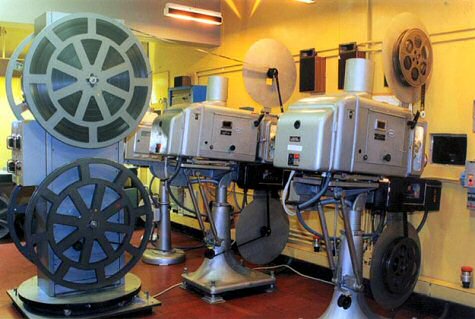
Posted by Amanda Mundin (Member # 3386) on 02-21-2008, 03:59 AM:
Thanks a lot for the help, our tower is at the side of the projector roughly at a 45 degree angle, the minimal bounce isn't generally a problem, just with certain old acetate films, but then we don't have floating hub spools, perhaps we need to invest in a couple of those.
Posted by Pete Naples (Member # 761) on 02-21-2008, 05:04 AM:
Aye, floating hub spools used on the take-up will help a lot. DON'T use them on the pay-off, they will work ok but the screeching noise made when rewinding is horrendous, they aren't designed for that.
My trick of adding a long length of poly scrap or spacing to the head of the film will help too.
Posted by Benjamin John Doman (Member # 4365) on 02-21-2008, 12:39 PM:
Hi Amanda,
The settings you are using sound about right. The Westrex tower was designed to alter the tensions during the show, but in practice it’s not necessary unless you are showing a longer than average film where you may need to turn the take up tension up to compensate for the extra weight on the reel towards the end of the film . The bounce is indeed to do with the ramp up speed of the projector. What projector do you have? We have successfully fitted the resister with a timing relay to single phase motors (such as Westar 2001 and Century) or we have replaced the single phase motor with a three phase and controlled with an inverter. Using the inverter you can set the ramp up / down time to whatever you like, though seven seconds is perfect for Westrex towers. We have retro-fitted many Kinoton FP20’s and DP75’s with three phase kits, as well as a pair of Century’s. Adding a slow start also prolongs the life of the main drive gears in the Westar / Century!
I do agree with Bernard’s comments on platters. They are so much kinder to film, though I guess it will all be out the door when we go 100% digital! ![[Big Grin]](biggrin.gif)
Regards,
Ben
Powered by Infopop Corporation
UBB.classicTM
6.3.1.2