This is topic New Company Policy on Movie Pre-Screening in forum Film Handlers' Forum at Film-Tech Forum ARCHIVE.
To visit this topic, use this URL:
https://ft-forum.com/ft/cgi-bin/ubb/ultimatebb.cgi?ubb=get_topic;f=1;t=009146
Posted by Chad M Calpito (Member # 3736) on 02-26-2008, 05:03 PM:
Greetings to all. Well, I got told of a new company policy that Reading Cinemas doesn't want nor believes in screening all movies after they have been built. So, in essence, build the movies, but, do not pre-screen them. Now, I do have confidence in my movie builds and have had no problems with my splices, etc. I just don't feel to comfortable with this new Policy, but, gotta live with it though.
Has anyone else ever heard of or have to deal with a policy similar to this?
Posted by Mark Strube (Member # 4190) on 02-26-2008, 05:18 PM:
I believe that's Marcus's policy as well. It wouldn't surprise me if this is more the norm, actually.
Posted by Tim Reed (Member # 137) on 02-26-2008, 05:41 PM:
Well, things have certainly come full circle!
Time was, if you had to run a movie on the screen to "inspect" it, you weren't doing your job properly to begin with. I remember when this practice started coming into vogue, it was considered very poor form. After all, when you "inspected" a print, you INSPECTED it. Every inch of film first ran through your fingers on the bench, and you stopped on every splice (or damaged section), checked it for frame and integrity, and repaired it if necessary. If there were questions regarding reel order, you could look to clues such as latent edge numbers, or the picture on adjacent reels to be sure.
You didn't have to run it on the screen to know it was right.
It's funny how the sentiment has been reversed.
Posted by David Zylstra (Member # 4230) on 02-26-2008, 05:41 PM:
I've heard many companies do this - in some cases it ends up being knee jerk reactions to issues with too many employees (or non-employees) showing up for the screenings and turning them into a party. When I was with one company we ended up restricting screenings to tech only and under GM approval, with a larger chain our region's policy was tech only under the regional manager's approval. With a lot of money riding on Friday's business I think it is good insurance to be 100% sure the new releases have no issues - quality film make-up cannot fix print issues.
Edit -> I just read Tim's post - yes, it is too bad not many companies would allow proper inspection of a print during make up . . . .
Posted by Scott Norwood (Member # 30) on 02-26-2008, 05:46 PM:
I'm with Tim on this.
On the other hand, pre-screenings do have the benefit that, if other employees are allowed to attend, they make it possible for the floor staff to become familiar with the film which, one hopes, will improve customer service. When customers ask "what is movie X about?" the answer should be something better than "I don't know."
Posted by Tim Reed (Member # 137) on 02-26-2008, 05:51 PM:
quote: David Zylstra
quality film make-up cannot fix print issues
I can understand the QC aspect, and I don't disagree with the intention. However, showing it at 2 in the morning won't get a replacement reel any sooner than running it at 11 in the morning. Granted, the 11A show will be for an audience, so that's an argument in favor of tech screening. Although, I don't know that print issues happen enough to justify showing everything - burning the electricity and running up the time clock - for every engagement. ![[Smile]](smile.gif)
quote: David Zylstra
it is too bad not many companies would allow proper inspection of a print during make up . . . .
David... it takes longer to show a movie than it does to hand-inspect it. ![[Wink]](wink.gif)
quote: Scott Norwood
When customers ask "what is movie X about?" the answer should be something better than "I don't know."
Ahhh, this was also handled in the "old" days. Boxoffice used to print synopsis and promo guides for most titles, every week, in the back of the magazine. They were already pre-punched for filing in a loose-leaf binder. ![[beer]](graemlins/beer.gif)
Posted by David Stambaugh (Member # 1102) on 02-26-2008, 06:43 PM:
Aren't screenings also for the purpose of making sure automation cues, sound format etc. are correct so that everything about the first public show is, uh, showmanlike? Not just that the reels are in order and splices are good and there's no film damage.
Posted by Mike Blakesley (Member # 26) on 02-26-2008, 07:08 PM:
Not to mention the discovery of bad lab work, minute scratches, etc.
I think in the "old days" hand inspection was more important because there was much more tendency for film to have breaks, splits, etc. than there is now -- mostly because prints were around much longer than they are now.
Posted by Tim Reed (Member # 137) on 02-26-2008, 08:04 PM:
quote: David Stambaugh
Aren't screenings also for the purpose of making sure automation cues, sound format etc. are correct
Hey, I ran booths with automation and I still never had to screen movies ahead of time - and I ran 14 different films a week! It was by-gosh RIGHT. No question. We never had as much as an out-of-frame in 7 years! Frozen framers - never used them.
I hand-inspected everything and applied my cues. The only issue would be as the cue rollers aged and started missing cues. Soon as that happened, I'd just replace them between shows and it'd be right back to normal for another year and a half. Nothing un-showman-like about it.
It's not that difficult.
Posted by Brad Miller (Member # 2) on 02-26-2008, 08:12 PM:
David and Mike have the idea correct, occasionally goofups DO happen, like forgetting to put a cue onto the film, or a misframe could happen with seasoned projectionists from time to time on very dark reel changes. Also these days it is often found that the digital sound doesn't work on reel 3, or halfway through reel 2 the picture washes out to yellow and back and forth for about 3 minutes...many lab issues like this just are not catchable on the bench. Also by waiting for the first public show, is there a knowledgeable person in there screening it??? Or is the theater just assuming that the audience will come out and say something?
I think David has the majority reason why many companies no longer allow the practice of pre-screening a print. It's a liability issue because sometimes the staff isn't particularly mature on how the screenings are handled.
Posted by Chad M Calpito (Member # 3736) on 02-27-2008, 03:43 AM:
I think everyone has good points there. And, I do agree with you Brad.
Posted by John Wilson (Member # 269) on 02-27-2008, 04:15 AM:
quote: David Stambaugh
Aren't screenings also for the purpose of making sure automation cues, sound format etc. are correct so that everything about the first public show is, uh, showmanlike? Not just that the reels are in order and splices are good and there's no film damage.
We don't pre-screen our prints...never have. The print is required to be built correctly...full stop. Cues, reels in correct order and the right way around, sound format, screen ratio...all correct.
Of course, this comes back to bite us in the bum if there's a dud reel, but unlike you guys in the States, it can take 7 to 10 days to get a replacement reel anyway, so a day earlier will make not a lot of difference.
Apart from that, it hits the screen for the first time at the first session.
Posted by Stu Jamieson (Member # 4626) on 02-27-2008, 05:46 AM:
Naturally I concur with John^ being from the same part of the world and all. And I agree with Tim. I think it's important that trainees do their share of Thursday mornings (opening day) because if nothing else, dealing with their own screw-ups on first run prints motivates them to get their builds done right first time. If you do your job properly, you don't need pre-screeners and like Tim, I run every inch of film through my fingers when I make it up. However:
a) it's always important to keep an eye on the first time a print is run to make sure all is in order, and;
b) I personally wish we did have pre-screeners, that way I'd see more free movies! ![[thumbsup]](graemlins/thumbsup.gif)
Posted by Mark J. Marshall (Member # 1409) on 02-27-2008, 06:45 AM:
Sloppy lab work being what it is, I don't think there's any reason in the world to not screen a print after you've built it, unless you're trying to save lamp hours or you don't want your staff turning the show into a party. Which, by the way... who cares? I say turn the screenings into parties. Staff only. No friends. Make it a perk. You're already not paying them much more than minimum wage. Make that something they look forward to. Give them another reason to like working for you. Why not? It's an easy way to get your staff to really like you.
How many people got burned by reel 9 of Fellowship of the Ring on the opening midnight show? I know the theater where I saw the movie did. In something like four sold out houses. No amount of inspection on the bench would have found that problem. And by the way, I'm not saying that we shouldn't rely on bench inspection because that is certainly part of it. Our print of the last Resident Evil movie had about thirty feet of BLACK film in the middle of reel 4. Nice. I guess someone opened the door while they were printing the film or something. We spotted it on the bench and called in for a replacement. The Simpsons had about fifty or sixty feet of yellow film around a lab splice. I see that a lot - especially on Fox films for some reason. We had a new reel before the first show.
Something else we spotted on the bench once was a strange problem. I'm not even sure how to describe it. But it was around a lab splice. It looked like the negative came off the sprockets in the printer or something, because the frames started drifting along the sprocket holes. I noticed it when I was about to cut out the frame with the lab splice, and I saw that about fifteen frames away the frame line was dead center on a sprocket hole. That continued for a good fifty or eighty feet before finally settling down. Remember your old TVs horizontal hold knob? It would have looked something like that being out of whack. (Or was it the vertical hold, I forget.) It was a miracle we even noticed that. I have only seen that particular problem one other time, and we didn't see it on the bench... and we didn't screen that movie either. What ended up happening was the picture "rolled" on the screen a couple of times, and then stopped in a position that put the picture out of frame. But since no one saw the rolling, the consensus was that we had a bad splice somewhere. We pulled our hair out trying to find that bad splice (which didn't exist) until one of us finally sat in the theater to watch the movie. When I saw the "picture rolling" phenomenon I almost fell on the floor.
So I say both bench inspections and pre-screenings have their place. One of the things that irks me is when we receive prints for big highly anticipated movies at the last minute for "security reasons" only to find a letter from the director inside reminding us of how important it is to screen the movie before showing it to the public. If it's so important, then get the damn print to the theater a day earlier! ![[Mad]](mad.gif)
Posted by John Walsh (Member # 168) on 02-27-2008, 08:26 AM:
We would allow staff to watch a screening just so they wouldn't be sneaking in to watch when they are supposed to be working. I think the reason nowadays is simply to reduce the payroll.
Posted by Mark J. Marshall (Member # 1409) on 02-27-2008, 09:07 AM:
Which is stupid. Pay someone for two or three more hours and make your entire staff happy while reducing the likelihood of costly lost shows. It's the cost of doing business. I'm sick and tired of so many people trying to squeeze every penny they can off of expenses rather than trying to figure out how to increase revenue in creative ways. And I'm not talking about showing ads in front of the movies. There's nothing creative about that, and it does nothing to put more butts in the seats (which is how you increase revenue).
Posted by Chris Slycord (Member # 4239) on 02-27-2008, 10:45 AM:
quote: Mark J. Marshall
or you don't want your staff turning the show into a party. Which, by the way... who cares?
Apparently a lot of people.
You say "make it a perk for the staff" but you seem to forget how idiotic staff can be. Some of them push the limits on staff screenings.
Posted by Jack Ondracek (Member # 1466) on 02-27-2008, 10:51 AM:
quote: Scott Norwood
floor staff to become familiar with the film which, one hopes, will improve customer service. When customers ask "what is movie X about?" the answer should be something better than "I don't know."
One would hope that'd be the case. However, staff usually showed up only for shows they were personally interested in. In a larger multiplex, that would still result in a lot of "I don't know's".
Posted by Christian Appelt (Member # 1067) on 02-27-2008, 11:28 AM:
Mark J. Marshall wrote quote: Mark J. Marshall
Sloppy lab work being what it is, I don't think there's any reason in the world to not screen a print after you've built it, unless you're trying to save lamp hours or you don't want your staff turning the show into a party.
I agree with that because there are many lab problems that will go unnoticed even if you prepare your print properly.
Maybe not a problem in the US, but in europe some labs produce different language versions for a number of countries, and with the short time given by studios to make thousand of prints...mistakes do happen.
IIRC some theatres in Germany received prints of the last Harry Potter movie with R4 or 5 in Russian dub version! Most projectionists noticed it in their prescreenings and the theatres lost only the early morning shows.
Especially sound printing defects will hardly be spotted in makeup unless the whole reel has no visible track - better to hear it before customers do.
Posted by Mark J. Marshall (Member # 1409) on 02-27-2008, 12:33 PM:
quote: Chris Slycord
you seem to forget how idiotic staff can be.
A perk can be taken away for bad behavior and can also be used to reward good behavior. But if it's not there to begin with, then you have no "bargaining power" (so to speak) with your staff. But my point is if your staff works hard and generally exhibits good behavior, then why not let them watch the movie while you check the print?
Either way, screening the prints is a necessary part of the business whether you decide to let the entire staff in the auditorium or not.
Posted by Scott Norwood (Member # 30) on 02-27-2008, 12:39 PM:
Question for the pro-pre-screen-everything people: what do you do for films that only play once? Do you really expect someone to pre-screen every single film that will play in a film festival? What about rentals and special screenings? To do so would be both time- and cost-prohibitive if the screeners were to be paid.
How many lab problems do you have, anyway? And how many of these should have been caught on the bench? (Yes, it is possible in most cases to check for subtitle and soundtrack language issues on the bench.)
I would never suggest that pre-screening was a bad idea...just that there are better uses of time and money in most cases.
Posted by David Stambaugh (Member # 1102) on 02-27-2008, 01:27 PM:
Seems like there would be possible legal liability issues allowing staff to attend a screening (in party mode) while claiming they're off the clock.
Posted by Brad Miller (Member # 2) on 02-27-2008, 01:53 PM:
quote: Scott Norwood
Question for the pro-pre-screen-everything people: what do you do for films that only play once? Do you really expect someone to pre-screen every single film that will play in a film festival? What about rentals and special screenings? To do so would be both time- and cost-prohibitive if the screeners were to be paid.
Absolutely!!! A film festival, particularly when the director is in attendance, is NOT the place to find out someone made a misframe or the last theater left a piece of tape in the middle of the reel that wasn't caught on inspection.
If the theater cannot keep their head above water by paying someone 2 hours on the clock to check-screen a movie, then that theater has far bigger problems and should go ahead and shut down their operations.
Posted by Blaine Young (Member # 3992) on 02-27-2008, 02:01 PM:
quote: Tim Reed
However, showing it at 2 in the morning won't get a replacement reel any sooner than running it at 11 in the morning.
I'm going to have to disagree with Tim here. I know that I've called DFS at 2am to order a replacement reel which was delivered by 10am the same day, in time for the reel to be changed out before the first show.
And in cases where we've got multiple prints, we'll move them around to allow the 'bad' print more time to allow the reel to be replaced.
I'll also chime in on the staff party routine. I work for an independent house, and we've had several problems with floor staff 'joining in' on the inspection screenings. Management comes down on these events when they get out of hand. When I'm screening, I am happy to allow other staff to attend (with management approval) as long as they shut the hell up. I've thrown an usher or two out of my screenings in the past.
I'm in favor of inspection screenings. GCC never did this when I worked for them and it was a Saturday Morning routine to change out replacement reels.
Posted by Jeremy Weigel (Member # 4208) on 02-27-2008, 02:10 PM:
We screen almost every print. Its fairly easy to catch image defects on the bench, but not always that easy to spot soundtrack track defects; analog or digital.
We had a print of "Clear and Present Danger" that repeated the last 5-10 minutes of the last reel near the end before the credits were to hit the screen. We all thought we had a case of deja vu. ![[Confused]](confused.gif) Ordered a replacement reel that night and had it in time before the first public showing.
Ordered a replacement reel that night and had it in time before the first public showing.
The biggest reasoning for not having "employee screening parties" after operating hours is due to insurance. If you have someone get hurt while not actually working it presents a huge liability; not just if they get hurt at the theatre, but also if they get into an accident on the way home. I believe Regal had one such case about 10-12 years ago.
Posted by Scott Norwood (Member # 30) on 02-27-2008, 02:10 PM:
So, if you have 25 prints in your film festival, each one averages two hours, and you pay your operators $20/hour (low for festivals), your labor cost for the screenings is $1000. Plus (probably) extra rental costs for the theatre plus you'd probably have to pay a manager or someone else to be there as well.
Even if it's "only" $1000, the money has to come from somewhere. Personally, I'd rather take the $1000 and pay a competent tech to do a complete service call on the theatre and fix any known issues before the festival. Maybe rent better lenses for the week. Or hire another operator to be available to help during the screenings. All of these uses of $1000 would provide noticeable benefits for every show, whereas screenings "might" identify issues that "might" be able to be corrected "if" replacement prints are available (highly unlikely).
Pre-screenings would be great if they didn't cost anything, but some of us don't get to deal with people or organizations with unlimited budgets and would prefer that what cash is available be spent in the most efficient manner possible.
Edit: I should add here that I am personally sick and tired of having to explain to directors why their movies look and sound bad. This is usually because the venue has crappy equipment or, more often, is in need of maintenance. Service calls before festivals should be standard procedure, but often aren't.
Posted by John Koutsoumis (Member # 1855) on 02-27-2008, 02:49 PM:
It is policy where I work that everything is screen tested and the projectionist who does so gets paid for their time.
We have rejected prints on the basis of scratching and bad lab work most of which you can't notice on the bench.
Occasionaly we are unable to test a print because it arrives on the day of the screening but they are usually only one off special screenings.
Also recently I started using Filmguard and a Kelmar film cleaner so I like to do one pass before it screens for a paying audience.
Posted by Joshua Waaland (Member # 287) on 02-27-2008, 03:02 PM:
At the first cinema I worked at there were eight screens and the other projectionist and I would come in very early on Friday mornings and build up prints. Then we would each screen one. Occassionally I may miss a splice if the frame was way too dark but most of the time they were right. We didn't have the benefit of frame counters or anything like that.
Sometimes there were too many prints to screen though. When I moved to a fifteen screen theater this became the case. With upwards of seven films leaving some weeks it just wasn't feasible to screen them all.
On a side note we did occassionally have employee only screenings after hours. For the most part everyone behaved and it was something we all looked forward to.
Posted by Mark Hajducki (Member # 1732) on 02-27-2008, 04:20 PM:
quote: Scott Norwood
Question for the pro-pre-screen-everything people: what do you do for films that only play once? Do you really expect someone to pre-screen every single film that will play in a film festival? What about rentals and special screenings? To do so would be both time- and cost-prohibitive if the screeners were to be paid.
Although not totally without an audience, the press show should catch any small errors, and give an opportunity to check the image on screen.
Posted by Stu Jamieson (Member # 4626) on 02-27-2008, 05:12 PM:
quote: Joshua Waaland
Occassionally I may miss a splice if the frame was way too dark but most of the time they were right. We didn't have the benefit of frame counters or anything like that.
I guess it goes without saying that a frame counter should be considered mandatory equipment but I too have worked in a cinema that didn't have one so I ended up making one out of some scrounged bits and pieces. It looks a bit like this (actually it looks exactly like this):
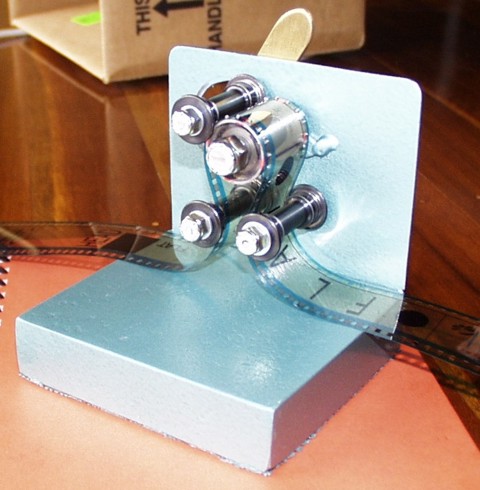
It cost me about 20 bucks to make and you're probably thinking that it looks it but it gets the job done.
Interesting that you guys are so militant about pre-screenings. I've found that lab problems are a rarity so if I were running a cinema, I probably wouldn't do them either. Or if I did, it would be the first thing to go when things got tough. Given that you guys in the US usually premiere before us, maybe the problems are all ironed out before we get our prints?? Although Aussie John says they pre-screen. Do you get frequent lab faults, John?
Posted by John Koutsoumis (Member # 1855) on 02-27-2008, 06:37 PM:
Yeah sometimes we get prints that have some weird flash colour shifting that's really annoying and recently we had a print where in place of the credits there was lab tech jargon printed instead. Looked like end cedits on the bench but on close inspection they were not. Of course the print had been shown elsewhere several times proir to us receiving it but no one noticed!
Most of the problems with prints that I have are Lab stock joins that are in the middle of the frame and poor printing quality on some prints but well what can you do.
9 out 10 times I get replacement prints due to the ones we receive having been trashed by others. Of course only really noticed after test screening.
I like testing prints before hand and will continue to do so regardless of what others think. Most importantly it gives me the chance to see the film too which I like doing
Posted by Tim Reed (Member # 137) on 02-27-2008, 06:52 PM:
quote: Blaine Young
I've called DFS at 2am to order a replacement reel which was delivered by 10am
Well, that's a new one on me. As I said, the routine has changed in the 20+ years since I was a full time projectionist.
Posted by Stu Jamieson (Member # 4626) on 02-27-2008, 08:48 PM:
^^ I've certainly cut out crap loads of lab joins but these can be done on the bench. I don't understand how it is that labs can't get those joins on the frame line anyway.
quote: John Koutsoumis
I like testing prints before hand and will continue to do so regardless of what others think. Most importantly it gives me the chance to see the film too which I like doing [thumbsup]
Can't argue with that, mate.
Posted by Steve Guttag (Member # 268) on 02-27-2008, 10:19 PM:
It all depends on the event for me.
For a Studio screening...oh you betcha...there WILL be a run-through. Then again, I normally have two prints at my access and they have long been assigned as "primary" and "backup."
During these run thoughs we have have found bad digital tracks, odd marks/scratches in the picture and such. These shows only have one chance and must be perfect.
This is not limited to film events either...digital or even analog tape are always prescreened. One never knows what "hits" are in the picture or possible audio drops.
So as to once-time shows...it all depends...if the event warrants it, then absolutely. Then again sometimes it would be time prohibitive....take the Warner Bros collection that was screened some years ago...each film only ran once and there were 12 hours of screenings per day...you would need to run the theatre 24 hours to "prescreen" them all....it just wouldn't be practical.
In a typical cinema application though...having to run on analog versus digital is not a show stopper...an odd mark or color shift is also not a show stopper. Heck, the labs can't color time two reels the same way anyway.
I have no problem with theatres prescreening films as it makes some amount of sense. I have never done it myself in the theatres I've worked however and never had a situation come up that was a show stopper as a result.
Steve
Posted by Mike Sellars (Member # 4042) on 02-28-2008, 06:56 PM:
The only time we do not preview a film before we show it to the public is when we get them in Friday morning and only have time to build them and show them... cross your fingers!
In addition, every print coming in the building gets Filmguarded during the preview, and since we only have one Kelmar machine, they get previewed one at a time. Luckily some come on Wed and some on Thurs, and Sun-Thurs during slowtime we don't run lates, so we are not usually here forever. As long as I'm the GM, and we still run film, it will be this way.
![[Cool]](cool.gif)
Mike
Posted by Tim Reed (Member # 137) on 02-28-2008, 07:38 PM:
You guys could also just get Moviolas in the booth, and run through them at high speed.
Posted by Daryl C. W. O'Shea (Member # 1303) on 02-29-2008, 12:57 AM:
Here I thought that was why my variable speed drives can exceed 60 hertz.
It's odd how all the last shows of the night end at the same time.
Posted by Sonja O'Reilly (Member # 1322) on 03-05-2008, 08:29 AM:
I work at an 18-plex in Southern California and we try to pre-screen every movie possible. Because we live so close to the border with Mexico (Tijuana, specifically,) theatres in the area have gotten reels that were in English and reels in Spanish. I received a foreign language film that had R4 with no subtitles at all. I like pre-screening and thankfully my GM agrees that it is vital, because it allows for us to catch unusual situations, like poor sound or even a quirk of the film itself. Like Cloverfield, shot on mini-DV and transferred to film, so it has a lot of video "noise" on it and it was also a shaky film, so I made sure that warnings went up for customers with motion sickness problems.
Plus, pre-screening is fun.
Powered by Infopop Corporation
UBB.classicTM
6.3.1.2