This is topic Interlocking with delay in forum Film Handlers' Forum at Film-Tech Forum ARCHIVE.
To visit this topic, use this URL:
https://ft-forum.com/ft/cgi-bin/ubb/ultimatebb.cgi?ubb=get_topic;f=1;t=009171
Posted by Thomas Pitt (Member # 4322) on 03-09-2008, 01:06 PM:
This is probably a stupid idea, but I just wanted to ask anyway...
If you want to run the same movie in more than one screen but only have one print, you interlock - as demonstrated in the Interlocking 101 video. What if you wanted to 'stagger' the start times? For example, you might have one screen starting at 12:00 and another at 12:30. Is there any way of storing up the film temporarily to delay it before it gets to the second projector? Perhaps having a single platter doing BOTH take-up and pay-out at the same time?
I suppose you could run the film from one end of the booth to the other and back using interlock rollers (in Interlocking 101, this gave a 20-minute delay between the first and last projectors), but that would be rather inconvenient.
It's probably more convenient to get hold of two prints, but would the cost of getting a second print outweigh the hassle of doing a delayed interlock like this?
Posted by Brad Miller (Member # 2) on 03-09-2008, 02:15 PM:
Bah, old news to me since I first did it back in 2003 with Pirates of the Caribbean. I don't have pictures of all of the delayed interlock setups sadly. I've done a 10, 15, 20, 30 and a 40 minute setup. The differences all depended on the particular booth it was in and the amount of space they had to fly the film back and forth. Here are a couple of pics of the 15 minute delay. (It's all the room they had.)
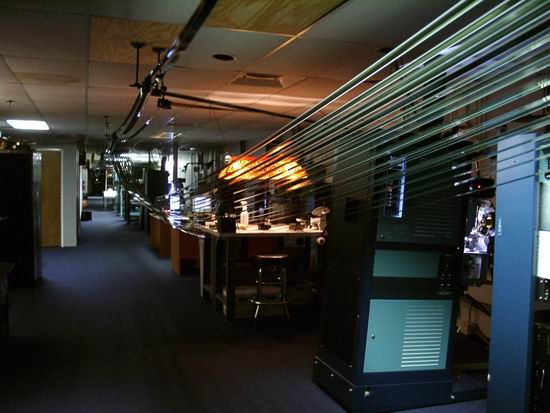
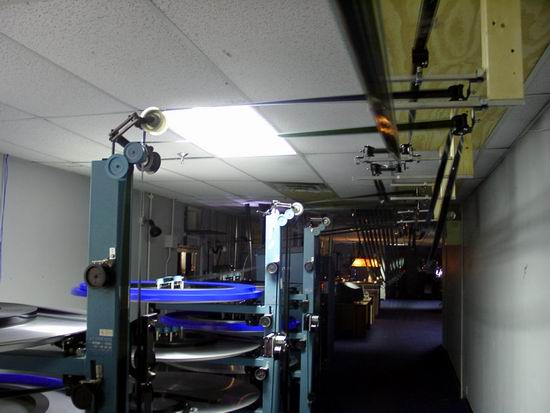
Here is a shot of the 40 minute setup.

Don't even think of attempting this unless you have a CA21 or some other extremely reliable and flexible automation system. The concept is very simple. In reality there is a lot of shit that has to be just right for it to work without damaging film. You want 30 minutes of delay, so think about it...that's 3000 feet of film that has to be flying somewhere.
Posted by Sean McKinnon (Member # 612) on 03-09-2008, 03:16 PM:
Wow, That is AWESOME!
Posted by Thomas Pitt (Member # 4322) on 03-09-2008, 04:38 PM:
Sean said it, one of the most incredible film setups I've ever seen - even beats Interlocking 101!
I thought of using a 'tank' of film, basically a box on the floor for the film to fall into and from which you would thread the second projector when it's time. But that's probably a bad idea as well, since the film might get scratched and/or tangled in that box.
I was thinking more along the lines of waiting until there's around 25 minutes worth of film on the takeup platter, removing the ring, threading it through a brain (all while it's still going) and starting the 2nd projector then. Probably wouldn't work in practice, but it's a nice idea anyway ![[Big Grin]](biggrin.gif)
Posted by Stephen Furley (Member # 1277) on 03-09-2008, 05:10 PM:
quote:
I was thinking more along the lines of waiting until there's around 25 minutes worth of film on the takeup platter, removing the ring, threading it through a brain (all while it's still going) and starting the 2nd projector then. Probably wouldn't work in practice, but it's a nice idea anyway [Big Grin]
The problem would be that the film would be paying out at a smaller diameter on the platter than it was taking up, so whatever speed the platter was turning at the film couldn't be paying out and taking up at the same speed. You might possibly get it to work on one of those platters which are normally used to run film in an endless loop, where the film winds in a star shape, so each turn contains same same amount of film, whether it be at the centre, or the outside, but these things have a bad reputation for damaging film.
Just out of interest, can a digital server play the same copy of a film to two projectors each at a different point in the film, at the same time?
Posted by Brad Miller (Member # 2) on 03-09-2008, 05:13 PM:
Thomas, your idea would not work because the platter has to slow down as it runs. You would have a brain wrap almost immediately.
Your idea of letting the film fall into a box would only work if you designed such a box to be about 37mm deep and very wide (and of course, very tall)...picture an ant farm but much bigger. It would also require a sprocket at the top interlocked with your projectors to force the film into the top of the "box", which would lay back and forth on the film below it. Then at the bottom of the box you would have to have a couple of stripper rollers to get the film out from the bottom so it could then travel to the second projector. Of course such a box in reality could probably only hold 5 minutes of film AT BEST. Simply putting accumulator rollers on the ceiling is FAR safer and simpler.
If anyone should decide to put a bunch of rollers up for this purpose, bear in mind you have to use the large 3 inch rollers with bearings, such as is available from Kelmar. The small Strong-type rollers, even though they have bearings, puts too much stress on the film (been there, done that). Also you have to find that magic distance between the rollers to keep the minimum amount of tension on the film or you risk sprocket damage to the print.
Posted by Stu Jamieson (Member # 4626) on 03-09-2008, 07:06 PM:
quote: Stephen Furley
Just out of interest, can a digital server play the same copy of a film to two projectors each at a different point in the film, at the same time?
I don't see why not, after all, that's basically what a PVR is doing when it's in "time slip" mode.
Posted by Louis Bornwasser (Member # 3063) on 03-09-2008, 07:37 PM:
Thomas; you are describing a "loop-bin" which works quite well for 2" audio tape but not well for film: scratches. All cassettes and open reel tape were mass-produced this way until the first practical digital memories were available. (That's when cassette audio improved.) Louis
Posted by Mike Olpin (Member # 1115) on 03-09-2008, 07:47 PM:
Why not use a looping cabinet?
Posted by Monte L Fullmer (Member # 2797) on 03-09-2008, 08:51 PM:
? with these delays, (which I still commend on the magnitude and how such a complex operation can be accomplished-some very serious training there..can you imagine this kind of booth in an operation full of booth clowns?) wouldn't it be simpler just to have multiple print releases of the one movie?
Posted by Andres Briano (Member # 4621) on 03-10-2008, 08:59 PM:
"Booth Clowns" That´s a definition I like!
Posted by Tim Asten (Member # 4051) on 03-11-2008, 11:48 AM:
Blimey! ![[Eek!]](eek.gif) How long does it take to lace up? I cant imagine trying to single man a 15 plex AND having that to worry about. If a cinema has equipment that can handle a set up like that, I'm sure it can afford a second print of a film
How long does it take to lace up? I cant imagine trying to single man a 15 plex AND having that to worry about. If a cinema has equipment that can handle a set up like that, I'm sure it can afford a second print of a film ![[Razz]](tongue.gif)
Posted by Brad Miller (Member # 2) on 03-11-2008, 12:24 PM:
It takes about 5 minutes to reset for the next show.
Posted by Ken McFall (Member # 845) on 03-11-2008, 12:32 PM:
Whilst I love doing this sort of thing I can see that it would only be of real benefit for one performance. Therefore not suitable for a multi plex running all day.
You have your 30 min delay whilst the film runs over it's rollers but when the film finished in the first screen it still has to finish in the second screen before you can lace up again. I would imagine that it would take easily 15 min to lace up add that to the 30 min delay you already have and you have a 45 min break of house in each screen before its second show.
Any gain is lost if you run more than one performance in this way.
What happens to all of the film in the loop when the film runs out of the first projector? All of the tension would be lost and the film would drape onto itself causing the last 30 min to scratch itself surely?
Would love to see it in action....
Regards
Posted by Mark Gulbrandsen (Member # 72) on 03-11-2008, 03:32 PM:
I've worked with looping cabinets several times over the years and they can work well if installed correctly or be your biggest nightmare. One at the Chicago Museum Of Science And Industry had such bad static problems with so many layers of film clinging to itself that you couldn't even pull the film through by hand... Also you'd need a humongus loop cabinet for a 40 minute delay... I think the way Brad has done it is the better choice.
Mark
Posted by Chris Slycord (Member # 4239) on 03-11-2008, 08:15 PM:
quote: Ken McFall
What happens to all of the film in the loop when the film runs out of the first projector? All of the tension would be lost and the film would drape onto itself causing the last 30 min to scratch itself surely?
Brad's always been suggesting that we add a trailer to the tail of a movie when building it up. So methinks you can just add more of them since there's more distance to travel. Though that would be adding roughly 30-40 mins worth of trailers. Still doable.
Posted by Brad Miller (Member # 2) on 03-11-2008, 10:15 PM:
Like I said, it takes about 5 minutes to reset for the next show. I never said rethread. (Think about it. ![[Wink]](wink.gif) )
)
Posted by Stu Jamieson (Member # 4626) on 03-12-2008, 03:35 AM:
Hmmm, intriguing. So you stop the projectors before the tail runs out and use the (already threaded) tail of the previous show as the leader for the next show?
Posted by Brad Miller (Member # 2) on 03-12-2008, 10:39 AM:
In a nutshell, yes, although there are a few other minor things in the setup that needs to be done.
Posted by Phil Ranucci (Member # 3820) on 03-12-2008, 01:08 PM:
But wouldn't that make the intermission in the first theater as long as the delay between 1&2 plus the intermission in #2?
I see that's already been pointed out, but I'm still curious about the intermission.
Posted by Brad Miller (Member # 2) on 03-12-2008, 01:39 PM:
Yes that is exactly correct. If the delay is 40 minutes and it takes 5 minutes to reset, 45 minute intermissions are the minimum that can be done. However in some instances, it is better for the theater to do this with one print for the entire first week than be stuck with a contract for 2 prints.
(Disclaimer - I don't book 'em, I just figure out a way to make the ideal schedule work in the booth.)
Posted by Stu Jamieson (Member # 4626) on 03-12-2008, 06:58 PM:
So assuming that you just ran the print from (say) Proj-A to Proj-B, do you reverse the threading in each projector and then run from B back to A? Or do you physically shift the print back to A, swap the old (threaded) tail for the new leader and then run to B again? I would think the latter would be easier. Presumably then, when the show starts, you utilise the turning platter to wind the removed leader onto the tail of the print and the cycle continues ad infinitum??
Posted by Brad Miller (Member # 2) on 03-12-2008, 07:51 PM:
Auditorium #1
11:00 2:00 5:00 8:00 11:00
Auditorium #2
11:40 2:40 5:40 8:40 11:40
This is just an example. The film is never unthreaded. There is a simple procedure of breaking a splice, winding the leader on and then making a splice.
Posted by Stu Jamieson (Member # 4626) on 03-12-2008, 09:11 PM:
Hmmm, you're being very cryptic there, Brad, but I won't give up!
So I'm guessing that what you're actually doing is this:
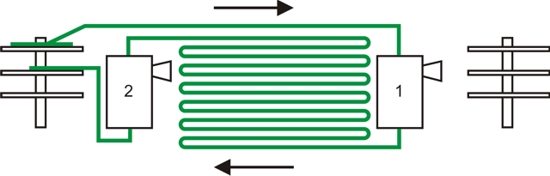
Correct?
Posted by Brad Miller (Member # 2) on 03-12-2008, 09:25 PM:
There is nothing cryptic about it...unless you can figure out some other way different from what you have drawn. It's not that complicated in concept. In reality tension and stopping/starting are a bit of an issue.
Posted by Stu Jamieson (Member # 4626) on 03-12-2008, 09:40 PM:
It was a little bit cryptic for me because a standard interlock for us would run from platter 1 to platter 2. The idea of running the print from a platter through 2 projectors and then back to the same platter is something I've never done (or considered) and so, for me, it wasn't obvious rather requiring a small conceptual leap to get it.
Posted by Ken McFall (Member # 845) on 03-13-2008, 05:59 AM:
Stu said ------------------------------------------------------
It was a little bit cryptic for me because a standard interlock for us would run from platter 1 to platter 2. The idea of running the print from a platter through 2 projectors and then back to the same platter is something I've never done (or considered) and so, for me, it wasn't obvious rather requiring a small conceptual leap to get it.
-------------------------------------------------------------------
In fact the type of interlock you mention, returning the film to the feed platter is nothing unusual. Indeed with some platters, Strong Alpha Platter is one, it's the only way of doing an interlock.
This type of platter does not have independant feed and take-up speed controls relying on the take-up variac to effectivly control both plates. The control module basically just turn's on or off the feed plate. There is a resistor in the take-up circuit so that the feed plate always has a slight speed advantage but that's basically it. Therefore you cannot feed film from the platter unless you are also taking film up as well.
I've done it with Alpha PLatters in a botth I would not normally consider interlock in as the staff are not exactly on the ball. But it's worked perfectly for them.
Like all interlocks it requires a very rigid operating procedure and sticking to it. Brad's mamoth delay system would be a disaster in any both where everyone goes their own way.
I'd turn around and go home if I came in and saw all that film hanging and lying on the floor ![[puke]](graemlins/puke.gif)
Posted by Sean McKinnon (Member # 612) on 03-13-2008, 09:39 AM:
I find that to be a great solution for when a film comes out that is going to do well on the opening weekend then die a very quick and financially painful death! Like brad said instead of being stuck with two prints for two or three weeks you book only one and drop the extra shows the second week, I like it a lot. This is another example where a professional, well trained, and qualified projection staff can save a theatre money. See, Were not the enemy! ![[Smile]](smile.gif)
Posted by Mark J. Marshall (Member # 1409) on 03-14-2008, 10:09 AM:
quote: Ken McFall
Indeed with some platters, Strong Alpha Platter is one, it's the only way of doing an interlock.
Not exactly true. You're right about the speed controls not being independent, but there are ways around everything. I have a theater where they interlock on a somewhat regular basis and sometimes go from one end of the building to the other (because that's where the two biggest houses are) and maybe hit a few in between too, and always go from one platter to a different platter. You have to be careful and aware of what you're doing. Having independent speed controls on the pay out and the take up would simplify the procedure by a few steps, but NOT having independent speed controls doesn't mean you can't do it if you're creative.
Posted by Brad Miller (Member # 2) on 03-14-2008, 11:21 AM:
What he means is you can clamp the takeup elevator rollers partway up the post. I used to do this all the time with SPECO LP-270 platters to make them run smoother during an interlock.
Posted by Monte L Fullmer (Member # 2797) on 03-14-2008, 12:32 PM:
...and by clamping up the elevator (I use coathanger wire to hook up the elevator to the desired level), using phase control brains works better in this operation than does those microswitch brains so the platter remains in constant rotation than stopping and going.
Posted by Brad Miller (Member # 2) on 03-14-2008, 12:57 PM:
You know what works even better than phase control brains Monte? Using Christie platters.
Posted by Ken McFall (Member # 845) on 03-14-2008, 01:29 PM:
OK I'll stand corrected on this.... but it's a work around that requires attention during the run to resposition the take up roller on the feed platter.
As for Christie platters.... what took you so long Brad
Regards.
Posted by Steve Guttag (Member # 268) on 03-14-2008, 02:27 PM:
And even better than that Brad? Two projectors on each screen...you can set the delay as needed and be ready to start the next show as desired!
As to SPECO platters (and other take-up dependent payout speeds) we would make up a loop of film to hold the elevator up...with SPECO, you could obtain 3-4 heights that way pretty easily and adjust it during the show...that is, hook the loop to the low roller for show start, move it to the high roller after that, then pull the loop so it goes over the low on its way to the high and finally over the high and back down to the low.
I'm sure the words are not giving the visual look of what is being done but it worked rather well and can be adopted to the Potts/Strong as well...if you don't want to just have the fixed setting.
Steve
Posted by Tim Asten (Member # 4051) on 03-14-2008, 02:43 PM:
With so much film being dragged through so many rollers, backwards and forwards, what is the tension like as the film enters the delay machine? The reason I ask is when we do a normal two projector interlock with a distance of about 40 ft with 6 or 7 guide rollers, you can feel that there is quite a bit of tension already as the film enters the delay projector. Tim
Posted by Mark J. Marshall (Member # 1409) on 03-18-2008, 08:31 AM:
I love Brad's method and I'd like to try it one day or see it in action. But I have no need for it, nor do we have anywhere near enough rollers to do it for fun.
quote: Ken McFall
but it's a work around that requires attention during the run to resposition the take up roller on the feed platter.
There's actually a position on the variac that pretty much lets the brain do all of its work normally without going too fast or too slow. If you find it when you start, you're ok throughout the show. But I don't tell my people that. I tell them to keep an eye on both projectors for the duration of the show.
quote: Monte L Fullmer
I use coathanger wire to hook up the elevator to the desired level
Clothes pins work great too.
Posted by Robert LaValley (Member # 4319) on 06-17-2008, 07:07 AM:
Brad, If you ever get a chance I would love it if you could make a video of an interlock with a delay, even if it is a 15 min delay one. I think everyone would really like to see this in action. plus to actually see the ending setup for next show would be interesting.
Slightly related question:
at my theatre I have two accumulator poles and some rollers, so at most I've only been able to interlock 3 theatres together. Is there anyway to "fake" an accumulator with a bunch of rollers so I could effectively interlock 4 theatres? I run Bigsky automation and the theatres are not hardwired together so I would have to have people hitting start at the same time (on the count of three..etc etc..) Bigsky platters too. I was thinking on disengaging the platters and creatively threading through all the accumulators on the side of the platter to have enough slack.
Posted by Sean McKinnon (Member # 612) on 06-17-2008, 11:06 AM:
You could set up two roller about a foot apart and level with each other then take a weighted roller (like a loose kelmar type roller with the bearings in it) and just place the roller on the film so that the weight of the roller will keep the failsafe up... Kind of like what you would do if you were running a test loop in a projector with a weighted roller... of course if it falls off the film then youre screwed. As long as no one screws with it it shouldnt fall of though...
Posted by Andy Frodsham (Member # 4061) on 06-17-2008, 03:49 PM:
I know that someone is going to shoot me for writing this, but with all that film being moved about and all the rollers involved, isn't there a really bad problem with static (and consequently dust)? I assume a lot depends on the humidity/temperature of the projection booth.
I just can't get over the feeling that this is a really terrible thing to do to film!
From a humble changeover guy (now, persona non grata, I assume)!
Posted by Brad Miller (Member # 2) on 06-17-2008, 03:51 PM:
A common misperception from a reel to reel guy. No, there is nothing to worry about. Air coming into contact with the film doesn't damage it, and any good theater will be running inline film cleaners regularly anyway.
Posted by Charles Greenlee (Member # 3856) on 06-17-2008, 04:14 PM:
Our Stron platters had a button to lock the elevator in place just for interlocks, so we could feed from one tower and rewind to another no problem.
Posted by Robert LaValley (Member # 4319) on 06-17-2008, 08:45 PM:
quote: Charles Greenlee
Our Stron platters had a button to lock the elevator in place just for interlocks, so we could feed from one tower and rewind to another no problem.
Correct me if I am wrong but wouldnt you NOT want to lock the elevator in place when attempting something like this? I would figure if it was locked in place if there was any mistiming and tension change the film would get damaged.
Posted by Charles Greenlee (Member # 3856) on 06-18-2008, 02:13 AM:
You lock the elevator on the payout platter, which switches on/off to accomodate the take off speed. You'd lock it in the lowest, which is the fastest, position. The rewind wouldn't be locked, and would use the film tension to adjust platter speed as normal.
Posted by Andy Frodsham (Member # 4061) on 06-18-2008, 09:42 AM:
I'm certainly not instrinsically opposed to the use of platters or towers (if the tension settings are OK)) but I would have thought that, statistically at least, the more exposed film there is knocking around, the more chances there are for damage. An extremely carefully controlled environment and very responsible operators must limit the risks, but they must still have increased. I'm still not convinced that there is not the smallest element of dust damage in all this!
It does look fun, interesting and stimulating (getting your head around all the timings and lacing options) but I wouldn't like to do it to copy 1 of 1 when that very rare print arrives!!
Posted by Brad Miller (Member # 2) on 06-18-2008, 12:29 PM:
Andy the same argument is made for running reels. Changeovers force more handling of the film than running on a platter does. A lot of people seem to think that running a changeover makes them "part of the movie", which is actually bullshit. Unless the changeover projectionist is screwing up, all the movie is doing is making a machine out of the projectionist, telling him where to thread up the incoming reel and when to push the buttons. In no way is the "projectionist machine" adding any sort of "art" to the movie. All changeovers do is give a bored projectionist something to help pass the time.
Anyone care to disagree with me on this needs to dredge up one of the countless changeover vs. platter threads in the archives here. I will delete any further postings on this thread about it so we don't get steered off topic.
Posted by Andy Frodsham (Member # 4061) on 06-18-2008, 01:27 PM:
Brad, I totally agree with you! Changeovers are certainly not kind to film and having to do them is a pain in the ass (I don't subscribe to any artistic merit in the procedure). I'm more concerned about the feet and feet of film zipping up and down the booth during some of these more exotic interlocking sessions!
By the way, if we didn't have so many one night screenings, I'd be off buying a platter in the morning (I'd even consider using my own money)!
Posted by Chris Slycord (Member # 4239) on 06-18-2008, 02:05 PM:
Something tells me Brad's regular platter array would make Andy shit his pants if he's worried about one print getting sent along extra footage.
Posted by Andy Frodsham (Member # 4061) on 06-19-2008, 12:26 AM:
Yes Chris, the prospect of such a setup definitely appeals!
Posted by Tony Bandiera Jr (Member # 2365) on 06-19-2008, 01:35 AM:
quote: Ken McFall
This (Strong)type of platter does not have independant feed and take-up speed controls relying on the take-up variac to effectivly control both plates. The control module basically just turn's on or off the feed plate. There is a resistor in the take-up circuit so that the feed plate always has a slight speed advantage but that's basically it. Therefore you cannot feed film from the platter unless you are also taking film up as well.
(Part in parenthesis added by me, bold hilite added by me.)
There is a work-around to that issue, which I used at the Laemmle Grande in Downtown L.A.
The interlock box (an abortion designed by Strong) had a tech-added switch labeled 1-2 and 2-1, which you would set to the direction the film was traveling. It would tie the takeup trolley of the second machine to the feed of the first machines' platter. Very clever and it worked well. The switch was added because the first attempt was a cable that ran between the two platters, that you had to manually unplug and SWAP THE ENDS to control the flow. In the center OFF position the switch allowed each platter to work normally.
About that interlock box...it had one serious (in my eyes anyway) flaw....to STOP the show you had to manually trip the failsafes of the SECOND machine or it would not always stop both projectors!! Turning off either automation or using the stop button on either projector would only stop the machine you hit the button on!!
We had about a 1 1/2 minute delay between the two auditoria.
Posted by Michael Cunningham (Member # 210) on 06-19-2008, 05:47 AM:
Huh, in my several years of working with Strong platter equipment I've not had any problems with this. The usual arrangement was to thread from Platter A through Projecter A back to Platter A as if doing a normal setup (i.e. passing the film through the take-up elevator). Then, instead of rewinding at A, you would pass the film from the top of Platter A across ceiling rollers to Projecter B and on to rewind on Platter B.
Once all is threaded, you hand roll Projector B forward which lifts the elevator back at A. It may take a little trial and error, but it's not that difficult to find the elevator's travel point that will allow smooth payout for the entire show. As a bonus, the elevator at A now acts as a "shock absorber" for tension changes or whatever between the two projectors.
Posted by Ken McFall (Member # 845) on 06-19-2008, 03:18 PM:
Rather than make things too complicated I just ran the film from A to B and back to take up on A. This left the print in it's correct screen and so far has caused no problems at all. In fact it is a better solution in this site as moving print between projections rooms is a bit of a nightmare.
The hardest part was undoing the HACKING that had been done to the automation by the installer to get it back to factory spec and therefore run interlock correctly. Once that was done the automation handled it with no problems.
The hacking was such that Smart refused to repair one unit, that developed a fault, due to the state it was in.
Posted by Bryan M. Montgomery (Member # 4412) on 06-19-2008, 09:37 PM:
With strategic placement of rollers all over the city, Brad can start a movie on Monday at the local mega-plex and watch it on Friday at Film-Tech central command's screening room, pushing start only once.
I applaud your creative solutions Brad, ask the impossible, see it done. If projection was an extreme sport, you'd be the champ. ![[thumbsup]](graemlins/thumbsup.gif)
Posted by Galen Murphy-Fahlgren (Member # 4535) on 06-20-2008, 11:40 AM:
The solution for Potts/Strong platters is extremely easy, especially if you have the two-hole elevator model like I do. I just pull it up to the bottom hole, stick the pin in, and tie it up so that any platter vibration doesn't make it fall. If you only had the one-hole model, which I believe is positioned off from the fastest speed, just drill a hole to stick the pin in right where you want it. I've interlocked numerous times on my Potts without ever returning to the originating platter. Granted, using AW3s is a better idea, but I don't make the decisions, I just make them work.
Posted by Patrick Dunn (Member # 3333) on 06-20-2008, 11:44 AM:
How would that work without if the second projector started pulling on the film just before the first one? Wouldn't that damage the film?
Posted by Galen Murphy-Fahlgren (Member # 4535) on 06-20-2008, 03:19 PM:
Well, any interlock should have at least one accumulator, although it will only give you a couple of seconds of time tops should something go wrong. The easiest thing to do is start both projectors simultaneously and not have anything go wrong. This is my personal method of choice, and it should work for anyone who is interlocking. Interlocking is not a task for the casual booth person, it is a projectionist's technique. I would be all over a delayed interlock or an interlock across all my screens, and maybe two miles down the street to my competitor's 35mm backups, but I can't seem to get enough excitement from anyone else.
Posted by Brad Miller (Member # 2) on 06-20-2008, 03:47 PM:
Bah! I interlocked all 15 at the Cinemark Hollywood USA when it opened in 1992 and they did not have interlock circuitry or accumulator rollers. The simple fact of stretching the film a great distance and letting it sag works just fine if there is enough distance between the rollers to let the weight of the film become a "gravity accumulator". All I had to do was thread them all tightly and then run down the hallway hitting the START buttons before the film sagged to the point of hitting the ground.
Posted by Galen Murphy-Fahlgren (Member # 4535) on 06-20-2008, 03:54 PM:
Well, some of us are not so advanced, or fortunate enough to have that kind of run of the building. Believe me, I would try if I could. I do, however, have dibs on running every interlock in my building, it's just that they are dinky 2-screen interlocks, and the projectors are only about 40 feet apart.
Posted by Patrick Dunn (Member # 3333) on 06-21-2008, 10:45 PM:
Are large theater has about 500 seats, so we never have to interlock, so I've am yet to do it. I have been planning on interlocking old trailers in our smaller theaters for the fun of it, and to know that I can do it without any film damage.
Powered by Infopop Corporation
UBB.classicTM
6.3.1.2