This is topic Change-Over Histry Info Needed.... in forum Film Handlers' Forum at Film-Tech Forum ARCHIVE.
To visit this topic, use this URL:
https://ft-forum.com/ft/cgi-bin/ubb/ultimatebb.cgi?ubb=get_topic;f=1;t=009214
Posted by Will Kutler (Member # 770) on 03-27-2008, 06:23 PM:
As we know, projectors were initially hand-cranked and carbon rods were hand fed, and booths often had two projectionists, one at each machine.
So, my question is, who produced the first change-over mechanisms and when were they first used? When was the first single-projectionist chang-over? My guess is that they were introduced around the same time as electric motors...and Strong's introduction of the automatic carbon feed.
I was looking at the various chang-over books in the F-T manual forum, but those books have no dates.
Cheers
K
Posted by Louis Bornwasser (Member # 3063) on 03-27-2008, 07:02 PM:
Senator, Thide, Weaver, Essanay: These are some of the early ones. Since Supers and Reg Simplex and maybe E7 originally did not have changeovers, maybe that will help. Century C was changovered from the start (1941).
My guess is that Weaver might be one of the first. Louis
Posted by Tim Reed (Member # 137) on 03-27-2008, 08:48 PM:
I agree with Louis. I've seen some very old installations that had either Weaver or Senator (can't recall) PORTHOLE dousers, which were large irises that alternately closed and opened around the projector ports.
I've also seen low-intensity lamps that had changeover devices attached to the hand dousers, though I can't recall if they were Weaver c/o's.
Both of these devices would go back to the silent days. It might help to look up the patent numbers on Essannay and Thide, et.al, to get some ballpark dates. Thide, I know, goes back at least to the 1930s.
FWIW, Thide was very well-made. I'm doing an installation in downstate NY right now with some used equipment, and there's a Thide c/o on an XL. The insulation on the wiring was falling off to the touch, but the coils were fine. In fact, they looked original because they are very dingy - almost like they've been burned - but I found that wasn't the case! I just rewired the flex cable going to the device and it's as good as new. These had to be the fastest changeovers ever made, it operates in the blink of an eye! WHAM!
Kelmar changeovers are patterned after Thides.
Posted by Adam Martin (Member # 641) on 03-27-2008, 09:08 PM:
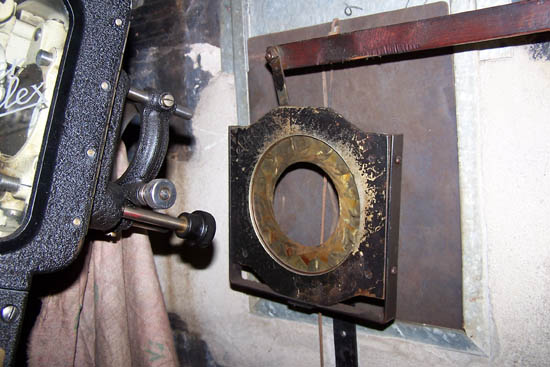
Posted by Tim Reed (Member # 137) on 03-27-2008, 09:25 PM:
THAT'S IT!
Adam, I'm not even going to point out the irony. ![[Wink]](wink.gif) Where is that installation? The ones I saw were in the Dunkin Theatre, Cushing, Okla.
Where is that installation? The ones I saw were in the Dunkin Theatre, Cushing, Okla.
Posted by Adam Martin (Member # 641) on 03-28-2008, 12:41 AM:
That is in the long-unused original booth of the Columbus Theatre in Providence, RI.
Posted by Phil Hill (Member # 371) on 03-28-2008, 12:44 AM:
quote: Timmy
I agree with Louis. I've seen some very old installations that had...PORTHOLE dousers, which were large irises that alternately closed and opened around the projector ports.
God! You guys are OLD! ![[Razz]](tongue.gif)
![[Eek!]](eek.gif)
Posted by Louis Bornwasser (Member # 3063) on 03-28-2008, 06:07 AM:
Old??? I just have really good record keeping, including all of Mr. Hadden's original wooden file cabinets from the early 1940's.
(I recently found the letter from Century where they set him up as as dealer....1950.) Louis
Posted by Scott Norwood (Member # 30) on 03-28-2008, 09:16 AM:
Tim has actually been in that booth!
Marginally on-topic question: what is the difference between the Century SA version of the Zipper unit (CV653) and the Century C version (I don't have that part number)? Are the coils at least interchangeable? I recently installed Kelmars on my home machines and am planning to give the old Zippers to a theatre with C heads for spare parts, but only if the parts would actually be useful to them.
Also, it seems that there are at least two different coil types for the Century C version. Why?
Posted by Leo Enticknap (Member # 534) on 03-28-2008, 09:18 AM:
The conversion to sound caused two things to be standardised: the projection speed of 24fps and the need for synchronised changeovers. During the silent period a cue sheet would be shipped with each print (some of which have been preserved by public archives and studio libraries) describing the out and in points of each reel (they also specified the projection speed). As almost all booths (by law) had at least two projectionists in them at any time, the dousers were operated manually in response to the action cues. Editors were encouraged to put a fade out/in and/or intertitles as the last and first shots in a reel, for obvious reasons.
Vitaphone started with cue sheets, too, which also described the sound in and out points (e.g. a line of dialogue, or a specific sound effect) along with those of the picture. Faders next to each projector were used to take down the outgoing turntable and turn up the volume on the incoming one. But with the early '30s and the end of SOD these were replaced by changeover dots. I never did managed to pin down exactly when the SMPTE standardised the four-frame cues punched out from an interneg, but my guess would be between 1931 and 1933.
Posted by Louis Bornwasser (Member # 3063) on 03-28-2008, 09:21 AM:
Century C blade is smaller than SA.
There are at least 5-6 different coils for Century; based on the "stroke." This is the height of travel.
I know for sure that there are special blades for: C, SA, Vistavision, and JJ. I suspect that Cinemascope 55 and others had there own system.
Cinerama used the C as a basis. The changeover was a large douser device, balanced against a spring. It was mounted on the lamphouse ahead of its douser and behind the shutter blade; mounted to the rear of the shutter guard. Louis
Posted by Mike Blakesley (Member # 26) on 03-28-2008, 09:31 AM:
I seem to recall the changeovers in our old projectors said "Wagner Zip-Change" on them...or would that have been Weaver? These were probably from around 1953 or so, and may have even been bought used then.
Posted by Jim Cassedy (Member # 4115) on 03-28-2008, 09:43 AM:
Many (many!) years ago I worked at an old theater out on Long Island (NY) that was built around 1915.
Their "changeover" system consisted of a long 2x4 beam mounted on some brackets attached to the front projection room wall in such a way that it could slide back-and-forth.
There was a two pieces of black-painted cardboard nailed to the 2x4 and spaced so that when one port was covered by the cardboard, the other was open, and vice versa. To do the "change-over", you slid the 2x4 either left or right to block & unbock alternate portholes.
This required some getting used to. If you did it too fast, the 2x4 jumped out of the brackets. One interesting by-product of this set-up is that becuase the cardboard was several inches in front of the lens, you could also do a sort of "soft-wipe" from one projector to the other if you moved the wooden beam slowly.
It was a neat effect as long as you did it on the right type of scene.
The sound system was even more Rube-Goldberg.
There was an old, open frame tube PA type amp sitting on a chair ( ! ) between the projectors. If you were standing between projectors, you switched the sound by operating a horizontal toggle switch on the front of the amp.
To changeover from the "far" projector, they had a piece of string, one end of which was tied to the toggle switch, and the other end was affixed to a thumb-tack stuck in wall in front of projector #2.
To do the sound change-over, you just pulled the string.
But once again, you had to do it right.... If you pulled
the string too hard, you'd wind up pulling the amp off of
the chair! (I'm not making this up!)
The projectors were very old Simplex'es (Powers) that dated back to the silent days. They were later modifed for sound. They still had the orginal hand-cranks for the projector heads in the parts cabinet.
JimC
Posted by Richard P. May (Member # 3598) on 03-28-2008, 12:13 PM:
In response to Leo's question about when cue marks were standardized, I checked the SMPE Journals around 1930.
I found in the July 1930 issue the record of the Academy of Motion Picture Arts and Sciences proposing release print standards. They had made up a sample reel to circulate among fourteen studios, and had uniform approval.
This would lead to standards being adopted for the "Academy Leader" and cue marks still used today happening during the last half of 1930.
The leaders of many films released in the early 1930s have printed into them "Academy Standard - 1930".
I don't know when SMPE published the standards, but they were actually established by the Academy.
RPM
Posted by Adam Martin (Member # 641) on 03-28-2008, 08:51 PM:
Standard Release Print Make Up and Practice, effective 1930 as published in the Film Daily Year Book, 1933.
Posted by Leo Enticknap (Member # 534) on 03-29-2008, 04:52 PM:
Many thanks Richard and Adam. Interesting that SOD playback is still being mentioned as late as 1933 (unless this is a straight reprint of a 1930 document).
Posted by Bob Koch (Member # 1062) on 03-30-2008, 03:43 PM:
Some of the theatres in the coal mining towns in Wyoming, that I serviced over 50 years ago,had the changeovers as posted by Eric Martin. The earliest electric changeovers I saw out here on the coast were the Weavers,made in LA. The earliest ones had a big disc blade that went on the earlier lamphouse cones. Boy, were they slow!Afterwards they put the blade in the cooling plate on the Simplex. When the Brenkert BX 80 came out in 1938 or 9 they made their own and was part of the machine casting and it was a good one. In 1936,the Kaplan dealer in SF[Preddy] copied the Weaver Simlex douser and sold it. It was identical except for no nameplate.Only saw one Thide on an XL in Roseville and, as posted previously, it was a good one.Don`t know whatever happened to Weaver.
Posted by Gordon McLeod (Member # 33) on 03-30-2008, 04:39 PM:
In Canada General Theatre Supply made a round cylindrical changeover mechanism that fitted the Super/E7 and XL and was very fast
It also had a massive inductive kick
Posted by Richard Fowler (Member # 893) on 03-30-2008, 04:43 PM:
Weaver tooling was bought out by Wolk. In their last location prior to the present address, they had a Weaver assembly area about the size of a desk. ![[Smile]](smile.gif)
Powered by Infopop Corporation
UBB.classicTM
6.3.1.2