This is topic What's The Proper Way To Return A Print? in forum Film Handlers' Forum at Film-Tech Forum ARCHIVE.
To visit this topic, use this URL:
https://ft-forum.com/ft/cgi-bin/ubb/ultimatebb.cgi?ubb=get_topic;f=1;t=009246
Posted by Jim Cassedy (Member # 4115) on 04-21-2008, 10:57 AM:
I'm almost embrassed to ask this question.
> What it the proper/prefered way to re-attach head & tail leaders when returning a print?<
I've been projecting for over 30 years (carbon arcs, changevovers) but I've recently been forced to lower my standards and start working with xenon lamps and platters.
(That's a JOKE, guys! ![[Big Grin]](biggrin.gif) )
)
Like all of you, I have received a prints wound heads out, tails out, emulsion in, emulsion out and with leaders 'attached' with every type of sticky substance known to man short of chewing gum. (if attached at all)
When re-attaching heads & tails, should it be a "full splice" (both sides) or tape-splice on only one side, to make things easier for the next guy? (assuming the "next guy" is not running reel-to-reel!)
Thanks
Posted by Demetris Thoupis (Member # 833) on 04-21-2008, 11:06 AM:
This tip shows some very usefull information (which most probably you already know) but it doesn't hurt refreshing our memories ![[Smile]](smile.gif)
Building 101
Posted by Brad Miller (Member # 2) on 04-21-2008, 11:45 AM:
Heads out / emulsion out / leaders single sided tape spliced on with enough tape to secure the tip end of the leader from unraveling during shipments (this means more than an inch, you cheapasses out there).
Posted by Kenneth Wuepper (Member # 1174) on 04-21-2008, 12:48 PM:
The tape strip should be pressed down over the entire length so it is really attached to the film. If you are feeling generous, you can double back one end for about 1/2 inch so the next person will have a tab to pull it off without using fingernails.
I find many reels where the tape is there but not actually sealed to the film so it comes loose in shipment.
KEN
Posted by Chad M Calpito (Member # 3736) on 04-21-2008, 05:04 PM:
I agree with all of the above. Unfortunately, when I received a print of Zombie Strippers, all of the heads were loose which pissed me off. ![[Mad]](mad.gif)
In essence, I agree with everyone who has posted thus far.
Posted by John Wilson (Member # 269) on 04-21-2008, 07:28 PM:
quote: Kenneth Wuepper
you can double back one end for about 1/2 inch so the next person will have a tab to pull it off without using fingernails.
Make sure the flap is on the 'end' side of the film so it pulls off easily from the print. Leaving the flap on the other end means you've still more work to do as it is still attached to the tip of the leader.
Posted by John Hawkinson (Member # 1135) on 04-21-2008, 09:14 PM:
Please try not to damage the copy#/barcode sticker when you tape down the reel ends...
--jhawk
Posted by Brad Miller (Member # 2) on 04-21-2008, 09:33 PM:
That is ridiculous advice.
I cut the damn barcode sticker off if it is within a hand's wrap from the tip end, because if I don't the tape will just tear the sticker off anyway and then whoever is breaking down the print has to run get a roll of tape to secure the reel end down properly thus wasting time.
Besides John, you know as well as I do that the film labs know what print number each reel is in a given print anyway.
Posted by Mike Olpin (Member # 1115) on 04-22-2008, 12:44 AM:
Use a new piece of tape. Don't just re-use the piece of tape that came with it.
Posted by Brad Miller (Member # 2) on 04-22-2008, 12:52 AM:
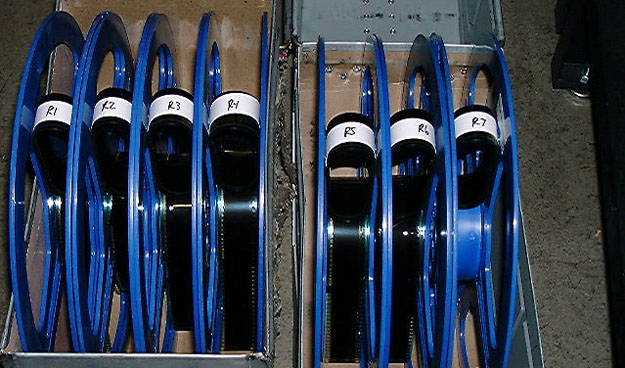
Mike is pointing out a minor oversight. I thought the "building 101" tips page covered this, but it was made back in the day when print bands were still in use and is only hinted at when ETS is spoken of. When building, a fresh piece of new quality tape 6 inches long should be used to wrap up the head leader and identify the reel number.
Posted by Joe Redifer (Member # 3) on 04-22-2008, 01:14 AM:
Don't forget the "courtesy tab" on the tape (folding one of the edges of the tape over underneath itself to make a convenient pull tab). This is essential and has been known to save lives in the past. It is also recommended, endorsed and sponsored by Kodak as well as Tom Hanks. Keep in mind that when attaching the tape to a reel, put the courtesy tab on the leader side, not on the film that is underneath it. This ensures that the tape comes off cleanly and doesn't try to take the leader with it.
Posted by Andres Briano (Member # 4621) on 04-22-2008, 09:53 PM:
quote: Chad M. Calpito
...when I received a print of Zombie Strippers, all of the heads were loose
WHAT were you expecting?? ![[Wink]](wink.gif) Specially with such a title...!!!!
Specially with such a title...!!!! ![[Razz]](tongue.gif)
Andrés ![[thumbsup]](graemlins/thumbsup.gif)
Posted by Chris Slycord (Member # 4239) on 04-22-2008, 09:57 PM:
He was likely expecting tight tails rather than loose heads.
Posted by Brian Dooda (Member # 3941) on 04-23-2008, 11:22 AM:
In the reel to reel world, which I think would mostly include archival and art house theaters, the preferred orientation received or sent out would be tails out, emulsion in, and leaders with splicing tape on both sides.
Having a film tails out makes inspection easier, so thats nice, but from an archival standpoint "emulsion in" is less stressful and better preserves the film image according to SMPTE test.
I've wondered if platter houses get pissed when they receive a print like this. Sorry if thats the case. We don't do it out of spite or laziness. Its just the best way for us and the film.
Posted by Brad Miller (Member # 2) on 04-23-2008, 12:04 PM:
The overwhelming majority of prints are ran on platters these days, so it only makes sense to single side splice the leaders back on, because a double sided splice is harder to undo and offers the incentive to the next theater to "just cut that frame off". Also there is less handling taking apart a single sided splice as opposed to a double sided splice. This is why the practice of single sided splices upon return is the proper one.
In regards to that emulsion in SMPTE test, it is outdated by 30 years of filmstock technologies and should be disregarded. If you pay attention to that SMPTE test as well, it was also designed with 6000' reels in mind where the core to outer wrap ratio is too great.
For reel to reel theaters running 2000' reels though, I do agree the reels should be returned however they come off of the takeup arm, because that wind will be superior to what is generally available from a rewind table, meaning it will protect the film better in shipping. As far as emulsion in goes though, prints I have played which have been stored emulsion in for a good length of time have various warping and playing problems. It is not a good idea.
Posted by Steve Guttag (Member # 268) on 04-23-2008, 12:19 PM:
And as always...I've found emulsion-in to be preferred on all of the 2-projector systems I'm responsible for, including with modern poly prints. I also will continue to fully attach leaders/tails.
Steve
Posted by John Hawkinson (Member # 1135) on 04-23-2008, 12:54 PM:
Brad, why do you think the SMPTE test was done on 6,000-foot reels? I don't see any reference to that in the paper, and it makes explicit reference to "standard release reels of approximately 1,800 ft each," as well as other references to 2,000' reels.
We should all recognize the emulsion-in advice was based on acetate film-base. Various people have reported other preferences for polyester; it seems like a lot has to do with humidity and climate, and thus with location.
Going back a bit, I generally find it's possible to securely tape down reels without damaging the barcode/copy# sticker, and I do find it useful to have them readable. Yes, in theory there are databases which have the precise correspondence. But reels do get moved around between prints and that is not always trackable. (Yes, I also realize that heads may move between prints as well. I do what I can).
--jhawk
Posted by Brad Miller (Member # 2) on 04-23-2008, 01:19 PM:
John, a long time ago John Pytlak explained the hub to outer wrap on 6K reels as being the primary reason for that paper.
And sadly more often than not prints that Steve plays will have that first frame chopped off by the next guy because most people are too lazy to peel a double sided splice. That advice is simply not in the best interest of the print.
Posted by Richard P. May (Member # 3598) on 04-23-2008, 01:20 PM:
The trouble with shipping a print to a theater emulsion in is that it is the opposite of standard U.S. projection practice.
If the projectionist does not catch this, the image is going to hit the screen "flipped" left to right.
The film would have to come off the reel clockwise (off the front of the reel), which does such things as make reel end alarms inoperative.
I am, of course, speaking only for reel to reel operation.
RPM
Posted by John Hawkinson (Member # 1135) on 04-23-2008, 01:23 PM:
That's only true of head-out emulsion-in. Tail-out emulsion-in is fully consistent with the typical S-wind.
--jhawk
Posted by Gordon McLeod (Member # 33) on 04-23-2008, 01:42 PM:
Richard said "The film would have to come off the reel clockwise (off the front of the reel), which does such things as make reel end alarms inoperative"
The Jackson reel alarms had no issues with either direction
Posted by Ron Funderburg (Member # 4561) on 04-23-2008, 01:44 PM:
Does anyone else miss the paper reel protectors that use to come on each reel? It made keeping the head and tail simple you put the head tail wound up inside it! I think if that is a dollar savings for Technicolor and Deluxe it is a false economy!
Posted by Richard P. May (Member # 3598) on 04-23-2008, 02:02 PM:
Ron,
What is a "head tail"? Yes, the old reel bands, used properly, kept the film wound securely, but I don't see how they would make sloppy people put them on the correct reels with their little strings wound around the tab.
John,
Of course your are right about tails out being emulsion in, but I was referring to the print being ready to show.
RPM
Posted by Steve Guttag (Member # 268) on 04-23-2008, 04:19 PM:
Richard, I think most, if not all of my reel-to-reel screens run emulsion-in on both upper and lower reels. The AFI being a notable exception, running a conventional S-Wind....but I will get them converted too!
As for the frame being chopped...that is up to the NEXT guy...nothing I did prevented them from peeling. I also don't like to encourage the platter thing...if they are reel-to-reel (sensible people), they will be appreciative...then again if it ran on 20-min reels at my theatre...all of the splices (if a used print run in a large-reel/platter house previously), would have a full splice...is it the shipping theatre's responsibility to peel one half of the splice before shipping?
Note, too, I never argued Brad's not leaving an ID frame point since really, in essence, the ID frame requires the original theatre (1st run) to compromise their show (out of sync sound pull up) in order to allow the subsequent run to feel-good about the reel order when there are several means of determining reel order in any case.
Steve
Posted by Brad Miller (Member # 2) on 04-23-2008, 07:37 PM:
I think that the overwhelming majority of reel to reel theaters in the US that are not setup by Steve actually do follow the traditional S wind. On the flip side, all of the reel to reel theaters I setup wind exclusively emulsion out on feed and takeup, like the labs do, because that is the right way to do it. (Right Steve? ![[Moon]](graemlins/moon.gif) ) But if you go to the average run-of-the-mill changeover theater (it is often hard to find them, but look closely) you will see the traditional S wind of emulsion out feed and emulsion in takeup is in use. Telluride Film Festival follows that practice as well primarily as I am told because it is what everyone is used to so as not to confuse anyone.
) But if you go to the average run-of-the-mill changeover theater (it is often hard to find them, but look closely) you will see the traditional S wind of emulsion out feed and emulsion in takeup is in use. Telluride Film Festival follows that practice as well primarily as I am told because it is what everyone is used to so as not to confuse anyone.
As far as a reel to reel theater untaping one side of a splice upon shipout, absolutely not. Leave it as it is because the next theater may be another reel to reel theater and I am all about not handling the film any more than it absolutely has to. However if the film was mounted on 6000' reels or a tower or a platter, then by all means a single sided splice should be used. Should that print happen to find itself in a 2000' changeover house on it's next playdate (with odds of probably less than 1% chance of that actually happening), then any good changeover operator is already well seasoned to expect everything from masking tape to stapled on leaders and will simply add the second side of tape before they project it.
On the ID frame issue, if someone absolutely HAS to cut a frame off, then it should ONLY be done on the head of the reel. Those who find it too difficult to give a "positive match" without an ID frame can simply do it at the head of the reel, and at least that only causes a 1 frame jump in continuity at the splice, and it also doesn't screw over a changeover theater that may end up playing the print (because remember, those guys are expecting 18 frames after the second cue mark).
Posted by Derrick Huggins (Member # 4670) on 04-27-2008, 06:57 PM:
hmmm i have always just used masking tape . and had heads out, tails in. i dont bother to resplice, just run the film over with masking tape is fine.
Posted by Brad Miller (Member # 2) on 04-27-2008, 06:58 PM:
Oh boy are YOU in the wrong place!
Posted by Justin Hamaker (Member # 2165) on 04-27-2008, 09:32 PM:
I don't know if this is a "good" practice, but I actually prefer to just tuck the head and tail under the film rather than adding more tape and/or splices to the film.
And I echo the others about the fold over tab on the tape. This makes it so much easier to pull off the next time around.
Posted by Brad Miller (Member # 2) on 04-28-2008, 02:40 AM:
Tucking the leaders is evil. When the next guy goes to unwind it, often the loose film will flap over from gravity and slap the ground. Please be a professional and single sided splice the leaders (BOTH head and tail) back on.
Posted by Jim Cassedy (Member # 4115) on 04-28-2008, 12:57 PM:
quote: Ron Funderburg
Does anyone else miss the paper reel protectors that use to come on each reel?
Being an old time reel-to-reel operator I do miss the paper reel bands. Contrary to presnt day accepted practice, one of the FIRST things I was taught by an old union projectionist was to NEVER use tape in any capacity on film. This included using tape for splicing. The reasoning was that the adheasive would only eventualy find its' way into gunking up your projectors.
Prior to the advent of non-acetate filmstocks, tape splices were considered by many people (including myself) to be unprofessional and lazy excuses for "real" splices.
The problem I currently find with paper reel bands is that most guys don't understand how to properly attach/use them. Their number one mistake is that they TAPE the end of reel band to the end of the film. No no no no NOOOOO!! No! This only 1)ruins the reel band when you try & re-use it; 2) Defeats one of the purposes of the reel band, which was to keep you from having to apply tape to the film at all. (thus gunking up the projectors again)
The reel band was made to be secured by using the string that was (usually!) attached to it. Yes, I know the strings often broke off, but any good operator kept a small spool of spare string in a drawer (right next to the splicing fluid....) to repair reel bands with broken strings. One thing you didn't find in that drawer was tape. NEVER!!!!
But I suppose I'm living in the past.
Posted by Scott Norwood (Member # 30) on 04-28-2008, 01:17 PM:
I recently got a print from the AFI Silver. It came in tails up, emulsion in, leaders uncut, and was in mint condition with handmade cues (not sure if that was done at the AFI or elsewhere). If it had not been shipeed from the AFI, I would have assumed that it was a lab-new print. Thanks to whomever works there.
How does everyone feel about leaving theatre-applied labels on prints when shipping them out? Most platter houses put a piece of tape on the tail (hopefully with 10-20' of extra film spliced onto the lab tail) that indicates the title and picture and sound formats. Most changeover houses do something similiar on the head (and often tail) of each reel. Does anyone prefer that these labels be removed when the film is shipped out? I always leave them in hopes that they will be helpful to the next house. Does anyone prefer that they be removed?
What about temporary changeover cues (grease pencil slashes, etc.)? Do people prefer that these be left on in order to save some work for the next theatre, or should they be removed because they didn't come with the print?
Also not mentioned yet: please do _not_ tape the film to the core or reel hub when shipping it out. Actually, don't use the "slot" in the shipping reels, either (it isn't needed). As mentioned above, don't use tape with reel bands.
As for winding orientation, I've never seen any difference and every booth that I have run does S-wind on reels or soundtrack-up on platters. Any other approach might be confusing and seems (in my experience) to offer little or no benefit.
Posted by Brad Miller (Member # 2) on 04-28-2008, 01:19 PM:
Amen Jim! Taped down reel bands was always one of those "what are they thinking" questions that baffled me. What was sad was when ETS back in the old days used to cut the string off and tape the band down on brand new prints. ![[Roll Eyes]](rolleyes.gif)
Re: grease pencil. That crap almost always goes by unnoticed in the next inspection and I've got news for some of you...IT LOOKS LIKE SHIT ON THE SCREEN! Also wiping it off causes more dirt at the reel changes due to the extra handling. Grease pencils should be outlawed.
I always leave the label on the tail of a plattered print, because it has no adverse effect on anyone in the future. The changeover houses that put a piece of tape on the tip end with the reel number, that is annoying and bad practice in my opinion (and I will tell you why). When the next theater has to build up the print and roll up the leaders, that practice I have seen tends to get people to wind up the leaders inside out, such that the outer wrap of film on the leader roll is the last foot of the countdown...meaning that section of leader that gets dirty now is placed directly up against the first wrap of the content of the reel upon shipout. This is because most people don't want to deal with untaping the label and most know better than to try to put tape on tape. The alternative is to cut that first several inches off, but then that is shortening the leader.
My preferred method for running changeovers, as well as how I teach people to build prints, is to check each reel one by one to make sure they are all heads up, then stack them horizontally on a table with the first reel on top and the last reel on the bottom of the stack. Then during the movie (or buildup process), the operator doesn't even have to think, he just grabs the next reel on the stack. Never have I heard of or seen a print built out of order or a changeover presentation ran out of order when this practice was used. Oh and the best part...no tape is needed! Just tuck the first few inches in between the film roll and the reel flange just like a platter house would tuck the end of the print. No damage, no tape, no hassle, no problem.
Posted by Scott Norwood (Member # 30) on 04-28-2008, 01:29 PM:
You prefer that changeover houses add permanent scratch cues, Brad?
I can see both arguments here:
- adding _correct_ and _neat_ permanent cues (with a Clint Phare device or similar) reduces the liklihood that some other theatre will add ugly and/or incorrect permanent cues
-or-
- since most engagements (at least for mainstream releases) are likely to be run on platters or 6000' reels, cues should be removable for a cleaner presentation for future audiences
I keep going back and forth on this myself, but my current preference is for removable cues. If anyone has a better method that is as easy to apply and remove as grease-pencil slashes and that can be easily seen on screen, I'm all ears.
Obviously, this wouldn't be an issue if every print came with lab cues, but that isn't the case with some films (especially from French or Spanish labs).
Posted by Justin Hamaker (Member # 2165) on 04-28-2008, 01:44 PM:
My theatre usually removes the labels on the tails as well as any bar code stickers because we've had problems with them being read as automation cues. When we have to pull of these labels, it usually leaves some adhesive. Rather than putting the information on a label that goes on the print, we write the relevant info on a white board posted at the auditorium.
Posted by Chris Slycord (Member # 4239) on 04-28-2008, 02:10 PM:
We move prints around enough that that'd be a pain.
And if I can't even trust all my coworkers to move prints when they close, I can about guarantee that I can't trust those same people to write down information for the print on a whiteboard.
Posted by Brad Miller (Member # 2) on 04-28-2008, 03:50 PM:
Scott, the solution is simply to refuse to play prints without lab cues.
Seriously though I know where you are coming from and it is a difficult choice to make. Lately I am leaning more and more toward putting a proper Clint Phare cue on. If I don't, someone else will just do a sloppy job with a knife.
Posted by Bill Gabel (Member # 1105) on 04-28-2008, 04:15 PM:
We get alot of pre-release prints from labs. Other than the standard cue we all see, cues done by a proper clint phare maker are the best. Grease pencil cues look like shit and as Brad said causes alot of dirt at reel ends. If you have to make a Temp cue on a print you should use those small paper dots tapes from places like Staples.
We use the clint phare style cue maker here.
Posted by Bruce McGee (Member # 131) on 04-29-2008, 08:47 PM:
I return all prints tails out, single side spliced on heads and tails, all cues removed, and about 3 inches of white artists tape holding down the end of the tail.
Almost forgot to mention the 6 feet of clear film I attach to the tail of the last reel. You, the next theatre, get that too!
Posted by Mike Blakesley (Member # 26) on 04-29-2008, 09:42 PM:
I, too, remember being taught the "no tape on film, EVER!" rule when first starting out. We had a roll of Scotch tape in the booth that was strictly to be used for taping notes, theatre calendars, etc. to the wall and nothing else. It was a weird feeling to start using a tape splicer.
When I first started getting reel bands that were taped to the film, I would just fold the tape over the end of the reel band. Figured that would reinforce the end of the band, and have the added benefit of the tape wouldn't be stuck to the film.
The stupidest idea in the history of reel bands was those self-adhesive, stringless bands that lasted exactly one time and thereafter had to be taped down. I wonder what bean-counter came up with that one? (Probably the same one who eventually decided reel bands weren't necessary.)
Posted by Bill Enos (Member # 440) on 04-29-2008, 10:23 PM:
Just send it out with the heads/tails on the correct reels with an uncut frame still attached to prove it and I'm happy.
Posted by John Hawkinson (Member # 1135) on 04-30-2008, 02:53 AM:
I'd have to go back and dig (I think this was posted here on F-T, but maybe I'm misremembering), but my recollection is that Technicolor discontinued reel bands because most of them did not come back. Theatres had "forgotten" how to use them on such a large scale that they were becoming impractical.
I know! Let's blame National Screen. When trailers stopped coming with reel bands, it was The Beginning Of The End.
--jhawk
Posted by Brad Miller (Member # 2) on 04-30-2008, 03:01 AM:
Speaking of which, is anyone else annoyed at the amazing durability of the clear tape coming in on some trailers these days? I'll have to look closer to find out which studio is doing it, but no longer can you grab the corner of the last wrap of film and just tear the trailer open. At least one studio is using a clear piece of tape so strong you have to really pry your finger in there or use scissors!
Posted by John Hawkinson (Member # 1135) on 04-30-2008, 03:15 AM:
Well, then there are those of us whacko "trailer archivists" who want to preserve the original studio label from the trailer tail for when we file the trailer away for future (repertory) use after it comes off-screen. Lately trailers have started to come with the label holding the end on, so I've had to resort to cutting the trailer open with a razor blade (cutting the film!) to keep the label intact
Ridicule away!
(While we're at it, a few Universal trailers have also had the labels start to fade really fast. We had trailers for Atonement sitting in our booth and by the time we got around to showing it (a bit late, to be sure), the labels had faded to the point near unreadibility. Like they were on thermal paper or something. Crazy...it's not like there's direct sunlight in our booth or anything...)
--jhawk
Posted by Chad M Calpito (Member # 3736) on 04-30-2008, 03:17 AM:
From what I can remember, I think it's 20th Century Fox that's doing that, Brad. But, don't quote me on it since I am doing this from memory.
Posted by Justin Hamaker (Member # 2165) on 04-30-2008, 05:40 AM:
While we're talking about trailers, one of the things that infuriates me is taped on "attached" trailers that are out of frame. I've had this happen about a half dozen time. If Deluxe/ETS is going to manually attach a trailers, the least they can do is get their people frame counters and teach them to do it right.
And while I'm at it, can I bitch about the split reels not being properly aligned to the cores. It's one thing to maybe have the occasional reel that's done wrong, but I've had more than one print where I've had to "fix" every single reel.
Posted by Brad Miller (Member # 2) on 04-30-2008, 11:22 AM:
TES used to have spindles with a drive dog on them to prevent their staff from assembling the reels incorrectly, such that it forces the theaters to break the reels apart and put them back together. I saw this in operation at both of the TES depots a few years back, but I am now seeing more and more of their prints coming in with the "slot" opening aligned with the drive dog hole in the reel (which is useless on many equipment).
Hey, it's their reels that are wearing out twice as fast. They are just plastic after all, and they are only good for so many assemblies and disassemblies before they have to be tossed.
Powered by Infopop Corporation
UBB.classicTM
6.3.1.2