This is topic 'Fight Club' and the bastardization of projection terms... in forum Film Handlers' Forum at Film-Tech Forum ARCHIVE.
To visit this topic, use this URL:
https://ft-forum.com/ft/cgi-bin/ubb/ultimatebb.cgi?ubb=get_topic;f=1;t=009267
Posted by Aaron Sisemore (Member # 145) on 05-05-2008, 01:05 PM:
Split from the other thread...
quote:
Fight Club's a great flick...except it refers to cue marks as cigarette burns. It's stupid and they've never been referred to as that in my lifetime as a projectionist.
Well, not before Fight Club, anyway... [fu]
I get the 'cigarette burns' from people outside the industry all the time - all of them have seen Fight Club too.
I also occasionally get asked if I have ever spliced porno frames into Disney movies. ![[Roll Eyes]](rolleyes.gif)
Another pet peeve are the idiots on eBay that call frames 'cells'...
-Aaron
Posted by Paul Mayer (Member # 355) on 05-05-2008, 01:22 PM:
At one place I've worked the chief projectionist absolutely hated the term "brain" for some reason. To him the correct term was "payout unit" or some such.
At the same place no one knew what I was talking about when I said "MUT." They all just called it a make-up table.
Me? I'm lazy and tend to use the easiest or shortest way to say things. "Brain", "MUT", and "cue marks" are all standard terms in our niche of this industry now, and in the case of "cue marks", have been since the beginning of time. And "cue marks" is a lot easier to say than "cigarette burns." So there! ![[beer]](graemlins/beer.gif)
Seriously, anyone who uses the term "cigarette burns" when trying to speak professionally reveals himself to be a poser.
And anyone who disagrees with me about this are inbred, slack-jawed, mouth breathing, single-helix, CHUD-like tree-worshiping druids who probably beat their wives and change their underwear infrequently. ![[Big Grin]](biggrin.gif)
Posted by Chad M Calpito (Member # 3736) on 05-05-2008, 01:25 PM:
Personally, I hate the term of Cigarette Burns as well. It bugs the hell out of me when people say that. ![[Mad]](mad.gif)
Posted by John Hawkinson (Member # 1135) on 05-05-2008, 01:29 PM:
The first rule about ... is that we don't talk about ... .
--jhawk
Posted by Tristan Lane (Member # 1169) on 05-05-2008, 01:31 PM:
CHUD!!

Posted by Tim Reed (Member # 137) on 05-05-2008, 05:03 PM:
Woo-hoo! Let's jump in here and PARTY! ![[Cool]](cool.gif)
![[thumbsup]](graemlins/thumbsup.gif)
Posted by John Wilson (Member # 269) on 05-05-2008, 09:23 PM:
RIGHT! NOW!... Oh crap...it's nowhere near as much fun here. ![[sleep]](graemlins/sleep.gif)
Posted by Randy Stankey (Member # 64) on 05-05-2008, 10:02 PM:
quote: Aaron Sisemore
I also occasionally get asked if I have ever spliced porno frames into Disney movies.
My usual answer to that question is:
"If I had porno on 35mm film... and I'm not saying I DON'T have any porno on 35mm film... but if I DID have it, why would I chop it up into little bits and splice it into other movies?"
Posted by Monte L Fullmer (Member # 2797) on 05-05-2008, 10:23 PM:
"WOW! Look at those big CAMERAS and the tape that those cameras uses...!!"
Posted by John Wilson (Member # 269) on 05-05-2008, 10:42 PM:
I splice Disney frames into my porno movies.
Posted by Dustin Mitchell (Member # 372) on 05-05-2008, 11:05 PM:
That reply is made of pure win.
In any event-I'm not against slang terms for projection equipment per se-as has been pointed out there are a lot of more technically correct terms for a platter's payout device than 'brain', its just that 'cigarette burns' sounds so....stupid. I don't know how else to put it.
Perhaps the best way to say it is it sounds made up-like someone trying to show off how 'hip' or 'in the know' they are but just failing miserably.
Posted by Mike Olpin (Member # 1115) on 05-05-2008, 11:41 PM:
So with all of everyone asking about cigarette burns and bits of porn spliced in, was any one else really disappointed when they finally watched Fight Club only to find that it has almost nothing to do with projection at all?
Posted by Joe Redifer (Member # 3) on 05-06-2008, 12:33 AM:
Did it really even have anything to do with the movie? I remember watching that scene from the booth and from what I remember Brad Norton Edward Pitt was taking a part-time job in a projection booth for no reason other than to splice porn frames in. The end. I also remember that everybody in the movie smoked about 90 cartons a day for no reason whatsoever. That movie gave me lung cancer.
Posted by Paul Mayer (Member # 355) on 05-06-2008, 01:37 AM:
Guess I'll have to go watch it somewhere...
Posted by Frank Angel (Member # 248) on 05-06-2008, 05:25 AM:
I think the reason most here seem to agree that "cigarette burns" seem so offensive is probably is because, at least for me, cigarette burn is a kind of violent thing to a piece of film. It's word like gouges or tears ...they are words that convey distruction and words you just don;t want to associate with film. It almost sounds disrespectful, at least to my ears. Cigarette burns on film are like spit on a projector. Just nasty and hence the instant distlike to the references.
To get away from that, but in the same vein of odd terms -- long time ago one of my mentors, instead of using the common, correct name count-own leader, he called it the sync leader, and similarly the first motor cue he refered to as the sync cue. I guess the idea being that it was the combination of those two items that "synchronized" the two machines and the change-over. I always liked it. And it also kind of made sence if you already were calling the tape deck or other sound source "non-sync," then it's reasonable when you switched to the film....it WAS indeed "sync."
No one else calls it that, to my knowledge anyway, but I worked with him for a year when I was 19yro so it pretty much stuck with me and I use it to this day. I also found out that when I happened to refered to them as sync leader and sync cues, two of my projectionist friends got it right away and knew what I was talking ahout. So I guess if it is intutive enough and it conveys what you want to say, there's not harm, unless it's interently obnoxious like cigarette burns....then you deserve do get pummeled or banned, whichever comes first.
Posted by Sean McKinnon (Member # 612) on 05-06-2008, 06:16 AM:
The thing is (as I posted in the other thread) that not only has smoking never been legal in projection booths, but if you tried to use a cigarette to "burn" a cue onto a frame of nitrate film it would cause a fire!
I love how in the movie he splices one frame of porn into the movie and you see in the theatre a flash and hear the sound of porn, well as you all know one frame would be like nothing it would be totally unintelligable.
I HATE fight club!
Posted by Tim Reed (Member # 137) on 05-06-2008, 08:21 AM:
quote: Frank Angel
they are words that convey distruction and words you just don;t want to associate with film.<snip>
it was the combination of those two items that "synchronized" the two machines
Destruction has nothing to do with it. It's just wrong. Period.
FWIW, the term non-sync is a hold over from the early sound days. You had sound sources that were synchronous with the film (sound on disc), and those that were not (interval music). It has nothing to do with changeovers.
Just because another projectionist understands what you're saying doesn't mean it's correct to use a particular term.
I had an early mentor who used incorrect terms, as well. He used to call cue marks "sequence dots," carbons were "rods," and capacitors "resistors". From being around so many old-school union projectionists by that time in my life (and having already been set straight on some of that by them), I knew all of that was wrong. But as he was so generously allowing me access to that particular booth, it wasn't my place to correct him. ![[Wink]](wink.gif)
Posted by Martin McCaffery (Member # 37) on 05-06-2008, 09:36 AM:
quote:
long time ago one of my mentors, instead of using the common, correct name count-own leader, he called it the sync leader,
It's been a long time since I've been in an editing booth, but I vaguely recall the head leader being called the sync leader, which makes perfect sense when editing. And you still see the word sync on some head leader on release prints, too. So at least that little quirk has some basis in reality.
Cigarette burns?!? No. Are any of the smokers here willing to actually burn some frames and post just to see how big and awful a cigarette burn would look?
Posted by Robert Throop (Member # 61) on 05-06-2008, 09:38 AM:
When I first started an old timer objected to the words "Flat" and "scope". Instead he would label prints "cine" and "reg".
Bob
Posted by Mike Blakesley (Member # 26) on 05-06-2008, 10:47 AM:
My grandpa had an old Bell & Howell 16mm sound projector. It had one roller near the bottom of the film path that was referred to (in the manual) as the "snubber roller." Well, in the theatre, in my Simplex sound head, the very last roller before the sprocket sort of looks like and operates the same way as the "snubber roller" in the old Bell & Howell, so that's how I think of that roller. It'll always be the "snubber roller" to me. Although I've never taught that to anyone else (nor ever even mentioned it until now, come to think of it).
Posted by Frank Angel (Member # 248) on 05-06-2008, 01:04 PM:
Well, a lot of terms are derived from simple common useage. Is calling the "fader" a "volume control" really wrong? It's not what may be the common name but it is not wrong except in very formal settings or if you are write a book about audio. But in real life, I don't see any right or wrong with using what someone will understand if it is not contradictory. Calling a capacitor a "resistor" is wrong no matter what the circumstances. Calling a fader a "volume control" or carbons "carbon rods" may not be the more common usage, but they are easily understood and are in fact correct by definition. Actually "level control" is probably by definition the most correct.
In my youth, tinkering with Heathkits, all I have ever heard or saw in writing was "volume control." It was only when I got into a projection booth that I heard the term "fader." Which I recall thinking was quaint and not very technical and thought it must be something held over from yearlier years (the fader wall box looked like a really old piece of equipment to me). I guess "fader" flips off the tongue better than "volume control," so that is what stuck.
Posted by Kenneth Wuepper (Member # 1174) on 05-06-2008, 01:42 PM:
Frank,
It was not uncommon for there to be a single knob in front of each projector (tied together mechanically) that would, in fact, FADE the signal from the outgoing machine to the incoming projector upon making a changeover. The center position was 0 so you could save the audience from hearing the nasty sound effects if you missed a changeover cue.
In later years it is still known as the fader as it does Fade in/out one or more channels of sound.
I remember my high school physics teacher explaining a capacitor as acting to AC like the resister does to DC. I think that could be easily misunderstood.
KEN ![[Smile]](smile.gif)
Posted by Scott Norwood (Member # 30) on 05-06-2008, 02:08 PM:
What about "soundhead" vs. "sound reproducer"? I learned "soundhead," but apparently "sound reproducer" is the correct term for the device. I suppose that dubbers are technically "magnetic reproducers" as well (unless they have record heads).
The old SMPTE projectionist book makes a big deal of how the "sound track" should really be called the "sound record" (or, more specifically, "optical sound record" and/or "magnetic sound record"), but this would seem to invite confusion when the topic of Vitaphone is discussed. I have only ever heard the term "soundtrack" used (with "optical track," "digital track," and "magnetic track" variants).
Do I even dare to mention the whole 1.33 vs. 1.37 issue? The Academy frame is really 1.37:1, but everyone calls it 1.33:1; the fact that silent prints, 16mm prints, and NTSC/PAL video are all really 1.33:1 adds to the confusion.
Does anyone actually use the terms "European widescreen" and "American widescreen" to refer to the 1.66:1 and 1.85:1 formats, respectively? And is anyone else annoyed by prints that are simply labelled "flat," without an aspect ratio designation?
Posted by Frank Angel (Member # 248) on 05-06-2008, 02:39 PM:
Sure, Scott, in the art houses which get foreign prints and even those American titles in that time frame between the mid-50s and early to mid 60s, which I call the a.r. Grey Period, where the aspect ratio of Flat hadn't been firmed up, not to mention the always ambiguous ar's of films shot in VistaVision, just saying FLAT is practically useless information for us. Then again, you'd be hard pressed to find a lot of booths which play current commercial releases with anything but two formats -- Flat and Scope. For those vast majority, the actual aspect ratio numbers are just as useless to them as FLAT is to us. They can't play anything BUT Flat and Scope and no matter what the actually intended ar of the film, their Flat is what it is -- 1.85.
On the other hand, if someone can't tell if a print is flat or scope by a quick visual inspection but needs a label to tell them.....it's pretty much a lost cause from the get-go. ![[uhoh]](graemlins/uhoh.gif)
Oh and here's a snipit from the Projection Report we've been using -- it's got your 1.66 with the "European" reference and my "Sync Leader."
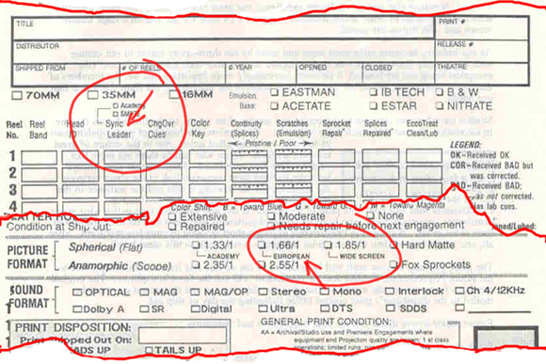
[ 05-06-2008, 10:05 PM: Message edited by: Frank Angel ]
Posted by Steve Guttag (Member # 268) on 05-07-2008, 12:22 AM:
You also have the influence of other countries on some terms. The word "FADER" seemed to gain a lot of steam in cinema with Dolby's emergence as a sound processor manufacturer.
Probably the most accurate term is "Attenuator." as that is what virtually all of them do...attenuate a full strength signal down to what you want. Even electronically with VCA...they are Voltage Controlled Attenuators.
I don't think there is a big problem with Fader, Volume...and so on as they are all "correct" terms.
Cigarette Burns is wrong on so many counts...including that I've get to find any section of the planet that ever has historically referred to cue marks as that. It was a made up term that, seemingly, only people, not in the business, picked up on and perhaps are now in the business.
As for smoking in the projection booth...other than perhaps for Nitrate screenings...it has been legal around here for seemingly forever. I remember a manager coming into the booth at the Uptown complaining to one of the projectionist to stop smoking in the booth. In an odd situation, I found myself defending the smoker (odd in that I hate smoking and HATE what it does to film...I've yet to find a booth with a smoker where the prints didn't show it). Since the Uptown booth was built to Nitrate codes...it had its own fresh air system that was NOT connected to the rest of the theatre. As such, the smoking was entirely contained with the booth and the booth's air system. It was not in a public place nor in a space that other workers had to work with the smoker while the smoking was going on. The manager backed off.
As for FLAT and SCOPE...they are some of the STUPIDEST terms to refer to formats...well at lest "FLAT" is stupid. Whereas most of the anamorphic formats had "scope" in their name, it makes some sense...but FLAT doesn't help. The aspect ratio is what they should be referred to...if 1.85 had been adopted as the name way back...that is what would be on the turrets today...not FLAT. Whereas the bulk of my theatres have at least 4 formats and many have more...FLAT as a term is wholely inadequate.
My personal peeve term is "Brain" I guess it shows who does the thinking in platter operations. Honestly...it was never a term used at the theatre chain I started in (K-B Theatres in the DC Metro area). They were always "Payout Mechnaisms" or "Centerfeeds." I do not nor will I use the term "brain" when referrng to that part of the platter and admonish any idiot that does.
SG
Posted by Chris Slycord (Member # 4239) on 05-07-2008, 01:40 AM:
So if you get the DVD of the movie the cue mark for that "reel" and that one only is put in digitally?
Posted by Dustin Mitchell (Member # 372) on 05-07-2008, 03:05 AM:
Oh, and for the record, I like Fight Club .
Posted by Frank Angel (Member # 248) on 05-07-2008, 10:54 AM:
I always assumed that the word FLAT came about because with CinemaScope was introduced the curved screen. So for a projectionist who had been showing Academy films for years and then came this fairly substantial change to a curve screen, the Academy films before this being shown on a flat screen, it's easy to see how Scope = Curved, and NOT Scope, well, that would be "not curved," the opposite of which is flat. Why they didn't wind up referring to them as FLAT and CURVED is anyone guess; mine would be cause that would be just to damn stupid for words.
Spherical Wide Screen 1.85. -- Anamorphic Wide Screen. They have a nice sound and pretty much say it clearly, albeit they don't exactly come tripping off the tongue. I'd settle for Cropped Wide Screen 1.85 as well.
Posted by Robert Throop (Member # 61) on 05-08-2008, 09:25 AM:
"Frank,
It was not uncommon for there to be a single knob in front of each projector (tied together mechanically) that would, in fact, FADE the signal from the outgoing machine to the incoming projector upon making a changeover. The center position was 0 so you could save the audience from hearing the nasty sound effects if you missed a changeover cue."
The WE faders operated in this manner. The early RCA literature referred to changeover switches as "faders".
Bob
Posted by Mitchell Dvoskin (Member # 751) on 05-08-2008, 09:37 AM:
The person who taught me to run 35mm projectors back in the 1970's referred to 1.85 as "Half Frame Flat". Never heard it referred to that way anywhere else, but I always liked that terminology.
There is some disagreement over where the term "flat" originated. The general consensus is that it originated in the early 1950's with the commercial introduction of 3D. Flat or 3D. Cinemascope came shortly there after, "The new miracle of the screen that you can see without glasses", and of course was referred to as Scope. 3D went away, leaving flat and scope. The last film to actually be shot in CinemaScope was "In Like Flint" in 1967. All anamorphic films since then have been shot in Panavision (a prism anamorphic), although most theatres use CinemaScope projection lenses.
Posted by Mike Blakesley (Member # 26) on 05-08-2008, 09:52 AM:
When I first worked in the booth, we referred to flat as "standard." I think I've pretty much stuck with that term although I do use "flat" from time to time, I guess.
I first saw "flat" when it was written on film ends by previous projectionists.
Posted by Monte L Fullmer (Member # 2797) on 05-08-2008, 02:22 PM:
quote: Robert Throop
Instead he would label prints "cine" and "reg".
... We would use "Reg" and "C/S" ... and I still catch myself doing "reg" instead of "flat".
I still put "C/S" on my used trailer rolls, but just the "F" on the flat ones.
Even now, the term for "scope" is "SC" (which bugs me some..lol)
(where did the term "flat" come from anywho, for I remember when the term floated to the surface, but never found out why the term was changed).
-Monte
Posted by John T. Hendrickson, Jr (Member # 849) on 05-08-2008, 04:12 PM:
Monte-
I believe Frank Angel's last post addressed your question. That's about the same way I heard how the terms come into existance when I started out in the late 60's.
Posted by Aaron Sisemore (Member # 145) on 05-08-2008, 04:19 PM:
quote: Mitchell Dvoskin
The last film to actually be shot in CinemaScope was "In Like Flint" in 1967.
Last live action film. The last two films 'in CinemaScope®' (with a screen credit and all) would be the animated Anastasia(1997) and Titan A.E.(2000).
-Aaron
Posted by Tim Reed (Member # 137) on 05-08-2008, 06:10 PM:
Mitchell's got it on flat. It was to differentiate between 3D subjects, circa 1953... the same year CinemaScope appeared. quote: Frank Angel
it's got your 1.66 with the "European" reference and my "Sync Leader."
FYI, that's referring to sound sync, not synchronizing with an incoming projector on changeover.
I'll bet you think there's only those two leaders in existence, Academy and SMPTE, right? The ones you see every day. And each of them has a frame that says, "PICTURE START". Did you ever wonder WHY it says that?
Well, it's not to give you something to thread-up on. There is a companion leader that you never see. It's for the sound negative roll, and in the same place on that leader there's a big full frame that says, "SOUND START" (I know you can sometimes see this in small writing over in the soundtrack area, but that's ALL you can see of it on release prints. It is a twin to the "PICTURE START" frame, in the "image" area of the soundtrack negative film, and they are both used for printing sync when the release print is struck (depending on the printer used, you may also see a longer leader that says, "PANEL SYNC").
But this is what they mean when they reference a "sync leader". It has nothing to do with making changeovers. quote: Scott Norwood
What about "soundhead" vs. "sound reproducer"?
To this day, when I fill out service reports, I write "reproducer".
Posted by Darryl Spicer (Member # 711) on 05-08-2008, 07:13 PM:
Just what ever you do don't call the projector head a friggin camera. I remeber someone asked me how do the cameras work. I said I don't know we don't have any!
I remember the movie Down With You had the Cinemascope logo at the begining. That came out in 2003. They movie was based in 1962 so I don't know if that was just used to incorporate that time period or what.
Posted by Monte L Fullmer (Member # 2797) on 05-08-2008, 11:16 PM:
quote: Darryl Spicer
Down With You had the Cinemascope logo at the begining
..and you can tell that was a very tired printing negative for that whole FOX/CinemaScope trademark for that movie.
So grainy and loss of color...yet, it was sorta neat seeing that classic trademark being shown on the big screen again ..
(Thx for the correction even though I never heard the word "flat" used those films until the early 70's - guess, being in an isolated area away from the large cities prob had to do with this new term change not being used until it finally caught up with every theatre...)
Posted by Robert Throop (Member # 61) on 05-09-2008, 08:13 AM:
When I first started hanging around booths in the early 1960's the projectionist used the words flat and scope regularly.
Bob
Posted by Frank Angel (Member # 248) on 05-09-2008, 10:52 AM:
quote: Tim Reed
on flat. It was to differentiate between 3D subjects, circa 1953... the same year CinemaScope appeared.
Well, for once I can say that I am not old enough to actual predate a time when there was no FLAT slang, so I can't be sure that my theory is anything but a theory (which is the way I prefaced my post).
Then again, Tim, you are probably younger than I am so unless you can point to some definitive reference, your contention that it came about to distinguish 2D prints from 3D prints is only a theory as well. In fact, I would think there would be less need to identify a 2D print from a 3D print given that a projectionist would immediately know if a print were 3D or 2D simply by the fact that there were a Left eye and a Right eye print. They really wouldn't need differentiating nomenclature, whereas just looking at the cans, it's not immediately apparent if you have a CinemaScope or standard print. And of course, THAT's just a theory as well. We would need a few REALLY old timers to settle this one.
quote: Tim Reed
this is what they mean when they reference a "sync leader". It has nothing to do with making changeovers.
Well, the countdown leader or "sync leader" certainly does synchronize changeover between the two machines -- in fact, that's its primary function along with the cue system. Hence my early mentor not only called the count-down leader the "sync leader," but neither did he use the more common term "motor cue;" he called then the "sync cue" (which indicates the start of the sync leader on the incoming machine) and changeover cue. Makes logical sense and I am not the only one who has heard them called this. So yes, there is sync sound and non-sync sound references to sound on the film and sound that is not, but synchronizing the outgoing projector with the incoming one at changeover is precisely the function of the leader and the cues so sync leader is fine by me.
quote: Tim Reed
I'll bet you think there's only those two leaders in existence, Academy and SMPTE, right? The ones you see every day.
Well, yes....those are the two types that have different timings and so those two would be of significance to the projectionist. What's your point?
quote: Tim Reed
each of them has a frame that says, "PICTURE START". Did you ever wonder WHY it says that?
Well, it's not to give you something to thread-up on. There is a companion leader that you never see. It's for the sound negative roll, and in the same place on that leader there's a big full frame that says, "SOUND START" (I know you can sometimes see this in small writing over in the soundtrack area, but that's ALL you can see of it on release prints.
Not sure what you mean here, Tim. Most Academy leaders still have PICTURE START and SOUND START frames. And yes, they certainly are useful for the projectionist in threading as they indicate the place where the soundtrack and its corresponding image frame are in sync, i.e., they indicated the soundtrack offset. Put the PICTURE START in the gate and SOUND START at the scanning slit and you are in dead sync. In fact, on Academy Leaders, each footage number has a corresponding diamond which gives an easy visual indication of the 20 frame sound offset.
Posted by Rick Raskin (Member # 1561) on 05-09-2008, 12:34 PM:
We used to call projectors "machines"; as in What kind of machines are they running at the <insert theatre name>? When we ran mag stereo some of the guys used to call it "running penthouse". I always referred to cue marks as just that. I was always puzzled why they called the record/tape input non-sync, but I came in well after the vitaphone days.
Posted by Tim Reed (Member # 137) on 05-09-2008, 06:13 PM:
Let's see if I can do this without being insulting.
Frank, age or length of time in the booth has nothing to do with technical prowess. Certainly, you've probably breathed more carbon ash and made more changeovers than I have - good for you - but I can tell by the things you've said over the years and the vernacular you use, that you don't fully understand, for example, how those arc lamps work. You may think you do, but it's a cursory knowledge. And, while that's probably a ton more than most people here know about that subject, it does leave open the possibility for misunderstanding - simply because you've not been exposed to anything else nor had the opportunity to "see the world," as it were. As well as the fact that you never seem to be open to amendment or correction.
No one is infallible (especially me.. and there's plenty of examples here to prove it), but regardless of how you try to rationalize your erroneous pet beliefs, sound sync and projector changeovers are two different things.
Posted by Mike Blakesley (Member # 26) on 05-09-2008, 06:27 PM:
quote:
We used to call projectors "machines";
Same here. Both booths I have worked in (the Roxy and the drive-in) the people who I learned from always called them "machines." We never called them projectors. I think I still use "machines" sometimes.
Posted by Kenneth Wuepper (Member # 1174) on 05-09-2008, 08:15 PM:
The IATSE/MPMO of the Us and Canada.
International Alliance of Theatrical Stage Employees and Motion Picture MACHINE Operators of the US and Canada'
KEN
Posted by Randy Stankey (Member # 64) on 05-09-2008, 11:38 PM:
I'm on the "machine" bandwagon.
Regardless of its purpose, a projector is a machine and a projectionist is a machine operator.
I also tend to call my projectionists "operators" but only once they have reached a level of proficiency where they are capable of operating the machine without me having to be there.
Posted by Monte L Fullmer (Member # 2797) on 05-10-2008, 01:40 AM:
quote: Frank Angel
In fact, I would think there would be less need to identify a 2D print from a 3D print given that a projectionist would immediately know if a print were 3D or 2D simply by the fact that there were a Left eye and a Right eye print. They really wouldn't need differentiating nomenclature, whereas just looking at the cans, it's not immediately apparent if you have a CinemaScope or standard print.
There has been some 3-D releases that were printed for single machine inventory and used a special split element lens that required an anamorphic attachment to expand the two side by side images to a 1.33/1 image release, or have a simgle frame with two 2.00/1 images stacked one upon the other and a split element lens that would merge the two and the patrons using polarized glasses for both imagery presentations.
In a changeover house, we would also get the special "red mirrors" to get more light out on the screen, plus having the silver screens helped also with 3-D presentation.
Usually, with these single film releases, the lens was also shipped with the prints under pre-arrangements by the theatre's technician to receive the correct focal length to fit the screen
In early days of CinemaScope, the cans had a big "A CinemaScope Feature" label on the back side of the cans along with the words "Safety Film" on a different label on top of the cans.
Then FOX had their unique way of labelling their releases - being the color of the film bands.
Green Band - "Regular" (Flat) print
Red Band - "CinemaScope" optical print
Black Band - "CinemaScope" mag/optical print
Blue Band - "CinemaScope" optical "foxhole" print (as of all I know, "Snow White and the Three Stooges" was the only Blue Band release ever done)
.
(Yep, the good ol' "I.A." ..member of local 463 - now a nonexistent local)
Yep, "Machine 1" and "Machine 2" - I used these terms as well.
In my terminology, I would call a booth person "booth operator" when all he did was lace and ran the movies.
If that same person can also do maintenance, repair, take initiative in figuring things out, be a little creative in making things work and not have to be told what to do, then he graduated up to the proper title of "Projectionist" - for he cared about the trade.
-Monte
Posted by Frank Angel (Member # 248) on 05-10-2008, 02:50 AM:
Come on Tim, because I called "carbons" "carbon rods," that means I only have a cursory understand how they really work and I only think I understand them? That a pretty high horse you are riding on, don't you think? You're are assuming I don't know that they are called carbons. That's an erroneous assumption. Fact is, there are many different common names that are used for a whole variety of items and which even change over time; this idea that you are the guardian of the single definitive absolute "correct" nomenclature of every one of them is a tad inflexible to say the least, wouldn't you agree? If a person uses the word "machine" rather than "projector," by your yardstick, that would mean he only has a "cursory" understanding of its workings?
Listen, I would be the first to admit I know a lot less than many on this forum and I have publicly admitted that any number of times; I have many times asked questions and sought advice and changed my opinion when that advice was given and I was happy for being enlightened.
You start off by saying you don't want to be insulting but in my set of values, saying that a man can't take correction or isn't willing to ammend his viewpoint, well that is pretty insulting. Then again, I think it was you who insisted on getting into a pissing contest over the use of carbons and carbon rods, so let's leave it at that.
Posted by Kenneth Wuepper (Member # 1174) on 05-10-2008, 06:09 AM:
Monte,
I was working at the Temple when we did a color 3D feature. I remember the Altec service technician changing out the old silvered mirrors for the newly developed "red" dichroic mirrors. There was a little difference in the light on the screen but a really great difference in how cool the apertures operated. The lamps drew 160 Amperes and the projector gates and Silver jaws of the lamp were water cooled, just as they are there today.
Boy do I feel OLD!
KEN
[ 05-10-2008, 03:02 PM: Message edited by: Kenneth Wuepper ]
Posted by Mike Blakesley (Member # 26) on 05-10-2008, 09:29 AM:
quote: Monte L Fullmer
"Machine 1" and "Machine 2" - I used these terms as well.
So was there a convention as to which projector was #1? In our booth, the machine on the right was called #1, even though we always started our shows on #2 (because that's where the manual dimmer and curtain-opening switches were). The numbers were written on the lamphouse doors.
Posted by Monte L Fullmer (Member # 2797) on 05-10-2008, 01:43 PM:
quote: Mike Blakesley
So was there a convention as to which projector was #1
I believe it was how the head operator, using the home created terminology, "audience position" (audience left, center or right) as which machine was numbered.
Thus, as with the positioning of the booth equipment as if one was facing the screen, No.1 machine was always the left machine.
(Be the same as with a car: driver's side is always left side of the car...)
Some chief projectionists would have instruction that the No.2 Machine to start the trailers with making the feature start on the No.1 (left) Machine.
(thx for the correct term of the mirror being "dichromic" - which I have a hard time remembering the name..yes, we feel old talking about the 'old school' method of showing movies, but we had pride in doing this trade..)
-Monte
Posted by James Westbrook (Member # 3690) on 05-10-2008, 03:14 PM:
The Ballentyne Pro-35's that ran on 6K reels the left one was "Master" and the right one was "Slave". This was how they were installed by Mann Theatres at the Fox in Lubbock, anyway.
Posted by John T. Hendrickson, Jr (Member # 849) on 05-10-2008, 07:35 PM:
OK- Now I'll go way back in time as far as nomenclature is concerned.
Machine # 1 (or projector #1 if you will), was the one on the left facing the screen. "After all, you read left to right, don't you?" as one old timer explained to me.
Trailers were started on #2. Why? As it was explained to me, because that way reels 1,3,5, etc. (odd reels) were always projected on number 1. Reels 2,4,6,etc. were run on number 2. That way, when you pulled a reel from the cabinet, there was less likelihood of threading up the wrong reel on the wrong machine.
Gosh, when you think of it, it makes perfect sense!
Now to throw another monkey wrentch into the discussion. I must admit that I never "laced" a machine. I always "threaded up". I've been doing that since I was five years old, when I got my first projector.
Monte Fullmer said:
"In my terminology, I would call a booth person "booth operator" when all he did was lace and ran the movies."
Sorry Monte, but when I hear the word "lace", it drives me nuts. I can understand our English and Austrailian breathren using the term, but quite frankly, I never encountered it until I started reading posts on this site.
I think of "lacing" a pair of shoes (v.t. to pull together or thighten, to fasten, interlace, or intertwine). "Thread" is for a projector (v.t to pass or proceed through in a winding or twisting manner) at least for as long as I've been involved in the business.
I do recall in the old days, there were "operators" (those who simply ran the shows) and "projectionists", a term that implied experience and professionalism in a craft.
No disrespect intended. I still thread. Always will. Old habits die hard.
Posted by Robert LaValley (Member # 4319) on 05-10-2008, 07:44 PM:
lace or thread
projector or machine
booth or "upstairs"
Theatre or Theater
Management or Mcdonalds employee
it's all pretty much the same thing. hahah
I'm being sarcastic for those needing the disclaimer
Posted by Paul Mayer (Member # 355) on 05-10-2008, 07:48 PM:
Ahem. Guys, that's "dichroic".
Posted by Monte L Fullmer (Member # 2797) on 05-10-2008, 08:49 PM:
quote: Robert LaValley
Theatre or Theater
..can be the same, but don't let the stage owners and employees see you spell the name of their "Theater" as "Theatre"
Sorry, I picked up the term "lace" from one of my operators long time ago, and it sorta stuck with me - even though I knew the correct term was "to 'thread' up the machine".
Posted by Kenneth Wuepper (Member # 1174) on 05-11-2008, 06:51 AM:
You THREAD a needle by pulling the thread through the eye of the needle.
You LACE your boots by pulling the laces AROUND the lashing pins. There were even hooks made to help you get the laces around the boot hooks back in the early time before they made the laces go through holes as they do new.
There were two innovative types of 16mm projectors. The first type was the "self threading" machine where you just put a trimmed end of the leader into the start of the film path and the machine did the rest. (You still had to attach the end to the takeup reel) The second was the "Slot Loader" where the film path was open with guides and you simply grasped the end and dragged the film through that slot from top to bottom as the machine guided the film into proper position. Securing the film to the takeup and closing the film path made the film ready for projection.
As a student operator in high school, I referred to the self threader as "The Self Shredder" since not all leaders were created equal and some did not work in that system.
KEN
KEN
Posted by John T. Hendrickson, Jr (Member # 849) on 05-11-2008, 12:16 PM:
Ah Kenneth, you're taking me back in time as well. We had one of those "Self Shredders" at the High School where I taught. Every time I saw that damned thing, I sent it back to the AVA office and requested another machine. You could always tell when someone else had used it from the look of the leaders on the prints they ran on it- chewed up. Damned thing couldn't take a splice, either.
I once asked the AVA guy why he bought the damned thing in the first place. His answer was for the teachers who couldn't thread the conventional machines. ![[Eek!]](eek.gif)
Posted by Matthew Bailey (Member # 601) on 05-11-2008, 09:17 PM:
I found ob Ypu Tube a 2 Girls 1 Cup spoof of the projectionist scene in Fight Club. (only the music is heard) click here I magine if the same thing happened in a Cinema Paradiso spoof.
Posted by Monte L Fullmer (Member # 2797) on 05-12-2008, 12:11 AM:
quote: Kenneth Wuepper
"The Self Shredder"
Ah, the classic "Self Shredder" - the Bell & Howell 567
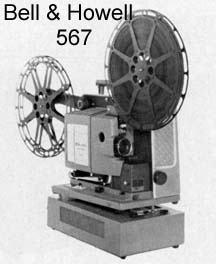
Hated their shredding properties and would manual thread these things back in HighSchool while I was in the AVA DEPT.
-Monte
Posted by Brad Miller (Member # 2) on 05-12-2008, 07:09 AM:
That "Hell and Bowels" projector wasn't quite the classic classroom unit, as that has a power supply underneath it for the Marc 300 short arc lamp. Regardless, those things sucked. The only auto loaders I ever liked were the Eikis.
(I used to use those power supplies to drive the Marc 300 lamp in my custom modified Super 8mm projectors until I switched to an external lamphouse behind a Beaulieu 708 setup.)
Posted by Jack Theakston (Member # 4484) on 05-13-2008, 04:52 AM:
For what it's worth (if it's worth anything), "Flat" DOES refer to the differences between 3-D, 'Scope and matted widescreen, which took over in May of '53. I've got a trade article talking about it somewhere that goes into depth (no pun intended) about the terminology.
What irks me? Projectionists that don't know the difference between 1.33:1 and 1.37:1. It's a small, but incredible difference, because if you say 1.33:1, I think you're talking about a silent aperture.
Powered by Infopop Corporation
UBB.classicTM
6.3.1.2