This is topic Cutting Manufacturing Costs and How it AFFECTS Product QUALITY in forum Film Handlers' Forum at Film-Tech Forum ARCHIVE.
To visit this topic, use this URL:
https://ft-forum.com/ft/cgi-bin/ubb/ultimatebb.cgi?ubb=get_topic;f=1;t=009271
Posted by Andres Briano (Member # 4621) on 05-08-2008, 08:57 PM:
I am currently installing a new 5-plex. It´s been 14 months since my last install. When uncrating equipment, it became sadly obvious how many (if not all) manufacturers are cutting costs in their 35mm line of products. Examples:
BEFORE:
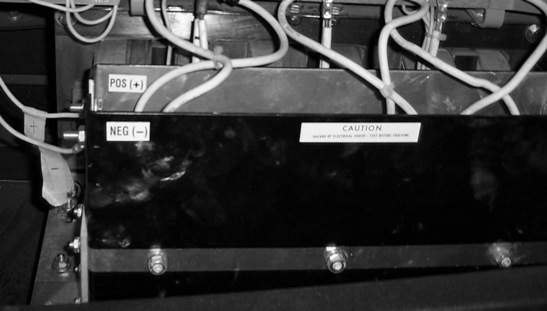
AFTER:
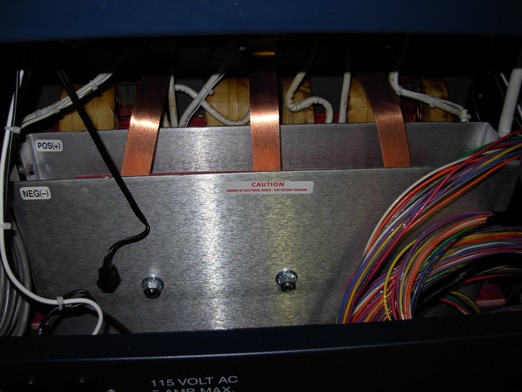
Where has the insulating paint gone?? ![[Confused]](confused.gif) I am not a big fan of touching the heat sink when it is energized
I am not a big fan of touching the heat sink when it is energized ![[Wink]](wink.gif) , however I´m sure the paint served a purpose.
, however I´m sure the paint served a purpose.
BEFORE:
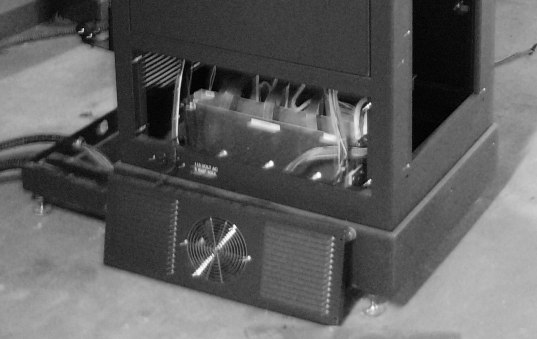
AFTER:
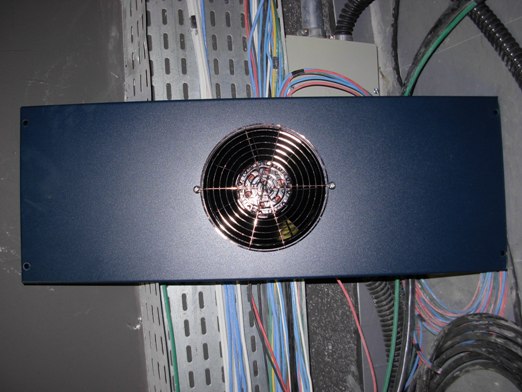
It is a given that the fan on the outside of the console sucks a lot ![[evil]](graemlins/evil.gif) ...of air. However, can you honestly tell me that the vents on the sides of the fan were useless?
...of air. However, can you honestly tell me that the vents on the sides of the fan were useless?
My point here is not to speak poorly of one or any company. It´s just that it pisses me off when the decision is made to cut costs where it clearly degrades the quality of an otherwise good product. Am I alone here?
Posted by Tristan Lane (Member # 1169) on 05-08-2008, 09:50 PM:
I'm not sure either one of these things really affects overall performance or reliability of the equipment.
The insulating paint probably provided little to guard against electric shock.
The vent panel may be somewhat of a cut corner, but the overall effect it would have on performance is probably pretty minimal. Sure, if the fan dies, there's little airflow coming from anywhere else.
Considering that Christie is now focusing much of their efforts on D-cinema, and the retail of 35mm equipment is probably anticipated to plummet soon, I'm guessing that the company is looking to find ways to maximize profits where they can. I'm sure these changes were discussed in great detail before being incorporated into the finished product, and it was probably deemed acceptable to make the changes in the interest of business.
I understand where you are coming from with the quality of most goods getting worse and worse lately. Look at vacuum cleaners, and the fact that most new cheap vacuum cleaners only last a year or so. Old eureka metal bodied vacuums are still working after 30 years of use.
Posted by Charles Greenlee (Member # 3856) on 05-08-2008, 10:13 PM:
Well, chenging out diode packs weren't my most favorite thing to do anyhow. But must it was because of the condition that compartment was in due to long term lack of care.
Posted by Tim Reed (Member # 137) on 05-08-2008, 11:14 PM:
Humm, I thought those buss bars were discontinued? I've tried ordering the set for 7K consoles, and all they send are heavier stranded cable.
Posted by Richard Fowler (Member # 893) on 05-09-2008, 05:30 AM:
Selling established manufacturers and producing our own product I can see the plus and minuses to the new "improved" hardware. Removing the insulating paint on the stack and panel vents may improve air flow and more even heat dissapation on the diode stack.....they probably need the extra $15.00 they saved in cost ![[Smile]](smile.gif) .
.
I know of two manufacturers who have added "refurbished" projectors into their production cycle in the past couple of years; so the writing is on the wall...
Posted by Steve Guttag (Member # 268) on 05-09-2008, 06:57 AM:
The Black paint was probably NOT for insulation purposes but for "black body radiation" theory in order to pull the heat to the outside of the stack so the air could remove it from there.
As to the vents...if you think about it...if you have a fan next to a vent...the fan will pull some air from the vents right next to it and thus NOT pull air across the heatsink/stack. The vents would need to be on the other side (across the console) to create a proper air flow over the heatsinks.
Now if you want to pick on a clear performance reducer...one manufacturer nixed their choke on the output of their high-reactance supply. That is guaranteed to increase ripple and actually take away protection from the diodes from an igniter back-spike.
If you want to see a rectifier company that has ADDed features since previous models...check out Irem's current stuff. More filtration, more accessory terminals, fuses, UL listing...and such. If you have an N3 series, the diodes are pretty easy to change, if you have a G series in a console...good luck with the headroom...they look to be a bare to change (need small fingers and you can't see what you are working on as they are located on TOP of rectifier and NOT all in one place as in previous designs.
Steve
Posted by Louis Bornwasser (Member # 3063) on 05-09-2008, 07:51 AM:
It's the way-of-the-world: charge more and more; deliver less and less. Louis
Posted by Mark Gulbrandsen (Member # 72) on 05-09-2008, 08:43 AM:
I agree with Tristian... None of the differences you see will affect performance in the least. I personally would prefer the copper buss to the cables myself... those copper busses are VERY EASY TO DUPLICATE!
quote: Louis Bornwasser
It's the way-of-the-world: charge more and more; deliver less and less. Louis
I definately see that as pertaining to Wrong International but when you stand back and look at the constant improvements that Christie has made to many of their products WITHOUT any major price increases you know that at least one company has their act together. The only thing Christie has done is to discontinue slow selling pieces like the 7KW console... it simply isn't needed any longer with other options that are now available. The "New Technical Folks" at Christie have made many "positive changes" to many neglected areas of different equipment over the last several years over what the "old school" crew didn't do or accomplish the "New Folks" definately have. Its one of the main reasons why Christie now has 80% of the North American market!
quote: Steve Guttag
Now if you want to pick on a clear performance reducer...one manufacturer nixed their choke on the output of their high-reactance supply. That is guaranteed to increase ripple and actually take away protection from the diodes from an igniter back-spike.
Steve... Don't let the disappearance of the chokes stop you form selling them... you can always add the chokes back in for your customers if you want! Custom wound chokes ARE NOT EXPENSIVE.
Its long been known that painting heatsinks with black paint actually keeps the heat sink from radiating efficiently. The only "Black" treatment that actually works to increase efficiency is black anodize.
Mark
Posted by Andres Briano (Member # 4621) on 05-09-2008, 05:42 PM:
Richard and Tristan: You are right, of course. But mine was a highly subjective post written while still pissed at those surprises.
quote: Steve Guttag
The Black paint was probably NOT for insulation purposes but for "black body radiation" theory in order to pull the heat to the outside of the stack so the air could remove it from there.
Steve: A question: If Black Body Radiation was the cause, why had they left a strip unpainted (where the diodes screw into the heat sink)? That was the reason I asumed that was for insulation purposes.
Regardless, I was just bitching about one thing they used to provide (for the same price as Mark Gulbrandsen stated) that is now GONE.
Mark G: Why is it that I am not in the least surprised about you defending Christie?. Would you please make a list for us with all the things you don´t like (or even hate) about Christie?
Don´t get me wrong! I love their SLC consoles. But no objective tech can fall (blindly) in love with a brand.
As a gift, I leave another example for you:
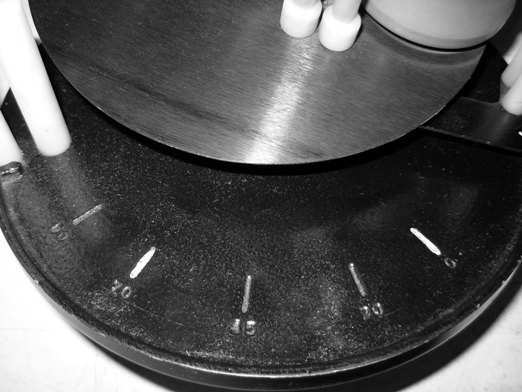
Remember the days when the feed units (avoiding the use of the word "brain" here) came with all the degrees of arm inclination in the bottom plate?
Posted by Tim Reed (Member # 137) on 05-09-2008, 06:44 PM:
quote: Andres Briano
But no objective tech can fall (blindly) in love with a brand.
He's been trying to get a job with them forever. Notice how he made excuses for Christie's shortcomings above, but if Strong had done that, he'd be all over them like stink on ![[bs]](graemlins/bs.gif) !
!
It's a charade - no one's taken him seriously for some time now.
FWIW, I was glad to see the redundant degree markings go away. They weren't necessary.
Posted by Brad Miller (Member # 2) on 05-09-2008, 08:01 PM:
Agreed, removing the marks is probably an improvement if anything. The only thing even Christie recommends to use on the center-feed "brains" is the 0 and the 70%. You seem to be complaining about non-issues or improvements here. Do you also feel shafted because they changed the color of the consoles? After all some people are simply resistant to change.
I have been VERY pleased with the quality of Christie equipment, which over the last several years has been only improving. The ONLY thing they have done which aggravates me is their switch to "auto calibrating infrared led" bullshit on their platters...but they WILL build them the good way with the visible leds if you simply request it when you order them.
Posted by Andres Briano (Member # 4621) on 05-10-2008, 06:10 PM:
That´s true!! Thanks for reminding me of that!! How would they dare change the color of their equipment!!
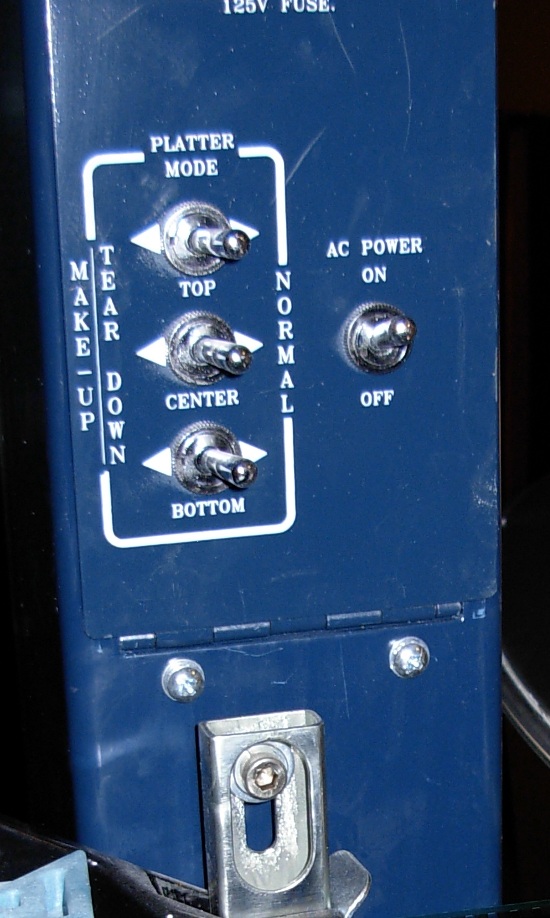
Here´s another "no-issue" for you all.
Have you seen the latest version of the Platter Select buttons (?) ![[Eek!]](eek.gif) Errr... switches?
Errr... switches?
Posted by Brad Miller (Member # 2) on 05-10-2008, 08:19 PM:
Andres, do you work for Strong or something? You're just getting ridiculous here. So let me get this right. You are saying that you would rather have a $300 assembly to change out when the old style AW3 makeup buttons broke, rather than being able to run down to the freakin' RADIO SHACK and blow $2 on a replacement toggle switch?
HOW IS THIS ANYTHING OTHER THAN AN IMPROVEMENT???
Remember, just because there is a change does NOT mean the quality went down. With Christie's products, the quality has only gone UP! Sheeeeeesch!
Posted by Michael Moore (Member # 3867) on 05-10-2008, 09:02 PM:
I really believe that quality of equipment is only as good as the operators that run the equipment. If one does not maintain or keep the equipment up to par it will fail. And if the operator can not run the equipment properly then the equipment will fail.
I have a cheap smithy lathe/milling machine made in china. And well let’s say many real machinists would say that Smithy Machines are crap.
I also have a small 1959 Atlas lathe, and many machinist would say that it is a fine machine.
However I can turn-down a piece of round stock on both machines with relatively the same accuracy; however the smithy needs a little more care to center everything. Also the Smithy needed to have adjustments for the tail stock and the gibs on the ways.
I have a 1953 Shopsmith 10ER, 5 in 1 machine, and many people say there has never been a machine made like it and never will be again. I will have to say the table saw on it is wonderful; however I can get the same results with a Delta, craftsman and Black & Decker with the same attention to detail
I worked for short time with an old timer machinist he said this, “if you’re a crap operator and you do not understand your equipment or pay attention to details, then you will produce crap no mater how expensive or good your tools are”.
I think it is the same with projection equipment to an existent.
I have had the honor to run Simplex, Century, Cinemeccanica , Christy, Speco, Xetron, and many others. And have found many of the equipments to work just fine, and have had not problems running any one piece of equipment or working on any one piece.
Yes I have confronted problems with particular pieces of equipment but once the problems are discovered and solved then the equipment works.
While quality of materials is important, I think the operator and technician are the other parts of the equation that are just or even more so important.
Look at Burt Munro, built almost everything he had, modified his motorcycle, and did all the work himself; and still holds the land speed record for under 1000cc. He had an eye for detail and understood his machine.
Michael Moore
I have a 1953 Shopsmith 10ER, 5 in 1 machine, and many people say there has never been a machine made like it and never will be again.
I also have a small 1959 Atlas lathe,
Posted by Mark Gulbrandsen (Member # 72) on 05-10-2008, 09:13 PM:
So far none of you have presented anything substantial and I call you all piss and moaners! But.... Ok, I have one complaint with OLD christie stuff from say 20 or more years ago. There were no fan under the heatsinks at all! Of course we install fans there ourselves to improve the reliability. Overall... I can find very little to fault Christie for. The sales people we deal with... especially Keith and Lisa go way above and beyond any other entertainment product companies I've ever delt with in the last 32 years. The film engineering team including Jim Dukes and Jim Graton are are also doing an absolutely superb job. Christie is indeed very lucky to have these folks working for them. While Strong sits on their asses its the folks I mentioned above at Christie that are STILL making very worth while improvements to many areas of quite a few different products. Agree with them or not Tim and Andres Christie Quality has beaten the pants off everyone else in the industry including Kinoton!
Do I want to work for them... Of course at CLACO the feeling is that we all work for Christie already, and we want to because we belive in them because they supply the most solid products for us to be marketing to our customers... I can however say that we tolerate many other companies out there... some large... some small. Would I want to be a Christie employee? If things were right possibly... but then I happen to enjoy where I live and how my life has shaped up so it isn't a necessary thing for me to approach.
Tim... If I were you I'd certainly be approaching them about work... How long will NEC "tolerate" Strong before it all goes through NEC Direct? I'll bet that Christie will ultimately be the only ones left in the North American game.
Michael... Burt Munro is one of my real life heroes! If you want something better than that 1959 Atlas... Look for a late 1930's South Bend flat belt drive lathe with taper bushing headstock... They're a superb piece if you find one with a bed that isn't worn out.
Mark
Posted by Michael Moore (Member # 3867) on 05-11-2008, 12:21 PM:
I have a question is their any one projection company that manufactures everyone single part of its components (excluding hardware: screws, nuts, bolts rivets. What I mean by this do they manufacture the castings, machine them, bend the sheet metal, turn down all shafts sprockets and gears; make their own dies and tooling? I doubt there is.... I just want to know if there is any company out there that controls every aspect of their operations under their own roof, or several buildings in the same country?
Mark I have my hands on a 1940's southbend gear head lathe, however I have no way of getting it home. If is on an outside loading dock and has been rusting away for over 10 years now. I could have dismantled it while at work, but I really did not have the time back then when It was given to me. i think later in the year the school is tossing it in the dump. the atlas is a nice lathe got it off ebay a while back, but i really do like the smithy. scored it form a guy in PA for 150.00 I just needed to haul it out of his house.
Mike
Posted by Mark Gulbrandsen (Member # 72) on 05-11-2008, 03:11 PM:
quote: Michael Moore
I have a question is their any one projection company that manufactures everyone single part of its components
No, and thats a very good point! I believe Motiograph was the very last of the companies that manufactured all its own parts... probably why they are out of biz. Both Christie and Strong have at least 50% of their parts made out of house.
Mark
Posted by Tristan Lane (Member # 1169) on 05-11-2008, 03:45 PM:
That is an interesting question. What companies DO manufacture most if not all of their proprietary components in house?
Does Kinoton make their own sprockets, shafts, intermittents, and such? I know that much of the electronics used in the projectors are obviously made by other companies, but is it OEM stuff or off-the shelf. Can you order a direct replacement for the Lenze inverter from a source other than Kinoton? Could you even order a different brand of motor controller?
I know that Christie makes IGA ignitors, and power supplies. Is most machining for projector components (less Lavezzi sprockets) done in-house as well?
Strong uses Design & Manufacturing to make most of their platter parts, and their High Reactance power supplies are of the ORC variety, are they made in-house as well?
It seems so difficult to specify what is made in-house anymore because you can get to a level where components are sourced and then assembled by a company.
Posted by Richard Fowler (Member # 893) on 05-11-2008, 04:10 PM:
Quality is also thought in design...going to a toggle switch insures you can find them anywhere. The audio racks we supplied to the International market we standardized on the IEC 60320 C13 connectors which can be found everywhere; this saved us from stocking on 4-5 different power plugs / sockets and having wiring confusion (example Australian and Argentina use a identical plug...but live and neutral are on different contacts).
Posted by Mark Gulbrandsen (Member # 72) on 05-11-2008, 04:49 PM:
quote: Tristan Lane
Does Kinoton make their own sprockets, shafts, intermittents, and such? I know that much of the electronics used in the projectors are obviously made by other companies, but is it OEM stuff or off-the shelf. Can you order a direct replacement for the Lenze inverter from a source other than Kinoton? Could you even order a different brand of motor controller?
It all depends on the operating software thats installed in the "off the shelf" Lenze. It may work just fine but you also may not have the exact same functions.
quote: Tristan Lane
and their High Reactance power supplies are of the ORC variety, are they made in-house as well?
Made for Strong by LP Associates actually.... Hanovia used to make the High Reactance rectifiers for Strong until they abandoned the theatrical market all together.
LaVezzi makes all of the sprockets, intermittent assemblies, and associated parts for the entire North American Market and also many parts for Kinoton, Arriflex and Panavision. Indeed, if LaVezzi pulled production on its film end of things... which BTW is a miniscule part of their production... film would literally vanish overnight!
Mark
Posted by Louis Bornwasser (Member # 3063) on 05-11-2008, 05:28 PM:
LaVezzi tells film: "We are in the aero space business." And they tell them they are in the film business. Actually it is a 3 way "telling." Don't believe ALL you hear. Louis
Posted by Michael Moore (Member # 3867) on 05-11-2008, 06:59 PM:
What makes LaVezzi so special, If they stopped making parts I'm sure they could sell off the toolings to another company.
Posted by Mark Gulbrandsen (Member # 72) on 05-11-2008, 08:11 PM:
What makes them so special? The most important thing they posess is the know how from about 75 years of experience to produce super high tolerance parts in quantity... some to micron tolerance. Most of the employees there have been there... well... for ever!
No... Yous guys completely missed what I said. As Al LaVezzi himself once told me on a visit there that the film end of things at LaVezzi is but a mere speck of their buisness. Louis... He also told me that they can't depend on Aerospace jobs for a steady flow of work either and there were some other reasons he also didn't like Aerospace contracts that I can't remember. So most of what LaVezzi produces today is medical related(mainly occular transplant related) and the work flow for that is endless, alot of the medical stuff they make is made with titanium! When I was in Elgin, IL. my shop was just a half hour from the plant and I used to make frequent visits there to pick up parts orders... and on occasion to Wolk to have lunch with Charlie.
LaVezzi would more likely destroy the tooling before they'd sell it off, much of what and how they produce parts are all internal company secrets. I was never allowed to take a camera in the back area when visiting! Sure these parts can also be made in China but to a much lower quality. Just take a look at the crapo Chineese projectors that someone was trying to sell here in the USA a while back... that went absolutely no where.
Posted by Wayne Keyser (Member # 2420) on 05-11-2008, 08:16 PM:
Re the vents on the fan panel:
If I need to ventilate anything with a fan, wouldn't it be better to have the air intake (or vent, I'm not experienced enough to know whather this fan blows out or in) located on the OTHER side of the hot space I'm ventilating?
Posted by Mark Gulbrandsen (Member # 72) on 05-11-2008, 08:20 PM:
Wayne.... Folks here seem to ignore the fact that the whole base is somewhat open all around the bottom front. The louvered sides are a recent addition in past years and most SLC's don't have them... Most simply depend on air comming in around the bottom front area anad being extracted out the top by the main exhaust.
Mark
Posted by Robert Throop (Member # 61) on 05-12-2008, 10:47 AM:
quote: Mark Gulbrandsen
they posess is the know how from about 75 years of experience to produce super high tolerance parts in quantity... some to micron tolerance.
I seem to remember some old LaVezzi literature saying they were founded in 1908. That would make this year their centennial.
Bob
Posted by Andres Briano (Member # 4621) on 05-12-2008, 05:15 PM:
quote: Mark Gulbrandsen
Ok, I have one complaint with OLD christie stuff from say 20 or more years ago.
I like the way Mark spinned the conversation into his own favour! He managed to make us think that he is indeed objective by mentioning something he dislikes but without defeating his own purpose of appealing to Christie by pointing out something minor from 20+ years ago! Way to go, Mark!
It is cool the turn this thread took. And what I enjoyed the most was finding out that us and the Assiues use the same plug, only configured differently! ![[thumbsup]](graemlins/thumbsup.gif)
Brad: if we want to get technical, the verb to affect does not necessarily have a negative connotation to it... ![[Razz]](tongue.gif)
Posted by Steve Guttag (Member # 268) on 05-12-2008, 06:43 PM:
quote: Mark Gulbrandsen
Steve... Don't let the disappearance of the chokes stop you form selling them... you can always add the chokes back in for your customers if you want! Custom wound chokes ARE NOT EXPENSIVE.
You miss the point...I was on topic of this thread in that a manufacturer chose to cut costs in a manner that can demonstratably lower quality. I was not questioning whether one could add that or any other "improvement" to an off-the-shelf product.
quote: Mark Gulbrandsen
Its long been known that painting heatsinks with black paint actually keeps the heat sink from radiating efficiently. The only "Black" treatment that actually works to increase efficiency is black anodize.
And I'm sure you can site the studies and examples to back that statement up since it has "long been known." In truth, I was neither endorsing or rolling my eyes at it...just stating what its most likely purpose was.
quote: Andres Briano
If Black Body Radiation was the cause, why had they left a strip unpainted (where the diodes screw into the heat sink)?
Well since the heat sink also forms the plate for the positive or negative output...it still needs to be electrically conductive where the diodes attach. As a manufacturing process, one could try and mask off the specific areas where the diodes will mount (and ensure the mask area is larger than the largest washer that might be used)...or just make a single mask that insures that the diodes will make contact.
quote: Andres Briano
Here´s another "no-issue" for you all.
Have you seen the latest version of the Platter Select buttons (?) Errr... switches?
I'm with the others on this. The AW-3 switches were a case of elegance getting in the way of reliability and servicability. Note, Christie actually tried to keep the push buttons once after the orignal ones became obsolete (went from the squarish to rectangular)...they finally went with something less custom that seems to have offered no down-side. I do, however, discourage the use of RS switches...unless you are trying to get a show up and going. With standard 1/2" toggle switches...one can set their own quality level too as there are several manufacturers and with different grades available.
quote:
Agree with them or not Tim and Andres Christie Quality has beaten the pants off everyone else in the industry including Kinoton!
Clearly a bait for me...the resident Kinoton cheering section. Christie has continually improved their equipment...then again, they have continually needed to just to catch up with others on many things. Christie's stuff is pretty uniform and about as consistantly assembled in the factory as anybody...including Kinoton. However as to final result...oh please...they are no Kinoton. I don't see the studios around the world pulling their Kinoton's for their Christies...in fact those sales seem to be holding their own these bad old digital times. In fact, we still seem to be installing Kinotons into non-studio rooms too.
Mind you, I'm not trying to take away anything from the people at Christie...they are quite fine folks and have been most helpful and supportive over the years...though they aways seem to be the first to obsolete things...as compared to others. While were on the subject...I know Strong seems to be the whipping post of some...they do have the majority of installed machines in both US and Worldwide...it is easier to pick on them and they DO have their golden people. I defy anyone to think they can find a better customer service person than Paul Sanchez at Strong. Everyone at Strong has treated us pretty darn well over the years.
quote: Tristan Lane
Does Kinoton make their own sprockets, shafts, intermittents, and such? I know that much of the electronics used in the projectors are obviously made by other companies, but is it OEM stuff or off-the shelf. Can you order a direct replacement for the Lenze inverter from a source other than Kinoton? Could you even order a different brand of motor controller?
I don't think you will find that any projector manufacturer makes EVERYTHING in-house. In the case of the Lenze inverters (there are several used...depending on the product) are often off-the-shelf items but with Kinoton programming. Again, depending on the model of equipment determines what alternative products you could sub. It is all in how the machine is controlling the inverter and what the machine expects to be happening. There are also quality factors as all inverters are not created equal. One thing is for sure...if you sub an alternate part, don't expect the manufacturer to back up the warranty on any subsequential damage. One thing a manufacturer does when they use a particular product (and any value adds they do to it) is to also ensure that it will properly work in the application that is intended. The manufactuer also has to contend with obsolesence...if the product they are using is discontinued, and they have to change devices, they will need to have either enough deep stock of the now obsolete product to ensure service life, or provide a means of an upgrade path to a current part.
If you look at a Kinoton projector (the mechanical parts)...it is really the art of simplicity and thus you will find that most, if not all of those parts are made in-house or by direct contract. There are really very few (mechanical)parts inside.
Steve
Posted by Brad Miller (Member # 2) on 05-12-2008, 06:58 PM:
While I love Kinoton projectors, the key problem Steve forgot to mention is that they simply cannot manufacture and import their equipment at a comparable cost to Christie's. Given the drastic difference in cost and the fact that Christie's current equipment is extremely close to Kinoton's performance (and in some aspects is superior), Christie comes out as the winner. For places such as government, educational and studio installs, Kinoton is generally what you will find because they have the bucks to spend.
Posted by Louis Bornwasser (Member # 3063) on 05-12-2008, 08:16 PM:
Brad: the $$ continues to slide versus the Euro; Kinotone & Osram & Schneider/ISCO will cost more and more. Louis
Posted by Steve Guttag (Member # 268) on 05-12-2008, 08:32 PM:
ISCO and Schneider "enjoy" the fact that they are both in the same country and both are considered the other's only true competitor.
While I do not agree with Brad (or Mark, for sure) on Christie's comparative nature to Kinoton on most technical aspects, there is no wiggling around the $1.55 to the Euro in that Christie's stuff is sourced primarily in countries that are somewhat tied to the USD. The same holds true for Strong brand products, regardless of what one's opinons of them are. Strong is finding exports to be booming, however, as US stuff now appears "value priced" to the mighty Euro.
If there was a US based lens manufacturer still in the Cinema business...then you would see people rationalizing the quality of the lens on a price comparative basis as well.
If the Free Market truely worked in a vacuume, then you would see projector manufacturers of all Euro countries moving their production to cheaper places like the US (not necessarily China as their strength in cheap labor comes from massive quanity, which this industry has NEVER qualified)...however this does not seem to be the case for these companies that seem to have some loyalty to their workers and industry, not to mention the expense of moving the tooling and some personel around just to constantly chase the cheaper currancy. It wasn't too long ago when the Euro was but a mere $0.80...Something like 7-years ago and a PK60D sold for LESS than most any American made machine, similarly equippped!
I have witnessed most all of the Euro manufactuers "eat" the majority of the dollar/euro losses too. While there have been increases that once seemed to track the difference in trade...the last several seem to be only fractions of those increases.
Steve
Posted by Brad Miller (Member # 2) on 05-12-2008, 11:26 PM:
You've got to look at the current equipment quality Christie is putting out, Steve. You can't make comparisons based upon the equipment (specifically their projector) of the 90s and early 00s).
Posted by Mark Gulbrandsen (Member # 72) on 05-13-2008, 07:41 AM:
quote: Steve Guttag
And I'm sure you can site the studies and examples to back that statement up since it has "long been known." In truth, I was neither endorsing or rolling my eyes at it...just stating what its most likely purpose was.
Actually YES! Just go read some of the heatsink manufacturers web site technical stuff. A couple of them clearly state that black paint tends to reduce the heatsink efficiency whilst black anodize is the most efficient. It all has to do with the heat generated in the amumnium heatsink not being able to transfer through to the paint layer because paint does not inherently stick well to alumnium... anodize actually penetrated the alumnium just slightly... duh!
quote: Steve Guttag
If the Free Market truely worked in a vacuume, then you would see projector manufacturers of all Euro countries moving their production to cheaper places like the US
Actually Steve... Many Kinoton parts are made here in the States by LaVezzi. Is it because the dollar advantage...? Certainly not. It probably costs them more $$ for those parts that LaVezzi produces... but they are also higher quality than can be produced in a place like the Small Kinoton Factory. When Phillips was making this line of projectors they had the know-how and where withall to produce those expensive parts to even higher standards than LaVezzi... but Phillips did not sell Kinoton those employees nor the tooling to make the parts... Hence Kinoton had to go elsewhere. Pay them a visit sometime and enjoy looking through the display cabinet in the QC room!! You'd be very surprised at what you'd find in there.
Also, Brad is 100% correct. Before you make judgment take a look at the current production that comes from the Christie factory. Anyone with at least 2 cents worth of technical knowledge would be able to tell that there IS indeed an equivelent and IMHO a better option to Kinoton. Actually the machining in general on a P-35GPS is still of much higher quality than the Kinoton stuff.
Brad... It is also now possibble to take an older P-35GP and upgrade it to the current standard production GPS for around $500.00 in parts. The maching quality on P-35's has always been tops regardless of production year.
Mark
Posted by John Walsh (Member # 168) on 05-13-2008, 08:51 AM:
I have to say that I am reluctant to cut a manufacturer slack if they produce a major piece of equipment of poor quality, (like a projector) even if it was awhile ago. I operated a Century SA, purchased new in 1982, and it was a dog that made me suffer for the next five years. Projectors stay in service a long time, (or should be able) lasting longer than a car.
Posted by Michael Moore (Member # 3867) on 05-13-2008, 09:04 AM:
I operated Century SAs between 1998 and 1999, and they were installed in 1981. When I Looked at the service reports for each projector, I did not see any major failures, or part replacements. Matter of fact not one of the 6 had an intermittent, gear, or sprocket problem. Come to think of it, the Xetron consoles were frequently serviced more then the Century SAs were.
I currently run a Century SA (Hadden ver.) and just love the machine!
I think I still hold to my guns on the operator has more to do with machine failure then the machines manufacturing does (in most cases).
Mike
Posted by David Zylstra (Member # 4230) on 05-13-2008, 11:42 AM:
We built 5 buildings using ORC made Centurys in '89-'90 - this was when they used the cheaper (?) graphite gears that would strip out in short order (in most cases the gears would heat up and the petroleum jelly type Century grease would liquify and drip off).
After all machines were rebuilt with new vertical shafts and better gears all was well for many years. When Century was bought by Strong they made ORC go through all recently sold machines and rebuild them again.
As a side note I loved working with the old Century tech they sent out - a no BS guy who taught me the finesse in rebuilding the Century (not to mention using some "optional" parts that he knew worked better). He had no kind words for the cost cutters that caused all the issues with the equipment.
quote: Michael Moore
I think I still hold to my guns on the operator has more to do with machine failure then the machines manufacturing does (in most cases).
I agree - an operator who has the wisdom to be pro-active in the booth leads to less issues caused by improper care of the machines (most issues I found were made worse by the operator not calling immediately when a problem arose).
Posted by Andres Briano (Member # 4621) on 05-13-2008, 04:49 PM:
Thanks, Steve for the lesson on black paint in the heat sink.
Andrés
Posted by Steve Guttag (Member # 268) on 05-13-2008, 09:07 PM:
Again Mark...please post your examples and studies on the subject...not just a manufactuer's reason to buy THEIR stuff...you always seem to choose the worst sources for your information...the people that have something at stake in swaying one's opinion. Personally, I don't much care about BBR...just stating WHY a manufactuer would make their heat sink black or other darker color than "natural." I wasn't trying to get philosophical with you. Perhaps you should tell Christie to start anodizing their heat sinks since that might work better...duh!
quote: Mark Gulbrandsen
Actually Steve... Many Kinoton parts are made here in the States by LaVezzi.
There are SOME parts OEMed by LaVezzi...not really what one would call "many" as a percentage of the machine.
quote: Mark Gulbrandsen
Before you make judgment take a look at the current production that comes from the Christie factory.
I have and...? Has Christie improved their machine...constantly (well at least changed it)? Sure...I mean...they only discovered the round tooth belt...15-years after Strong standardized it on Simplex...then again...Christie discovered the curved gate a mere 30 or so years after...well....most everyone else.
So let me get this straight...you want to compare a projector, the Christie, that has been fiddled with (just to get it to work properly mind you)...to essentially a Kinoton whose gear train and film control system essentially goes back nearly 50-years (A and D series)? What do you want...a medal that what you are pushing is almost as good? It isn't better. If you run target film, you will find that the Kinoton remains steadier, still can put out a higher resolution and yes remains cheaper to maintain (sorry the bicycle chains don't wear like your belts nor introduce elasticity into the precision). The Kinoton mechanical machines also are more light efficient than the Christie as Christie still uses that tiny shutter (now single bladed...how many years did that take?) which brings it up to about the equivalent of an 8" bow-tie shutter in efficientcy (less than a Century). Kinoton uses a single wing shutter too...only larger to make it MORE efficent than a Century (or Simplex). Whats left? The soundhead? It has never been Christie's shining moment...though it now, at least, works. I guess a second medal is in order.
On the ancillary side, I'll give the turret to Christie...though we rarely use turrets. I would also give the single lens holder to Christie, if they still made it!
But okay...that is comparing a upteenth-million revision Christie P35-GPS in 2008 with essentially a 50-year design...lets look at Kinoton's evolution...the E projectors which came out almost 20-years ago for studios and 10-years ago for cinemas...a significant improvement in image steadiness. This are CINEMA projectors (FP30E, FP40E, FP50E). Their cost is only an incremental increase rather than a category increase as would be the case for Studio or even 35/16 models. Due to the dwinding Dollar/Euro, you are more likey to see them in normal Cinemas in Europe...Kinoton America can probably list who has them in conventional cinemas in the States...probably Arclight and Malco and we have one in the Ambler Theatre with a second going in.
But wait...we are comparing 2008 to 1998 or so...in 2007 Kinoton replaced their standard "E" projectors with the "premiere" line for CINEMAS...these units are 4-5 times more steady than the previous "E" machines which were already much steadier than any mechanical intermittent machine. They are also about 20% MORE light efficient. That is huge! All else being equal, you electrical cost for lighting your lamps drops by 20%...just because of this machine. The increased steadiness also, as a direct result improves resolution (less motion of the frame results in less blurring of the image)...80 lines/mm is no longer a high enough measurement.
So sorry Mark...I guess technically aren't giving 2-cents...you dont' know what you are talking about.
quote: Mark Gulbrandsen
Actually the machining in general on a P-35GPS is still of much higher quality than the Kinoton stuff.
On at least this much we can agree. Christie's machining has always been the best I've seen in this industry with respect to their projector. Kinoton seems much more selective in their precision.
I really don't want this to be a pick on this brand or that...I do not dislike Christie or blindly swear by Kinoton for they certainly have their shortcomings too. But at the end of the day, if you want the best picture and sound...Kinoton is going to get you that, at the end of the day. Whether you want to agree or not...Kinoton is THE standard by which others are judged, not the other way around.
The cost per year on just about any "Cinema" projector...when you look at their life-span...is pretty darn cheap (at least film projectors), even the top-of-the-line...Kinoton E premiere.
Steve
Posted by Tristan Lane (Member # 1169) on 05-13-2008, 11:43 PM:
quote: Michael Moore
I think I still hold to my guns on the operator has more to do with machine failure then the machines manufacturing does
I feel this way about the Ballantyne PRO-35. Although I don't particularly care for the machine, it had performed very, very well in sites where care was given to the machine. I serviced two two theaters down the street from one another, and there was an evident change in how well the projectors were taken care of when the chief operator at the Ballantyne site moved to the site down the street. The Bal site's projectors were always clean and well take care of. They required little extra work during PM's and the presentation was always good. When that operator transfered to the site down the street (running Century SA's) the problems with the Pro35's started popping up. The Century projectors began to look better, and I started receiving much better input in regards to presentation issues and concerns about the condition of the SA projectors. The operator mentioned is now a technician and I would stand by his workmanship.
I guess the point of my long-winded response above is this:
The Pro35 was an "economy projector" whereas the Century SA had a long standing reputation of being a reliable, quality machine. In the site with the good operator, presentation looked much better than the other, regardless of brand.
Posted by John Walsh (Member # 168) on 05-14-2008, 07:50 AM:
Century was in the process of moving (again) during the time (1981-82) when the projectors I mentioned were purchased. I agree that many projectors are maintained poorly, but it's hard to blame the operators when two, other different machines ran fine. The intermittent on this SA had to be replaced three times within the first 6 months, until we finally had a local person rebuild it. Century implied we shouldn't complain, since the first three were under warrenty!
Posted by Mark Gulbrandsen (Member # 72) on 05-14-2008, 08:45 AM:
quote: Steve Guttag
Again Mark...please post your examples and studies on the subject...
Here ya go Steve.... found all these in about three minutes. You can also go to Wikipedia and get all the formulas and find out for yourself that I am correct. No, I certainly can't run the calcs... I suck at math... but I could have my wife do the calcs for you... What your calculations will show is that paint INCREASES the thermal resistance of a given heatsink! Note: There are also thermally conductive paints mainly used in the aircraft/aerospace industry but they are EXTREMELY expensive at hundreds of dollars a gallon and its highly doubtful that Christie spent alot of extra money to go that route. So indeed the plain heatsinks are better at radiating than the painted ones. Some smart person at Christie figured that out too and changed that back. When they added the fan under the heatsinks they in effect lowered the thermal resistance of those plain old sinks and increased the efficicncy dramatically.
There was an interesting article written way back in the early 70's that was published in Audio magazine. The Article was written by Brian G. Waghner (of BGW fame) and it was titled something to the effect "Thermal Efficiency of heatsinks as used in audio power amplifiers" Although I don't have ready access to that article I do remember it pretty well. Brian explained in great detail how the calculations for dissipation are done and he also compared different types of radiating surfaces. It was a very imformative article to be printed in a "home Audio" magazine but knowing Brian it more than likely also also made it into other technical journals as well.
________________________________
"Heat Sink Basics:
The reason an amplifier has a heavy aluminum outer case (heat sink) is to help dissipate heat. The heat sink is needed because no electronic component is 100% efficient. This is especially true in most audio circuits because they require a voltage drop across the output transistors in order to reproduce the audio signal. As you already know, if there is a voltage drop across a device (wire, transistor... anything) and current flowing through that device, power will be dissipated (in the form of heat) in the device. All semiconductors (transistors, rectifiers, regulators...) which dissipate significant amounts of power are mounted tightly to the heat sink (to provide a thermal connection between the two). You should also know that electronic components become more susceptable to failure as their temperature increases. This is the reason that amplifiers (or any device which supplies or converts power) must have a heat sink. If there were no heat sink, the temperature of the electronic components would quickly reach unsafe levels and they would die a horrible painful death. For example... If an amplifier is taken out of it's heat sink and played at normal volume levels into an otherwise safe speaker load, the amplifier would fail in just a few minutes.
Surface Area:
Most heat sinks have fins and/or ridges. The fins are used to increase the surface area. The extra surface area allows more metal to come into contact with the air which allows the heat to be dissipated more quickly.
NOTE:
Do not paint a heat sink. Most heat sinks are anodized aluminum. Painting a heat sink (especially if it's a thick coat of paint) is like putting a blanket on the amplifier. If you absolutely must paint the heat sink, use the lightest, thinnest coat of paint possible.
Thermal Conductors and Electrical Insulators
Thermal Grease:
No matter how good production methods are, the metal surfaces of the heat sink and the metal mating surface of the semiconductor will not be perfectly smooth (as shown below). When mating semiconductors to a heat sink, you'll generally use a 'heat sink compound' (the white grease that you often see when you open an amplifier or other electronic device with high power dissipation) between the metal surfaces to help fill in the microscopic irregularities. Without the grease (compound), the effective surface contact/area would be greatly diminished and result in higher semiconductor operating temperatures and therefore higher failure rates of the semiconductors. This metal to metal contact (no insulator between the sink and the semiconductor) is the most efficient way to transfer the heat from the semiconductor to the sink (except for soldering or welding to 2 pieces together).
Mica Insulators:
Mica is a hard clear crystalline material that can be split into thin sheets. It is a very good electrical insulator and a good thermal conductor. It's used to insulate semiconductors from a heat sink. If the heat sink is electrically conductive, you must have some sort of insulator between the semiconductor and the sink to prevent a short circuit. The following 2 images show a semiconductor and its respective mica insulator.
Kapton©/polyimide:
polyimide film is used by some manufacturers for electrical insulators. It is an amber colored film that can handle temperatures as high as 800°F. The following picture shows what polyimide film looks like.
Sil-Pads:
Sil-pads come in a few different varieties. The most common is a silicone rubber material reinforced with fiberglass. A different version has 2 thin silicone rubber layers sandwiching a layer of polyimide film. The following is an example of a glass reinforced sil-pad. Many manufacturers use sil pads because they don't require grease to perform to spec (which makes assembly quicker and easier). All others listed on this page require thermal grease to properly conduct heat.
Metallic Insulators:
Some manufacturers use a metallic insulator like anodized aluminum. The anodizing process creates a thin aluminum oxide layer which is an electrical insulator. This is a very effective thermal conductor. The following is an example of a metallic insulator.
Thermal Impedance/Resistance:
Some electrical insulators are more efficient than others in transferring heat from a semiconductor to the heat sink. The thermal transfer efficiency is expressed by the formula Rth=°C-in²/W and says that... for every square inch of area, the temperature will rise a given number of degrees celcius for every watt of dissipation. If the specification says 0.5°C/W and you have 10 watts of dissipation, the temperature of the semiconductor is is going to be 5°C higher than the heat sink. From best to worst (of the types listed) I prefer... aluminum oxide, mica, kapton and lastly sil-pads. Remember that the formula expresses the RATE that the insulator can conduct the heat. All of them can transfer the heat but some can do it more quickly.
__________________________
"Painting Heatsinks?
So painting a heatsink (well not the base) to give it say a new color, i.e. HOT PINK affect the performance? I'm pretty sure if you do this, you would have to use paint that would be to stand up to much warmer temperatures. From what i can imagine, paint would act like insulation, thereby rendering the heatsink useless."
"short answer: NO! Do not do this..
(Stares at the heavens wondering why someone would even think of insulating an item intended to disipate heat)"
"They went through all the effort of making the whole case into a heatsink. Cool. Why then paint the heatsink? painting reduces the thermal efficency compared to bare metal."
"Thermodynamics 101: the case mostly looses it's heat by radiating it into the surrounding atmosphere. For maximum effect you want the inside nice and polished, and the outside matt black, preferably anodized black."
Posted by Robert Minichino (Member # 3495) on 05-14-2008, 10:54 AM:
I have to back Mark here; we don't paint our heatsinks either, just a black anodize if anything.
Most paints have significant thickness and any increase in radiation is more than canceled out by their insulative properties.
The anodize coating is actually porous aluminum oxide, which is a good thermal conductor. The black color comes from an organic dye (with negligible coating thickness) adsorbed into the porous Al2O3 structure.
Posted by Richard Fowler (Member # 893) on 05-14-2008, 05:41 PM:
Mark is using the classic seven steps of the "Scientific Method" in his quest of heatsink temperature dissipation.
#1 Observation. #2 Statement of Problem. #3 Formulation of Hypothesis. #4 Test of #3 by experimentation. #5 analysis of #4 results. #6 Interpertation of data to form a conclusion. #7 Publication of results to spread information for review and or rebuttal.
As noted in his posted picture his observation, hypothesis, experimentation, results analysis, conclusion and publication on Film-Tech........application of his facial hairs on top of heat sink assemblies does not show improved heat management of the typical heatsink ![[Big Grin]](biggrin.gif)
Posted by Mark Gulbrandsen (Member # 72) on 05-14-2008, 05:46 PM:
Richard... You said it just the way I had intended to... Thats really hilarious!
Mark
Posted by Michael Moore (Member # 3867) on 05-14-2008, 06:31 PM:
quote: steve
"...or blindly swear by Kinoton..."
quote: steve
"Kinoton is THE standard by which others are judged, not the other way around."
Sounds like you do....
Mike
Posted by Mike Blakesley (Member # 26) on 05-14-2008, 08:03 PM:
quote: Richard Fowler
application of his facial hairs on top of heat sink assemblies does not show improved heat management of the typical heatsink
However, he may have singed some of the hairs off the TOP of his head from the radiant heat of the bulb!
Posted by Mark Gulbrandsen (Member # 72) on 05-14-2008, 10:49 PM:
Geez guys, I have more hair on my legs and chest that I do on my head ![[uhoh]](graemlins/uhoh.gif) .
.
Mark
Posted by Andres Briano (Member # 4621) on 05-15-2008, 04:36 PM:
quote: Steve Guttag
I do not dislike Christie or blindly swear by Kinoton for they certainly have their shortcomings too. But at the end of the day, if you want the best picture and sound...Kinoton is going to get you that, at the end of the day.
That kind of response was what I meant when I said that "...no objective tech can fall (blindly) in love with a brand."
Now getting back on topic, today I realized that the spare kit that comes with the AW3, comes with 2 rollers, but none of them come with the Shaft Assy (Part # 196213-001)!! Only the swivel bracket and the roller itself have survived!!
That is not a "non-issue". I remain waiting for the usual suspects to jump out of their seats to justify the decision to cut those out.
Until then...
Andrés
Posted by Richard Fowler (Member # 893) on 05-15-2008, 06:26 PM:
It is like the cereal box that has become thinner to save costs and hope you do not notice. I remember years ago when removeable platter brains became available.....a short while later you had two units sold to a system instead of three....with no price reduction.
Posted by Chris Slycord (Member # 4239) on 05-15-2008, 08:39 PM:
Similar to the cough syrup manufacturer who was asked by a national news group (ABC, NBC, or CBS; can't remember which) about how the cost of their product rose one year. The conversation more or less went like this:
News Correspondent: Your product costs consumers twice what it used to.
Spokesperson: The price is exactly the same and in the same size bottle in before.
Correspondent: But it has half the active ingredient as before and the recommended dose doubled; effectively you have to buy 2 bottles to get the effect of your old bottle.
Spokesperson: The price is the same; we didn't raise it.
Posted by Mark Gulbrandsen (Member # 72) on 05-15-2008, 09:44 PM:
quote: Andres Briano
That is not a "non-issue". I remain waiting for the usual suspects to jump out of their seats to justify the decision to cut those out.
Andres,
We are lucky to get any spares from anyone gratis any more. You can blame that on inflation... not someone at any given projector factory not wanting to give you basic spare parts. If you think that spare AW parts reduction is a problem you should deal with the seating industry some time... they are an absolute joke at best. You are supposed to get around 5 to 7% spare seat parts on any order but you're lucky to get one seat bottom or an end standard these days. With American projector manufacturers its best to plan ahead and order any spares you want to have on hand at the same time you place your order for the equipment... I realize there are many reasons to do this when doing a new equipment purchase. The final price you pay for said piece of equipment will then also be based on the quantity of spares you order along with it... but getting it all into the country would be much easier than ordering parts after the fact. We have shipped parts AND equipment to many South American locations over the years and have had no real problems doing so except that duties and taxes can be ludicrous at the receiving end for spares, sometimes tripling the costs. But then you SHOULD be blaming that on your govenments!
Mark
Posted by Steve Guttag (Member # 268) on 05-15-2008, 10:35 PM:
As I recall, Christie does have an AW3 spare parts kit for sale that has quite a bit of stuff in it...including things like motors. I've always admired that sort of thing. In fact, I have created spare parts kits for other things myself (in our inventory program so it is sold as a line item and all the proper parts are picked). You know, its the little things like the spare framing lamps or the next set of belts or whatever.
Now if you want an oddity...Kinoton in their little projector spares for each and every projector includes a spare set of runner strips (1 pair) but never any skates! For those not in the know, Kinoton's skates/runner strips make up what most would call the gate and trap (gate = skate, in this case) and they are normally made of delrin. As such, they are a wear item. So anywho...the runner strips, which they include, have dual lives...like the old Century-C trap runners...after they wear, you transpose them and then wear the other half. The skates, on the other hand, only have one life...but you don't any spares of those!
Steve
Posted by Andres Briano (Member # 4621) on 05-16-2008, 08:45 PM:
Seeing how everyone is in a good mood (TGIF) and we have this sort of truce going on, I will volunteer one of the things that Christie has not cut back (and that surprises me).
KEYS TO THE LAMPHOUSE DOORS
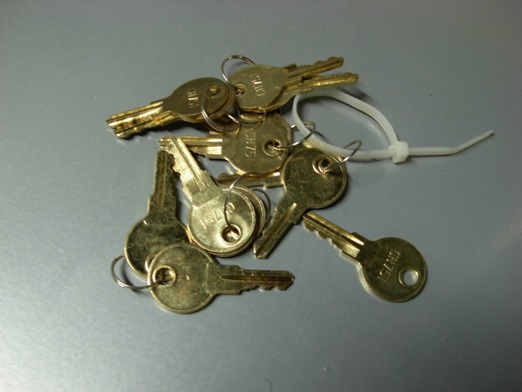
This is a picture of how many spare keys I have left after putting one in every lock of a 5-plex!!
INSANE, dude!
Andrés
Posted by Mark Gulbrandsen (Member # 72) on 05-17-2008, 09:40 AM:
Thats because Christie IS the KEY PLAYER in the industry today! If you think thats insane you should see how many keys there are to the Christie factory .
Mark
[ 05-17-2008, 10:47 AM: Message edited by: Mark Gulbrandsen ]
Posted by Andres Briano (Member # 4621) on 05-17-2008, 11:38 AM:
Good one, Mark!
Posted by Andres Briano (Member # 4621) on 06-20-2008, 05:28 PM:
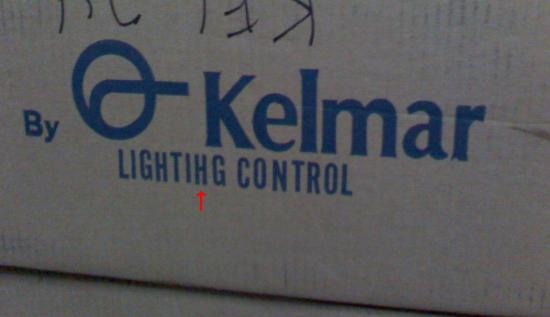
It´s been a while. Right now I´m back in Brazil on install 2 of 4 of 2008. Continuing with this topic that has brought grief to sooo many, here I want to share something funny with you guys: a typo.
Posted by Tristan Lane (Member # 1169) on 06-21-2008, 02:57 AM:
Ha! I love typos on product packaging and the products themselves.
At one new install I was working on, I noticed in the men's restroom that the fold down baby changing table said "Baby Channing Station" It was printed on the branded label for the unit. I wondered to myself how many other consumers received one that said this.
The Women's baby "Channing" station was spelled correctly though.
Posted by Charles Greenlee (Member # 3856) on 06-21-2008, 04:19 AM:
Hmm, I know a few people that wished they could change their babies, my parents being a couple. Eh, well, those changing tables don't change anything. The baby's just as annoying as it was before you brought him/her to the table. Oh well, there's always ebay. (Hmm, suprised someone hasn't tried that already. It'll be a sad day when someone does try to sell their baby on ebay.)
Powered by Infopop Corporation
UBB.classicTM
6.3.1.2