By that standard, my Projector #1 grades out at a D, and my #2 at an F. Pretty bad! ![[Embarrassed]](redface.gif) Admittedly I think the gate tension was probably set waaay low, so I should probably reset it and rerun the test. But in the meantime, post your numbers!
Admittedly I think the gate tension was probably set waaay low, so I should probably reset it and rerun the test. But in the meantime, post your numbers!
--jhawk
Posted by John Walsh (Member # 168) on 05-17-2008, 10:48 AM:
Funny, I was just explaining to a friend about my doing the same test on some projectors 1982. I've tossed most of the notes but the one that remains lists of a pair of rebuilt JJ's, and one SA. I was using RP105-1981 (don't know if a newer practise has been published or, if so, if it's any different.) We couldn't get a long length of 35PA; (too expensive) we had to use 8ft loops.
The JJ's did OK at class 'B' (0.18%). The one SA at our 'dump' theater was a class 'D' (0.31%). Those are jump numbers; for some reason I didn't do weave. Not that it matters; none of those projectors are in service anymore. Also, few intermittent rebuilders are going to take an intermittent back and redo it.
Posted by Sean McKinnon (Member # 612) on 05-17-2008, 03:02 PM:
unfortunately, I no longer work for the company I used to work for where I serviced the projectors we were discussing.
Posted by Galen Murphy-Fahlgren (Member # 4535) on 05-18-2008, 06:01 PM:
As I said, today was my first opportunity to do any sort of check on this front, and even today I only had time enough to eyeball it from booth, and only a couple of my projectors. All measures were made in scope. Here we go:
Aud. 7- Proj. V5 Horizontal movement was almost a full square. Vertical, about .5. F
Aud. 1 Proj. V5 Horizontal, approx. .75, vertical about .5 again. F
Aud. 4 Proj. Simplex XL Horizontal around .3 or .4. I could detect no vertical movement, steady as a rock. B?
Aud. 5 Proj. XL Horizontal .7 or so, vertical .4. F.
Again, these were eyeballed, and I'm lucky to have had time to do even that today. I will attempt to get some more accurate figures and figures for my other V5 and my pair of Christies. Also, I probably need a new RP40, I almost think mine is acetate. While that would obviously affect overall values because of gate tension being set for poly, could it have an effect on relative values, ie, some designs being better suited to accommodating different base thickness?
What steps can I take to improve the steadiness of these projectors? I mean, it isn't like I want the V5 to fail. I'm trying to provide good presentation, as I think most people are. I'm just doing it with very little experience and minimal guidance.
Posted by Sean McKinnon (Member # 612) on 05-19-2008, 09:58 AM:
I went through my files and pulled out my technician copies of my old service reports and PM reports. It seems like I recorded everything else except these measurements, I just noted either no or minimal horizontal movement (weave), or no or minimal vertical movement (jitter). Sorry, I tend to be pretty thorough but I guess not that thorough.
Posted by Richard P. May (Member # 3598) on 05-19-2008, 12:39 PM:
This is a good exercise. On our Norelco FP20s:
Proj 1 - C
Proj 2 - A
RPM
Posted by John Hawkinson (Member # 1135) on 05-19-2008, 01:01 PM:
Real numbers, Richard? I'll try to do ours more properly...
--jhawk
Posted by Steve Guttag (Member # 268) on 05-19-2008, 10:27 PM:
Today I looked at a Kinoton FP30E running 35PA...which is not always the most steady of test films...it varies batch-to-batch...
1/20th of a square jump (could have been closer to 1/30th...the screen was up there though I was trying to measure at the screen). So I guess that puts it in an "A" classification.
Posted by Michael Moore (Member # 3867) on 05-21-2008, 08:15 AM:
If i did this test with a screen say 10 feet away from the projector, (in our place I have room in the balcony to set up a smaller screen) will the test results be comparable to our 90 foot throw?
Posted by Paul Mayer (Member # 355) on 05-21-2008, 12:02 PM:
Since you're going to be measuring how much a given projected square moves in relation to its own height and width, the actual size of the square is not important. However, on such a small screen it may become difficult to precisely measure how much the square moves since it will be quite small.
Posted by Richard P. May (Member # 3598) on 05-21-2008, 02:15 PM:
This is a lab screening room, with about a 6 ft. high screen. An exact measurement is pretty hard to accomplish.
I re-viewed with a new, Estar based projection chart, originally created by the MGM Camera Dept. It's somewhat different from SMPTE, but with the necessary objects to compare the image with the screen edge or masking. With this, there is absolutely no discernable movement with either of our FP40s.
RPM
Posted by Carey Barber (Member # 1586) on 05-22-2008, 11:57 AM:
What is the recommended length for a good test loop of 35PA?
Posted by Paul Mayer (Member # 355) on 05-22-2008, 01:30 PM:
For this kind of test a loop is not recommended, since a loop doesn't recreate the typical condition of film running through a projector. With each pass the loop heats up a bit more and changes the way the film behaves when it is stopped and flashed within the gate.
Loops are fine for doing things like checking and filing plates, but not for critical testing.
If you absolutely must use a loop, longer is better. Mine all happen to be 8-footers.
Posted by Carey Barber (Member # 1586) on 05-22-2008, 09:10 PM:
Okay...This may be a stupid question, but what do you use in place of a loop?
Are you just using tons of 35PA and running it through? I would think that you would want a few minutes worth to give you time to check everything. That would be awfully expensive, as that test film is not cheap.
Posted by John Hawkinson (Member # 1135) on 05-22-2008, 09:18 PM:
I did my numbers from looking at perfs without the aperture plate.
If you run a reel of 35PA, you get much less wear than you do with a loop. It might not be economically reasonable for you, but it is the better way ![[Smile]](smile.gif)
(We do use a 50' length of Cat69T for our Dolby Alignments, with heads and tails. That works pretty well, and lasts a long time...)
--jhawk
Posted by Carey Barber (Member # 1586) on 05-22-2008, 09:27 PM:
So, do you generally use a full 15-20 minutes worth of test film on a reel?
(Sorry, if I am beating this to death, but I know that just 100ft of that 35PA is very expensive...I cannot imagine being allowed to purchase over a thousand ft.)
Posted by System Notices (Member # 2357) on 08-08-2010, 05:08 PM:
It has been 807 days since the last post.
Posted by Jason Metcalfe (Member # 5739) on 08-08-2010, 05:08 PM:
Our Simplex Millenium has recently started to exhibit more horizontal movement and I'm having trouble determining the cause.
I've tightened the two screws that attach the gate support to the housing and also tightened the screw on the intermittent shoe pad and had a little success but there is still some movement.
We've only really had problems with vertical movement in the past so this problem is a bit foreign to me, I wanted to see if anyone had any ideas.
Posted by Brad Miller (Member # 2) on 08-08-2010, 06:28 PM:
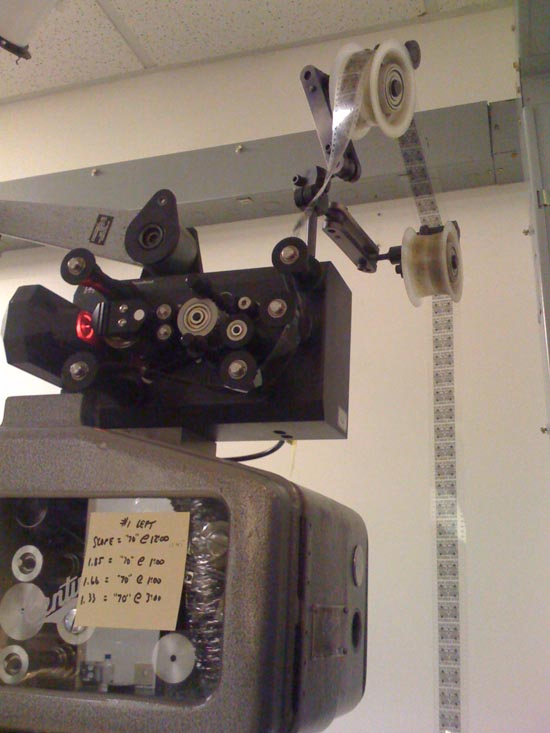
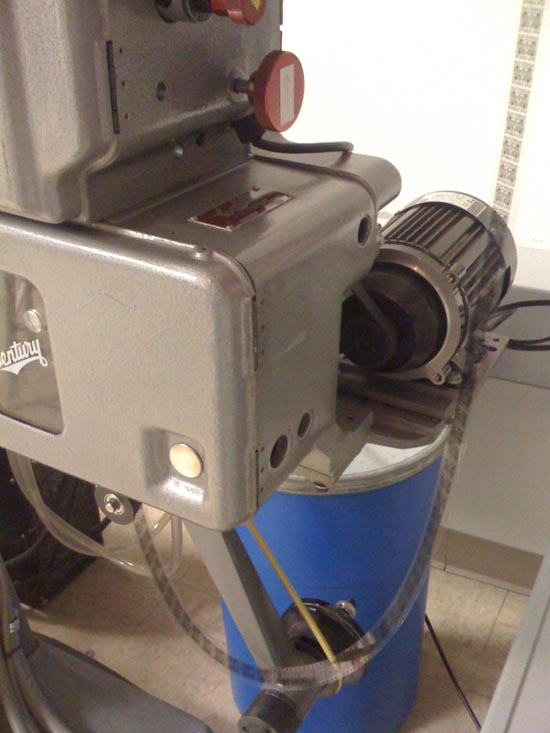
For what its worth, this is how I setup my loops. You can run them for hours and never put a scratch on them. Also when you are done running it, you can unthread it from the higher of the two rollers you see in the top picture and let it rest out of the way on the lower roller.
Posted by Randy Bowden (Member # 587) on 08-08-2010, 06:46 PM:
Jason, check your lateral film rollers in the top of the film trap. The inboard roller should push in and spring back easily, also the entire roller set should not be sloppy. Check for endplay on the star collar as well.
Posted by Monte L Fullmer (Member # 2797) on 08-08-2010, 07:21 PM:
Funny is that on one Simplex "XL" (same as the Mil2000) that I had to go service this last spring, is that the INT assembly was loose in the framing cam-the two assembly locking tabs were loose where the assembly would actually move in and out during operation causing the same horizontal weave issues.
Also, the end collar could be out of adustment (the "oil thickness" requirement between collar and the bracket) where there is excessive end play on the sprocket shaft making the sprocket shaft bounce in and out from the face of the cam.
..and I've seen gunk buildup on sprockets do somewhat the same thing ...
If you want to see steady projectors, shove a loop of 35PA in either a SuperSimplex or an E7 ...
Posted by Eric Robinson (Member # 2966) on 08-08-2010, 09:44 PM:
![[Frown]](frown.gif)