This is topic Strong Lamphouse problem in forum Film Handlers' Forum at Film-Tech Forum ARCHIVE.
To visit this topic, use this URL:
https://ft-forum.com/ft/cgi-bin/ubb/ultimatebb.cgi?ubb=get_topic;f=1;t=009307
Posted by Louis Belloisy (Member # 3836) on 05-26-2008, 12:01 PM:
In one of our theaters, we have an older simplex with an older Strong lamphouse. We are having a problem, whereas when we start the projector the lamp will occasionally light in a most unusual manner. The arc will not go from anode to anode but will jump to the top of the bulb and then back down. this will give very weak light. If we shut the projector down and then restart, it will be fine. It used to happen occasionally, but is more frequent now. I thought it might be the bulb, I changed it and it still malfunctions.
See attached (terrible) sketch to see what I am talking about.
Info on projector:
Simplex 35 mm
Strong Super Lume-X lamphouse
Rectifier - Strong solid state
Bulb - Osram 2000 watt - XBO 2000w
Amperage - 75 watts
Voltage - 26 volts DC.
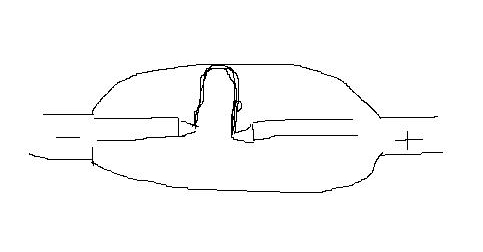
This has us all stumped, any help will be appreciated
Louis
Posted by Steve Guttag (Member # 268) on 05-26-2008, 12:55 PM:
It is a characteristic of the rectifier. If you look, during this problem, the current will be way down but the voltage will be way high and still have about the same power...the rectifier thinks all is okie dokie.
If you want a period of time, it will self correct. If you change your lamp, the problem will go away until the new one wears in. If you change your rectifier, it will go away forever.
I'm not sure, but they may have corrected this problem on the version 2 (gray colored cabinets) of the rectifier.
Steve
Posted by Louis Belloisy (Member # 3836) on 05-26-2008, 01:56 PM:
hello steve,
thanks for answering. i should have mentioned, that the rectifier is fairly new, having been replaced about 3 months ago. we had this problem with the old rectifier also.
i will make a note of the current and voltage the next time this happens.
Posted by Richard May (Member # 2627) on 05-26-2008, 02:09 PM:
The gray colored power supply still has the problem. I put one in an X-90 console about 6 months ago. It would happen maybe once or twice a week.
Posted by Randy Bowden (Member # 587) on 05-26-2008, 02:44 PM:
I had a theatre with that exact same problem. IIRC I changed out the power supply, it was a strong swithcer with a quick disconnect for the AC and hardwire for the DC side. Unfortunately the damage had already been done to the bulb and continued to exhibit the same problem, even after the new supply was installed. A new bulb was installed for a complete fix of the problem.
Posted by Louis Belloisy (Member # 3836) on 05-26-2008, 02:46 PM:
thanks, guys, i will swap out the bulb and will let you know the results.
lou
Posted by Monte L Fullmer (Member # 2797) on 05-26-2008, 05:42 PM:
.makes one wonder if those new 'compact suitcase' switchers are more sensitive to variables, for I've had the same problem with these 1k-3k compacts with the MS plug when running 2.5k bulbs...and with some Series 2 compacts. (Strong... ![[Roll Eyes]](rolleyes.gif) )
)
For after 1200hrs on any bulb, these bulbs act the same way: high voltage, low current - and the flame wanders all over the anode until it wants to settle down where it supposed to be.
At least the old large 'black suitcase' switchers can be more reliable-for I've got a good dozen of these 68005's still plugging away and almost with 20yrs on them..
Posted by Jeremy Weigel (Member # 4208) on 05-26-2008, 09:21 PM:
Does anyone know what exactly causes the arc to shoot up to the envelope like that? I only know of one time that it happened here. It has probably happened again and just corrected itself fairly quickly. At the time I couldn't tell if the arc was attracted to the wire running over the outside of the bulb or not.
Posted by Louis Belloisy (Member # 3836) on 06-01-2008, 11:41 AM:
Problem has been solved, bulb change with new bulb fixed the problem.
Here is the list of events:
About two years ago, the lamp started to display the unusual lighting.
Replaced the bulb and problem went away for a few months.
rectifier died, replaced this past spring.
bulb still displayed the erratic lighting pattern.
bulb change now, fixed the problem.
What I think is that the rectifier harmed the first bulb, when i changed the bulb, the defective rectifier harmed the new bulb. even after the rectifier change. the bulb still displayed the unusual lighting pattern because it was already harmed.
So now with a new bulb and new rectifier, all is well in our little world.
thanks, everyone for your suggestions.
Louis
Posted by Mark Gulbrandsen (Member # 72) on 06-01-2008, 11:51 AM:
Actually the problem WILL re-occur after there is just several hundred hours on the lamp. I have only seen this happen with the version 2 gray colored switchers, not with the older compact black units. At several locations over the past few years I solved this problem by installing new stabilizing magnets under the reflector. The Super Lum-Ex lamphouses involved were always in excess of 20 years old. All of them were running on later version Gray Strong 1-3kw Switchers. I haven't seen the problem re-occur at any of my locations after the new magnets were installed.
Posted by Louis Belloisy (Member # 3836) on 06-01-2008, 11:56 AM:
Hello Mark, thanks for the tip. did you change bulbs along with the magnets and did the bulbs that were in the unit display this effect after the magnet change.
Louis
Posted by Steve Guttag (Member # 268) on 06-01-2008, 12:24 PM:
I have see the problem with the version 1 (compact, black) rectifiers (in fact, that was the first time I encountered it). I not NOT had the problem with the version 0 (larger, suitcase sized) switchers. I have had numerous other problems with the version 0s though.
In general, the problem seems to show up in lamps in the 2000-2500 range. I've had the problem in X90s as well as Super Lume-X. I have NOT had the problem with Kinoton lamphouses that have been running switcher in the 700-2000 watt range so the magnet theory Mark has may have some merit.
I think the problem is that the design of the rectifier seems to be one of power regulation, rather than current regulation. It won't raise the current if the voltage doesn't drop right away and it gets "stuck." The current isn't strong enough to pull the arc down and it is trying to burn like a flame. If the rectifier were to force the voltage down as it ramped up the current, it probably would not have this problem...it is possible it would be harder striking though. Probably a better idea is to have the boost in the switcher be a separate circuit that is current limited while the main supply is voltage limited to force the rectifier to switch modes from striking to sustaining.
You don't have this problem with HR type rectifiers as they can't sustain the arc like this...there isn't any current for the high voltage and it just immediately drops based on the capacitor size.
Let us know if the problem comes back...I suspect it will.
Posted by Tristan Lane (Member # 1169) on 06-01-2008, 12:54 PM:
I hate problems like the one described here. Troubleshooting something like this is difficult and the results are questionable until the "fix" has been time tested.
I had what I would describe to be an opposite problem on a set of highlight II consoles. The consoles used high reactance rectifiers. Ignitors were DC. The problem was this:
New lamps installed - Struck fine for the first 300 hours and then would exibit striking problems. The ignitor would pulse at a very fast rate and the time between pulses would decrease the longer the rectifier was powered. One console generally took 1-2 minutes to establish a reliable arc. Once the lamp struck, the arc would move around and then go out. On the 2nd or 3rd time, it would finally stay lit.
We tested power, replaced components, and then started trying things like removing the doors from the plenum, moving the magnet around, replacing the magnet, replacing the ignitor, etc... None of which solved the problem. After months of tinkering, I spoke with a fellow technician who was having a similar problem and he suggested cutting the nichrome wire.
I went back on site, found a lamphouse with a lamp old enough to cause problems and cut the wire. Problem fixed. Lamp immediately struck up and stayed lit.
There was another solution that was impelemented which involved installing an IREM ac ignitor in place of the ballantyne DC unit. I found that all parts were ordered and sitting in a storage room at the theater, so I installed them as well. Now the nichrome wire can stay on and the lamps strike up like normal regardless of hours.
The question still remains: What is causing the problem? The DC ignitors should be sufficient, and work in many other installations with the exact same setup. There was speculation that it was a bad "batch" of consoles because there were a few other sites that were opened by the same company that had the same vintage of equipment, and they all exhibited this problem.
Posted by Mark Gulbrandsen (Member # 72) on 06-01-2008, 01:34 PM:
Tristian,
This isn't a localized "Console Only" problem nor a DC ignitor issue. I've seen it in lamphouses AND consoles, mainly older units and these always have AC ignitors. I believe the X-90 and Super Lum-Ex use the same magnet... magnets do loose their strength over time. This is why I choose to try new magnets the fist time I encountered this problem and at least for me it was the fix. It may very well return again as the magnets age. I have not seen this problem occur in Super Highlites although it may very well happen.
Posted by Ken Lackner (Member # 1002) on 06-01-2008, 06:28 PM:
Hi Tristan,
That is some good information to keep in mind, as I have those consoles and ignitors almost exclusively. There was a power issue at one of my sites this weekend, and before I figured out it was a power issue and I was troubleshooting individual houses, it was suggested to me to cut that nichrome wire. I have never heard of that before, but I will keep that in mind.
As for the Irem conversion kit, I have done it. Works great. Problem is, it costs about three times the price of a repair/exchange on the DC ignitor. I sure would love to put one in every house, though.
Posted by Steve Guttag (Member # 268) on 06-01-2008, 06:37 PM:
Anything coming from Europe is going to feel pricey these days...the dollar is so weak.
Then again, Strong still makes their AC igniters (Super Lume-X, Super-80 and Ultra-80) for their stand alone lamphouses so that too is an option.
We have not had too many problems with the DC igniter.
Steve
Posted by Tristan Lane (Member # 1169) on 06-01-2008, 09:03 PM:
In regards to Mark's comment: The magnet was one of the first items to be replaced since arc instability seemed to be the cause of the problem.
The DC ignitor was simply not the problem. It's effective enough when coupled with a switcher, and from what I hear is equally effective with high reactance. Some people speculated that the inrush current on the Strong Super Highlight console rectifiers wasn't quick enough, and thus the ignitor struck too early. Adjusting the spark gap within the ignitor and other items were tried, with no success.
It is my opinion that the AC ignitors provided only a small improvement. Lamps frequently double and triple striked even with only 500 hours on them. It seems that there was some other characteristic of the lamphouse causing the problem.
One thing to note: I tested one of the problem lamphouses with a hardwire V1 switcher and the problem went away. So it indicated to me that the rectifier was bad, but other affected theaters had already tried swapping the HRPS rectifier with a newer one without success. It seems that a combination of many things is leading to the problem.
Posted by Mark Gulbrandsen (Member # 72) on 06-01-2008, 11:09 PM:
quote: Tristan Lane
Some people speculated that the inrush current on the Strong Super Highlight console rectifiers wasn't quick enough, and thus the ignitor struck too early.
This may have been speculated because Wrong had many, many problems with Stupid Troopers about 7 otr 8 years ago. The lamphouse and ignitors in the Stupid Troopers which were just made from the old Lum-Ex lamphouses and always struck too early for reliable igniton when run from the switchers. After Jack Schmidt had a heart attack over the problems(literally!) he got them to switch over to the DC type ignitor. That also did not totally solve the problem and another problem krept in at the same time. When I was at GTS we discovered that the black coloring in the ignitor cases they were using conducted the high voltage from inside the case to ground and also to one of the mounting feet which was metal. We then mounted all of our ignitors on thick delrin insulating mounts and the DC ignitors then performed very reliably. Interestingly, ever since that episode the cases on Wrong DC ignitors have been white or beige in color.
We also have a fair number of the 4 to 7kw gray version 2 switchers and none of them exhibit this "horseshoeing problem" at start up and these rectifiers are nothing more than 2 of the 1 to 3 k units stacked in parallel and operated from one control board. Go figure....
Mark
Powered by Infopop Corporation
UBB.classicTM
6.3.1.2