This is topic The stupid are spreading their stupidness in forum Film Handlers' Forum at Film-Tech Forum ARCHIVE.
To visit this topic, use this URL:
https://ft-forum.com/ft/cgi-bin/ubb/ultimatebb.cgi?ubb=get_topic;f=1;t=009348
Posted by Brad Miller (Member # 2) on 06-13-2008, 04:05 PM:
Stupid people. You know what I am talking about. The kind of people who are so embedded into their ways that they simply cannot handle any form of change whatsoever, regardless of the validity of the argument presented to them. These are often the same sort of people sometimes referred to as "old coots" (not you Phil), that say things like "I've been doing it this way for 50 years" and won't even consider a superior method or procedure. Maybe it's because they are incapable of change, perhaps it is just stubbornness, an overall lack of not caring, or just being flat out stupid in general. Some of these people qualify as "stupid" just because they read something and fixated on it, taking it to ridiculous proportions. Regardless, the stupid are spreading their stupidness through their training of others.
Post your stupid people stories here so we can all be entertained by the sheer stupidity of some people out there. (Trainers beware, we are going to be talking about you!!!)
I'll start. I recently came across a theater that took threading patterns to a whole new level. The trainer is so fixated with "never let the emulsion side of the film touch any of the rollers", that these poor guys are being forced to thread the base side of the film on EVERY ROLLER, regardless of what sort of ridiculous twisting or film damage occurs.
Folks, film was designed to curl, as in being wound onto a reel or through loops in a projector. It was NOT meant to make unnecessary tight twists!
Here are two example pictures of how these poor stupid people are being forced to thread.
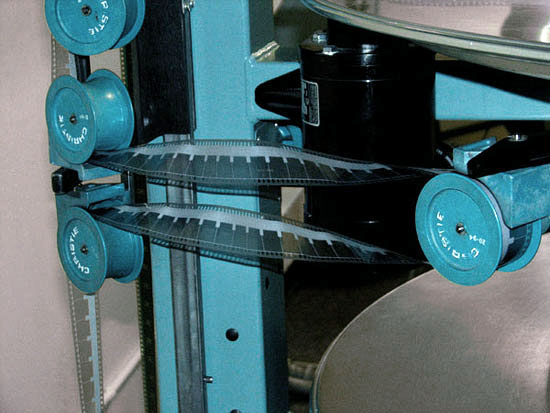
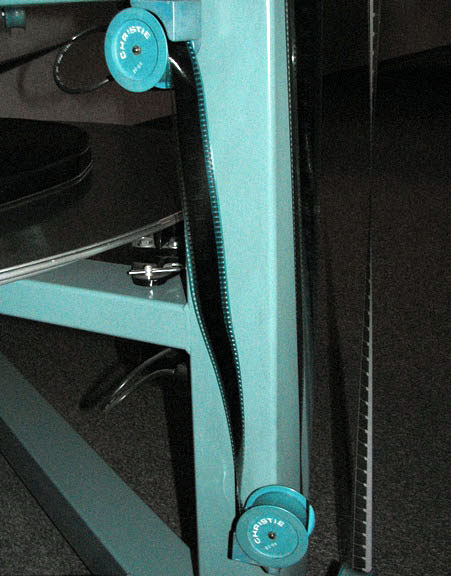
And for those of you wondering just how this process works on a Strong platter...
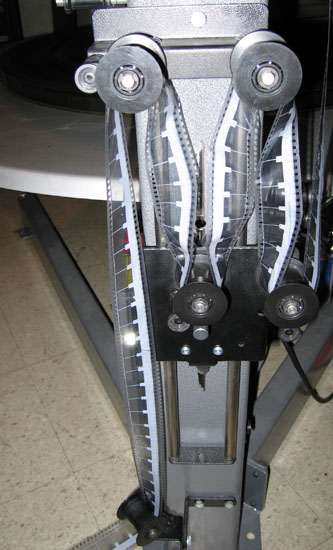
Pretty ridiculous, eh? Particularly because (this is where the stupid people need to pay extra close attention)...THE BASE SIDE OF THE FILM IS WHAT CARRIES THE DIRT!!! This has been proven many times before. Simply put, running the emulsion side of the film over the rollers will keep the film CLEANER than a film that runs over rollers on its base side. ALSO, the entire design of a roller is such that IF a roller should seize and stop spinning, the middle part where the picture resides is beveled inward, such that the film wouldn't get scratched anyway! Durp! Somebody's got 'um sum real smarts there.
So at this point somebody is bound to be saying to themself "hey, I've worked with a Christie platter like you have pictured there. How do you deal with the 3 roller cluster in the brain? Even best case senario this stupid moron trainer would HAVE to have the emulsion side of the film run over at least ONE of the rollers, right?"
WRONG!
The Christie brain is easily modified to prevent such foolishness...
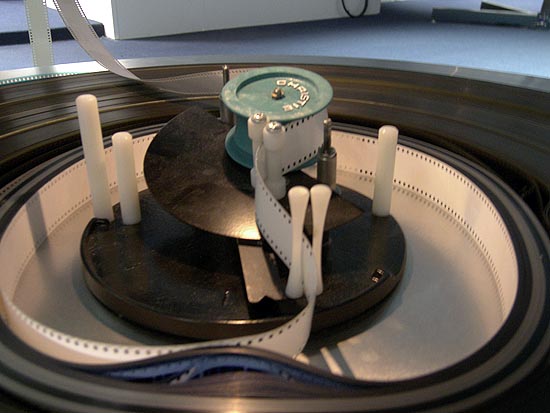
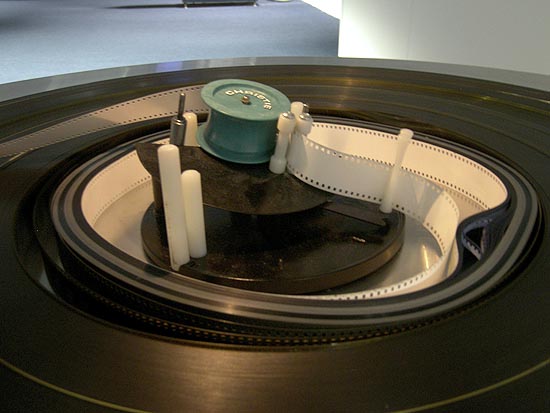
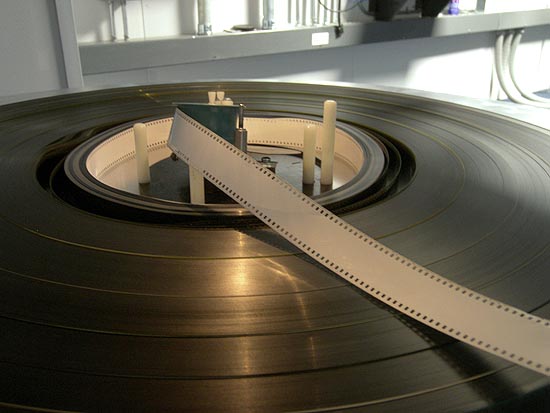
The sheer stupidity is mind boggling!
Posted by Brad Miller (Member # 2) on 06-13-2008, 04:14 PM:
Now fortunately I haven't actually seen the following in action, but for the sake of outing this stupid "base side on the rollers only" threading ritual, I figured I would see just what it would take to thread a projector with the "base side only" touching the rollers...
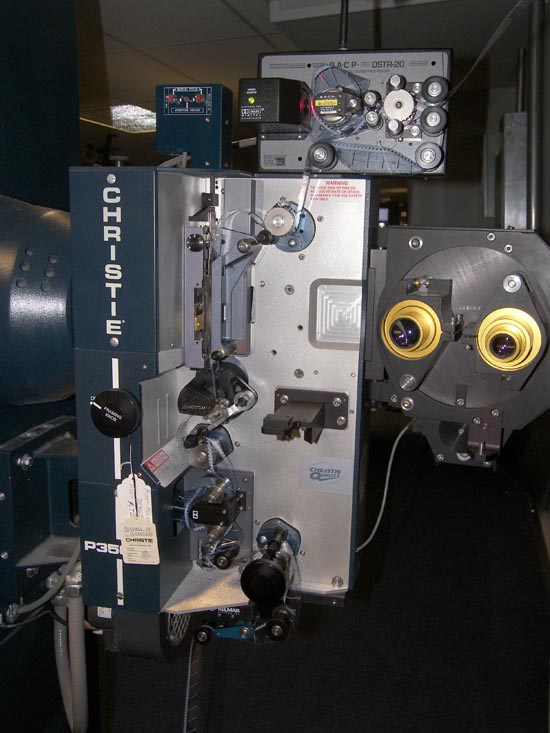
Aaaaaaaaaaaaah yes, that's MUCH better! Care for some closeups?
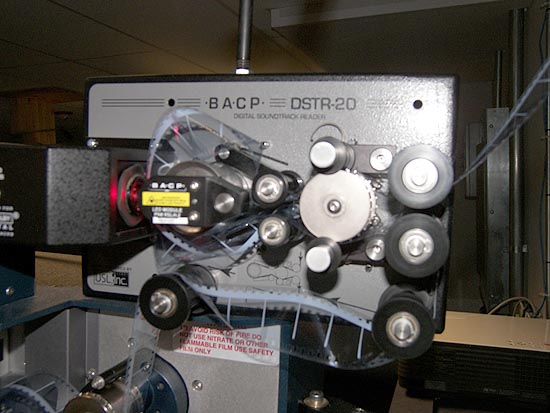
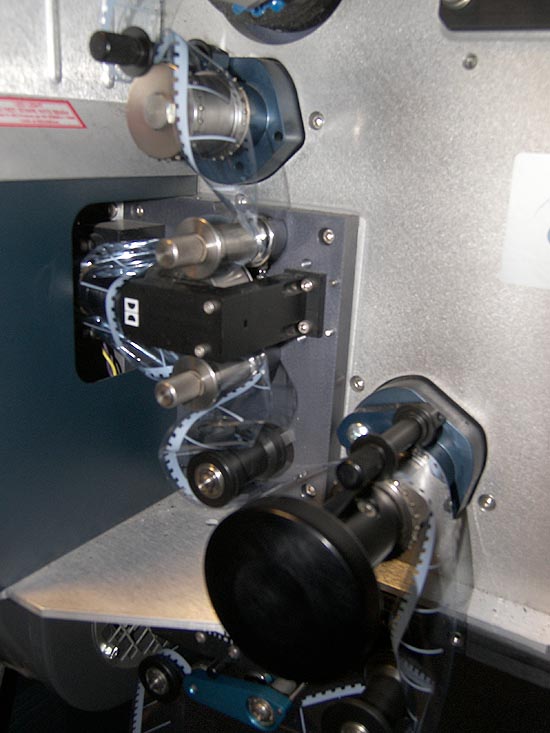
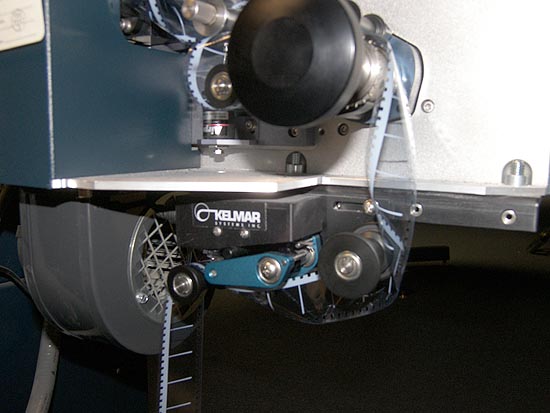
I hope all of you are taking notes. After all if everyone doesn't switch to this threading procedure ALL OF YOUR FILMS WILL GET SCRATCHED BY RUNNING THE EMULSION OVER THESE ROLLERS! OH NO!!!
I wouldn't want to leave Simplex guys out, so here is the proper way to thread a Simplex projector. I had to ask Joe to take these pictures since I don't work with Simplex machines, and he dutifully took it one step farther by avoiding the sprockets in the projector too!
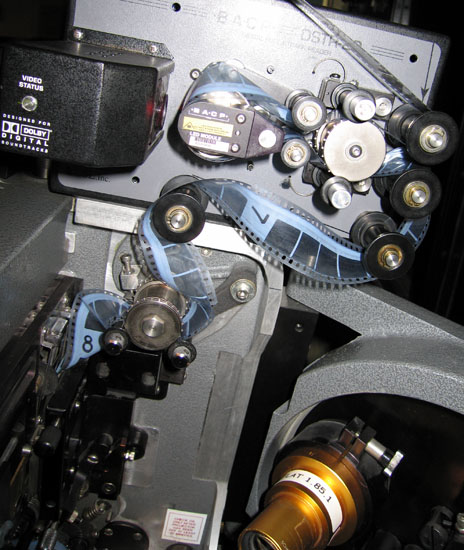
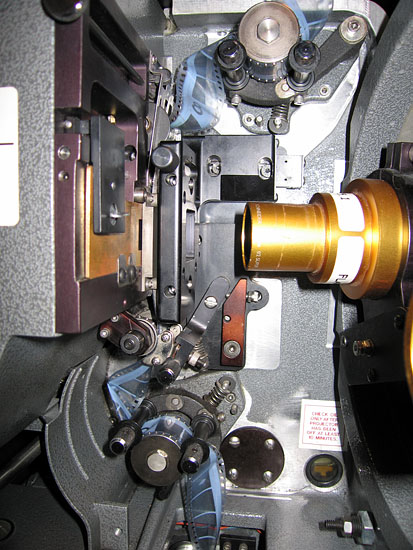
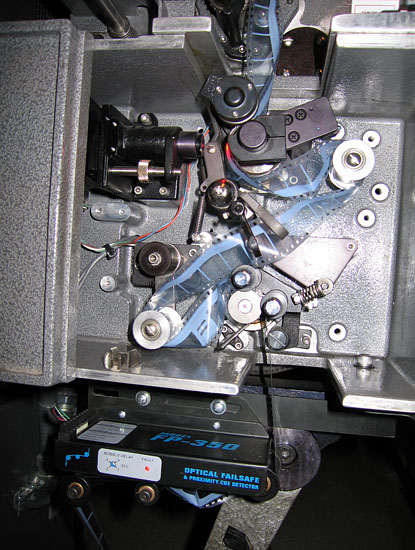
WHOOOOOOOPS!!! Shame on you Joe! YOU CLOSED THE PINCH ROLLER ON THE SOUND DRUM! That simply CAN NOT HAPPEN or the film will be scratched because not only is that running ON the emulsion side of the film, but it is also not beveled and is directly TOUCHING the emulsion!!!!!!!!!!!
(By the way, note the proper threading of the FP-350 failsafe.)
Seriously, just how widespread is this fear of the emulsion side stupidness?
Posted by Mike Olpin (Member # 1115) on 06-13-2008, 04:56 PM:
That's twisted.
Posted by Ben Wales (Member # 92) on 06-13-2008, 04:57 PM:
Yep, I got a good few to share.....
1) Was asked by the Chief Projectionist while working at a special 70mm venue to test the 35mm Opicital sound head on a Cinemaccancia Victoria 8 with a 70mm film! ![[Confused]](confused.gif) .
.
2) Same venue where Blooping Ink was ordered for 70mm DTS prints - and I have the pictures!.
3) worked at a Regional Film Theatre and was informed by a BFI rep while on a site visit we could not run their archive prints - as ALL Platters/Cakestands scratch films ![[Eek!]](eek.gif) .
.
So I informed them about the countless prints I have seen from them oiled and scrached and several sets of Cue Dots, poor joins, leaders missing.
Oh yes, this was a BFI funded venue when built.
Posted by Joe Redifer (Member # 3) on 06-13-2008, 05:09 PM:
Those platter pics are real, folks. Brad didn't make those up. Is there ANYONE here that threads like this? I doubt it seriously. But what would you do if you worked at a place/chain that demanded you thread like this? What if you were threatened with disciplinary action if you didn't? That's the position these corporate trainers put a lot of otherwise decent projectionists in... projectionists who could otherwise have a lot of potential but instead learn crap like this.
There are so many twists that I keep thinking the platters were threaded by M. Night Shyamalan.... OK... that was bad. Really bad!
Posted by Sean McKinnon (Member # 612) on 06-13-2008, 05:56 PM:
Oh man... Where could I even start here... I dunno, I got so many let me get my thoughts in order here and I will be back.
Posted by Ron Lacheur (Member # 1126) on 06-13-2008, 07:52 PM:
How many scratched/damaged prints come out of there on a regular basis?
Posted by Rene Ferron (Member # 4674) on 06-13-2008, 07:56 PM:
OMG... That person need a little slap............. With a 2 X 4 ![[evil]](graemlins/evil.gif)
No really, I mean who thought those people how to thread film. I have only 4 months experience and i already show 1 person (part time projectionist) how to thread, make up and tear down.
Posted by Chris Slycord (Member # 4239) on 06-13-2008, 08:45 PM:
At my old theater someone transferred to that location and had been dead set against using timers but eventually relented and used them herself. Then when she scratched a print she commented that "Timers scratch prints." Yep, timers scratch prints; electrical circuits are so advanced today that they can grow arms to add their own etching on a print.
And an old manager had been transferred to another theater. One day he got a complaint about the picture in an auditorium and he noticed that you could see the soundtrack on the right side of the screen (obviously it was threaded incorrectly). When he told his operator that, the guy said "I threaded it right! They put the soundtrack on the wrong side!" Then lo and behold, he went upstairs to find a twist in the film right before it entered the projector.
Posted by Monte L Fullmer (Member # 2797) on 06-13-2008, 10:10 PM:
The one that totally cracks me up is the threading concept of 'soundtrack towards the wall, or screen' for the same basis...and how that film looks so twisted heading into the machine if the platter is positioned 'gear side' or left side of the machine.
These must be KISS booths for sure.
Posted by Chad M Calpito (Member # 3736) on 06-13-2008, 10:13 PM:
After I looked at those pictures, I was shocked. That is purely F***ed-up. If I ever saw a projectionist of mine do that, I would do more than be pissed at him, I'd kick his ass out of my booth immediately.
In answer to your question(s) Joe, I'd tell the company and corporate people to simply goto hell and I'd quit right away.
Posted by Mike Blakesley (Member # 26) on 06-13-2008, 11:16 PM:
Just do it the "wrong" way they tell you to, and then when they leave you alone, start doing it correctly. How often do these trainers come back and check on their trainees after training is done?
Posted by Joe Redifer (Member # 3) on 06-13-2008, 11:43 PM:
quote: Chris Slycord
"Timers scratch prints."
That's hilarious! I bet she truly, honestly believed that, too. I am amazed at the things some people are able to think. I am also amazed that these people are able to brush their teeth without dropping the toothbrush, putting the paste on the wrong side (or wrong end) of the brush and things like that. I guess common sense gets thrown out the window when one goes to work for an industry they know nothing about (but think they do). Actually, not knowing about your business but thinking you do can lead to the ultimate embarrassment.
quote: Mike Blakesley
How often do these trainers come back and check on their trainees after training is done?
That's a good question, but I imagine that they delegate the responsibility of checking to local managers and techs, etc.
Posted by Brad Miller (Member # 2) on 06-14-2008, 12:16 AM:
Back in the early 90s Cinemark hired a guy to do training that shouldn't have even been allowed near film. He is no longer with them, but he would stand there and argue with anyone who dared to try and use any sort of logic to his crazy rules. After awhile everyone realized just to open the theater doing things his way, tell him how wonderful he was...and then after the first few days Cinemark would pull him out of there and they could start doing things the proper way (or at least MORE proper). It was pretty pathetic, oh and did I mention STUPID?
Of course Cinemark's chief technician (no longer with them) would freak out if the upper projector roller was not swung forward to within 1 inch of the auditorium wall, because according to him "the film won't run if the upper roller is in any other position". Ummmm, yeah right. So for a week at every new location opening we would stand there and watched as our leaders would get MANGLED because of the film getting dragged across that roller sideways, and then we re-oriented them upward once he left to save our leaders. Odd how we never had any problems or scratches after he left!
Same thing goes for a UA tech. No shit, he actually stood there and declared "the projector cannot run without a douser. We are going to have to cancel all shows until we can get a new douser!" He was of course speaking of Christie's old electric douser that would commonly get warped and would jam. Rather than to literally lose shows, many theaters would just pull it out and use the manual lamphouse douser or whatever to keep the shows on the screen. But according to him it was IMPOSSIBLE to run a movie without that stupid douser and he stormed into the manager's office to demand they cancel all future shows. (Fortunately the GM was not stupid, unlike the tech.)
So to answer your question Joe, I'm pretty sure this sort of thing happens at any big chain like that, whether it is Cinemark, Regal, AMC, whatever. Of course if *insert chain name here* would hire people who truly were good at their job to do the training that didn't come up with moronic practices that are actually NOT in the best interest of the equipment, film or presentation, then that wouldn't be an issue. It's all a matter of the stupid teaching the ignorant.
Posted by Mike Blakesley (Member # 26) on 06-14-2008, 12:26 AM:
I remember when we first got our tape splicer. It was around 1978 or so. The owner got it into his head that it was only necessary to put tape on one side and would chew us out for wasting tape if he saw us doing a two-sided splice (mid-reel -- this was before the platter days).
Posted by John Wilson (Member # 269) on 06-14-2008, 12:32 AM:
How timely this subject is...
One cinema I do a shift-a-week at had evening sessions interlocking last Friday. When I came in at 5pm I was asked to put the interlock leader on (!). OK...I guess that's sort of alright since it was the first time it had interlocked. BUT I was also asked to swap it back again to the standard leader for its two matinee shows the next day and leave notes to put it back on again for the interlocks the next night. Worth noting here that the guy who was to do the next night's interlocks was an interlock virgin and he was to be asked to swap out leaders with around 20 minutes between the shows.
Now, I don't know about you, but that seemed to me like a dumb idea to take it off for 2 shows just to put it back on again so I left the dayshift guy the next day a note to say I'd left it on as the request had been un-necessary and he should just run it down for the 2 matinees.
Well, the guy who'd asked me to do this whacked idea found out I didn't do it he called me at home the next day and tried to chew me out about it. That didn't go too well as I told him on the phone it was a dumb request so apparently he then took it to his boss. I was then part of a meeting last night when I arrived on shift between this guy and was also 'witnessed' during the meeting by the manager on duty.
After my amazement at this meeting situation had subsided where he told me I had said he was stupid for asking it (I didn't) and also that I'd hung up on him (also no) I pointed out again his request was unnecessary especially considering the next guy would have been mightily nervous as it was.
I said to the booth boss why didn't he just come to me and talk about his grievance instead of taking it to his boss and the other manager...he said he just wanted a reference point. Huh? You mean reference, right? He seemed to not know what I was talking about. (Point of note here...if you're going to blindly do what your boss tells you to do, make sure you know what he's talking about before you repeat it in an attempted dressing down.) Meeting over.
The way I run a booth is to try and make it as easy as possible for my staff...not to throw hurdles in the way where they don't need to be.
So I finished the shift and made a note of all that had transpired for the record in the booth diary. I ended the notation with the following...
'There are those around who will willingly put up with shit like this, fortunately...I'm not one of them'. The shift ended and I won't be going back.
And just before you get upset at me again Antony at Palace Verona Cinemas in Sydney...I did not ask Brad to call this thread stupid...although I'm sure you'll think I did that as well anyway.
By the way,
- your top loops are 4 sprockets too big so your sound is always out of sync...
- masking is meant to mask the image with a nice sharp edge...this is not the job of the aperture plate. Get a file for goodness sake because your images on screen are appalling.
- When a xenon if flickering or is waving about on screen uncontrollably, that's not your cue to ignore it for a few more months. Change the bloody thing.
- Your job is to run the booth. If you took more care in there stopping yourself and others scratching all your prints instead of worrying about getting quotes to have the toilets stop leaking things'd be a lot better there. I'm not saying you shouldn't stop the toilets leaking, but the booth comes first.
One more time in case you missed it...if your job is to be in charge of the booth..the booth comes first.
Posted by Monte L Fullmer (Member # 2797) on 06-14-2008, 12:53 AM:
quote: Mike Blakesley
...it was only necessary to put tape on one side and would chew us out for wasting tape...
When I began working with platters in 1977 (AW2 variety), I used to build films for UA Cinemas in our town. I would <with the Guilitoine splicer) do single side splices and did this practice as long as I was there - and they held fine.
But, on the same note, I also did filmwork for a dinky 'mom and pop' operation where they had no splicing tape to speak of .. just good ol' Scotch "Magic" tape - and "by dang", those splices help pretty well for the duration of the engagement.
-Monte
Posted by Chris Slycord (Member # 4239) on 06-14-2008, 01:15 AM:
quote: Joe Redifer
That's hilarious! I bet she truly, honestly believed that, too.
Nah I think she was just flustered/embarrassed and came up with the first "excuse" that came to mind. I'm pretty sure she knew/knows what really happened.
Posted by Ben Wales (Member # 92) on 06-14-2008, 04:00 AM:
quote: Brad Miller
I'll start. I recently came across a theater that took threading patterns to a whole new level. The trainer is so fixated with "never let the emulsion side of the film touch any of the rollers", that these poor guys are being forced to thread the base side of the film on EVERY ROLLER, regardless of what sort of ridiculous twisting or film damage occurs.
Looking at those Platter Pictures, I just wondered how many prints they have trashed or scrached?.
I feel sorry for the Projectionist Trainee shown this poor method that is plain stupid, may be this Trainer has below average experience in Platter operation and it's maintance?.
Posted by Louis Bornwasser (Member # 3063) on 06-14-2008, 06:36 AM:
Guys, don't even get me started!
Present problem: On Potts platter, "won't work right if 2 feed outs are installed at once." So says the self proclaimed "expert" off the street. Half of the removable feed outs are now locked away so mistakes can't be made.
We designed, installed and are currently maintaing this booth. NOTHING we say can help this unfortunate situation. We do make money replacing the small plastic plug, which is the dominant repair problem. It is annoying that an unknown stranger has "power" when no one else does.
Imagine how unhappy he'd be on the older Potts with non-removable feed outs! Louis
Posted by Monte L Fullmer (Member # 2797) on 06-14-2008, 03:48 PM:
True, really makes you wonder on how these 'old wives tales' begin - like one place I know of, they do the similar as what Brad presented us, but in a very small way: As the film leaves the AW3, they put a half twist from the top roller of the AW3 to the top roller of the machine.
For some reason or another, the main guy who started training there said that this twist is necessary due to the basic same reason that Brad shown us - to not scratch the emulsion side of the print
I've shown them, including the mgr, that this isn't necessary. But, as 'horsebroke' as they are, that procedure remains to this day.
-Monte
Posted by Justin Hamaker (Member # 2165) on 06-14-2008, 05:15 PM:
I've been running projectors for about 12 years and before I started reading Film-Tech, I never had any indication that mattered whether the emulsion was up or down. But the way I thread, and the way I've always taught others, there is never more than a 1/4 twist in the film - the only twists happen when the film path actually changes directions. To the best of my recollection, we have never had a problem with scratched film. Virtually all of our film leaves without any scratches and virtually no dust/dirt.
In fact, the only real problem we've ever had with scratching is the first few seconds of the first trailer because the projectionist was pulling the film through too fast when threading.
Posted by Bruce Hansen (Member # 281) on 06-14-2008, 06:31 PM:
What bothers me is that someone will hear something, and will blindly believe it, without checking it out. With the internet, it is very easy to check things out now a days. Some people are so stupid that they will believe anything, as long as it is what they WANT to hear, even though it has nothing to do with the truth. Let's face it, there are some who play on this. They will say the same lie over and over, and people will start believing it, even though they should know to check it out first.
One of the things that is false, but I have heard it MANY times: a phone line (coming from the phone company) is 4 wires, the bell is on it's own wires. WRONG! I have been playing with phones for 40 years, and I know that a phone line is only 2 wires. But try to tell someone who has never hooked up a phone in their live that you have been doing it for 40 years, and it is just 2 wires, and they will argue with you.
I have been saying for years that we need to teach a class in school about how to check things out, and how to go about figuring out a problem. When people in this country cannot even set the clock on their VCRs, something is VERY wrong.
Posted by Paul Mayer (Member # 355) on 06-15-2008, 12:43 AM:
What's a VCR? ![[Big Grin]](biggrin.gif)
Posted by Frank Angel (Member # 248) on 06-15-2008, 02:20 AM:
But wait....the emulsion of the image never touches the rollers because they are designed so that only the sprocket hole areas touch the emulsion, thus you can thread them the proper way and insist that you are following his instructions -- the image and sound emulsion never touch the roller. Except of course, SDDS tracks. But I bet this genius doesn't even know where the SDDS tracks are located.
Posted by Monte L Fullmer (Member # 2797) on 06-15-2008, 02:27 AM:
the nowday, or at least, was the CD drawer on a PC tower as a cupholder.
Remember when the reel lawn mower was a common thing to have, then the rotary version came out and couldn't cut lawn as good as a reel? Guess too many people where slicing their fingers off since they had no safety devices - now, you have to pick your nose, twitch your ear and do a number of things before you start a lawn mower.
And seat belt/key/light reminder chimes, bells or buzzers...DANG! I don't need to be reminded to do these things when I get in and out of a car! (course, I'm too mean - I find the little black buzzer box, open it up and cut the wires to the speaker device to shut the flippin' thing up for good! The car doesn't know that I whacked the speaker wires, for the ECM is still communicating with the little black box to do its screaming..)
I do believe IMO, that the world's public in a whole is forced to be taught that "they can't think for themselves - they have to be told."
And it also seems that nowdays, having experience is NOT what every occupation wants, esp. if that occupation is more or less a team orientated occupation. If you have any form of experience and knowledge in what the occupation has to offer, you've become dead competition to that occupation in fear that you can perform better than they can and they will NOT allow anyone to both - prove them wrong, and/or show them up that it could be done better.
...looks like this present and future generation is turning into a ISO 9001 form of society.
-Monte
Posted by Brad Miller (Member # 2) on 06-15-2008, 02:48 AM:
quote: Monte L Fullmer
(course, I'm too mean - I find the little black buzzer box, open it up and cut the wires to the speaker device to shut the flippin' thing up for good! The car doesn't know that I whacked the speaker wires, for the ECM is still communicating with the little black box to do its screaming..)
Care to fix my car?
Posted by Thomas Pitt (Member # 4322) on 06-15-2008, 03:40 AM:
I can't believe the film even RUNS through the projector when threaded that way! I've seen similar things happen with audio and video tape before, and the twists nearly always cause the unit to auto-stop because the tension is too great.
Oh, on the Christie Platter pic, there's a 'bulge' of film in the center near the brain. Is this part of the stupid threading method; that you have to wind the beginning of the film so it bulges out and is 'closer' to the brain?
Even today, I'm still seeing film handlers that just take the very first bit of leader to come off the platter, thread that up and then motor the film through onto the floor until the countdown reaches '4'. Then they take that mass of film and attach it to the takeup ring, spinning the platter by hand until all the slack is taken up.
When the show starts, it often needs re-framing since the very first bit of leader is opaque with no frame lines - no reference to thread in frame!
I can't help thinking of people who grew up on the old 8mm projectors that were auto-threading. Just put the film in the top slot and let the projector do the rest of the work. It's a lot more complicated with 35mm and 70mm, folks!
Posted by Joe Redifer (Member # 3) on 06-15-2008, 03:42 AM:
quote: Brad Miller
Care to fix my car?
Mine, too. Seriously.
Posted by Leo Enticknap (Member # 534) on 06-15-2008, 06:29 AM:
quote: Ben Wales
3) worked at a Regional Film Theatre and was informed by a BFI rep while on a site visit we could not run their archive prints - as ALL Platters/Cakestands scratch films.
This is an urban legend which has become firmly established in the archive world. None of the major archives in Europe or the US will allow their viewing prints to be run on platters (specifically, it's cutting the heads and tails off which they actually ban). To be fair, the root of the problem is the fact that many poorly trained projectionists make up their prints using poor handling techniques, and therefore the process DOES inflict some dirt and scratching on the heads and tails. Of course it doesn't have to and with good film path cleaning, good equipment maintenance, a dust-free booth and good film handling, the use of a platter will not inflict any more wear and tear on a print than any other film transport system. The problem is that platters can be and sometimes are used purely as a labour-saving device, and the people who do this give everyone a bad name in the eyes of archive access officers.
One of them, who is responsible for print circulation for one of the big US public archives, summed it up when she told me that she didn't care what went on in the booth - in her experience prints which have been run on a platter come back damaged, and ones which weren't don't. The solution - insist that all prints are run as 2k reels with changeovers. We all know that the problem isn't platters vs. changeovers per se; it's the fact that any venue which runs changeovers is likely to be a specialist arthouse/rep venue and therefore, by definition, is likely to have projectionists with more advanced film handling skills than the average. Crucially, they're also more likely to actually care about the films they're showing. Another thing it's worth bearing in mind is that an archive print is not like one of 1,000 prints made for the first release of a new mainstream feature. The archive may have had to do serious fundraising in order to strike that one copy, and in the case of more unusual titles for which there is less demand, make difficult decisions about which title gets a viewing print and which doesn't. If that print gets trashed, they probably won't have the money to replace it any time soon.
At the AMIA conference a few years ago Katie Trainor organised a panel called 'To platter or not to platter?' at which all these issues came out and a good, erm, 'argument' was had by all! Not surprisingly, there was a huge gulf between the archivists in the room who had actually worked in a booth and those who hadn't.
Posted by Andy Frodsham (Member # 4061) on 06-15-2008, 09:25 AM:
Interested to read your post Leo.
We originally opened in 1974 as a BFI theatre and were equipped with Westars (3000ft spool boxes). Joining parts was not an option (and was specifically prohibited by the BFI when screening their prints).
All the BFI archive prints we have recently screened (with the exception of the odd silent film) have splices on the leader and tail joints, so someone, somewhere is defintely joining the parts! 20 to 30 years ago the leaders and tails would not have shown signs of having been removed. Additionally, the instructions included with archive prints no longer mention that parts should not be joined.
What's the official line?
Posted by Frank Angel (Member # 248) on 06-15-2008, 11:55 AM:
The mistake with the archive departments at the studios is that they make the mistake about platters being a threat and so they insist on change-over. They need to wake up and understand that instead of insisting the prints can't play a platter house, they just need 1) get to know the theatres where they are sending their prints and what their record is for treating prints with care or not and 2) instead of insisting on playing prints only in change-over houses, insist that a qualified projectionist STAY WITH THE PRINT the entire time it is running thru the projector, platter or not. Problem with platters isn't with the equipment, it's that it allows the theatre owner think because it's automated and plattered that he doesn't have to have a projectionist in the booth at all times. Even those rep houses that have change-over setups still mount the prints on 6000ft reels and then they have operator go down and work concessions or whatever until time for change-over. If no one is in the booth or is not attentive to the system from the time the projector starts until it stops, THAT's where the potential for substantial print damage exists. And either system can malfunction and cause irreversable damage to a print and anyone who thinks change-over won't just hasn't seen sprocket punctures throughout an entire reel. Thing is, with a changeover booth, it pretty much requires at least that there be a human being running the show. Automation and platters tend to encourage the absence of a human. That's the key.
Instead of the studios ranting about No Platters, they just need to demand that if an archive print go to a platter house or LP reel house, the print is always attended by a human who can, at the very least, turn the damn system off before irreperable damage is done.
Posted by Andy Frodsham (Member # 4061) on 06-15-2008, 12:55 PM:
You are, sadly, spot-on Frank!
Even in the early days of our operation we were getting archive prints (still with integral leaders and tails) which had been absolutely trashed while being screened at other theatres. I recall, on one occasion, receiving a brand-new archive print from the BFI, screening it and returning all the parts in the same pristine condition. We needed to screen a copy of the film again four weeks later and the same copy arrived. This time, it had about 30 splices per part, regular perforation damage (warped reels, perhaps) and running abrasions throughout its length. The leaders and tails had still not been removed!
It made me so angry to see how someone could have done this in such a short time.
Posted by Brad Miller (Member # 2) on 06-15-2008, 02:15 PM:
quote: Leo Enticknap
We all know that the problem isn't platters vs. changeovers per se; it's the fact that any venue which runs changeovers is likely to be a specialist arthouse/rep venue and therefore, by definition, is likely to have projectionists with more advanced film handling skills than the average.
Interesting Leo, but I have seen exactly the opposite.
Also little art houses are more apt to have the cheapest, crappiest equipment with little to no maintenance.
Frank put it best here...
quote: Frank Angel
1) get to know the theatres where they are sending their prints and what their record is for treating prints with care or not and 2) instead of insisting on playing prints only in change-over houses, insist that a qualified projectionist STAY WITH THE PRINT the entire time it is running thru the projector, platter or not. Problem with platters isn't with the equipment
Posted by Leo Enticknap (Member # 534) on 06-15-2008, 03:39 PM:
OK, maybe that was a little bit of a generalisation. There are some crappy 'specialised' (as the UK Film Council, known as FCUK to its friends, likes to call them) venues too. University film societies are particularly high risk: you can have a student projectionist who really knows what (s)he's doing and takes care, then leaves and is replaced by a film mangler.
quote: Andy Frodsham
What's the official line?
It's softened a lot in recent years, largely because of FCUK's line that access is everything. In other words, the BFI's paymasters are pulling funds from everything except what the public can see on the screen, and denying access to prints on what they would see as a mere technicality is a big no-no. There are some National Film and Television Archive (a separate division of the BFI from their main theatrical distribution department) prints which are still guarded jealously: despite having been out of the booth professionally for seven years now, I was recently asked to check out a venue near here which wanted to show a hand tinted and toned print of a recently restored late silent, because the cost of replacing that would be eye-watering. But it's certainly true to say that they're more hands-off about the bulk of their circulating print stock than was once the case.
Platters have become the bogie-machines of a lot of old school archivists, and there's no doubt in my mind that this attitude has stopped film shows from happening that would have given a lot of taxpayers the chance to see some of the films their money was paying to preserve and restore. But there's also a risk that the pendulum will swing too far the other way and that archive access officers will feel too scared about trying to make sure that their prints are handled professionally, for fear of being accused of throwing up unnecessary barriers to public access. IMHO the key to the issue is for archives to hire more people who've spent time in the booth and can use that experience to make a judgment call as to whether a venue is OK or not.
Posted by Howard Johnson (Member # 62) on 06-15-2008, 04:52 PM:
All the BFI prints that I've shown (on a tower) have joins despite sometimes still having warnings on the cans about not cutting off the leaders. As has been mentioned, if a competent projectionist stays with the projector then there won't be any damage. If the joins are carefully peeled back on make-up and spooling off then you won't lose any frames. I made up 2 BFI films last week but all I had to do was plug in a hard-drive and do a few mouse clicks!
Posted by Bruce Hansen (Member # 281) on 06-15-2008, 05:31 PM:
Here is something from todays Atlanta Journal-Constutition
AJC story
You say sabotage, I say checklist for my job
By Richard Halicks
The Atlanta Journal-Constitution
Published on: 06/15/08
Sixty-four years ago, U.S. intelligence issued a "Simple Sabotage Field Manual" for "citizen-saboteurs" in Europe, showing how small acts could cause big headaches for the Nazis.
The section of the 36-page manual that explains "general interference with organizations and production" provoked some laughs, however, when observers spotted parallels between 1944 sabotage techniques and 2008 corporate culture.
Some examples:
> Insist on doing everything through "channels." Never permit shortcuts to be taken in order to expedite decisions.
> Make "speeches." Talk as frequently as possible and at great length. Illustrate your "points" by long anecdotes and accounts of personal experiences.
> When possible, refer all matters to committees, for "further study and consideration." Attempt to make the committees as large as possible —- never less than five.
> Bring up irrelevant issues as frequently as possible.
> Be worried about the propriety of any decision —- raise the question of whether such action as is contemplated lies within the jurisdiction of the group or whether it might conflict with the policy of some higher echelon.
The manual, declassified long ago, came up last week at the Enterprise 2.0 conference in Boston during a presentation by the CIA, said conference general manager Steve Wylie.
Sean Dennehy, the CIA's "evangelist for Intellipedia and Enterprise 2.0," and Don Burke, "Intellipedia Doyen," were describing efforts to share information among agencies in the wake of the intelligence failures before 9/11. Intellipedia uses the same software as Wikipedia to connect analysts in one agency with those in another.
The conference Web site posted a link to the "Simple Sabotage" manual, which quickly became a bit of a sensation online. The headline on Boingboing.net, for example, noted: "Sabotage manual from 1944 advises acting like an average 2008 manager."
But if that part was for managers, the manual seemed also to have a part for contemporary workers. To wit:
> Give lengthy and incomprehensible explanations when questioned.
> Act stupid.
> Be as irritable and quarrelsome as possible without getting yourself into trouble.
> Cry and sob hysterically at every occasion, especially when confronted by government clerks.
Posted by Phil Blake (Member # 2012) on 06-16-2008, 07:52 AM:
well i can only say that digital projection can't get here quick enough when we have guys threading like that.
Posted by Jonathan Bodge (Member # 4072) on 06-19-2008, 07:02 PM:
Now wait a minute, you did this test on a Christie? When you pushed start did it work better? It certainly couldn't be worse!
Posted by Bryan M. Montgomery (Member # 4412) on 06-19-2008, 09:21 PM:
I remember the debate in the late 90's over film positioning during platter take-up, either emulsion in or emulsion out. Sound track up? Or sound track down? It was just about as stupid as this, at least that debate didnt endanger the film however.
Posted by Monte L Fullmer (Member # 2797) on 06-19-2008, 11:40 PM:
quote: Bryan M. Montgomery
the debate in the late 90's over film positioning during platter take-up
... and this debate still goes on for some still rewind both ways.
Posted by Steve Guttag (Member # 268) on 06-20-2008, 08:35 AM:
Bryan...the Soundtrack up/down thing related to more than the potential scratching by presenting the base or emulsion to various parts of the film path...but also film curl and focus stability. Depending on your humidity situation, it can be a huge issue.
Steve
Posted by Joe Redifer (Member # 3) on 07-18-2008, 07:55 PM:
I have something to add to this thread. I don't know if this is ALL of Regal Cinemas or just the Continental in Denver, but apparently it is required that they pile all of the leader onto the floor as they thread so that they don't have to motor the projector. Motoring the projector makes it wear out way faster so this, of course, is unacceptable.
Next thing you know, they won't run any movies just to make sure nothing ever breaks down.
Posted by Ron Curran (Member # 3631) on 07-18-2008, 11:22 PM:
Joe, you remind me of attending a cinema which HAD the best sound around. I questioned the new owner as to why they no longer ran 4 track mag. He replied that it would wear out the heads.
Posted by Chris Slycord (Member # 4239) on 07-19-2008, 04:38 AM:
Well today I got a particularly stupid call/complaint.
Here's the convo:
Downstairs staffer asks on radio: Do you guys have a speaker on up there?
*Long pause where I (and presumably the other operator and the booth mgr) ponder what he heck he could be asking*
Me: Could you please repeat.
Him: They're saying they can hear you in the back speaker.
*another pause*
Me: What do you mean?!
He mumbles something
Me: You're gonna have to go into the auditorium [he never said which one it was] and listen to what is going on; you're being to vague for me to figure out how to fix it.
When I next saw the booth mgr, he looked just as confused as me despite the fact that he had gone directly to the staff member in question and asked them what they were talking about.
Though I imagine the person in question was newer and didn't quite find out yet about how you have to be somewhat specific to get things fixed.
Posted by Tim Reed (Member # 137) on 07-19-2008, 12:19 PM:
Well, maybe I'm stupid, too... I absolutely could not follow what you just wrote. ![[Razz]](tongue.gif)
Posted by Chris Slycord (Member # 4239) on 07-19-2008, 12:37 PM:
And it was pretty much verbatim... so what does that tell you? ![[Smile]](smile.gif)
Essentially, a staff member said someone complained that "they could here us in the back speaker." Then when asked what that meant and which auditorium was having the problem, he didn't answer to either and later the booth manager headed downstairs to figure out what the heck the complaint was about and came back up and the staff member in question still was unable to explain what was meant.
This is one thing I hate:
A staff member hears some vague complaint about a certain auditorium and instead of either going into the room and checking it out or at least asking for a short explanation from the guest, they relay to us a useless description to a problem.
Posted by Brad Miller (Member # 2) on 07-19-2008, 01:06 PM:
That's no different than the classic "the sound is broken" or "the THX isn't on" complaint...only to find out it is a quiet dialogue scene where only the center channel is being used. ![[Roll Eyes]](rolleyes.gif)
Posted by Frank Angel (Member # 248) on 07-19-2008, 02:01 PM:
Tom, how sound proof is your booth? He said they could hear you in the back speaker. Someone may have made that complaint if you were talking in the booth and it could be heard in the house. A patron might have perceived that as coming from a rear speaker. In one of the theatres we have a wall-to-wall port window and if I talk above hushed level in the booth, the people in the balcony can hear me.
Just a thought.
Posted by Aaron Mehocic (Member # 15) on 07-19-2008, 03:06 PM:
quote: Chris Slycord
This is one thing I hate:
A staff member hears some vague complaint about a certain auditorium and instead of either going into the room and checking it out or at least asking for a short explanation from the guest, they relay to us a useless description to a problem.
You're fortunate that a staff member even called up. Not long ago this happened:
7:00 PM Indiana Jones IV with 12 in attendance . . .
BOX ATTENDANT: Manager, please come to the Box Office. A customer wants a refund.
ME (figuring possibly film related given time of the call): What's wrong?
BOX ATTENDANT: The sound messed up in Indiana Jones.
ME (frustrated with the attendant): Why didn't you call when the customer first came out?!
BOX ATTENDANT: I don't know.
ME: OK its fixed!
BOX ATTENDANT: What for, we already gave the refund.
UNBELIEVABLE !!!!
Posted by Chris Slycord (Member # 4239) on 07-19-2008, 03:09 PM:
Frank,
I was the one who wrote the thing up. Tim (not Tom ) was just responding to me.
I remembered how at my old theater the port glass allowed through the sound of the small slide-projector when the film was off so I asked someone else the same thing and they said that during the screenings they had if he tried yelling at the person that was in the back row (since he needed their attention), they couldn't hear him.
But regardless, I still have no idea IF there ever was a problem to begin with. It's entirely possible the "back speaker" noise was simply background from the movie or another person talking inside the auditorium. And since the person taking the complaint didn't tell us which auditorium it happened in, I was left going "All we know is one of the 30 screens may or may not have a problem."
quote: Aaron Mehocic
BOX ATTENDANT: What for, we already gave the refund.
Giving the refund is fine... suggesting that fixing a problem is unneeded because the only person complaining already got their refund is ridiculous. But obviously you already know that since you seem peeved about it.
Posted by Thomas Pitt (Member # 4322) on 07-19-2008, 03:29 PM:
Whenever there's a problem when I'm watching a movie, I wait until the movie is over (unless it's a severe problem, like no picture). I then find the nearest member of floor staff, and tell them in detail what was wrong with the presentation.
After that, while walking away I often see the staff member on the radio or internal telephone to the projectionist, relaying my message. I have to wonder though, how much of my detailed message gets through? Perhaps I should listen next time and see how much detail is given to the projectionist ![[Wink]](wink.gif)
Posted by Aaron Mehocic (Member # 15) on 07-19-2008, 03:32 PM:
quote: Chris Slycord
But obviously you already know that since you seem peeved about it.
I was peeved. What made it even worse for me was later that night the rest of the staff just laughed it off as the ditz employee who said something stupid. "Don't worry, its just so-and-so . . ." was the reply.
Well, yes it just might be so-and-so, but its crap like that that can ruin a staff. Young workers seeing what happened and not doing anything when it happens to them is a recipe for disaster.
Had that been my home-base theater, the managers there would have sent her packing (or at least two weeks off the schedule).
[ 07-19-2008, 04:11 PM: Message edited by: Adam Martin ]
Posted by Michael Brown (Member # 890) on 07-19-2008, 03:57 PM:
who's post are you quoting Arron? ~I've lost the flow of this thread.
Posted by Andy Muirhead (Member # 712) on 07-19-2008, 08:22 PM:
quote: Thomas Pitt
Whenever there's a problem when I'm watching a movie, I wait until the movie is over
Sorry Thomas, but I hate that attitude when dealing with customer complaints. Obviously we can't be everywhere but as soon as we are alerted to a problem, it is sorted IMMEDIATELY. I often come across customers complaining on leaving (whether it be technical, or other customers causing a disturbance, or anything). I always stress that if they make staff aware of the issue it would have been sorted immediately, after the event, there isn't much we can do.
Posted by Tim Reed (Member # 137) on 07-19-2008, 08:37 PM:
quote: Chris Slycord
This is one thing I hate:
A staff member hears some vague complaint about a certain auditorium and instead of either going into the room and checking it out or at least asking for a short explanation from the guest, they relay to us
Hey, Chris, try working in the service business these days! LOL!
Posted by Louis Bornwasser (Member # 3063) on 07-19-2008, 09:59 PM:
Tim; recently drove 5 hours to a theatre to work on LED/sound issues. "While you are here. . . . .work on these items also." Great! If I had known (received a letter listing all(?) complaints the day before) I would have brought all of the parts to do so. All I could do is make a list for next time. Louis
Posted by Kenneth Wuepper (Member # 1174) on 07-20-2008, 06:55 AM:
Service delays are not new. In the 1960s the Butterfield chain used Altec service. The technician for Michigan came from Chicago. He would make a list of the worn parts, place an order for them and leave. The next month he would return and, if the parts were there, install and adjust them.
Once he came and installed a new gear in the sound head. I got the next shift after the install and noticed that one of the sprockets of the sound head was crawling out of position. Seems he forgot to tighten the set screw to the shaft. The technician was already driving back to Chicago and could not be reached.
Our manager had to get permission from Altec for us to open the machine and tighten the screw without voiding our service contract.
KEN
Posted by Leo Enticknap (Member # 534) on 07-20-2008, 08:44 AM:
quote: Thomas Pitt
Whenever there's a problem when I'm watching a movie, I wait until the movie is over (unless it's a severe problem, like no picture). I then find the nearest member of floor staff, and tell them in detail what was wrong with the presentation.
I wish I had the self-control to do that! Saw There Will Be Blood at the Odeon Wimbledon a few months ago, and the feature started just very fractionally out of rack, as in the bottom matte line just fractionally vibrating off the masking and into the picture. After about 10 minutes it got so annoying that I thought that if I didn't ask for it to be corrected, I'd come away from that show not remembering much about the film but fixated on that f***ing frame line! So I got up and asked an usher to ask the projectionist to put the picture back in rack (saying that it was just off at the bottom), and to the credit of the staff there, it happened within 2-3 minutes.
Posted by Thomas Pitt (Member # 4322) on 07-20-2008, 12:46 PM:
Not to change the subject of this thread, but here's what I would class as 'severe' problems; need reporting right away:
* No picture or partial picture (aperture plate or turret out of place)
* No sound or unwanted sound (e.g. if some or all channels go to white noise)
* Badly out of frame; half the image off screen
* Masking incorrectly set; covering up part of image
* Wrong lens/plate selected for feature (flat for scope film or vice versa)
The following I would class as more 'minor' problems and could probably wait until the end of the feature - i.e. doesn't interfere too much with enjoyment of the movie:
* One surround sound channel missing
* Auditorium lights shining on the screen (often there is nothing the staff can do about this; it's up to the architect)
* Torn speaker buzzing occasionally, but not enough to be distracting
* Projector very slightly misaligned to the screen, or minor framing error
* Projection booth lights spilling into the auditorium
Also, if there is an individual or group of people causing a disturbance (being noisy), I would go and tell one of the floor staff straight away.
The times when I have complained about a 'severe' problem, like one of those in the first list, it's either been fixed within a couple of minutes or the show cancelled and a refund given.
Posted by Brad Miller (Member # 2) on 07-20-2008, 02:14 PM:
quote:
After about 10 minutes it got so annoying that I thought that if I didn't ask for it to be corrected, I'd come away from that show not remembering much about the film but fixated on that f***ing frame line!
Well its good to know I am not the only person who will hate a movie for something in the presentation like that. I also tend to fixate if the aperture is poorly cut, the anamorphic slightly skewed, a part of the image is a little out of focus or any other unnecessary distraction. By far the most common I find is that I will sit down and the trailers are a bit loud. Not TOO loud that it is painful, but a bit. Then the feature comes on and I have to get out of my seat and miss the first 5 minutes of the movie because the theater hasn't automated their fader to turn it up to a proper level and the projectionist is a lazy fucktard who isn't there when the show starts to turn it up manually.
I would like to go on record AGAIN with the past prediction of mine that the trailer level committee would turn out to be a complete waste of time. Absolutely NOTHING preceptable changed volume-wise in the trailers. I was playing them at 4 ten years ago and I still play them at 4 now (both instances the feature plays at 7).
Posted by Joe Redifer (Member # 3) on 07-20-2008, 05:13 PM:
Didn't they say their plan was to adjust trailer sound levels over a 5 year time period? How stupid is that? How do we get in contact with these people? I want to write them a letter.
Posted by Greg Anderson (Member # 235) on 07-20-2008, 06:26 PM:
Shouldn't the title of this thread say "stupidity" instead of "stupidness"? Otherwise, you know, it sounds kinda like this thread is, itself, spreading, you know, that stuff we don't want to spread.
Posted by Brad Miller (Member # 2) on 07-20-2008, 07:40 PM:
Somebody didn't get the joke.
Should I edit the title to read "stoopidness"?
Posted by Andy Frodsham (Member # 4061) on 07-21-2008, 11:53 AM:
Also, along the same lines of irritating frameline problems, us art-house guys have to put-up with the additional issues posed by subtitles! My pet hate is seeing a picture on the screen where the printed subtitle droppers (the tails on letters like 'y' and 'g') are hanging off the screen (or on the bottom masking). In chageover houses, I also like to see that the subtitles are positioned at the same height across both machines.
Posted by Steve Guttag (Member # 268) on 07-21-2008, 12:22 PM:
In the US...they are called "decenders."
Most of our art houses that run subtitled films have 1.66 lenses that pretty much ensures that there are no cut off subtitles. The difference in height on the film is very small (.446 versus .497") but the difference in subtitle vs. headroom is pretty substantial. With rare exception, most films seem to be protected out to .497 (1.66:1) ratio.
As for changeovers...well...yeah, both machines should be properly framed.
Steve
Posted by Rick Raskin (Member # 1561) on 07-21-2008, 01:05 PM:
Anybody here remember the framing cues on "The Ten Commandments"?
Posted by Monte L Fullmer (Member # 2797) on 07-21-2008, 01:42 PM:
(Hand up here ...ran an IB print back in 1972 on an unmasked screen..<bummer>..) they were about 3 seconds after the changeover and were six frame long.
EDIT: excuse the Super8 B/W reduction of the opening trademark of this movie, yet one can make out these "F" framing cues (for the top horiz. line was for 1.66, the left horiz. line was for 1.85 and the lower horiz. line for 2.00/1 aperture openings) in the upper right corner of the frame where the normal changeover cues were at.
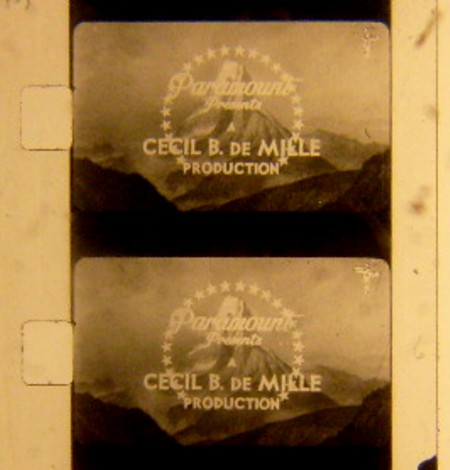
(and on a side note: NEVER did I see a flat print look so sharp and clear...."Ten Commandments" could have easily been released in scope being shot in VistaVision by being matted to 2.35/1!)
[ 07-22-2008, 05:25 AM: Message edited by: Monte L Fullmer ]
Posted by Blaine Young (Member # 3992) on 07-22-2008, 12:16 PM:
Yes, these are the original VistaVision framing queues? They are on the original negatives.
In theory, I suppose, they would be in the same spot for each reel. Or did they vary from reel to reel, making adjustments necessary at each change-over? Of course, I'm assuming that threading was always done in frame - and shouldn't have to be adjusted at each start.
[ 07-22-2008, 03:34 PM: Message edited by: Blaine Young ]
Posted by Monte L Fullmer (Member # 2797) on 07-22-2008, 04:40 PM:
Yes, all 12 reels of this film had these markings at the beginning of each reel. There were three, or four sets of these six frame markings to ensure that the projectionist had his framing correctly per each changeover.
(also, in color, the opening trademark was in a red hue with gold lettering. Plus, it was totally crisp and sharp to look at on the screen. The cues themselves were in gold whereas the rest of the cues in the feature were in black.)
There's quite the article in the widescreen museum site on VistaVision that one could gain massive info on.
Paramount had the right idea with this format- creating a widescreen picture using a flat camera lens so the depth of field was held intact.
But as with Cinerama and Todd-AO, it became a costly process down the road and productions had to find a way to get things back in budget and find more effective ways to produce a film.
EDIT: In the link sent down below by Mr. Gabel , there were two sets of framing cues - not the quantity that I mentioned being that was over 30yr ago when I ran this film.
[ 07-22-2008, 07:03 PM: Message edited by: Monte L Fullmer ]
Posted by Bill Gabel (Member # 1105) on 07-22-2008, 05:07 PM:
Here is the projection instructions for "The Ten Commandments" from the wide screen museum. Page three talks about the framing of the picture.
The Ten Commandments
Posted by David Stambaugh (Member # 1102) on 07-22-2008, 05:32 PM:
The 1989 70mm rerelease shown at the Cinerama Dome in Los Angeles was severely cropped top and bottom. Awful. And Part 1 jammed in the projector and burned at the screening I attended, just a couple minutes before the intermission. It was very weird because I had a feeling something was wrong in the booth minutes before that disaster occurred.
Posted by Monte L Fullmer (Member # 2797) on 07-22-2008, 07:00 PM:
The one theatre that I worked at did have "scrim" (title) curtains along with the main waterfall curtains.
When we would begin, the waterfalls would begin to rise with house lights being turned off and the foot lights remained on.
Then we would begin the projector, and we would open the dowser plus the sound when the waterfall was 2/3rds up it's travel. The opening image would then fall on the scrim curtain. When the waterfall reached its full open positon, footlights would be turned off and we would then open up the scrim curtain and continue the performance.
It was a standard and strict procedure that the screen itself is never exposed without any film image shown on it.
Having a bare screen was a total unprofessional way to have an excellent presentation - like having the stage exposed while the stage crew and actors are getting ready for the evening performance.
..those were the good ol days...
-Monte
Posted by Mike Blakesley (Member # 26) on 07-22-2008, 08:31 PM:
Was "Ten Commandments" the first instance of the Paramount mountain dissolving into a mountain in the first scene of the movie?
Also - I was looking at the projection instructions linked above...it says that prints were 1.85:1 for this picture. But when we ran it in 1990 it was scope. Why and when was this change made? Or were the flat prints only used for the "popular price" engagements?
Posted by Monte L Fullmer (Member # 2797) on 07-23-2008, 03:23 AM:
quote: Mike Blakesley
it says that prints were 1.85:1 for this picture. But when we ran it in 1990 it was scope. Why and when was this change made? Or were the flat prints only used for the "popular price" engagements
"VistaVision" was Paramount's answer to Fox's "CinemaScope" distorted image to produce a wide screen picture, where those early Bausch & Lomb anamorphic lenses didn't have the elements as do the present Panavision lenses has within them.
Thus, on closeup scenes that were shot in "CS", the center part of the image still had a slightly expanded image.
Plus, with "CS" and creating a distorted image, the depth of field in the frame was lost due to the compression of the anamorphic lens. Paramount saw the way to keep this by shooting the scenes with horizontal, 8-perf film through a flat lens, thus keeping this dept of field, along with massive film area exposure to present a very sharp, wide screen image.
During the printing process is when the master film was offset 90 degrees to the printing negative, thus the hard matt frameline was introduced for standard 35mm releases. Thus, to the question: all VV releases were in flat.
As for the scope release, I'm not familar with that release, nor why it was specifically done. Yet, I'd take it as a fad like what MGM did with "Gone With the Wind" being released in 70mm (and this film was definitely a full-frame release! Can you imagine how much cropping took place with this 70mm version..?!), but only made a disaster out of these special releases - just to regain the attention of these films.
(can you imagine a present booth clown handling such a roadshow performance these days..??)
Posted by Kenneth Wuepper (Member # 1174) on 07-23-2008, 06:25 AM:
Monte
The Temple Theatre has screened "The Ten Commandments" in all of its formats.
First run road show in 35mm Mag Scope
Later we ran the rep Vista Vision version
Our last performance was from the new 70mm print as we were the first theatre to screen it after the transfer to video.
In fact, we received reel #7 with the sprocket holes torn out on one side. (It really PAYS to inspect all incoming film) They had to over night a replacement reel for the first showing. Seems there was an accident at the transfer lab and they "forgot" to mention it to the film company. We showed it a month before it opened in New York.
KEN
Posted by Mike Blakesley (Member # 26) on 07-23-2008, 10:00 AM:
That would explain why my DVD of "Commandments" has a taller picture than the typical widescreen DVD of a scope film. I always wondered about that but I knew the whole image was there.
Posted by Andy Frodsham (Member # 4061) on 07-23-2008, 10:15 AM:
quote: Monte L Fullmer
The one theatre that I worked at did have "scrim" (title) curtains along with the main waterfall curtains.
When we would begin, the waterfalls would begin to rise with house lights being turned off and the foot lights remained on.
Now, that's what I call presentation!
Posted by Bryan M. Montgomery (Member # 4412) on 07-23-2008, 11:23 AM:
I'm old enough and lucky enough to of caught the end of the grand old single screen / change-over / carbon arc days when I was a kid. You guys have reminded me of "the good old days" for sure. Sure do miss the grandness and showmanship of those old theaters. ![[Frown]](frown.gif)
Posted by Charles Greenlee (Member # 3856) on 07-23-2008, 01:03 PM:
I'd do that at the Eisenhower. I'd use the waterfalls. Dim the lights down and back real quick like a min before show. Etc. I actually liked pretending we were a more professional house.
Posted by Louis Bornwasser (Member # 3063) on 07-23-2008, 06:51 PM:
I serviced these wonderful old atmospheric theatres. One, an Eberson, in Louisville still had 70mm from the heyday of the 50-60's along with a D-150 deep curved screen (84 feet around the curve.) Louis
Posted by Thomas Pitt (Member # 4322) on 07-24-2008, 02:48 AM:
I also remember how single-screen cinemas were all about presentation. I don't think I'm old enough to remember carbon-arcs, but I do remember cinemas that did changeovers! I enjoyed the experience of seeing the house lights go down leaving just the curtain warmers/spotlights, and then they too faded out as the curtain raised or parted (horizontal or vertical)
The Pictureville and Cubby Broccoli cinemas in Bradford (part of the National Media Museum) can still run changeovers, and do everything manually. It sure brings back memories to see the curtain open and the lights go down in stages!
It's very unlikely I'll see a changeover again though, since 99% of multiplex booths are equipped for platter operation - at least in this country. Never again will I see the projectionist miss a cue and the reel tail out!
I remember it happening once in the middle of a movie at the (now closed) Lounge Cinema. Took them a few minutes to get it sorted out - the picture came back on with lights full, sound cut off, then the lights went down and sound went back to non-sync, before they finally switched back to the film sound
BTW, isn't this thread getting a little off-topic now?
Posted by Andy Frodsham (Member # 4061) on 07-24-2008, 05:09 AM:
Thomas,
We're still running on 6000ft reels (changeovers every 60 minutes or so)!
Andy
Posted by Monte L Fullmer (Member # 2797) on 07-24-2008, 01:12 PM:
Getting this thread back on topic real quick now:
There is this 6plex discount that one house has a two platter assembly, setup in tandem (almost like a mini platter farm) so this one house can play up to 5 movies.
Granted, this was an absolute novel concept that I put together for this plex and it really works well, all the booth staff are well trained on handling this setup flawlessly......BUT for one supervisor....
..somehow this sup (who doesn't care about the job in hand totally) manages to scratch prints in this one house...
Now, back to my setup here: Strong AP-3 platters, but one is the 52inch while the other one next to it is the 42inch miniwind variety..and the booth is only 9 ft wide. The 52inch one is an older one that doesn't have any keeper rollers on the tower, whereas the 42inch one is fully loaded with keeper rollers.
With the size of the booth and where this is all setup at in the booth, the placement of the 42inch deck fits extremely well where it's at.
Back to this problem: The DM of this company, instead of saying that either retrain this sup or this person is gone, suggested that the platters be switched around so that the one with the keeper rollers be placed next to the console so the scratching will stop when this one sup works. (Everyone else has no scratching issues when they work with this system being properly trained)
NOW, aint that the most stupidest thing one has ever heard?
-Monte
[ 07-25-2008, 12:33 PM: Message edited by: Monte L Fullmer ]
Posted by Brad Miller (Member # 2) on 07-24-2008, 01:32 PM:
Keeper rollers aren't that expensive.
Posted by Monte L Fullmer (Member # 2797) on 07-24-2008, 02:16 PM:
True, but adding keepers on a STRONG platter, a massive bunch of drilling and tapping has to be added to the tower to fit and we don't have the proper equipment to do such a task - I was presented with this concept before.
Even such, why do such an adjustment for one lazy person who doesn't care on what goes on when everyone else can do it right?
Posted by Joe Redifer (Member # 3) on 07-24-2008, 05:05 PM:
I had to drill and tap holes on the platter tree for four Strong platters once since the older models were not designed to have keeper rollers anywhere. Pain in the ass! I cannot believe the platter was designed like that. Oh wait... it was a Strong. I don't think they are allowed to hire bright engineers.
Posted by Louis Bornwasser (Member # 3063) on 07-24-2008, 05:58 PM:
Monte: your theory is that if we fix this so an orangatan can do the work OK; they will then be enabled to hire a lower class of orangatan? I concur!! Louis
Posted by Monte L Fullmer (Member # 2797) on 07-24-2008, 06:49 PM:
quote: Joe Redifer
it was a Strong. I don't think they are allowed to hire bright engineers.
..won't argue that one...
quote: Louis Bornwasser
they will then be enabled to hire a lower class of orangatan?
...the way some of this market seems to be heading towards - save it for some owners waking up and switching to digital just to save their businesses from such an infestation...
...and I might have to make the same move to save myself so I won't be engulfed in this same sort of infestation.
.......................
...and WHY do booth operators whack off the tail lead of the last reel of the film then don't splice it back on, I'll never know.
Don't they know that they CAN leave that leader on as with the other tail leads that needs to come off when assembling prints??
-Monte
[ 07-24-2008, 09:12 PM: Message edited by: Monte L Fullmer ]
Posted by Justin Hamaker (Member # 2165) on 08-08-2008, 12:27 PM:
We're opening Mamma Mia today. When I was building up our print last night, I discovered that whoever broke it down at the last theatre used white duct tape to attach some of the heads and tales to the reels. I've been building up prints for about 11 years and this is the first time I've ever seen duct tape used on film.
Posted by Darryl Spicer (Member # 711) on 08-08-2008, 12:45 PM:
quote: Justin Hamaker
We're opening Mamma Mia today. When I was building up our print last night, I discovered that whoever broke it down at the last theatre used white duct tape to attach some of the heads and tales to the reels. I've been building up prints for about 11 years and this is the first time I've ever seen duct tape used on film.
You haven't experienced anything until you have experienced the massive stupidity of someone stapling the heads and tails back on.
Posted by Monte L Fullmer (Member # 2797) on 08-08-2008, 01:14 PM:
quote: Darryl Spicer
someone stapling the heads and tails back on.
...or, seeing this in film splices-thats even more fun to see...
Posted by Justin Hamaker (Member # 2165) on 08-08-2008, 02:10 PM:
I can't even begin to imagine how someone who knows anything about projectors or film would think staples are a good idea. Even if we ran out of splicing tape, I would use scotch tape before I ever considered staples.
Posted by Alban Birch (Member # 4121) on 08-08-2008, 03:04 PM:
for heaven's sake, staples are dangereous, I would track that person down and sue him.
If I'm short on Tape, which should never happen, I just tuck the Heads and Tails in and leave a note in every can that the leaders aren't attached properly so extra care can be given to avoid scratching while building.
Posted by John T. Hendrickson, Jr (Member # 849) on 08-09-2008, 01:42 PM:
No projection booth should ever run out of tape, and if the owners/managers are too cheap to order before that happens, they shouldn't be in the business in the first place.
Powered by Infopop Corporation
UBB.classicTM
6.3.1.2