This is topic Changing Trailers on a Platter in forum Film Handlers' Forum at Film-Tech Forum ARCHIVE.
To visit this topic, use this URL:
https://ft-forum.com/ft/cgi-bin/ubb/ultimatebb.cgi?ubb=get_topic;f=1;t=009372
Posted by Sean McKinnon (Member # 612) on 01-26-2008, 10:47 AM:
I dont know if this belongs here but I think it does because I am seeking a technical opinion, if not I apologize and feel free to move it.
I read on another "Big" movie theatre forum numerous posts by a person stating that you cannot easily change trailers or add shorts to a film made up on a platter and that because of that you should use 2 projector changeovers. Well, I sent this person a private email to correct him which he chose to publicly post on that forum claiming that I was attacking him because I like platters better than changeovers, which is clearly not the case. Now I am bieng attacked by other mebers of that forum.
Never mind that posting private e-mail on a public forum is impolite, Do you think that I am correct in saying that trailers can be changed and shorts added just as easily on a platter system? Do you think that stating that "It cant be done" and "Can you do it... NO!" is misleading and incorrect?
Posted by Mike Blakesley (Member # 26) on 01-26-2008, 11:46 AM:
Well it obviously CAN be done, but it's not as easy as on a changeover system. It just requires a bit of planning ahead. But to say it's impossible is stupid.
Posted by Ron Funderburg (Member # 4561) on 01-26-2008, 11:59 AM:
There are several ways to do it. Run the leader though the projector and stop a the point you want the new one and put it on there. Then run the film though (or the tried and true fast forward method of getting from one level to the other). You can snake them in but he is right it is difficult but no where near impossible!
Now of course he may just be lazy or he may think that having the film on two projectors saves him his job! He may just not be enlighten as how to do things!
Posted by Michael Barry (Member # 237) on 01-26-2008, 12:24 PM:
It is dead easy to change trailers on a platter system. It can be done in minutes, too.
This one is definitely fiction.
Posted by Ron Funderburg (Member # 4561) on 01-26-2008, 12:43 PM:
Sean I think maybe on issue of the forum, which is actually the subject of the thread, maybe you just make a polite statement saying you agree to disagree and refuse that you refuse to argue or become part of silliness. See if they don't stop if they don't maybe just drop off the board!
Posted by Brad Miller (Member # 2) on 01-26-2008, 01:33 PM:
Well I can change trailers on a platter much faster than on a reel to reel system, so it's clear to me that they just haven't been properly trained on the right way to do it.
There is also no reason to have a show that runs without some or all of the trailer pack. That procedure actually takes significantly longer and causes unnecessary handling of the film.
Posted by Scott Norwood (Member # 30) on 01-26-2008, 03:04 PM:
There are a couple of advantages to a reel-to-reel setup that may apply here: a) trailer changes can be done during a show, rather than having to be done during an intermission and b) the same trailer reel can be used with multiple features (whereas a double feature in a platter house would normally require a duplicate set of trailers.
On the other hand, some tasks, such as re-arranging the order of existing trailers, can be done more easily on a platter than on the rewind bench.
I've always thought that someone should build a rewind bench with three spindles (two powered), as it would make it easier to, say, remove a trailer and replace it with another one when dealing with reels.
Regardless, trailer issues would be pretty far down on any list of "reasons to install a changeover system."
Posted by Thomas Pitt (Member # 4322) on 01-26-2008, 05:06 PM:
I would have thought it would be dead easy to change trailers (or commercials) when the movie's on a platter. Run the film onto a reel using your MUT (as if you were breaking down), then when you see the trailer you want to change, splice the film and pull the trailer out. Then splice the new trailer onto the reel and platter film, and wind it all back.
Alternatively take the whole trailer 'reel' off the platter this way, then rearrange/add/remove trailers as you wish on the rewind bench before winding the trailer 'reel' back onto the platter.
Regarding running a show with only part of the trailer pack, there's an easy way to do that without needing to splice the film at all. Simply thread the projector as normal, and run the film through until it gets to the point where you want to start your cut-down trailer package. Then, when it gets to the advertised showtime, start up the projector and it'll run without the earlier trailers on the film.
I've actually seen cinemas do this for 'last play' screenings, on which they have fewer adverts and trailers.
Posted by Tony L. Hernandez (Member # 3524) on 01-26-2008, 05:07 PM:
Posted by Andres Briano (Member # 4621) on 01-26-2008, 06:04 PM:
The way we do it in Argentina (which is the same way they do it in this chain in Britain, cause the guy who taught me was British) is removing the take up ring and ripping the existing splice where you want to insert your trailer. We take out of the center everything that was before the splice. We drop the trailer in the center and unwind it from the core. Then we just splice back in what we have removed. Hopefully the explanation was as easy to understand as the proceedure is to do.
I believe that involving a MUT is much too much work.
No matter how wrong you might be, there´s always a polite way to point it out.
Posted by Ron Funderburg (Member # 4561) on 01-26-2008, 07:12 PM:
Brad I don't do change outs during showings. As I said before there are several ways the snake it in method as explained by Andres is my normal method of operation but the other is done when there is plenty of time before show.
I personal don't care what method you use you are welcome to it I was merely pointing out that there are several ways that work. And for the record where did I say that if I did the run on to another level I wouldn't run all the previews before the show? NO where so you made an assumption one that is incorrect!
Posted by Jack Ondracek (Member # 1466) on 01-26-2008, 07:33 PM:
Sean, your opening post here is not entirely accurate. I read the thread over there, contributed to it as well. Correct me if I'm wrong, but until you brought it up, your name was not mentioned, only text from your email. Certainly, everyone who posts on both boards can now figure out who you are and that you aren't happy.
The person who posted text from your response did so because he doesn't see things the way you do. So what? These boards are here so everyone can express their opinion. If you can't handle it when somebody doesn't agree with you, this isn't the friendliest place for you to be. Seems to me that unless you two had some privacy agreement, your message to him became his property, once you sent it into his computer. Nobody's "attacking" you. Your position is just being challenged. Defend it or shrug it off. Just don't plant a bomb somewhere then go to another forum and whine.
That said, you're welcome to believe what you do. I've been around projectors for nearly 40 years, and I freely admit that many of the habits I'm comfortable with go back maybe before you were born. That's not to say I'm any more right than anyone else. However, if you or I choose to lay our ideals out in a professional forum, we should be fully prepared to have them challenged by people who don't necessarily agree with you.
So how 'bout dialing it back a bit? The guy over there likes things the way he does it and feels most comfortable with a process that you don't care for. You feel OK with the way you do things, even though they're different. The audience doesn't know any better, and the show goes on.
Keep clam!
Posted by Ron Funderburg (Member # 4561) on 01-26-2008, 07:56 PM:
Thats a Fact Jack there is always more than one way to skin a cat or a rabbit or change a preview!
Posted by Brad Miller (Member # 2) on 01-27-2008, 05:27 AM:
Ummm Ron, that posting of mine was in no way directed at you. It was a general comment as I am simply amazed at how many people out there DO make a total mess out of doing a trailer change on a platter and take forever to do it as well. Sadly I often see people skipping running some or all of the trailers as well because they have the mindset of dealing with the platter as if it is a sort of reel to reel system and don't realize they can drop trailers into the pack in "loop" form (so they end up motoring through what they want to keep, break the splice, motor what they don't want onto the floor, etc...then they start the next show wherever it happens to be at that point).
Fact of the matter is I use a few different methods myself depending on where the trailer is in the pack. None of my methods (of which admittedly I have not explained in this post because I am too tired and don't have the time) damage film and all of them are faster than changing out a trailer on the bench when running reels.
The counter argument is also there though, in that while reel 2 is playing, the trailer pack can be changed out on reel 1...so my personal opinion is that changing out trailers is physically faster on a platter...but reels, if done while another reel is running on screen, is also in essence faster in that it doesn't require any time at all from the point the movie drops until the next show could start with a new trailer pack. It all depends on how you look at it.
Posted by John Walsh (Member # 168) on 01-27-2008, 06:10 AM:
Like most things, if an operator knows what they are doing, changing out trailers on a platter can be done quickly and 'cleanly.' But if they don't, it can turn into a nightmare. I would guess that 75% of 'film-threaders' are employees with less than nine months of total theater experience, very little of which is spent learning actual projection. Even then, they are taught improper/lazy/damaging practices. As such, they do not have the skill to properly change trailers on a platter. In those cases, the; 'run the trailers on, stop and splice such that they are not seen for the first show' may be the best way to keep things clean.
Posted by Sean McKinnon (Member # 612) on 01-27-2008, 10:10 AM:
My issue is not with his opinion that he likes Changeovers. My issue is with the statements that you cannot change trailers or add shorts to a platter system. Anyone can have any opinion they want but when you post innacurate information to back up that opinion is wrong. His OPINION is that Changeovers a better for him but he stated a FACT that certain things cant be done with them. On this forum you are not allowed to post private emails and I think that is how it should be, if I had wanted to make a public spectacle out of it I would have. I only wrote to the man so that he would realize that it can be done, and so that he wont make those statements of fact in the future so that down the road no one else will call him out publicly on it, I was trying to spare him the embarrasment.
You know it seems like some people over there dont understand the difference between stating an opinion and stating a fact. An opinion is "I dont like chocolate milk" a fact is "Chocolate milk will kill you" so saying "I dont like chocolate mile because it will kill you if you drink it" is an opinion and a fact.
What ifa new theatre owner who read that board to find out where to start to get his theatre open read that and decided that because it says you cant change trailers or add shorts on a platter that he is going to toss a perfectly good platter and spent a lot of money to purchase and install a second machine? Is that fair to him?
In all fairness though I realize that my email to him did not come out the way I had intended, maybe I was too tired and frustrated at the time but I can see that it is more blunt and accusatory than I had intended, Lesson learned I should have slept on it and wrote it when I was fresh and relaxed. I only meant it as a friendly note to educate but it did not come out that way, I can admit that. At the end of the day though I still think it needed to be adressed because it is not fair to the newer readers of that forum who take what the more experienced people say as gospel.
Posted by Ron Funderburg (Member # 4561) on 01-27-2008, 10:44 AM:
Sean, communication through email or forum posting is an inexact science at best. If add in person problems of the individuals such as turned around letters resulting in spell check having to be used and quick selection without a lot of thought put in to (Guilty as Charged)then it gets even more dicey!
However, the exchange of ideas is whats important.
Posted by Chris Slycord (Member # 4239) on 01-27-2008, 11:50 AM:
quote: Thomas Pitt
I would have thought it would be dead easy to change trailers (or commercials) when the movie's on a platter. Run the film onto a reel using your MUT (as if you were breaking down), then when you see the trailer you want to change, splice the film and pull the trailer out. Then splice the new trailer onto the reel and platter film, and wind it all back.
That way will, obviously, work but the problem is that it's way too time consuming. Other methods take a few minutes at most.
And the idea that it's better on a changeover house since one could change out the trailers during the movie would only matter if the gap between shows was too short to do the swap.
Posted by Ron Curran (Member # 3631) on 01-27-2008, 09:19 PM:
As I have to load trailer reels onto the MUT and onto the platter, depending on the circumstance, I can say that I don’t like either.
Whatever method I use, I find it easier to make up a feature than a trailer reel. One of the complications is the legal requirement to have like-rated trailers on the feature and to splice the appropriate classification tags on each trailer.
Having a second brain helps (for me and the platter) so that you can wind out the whole trailer run, then make changes on the bench and put the altered pile back into the centre.
Trailers are probably God’s way of telling us that we should all go totally digital.
Posted by Chad M Calpito (Member # 3736) on 02-03-2008, 10:51 AM:
When I change out a trailer(s) from a particular movie, I look at my trailer pack listings for that movie to locate it's position. Then, I take out the center ring, place it on another platter and take out the trailer pack up to the end of that un-needed trailer. Then, replace it with a new one. Of course, I would use a 2,000-foot reel to rewind the trailers onto and load onto the platter and resplice the tail end and do a drop. For me, that's the easiest way to do it. Granted, I never worked a change-over booth, so, I don't know what that is like.
Posted by Peter David Bruce (Member # 4447) on 02-03-2008, 12:02 PM:
quote: Ron Curran
Trailers are probably God’s way of telling us that we should all go totally digital.
ron is right there. i also apply that to adverts. looks like our cinema is next in line to go digital. apparently sooner rather than later! never thought id miss 35mm but i think i will. for about a day!!!
Posted by John Hawkinson (Member # 1135) on 02-11-2008, 01:24 AM:
Scott wrote, "I've always thought that someone should build a rewind bench with three spindles (two powered), as it would make it easier to, say, remove a trailer and replace it with another one when dealing with reels."
I think this picture from the Dolby Screening Room (in the Picture Warehouse) has this feature:
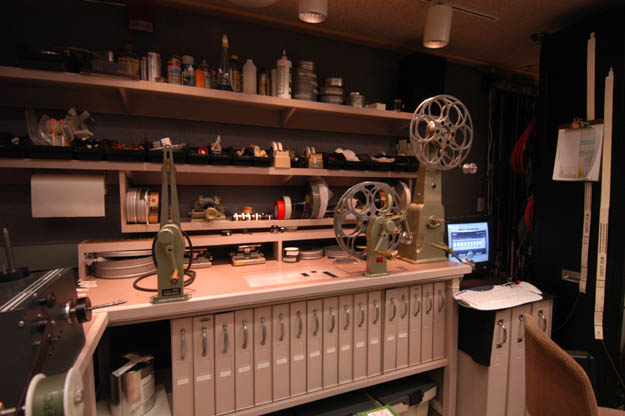
(or maybe there's something else going on there? It looks kind of offset...)
--jhawk
Posted by Stephen Furley (Member # 1277) on 02-11-2008, 02:41 AM:
I think it's just two sets of rewinds, 6k powered ones behind 2k hand ones, with the left hand ones of each set almost lined up with each other from the angle the picture was taken.
Posted by Steve Guttag (Member # 268) on 02-12-2008, 09:14 AM:
This is pathetic...changing out trailers/ads are God's way of saying YOU SUCK...get out of the business. Handling film is what the job is...just check the title of the forum.
If you find it hard, you have no technique. The whole platter vs. reel-to-reel on trailer changes is beyond a stupid arguement. From trailer on a core to trailer on a core...reel-to-reel is going to be faster and brain dead easy but with the right tools or just plain simple forethought, changing trailers on a platter isn't such a big thing either.
For those that have not changed trailers on changeover booth...it kinda works like this...you rewind your film as normal...when you get to the trailer section (Which can even be kept on a separate reel to begin with)...you stop and spool off the trailers you no longer are supposed to play and you spool on the new ones...continue rewinding until the leader is back on and whola...ready for the next show. It is so fluid that it practically is not like you are doing anything extra.
The number of ways to change trailers on a platter are quite numerous though I tend to favor an isolate and drop method, if I have adequate warning and the time to isolate (sponge/core off). But I've double-decked and just about every trick as well and have done so on a great many platter types. The one that seems to freak some out is I'll pull the trailers mid show...after about 3-reels go on the take up platter, it won't scoot about on its own...so I pull the trailers after about an hour into the movie...take em to the rewind bench to adjust them as per the trailer schedule....drop em back in before the show ends...make the one splice to reattach and thread up without taking much more time than that one splice once the show drops to get it ready for the next show. If you have one of the handy retractable hub split reels or trailer retrieval reels, this makes this method go all that much faster as the MUT never has to come out.
But there are really many, many techniques out there. What I do often depends on the tools/equipment available in the particular booth and the time allotted for carrying out the task.
Oh an Sean...I defy you to name an exhibitor that would read THIS or any other forum...see just one guy say something to the effect of an opinion...not verify the opinion and then proceed to throw away their equipment, spend yet more money. If such an exhibitor exists, then they are not doing THEIR homework. One is always going to get conflicting opinions. Then again, in today's world, if you plan on running FILM...2-projectors are not a bad idea...as films start to become more of an archival medium, platters and large reel transports will limit the available choices of films to play.
Steve
[ 02-12-2008, 10:17 AM: Message edited by: Steve Guttag ]
Posted by Peter David Bruce (Member # 4447) on 02-12-2008, 04:23 PM:
I guess my only nag about changing ads and trailers on the platter is that i once had one cause a brain wrap. I am alot more cautious now when running them through - although technique-wise I have it down to an art, theres always that 'one time that went wrong' which I hope to avoid in future.
I rather like how it all sits on the platters and watching them play through is almost hypnotic... as it feeds and that. A proper piece of engineering happening there. Nice to see it working right, as it should be. Now to find a reliable brain unit. weve had so many go down over the years. it not just a case of cleaning them or dismantling and rebuilding the unit... somethings just stopped most of them working.
Oh well. Looks like they will all be sent off for servicing soon.
Posted by Thomas Pitt (Member # 4322) on 02-12-2008, 06:10 PM:
I don't know about this 'drop in' method that you guys are talking about. It sounds as if you run your trailers onto a reel, change the one you want, then literally drop the new trailer package onto the centre of the platter before winding the other film round it. Surely this causes uneven tension in the winding, and could lead to brain wraps.
Can a platter run backwards? If so, then the MUT method I mentioned would be ideal - after changing the trailer, run the film backwards through the brain onto the platter again.
If not, the way I would do it would be to thread everything up except the projector, run the film until I see the trailer that needs changing, then splice and pull it out. Stick in the new trailer, then allow the rest of the film to run onto the other platter. When you next run the movie through the projector, it'll have the replacement trailer on it.
Posted by Scott Norwood (Member # 30) on 02-12-2008, 06:32 PM:
Re: the "drop in" method: no, you don't need a MUT or a reel. In the case of "adding a trailer," the quick version is as follows:
- inspect trailer and wind it heads up on a core; take it over to platter and set it aside
- remove center ring of made-up print
- locate existing splice where you want to add trailer
- remove tape from both sides of this splice
- remove leader and trailers up to this (former) splice
- take this "loop" of film and place it loosely around another center ring on an empty platter deck
- take new trailer, remove leader, and splice it to the loop of trailers
- wind the new trailer by hand (or with platter motor) onto loop
- take entire loop off of center ring, remove tail of new trailer, and splice loop back onto print
- fit loop as best as possible into print; since it is now larger than it was when you removed it, it will form an "outward bulge" as part of it will need to sit on top of the print
- thread and run film as usual
This will look odd, but should feed fine on most platters. Ideally, you will want to stand next to the platter until the entire new section of trailers has fed through.
Someone really needs to do a photo page for this procedure, since it's easier to show it than to describe it. The complete process takes about five minutes and can be done easily between shows.
It gets more complicated when there are multiple trailer changes or when the order of existing trailers needs to be changed.
Posted by Peter David Bruce (Member # 4447) on 02-12-2008, 07:04 PM:
perhaps I will be able to help on this one. ill go about getting step by step photos done for how we do this drop in procedure.
also, if i have to remove a couple of trailers about half way thru the inners, i remove the ring, flick thru til i find the head of that trailer, break the join and remove the tape, flick thru to the foot of the trailer, and do the same. then i grab both sides of the trailer (head and foot) and literally pull it out, leaving a lovely even circle gap in there. i join the loose foot and head of the 'keep' film and then go about the rest of my changes.
Posted by Brad Miller (Member # 2) on 02-12-2008, 07:27 PM:
One of my projectionists has agreed to videotape changing trailers in a few different styles, so we'll see if we can't whip something up here.
Posted by Chad M Calpito (Member # 3736) on 02-13-2008, 09:48 AM:
That would be awesome, Brad. I'd like to learn and see other people's method as well. ![[Big Grin]](biggrin.gif)
Posted by Brady Wilson (Member # 4345) on 02-18-2008, 09:04 AM:
![[Smile]](smile.gif)
[ 02-18-2008, 11:03 PM: Message edited by: Brady Wilson ]
Posted by Chris Slycord (Member # 4239) on 02-18-2008, 10:49 AM:
Brady,

![[Wink]](wink.gif)
I'd be more comfortable doing the method you've described ENTIRELY when the movie has stopped.
Posted by Brad Miller (Member # 2) on 02-18-2008, 02:07 PM:
I stopped reading right here...
quote: Brady Wilson
Whilst we have that ring of film on the bench , We put the smaller sized ring into the centre of the film, and simply spin it onto the smaller centre ring.
Bad projectionist! Bad! That puts cinch scratches in the print as the film is slipping on itself.
Posted by Brady Wilson (Member # 4345) on 02-18-2008, 07:32 PM:
[ 02-18-2008, 11:03 PM: Message edited by: Brady Wilson ]
Posted by Andy Muirhead (Member # 712) on 02-18-2008, 07:51 PM:
I'd actually love to read Brady's post, but sadly I'm too tired to decipher the code used. I think the key is to split it into paragraphs.
Posted by Brady Wilson (Member # 4345) on 02-18-2008, 07:58 PM:
[ 02-18-2008, 11:02 PM: Message edited by: Brady Wilson ]
Posted by Brad Miller (Member # 2) on 02-18-2008, 08:55 PM:
Brady, read up in the archives. There are many well documented ways to do this faster than you are doing now without the film damage that IS happening. Just because your particular theater does not have enough light on the screen to be able to see it doesn't mean that the next person to get that print won't either. (Even if your response is "all of our screens are flawlessly putting out 16fl of light" doesn't mean someone else won't run it at 20fl.) The key is never damage film, no matter how minor.
Posted by Phil Blake (Member # 2012) on 02-19-2008, 04:39 AM:
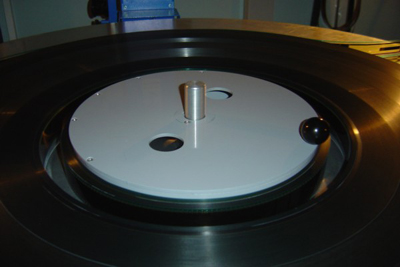
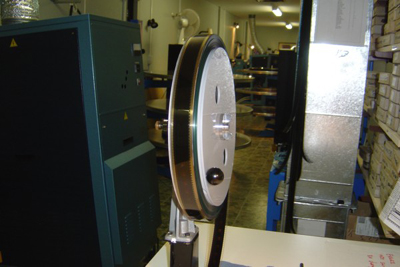
Brady get yourself a Film Spinner , makes trailer changing a piece of cake , do a change in a couple of minutes safely without any risk of film damage. It is also very handy for fixing the results of head wrap issues.
Posted by Michael Brown (Member # 890) on 06-22-2008, 10:07 PM:
quote: Thomas Pitt
after changing the trailer, run the film backwards through the brain onto the platter again.
You need to get this idea of film running back into the center of the platter out of your head, because it aint happening.
Posted by Joe Redifer (Member # 3) on 06-22-2008, 11:42 PM:
Here's a fact to chew on: removing a trailer (not replacing) is about 100 times quicker on a platter than it could ever be on a reel.
Posted by Galen Murphy-Fahlgren (Member # 4535) on 06-23-2008, 12:00 AM:
I almost always change trailers on my AW3 equipped theaters, and I just load them to a Potts ring, which has a much smaller diameter, and drop them in. For once, having Potts platters pays off.
Posted by Mike Blakesley (Member # 26) on 06-23-2008, 09:54 AM:
quote: Peter David Bruce
i remove the ring, flick thru til i find the head of that trailer, break the join and remove the tape, flick thru to the foot of the trailer, and do the same. then i grab both sides of the trailer (head and foot) and literally pull it out, leaving a lovely even circle gap in there. i join the loose foot and head of the 'keep' film and then go about the rest of my changes.
I've never done this and could see doing it in an emergency, but I would bet it could scratch the hell out of the trailer. How do you get the trailer back on to a core?
Posted by Chris Slycord (Member # 4239) on 06-23-2008, 10:24 AM:
Using that method the trailer should look the same as in the "Winding and Storing Trailers" section of Cutting Trailers Properly
Though I've only personally used that method for removing trailers that weren't going to be stored.
Posted by Bryan M. Montgomery (Member # 4412) on 06-24-2008, 02:49 PM:
If you run with the Strong/Potts platters, get one of thier larger 19" rings, a bit expensive, but worth it. Run your feature onto one of these rings,now make up your new trailer pack onto the normal 13" ring and set aside, at show end pull the large ring and pull the old trailer pack out, now place the new trailers, ring and all in the center and connect the ends. Easy. I also run all newly built features onto the larger rings to facilitate an easy fix of any rare bad splices that usually occur in the trailers if it ever happens.
Posted by Monte L Fullmer (Member # 2797) on 06-24-2008, 03:26 PM:
quote: Bryan M. Montgomery
get one of thier larger 19" rings, a bit expensive, but worth it.
..or, if the budget is tight for booth accessories, wind 8inches worth of old trailers on a spare ring and duct tape the entire roll closed...works either way....
Posted by Bryan M. Montgomery (Member # 4412) on 06-25-2008, 10:02 AM:
Excellent idea Monte. Wish I'd thought of that years ago.
Phil, who makes the "Film Spinner?" Where did you get yours? I saw a guy from Dayton make a similar tool years ago that had a power drill bit in the top, chuck it in the drill, tape on the offending trailer and pull the trigger. It was fun to switch the drill to reverse and send a junked trailer flying.
Posted by Michael Brown (Member # 890) on 06-30-2008, 07:08 PM:
I guess it's about technique and lots of practice. As a trainee it's one of the things i'm finding hard at the moment. I just need to speak to my trainer to improve my technique and soldier on. Hopefully over time it'll become like second nature.
Posted by Adam Lautenbach (Member # 5140) on 04-22-2009, 11:51 PM:
quote: Brad Miller
One of my projectionists has agreed to videotape changing trailers in a few different styles, so we'll see if we can't whip something up here.
where are these?
Posted by Michael Hossen (Member # 4274) on 04-23-2009, 12:02 AM:
The easiest way I have found is to use a spinner as previously discussed. Makes it very easy and fast to change out trailers/ film ads, which we have to do on a weekly basis.
Posted by Monte L Fullmer (Member # 2797) on 04-23-2009, 12:26 AM:
quote: Adam Lautenbach
where are these?
Someone just haven't submitted any videos of this technique yet...
Posted by Brad Miller (Member # 2) on 04-23-2009, 12:29 AM:
I'll get to it when I can. Spare time isn't something I have seen in a long, long time, and also Joe isn't here. Instructional videos just aren't as good without Joe being a part of them, ya know.
Posted by Eric Robinson (Member # 2966) on 04-23-2009, 02:06 AM:
With Joe involved you could make a video which shows the right way to do it and the wrong way. This could be very entertaining, making sure of course to use Strong platters at full speed to generate mighty gales.
Posted by Monte L Fullmer (Member # 2797) on 04-23-2009, 03:23 AM:
quote: Eric Robinson
Strong platters at full speed to generate mighty gales.
..esp. with us that don't have the newer AP3 platters with every roller having a keeper roller next to it. We're still stuck with A3/early AP3 units with no keepers, or just the one keeper roller on the bottom roller on the payout side.
Also, when some of us forget NOT to be paying out on a platter that is below the breakdown platter, but to remember to move that print to the platter above so the rewind platter is then below the breakdown platter.
Then the gale forced winds have no affect of the film in usage.
('sides, Joe's a great actor - we love his version of 'show and tell' pertaining to booth operations... . So, why the flip is he behind the projector when he could easily be in front of the lens.....)
-Monte
Posted by Joe Redifer (Member # 3) on 04-23-2009, 12:25 PM:
Thanks guys. Monte, you can easily drill threaded holes for keepers on your Strongs like I did. When I got my platters in, they were used and damaged beyond almost every conceivable way. I ordered almost every new part new except for the actual tree. That included new motors, new variacs, 100% all new rollers and posts, tension sensors, decks, the works. Of course this was years and years and years ago. I drilled holes for keepers since I ordered the posts and rollers for them as well.
I need to wait for the proper spindles for my PRT Ultra tables to arrive because now I must spin the flange by hand. Then maybe I will make a video about changing trailers.
Posted by William T. Parr (Member # 677) on 04-23-2009, 02:31 PM:
quote: Brad Miller
Instructional videos just aren't as good without Joe being a part of them, ya know.
Joe has been the Bomb in all of them. I bet he could do well in some of the Hollywood Slapstick Comidies. Maybe even academy award stuff. ![[thumbsup]](graemlins/thumbsup.gif)
Posted by Troy Hilsman Powell (Member # 4326) on 04-23-2009, 05:33 PM:
We always just use a trailer break down reel which you can get at goldberg brothers.Works for me...
Posted by Monte L Fullmer (Member # 2797) on 04-23-2009, 11:26 PM:
quote: Joe Redifer
you can easily drill threaded holes for keepers on your Strongs like I did
Oh I do agree, but I've worked with these units for quite a while and have easily adjusted to what and how to work with them and have no problems with them at all.
Plus, if I do this roller mod to all of the platters that we have, all I'd be doing is doing somebody a favor.
Also, the staff at the other theatres have also adjusted to these platters in make and break procedures with no problems...so why make the change.
..just, I do miss my AW3R's....
-Monte
Posted by Justin Hamaker (Member # 2165) on 04-24-2009, 02:12 AM:
Since I don't have any of the specialized reels for changing trailers - aside from the 19" ring for the AW3's, I've had to be a little creative.
The show prior to the change, I use the 19" ring so I have extra room to work with. I prep the trailer on the bench and wind it back on a trailer core. I splice the trailer onto the leader or another trailer and then put slide it on a trailer flange (? proper name). I put the flange on a screw driver and just use the platter motor to wind the trailer onto the platter. Then drop it into the middle of the print and splice it together. When I do this, I go through the rollers for the take-up arm so I ensure the film is running onto the platter at the right angle. Including the prep work, it takes me less than 10 minutes to change out a trailer this way.
When I have to remove a trailer, I will run it down to the head of the trailer(s) I want to remove, cut the splice, and lift out the trailer(s) to be removed. At least if it's something I don't intend/need to reuse. Then I just throw it away.
If it's something I need to reuse or return to the studio then I'll cut it at the head and run it onto an empty ring and pull it off onto a house reel with the MUT.
Posted by Joe Tommassello (Member # 4632) on 04-24-2009, 03:22 PM:
I didn't work as hard as Justin. I had a plastic reel the I snipped one side off of and then used some old film and cardboard to make a new "hub" that was about an inch wider in diameter than my brain - the platter brain, not the one in my head. I would remove the ring, identify the outgoing trailer(s) on the print and remove it attaching the head and tail of the trailers after and before it. Then I would remove the policy trailer at the head of the print and wind it onto my homemade trailer makeup reel and attach the ongoing trailer(s) to it. Then I simply dropped it into the start of the print and attached the tail to the head of the first remaining trailer. I made the changes to my program sheet and was done. Fortunately the new Strong platters had no problem keeping up speed to accomodate the narrow diameter at the start of the show.
Posted by Graham Ritchie (Member # 5226) on 04-29-2009, 09:40 PM:
Hi Folks
I am new here... I have some photos you might be interested in how we go about, in most cases changing the adds and trailers.
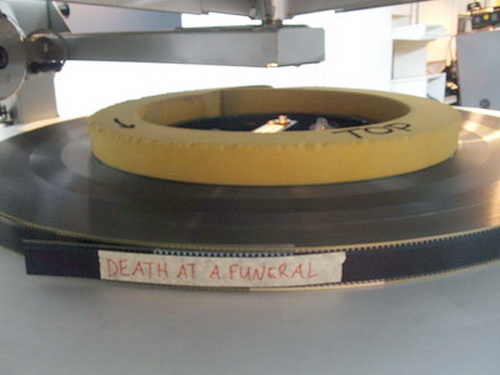
The snake.
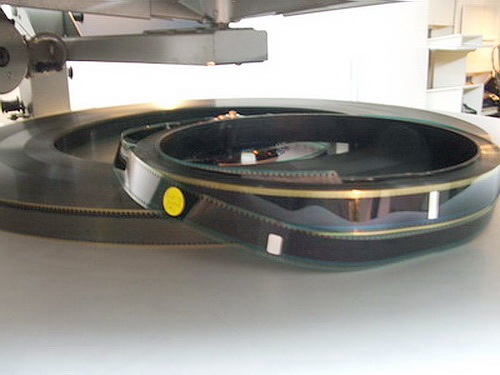
With the snake removed, we lift out the ring complete with the trls and adds all of which have a white removable sticker on the outside of the splice, placed on the frame line and across the sound track, from there its just a case of peeling away the splice.
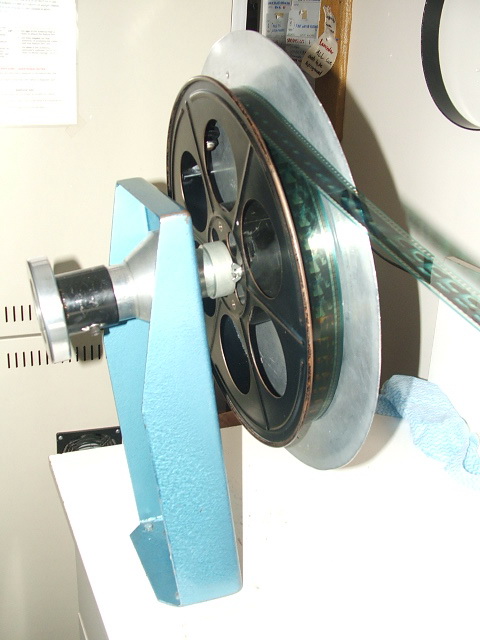
A previous projectionist came up with this idea of using an old reel, it works well, clamp the ring with its adds and trls... and.
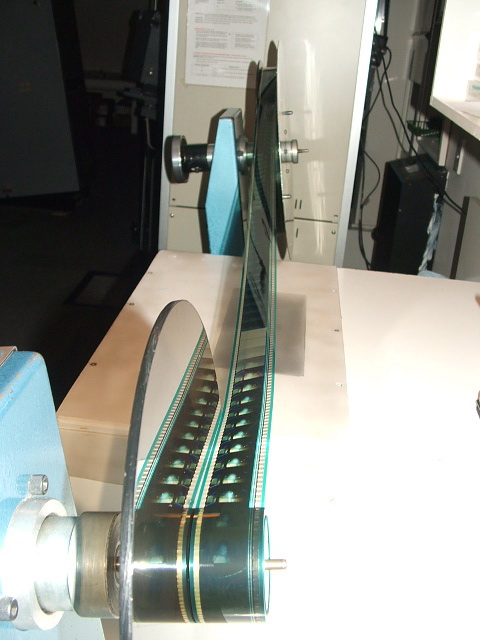
rewind the trls/adds back onto there cores.
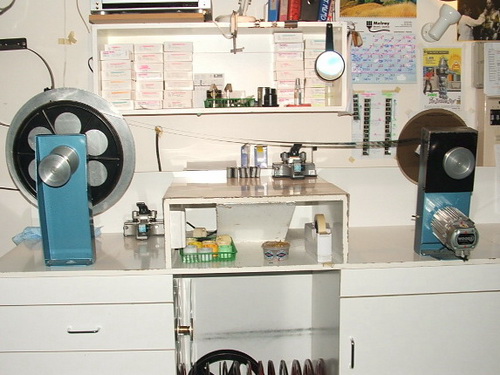
when the trls or adds, or both are removed then its just a case of swapping things around on the bench "the above photo still shows removing" and then starting from the front "leader" splice the adds and trls in order. The cinema where I work "three screens" is part of a shopping mall and runs 12-14 hours a day 7 days a week, we allow a 15 minute gap between sessions "I do the schedule as well" its easy to change a trailer within that time frame and quite often we can change a lot more and still manage to start on time, as far as adds and trls are concerned we dont place more than about four trailers, so the feature should hit the screen no later than about 15 minutes from the start.
Well thats just one way of doing things, hope you find it of interest.
Graham.
Posted by John Wilson (Member # 269) on 04-29-2009, 10:06 PM:
Wow...if you have those white stickers at every splice that must look fucking horrible on screen. Surely you can tell where a splice is without making the audience have to see all those white stickers.
...and the huge yellow sticker is for what?
Posted by Graham Ritchie (Member # 5226) on 04-29-2009, 10:32 PM:
The white sticker does not show up on the screen as the splice is in the "black" it also helps to see the splice that you want find to place the snake in the right place.
The larger round one you refer to is at the start of the trailer and states its name and rating, it does not show up on the screen as its placed also in the black area of the film.
Posted by John Wilson (Member # 269) on 04-29-2009, 10:58 PM:
Yes they do.
Just because you're projecting 'black' film does not mean no light is passing through it. When the sticker goes through that changes though and you will see it.
You could (if you really, really need a sticker to tell you where the splice is) make it thin enough to go across the frame line. That way everybody wins...you get your sticker and the audience doesn't have to see it.
The huge yellow one could be disposed of altogether. Just write in black marker between the sprocket holes what it is and its censorship. Same result.
Posted by Brad Miller (Member # 2) on 04-29-2009, 11:18 PM:
quote: Graham Ritchie
The white sticker does not show up on the screen as the splice is in the "black"
Wow. John hit the nail on the head with that one! Do you use shoe polish to mark the reel changes as well?
I can see where you have a good concept, but those stickers!!! Also your method requires you to plan ahead by standing at the platter the show before the change and putting your foam inside the takeup, which isn't something that people can do every time.
Unfortunately you are stuck with a pretty shitty rewind table there, so forgetting about the hideous stickers, there aren't a lot of better ways for you to go about handling trailers in that booth. (It's time for a new rewind table.)
Posted by Graham Ritchie (Member # 5226) on 04-30-2009, 01:26 AM:
I do mark a white edging at the splice between the feature reel changes although its applied very carefully only on the edge.
Is there a problem using this method? and what do you suggest as an alternative?.
Regarding the use of the white sticker, the centre of it is put on the frame line on top of the splice and only used on adds and W/S trailers and as such I dont see how its possible to see it on the screen as the projector "aperture plate" is in its W/S format and would be masking it.
The methods that are used were established by the previous projectionists that worked here and as such I followed on with the sticker thing, in particular using it on the trailers, although I was a bit sceptical at the time as the previous head projectionist started to use it, my initial resevations towards its use has changed, so to his credit I feel it has worked out fine.
Graham.
Posted by Richard Hamilton (Member # 321) on 04-30-2009, 01:33 AM:
What is W/S
Cheers, Rick
Posted by Graham Ritchie (Member # 5226) on 04-30-2009, 01:38 AM:
W/S is short for Widescreen 1.85:1 ratio.
Graham.
Posted by John Wilson (Member # 269) on 04-30-2009, 04:52 AM:
Graham,
If that white sticker is covered by your aperture plate, then you've got a seriously undercut w/s plate.
And that yellow one's got to block off a frame and a half. ![[Eek!]](eek.gif)
Just because the guy before you did it, doesn't make it good practice (and it isn't). It looks like ass on screen...you need to see it what, once a week maybe? Meanwhile it's being projected every session. If you've known no other way, it may seem difficult or impossible but try it and you'll see it's very possible and your patrons get a clear projection without darkened spots turning up every time a trailer ends and starts.
Regarding W/S as a terminology, I used that for around 25 years in this biz. Then those dreaded VHS WIDESCREEN versions turned up...then the DVD's made it even more widespread in its use. I changed my terminology to FLAT and SCOPE as new guys were coming in and WIDESCREEN to them meant 2.35:1 thanks to the DVD's.
Posted by Mike Blakesley (Member # 26) on 04-30-2009, 09:58 AM:
ALso Graham mentions that the white sticker covers the soundtrack area, so unless he is running DTS or SDDS, there is probably a noticable "thump" in the sound when that goes by.
I don't see the need for stickers either. What I do is, when I'm adding new trailers I make a label for each one out of tape, with one end folded over making a "tab." I write the trailer title and version # and format on the tape. As I build the trailer reel, I stick the tape labels, in order, in a designated spot. That way not only are the labels handy for later, it gives me a "list" of what trailers are playing and in what order.
When working the trailer reel, I just use the tried and true method of looking for the "green tag" which is easily visible when winding the reel. (In situations where there are no green tags, it should be easy enough to spot the title card near the end of the trailer to verify which title you're working with.) I refer to my "list" of tape labels to know what trailer I'm winding.
Posted by Monte L Fullmer (Member # 2797) on 04-30-2009, 12:42 PM:
Look, leave him alone: it's his booth. He came on to share his verions of trailer changing, not to be hammered by his film handling procedures that he was shown making it not his fault.
We've all seen worse, so give him a break as a new member. Maybe someone can point him to the "Tips" section and that way it can be explained to him how the lot of us handle film.
Posted by Chris Slycord (Member # 4239) on 04-30-2009, 02:22 PM:
A simpler idea than the yellow sticker saying the movie name/rating is to simply have a spreadsheet printout next to each auditorium and when you move the print you move the printout with it. Then when you make a trailer change, you write in the change and then update the computer copy later.
Posted by Ian Parfrey (Member # 5122) on 04-30-2009, 04:42 PM:
John may be able to correct me if I'm wrong on this, but the "W/S" Widescreen term was used here in Aus to differentiate that format from 1:33 and 1:66 in the 50's. Its always puzzled me too but makes sense when seen in this light.
Cheers
Ian
Posted by John Wilson (Member # 269) on 04-30-2009, 05:20 PM:
quote: Monte L Fullmer
Look, leave him alone: it's his booth. He came on to share his verions of trailer changing, not to be hammered by his film handling procedures that he was shown making it not his fault.
Who's hammering him? Geez Monte. I'm simply pointing out that what he believes is not happening...
quote: Graham Ritchie
it does not show up on the screen as its placed also in the black area of the film.
...as you fully know, actually is.
I appreciate his reasons for using his 'snake' method and truly appreciate also the time he took to take the photos and post them here. But am I also supposed to ignore the shot of the print littered with huge stickers? No-one is telling Graham what to do. As if...but pointing out that just because he was taught a certain way does not mean that there may not be better ways to do the same job is surely an option should one of us see things differently. It IS a forum, after all. We talk. It's really not necessary for you to come in and accuse us of bullying the guy. I'm quite sure he's able to see it for what it is...advice. He can take it or not. It doesn't worry me a bit.
Ian,
Your theory makes perfect sense. By the time I started in 1977 we were only running W/S and SCOPE. There are still many booths around the place that refer to it this way. I stopped when DVD's use became the norm to refer to both 1.85 and 2.35 transfers. Now it's just FLAT and SCOPE for us.
Posted by Monte L Fullmer (Member # 2797) on 05-01-2009, 01:15 AM:
Sorry John, Just got a little defensive. No offense, of course to all .. - thx, Monte
[ 05-01-2009, 04:32 AM: Message edited by: Monte L Fullmer ]
Posted by Stu Jamieson (Member # 4626) on 05-05-2009, 06:07 AM:
@Graham from NZ: What does "The Snake" do, mate?
Posted by Carl Martin (Member # 1146) on 05-05-2009, 12:47 PM:
if you're going to put a sticker in the black, a more unobtrusive (if counterintuitive) way is simply to cover one whole frame. what's most noticeable is when you see different gradations of black within a frame. a single darker frame is really very hard to notice, particularly if the house lights are partly on.
i sometimes find myself having to do this, at times even on 2 consecutive frames, to cover up negative tape splices and "cut here" markings when they're too close to the body of the trailer. it's a compromise, to be sure, but i insist on having a good amount of black at either end.
Posted by Mike Blakesley (Member # 26) on 05-05-2009, 03:23 PM:
quote:
@Graham from NZ: What does "The Snake" do, mate?
Since Graham has probably been scared off I'll answer: It's a piece of foam that you place in to the film pack after the trailers (while the platter is turning) to separate the trailer pack from the rest of the print.
Posted by Graham Ritchie (Member # 5226) on 05-05-2009, 04:10 PM:
Just been busy
Carl
Thats a good point, I spent last weekend watching splices go through and to be honest I found some very hard to pick up on the screen others yes I did but only just picked up on there presence.
I am going to catch up with the other people I work with this week and see what they think to removing them altogether from the trls and adds, and will keep using the white sticker but will make it a lot more narrow. The projectors we operate are only 1600 watt xenon Kinoton and our old Bauer U4 and a Simplex 2000watt.
Mike
I could not hear any poping sound wise, I think the idea years ago was to stop it. Thats when cinemas used a white exciter lamp, well thats what I was told at the time not sure that thinking is relevant these days, would anyone like to try it out on a trailer and see what they find "sound wise". Well I better.. zap.. and get to work.
Graham.
Posted by John Wilson (Member # 269) on 05-05-2009, 05:15 PM:
That's good news Graham.
BTW, the way you're holding film in that picture is incorrect.
Posted by Jillian Brock (Member # 4709) on 05-06-2009, 09:56 PM:
I've never used a changeover, but I change about 5 trailers each week on the platter. I stick film cores at the splices of whatever I want to remove while the show is playing, and then just swap it out when the movie is done. It seriously takes less than 5 minutes and it is mess-free!
Posted by Michael Barry (Member # 237) on 05-22-2009, 09:31 PM:
I saw the movie, 'What Just Happened?' at a local theatre yesterday, and the thing that I noticed immediately were the stickers between the trailers.
The main thing about it is that it just looks messy and it interrupts the illusion of a seamless flow of material leading into the feature, much in the same way that excessive dirt on the film is distracting because...you know it's just not supposed to be there.
I'm just sayin'
Posted by Tom Inglis (Member # 5181) on 05-29-2009, 03:38 AM:
I've tried to follow this as best i can, and the photo tutorial posted comes pretty close to our method, which i'm going to make my pwn photo-tute of at work tonight.
The foam core is what we use for big drop ins, like new ad/trl sets for films that lack them.
Planning ahead to get them in isn't that much of a chore, just leave it by the platter in advance and stick it over the ring for the next lace up...
anyway, photos up tomorrow i hope.
Posted by John Wilson (Member # 269) on 08-05-2009, 08:20 PM:
quote: Tom Inglis
anyway, photos up tomorrow i hope.
![[sleep]](graemlins/sleep.gif)
Posted by Tom Inglis (Member # 5181) on 10-29-2009, 06:01 AM:
Right, ok, i've done this, but apparently have to resize and reupload all the photos, so i'll do that another time.
Posted by Chris Slycord (Member # 4239) on 10-29-2009, 09:20 AM:
Or just email them to one of us who'll do it in a few seconds for you...
Powered by Infopop Corporation
UBB.classicTM
6.3.1.2