This is topic Seeking information on old projector equipment in forum Film Handlers' Forum at Film-Tech Forum ARCHIVE.
To visit this topic, use this URL:
https://ft-forum.com/ft/cgi-bin/ubb/ultimatebb.cgi?ubb=get_topic;f=1;t=009373
Posted by Michael Kenney (Member # 4841) on 06-23-2008, 06:55 AM:
Hello. As this is my first official post on this forum, I think I should introduce myself. I am not a projectionist or cinema employee, but rather a person who is researching an old theater in his town. I am doing this in the hopes that we can someday save and restore the theater. For the time being, I am trying to research all I can about the theater and have that information on hand to produce a short documentary about it, the men behind it and it's history up until it closed it's doors officially in 1991.
As part of my research, I have been allowed access into the theater, and I have seen the projection equipment in the projection house. I've learned a lot over the course of the last couple of weeks, but *know* I still have a lot to learn.
A little of what I have learned is that the theater was built and opened for business on Christmas Eve, December 24th, 1913. Although built for both Vaudeville and movies, I don't believe the theater ever featured vaudeville acts, as all of it's advertising for much of it's early years only featured "photoplays" and movies. What kind of projection equipment would have been used back in 1913? I am not sure, but would love to hear suggestions. Sadly, information on projectors is limited online, and it's difficult to research.
In 1927, it was the first theater in my town that featured a "talkie", Al Jolson's "The Jazz Singer". Obviously, newer equipment was probably installed to accomplish the presentation of this now classic film.
In 1950, the theater, now under ownership by Warner Brothers, was completely remodeled. The old box seats, fly space above the stage, plaster decorative work, wood and brass were gutted, and a straight forward movie house was born. The original marquee was replaced with a 'modern' neon marquee that was very popular for the time, and the street level facade was covered in a sheet metal (streamline-esque) facing that covered up the old terra cotta and brick work. I believe it was around this time that the current projectors were installed.
There are only two in the projection booth. Both projectors have Ashcraft Suprex C70 Carbon Arc lamp houses. I haven't found any material about these particular model lamp houses, but I have learned quite a bit about Carbon Arc systems. This is a big movie theater, so a very strong light source would be needed considering the distance from the projectors to the screen. I understand the basic concept of the carbon arc system. But have not seen one in actual use yet (well, not counting watching movies).
Projector #1 has a Brenkert BX-100, while projector #2 has an RCA-100. My belief is, these are the same, just one was manufactured for RCA with the RCA logo and model number, the other one only mentioned Radio Corporation of America on it's Patent plate. These both seem to be in good shape, considering their lack of use for 17 years.
The soundheads are both RCA 9030 soundheads, and projector #2 also has a box that reads "Magnetic Soundhead MI-9010" and it sits atop the projector, while the 9030 sits below. I'm not sure what this is for. As I said, I still have much to learn.
Last but not least are the IPC Simplex... I want to call them canisters, but I know this isn't correct... for the source and take up reels.
The screen is an XR-171 made by Technikote Corporation. I found an address and phone number, but learned they recently went out of business. I did find a company called Xetron (neumade) that bought up Technikote's business, and still apparently sells that screen. Unfortunately, I don't think they would be able to tell me when they installed the screen or even what aspect ratio is it. My guess is 1.85:1, (based on a photo I took and measured out in Photoshop) but I have been told by a former manager that the screen is supposedly a true Cinemascope screen, the only one ever in town. If that is true, I would have expected the screen to have a slightly wider shape to it, wouldn't it? There is a concave curve to the screen, so I can't say for sure that my estimates are correct. Sadly, the screen has 3 holes (fist size) in it, and it's been exposed to 17 years of moisture (indirect, not directly on the screen), neglect and age. I doubt the screen is in any kind of useable condition anymore, but I could be wrong.
I have been told the projectors could be refurbished and have a new life, but for a movie theater, I think their time has come and gone. Considering the advances in projection technology, and sound, I have my doubts they could be used for current films. I would love to know anyone's thoughts on this, any information they could share on the various components I have listed here, and their opinions on the projectors themselves.
I admit am completely a novice, but I've learned enough that I want to know more. What was first a project to learn some history about a local old theater, has now become something much larger for me. I have a new appreciation for film presentation that I never had before, and I realize there is a lot of skill, care and dedication needed to be a projectionist.
I guess it's all part of the magic, isn't it? ![[Smile]](smile.gif)
Posted by Martin McCaffery (Member # 37) on 06-23-2008, 12:00 PM:
I don't have time to respond to everything, but I'll throw in a few thoughts.
Built in 1913 for vaudeville it is very likely it did vaudeville. Not at all uncommon for vaudeville to have film incorporated. Some theatres had it up through the 30's and maybe even the 40's.
What kind of projector did they use in 1913? Who knows. Hand cranked and silent probably. There were may types on the market back then, most of which are now just memories.
The Brenkert was a cool looking projector when it was all Brenkert (I have a publicity photo somewhere), but sounds like you have a mix and match set. It could probably be made to run, but not much point.
Exploring old theatres is fun. Let us know what else you find
Posted by Mitchell Dvoskin (Member # 751) on 06-23-2008, 12:24 PM:
CinemaScope was introduced in 1953 with the motion picture The Robe. Original CinemaScope installations included magnetic stereo and a slightly curved screen. My guess is that is when those projectors were installed, although the BX-100's and the 9030 sound head could be older.
What kind of projector did they use in 1913? Who knows.
Edison Projecting Kintoscopes and Powers Cinamagraphs were widely used in 1913, but there were dozens of other manufacturers. There would be no way of telling unless the old equipment is still sitting in the theatre somewhere.
Posted by Michael Kenney (Member # 4841) on 06-23-2008, 12:39 PM:
Thank you Martin, for your quick thoughts. I look forward to hearing more from you when you have more time.
From what I can determine, the owners who built this theater never wound up bringing in vaudeville acts, unless they were enticements to stay for 'photoplays'. I spoke to someone recently (a wonderful lady who is now 90 years old and was married to the son of the original theater owner) who told me they used to bring in live animals and strong man acts as part of the movie showing, either before or after the show. I'm not sure however, if these were true Vaudeville acts.
I do know these kind of promotions continued well into the 50's. I have a scan of an old B&W photograph from 1952 taken in front of this theater that shows a promotional event for an MGM film "The Wild North" which featured a sled-dog team complete with a driver dressed in an eskimo parka.
The owners opened another theater in town specifically for Vadeville and movies only 10 years after this one was opened. And that one was confirmed to have had Vaudeville acts up until the 1930's. I think (though I can't confirm this) the owners wanted to separate the two entertainment styles for some reason, between the two theaters. Thankfully, I am in contact with a gentleman who knew the original theater owners from the time he was 10 years old. He will be visiting my town next month and I'll be interviewing him for sure. His mind is still sharp as ever, and he can remember things back to when he was 2 years old, so his recollections of the theater I'm researching are, in my opinion, priceless.
The theater auditorium is quite large, and when it was constructed, it did have electricity installed, and specifically had a booth called the Lamp House in the original blueprints. I'm not sure a hand cracked projector would have been okay for that sized theater, but I'm still only learning about the technology of the day. I'm hoping to expand my knowledge in this area, and with any luck, maybe run across a gem of information that will answer that question of which projector was used 95 years ago in that theater. Stranger things have happened.
Yes, these projectors are mix & match. I also think they could be serviced and refurbished to run again, but considering their age and how far advanced film tech has become, I doubt there would be little point in doing this other than for a museum piece or display. I would love to see the publicity photo you have if you can post it sometime. Thank you.
Yes, I have had an amazing time researching this theater. When I started this endeavor over a year ago, it was little more than an effort to learn something about the theater that we could use in the purchase of it for a theater group I'm a part of. Sadly, our group has passed on doing that, but I'm still fascinated by this theater. I've been inside it about 4 times now over the last 2 months, and every time I go in, I get this amazing overwhelming sense that the old girl has some life left.
If I had my way (and a significant amount of investment capital) I'd love to renovate the theater into a multi-function entertainment complex, keeping touch with it's theater roots with a redone, somewhat smaller theater, updated system (digital of course), with much more. With the price of gas continually going higher, and people starting to cut back on needless expenses, they're less likely to drive out to a theater when there could be one a short walk away. At least that's what I keep telling myself. Maybe it's a pretty big dream... but "where is it written that all of our dreams must be small ones?"
Posted by Bill Gabel (Member # 1105) on 06-23-2008, 12:42 PM:
The Winter Garden Theatre in Jamestown, NY was part of the Warner Bros. chain in 1932, which in 1969 was known as the Stanley Warner Theatres chain. Warner also operated the Palace Theatre (opened in 1923) in that town.
Posted by Michael Kenney (Member # 4841) on 06-23-2008, 12:49 PM:
Bill: Can you tell me where you found this information? Part of what I'm looking for is information about who owned the Winter Garden through the years. From what I could find, the Winter Garden wasn't owned by Warner Brothers until around 1949 or 1950. It is possible they did own it for a time before that, but I haven't found proof of this yet. Your help pointing me to this source would be greatly appreciated.
Posted by Jack Ondracek (Member # 1466) on 06-23-2008, 01:04 PM:
Mix 'n match isn't all that uncommon. Except for combined projector/soundhead units, adapters are made so that most of that old stuff can work together.
Yes, that stuff can still run a show. If it's only once or twice a year, you could find some carbons and go for it. If more often, you'd probably want to replace the lamphouse with a more-current xenon model. Sounds like you'd need one of the larger ones... maybe a Super-80, or a Big Sky 7kW model.
The sound head probably needs its exciter lamp & pickup replaced with a red light reader. You probably would need to put in a sound processor & update your amplifiers with newer models.
The "magnetic reproducer" is a big tape playback head. It is the film version of what your cassette tapes used to pass by in order to pick off the sound. You can take that off. You'll probably never see a magnetic print.
On the other hand, that does suggest you've got a lot of speakers in the auditorium... maybe something to work with there.
You can certainly renovate the booth. Whether there's any point to it is a better question. Running mainstream films in a huge old single-screen theatre would probably not be viable. Developing an indie/retro/classics format for occasional presentation might work, but this will take as much effort as getting the machinery back on line will.
The stuff in the booth was good equipment for its time. There are still a bunch of BX-projectors and 9030 sound heads running out there. The stuff around the projectors is probably what you'd have to pay more attention to... the old carbon lamps and tube sound systems.
Posted by Bill Gabel (Member # 1105) on 06-23-2008, 01:07 PM:
Michael , the info was found in Film Daily Yearbooks. In 1932 it and the Palace were in the Warner Bros. Theatre's Albany District. The theatre had two fires in it history one in 1920 and another around 1969. During the later fire the theatre was gutted and not completely restored to before the fire state. It was just repaired to function as regular movie theatre.
Posted by Tim Reed (Member # 137) on 06-23-2008, 01:13 PM:
Michael, you've done your homework well.
AFAIK, Ashcraft didn't make many Suprex-style lamps, although the C70s were moderately popular in their day. Ashcraft was better known for the larger, rotating positive, water-cooled lamphouses as used in drive-ins and large indoors.
Like Mitchell said, your theatre could've had anything for equipment in the silent days.
The mag penthouse was for, surprisingly enough, films with magnetic stereo soundtracks, which began with CinemaScope in '53. Goodness knows what happened to the penthouse from the other machine. It's probably still there somewhere.
The Simplex reel magazines (IPC = International Projector Corp.) may have been left over from a prior Simplex installation. The RCA stuff was probably installed when they did the CinemaScope and stereo conversion. The BX-100 dates from the early 50s, so it follows that your place had a third equipment roster between the silent days and CinemaScope. This can often be confirmed by the presence of old parts in the booth that don't go with any of the current equipment.
FWIW, the fact that the two projectors don't match (although they are the same model) suggests that one was removed for repair at some point and replaced with another.
Good luck! You're off to a great start.
Posted by Carl Martin (Member # 1146) on 06-23-2008, 01:48 PM:
quote: Michael Kenney
If I had my way (and a significant amount of investment capital) I'd love to renovate the theater into a multi-function entertainment complex, keeping touch with it's theater roots with a redone, somewhat smaller theater, updated system (digital of course), with much more.
it would be great to make a go of reopening this theater, but why make it smaller? may as well just find a smaller space to begin with. and why digital? film isn't dead, and there's nothing sadder than video projection in a grand movie palace.
Posted by Michael Kenney (Member # 4841) on 06-23-2008, 02:22 PM:
Mitchell: Thanks for the information. I did find a bunch of information online (through this website and a couple others) about Cinemascope, but knowing the year helps immensely. The screen is slightly curved, so it could very well be a Cinemascope screen. Hopefully I'll be able to find out more. In fact, I just got a call back from Nuemade with a contact number for someone who could help me with information about Technikote Corporation screens, so if luck is on my side, I'll know a lot more shortly.
Bill: Wow, I never knew about those yearbooks. Thank you! From what I gathered online, the Film Daily Yearbooks ran from 1915 until 1970, is that correct? Do you know if there any way I could get ahold of these invaluable guides for some additional research?
Jack: Thanks for your insights. Ironically, there are boxes of unused arc carbons still in the projection booth. 7mm and 8mm were both used if I'm not mistaken, one for positive and the other for negative, yes? There are a lot of speakers. Unfortunately, I can't seem to find an amplifier system....yet. (probably buried backstage or hidden in one of the rows of seats somewhere.) The years of exposure though, make me wonder if they any good anymore. Thanks again!
Tim: Thanks! I'm nothing if not curious and persistent. These are definitely Ashcraft Suprex Carbon Arc lamps. I have pictures to prove this which I'll upload shortly. I researched the patent numbers on the model number plates to find the Carbon Arc patent written by Clarence S. Ashcraft. It's through that document that I learned the basic principle of Carbon Arc lighting. And just from an design aesthetic point of view, the housing just looks cool as hell, IMO. I am in agreement with you on the point of there having been other projection installations prior to this one. My guess is that there was one from 1913 until around 1927, then they installed a system for the talkies. I assume another setup was installed when the theater was renovated in 1950, and it's possible that's the basic system that we see now, with some modular improvements or replacement until the theater closed in 1991.
Carl: The reason I for a smaller auditorium would be simply due to the fact that where the theater is located, parking is not plentiful. There are 3 parking garages nearby, but 2 are 3 blocks or more away, and one is connected to a hotel, so it's full most of the time. A 1231 seat theater is simply not feasible without adequate plentiful adjacent parking. A smaller theater would be better, as it would make room for some additional business enterprises in the same building, related to the theater. I can't go into detail here, but it's simply an idea. As for the digital system, I want to keep a forward thinking view of this theater. I would love to have a standard film system but either way you slice it, I would have to look at purchasing a new projection and sound system, especially if it was to show first run films. If it stayed as an art house, the older system would be okay, but we already have 1 art house in town, and it makes no money, period. The idea is to make the property a self-sustaining business venture, while maintaining a connection to it's past. I think it can be done, slightly smaller than it currently is, but with more opportunity to make money and support itself. There are some who love the idea, and some who flatly disagree with me, locally. But we'll see how things go.
Posted by Bill Gabel (Member # 1105) on 06-23-2008, 02:43 PM:
Those yearbooks turn-up at used book stores and on eBay. They hold information about the film industry for that year and before. You can find them for as low as $10 to over a $100 per book.
From looking at pictures of the auditorium from another site, the theatre was restored very simple with just drapes on the walls.
Posted by Jeff Taylor (Member # 443) on 06-23-2008, 03:06 PM:
FWIW: I'm under the impression that RCA formed a relationship with Brenkert way back so they could market complete booth packages, and ultimately bought Brenkert renaming the basic Brenkert machines as RCA's.
Posted by Mitchell Dvoskin (Member # 751) on 06-23-2008, 03:16 PM:
I still run carbon arcs at the Landmark Loews Jersey Theatre. The Loews Jersey is a 3000 seat movie palace built in 1929 that is now owned by the city of Jersey City and operated by a mostly volunteer group, Friends Of The Loews. Click on the link and take the virtual tour.
Posted by Tim Reed (Member # 137) on 06-23-2008, 03:48 PM:
That's right, Jeff.
Michael, 1950 would be right. Then stereo would've been added in '53. Actually, carbon arc goes back to Sir Humphry Davy in the early 1800s. Harry Strong also did pioneering research in the 19-teens and developed the first reflector arc lamp. AFAIK, the C.S. Ashcraft company went back to the silent days as well, and made low-intensity lamps.
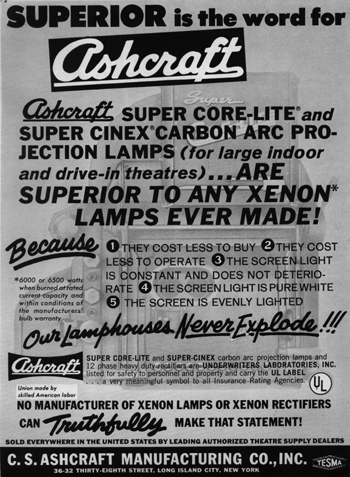
I have pictures of some C70s, too, somewhere... but this is what Ashcraft produced in their heyday:
Posted by Michael Kenney (Member # 4841) on 06-23-2008, 04:11 PM:
Bill: Thank you. I'm going to keep my eyes open for those books and snag them whenever I can. Thanks for the help on that. It may only be a little tidbit of info I need from each book, but it will help with making a timeline of ownership, and help fill in the overall picture of the theater's history.
Jeff: That would jive with the impression I got from the plates on the RCA and inside the Brenkert. The Brenkert plate actually says..
quote:
Brenkert Professional Projector
For Use with 35mm Film
Model BX-100
Designed, Engineered & Manufactured by
Brenkert Light Projection Co.
Detriot, Mich., USA
For Radio Corporation of America
Camden, NJ, USA
Mitchell: Thank you. That virtual tour is spectacular. I know pictures can't replace actually being there, but this is pretty nice, nonetheless. Maybe someday when I am out that way, I'll have to stop by and check the place out.
Tim: Cool! Thanks for the info. I'll have to look into that a little more. I'm going to try to get my pictures uploaded shortly. I definitely want to share these with all of you.
Posted by Mark Gulbrandsen (Member # 72) on 06-23-2008, 05:21 PM:
Simply amazing how Ashcraft and Christie are so similar!!! "They Cost Less To Buy", "They Cost Less To Operate" and so on. And the best part "Our Lamphouses Never Explode"!
Mark
Posted by Larry Myers (Member # 738) on 06-23-2008, 07:16 PM:
From an historical viewpoint, in 1913 Warner Brothers Studios was based in Pittsburgh. Louis Selznick who was David O Selznick's father worked for or was a business partner with the Warners. Some of the Selznicks still lived in Pittsburgh as lated as 1950. Just about everyone relocated to Burbank California in the early 1920's. The Warners retained control of most theaters in NY and PA area. Milt Selznick, a cousin of David O Selznick worked for the O'Hara/Schenley family of Pittsburgh as a horse trainer. There was a rather large race track where the new baseball stadium is now located on the Northside of Pittsburgh. Louis B Mayer who was David O Selznicks father-in-law owned War Admiral's son Brusher. War Admiral raced Seabiscuit in the 1930's. Seabiscuit was once owned by the O'Hara, Carnegie, Phipps family of Pittsburgh but was later sold to the Howard family of San Franscisco. Louis B Selznick tried to buy Man-of-War the grandfather of both Seabiscuit and War Admiral. The owners turned down an one million dollar offer in 1930.
Posted by Robert Madara (Member # 3981) on 08-25-2008, 03:19 PM:
Hi, Michael. Your theatre sounds a lot like the Baronet in Asbury Park, NJ. Thanks to Gary Crawford for posting an ad on Film-Tech, I got to work in this carbon arc, change-over booth from time to time. I even got to run an independent film for Crispin Glover, & hung out with the crazy dude!
The Baronet has a pair of Ash Craft Suprex Model D arc lamps, & Brenkert BX-80 projectors. The sound heads are the old RCA Photophone 1040's?
In the rewind room sits one of the old machiness, a Super Simplex, on a 5 point base, with a Western Electric sound head. The theatre was built in 1913, & was remodled by Walter Reade around 1950.
[ 08-29-2008, 10:01 AM: Message edited by: Robert Madara ]
Posted by Tim Reed (Member # 137) on 08-25-2008, 08:31 PM:
Hi, Bob!
KF2IB de W3HR
Posted by Robert Madara (Member # 3981) on 08-26-2008, 08:43 AM:
Hello, Tim! What an honor it is to meet you right here on Film-Tech! It's my pleasure, sir.
I've been on the internet since 1996. My favorite web site was Tim Reed's drive-in answer man! I see that the site still exist under Brad Light.
I use to read your stories about your drive-in experiences in KY. You spoke about working at a small radio station. I do board-op & fill-ins, etc. at WVLT Vineland, NJ, when i'm not trying to run a projector somewhere.
I made my 1st change over at the Absecon drive-in near Atlantic City, in 1970. The film was Kelly's Hero's. My heart still skips a beat when I think about it.
I'm now retired from the US Postal Service as a rural letter carrier.
In 2004, a local doctor bought the long closed Delsea drive-in, in Vineland, NJ. I closed it in 1987 (Budco sold it to AMC).
The doctor got in contact with me, & I helped him put it back together. We had sellout crowds of over 700 cars!
I'm just a projectionist (Local 310 Atlantic City), not a tech.
I now have a long trem lease on a drive-in near Willaimsport PA.
I see that you are in PA. Please stop by for a visit sometime!
I have flat-gate XL's. 4K sStrong X-60, & Xenex II. I just had Andy Mill install red readers (he's a ham, but I fogot his call sign.) The platters are Chrite Autowind II in booth 0ne, & Xetron XNR 335 in booth two. These old relics work great! I'd really like to make booth one back into a change over booth & switch the platters, putting the Xetron in booth one. The Xetron cannot hold a double feature. I could run my clock & trs. on the other machine, while I'm threading up the second fea.
I brought my ICOM 706 (not MK II G) up there but I have to put up antennas. What repeater or HF frequencies are you on?
I'd like to have field day or a big hamfest at my drive-in, in the future. 73 de KF2IB.
Posted by Bob Koch (Member # 1062) on 08-26-2008, 01:58 PM:
Clarence Ashcraft actually made the first "Suprex" lamp in the early thirties.It was a "single screw lamp"similar to the 1kw lamps brought out by Brenkert, Strong/Simplex shortly before WW 2. It used 7mm posive and 6mm negative and would only feed right if the current was 42 amps because the feed ratio was fixed. I don`t know the birth and death dates of C.S. Ashcraft but he spanned a lot of years with his equipment. His rotating positive,condenser lens, high intensity lamps were in use in large picture palaces long before drive-ins were ever dreamed of.He also had a rotating positive lamp without the condenser lens that used a reflector and he called this Ashcraft "Hi-Lo"The later lamps, the one in this theatre and the Core Lite, Brite Arc were made up until a few years ago.
Posted by Bob Koch (Member # 1062) on 08-26-2008, 06:01 PM:
Forgot to say the first Suprex lamp designed by Ashcraft was called the Sterling Suprex
Posted by Robert Madara (Member # 3981) on 08-26-2008, 06:54 PM:
I've used a few different Ashcraft's over the years In Trenton, NJ. We had "Super Power" The Music Hall Theatre on the Steel Pier, in Atlantic City, Had "Super High". The Delsea drive-in, in Vineland NJ had "RCA Dyn-Arc's", but they looked like Ash craft. In Later years we had "Super Corlite's"at the Delsea, The Bridgeton, NJ drive-in had "Super Cinex". I ran "Corlite 135's" at the Fox Theatre in Langhorne, PA. The Levoy Theatre in Millville, NJ, has a pair of Suplex lamps, last used December, 1974.
My head is full of info like this ...sorry.
Posted by Bob Koch (Member # 1062) on 08-28-2008, 07:03 PM:
Robert;
I`m like you, a goldmine of useless information.
Posted by Steven J Hart (Member # 2340) on 08-28-2008, 10:19 PM:
Michael, Welcome to the forums! I share with you the interest in old theaters, and have dug into the bowels of several, including the one I now manage, Roxy Theater. You state a common misconception in your original post, quote: Michael Kenney
This is a big movie theater, so a very strong light source would be needed considering the distance from the projectors to the screen.
The "projection throw" or distance from the aperture plate in the projector to the screen actually has almost no effect on the amount of light needed to properly illuminate the screen. The important thing is the size of the screen. For a fixed screen size, increasing the throw will require increasingly longer focal length lenses and vice-versa. What is the width of the screen at the theater you've been describing?
Steve
Powered by Infopop Corporation
UBB.classicTM
6.3.1.2