This is topic showing a silent movie right before Batman? in forum Film Handlers' Forum at Film-Tech Forum ARCHIVE.
To visit this topic, use this URL:
https://ft-forum.com/ft/cgi-bin/ubb/ultimatebb.cgi?ubb=get_topic;f=1;t=009411
Posted by Ralph Martin (Member # 4876) on 07-16-2008, 02:22 AM:
I’m a high school music teacher who wants to have our orchestra accompany a silent film in a 16-plex movie theater in our town. The facility is only about 8 years old and as you would expect, is not set up to run a silent film. The movie is Wings (1927) and is a full frame 35mm print that will run fine at 24fps.
Their projector in their biggest auditorium is a Century SA-TA with a 2-lens automatic turret. I don’t know the throw or the exact screen size at this point. They are checking this for me.
As you may guess I’m not an expert in these matters, but it’s up to me to purchase or get my hand on any lens or aperture plate needed to give the movie the nice presentation it deserves. And of course anything they do to alter the projector will have to be removed in time to show the next picture (You know, like the new Batman movie or something like that) within about an hour or so. ![[Roll Eyes]](rolleyes.gif)
Any thought on this???
The kids are excited about the project. They have the musical score just about ready and the first screening date is August 13. so I have to work fast.
Posted by Andy Frodsham (Member # 4061) on 07-16-2008, 03:45 AM:
The projectionists (or their technicians) will need to file a new aperture plate for the film you are planning to run. Unfortunately, these have to be 'made to measure' in order to allow for the 'rake' (angle of the projector to the screen). It is very unlikely that the theatre you describe will already have silent aperture plates pre-cut.
Since the size of the newly-cut 'silent' aperture plate is now going to be bigger than any of the existing formats the theatre screens, the resulting image will be too big for the existing screen settings (width ways at least). The larger image will need to be accommodated by either opening-up the screen masking (if it is adjustable to this degree) or using a longer focal length lens to drop the image size down to fit the existing masking.
Additionally, because you have now added (when the plate was filed) extra picture to the frame (but on one side only), the image on the acreen will be slightly off-centre. I very much doubt that the projectionists in the theatre will be keen on moving the projector laterally to accommodate this offset (especially since a conventionally plated film is to follow), so you will probably have to put-up with it!
You need to talk with the projectionists/technicians to see what is available and how far they are willing to go!
Apologies if my explanation seems clumsy! Good luck with the screening (I'm an ex teacher myself and know how children value such events)!
Posted by Monte L Fullmer (Member # 2797) on 07-16-2008, 04:42 AM:
quote: Ralph Martin
and is a full frame 35mm print that will run fine at 24fps.
Being also full-frame, and with the Century SA-TA unit, the auto lens assembly might have to be taken off so the Century can be used as a single lens model so the lens barrel holder can be shifted to silent film center (since right now, the lens is centered for soundtrack film-being shifted to the left of film center) via the eccentric adjustment on the holder.
Good luck in finding TA-slider aperture plates (or, if you know of anyone who has a regular SA and swap out the TA trap with the SA trap that uses single aperture plates) and doing all of that recutting from a new aperture to run silent frame size...that's a lotta brass to cut out.
(..at least you got til the 13th of Aug to come up with a conclusion on how this is to be pulled off ...)
-Monte
Posted by Leo Enticknap (Member # 534) on 07-16-2008, 07:23 AM:
About the only thing on your side is the speed - the modifications needed for a typical multiplex setup to run below 24 without flickering are complicated and expensive.
On the lens issue, if the 'scope backing lens can be detached from the anamorph, it will be roughly the right focal distance for full-gate silent. You'll probably see a little bit of the frame matte at the top and bottom, but it won't look too bad. If the anamorph swings into place on a bracket, you're in luck - simply swing the scope lens into place and leave the anamorph out of the beam. However, if it screws into the back of the anamorph, things get a little bit complicated. Showing the silent is no problem - simply unscrew the backing lens from the anamorph and show that. However, between the end of Wings and the start of the next regular show (assuming the feature is 'scope), the anamorph will need to be realigned using an RP-40 (or equivalent) test loop. This procedure shouldn't take more than 10-15 minutes or so, but it will take that long.
As a very basic strategy, the only serious work needed will be to cut a plate. After that, using the 'scope prime lens, opening the masking out and living with the slightly off-centre picture (perhaps seat the orchestra a little off-centre in front of the screen, too, so that the audience don't notice it so much?) will get you a show that is basically acceptable. Refocusing the mirror, centre-ing the picture (either with an offset barrel or by physically shifting the projector) is all icing on the cake if you have time to do it and the projectionists at your theatre are comfortable doing it.
Posted by Stephen Furley (Member # 1277) on 07-16-2008, 07:54 AM:
Have you been rehersing with a video copy of the film? If so, make sure that it is running at the same speed as the film print will be, or it's going to make life difficult for the orchestra. If the film will be projected at 24, then a NTSC video copy transferred at 23.976 will be close enough, but if the projector speed is out, or the video was transferred at 16 2/3, or some other strange speed which is possible if transferred on a polygon telecine, or if you've got a PAL copy, then you might have problems.
As with any old film, ensure that you haven't been sent a nitrate print; it's most unlikely, but it is possible.
Posted by Scott Norwood (Member # 30) on 07-16-2008, 08:24 AM:
Vacaville isn't too far from the Bay Area (according to Google maps, anyway). There are a number of F-T members in that region and I bet that, if you ask nicely, you can get someone to come out and file the aperture plate for you for free or minimal cost. (Obviously, you would still need to order the plate.) Alternatively, it is possible that someone has a silent plate for that model of projector lying around that could be sent to you by mail and would be "good enough" for your purposes. Try posting in the help wanted section and/or the for-sale/wanted section.
Also, try to find out the focal length of the scope backup lens ahead of time; the number is normally stamped on the lens barrel and should be something like "4.00 in" or "100mm" (the number will vary, but it will be in either inches or millimeters). It may be easier to borrow or rent the correct lens, rather than dealing with disassembling and re-assembling and -aligning the anamorphic lens.
If the screen gets shorter (as opposed to wider) for scope (i.e. masking opens vertically), then things get more interesting, as you would really want to get the correct lens to fill the full height of the screen at its tallest (i.e. 1.85) setting. If this is the case, post the screen height (tallest position) and throw distance and someone here will tell you what size lens you need. In a multiplex, there may be one of the correct size already in the complex that you could use. Otherwise, you will want to borrow or rent one.
Posted by Leo Enticknap (Member # 534) on 07-16-2008, 08:43 AM:
One other thing occurs to me - we're talking about 'projector' singular here, which presumably means that this print will have to be plattered. Most prints of 35mm silents come from archives these days, and most archives do not allow the heads and tails to be cut off their prints for long-play presentation. I would guess that for a title like Wings you're either getting the print from UCLA or GEH, both of which have a 'no decapitating' rule for their circulating collections. If you are in that situation, about your only option is to platter the print with the heads and tails left on each reel, taking care to cut the head spacing in rack when making the join, and close the douser as each head and tail goes through. It'll mean about a 45-second pause every 20 minutes or so, but if you don't have two projectors and you can't cut the heads and tails off, it's about your only option.
Posted by Mark J. Marshall (Member # 1409) on 07-16-2008, 09:15 AM:
Yes, Ralph, it sounds like you have some work ahead of you, but I think I speak for everyone when I say that this project sounds really cool. Please do keep us all posted here on the progress and how the show turns out.
Good luck, and welcome to Film-Tech!
![[Smile]](smile.gif)
Posted by Bill Enos (Member # 440) on 07-16-2008, 11:04 AM:
The whole thing sounds like a large pain in the ass for the theatre people especially on top of the Batman screening. The simplest solution is to use the scope prime lens and the scope plate. It will still be centered and the small amount of picture lost on one side will barely be noticeable to few if anybody. Under the circumstances I think it unreasonable to expect the theatre to change their set up for one screening. It is more important that they get Batman right than Wings.
I can change from our modern film set up to silent in about 15 minutes.
The last time I ran Wings the print was excellent but it had been cut several times with a bunch of single frames taped in. I don't remember where it was from.
Posted by Mark J. Marshall (Member # 1409) on 07-16-2008, 11:20 AM:
Ok, well maybe it doesn't sound cool to EVERYBODY.
Posted by Stephen Furley (Member # 1277) on 07-16-2008, 11:44 AM:
quote: Bill Enos
It is more important that they get Batman right than Wings.
I'm sorry Bill, but I cannot agree with that. All screenings are equally important, it doesn't matter whether you're screening a film student's first work, on VHS, to a few of his friends, or 'Lawrence of Arabia' in 70mm with the Queen and David Lean in the audience. (I've never run a show with the Queen in the audience, but I think one of our members has) It doesn't matter what you're showing, or to who, you owe it to the film makers, the audience and the person hiring the theatre if it's a private screening, to present the film in the best way that you can. If there is something which is technically impossible, or impractical, for you to do then you should explain that fact, and whoever is organising the show can accept the limitations, or go elsewhere, but I don't think it's acceptable to regard one show as more important than another.
Posted by Dominic Espinosa (Member # 2122) on 07-16-2008, 12:00 PM:
Following the same idea of from the rehearsal. It obviously wouldn't be perfect but what if you were to use a digital projector and a DVD or some other digital source material instead? You'd save a grip because you'd only have to pay for licensing -- no print shipping, no plates being cut, etc.
My theaters do rentals all the time for indie film makers and a bunch of other folks that bring just about any imaginable source material.
Posted by Leo Enticknap (Member # 534) on 07-16-2008, 02:46 PM:
quote: Bill Enos
The simplest solution is to use the scope prime lens and the scope plate. It will still be centered and the small amount of picture lost on one side will barely be noticeable to few if anybody.
Might crop some of the opening title and intertitle text.
Posted by Monte L Fullmer (Member # 2797) on 07-16-2008, 03:43 PM:
..also, I forgot to mention: the lamphouse, would have to be shifted to silent aperture center as well, but I think one showing wouldn't be to obvious with the bulb center being left of screen center.
Posted by Ralph Martin (Member # 4876) on 07-16-2008, 04:35 PM:
Thanks for all of the great advise.
It’s a newer print of the restored version but still in full frame format (not nitrate).
The theater is very supportive of our project. True this is going to be a bit of work – even on the part of the theater projectionist. But this is new and different to us and we all appreciate the challenge
Last year we did the restored film Metropolis which had the musical soundtrack added to the print so the theater was able to project it and simply turn off the sound. They had the right lens in one of their other locations.
We did two public screenings and sold out both nights. Even our town mayor publicly proclaimed our opening night “Metropolis Day” in the City of Vacaville!
So we’re ready to do the job – whatever it takes.
Thanks again for your friendly and experienced help. This is a great forum! I’ll keep you all updated.
Ralph
Posted by Rick Raskin (Member # 1561) on 07-16-2008, 04:59 PM:
Isn't it possible that the release print has been reduction printed to compensate for the soundtrack area? I seem to remember running silents that way and no lens or lamp adjustments were necessary. It might pay to ask the distributor. The print may even have a music track, which of course you can mute.
Posted by Jim Cassedy (Member # 4115) on 07-16-2008, 06:17 PM:
I've had to deal with quick "down & dirty" silent screeings a couple of times.
What worked for me was:
1) Use the prime lens from the scope adapter.
2) Use the scope aperture plate
3) I was using SA's or SAW's and it was possible to pull the aperture plate out (towards you) slightly so that the plate would not cut off the left side of the title cards.
4)Once the plate is in the right position, you can use the eccentric lens shifter to center the picture on the screen.
It wasn't elegant, but it works.
Posted by Frank Angel (Member # 248) on 07-16-2008, 06:24 PM:
Question still needs to be answered -- dual projectors or platters? If platter, then yes, that presents a big problem IF the distrib insists on the "no platter or long play" rule. We do this kind of thing all the time in a number of different theatres and many times I see prints that supposedly are designated as "not to be plattered or long played" and yet the print arrives with heads and tails already cut. If this is the case, rather than leaving the heads and tails and splicing them end to end as Leo pointed out is the only alternative, definately call the distrib and explain that the theatre doesn't have dual projectors and the print is no longer a virgin and has already been, as Leo put it, decapitated (and podectomied), and ask if they can make an exception and let your highly qualified projectionist platter the reels, assuring them that no frames will be lost and the head and tail joins will be perfect when the print is returned. If the booth uses anything other than high quality clear splicing tape (maybe that zebra crap or -- whack their knuckles with a ruler -- the opaque yellow or white stuff), you'll need to buy a roll of clear splicing tape in order to be true to your promise.
Depending on how easily you can get your hands on an additonal apeture plate, I ran into this problem where I had to make-do only with what the theatre had, and as has been pointed out, you can easily show the print using the backup/prime lens from their anamorphic lens set; any qualified projectionist won't be, or at least shouldn't be, thrown by removing and then replacing and realigning the prime lens on his scope setup. Seems like from what you say, the theatre personnel are very supportive -- this extra bit of work shouldn't be a big deal for them.
If you can't get your hands on an aperture plate that you can cut, you can get away with using the existing scope plate. I've had to do that and here's a way to lessen what you are loosing on the screen from the soundtrack -- simply pull the plate out toward you slightly. This will halve the lost between the two sides of the frame; you won't will be loosing the soundtrack width only on that one side, but splitting the image loss from both sides. This will help prevent any of those titles and intertitles that might be close to the edge of the full aperture from being cut off. To tell the truth, I've not seen titles ever framed that close to the edge.
This little cheat will even out the loss but still not fix the center line offset, but it won't be terrible and something that you won't pull your hair out over.
Posted by Ralph Martin (Member # 4876) on 07-16-2008, 11:47 PM:
We have the green light for plattering this particular print but we do have explicit instructions on film speed (fortunately 24fps in this case) and that it is presented full frame.
In searching out silent films to use I came across no owners who were completely against plattering. One was concerned about the distance the film must travel to and from the platter as the extra length, they thought, would allow the print to gather more dust. That seemed to be a minor concern though.
I found that distributors with multiple copies felt ok with reserving one of their prints for plattering situations so long as no frames were lost. Mostly they are happy that young people are taking a real interest in silent cinema.
I’ve learned a lot from you all - mostly pointing to the fact that this is a bigger project than I first thought. Now, I’m more excited than ever about it!
What impresses me most is the attention to detail in your posts. It tells me that the art of cinema isn’t finished by the movie studio producers – that a movie isn’t truly finished until the projection artist in each theater puts his finishing touches on the presentation.
This is why I’m in the arts!
Ralph
Posted by Monte L Fullmer (Member # 2797) on 07-17-2008, 02:19 AM:
quote:
that a movie isn’t truly finished until the projection artist in each theater puts his finishing touches on the presentation.
This is why I’m in the arts!
..and why the lot of us take dubious pride in being that artist ... and why of this forum created by an artist to allow us artists to gather together to share our talents and offer info for potiental and achieving artists!
- Good luck, once again with this project.
Posted by Leo Enticknap (Member # 534) on 07-17-2008, 04:59 AM:
quote: Ralph Martin
In searching out silent films to use I came across no owners who were completely against plattering.
Out of interest, where is your print coming from? Of the major US archives I know people at, GEH and MoMA have a strict and non-negotiable 'no platters' rule. UCLA has a small number of its most heavily requested titles for which it has two prints - one which only goes to venues they know and trust and is a 'no platters' print, and another (usually a bit older and worn, or of a now out-of-date restoration and possibly slightly incomplete, an answerprint with one or two timing glitches or something like that) which can go anywhere and on a platter. On this side of the pond the British Film Institute has been a little more hands-off in the last decade or so, but this has resulted in a deterioration in the condition of some of its more popular archive viewing prints.
Posted by Stephen Furley (Member # 1277) on 07-17-2008, 06:46 AM:
The BFI seem to be distributing more titles in digital form now. The current David Lean season which is screenng at a number of cinemas around the Country for example seems to be at least mainly in this format; I'm not sure if any new 35mm prints have been struck as well.
I saw 'In Which we Serve' at the Clocktower last night, the sccond black abd white film that I've seen digitially, and it still looked a bit odd to me, articularly in grainy scenes; the grain just looked differnt to the way it does on a film print, but it is difficult to describe.
I've never seen a print which has been made up and broken down many times without noticable damage; is there a case for distributing such prints on 6k reels? There's a lot of difference between a normal print which may only be made up and broken down a couple of times during its life, and an archive print which will have a life of decades, and be sent out to maybe 100 times during its life.
Venues running 6k changeovers would simply run the print as it comes, while those with single projectors and either towers or platters, or indeed projectors which can take large spools directly as some Cinemeccanicas can, would only have to make and break at one point during most features.
I know that distribution in 6k parts was tried briefly some time ago, and was not successful; what was the reason for this? How many cinemas are there now which can only run 2k reels?
Posted by Leo Enticknap (Member # 534) on 07-17-2008, 07:21 AM:
There was the Warners ELR system and more recently Brian Guckian proposed a distribution system based on shipping and projection using 6k reels. If I understand the situation correctly, the problem in both cases was essentially the overall capital cost of a large scale conversion in the way prints are shipped and handled, both at Perivale/Berko etc. and in individual projection boxes. It makes perfect technical sense, but the cost of (i) several tens of thousands of spools and shipping cases, (ii) converting vans, fork lift trucks, the shelving in film stores etc. to handle the things, and (iii) extra equipment purchases in projection booths where necessary just wasn't something the industry was willing to stomach, especially with the 'full-scale conversion to digital is just around the corner' mantra that's been hanging over us for several years now.
Posted by Jim Cassedy (Member # 4115) on 07-17-2008, 09:40 AM:
quote: Ralph Martin
that a movie isn’t truly finished until the projection artist in each theater puts his finishing touches on the presentation.
Thank you!
I have always approached my job as the last (but no less important) link in the film production process. Unfortunately it's the nature of the job that if I do it right, no one should be aware of my presence.
I'm a nice guy, but whenever someone says to me "You have such an easy job, all you do is push buttons and watch movies!"; I want to punch them! ![[Mad]](mad.gif)
Several years ago I got to work an "open" carbon-arc changeover booth at an outdoor film festival.
(and I had to keep an eye on two large generators)
I was under a tent-like canopy enclosure in case of bad weather, but otherwise exposed to view.
On more than one occasion someone would come up to me afterwards and comment on how busy I was during the show.
I made sure to thank them profusely for noticing.
One guy once told me that "watching me work was more entertaining than the movie" that night.
I almost could have kissed him! ( ![[Eek!]](eek.gif) well, you know what I mean...It was a rethorical reaction!)
well, you know what I mean...It was a rethorical reaction!)
Posted by Monte L Fullmer (Member # 2797) on 07-17-2008, 02:07 PM:
quote: Jim Cassedy
One guy once told me that "watching me work was more entertaining than the movie" that night.
..like me when I used to run a carbon arc booth at a drive-in and the patrons would walk by the booth watching me do "the full monty" on changing/setting the rods, wiping out the machine/lamphouse, lacing up the Motiographs and making the changeovers...they'd asked me if I went to school for this position since it was so 'technical' to them ... "No, just the love of the trade" what I told them.
Posted by Frank Angel (Member # 248) on 07-17-2008, 03:37 PM:
quote:
The current David Lean season which is screenng at a number of cinemas around the Country for example seems to be at least mainly in this format;
Ummm, LAWRENCE OF ARABIA in 2K digital? Not sure if that's a good thing. Even in 35mm it lacks what a 70mm presentation will give. But video? Not even 4K? Somehow the thought isn't exactly giving me goose-bumps.
Posted by Ralph Martin (Member # 4876) on 07-17-2008, 04:22 PM:
quote: Leo Enticknap
Out of interest, where is your print coming from? Of the major US archives I know people at, GEH and MoMA have a strict and non-negotiable 'no platters' rule.
I could see UCLA or other archival systems being extremely careful as to how their prints are used. After all if their prints are made from an original negative or some degradable source there’s a good reason to be nervous.
In the case of both Metropolis (Kino International) and Wings (Channel 4). These are 2k digital restorations so that use of their 35mm print risks only that particular print. It can be replaced for the cost of a new digital copy – perhaps around $8000.00. Based on what they charge per screening it doesn’t take too many presentations to turn a profit as well.
I’m glad that these companies exist. If it weren’t for them our city would never get to experience a silent film and my students would never get to accompany one. And the 2k restorations do look better than the scratchy jittery worn (and maybe dangerous) archival prints.
Posted by Louis Bornwasser (Member # 3063) on 07-17-2008, 06:13 PM:
No changes in distribution in the USA should be needed. We "moved" 70mm and 3D 35mm reels in the 1950-1960 era with no trouble.
Perhaps reissues could further reduce the Mylar thickness another 30%. This would leave us at 49% thickness of Acetate. A 6000 ft reel would then hold 12000 ft+ (6+ reels); all on one 26" reel!
"Archive" prints would never need to be cut!! Louis
Posted by Jack Theakston (Member # 4484) on 07-18-2008, 04:50 PM:
I disagree that just because these prints come from a digital restoration means that you don't have to take the utmost care in how you run them. Fact is, they're NOT ever going to make back the money that went into restoring and printing up that print. So to anyone who thinks it's "just another print," think again before you run something archival.
Posted by Leo Enticknap (Member # 534) on 07-18-2008, 05:42 PM:
Half agreed. There is a difference between a print of a provenance which is irreplaceable and one that isn't. For a (hypothetical) example, let's say you are an archivist who acquires the cut camera negative, an IP, a dupe neg and an original (as in, was printed for that film's initial release from the dupe neg you already have) prints of a given title. There is no theoretical need to designate the print as a preservation master, because you have the (higher generation, and thus better quality) source material it came from. Now let's say that the neg and IP had some notable defects, and you corrected these by striking new preservation elements, perhaps using a step printer which can compensate for shrinkage, or, if the problem is too bad for that, using digital intermediate technology. You then strike a print from these new preservation materials.
I'd argue that circulation of the print struck from original materials when they were still in good condition should perhaps be more restricted than the one struck from new preservation materials, because you can't replace the former but you can the latter. That original print potentially gives you information about how the film will have looked and sounded when it showed to the public on its first run. If you don't have the money to make new preservation masters and a print, then that might add up to a case for allowing your original release print to be shown (because you have the higher generation elements it derived from, and therefore that print isn't strictly needed to preserve the content per se), but imposing pretty rigid film handling standards (basically, only sending it to places you trust and which have a track record of being trustworthy) which aren't as necessary for your new print made from new preservation dupes.
Posted by Steve Guttag (Member # 268) on 07-18-2008, 07:11 PM:
Wow...what a bunch of hard-nosed people. This really shouldn't be a big deal!
Its 24fps so as Leo points out...no speed issues (And if there were...it would not be too expensive to overcome for a 1-off...a simple DC motor and controller...nether are too expensive and getting a motor that will fit the Century soundhead with a 5/8" shaft is not too terribly hard...but back on subject.
The lens...as others have pointed out...the prime lens for their scope format will give you a good enough focal length for what will work, presumming constant height screen (side movable masking). I suggest obtaining a separate lens of the same focal length just so you are not messing with the lens they need for the next show...but swapping out the prime lens isn't too big a deal, if it is a 2-piece anamorphic system.
The lens turret can probably deal with the lens shift you will need to center up on the full frame silent aperture (.680 x .910"). If not, the console/pedestal should be able be moved enough and returned to its previous position relatively fast.
The aperture plate for the SA-TA, as Monte has pointed out, is probably going to be the tough one. It may or may not be available and there were two varieties of it. I do think, though, a standard plate will fit the slot. Check and see (I don't have an SA-TA trap or I would find out for you). If it does, then things are not so bad...I would probably suggest getting a JJ aperture plate (longer, PE-719-5) and then wrapping tape on the end to form a stop (just a couple of wraps should do) so you don't stick it in too far. SA plates are certainly more plentiful and cheaper and can also work just fine...there is just less material for you to rig a stop...you could merely mark the plate to know how far to stick it in but it will make the person's job of filing the plate more difficult. If you start with an "SA" plate, use a CinemaScope and start opening up the side as needed.
Measured test film for silent is hard to come by nowadays but again, for a 1-off...and given the audience (not historians or archivists with a critical eye) there is a lot of forgiveness here. The trick of using standard target film (35PA) spliced base to emulsion will get you close enough.
When making choices, try to do the least amount of "modifications" to the standard way the theatre operates the equipment to ensure that putting things back goes quickly and painlessly.
This really shouldn't be all that hard for a competent technician to do. And I did mean a technician. Don't cheap out and cause potential harm to the business in name of "thrift"...have someone competent to perform the work and ensure that everything is restored back. It will save you and the theatre a lot of grief in the short and long run. The cost of a technician for this sort of thing should be considered just the cost of doing business.
Steve
Posted by Brian Guckian (Member # 1678) on 07-18-2008, 07:30 PM:
quote: Ralph Martin
a movie isn’t truly finished until the projection artist in each theater puts his finishing touches on the presentation.
Don't forget to involve the theatre's tech as well as the projectionists. They can source the items you need.
[EDIT: Apologies Steve, you got in ahead of me while I was typing!]
It's also worth going the extra mile and doing it properly; Stephen said it best earlier:
quote: Stephen Furley
It doesn't matter what you're showing, or to who, you owe it to the film makers, the audience and the person hiring the theatre if it's a private screening, to present the film in the best way that you can
You could make a virtue in the publicity that the film is being presented absolutely faithfully in its original aspect ratio and this could be detailed in the press with emphasis on the achievement angle. E.g.: "How local theatre techs gave 'Wings' to silent movie classic" ![[Wink]](wink.gif)
BTW thanks Leo for mentioning the 6K reels project I was involved in. Note that this differed from previous initiatives by being very limited in scope and intended only for specialised prints. It was not intended for bulk release prints.
FWIW the concept was commercialised (with the grateful support of a leading UK cinema engineering company) and written up in the December 2005 issue of the Journal of the BKSTS Cinema Technology. Considerable R&D went into it (not at all a case of "reinventing the wheel" incidentally), and it is really down to lack of interest that regrettably there has been no take-up to date.
Posted by Monte L Fullmer (Member # 2797) on 07-19-2008, 12:44 AM:
quote: Steve Guttag
I do think, though, a standard plate will fit the slot
Fortunately, one CAN slide a standard plate in this SA-TA slider trap, but there is no end stop on the inside part of the trap to hold the plate in alignment center (it's like the 1050 requiring a stop mounted on the operator side of the trap..), thus the single plate would have to be firmly held in place by some external means - of a wedge, shim, et.al. ...
It can be done.... - Monte
Posted by Stephen Furley (Member # 1277) on 07-19-2008, 02:47 AM:
I don't know this model; how does a SA-TA differ from a 'normal' Century?
If the problem is that a standard plate can be pushed in too far, how about drilling a small hole in the plate and putting in a screw or a pop rivet to prevent it going in too far?
Posted by Steve Guttag (Member # 268) on 07-19-2008, 06:27 AM:
Did you all not catch my idea of just wrapping some tape on the end (hence wanting to use a JJ (70mm plate) to form a stop to ensure it won't go in too far and to make it repeatable?
Again...this is a one-off...there is no need to make it something that can withstand zillions of operations.
Steve
Posted by Stephen Furley (Member # 1277) on 07-19-2008, 07:42 AM:
My thinking was that once the plate has been cut for silent film it can't be used for anything else, unless somebody wanted to show a track on screen for some reason, it's already the largest possible format on 35mm, so it can't be re-cut for some other format later. Once the show is over the only thing that can be done with the plate is to keep in in case of another silent show in the future, in which case the stop will be needed in the same place. A metal stop, rather than a soft tape one would be more permanent, and possibly more accurate, than a soft tape one.
This will almost certainly be the only theatre running this film at around this time. They're not in competition with other venues running the same film; with good publicity they could probably draw in a good audience, from a wide area. If that turns out to be the case then maybe this won't be a one-off, but might become a regular event, with another film next year etc. Since the theatre will already be equipped to run silent film they would be the obvious place locally to hold such sreenings. If that happens then maybe they would consider equipping for variable speed drive in the future. The theatre management seem to be supportive of this event (good for them); lets hope that more comes of it in the future.
Posted by Rick Raskin (Member # 1561) on 07-19-2008, 12:21 PM:
You guys will probably jump all over me for this.
For one showing why not run without an aperature plate and tape some cardboard to the port glass. The screen masking can absorb any spill making for a cleaner edge.
FWIW, I wouldn't jump through hoops for one show but I would make a reasonable effort to give a good presentation.
Posted by Steve Guttag (Member # 268) on 07-19-2008, 07:52 PM:
Depeding on the lens and throw...that might work. It all depends on how in focus the image is where you are masking the port...if it is not really in focus at all, the fringe area will be too large to look respectable.
Steve
Posted by Ralph Martin (Member # 4876) on 07-19-2008, 08:16 PM:
quote: Stephen Furley
with good publicity they could probably draw in a good audience, from a wide area. If that turns out to be the case then maybe this won't be a one-off, but might become a regular event, with another film next year etc.
This is the second silent film we did at the theater so this is probably going to be an annual thing. Last year we completely sold out two performances. The difference this year is that this print is full frame. We were lucky last year in that the digital copy had a soundtrack and could be played without much additional effort – We just had to turn off the sound system. Anyway, I'm sure they'll use any plate or lense needed for this print in coming years.
Just to let you know how expensive This silent picure performance is:
To rent this 35mm print for two performances cost $1700.00. This is not counting Paramount Pictures’ license which is half the gross ticket sales. Add to that the rights to perform the music which is $2400.00. Add to that the movie theater rental and professional musicians to cover part not covered by the students - $4000.00. Adding movie posters at $40.00 a printing, ticket service at $300.00 and you have an expensive venture.
This started out as a local student class project and has turned into a little industry! But no matter what, I will do everything in my power to present the movie as close to perfect as possible. I owe it to the kids.
[ 07-19-2008, 11:29 PM: Message edited by: Ralph Martin ]
Posted by Frank Angel (Member # 248) on 07-20-2008, 03:00 AM:
Some booker at Paramount saw you as a cash cow and is milking you for all it's worth. $1700 against 50%? I've paid 50% only twice in my life when running classics -- once for EUROPA EUROPA and only because there was screw-up and the publicity guy put it on our calendar before I had a confirmation. The SOB at Orion knew I wasn't about to cancel the engagement so he charged me $1000 against 50% and I just bit the bullet and paid it. But not without a lot of cursing. I booked it last year again for an screening with the director in attendence and I got it for $250 against the 35%. 35%, by the way, is the NORMAL percentage I pay on almost every classic title for multiple runs over a weekend. Bet this guy made this deal for only ONE show, correct? AND you probably have to ship out the print the very next day too. They had some fascist named Joe Moscarat there for years who used to try to pull that crap when students wanted to play older Paramount titles. I think he is long gone though.
Disney once wanted 50% for FANTASIA, but I am used to them by now and I knew I would still have an overage because it's a good grosser. But those were the ONLY two instances that I would ever agree to pay that percentage for a title that is sitting in storage which is making them NO money at all -- probably loosing storage costs, in fact.
Are you booking this as a non-theatrical entity...as a school? Studios love to rip off schools because they that realize schools, museum programmers, and the like, don't book primarily on a strictly business basis -- they book because they WANT a particular title....usually with an almost "We'll pay almost anything to be able to show THAT movie" attitude. So they charge accordingly, knowing that such non-theatricals will be willing to pay a lot more that a business man who will take one look at the terms and say, Hell no -- take your 40 year old title at $1700 against 50% and shove it. You won't do that, so they take advantage of you.
As for the music rights, wouldn't the theatre already have ASAP and BMI licences for music performance in their theatre? Why would you need to pay that kind of exhorbidant license fee? Or is that for the actual sheet music? I don't know that much about sheet music licenses, but seems to me if you buy the parts, shouldn't that about cover it? How many voices in the orchestra? Divide them by $2400 and that sounds like a lot more than the cost of the sheet music in parts. Something smells like a major rip-off here.
Posted by Jack Theakston (Member # 4484) on 07-20-2008, 02:19 PM:
Ralph, I think you're getting a raw deal. $2,400 for just the music rights? Are they renting a score? Are you using a full orchestra or something?
I'd just book Paramount's old b/w print of WINGS (which I think is even reduced to 1.37) and hire a theater organist for $600 to come in (and if you don't have an organ, hook up with your local ATOS chapter to get an electric put in for that show). You'd be saving yourself a lot of money.
Posted by Ralph Martin (Member # 4876) on 07-20-2008, 03:48 PM:
quote:
Some booker at Paramount saw you as a cash cow and is milking you for all it's worth. $1700 against 50%?
No, it’s worse than that. ---
I’ve already paid $1700.00 to the owner of the print in London just to rent the print. I’m not getting the print from Paramount. However, Paramount owns the rights to Wings so in adition to what I’ve already paid to use the print, I must now pay Paramount 50% of the gross sales.
You can see why plattering the print isn’t much of an issue. After about 10 plays the print is paid for and anything after that is profit for the print owner. If he needs another copy - the digital file of the whole movie is sitting on a hard drive. Waiting for an occasional art house to book your digital copy just to save a replaceable $8,000 print doesn’t make much business sense at almost a grand per play.
If it were my print, I'd say, "platter that sucker... TWICE!! That will be $1700.00 please ![[Big Grin]](biggrin.gif) - Oh, and by the way your still going to have to pay Paramount for the rights "
- Oh, and by the way your still going to have to pay Paramount for the rights "
Don't get me wrong -- It's business -- and I agreed to pay the price.
quote: Jack Theakston
I'd just book Paramount's old b/w print of WINGS (which I think is even reduced to 1.37) and hire a theater organist for $600.
Yes but remember I’m not in the movie business – I’m a music teacher. I’m donating my time for the summer. The orchestra is largely made up of my students and the experience they’re getting is priceless. I just hope this doesn’t get so expensive that I can’t do this for them any more.
Posted by Rick Raskin (Member # 1561) on 07-20-2008, 04:04 PM:
If its going to be an annual thing at the theatre, file the plate. I would keep possession so you'd be sure and have it in the future.
Posted by Leo Enticknap (Member # 534) on 07-20-2008, 04:06 PM:
quote: Ralph Martin
I’ve already paid $1700.00 to the owner of the print in London just to rent the print.
You mentioned Channel Four earlier, so I presume this is the Brownlow version. Agreed totally with Frank - this sounds like a right royal ripoff. The going rate for a non-theatrical, one show print rental here is around £150-200, not the £850 they're stinging you for. OK, you can probably add a couple of hundred quid to that for shipping a 35mm print from London to California and back, but even so I still smell a big, furry, Basil Fawlty-style rat.
Posted by Frank Angel (Member # 248) on 07-20-2008, 04:59 PM:
I know this is probably too late in the game to consider, but for those kinds of bucks, you could easily rent a high quality video projector that will give a bright enough image and with the proper lensing, sized correct for the screen. Just use the DVD as the source. Then you would only have to pay Paramount their bloody 50%.
I am assuming from what you say, the purpose of the event is for the music students to experience performing a music score and accompanying a film. It is not primarily that you are resurrecting a extant print of WINGS for movie enthusiasts, correct? Personally I would go the video route before I would spend that kind of bucks for a one time event.
I HAD to do a video screening of THE SEARCHERS for which there were no prints and the Chair of the English department insisted that we had to show THAT title for the students. Video was the only alternative and it looked quite acceptable (actually, much to my surprise), even off a standard DVD. Hey, you frame the image and mask it properly so it mimics what film would look like in that theatre and if you have a projector that can get the image decently bright, the audience will probably not even notice those brick sized digital blocks.
For THE SEARCHERS, the audience was students and they were watching it for the story content and social differences of what was acceptable when the film was made and now. It wasn't a MOVIE event, it was an Literature Department extra curricula event....there is a difference.
At my Performing Arts Center we work with the college Conservatory of Music all the time. The orchestra is always securing rights for sheet music which they perform (we have ASCAP & BMI licenses so the actual music rights are already covered in our theatres) but I have no idea what they have to pay for the sheet music. I will find out what the usual cost is to them when they play a work from scores. Knowing their budgetary woes, I can guarantee that they are NOT paying royalties in the numbers you are saying you're being charged.
I will get back to you on what I find out.
Posted by Ralph Martin (Member # 4876) on 07-20-2008, 04:59 PM:
quote: Leo Enticknap
one show print rental here is around £150-200, not the £850 they're stinging you for
It is expensive – in fairness to them - the price is for two performances. They pay the shipping to California and I pay the shipping back to the UK.
I think the real problem with the cost is that there are simply too many hands in the cash box. When we did Metropolis Kino International had the print and the rights and they gave us a very good deal because we’re a school. They're amazing people. I can’t say enough good things about Kino.
In the case of Wings, everything is separated so nobody is able to offer a “package deal.” But I’m learning a lot about the business and I think next year’s production will cost a little less
quote: Frank Angel
As for the music rights, wouldn't the theatre already have ASAP and BMI licences for music performance in their theatre? Why would you need to pay that kind of exhorbidant license fee?
Actually I do many concerts with our school orchestra. The musical fees for the orchestral score to wings are about right. BMI, ASCAP, etc. don’t deal with Grand Rights - that is to say large dramatic works such as musicals, operas, etc. nor do thy deal with synchronization rights (the right to put music to visuals such as a movie). It's generally quite expensive.
This leads me to a complaint: When a theater books a movie they are getting a license to present both the visuals and sound – including music. In the case of a silent only the visuals are licensed by Paramount – the music must be licensed separately so the movie should be cheaper. Oh well…
Posted by Jack Theakston (Member # 4484) on 07-20-2008, 07:13 PM:
Where are you renting the music from? There are a number of people, including myself, who can rent you original scores made out of public domain or original music for a flat rate.
Posted by Frank Angel (Member # 248) on 07-21-2008, 02:12 AM:
What is this score you are buying rights to? Is it something composed specifically for the film? We just finished a CinEvent as we call them, where we booked THE GOLEM, silent, and we commissioned a score composed for the film by an accomplished musician and composer, Tom Nazziola who also conduced The BQE Project ensemble during the screenings. Even commissioning someone to write an original score didn't cost us as much as you are paying.
We were going to rent the print from Eastman House after jumping thru allot of hoops...good hoops though -- I am glad they are so protective of their prints (can anyone tell me what's the highest, lowest and mean temperature in the area where you store your prints? How bout the humidity?). Then we discovered that the Kino version on DVD was really the definitive version with lots of additional footage that they assembled from various sources in different countries. Also, our composer had already been scoring to the longer Kino version and re-editing the score for the 35mm print was out of the question.
And yes, Kino is one of the best in the industry.
Just Saturday we ran ENTER THE DRAGON ENTER THE DRAGON with an incredible score composed by Karsh Kale/Soh Daiko, again which we commissioned.
How about this for a class project -- have the music students compose their own score AND perform it. Now THAT would be special and would pack the house!
Posted by Leo Enticknap (Member # 534) on 07-21-2008, 03:49 AM:
My favourite question on the GEH questionnaire is where it asks if the prints will be stored under armed guard while they're in your building.
Posted by Frank Angel (Member # 248) on 07-21-2008, 03:56 AM:
Yah, and what are the guards' rotation schedules....how many times do they patrol film the storage room, the room where they are shipped, the room where they are inspected. What kind of locks are on the doors. Who has the keys?
Posted by Monte L Fullmer (Member # 2797) on 07-21-2008, 04:30 AM:
To satisfy's Ralphs curiousity on the technicial jargon in describing this one part of the projector:
First image is the slider trap for this one projector that is planned to be used for this silent film presentation - which holds the slider aperture:
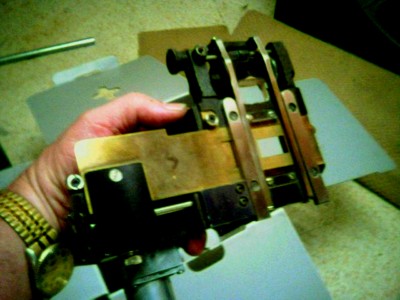
Second image with the slider aperture removed and a standard aperture plate in it's place - that can be held down with external means as Steve previously mentions.
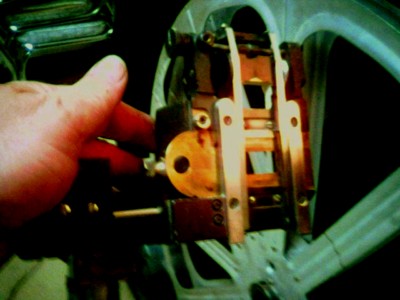
(Just a little visual help here for Ralph and sorry on the weak fotography due to celphone cameras..)
-Monte
Posted by Ralph Martin (Member # 4876) on 07-21-2008, 09:56 AM:
quote:
How about this for a class project -- have the music students compose their own score AND perform it. Now THAT would be special and would pack the house!
Agreed - Last year the music students scored and accompanied a Looney-tunes cartoon and our media class provided the live sound effects and even live Foley effects. Scoring a cartoon is really tough, but it was only about 8 minutes long.
They were able to do it because of their study of the professional composers. So, during the summer we get the professional stuff.
This score we’re using for Wings is by Carl Davis. We have a 35-piece orchestra (crammed between the screen and the first row of seats in a multiplex theater)
Today I should be getting the information about the throw and screen dimensions. With all of the information I've learned from this forum I'll be
-- Looking for a proper lens and cutting an aperture plate to fit the projector and keeping it for future presentations
-- Using the scope prime lens if finding a proper lens isn’t accomplished.
-- Looking into better options with regard to rental of prints next year.
And then have a memorable performance in August.
Thanks for all of your great advice help. I’ll keep you posted.
Ralph
Posted by Bill Enos (Member # 440) on 07-21-2008, 10:46 AM:
One thing that musicians must be aware of on this type of film is that the DVD or VHS they practiced to may be different from the film they play for in the live show. Our organist of several years ago practiced extensively at home with a VHS of Phantom of the Opera, comes show time, the newly struck 16mm print had scenes in a different order from the VHS and had something that wasn't on the VHS, fortunately he's quite an accomplished player and improviser and never missed a note. A 35mm print we played later was different still but the same as a DVD that is currently available.
Posted by Steve Guttag (Member # 268) on 07-21-2008, 11:42 AM:
Another issue with using video as the practice source...their times (at least on tape media) isn't too precise...if a sequence is to take 2:15 on tape...it might be something different with a film show. I would hope that with DVDs that tape stretch would not have the same effect it does on VHS. If you have a precise number of beats on a sequence...be prepaired to adjust that.
Make sure you have rehersal time with the actual print you are going to run (video or film)...the final plate or lens is unimportant for the rehersal...the key is to ensure your timing is what you think it is going to be.
For one violinist, I was adjusting the film speed in 8/100ths of a frame increments to get the sequence to come out right! It seems silly but some musicians just have to have the timing their way and if they reherse to one speed then by god they have to have it at that speed. To accommodate this violinist, the conductor insisted on specific number of beats in a particular sequence....which I did...for another sequence it had to be again a specific number of beats...which, if using the same speed, it would not have been! So mid performance I was adjusting speed (to presets) to ensure that each sequence would have the required number of beats. Fortunately, this has been the exception, not the rule! Rarely does one performer get to make such demands.
Steve
Posted by Chris Slycord (Member # 4239) on 07-21-2008, 12:38 PM:
That's ridiculous. My band teachers in JH/HS were professional musicians at various points in life and said that they'd have to be ready for anything because there were times when the conductor would start up a performance at a speed different from when they had rehearsed the piece prior.
Posted by Leo Enticknap (Member # 534) on 07-21-2008, 02:08 PM:
quote: Steve Guttag
Another issue with using video as the practice source...their times (at least on tape media) isn't too precise...if a sequence is to take 2:15 on tape...it might be something different with a film show.
Yonks ago, during the year I worked at MOMI in London, we ran a season of Kevin Brownlow / Carl Davis silents with recorded orchestral track. The way we came up with to sync the two was to play the orchestral track from a hi-fi VHS tape. There was a CCTV camera on the projected image, the image from which was displayed on a monitor in the booth. Right next to it was another monitor showing the image from the VHS. A projectionist monitored both images and operated a projector speed control on the fly in order to keep the film in visual sync with the tape, so that the score being played back from the tape in the auditorium would remain in sync with the projected image from the film projector. Though it was labour intensive and needed quite a bit of practice to get right, it worked.
Posted by Ralph Martin (Member # 4876) on 07-21-2008, 04:53 PM:
We have no problem with tempo or synchronization. Musicians learn to watch the conductor. In our performances I always conduct different tempi from our rehearsals just to keep them paying attention. All they have to do is watch me.
The students study 107 hours in our rehearsal Studio at school before the first dress rehearsal with the print. The DVD is provided by the print owner with the score recorded on the DVD for reference. So it should be the same. If not we have another cool challenge to deal with – just another one of life’s happy moments.
Posted by Bruce McGee (Member # 131) on 07-21-2008, 04:55 PM:
I'd like to be at this presentation of Wings in California.
You must teach a fun class.
Scoring a Looney Tunes cartoon. What a riot! I bet you had some real kooky stuff done!!!
Posted by Ralph Martin (Member # 4876) on 07-21-2008, 08:19 PM:
Yep, they’re a great bunch of kids.
The theater just gave me this information:
Audutorium 16
Screen dimensions: 26ft X 49ft 3inches
Throw to center of curved screen 82ft 11 inches (just corrected)
Curved screen recesses 3ft 5inches at center.
Anything I have to worry about here?
BTW – I don’t think I mentioned --- It’s Brenden Theaters in Vacaville, Ca. It’s a privately owned chain based in Las Vegas. I believe they have 7 locations - One IMAX.
Posted by Frank Angel (Member # 248) on 07-21-2008, 08:20 PM:
quote: Chris Slycord
That's ridiculous. My band teachers in JH/HS were professional musicians at various points in life and said that they'd have to be ready for anything because there were times when the conductor would start up a performance at a speed different from when they had rehearsed the piece prior.
Adjusting tempi when you are not fettered with an external element like the pacing of shots and scenes in a movie is one thing, needing to change the tempo when a scene that has music written for it goes missing or when additional scenes all of a sudden appear, that's a different story; changing tempi won't necessarily be enough to fix it. Composing film scores is probably one of most difficult of music disciplines.
As stated above, those video copies can vary so radically from existing 35mm print elements that one can't assume ever that they will match. Most silent films have gone thru many reincarnations over the decades.
Bruce is right, it must be a hoot and a hollar for the kids in your classes.
Have a great show, Ralph. Take some pictures if you can to post here.
Posted by Bill Enos (Member # 440) on 07-22-2008, 12:16 PM:
The Wings print we played a few years ago came from Kino, film rental was $350--$400 flat.
Posted by Mitchell Dvoskin (Member # 751) on 07-23-2008, 08:32 AM:
Frank Angel,
I am confused. How did you run the sound film Enter The Dragon with your own live score? How did you kill the films original score while leaving the dialog?
Posted by Jim Cassedy (Member # 4115) on 07-23-2008, 09:42 AM:
quote:
We were going to rent the print from Eastman House after jumping thru allot of hoops ....(can anyone tell me what's the highest, lowest and mean temperature in the area where you store your prints? How bout the humidity?). >Slightly edited quote from Frank Angel post<
Hahahah- I know EXACTLY what you are referring to.
For those who don't: EASTMAN HOUSE requires you to fill out quite a questionaire, I seem to recall it it was about 7 pages long, before they will let you rent a print from them.
As Frank sez in his message- it's all information necessary to insure the safety of their prints, but some of the questions get into some pretty fine minutia.
I think it took me almost 2hrs to fill the whole thing out due to the amount of research necessary to provide accurate answers.
But.... we got our print!
Posted by Ralph Martin (Member # 4876) on 07-23-2008, 04:29 PM:
I tried to buy a lens and aperture plate from ICECO in Florida. The gentleman on the phone said that based on our theater’s throw and screen size it would be cheaper to just use the an existing scope prime lens and to widen the aperture plate at the sound-track side to .980”. He also said that the full frame would be visible but would not quite fill the screen top and bottom about 6 inches. A proper lens would still be short by a tiny bit and could cost $100 to $400 depending on what’s available.
So I need to decide if 6” is worth 100 to 400 dollars.
Hmmm……..
Posted by Scott Norwood (Member # 30) on 07-23-2008, 06:11 PM:
I've never seen a pre-cut silent plate available for sale (new). You have to buy an Academy (1.37:1) plate and file it out. Or, if you're in a hurry, start with a scope plate (which won't be quite perfect, but will be close).
Agreed with the others that it sounds like you are paying too much for this screening. Also agreed that Kino is very good to deal with. It sounds like a great project, though, and I hope that it is successful.
Posted by Ralph Martin (Member # 4876) on 07-23-2008, 10:31 PM:
Thanks for the good wishes and thanks for the advice. (Monte, Thanks for the posted pictures – They were very helpful)
Sorry for my next ignorant questions but –
If I get a scope plate and file the sound-track side so that the total width is .980” will it work? If so I think I can do this. All I need is a caliper, a file and a little luck. ![[uhoh]](graemlins/uhoh.gif)
Posted by Monte L Fullmer (Member # 2797) on 07-23-2008, 11:57 PM:
quote: Ralph Martin
so that the total width is .980” will it work
It can work - also make sure the height is at .715
to ensure that your filed edges are straight, best run them in the projector with some sort of film to check for inperfections.
It's quite tough to get a straight edge without some sort of visual testing performed.
Posted by Steve Guttag (Member # 268) on 07-24-2008, 02:10 AM:
.980"? Yeah, right. And Monte... .715"? Where did you pull that one from?
Posted by Leo Enticknap (Member # 534) on 07-24-2008, 05:16 AM:
quote: Jim Cassedy
For those who don't: EASTMAN HOUSE requires you to fill out quite a questionaire, I seem to recall it it was about 7 pages long, before they will let you rent a print from them.
As Frank sez in his message- it's all information necessary to insure the safety of their prints, but some of the questions get into some pretty fine minutia.
I think it took me almost 2hrs to fill the whole thing out due to the amount of research necessary to provide accurate answers.
I didn't stop laughing for several minutes after I saw:
Question 234 A: Does your facility have security guards patrolling the film storage area?
B: Are they armed?
GEH's philosophy is pretty much the same as ours: to treat projection prints, both original and of restorations from their own preservation elements, as valuable objects that should always be treated with care, expertise and respect. I suppose the questionnaire is basically a massive hoop they ask venues to jump through as a way of showing that they take that seriously, and the next best option if you don't have the budget to do a site inspection visit of everywhere that is going to show your prints. But frankly, asking for the home phone number of the janitor's assistant's cat (along with about 10 other people) is taking things a tinsy bit far.
Posted by Ralph Martin (Member # 4876) on 08-01-2008, 12:19 AM:
I just received the print for Wings today without reels. Just 7 round canisters and inside is film coiled around a plastic core. You’d think they would have shipped it with reels. That’s the way metropolis came to us last year. But it’s here and I suppose the theater technician knows how to build the print for the presentations.
I just ordered 45mm lens – it cost $250 and a aperture plate for the Century SA-TA ($30) and a test film to help me file the plate ($4 per foot). WOW, I thought that the music business was expensive!
So, Monday I’ll be filing my first (and probably last) aperture plate before the theater has to use the projector for a movie.
You know… I should probably tip my hat to our local theater for being so willing to let me “play with” their projector. I doubt many other corporate theater chains would be so understanding.
Posted by Monte L Fullmer (Member # 2797) on 08-01-2008, 02:35 AM:
quote: Steve Guttag
.980"? Yeah, right. And Monte... .715"? Where did you pull that one from?
..if so these numbers are incorrect, then what are the correct decmial measurements for his needed aperture settings instead of barking on us making us look like we don't know anything?
(got my number from the Simplex parts manual for a 1.37/1) aperture..)
-Monte
Posted by Frank Angel (Member # 248) on 08-01-2008, 04:18 AM:
To be fair to Eastman House, I think those really detailed questions about armed guards and what's the height of the loading dock, etc. has more to do with the big collections that they loan out to other museums on long-term basis, rather than on the arthouse that is running a title for a few days. I understand that they loan entire exhibits of not just film but film memorabilia as well.
If I was going to loan a print or a bunch of prints so a place for them to keep for a few months, you can bet I would want to know were they were going to be house, who had keys and what was kind of security the place had.
quote: Mitchell Dvoskin
How did you run the sound film Enter The Dragon with your own live score? How did you kill the films original score while leaving the dialog?
Mitchell, they had a DVD that was specially authored for them by the studio which only carried the dialog. Since this film originally was extensively overdubbed throughout, it probably was not too difficult to get just the dialogue track.
We do a lot of these live music accompanied films and the groups make arrangements with the studios so they can perform with film on an on-going basis, like Alloy Orchestra, The BQE Project, The Philip Glass Ensemble, etc. They all have a repertoire of titles that they travel with and rotate. In one case, The BQE Project got rights to THE BLUE ANGEL and as you would guess, there was no dialogue-only track to be had, so the group had to use the existing track that was on the print.
The conductor, Tom Nazziola, had a fader at the podium so he could mix the filmsound at whatever level he needed, ducking it under when there was no dialog and covering with his live score. He knew the film intimately enough that he would fade out the soundtrack precisely when his ensemble was playing. Luckily for him, most of the dialog in that film (as is the case in a lot of very early sound films) had very little music underneath it. In fact, in many early sound films, music was heard only for the credits. When Dietrich sang, he just played to match the music that was on the track. It was so well done as to be almost undetectable.
Some of the studios are very supportive of this kind of thing while others are, well, how can I put this delicately.....like Disney.
Tomorrow we have another such collaboration. The music of Carl Davis (prolific composer of TV movie scores and a slew of silents including BEN HUR, PHANTOM OF THE OPERA, THIEF OF BAGDAD) will accompany Charlie Chaplin's THE ADVENTURER, THE RINK and THE IMMIGRANT.
In the spirit of full disclosure, this show is NOT film, but standard DVD into stacked Barcos. We just finished aligning them till about two hours ago and I have to tell you, I was getting a very decent image -- full screen height at 1.33:1 and hella BRIGHT. It even showed the neg splice flashes until we shuttered it down -- I almost wanted to leave them just so I could fancy it was film.
Those electronic shutters on the Barcos, btw, are the video equivalent of what would be an adjustable aperture plate in a 35mm projector -- something someone should have invented long ago instead of all this primitive filing the plate, then checking, then filing the plate, then checking, etc. for hours. Really, how come Mr. Simplex or Mr. Century didn't come up with an adjustable aperture plate for the projectors like in 1935 or something? In my book, that certainly would be worthy of one of those Technical Academy Award. Such a thing would have solved Ralph's silent apeture plate problem lick-it-ty split. ![[thumbsup]](graemlins/thumbsup.gif) Celebrate Brooklyn - Charlie Chaplin Under the Stars
Celebrate Brooklyn - Charlie Chaplin Under the Stars
Posted by Steve Guttag (Member # 268) on 08-01-2008, 12:14 PM:
Monte,
I'm not trying to sound nasty here...but what Simplex manual has that dimension...I checked several of ours...not just the XL but E7 and Supers...nothing about a 715 x (980) aperture.
981" is a Camera aperture and it goes practically perf to perf.
I listed the nominal silent aperture on page 3.... .680" x .910". On another thread, there is a link to an SMPE article that lists the silent aperture within a few thousands of those numbers (my numbers were by actually measuring the machines of the day).
Steve
Posted by Monte L Fullmer (Member # 2797) on 08-01-2008, 01:18 PM:
After doing this post, I keep on forgetting that this topic is pertaining to a silent aperture instead of sound apertures, thus I got the .715 height from a 'sound' aperture from the manuals and true, the width number .910 wouldn't be posted.
Thus, my total goof in not getting the full facts together before my original post..my apologies to all.
Posted by Ralph Martin (Member # 4876) on 08-01-2008, 02:40 PM:
quote: Frank Angel
Tomorrow we have another such collaboration. The music of Carl Davis (prolific composer of TV movie scores and a slew of silents including BEN HUR, PHANTOM OF THE OPERA, THIEF OF BAGDAD)
And WINGS. His is the score we're using.
Posted by Leo Enticknap (Member # 534) on 08-02-2008, 05:25 AM:
quote:
I just ordered 45mm lens – it cost $250 and a aperture plate for the Century SA-TA ($30) and a test film to help me file the plate ($4 per foot). WOW, I thought that the music business was expensive!
Assuming that's a decent lens it sounds to me like you got a pretty good deal. You'd pay that figure in pounds for an Isco Ultra-Star or similar here.
quote: Ralph Martin
I just received the print for Wings today without reels. Just 7 round canisters and inside is film coiled around a plastic core. You’d think they would have shipped it with reels. That’s the way metropolis came to us last year. But it’s here and I suppose the theater technician knows how to build the print for the presentations.
That's the standard way release prints are shipped pretty much everywhere except in North America. Furthermore, archival elements are never mounted on solid spools for long-term storage, because the nitric or acetic acid offgases (if the film is nitrate or acetate) will get trapped between the flanges of the spool and the film pack, thereby accelerating the chemical decomposition process. Even if the film is polyester, residual bleach or hypo from the processing can cause a similar problem.
If your projectionist has a split spool (effectively a projection spool split down the middle, the hubs of which clip into the core to form the reel which can then be mounted on a projector, make-up table etc.), then no problem. If (s)he doesn't, then you'll need to get hold of one, and with the correct hub diameter for the equipment in that projection booth (there are a number of different ones in use). If your print is on 4" cores, then you might be able to 'borrow' a spool from another print in that booth which is currently on a platter, unclip the core from it and use that. These are actually split spools attached to 4" cores. However, IIRC (and I may be wrong in this), the plastic split spools on which most US release prints are shipped won't clip into 2" or 3" cores.
I can only presume that your Metropolis print was so widely used and in venues which aren't used to handling reels in cans and cores that they do keep that one on shipping spools to prevent problems.
In Britain this used to be a significant problem with 16mm prints. In the days of 16mm school, film society and other non-theatrical shows, these prints were almost always shipped on spools. When archives would ship them in cans and cores, the venue often didn't have a 16mm split spool and couldn't show them. As recently as the late '90s/early '00s, I'd occasionally get 'help!' phone calls from people in this situation.
Posted by Frank Angel (Member # 248) on 08-02-2008, 10:09 AM:
All went smashing with the Chaplin nite. Carl Davis is a character. The only glitch the whole evening was that the image froze for about 3 seconds -- if I were hooked up to an EKG, it would have made that flat-lining, high frequency "sorry, your dead" sound. Luckily for me, the thing unfroze and kept going without further incident for the rest of the show, but it took all the fun out of the rest of the night for me; I couldn't wait for it to be over. I could hear that Davis had to slow the orchestra down a bit to cover the time delay.
Ken Gordon, a silent film scholar was there and came to chat before the movie. He is an avid film advocate for all the silent-with-live-accompaniment shows that he organizes around Brooklyn. He questioned why when he looked up at the booth, he didn't see any film on the two Centurys. I told him it was video. He winced. I said, I would really appreciate his input, if he would try to evaluate what he saw objectively and let me know his thoughts. He said he would and would call me during the week.
Personally I think it looked every bit as good as he is used to seeing with his 16mm presentations -- certainly bigger than he could get with 16mm and much brighter; he could never do a presentation and reach the 5000 people we did with 16mm. We shall see what he says.
Posted by Ralph Martin (Member # 4876) on 08-02-2008, 05:10 PM:
quote: Leo Enticknap
That's the standard way release prints are shipped pretty much everywhere except in North America.
Yet another challenge! That's ok Maybe they have the right spool. If not I'll get it for them. Thanks for the information.
I meet the projectionist this Friday morning to file the plate. Then Saturday morning to test-screen the print. I'm sure this is pretty standard stuff for you all, but for me this is really exciting! i hope it works.
quote: Frank Angel
All went smashing with the Chaplin nite. Carl Davis is a character.
I'm glad it went well - congratulations! Carl Davis is a great guy. I'm glad he let us perform his score to Wings. It's a really nice work. Huge too --- 2hrs 20min. -- My score is one thousand pages long!
Posted by Bernard Tonks (Member # 809) on 08-03-2008, 06:15 AM:
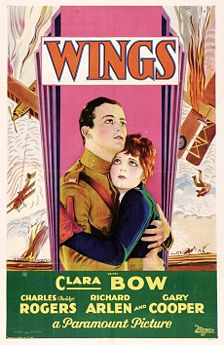
The original Paramount release of “Wings” was color tinted and had some sequences in an early widescreen process known as Magnascope. Some prints had synchronized sound effects and music, using the General Electric Kinegraphone (later RCA Photophone) process.
http://en.wikipedia.org/wiki/Information
Search: Wings (film), sorry direct link fails?
There used to be a website of the Carlton Theatre Haymarket that included details of the London premiere run of “Wings” in 1928 which had a Magnascope wide screen.
[ 08-03-2008, 09:58 AM: Message edited by: Bernard Tonks ]
Posted by Richard Fowler (Member # 893) on 08-03-2008, 07:34 AM:
Regarding adjustable aperture plates on 35mm projectors, some European machines (Wassman Euro Kino - Spain) had ajustable aperture "curtains" with cams to readjust to different formats. Harbin projectors of China also use this on some of their models.
I have provided and projected both "Wings" and "The Wind" in Miami using a Cinemeccanica V5 with 3 blade shutter and D.C. motor with a tachometer.
Chaplin's Roy Export Company maintains most of his negatives and preservations. The DVD probably looked superior to the 16mm prints made from 1960's or earlier printing materials.
Posted by Ralph Martin (Member # 4876) on 08-03-2008, 04:26 PM:
quote: Bernard Tonks
The original Paramount release of “Wings” was color tinted and had some sequences in an early widescreen process known as Magnascope. Some prints had synchronized sound effects and music, using the General Electric Kinegraphone (later RCA Photophone) process.
Our print contains all of the original tints but no magnescope scenes - I could only imagine what can of worms that would have opened for us
Posted by Gene Stavis (Member # 110) on 08-03-2008, 05:00 PM:
Magnascope was simply a matter of changing the lens to a shorter focal length and having a screen large enough to register the larger image. To the best of my knowledge, there was no difference in the film itself. The system was used as late as Selznick's "Portrait of Jennie".
Posted by Bernard Tonks (Member # 809) on 08-03-2008, 06:56 PM:
Ralph,
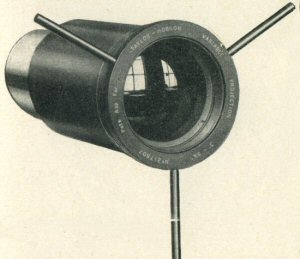
Magnascope was a simple projection process that is not even mentioned on Martin Hart’s The American WideScreen Museum. Reproduced as follows is the article in the book The Complete Projectionist by R. Howard Cricks, F.R.P.S (1943).
Magnascope Effects
A favourite effect in some cinemas is the “Magnascope” or wide-screen effect, in which the width and height of the screen may be increased by 75 per cent. for the presentation of special scenes- large crowd or stage scenes, certain types of shots in the news film, and so on. This is achieved by the variable focus zoom lens in conjunction with which is used an elaborate system of moving screen masking, by hand or motorised. If the alteration in lens focus carefully follows the enlargement of the screen, a very striking effect can be achieved; in certain types of scenes the screen masking should be opened out when objects are coming towards the camera, and the screen masking closed when they are moving away from it. These effects should however, be used with discretion; the projectionist or manager may be become so proud of the device that there is a risk of its being overdone and losing its novelty.
Variable Focus Zoom Lens.
Martin Hart name correction made.
[ 08-05-2008, 05:19 AM: Message edited by: Bernard Tonks ]
Posted by Ralph Martin (Member # 4876) on 08-04-2008, 05:09 PM:
That's amazing. It must have been quite a thing to see the picture oversize the original screen during particular scenes.
Now that I think of it -- there are some scenes that look peculiar. Like a plane flying into the camera and one of the characters is in a trench and crawls up to the camera so close it’s almost out of focus. I’ll bet that’s when the projectionist kicked in the “Magnascope.” That must have been fun back in 1927. It’s like those shots in 3-D movies where they make it a point to “throw” something at the audience for effect.
[ 08-04-2008, 11:43 PM: Message edited by: Ralph Martin ]
Posted by Ralph Martin (Member # 4876) on 08-06-2008, 01:33 PM:
I can’t believe all of the help I’m getting!!!
Magna-Tech sent me a 50mm lens instead of the 45mm. They felt they were being a bit too conservative with the size at first. The 50mm was perfect (same price).
They also sent me 2 aperture plates (no extra charge) and told me to send back the other if I didn’t need it. Well, guess what? I needed it. I ruined the first one by going to fast and filing a bit too far on one side. I slowed down a lot after that. It took me almost two hours to finish the second plate [insert laughter here] but I didn’t want to hurry and mess that one up as well. Taking my time made all the difference. It turned out great.
So we screened the entire print and the tech figured out the house light effects and the “curtain call” at the end. ---- The “curtain call” was cool. When the movie ends the lights go up – the audience applauds as the orchestra and I bow. Then we extend a hand motion to the screen and the lights dim as a portrait of the movie director appears on the screen. Nice touch!
The theater got tuxedos for their employees to wear on the performance nights. They bought a roll-out red carpet to extend from the parking lot outside all the way to the seating area for the movie. They're hanging model bi-planes from the ceiling in the lobby and all of their concession stands are offering special Wings Snack Combos.
I don’t think I could ask for anything more from Brenden Theaters or Magna-Tech in terms of their support for our project and I certainly THANK YOU ALL in this forum for your help and patience with a projector novice as myself.
Now for the real fun part: The performance.
Posted by Leo Enticknap (Member # 534) on 08-06-2008, 03:22 PM:
Did the studios provide cue sheets for Magnascope effects? Presumably the zooming was supposed to be done at certain points in the action (as Ralph describes) rather than simply as a form of improvisation.
Posted by Jack Theakston (Member # 4484) on 08-07-2008, 10:26 AM:
My understanding is that there was some sort of cue sheet that was sent with the shippers specifying the location of the Magnascope sequence.
The system was created by a technician named Lorenzo Del Riccio, and the premiere film for the patented system was OLD IRONSIDES (1924). From what I understand, the actual system was abandoned in the '30s, but the same concept was used for a number of premiere engagements up to the '50s, with films like PORTRAIT OF JENNIE and NIAGARA using it. Obviously not any old neighborhood theater could do this effect-- only larger theaters that had the stage space to open up to a larger screen.
Del Riccio also invented the large-format system Magnafilm.
Posted by Mark Lensenmayer (Member # 134) on 08-07-2008, 12:28 PM:
The Drexel Theatre in Bexley (Columbus), OH did something similar for NAPOLEON. On the 35mm print, when the 3 screen section came on, the 3 images filled the screen horizontally, but MUCH smaller vertically so all three images would fit on the screen. The Drexel had some white side panels put up next to the screen, and when the 3 screen section hit, the projectionist (yes, they had a union man at the time) operated a zoom-type lens to fill the screen and the panels. This was usually met with applause.
Posted by Mark J. Marshall (Member # 1409) on 08-07-2008, 12:51 PM:
I can't wait to hear how this all turns out.
Posted by Leo Enticknap (Member # 534) on 08-07-2008, 12:52 PM:
Thanks Jack. As with tinting and toning records and projection speed cue sheets, if only the pioneers of the film archive movement had placed as much emphasis on preserving related documentation as on preserving the films themselves, there would be so much more contextualising information at our fingertips now.
Posted by Jack Theakston (Member # 4484) on 08-07-2008, 02:27 PM:
Ironic, isn't it, that for the films that exist, so little paperwork survives, but with the films that don't, we can almost reconstruct them shot for shot?
For example, in my file on LONDON AFTER MIDNIGHT, I've got the shooting script, cutting continuity, cue sheet and reviews. That's practically the film right there... but it doesn't exist anymore!
Posted by Ralph Martin (Member # 4876) on 08-15-2008, 01:57 PM:
This is my final post to close a very interesting and rewarding experience for both my students and I.
We just finished our second and final live screening of WINGS last night and the turn-out was great.
The orchestra was in sync and there wasn’t a dry eye in the audience (WINGS is a very sad movie).
Along with the local dignitaries (the mayor, the police and fire chief) beauty pageant contestants in the area Miss America and Miss USA came with their full gowns, crowns and sashes with Miss Solano County, or miss - wherever section their competition was held – scrawled across.
The owner of the Brenden Theaters chain came up from Las Vegas and attended the movie.
BUT, this tops it all for us…
On the last night, when the audience was giving the orchestra a standing ovation we motioned to the screen where the projectionist displayed the late movie director, William Wellman’s portrait with cheers from the audience and something amazing happened…
William Wellman’s son and two grand children walked up to the orchestra to congratulate the kids! Mr. Wellman talked to us about his father and how proud he would have been to know that young people would take such a devoted interest in his work.
It was an experience my students and I and the whole community will never forget!
I want to thank everyone in this forum who took time to give me advice and guide me through the projection process. You all had a big role in making the production a success. I would have to guess that the movies in your theaters are a bit brighter than others. I know that the true shine in your projection booths doesn't come from your Xenon lamps!
Thanks again….
Ralph
Posted by Emma Tomiak (Member # 1862) on 08-15-2008, 10:40 PM:
That's just awesome in every way. Congrats on putting on a great show.
Posted by Monte L Fullmer (Member # 2797) on 08-15-2008, 11:52 PM:
You're very muchly welcome! Once again, as with you, we're also perfectionists in our career and do feel good in putting on a good show for those who love to be entertained.
Please come back and visit and chat with us anytime here on Film-Tech.
Good luck as always ... thx-Monte
Posted by Frank Angel (Member # 248) on 08-16-2008, 02:42 AM:
Absolutely great, Ralph. It is a pleasure hearing such a positive story. I am sure that your students will take this experience of the power of film and music with them as a highlight of their school careers. You have given them a gift;
congratulations on a spectacular project.
Posted by Andy Frodsham (Member # 4061) on 08-16-2008, 02:56 AM:
Brilliant, Ralph!
One of those experiences that will stay with those children forever.
Posted by Mark J. Marshall (Member # 1409) on 08-16-2008, 08:30 AM:
That is truly awesome! Congrats on a job well done to you and your kids! I can only imagine the pride and satisfaction you all must be feeling right now. I'm sure you won't ever forget this experience, and neither will the children nor the audience for that matter. And the kids will never forget you for working with them on it.
If you spend any time at all looking through this forum, you'll notice the common theme that showmanship is in a lot of ways lacking in our industry. And that stretches from the presentation side at the theater, up through the people who make the prints, through the movie makers themselves, and in some cases all the way up to the studio executives. So we are all very encouraged when young people take such an interest in film presentation in particular, but also putting on a good show in general. It sounds like your performance of Wings was amazing to behold, and if it wasn't so far away I would have been there myself.
Best of luck to you and your children on future endeavors, and please do pop in here from time to time and let us know what you're up to.
Powered by Infopop Corporation
UBB.classicTM
6.3.1.2